Creative Operations

Creativity according to John Cleese is “A way of operating.” This smart 1991 YouTube talk, is full of lightbulb jokes and advice on creativity. How many socialists does it take to change a lightbulb?

The problem with creativity is that it seems difficult. It’s like running a 5K for someone who doesn’t run. Like, c’mon, I can’t do that. Cleese nips this complaint right away and offers two helpful pieces of advice.

First, is to be a designer, and we are all designers. We are all designers because designs influence actions. Some designs tightly constrain action, like this Mario 1-1 walkthrough on YouTube. Other designs constrain loosely.

To design for creativity requires two things: space and time. Set the phone to DND. Sit at the desk. As Steven Pressfield notes, put your ass where your heart wants to be. Like a chef ready for the dinner rush Cleese offers his next piece of advice: think.

Rather he says ‘to play’. That’s the second step. Creativity is the subconscious bubbling up and it’s the conscious shutting up.

“As a general rule, when people become absolutely certain that they know what they’re doing, their creativity plummets.” Jon Cleese

Without interruption, think widely.

This will be hard. Most people, says Cleese, don’t like it. It’s hard to just sit or walk or be. It’s hard to just think. Annie Duke faced this. When she coached poker players they wanted to act, to do, to play the hand. But a lot of poker is not playing. Duke’s challenge was to get players to feel like they were poker players while also making good decisions. So, she reframed the actions.

Rather than playing hands as the action, Duke explained that deciding was the action. Thinking through the hands, the outcomes, the pot odds, the base rates and the game-theory-optimal case was what good players did. That was the secret for being a good poker player. This is the secret too, according to Cleese, for operating creatively.

Creative people are comfortable with the lulls. They understand that the time of play is time working on the problem.

There aren’t good metrics for this. There’s no word count. There’s no investment return. There’s no miles or dollars or calls made. There’s nothing to count which means no numbers which means no comparison which implies no value.

Do not fall into this trip says Cleese. Trust that the moments of wide-open thought matter.
After the play it’s time for work.

How many socialists does it take? Five, but they don’t change it and instead insist that it works.
3 prompts to being Bayesian

How much should new information matter? Or, is this time different? Because sometimes it’s not.

“Merlin (Heidemanns) said that essentially the polls gain more weight. It’s not that we construct a model and weight the polls. We don’t take a weighted average of the polls, we estimate latent parameters and the polls are data. That said, you can roughly approximate the estimate as a weighted average.”

Andrew Gelman

According to Gelman, priors like “the economy, stupid” never exit the model. According to Nate Silver, the final poll removes all prior data.

In college sports priors matter more than Gelman allows for politics. Nearly two-thirds of college basketball teams who start a season ranked in the top-25, finish in the top-25. College football is the same.

How much new information should matter is a tricky question, but it’s helpful and why the Wharton Moneyball co-hosts encourage each other to become more Bayesian.

At the start of a football season we can guess (or hope) on a team’s chances. With more information, each play, game, and season, we update our idea. Eventually our guess at the start of the year gives way to the information of the year.

It’s hard to do though because we don’t know is this time different. Most of the time it’s not different enough, and base rates work best. But there are three general frameworks which might help us become more Bayesian.

First is to ask a Marc Andreessen like question: is software eating the world? How has the system changed and what does that mean? From FAANG to Testa joining the S&P, it seems like a systemic shift toward technology. Ditto for passing in football.

Second is to ask the Michael Mauboussin question: how much of this was luck? There’s a lot more luck in a single football play than an entire football game. It’s always a mix of skill and luck, but in what ratio?

Third is to consider our identity: am I attached to a position for unacknowledged reasons? This category includes biases like sunk cost and personal influences like ego or status.

The 2021 vaccine rollout is a good instance of practicing Bayesianism. Start with the base rate for vaccines. Watch for evidence. Adjust accordingly.

Baseline data

Want a daily email with one idea? It’s quick, fun, and sometimes helpful. Sign up here.

One of the coronavirus problems, one of any system’s problems, is lack of good data. When data is precise and simple it’s just a math problem. This is why we have to gamble with coronavirus.

In mid-March I started to feel kinda ill. Did I have it? Everything pointed to yes.

I’d traveled through airports. I felt congested and achy. The news talked more about coronavirus than allergies. Wait. What? The noise of the news made me overlook the color of my car, which was a nicely tinged yellow thanks to an above average pollen count in central Florida. 

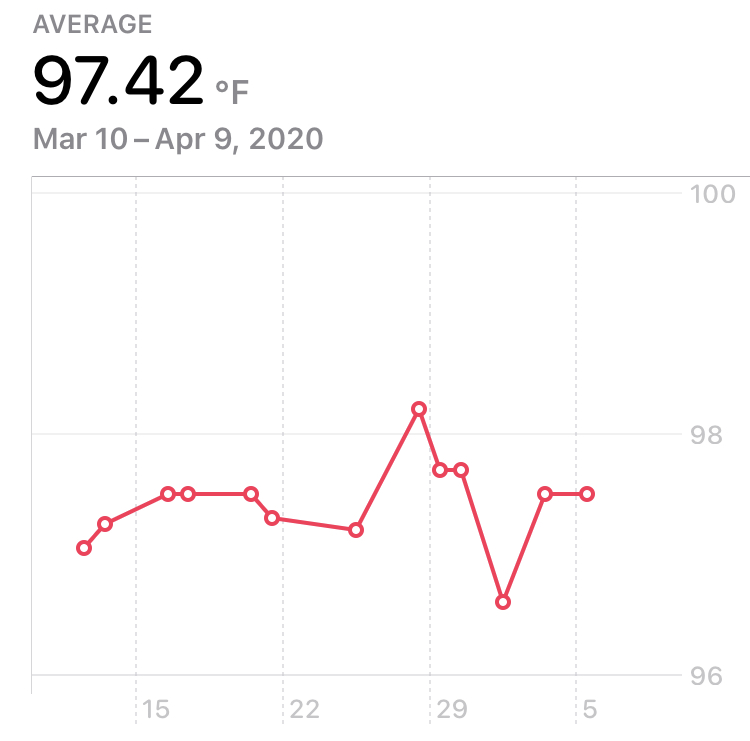
My problem was that the ‘fifth vital sign’ had overtaken all the others. Or put differently, the only data I was using was highly subjective. Instead of continuing my confoundedness I started counting. 

IMG_5490.jpeg

Regularly tracking my temperature showed nothing to worry about.

The other potential problem at the the time was toilet paper. 

Well before we were storming stores and short sheets I had stocked up. But watching the paper pandemonium I had no idea how long our stockpiles would last. So, I counted. Our  conservative count is two rolls per person per month. Prior to counting, I’d never have known.

Now do emergency funds

Good data is an objective tool to use alongside the subjective. If we kinda feel ill, we can take temperatures. If we see toilet paper rolling out of stores, we can use a rule of thumb. If we’re worried about finances, we can compare spending to savings. Good data is the base rate, our adjustments are the subjective. 

In any quantitative field three things matter: counts, computations, and communications.

Without accurate counts, we know nothing. 

Without accurate counts and computations, we infer nothing. 

Without accurate counts, computations, and communications, we do nothing. 

Sometimes we jump the gun. We build a model and share it to the world. #dataisbeautiful. Sometimes though we just need to start at the beginning and count. 

Thanks for reading.