Smuggling or Selling Cigarettes

It’s 1943 and Rae and Joseph meet in a Nazi concentration camp. Then, in 1945…

When the war came to an end, Rae and Joseph fled to Hungary, where they were quickly married. The day after the wedding, they trekked through the Austrian Alps and snuck across the border into an Italian displaced persons camp. They applied to come to America, using my grandmother’s last name, Kushner, since my grandfather had accrued a rap sheet from smuggling cigarettes into the camp to provide for his family.

They were accepted into America three years later.

The same day I read this, in Jared Kushner’s Breaking History, someone had been a real jerk. A Lowlife, snake-licking, dirt-eating, inbred, overstuffed, ignorant, bloodsucking, stiff-legged jerk.

But what’s the context? When is it smuggling cigarettes and when is it selling them? When is someone a jerk and when is someone having their own bad day? Maybe they had to deal with their own snake-licking, dirt-eating, inbred, overstuffed, ignorant, bloodsucking, stiff-legged jerk?

JTBD requires an empathetic perspective. Figure out why someone acts the way they do. Not that many people roll out of bed with the express goal of being a stone in our shoe. Instead we can be curious, ask questions. We can conclude if someone was selling cigarettes or smuggling them.
Visualizing Tradeoffs

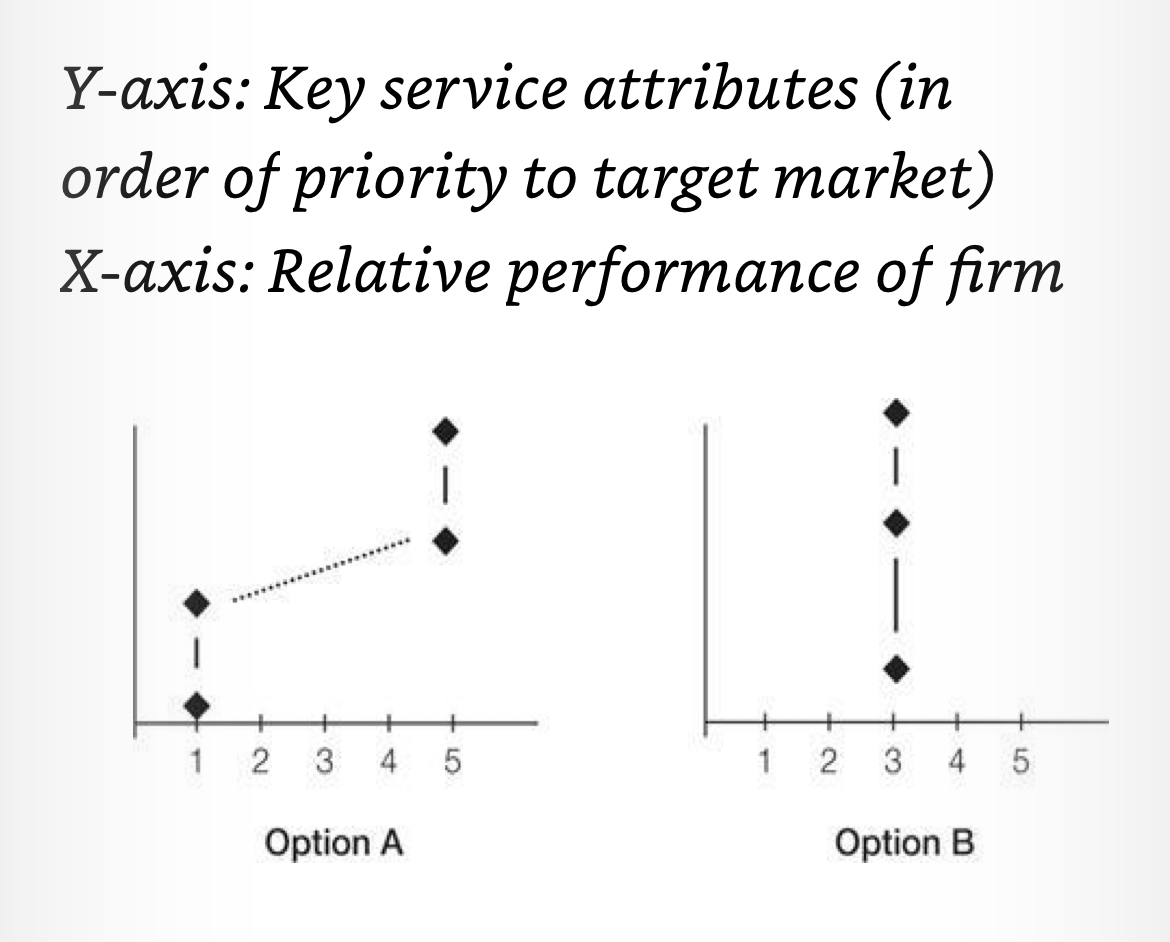
In Uncommon Service the authors note that customers want businesses to suck at something. It’s a Never Split the Different vibe. Or in terms of a karaoke bar: Play the hits!

A visualization from the book:

Restaurants have different attributes: food quality, pacing, pricing, ambiance, and so on. For a celebration, people are willing to trade price for service. This is the sort of “context” at the heart of JTBD.

“Our business,” listings read, “has 100 years of combined experience.” Well, that sounds like a lot. But is it two people with fifty years or ten people with ten? Then again, is fifty years of experience good? Do you want a doctor who went to medical school in the 70s?

There’s no answer, it’s all contextual.

But we do make trade-offs and must be honest about what they are and what that means.

Mary and Rory: Two Great Brits

If you want to change, writes Katy Milkman, consider the advice of Mary Poppins. In every job that must be done. There is an element of fun. And a spoonful of sugar helps the medicine go down.

But we don’t do this. “When committing to a healthy new eating regimen, we buy a basket of the most sinless foods – broccoli, carrots, kale, and quinoa – without regard for taste.”

Ahh, yes. Of course! Rory Sutherland enters.

We are rationalizing creatures. We ask, Why is this so cheap? If junk food tastes great then healthy food must taste bad. It’s the gross medicines that work best!

But, but, but, Milkman butts in. That’s what the research shows.

Think of things you want to change as chronic conditions. Diabetes is a chronic condition. Stress can be chronic too.

But so is shelter. That’s a recurring problem people deal with every day. So is food. And Milkman argues, so are your habits. So make them fun.

We have learned a lot from Milkman and Sutherland because they both share lessons that work. It’s not whether something works, but where, when, and with who. Monster Energy is large, full of caffeine and calories, and it tastes great. It found a where, when, and with who. Snickers found a context too.

Boiling water softens a carrot and hardens an egg. Solutions must match their contexts.