Interesting Listening Jobs

One aspect of Jobs Theory is when producers focus on one aspect but consumers prefer another.

Often this is in terms of measurable features: size, speed, cost and so on. But consumers think about their tradeoffs in a different language. Here’s an example from November 2023.

Bill Simmons: “To me audiobooks don’t seem that much different than podcasts. My wife likes audiobooks more than podcasts but it’s not like ‘I’m an audiobook person and not a podcast person.’”

Malcolm Gladwell: “There’s been a real blurring of that line – but these distinctions don’t matter to listeners who just want to hear something interesting. It’s only insiders who obsess over the differences between podcasts and audiobooks. It’s just interesting stuff to listen to.”

Art Auction Markets

From an August 2023 interview between Tyler Cowen an Paul Graham.

We think of the market mechanism as an information network: What information is considered important? In the world of business, profits are the important information and alpha erodes. To be successful then, your important information should be secret from someone else. This can be done by obscuring your information or by elevating something else for the competition. In Graham’s case the elevated information is “fashionable contemporary crap”.

GRAHAM: It sounds weird, but if you look at where the money’s spent at auction, it’s almost all fashionable contemporary crap because if you think about how prices in very high-end art are set, they’re auction prices. How many people does it take to generate an auction price? Two. Just two. So, you have boneheaded Russianswho want to have a Picasso on their wall so people will think they’re legit, or hedge fund managers’ wives who’ve been told to buy impressive art to hang in their loft so when people come over, they’ll say, “Oh, look, they’ve got a Damien Hirst.”

The way art prices at the very high end are set is almost entirely by deeply bogus people, [laughs] which is great, actually. When I was an artist, I used to be annoyed by this. Now that I buy a lot of art at auction, I’m delighted because it means there’s all this money. You see Andy Warhol’s screen prints selling for $90 million.

COWEN: Yes. Old masters can be, I wouldn’t say cheap, but I would say radically underpriced.

GRAHAM: A couple hundred thousand.

COWEN: Or even less for some good ones.

GRAHAM: Yes, I know because I buy them. [laughs] I used to be annoyed by this, and now I think it’s the most delightful thing in the world because there’s all this loose money sloshing around, and so-called contemporary art is like this sponge that just absorbs all of it. There’s none left. Some of the things I buy, I am the only bidder. I get it for the reserve price. No one else in the world wants it, or even knows that it’s being sold, so I am delighted about this.

The answer to your question, which artists are undervalued? Essentially, all good artists. The very, very, very famous artists, artists famous enough for Saudis to have heard of them — Leonardo, I would say, is probably not undervalued. But except for the artists who are household names — every elementary school student knows their names — they’re all undervalued.
The Comedy Success Equation

If you can fail on purpose Michael Mauboussin writes in The Success Equation, then the endeavor is skillful. It’s easy to purposefully lose a game of h-o-r-s-e.

Noam Dworman expands this idea some. Talking about comedians who come through his Comedy Cellar he told Tyler Cowen:

Now, there’s a lot of overachievers in this profession. It’s not like the NBA. If you want to be in the NBA, you’ve got to be in the top one-tenth of basketball players in the country, or it’s immediately obvious.

You can scratch out and work hard and put together a good 15 minutes, so there are a lot of overachievers working in comedy. The real super talent, the real gems, like the Chappelles, like the Louis C.K.s — they really are on another level, and the world sees that.

https://conversationswithtyler.com/episodes/noam-dworman/

What makes a great comedian, Noam expanded, was someone who was funny but also needed to be on stage. They were compelled. Drew Carey simply got a book from the library and then wrote a joke a day. It had to be clean, original, and no knock-knock-jokes. Carey could – and did – write those jokes they just didn’t count. And he assembled fifteen minutes, then a set, then a career.

Mauboussin mostly writes about sports and investing because those domains are measured.

But it’s helpful to color in some other areas of the system. To think about what’s luck, what’s skill, and how they matter.

Calendly’s CAC

Approximately seventy percent of Calendly’s new users come from using a Calendly link. That’s a crazy CAC.

But that’s not all.

Customer acquisition cost requires converting customers which requires building something that offers progress (the JTBD).

At first, Calendly’s users were broad. “What that means,” said Annie Pearl “is that product managers had a really hard time prioritizing.”

What the heck to build?

“We’ve made a clear distinction that while a lot of the feature work – that we’ll do to support our target personas of sales teams, customer success teams, and recruiting teams – will impact folks who are not in those personas. Those are the core ICPs that we’re going after. And so, historically, that would’ve always been a sort of trade-off decision and a question. And now I think we have a lot of rigor around our target market and the persona we’re going after. And so, teams can use that to prioritize and deliver better value for those users.”

A lot of people join, but the product may not be built for them.

Calendly’s actions represent Todd Rose’s three features from The End of Average.

We are jagged creatures. ‘Good’ executives are a collection of leadership, insight, and strategy skills. The average ‘good’ is a collection of jagged parts.

We are contextual creatures. We aren’t ‘jerks’, it’s just when we are driving. We aren’t ‘generous’, it’s just while tipping a server.

We are path dependent. The places we’ve been, affect the places we will go.

If a business serves “the average” they won’t find the jagged, contextual, or path-dependent parts that really matter. Calendly’s decision to build for sales teams, customer success teams, and recruiting teams show how their process embraces Rose’s observations.

1400s Portugal’s Innovator’s Dilemma

It’s the late 1400s and Christopher Columbus needs money.

People know, (Gutenberg, 1440) the world isn’t flat. But people don’t know what’s out there.

Marco Polo (1295) reported that there’s a lot out there and it’s not that far. But there’s no consensus that westward from Portugal, Spain, and England is anything more than some rocky island.

“By late 1491,” Christopher Columbus, “is about ready to give up.” “England wasn’t going to (fund him)” said Dominic Sandbrook, “the most plausible alternative to Spain doing it is Portugal but their eastern ventures are successful.” Portuguese sailors found a route around the tip of Africa to India. They don’t need to explore.

The innovator’s dilemma exists within the explore/exploit dichotomy because of incentives: ESPN go brrrr. If it were obvious, there would be no dilemma.

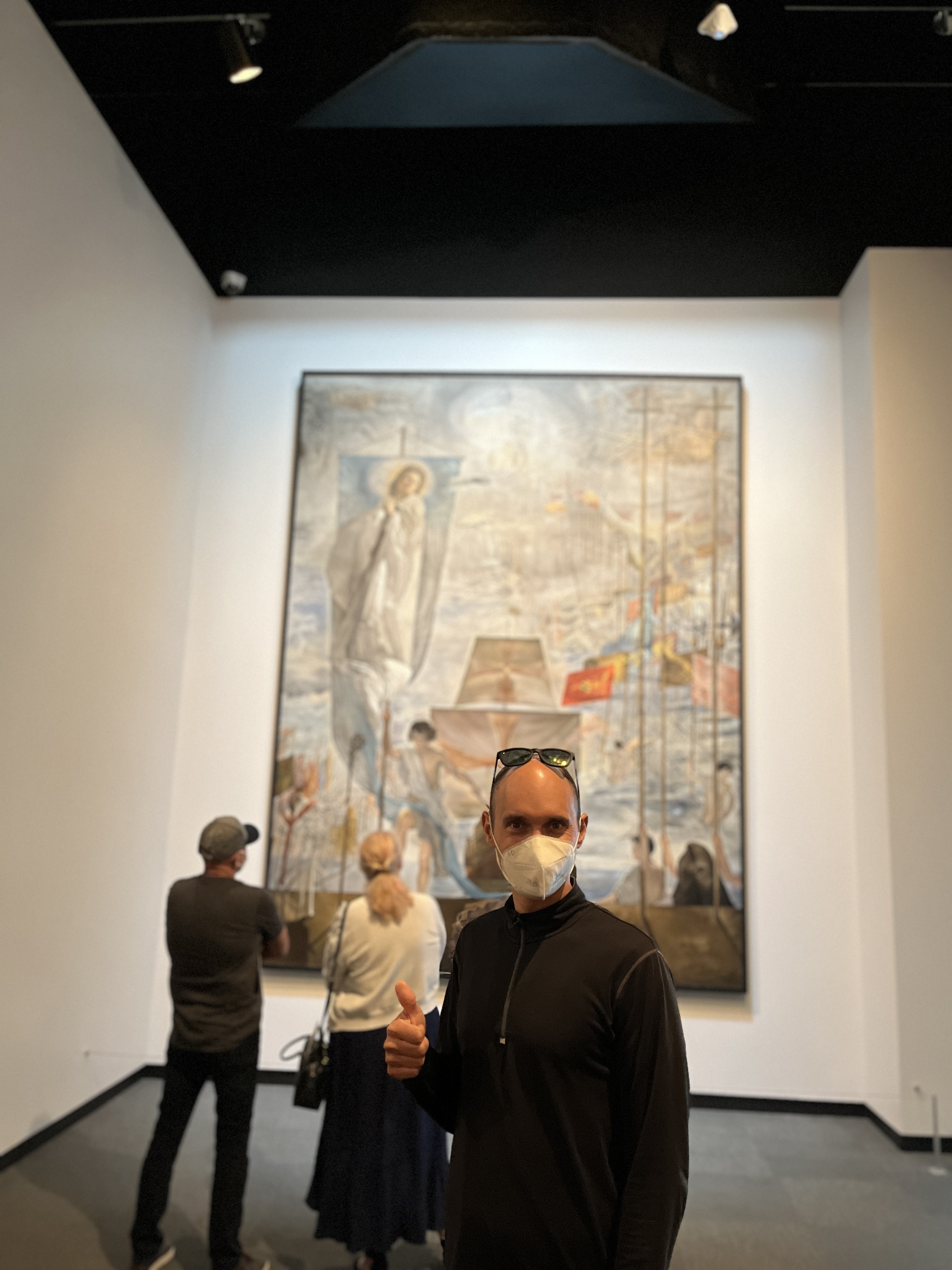
This is Dali’s The Discovery of America by Christopher Columbus at the St. Petersburg Dali museum (January ’22). It’s not a large museum but these paintings are huge – 14 feet tall!

Sandbrook says that Columbus embraced his namesake who carried the poor and weak across a river. Columbus felt like he ‘carried Christ’ across the Atlantic. That’s how he saw himself. That context gives that painting a different meaning.

If pre-1900s trade excites you, look up For All the Tea in China by Sarah Rose. It’s the of Scottish botanist Robert Fortune’s EIC’s sponsored trip to sneak tea out of China.

Pump Up the Incentives

One human mistake is psychological myopia – thinking our view of the world is the world.

When Andy Galpin trained future NFL players for the draft he noticed something “odd”. These players stood to earn huge sums of money, achieve the highest success in their lifelong pursuit, and had all the resources in the world behind them – yet they skipped workouts.

Rather, they skipped Saturday morning workouts.

Our view, as a non-NFL player is, “C’mon focus!”

Their view as NFL players is, “C’mon, Friday night!”

Fortunately, we can design our modern environment for our evolved brains.

Galpin wanted Saturday mornings to be recovery: massage, yoga, stretching. Hence the low attendance. But once he added biceps and triceps attendance increased. The guys loved the pump. After the athletes were in the gym it was easy to tack on the recovery session.

Galpin’s (3-hour!) Optimize Your Training Program for Fitness & Longevity podcast is about intentionality and that takes design. Want to live your best, strongest, healthiest life? Design it.

Three Bob-isms

This is from The Circuit Breaker reset email. It’s my tribute to Jobs theory using the podcast by Bob Moesta and Greg Engle as a base. When their podcast is on, the newsletter will recap, summarize, and provide additional links. When their podcast is off, like now, it will keep the good times rollin’.

Subscribe here -> https://thecircuitbreakerpodcast.substack.com/

Unpack here -> https://thecircuitbreakerpodcast.substack.com/p/postseason-2


The Secret Language Of “Bob-isms” introduced three Moesta mantras. These are BIG ideas with later explanations. 

Your product is the mustard, not the sandwich. Bob met with members of TransUnion who were proud of their product: credit scores. No, no, no begged Bob. People do not care about their credit scores. They care about buying a home or a car – for that, they need a credit score. After this Moesta meeting, TransUnion teamed up with businesses that helped customers make those purchases. 

Context creates value. Baby carrots were created to help with cooking but when the product was tested, consumers wanted them for snacking. That context: I’m at home and want something healthy, easy, and tasty to eat or serve created a category and most carrots sold today are baby carrots. The End of Average discusses this idea further.

Contrast creates meaning. Consumers are okay-ish at communicating importance. Asking “What do you want” isn’t helpful. Instead, Bob and Greg use contrast and bracketing. Is this for you or you and the family? Did you drive or fly to the hotel? So this was too expensive/cheap or long/fast or sweet/salty? When people eliminate options they share what’s important. 

Homework: Continue to do Jobs thinking. Reply to this email or share in the comments with the slightest idea.

Helpful Lessons & Directions

Why is India a good place to walk, Tyler Cowen asks Paul Salopek as he retraces the steps of the first human migration.

India is good, Salopek says, because the people there have walked the walk.

“Whereas in motorized societies — and I’ve written about this — it’s pointless to talk to somebody in a car — if you’re on foot — about directions because the scale of their sense of landscape is limited to these strips of asphalt that are a few meters wide that wheeled vehicles can go on. Beyond that, it’s just this moving tableau that’s an abstraction.

“In India, people can tell you shortcuts. They can tell you where the best tree is to take a break, where the best temple is to sleep at night, where the next jug of water waiting the foot traveler lies ahead. India was marvelous. I felt among a brotherhood and sisterhood of walkers there.”

Paul Salopek, Conversations with Tyler

Our This Time is Different is about understanding this idea. Walkers and drivers travel through the same physical space but travel through different temporal spaces.

When there are different rules then this time is different.

Looking Stupid

“As president,” David Brooks writes about Dwight Eisenhower, “he was personally willing to appear stupider than he really was if it would help him perform his assigned role.”

“I didn’t think you were that smart,” a friend told Bob Moesta, “because you ask all these, almost stupid questions. But those questions are how you understand contexts.”

We’ve looked at looking stupid before but it’s an idea worth repeating.

Is the goal progress or satisfaction?

These aren’t mutually exclusive. Often progress and satisfaction accompany one another.

But sometimes they don’t.

Arguments carry this tradeoff. Is the point to prove how smart you are, or something else?

It’s ego.

Annie Duke offers an alternative. When she coaches poker players they gripe that nothing is happening. Good players, Annie advises, sit out a lot of hands.

But, there’s still a lot going on! It’s in your head.

What’s happening is the decisions. Framing the ‘action’ as mental appeals to progressing players.

Looking stupid isn’t stupid. It’s a path to the destination, a choice even our ego can love.

The birthday cake’s JTBD

One question within jobs to be done is: Are the consumer and the customer different? 

A manager who buys software or uniforms or food for their staff is the customer whereas the staff is the consumer. And this happens a lot. 

Homeowners use thermostats but HVAC companies buy them. About one-fifth of books sold are gifts. Physicians choose the medicines that patients take. And then there is the birthday cake. 

“We aren’t making nearly as many of our decorated cakes as we used to. When we do, it’s a half sheet instead of a full sheet or even nine-inch cakes. In our Chicago industry, we’ve seen a drop in decorative cakes mostly from the people who are in their twenties and thirties who don’t want to buy the same things for their kids that they got when they were kids. They want ice cream cakes or experiential things instead of having a birthday cake at home.”  – Ken Jarosch, Odd Lots, December 2022

If the customer and consumer aren’t aligned then a business gets what Bob Moesta calls “zombie revenue”. 

Gyms run on zombie revenue because the customer, the current me, is different from the consumer, the future me. 

Products are not: build it and they will come. There’s much more why, how, and when – even at a kid’s birthday party. 

Birthdays are common posts around here: The Birthday Cake Diet and The Birthday Bet.