Information Questions

close up photo of woman covering her ears
Photo by Oleg Magni on Pexels.com

“People always ask us how we do what we do without talking to management. I say that’s probably made me more money than a single fact of my investing process.” – Jim Chanos

Part-of-the-reason we are the way we are is because of energy conservation. Human tendencies (nee biases) exist so we, unlike a robotic vacuum, get stuck in a never-ending decision loop. We’ve survived this far, so these things work.

However sometimes we need to consider, weigh, or evaluate information. One tactic to do that is to think about the who, what, when, and how of the information.

Who. The person communicating a message offers information and we use that, even when we say we don’t. Doctors face the white coat effect as well as the halo effect. In his book, Messengers, Stephen Martin notes that “the messenger has increasingly become the message.” Why, do you think, businessmen wear suits?

What. A silver lining of the coronavirus pandemic is the rising awareness of statistics and their limitations. Average rarely is. The same treatments can have different outcomes because the groups are different in some way. If someone says ‘the average’ we think ‘the red flag’.

When. Ben Hunt spoke with Aaron Watson and noted “I always ask myself, why am I hearing this? It’s not just the what you’re hearing but also the why. it’s not to be conspiratorial, it’s just to ask the question.” We get this when it comes to marketing a movie but forget it in many similar areas.

How. The medium is the message. Audio offers intimacy. Have people read, listen, or watch opposing political messages and the the audio conveyers are “dehumanized less.” The sister effect is why audiobooks are different, not good or bad for learning.

On the Long View podcast, Moshe Milevsky spoke about narrowing the distribution of retirement returns. Just as some jobs are unlikely to make you obscenely rich (or poor), some financial products are unlikely to make you obscenely rich (or poor).

The employee of Enron (or Facebook) had (or has) a much greater chance of banking billions or blowing up, rather than earning an average retirement account return. A teacher who buys an annuity, has a great chance of earning the market average, but avoiding the extremes.

When Milevsky spoke in May 2020, it was a good chance to apply the who, what, when, and how to communication. Milevsky is an academic, speaking about finances during hectic time as people saw portfolios cut in half, but then running up. And it was the Morningstar podcast which has an authority and intimacy in itself.

Information used to be through a few sources and the contrast was easy. Visual or not. Political or not. Mainstream or not. Now, what is mainstream, what is orthodox, what is real? Whatever the answer, it comes from a question.

Want more? Check out this pay-what-you-want placebo prescription pdf.

Appropriate Proxies


roryh
Is this art?

One of the best way to find deals in life is to find things where people have attached the wrong proxy metric.

In any systems where we count things (scores, hits, years, etc.) we optimize. People buy more fuel efficient cars rather than consider riding a bike, carpooling to work, or calling an Uber. If it’s counted, it’s prioritized. “Personally, I feel it has gone too far in that direction, and economics has overinvested in one very particular kind of intelligence,” laments Cowen.

How do people find new metrics?

Creativity. It takes a certain worldview to see that there might be a better way. Like the vertical-horizon illusion but for our worldview.

New counting techniques. Sports changed, and is changing, when data collection  (e.g. cameras) changed. Math ability is easy to quantify, so we do.

Career capital. Jason Blum outfitted a van as a mobile office because he spent so much time in Los Angeles traffic. From there he made calls to directors who had recently flopped and asked if they wanted to make movies for his company, Blumhouse Productions. In an industry where ego rules too many decisions, Blum only had to answer to himself.

Ties to history. Since 1987, the NFL combine has been held in Indianapolis. With activities like the 40-yard dash, 20-yard shuffle, and 3-cone drill it’s an annual tradition for fans and front-offices. But those tests have less predictive power than collegiate performance. Yet the show goes on.

First principles. Of the many flaws highlighted in Bad Blood, was a lack of scientific understanding from the Theranos investors. “Since he didn’t have the expertise to vet her scientific claims,” John Carreyrou wrote, “Parloff interviewed the prominent members of her board of directors and effectively relied on them as character witnesses.”

Front lines. Proxies exist to make things easy, but business doesn’t exist on a spreadsheet. Alain Bertaud said ” By living in the cities, and confronted very early, I learned the difference between the theory about a city which you read books and what it means to live in a city.”

Perhaps Rory Sutherland, of course, put it best. Too many people, Rory reasoned, think of art as something you hang on a wall. It’s something famed and famous. It’s by a so-and-so from a certain era. It’s recognizable. That. Is. Art.

Unless it’s not. Architecture is also art, and because people don’t think of homes that way, they may be undervalued. Sutherland thinks so:

“Human decision making is also pretty path-dependent. In one case in my life I’ve been able to profit from this. I live in a house, which in the UK is something called Grade 1 listed. It’s by the great eighteenth century Robert Adam, and the grounds are by Capability Brown. I’m in a four bedroom flat on the roof of a house built for the doctor of George III in about 1785. For a time it was the home of Napoleon III.”

Want more? Check out this pay-what-you-want placebo prescription pdf.
The room or use Zoom?

We noted in the Quarantine Education post that things will need to change in how teachers teach. The classroom model, with breaks for stations, specials, and snacks works fine only in the classroom. Teachers will need to adapt.

Rory Sutherland spoke on Great Minds and Jason Blum spoke on Bill Simmons and both addressed how being in-person was especially helpful in creative endeavors.

“When you’re talking to a creative person, there is so much insecurity and doubt if this is going to be a good idea. Part of what my job is making whoever I’m talking to feel early on that there is no bad idea.

“Of course there’s bad ideas, but right now, talking early on or how something fits, we can think of any idea.

“And that’s very hard to do on video.”

Jason Blum

Blum makes horror movies in a Moneyball way so he even kinda wants things that look or sound a little hairy. He wants something to be ugly on the first draft and beautiful on screen.

Sutherland’s angle is only slightly different and it’s in the field of marketing.

Take comedy, for example. It’s a field very similar to marketing because it reframes an idea. People are relative thinkers (more than that, different from those, etc.) and comedy changes the that and those we compare against.

In his book, Shtick to Business, Peter McGraw prints an Anthony Jeselnik joke: “My parents were strict. My mom and dad once made me smoke an entire pack of cigarettes. An entire pack of cigarettes in one sitting..just to teach me a valuable lesson..about brand loyalty.”

That’s good reframing. That’s a good laugh.

But it probably didn’t start out that way. It probably started in a place, as Blum put it, of “insecurity and doubt.”

At Ogilvy’s behavioral unit, Sutherland said they have a rule to “dare to be trivial and don’t be afraid of looking stupid.” That’s easier in the room than on the Zoom.

Coming out of social distancing it’s likely that the individuals and collectives that do best are the ones who can communicate the best. If Jason Blum has a series of great meeting he’ll have a great movie. If Sutherland finds a ‘Python-esque’ framing, he’ll have a great ad and behavior change. Alchemy, is powerful but will take more work when using Zoom rather than in the room.

Want more? Check out this pay-what-you-want placebo prescription pdf.
Survivor Explains Sampling

One of the nice parts of distance learning and social distancing has been extra family time. Without commutes, commitments, and the common-chaos, things are kinda quieter. So we’ve been watching Survivor.

I was a huge fan the first season. I was in college, online, and this was new. I kinda grew out of the show, losing touch with the premise, but now with kids that are twelve and ten we are ready.

We’ve watched as a family, working backwards from season thirty-four. Our favorite contestant of season thirty-three was Ken who played a straight version of the game; forming alliances, keeping his word, and winning challenges.

In this case it was the wrong way, as Adam took the final vote. Unanimously.

Ken was liked by all, played well, won challenges, and made it to the final three. What happened?

Two guesses.

Option 1: Survivor is a television show that’s edited a certain way. This is good. A time lapse or documentary or Instagram version of Survivor is worse. Television is a certain medium that excels with a certain message.

The producers know it’s sweeping panoramic of Bali islands, difficult-but-not-impossible challenges that make people at home say I-could-do-that, with some interpersonal drama mixed in. People are edited a certain way so there could have been a lot we didn’t see.

Maybe Ken wasn’t as sharp as he looked. Maybe Adam was even better.

Option 2: A sampling bias. The jury didn’t vote for Ken because they weren’t like him. They were there to play the game a certain way which is what Adam did. The people who want to go on Survivor want to play the game.

Sarah Tavel told Patrick O’Shaughnessy that in the early days of Pinterest there were a group of power users who wanted a specific feature to rearrange their pins. It would take a lot of work, but people really wanted it. So the engineering team built the feature and it largely went unused. What happened?

Sampling bias.

The power users weren’t a good sample.

The same thing was said by Ken Jennings about his run on Jeopardy. Everyone, Jennings said, that makes it to Jeopardy is really smart. That means they compete on something besides smarts. Competing against Ken was really about mastering the buzzer.

In his SSAC talk, Ken said that the producers didn’t know if his run was good or bad. Would this move Jeopardy to, “this is the spirit of the age” or repulse the loyal audience. After watching Ken rip off another week of winnings in a single day, the producers started to let the other contestants have longer buzzer practice. Jennings had mimed and timed the pattern and that was his key to winning.

Samples are fun to think about. With a good selection, a thousand people can explain the world. With a bad selection, and selection is often bad, we get things that may appear one way, but are not.

Want more? Check out this pay-what-you-want placebo prescription pdf.
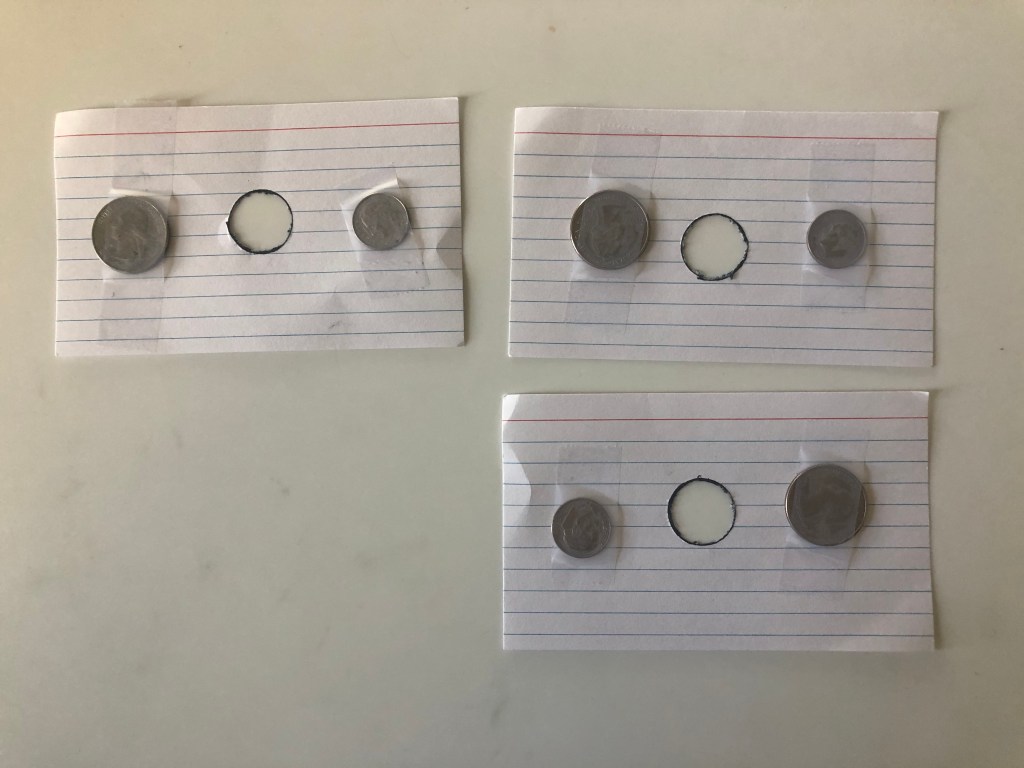
When a quarter and dime are the same size.

Collect a quarter, a dime, a notecard, and a pen. Trace the dime with the pen on the notecard. Press and repeat to the point where the ink softens the paper and the circle easily pushes out.

Make extra for the neighborhood kids – and the neighbors who are kids at heart.

You’re reading this and I’m writing this so we both know there’s a catch. But like with comedy, we’re here for those moments.

It seems like the quarter won’t fit because it’s larger. But what does that mean? There’s two approaches. 

  • The quarter’s diameter is larger than the dime’s diameter.
  • The quarter’s circumference is larger than the dime’s circumference.

But we can change the framing and get the larger quarter through the dime size hole.

  • The quarter’s diameter is NOT larger than the dime’s circumference.

One of the largest lessons from Herbert Simon’s Confessions of a Pricing Man was that all value is perceived value. The starkest way to understand this is to think of the expression, you couldn’t pay me to. For example, you couldn’t pay me to sit outside on a hot Florida Saturday surrounded by tens-of-thousands-of-other people watching a game I don’t understand or care about

Yet people pay good, and sometimes a lot, of money to watch college football.

In a literal sense this expression doesn’t work so well but in a figurative sense it shows that all value is perceived value—and that all perception is malleable. As Rory Sutherland said, “you can always use a bit of psychology to make products better.” 

People don’t like investing in stocks when the numbers are red. People do like red painkillers, believing they work better. And half of all Ferrari’s are, you guessed it, one color

Framing things in a new way is how we make the impossible easy. 

Want more? Check out this pay-what-you-want placebo prescription pdf.

Summer Listening

The Behavioral Scientist listed their summer reading suggestions and it looks like a nice mix of new and old. But it’s also a long list at twenty-five books.

Most of us will not benefit from spending three-hours with Robert Frank (Russ Roberts excluded) but most of us will benefit from thirty minutes. Listening is like playing the idea lottery. A change in point-of-view could be worth forty-IQ.

In that spirt, here is a podcast list of interviews of the authors. I made the list so it’s a collection of podcast I listen to, recognize, or randomly selected.

If listening in browser isn’t your jam, then follower the link over to Listen Notes for the option to add the RSS to your podcast player of choice.

We believe that mediums matter and that this list of podcast episodes is not the same as the list of books. Though it’s the same people it’ll lead to different ideas, and that’s good.

If you think you might like Frank, consider this question: why do people buy wedding dresses but rent tuxedos when the former will be worn once  and the latter could be used again and again? If that’s interesting, check out Robert Frank’s work.

Also, if this playlist sounds perfect, you might like this bit of hour-long reading I put together. 

Average Lies 2

Edit: see the comments about the original purpose of the VCR and why the clock was important. That said the overall idea still stands and applies to IOT, cameras, chips. 

When I was a kid there was something I didn’t get. Why did VCRs have a clock? The thing never seemed to work correctly, was slightly different from every other clock in the house, and wasn’t central to the functionality of the VCR unit. I was going to watch True Lies (again) and did not need to know what time it was.

giphy

As an adult I think I get it. The VCR had a clock because clocks were inexpensive to install. A few cents may not make sense from a JTBD approach, it does make sense from a sales approach. When people compare A to B at the same price but A has something B does not (a clock), consumers will choose A even if it’s a feature they don’t really need.

Like a VCR clock.

The same thing happened with pictures. Instagram changed not only how people took photos but how many. Pictures are cheap to take and share. As things become digitized they are cheaper.

Like numbers.

More counts, more code, more algorithms, more nodes. The network grows and the network shows everywhere that Mikey-boy goes. 

We are counting more and computing more which means we will be sharing more numbers. This Average Lies series (part 1) is a reminder to dig deeper into numbers and come up with a framework for when average is, and is not a good measurement.

  • Good: Biological (height). Mediocristan. Large samples. Homogeneous.
  • Bad: Social (media). Extremistan. Small samples. Heterogeneous.

Here are three more examples:

On The Long View, Moshe Milevsky said, “The number of times you’ve circled the sun, your chronological age, doesn’t really reflect the years you have remaining. You can be fifty-five years old chronologically, and I can be fifty-five years old chronologically but that doesn’t really tell us how long we have to spend in the lifecycle.”

Tuscan is cooler but south of Phoenix.

The most successful country in the NBA? Poland of course.

As numbers are cheaper to produce more numbers will be produced. Like VCR clocks and Instagram pictures, some will be good but some will not.

Want more? Check out this pay-what-you-want placebo prescription pdf.

Calorie Labels, Screen-time Labels

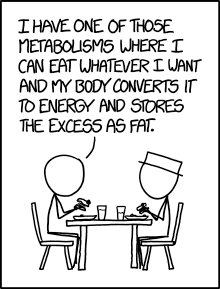
One of the most important findings of behavioral psychology is Daniel Kahneman’s idea of WYSIATS, what you see is all there is. If something is salient, it’s important. If something is hidden, it may as well not exist.

But this tendency comes in contact with any ‘easy’ choice, like what to eat.

Metabolism
xkcd

On the one hand salience heightens importance. On the other, we love good food.

In the battle between salient calories on restaurant menus and ‘mmm…barbeque‘ who takes the cake?

Humans will adapt. New Yorkers got used to the calorie displays and slowly ignored them. This is why commutes always suck and houses loses their shine. We get used to things that are presented in the same way (your home) but notice all the novel ways things can be good or in the case of a commute, bad.

Incentives work, to a point. When school children were offered a health snack about 15% chose it. Offer an incentive though, and 75% of kids choose the snack. This effect degrades over time. It works for adults too.

People trade-off. When researchers looked at the buying habits at Starbucks, customers reduced the food they purchased once calorie labels were on the menu but made only the slightest adjustments when it came to their drinks.

People like low numbers. At a cinema, the concessions operators varied the prices of drinks. Sometimes they were the traditional S/M/L pricing. Sometimes they were priced traditionally and per-ounce [i.e. $1.29 (4 cents per ounce)]. People purchased more large sodas when the price-per-ounce was included. This helps explain our family’s Fro-Yo receipt.

Nutritional labels is a logical approach. It’s non-alchemic approach. And it doesn’t work.

I got hungry writing this post. Not from all the talk about the food but to think about all the effort in legislating, designing, crafting, installing, asking, updating, cooking, and serving this idea. It’s a lot, mostly for no effect. Alchemy, on the other hand, is all about creating value from low-cost.


Instead we can think of an idea Paul English had during his time at Kayak. English noticed that a lot of people paid a lot of money for a lot of watch without a lot of features. He realized watches mostly do two things: tell time and signal status.

Why not then, make a watch that does both but signals in a unique way? What if Swatch made a purple watch which cost thousands of dollars which were donated to charity?

Two birds, one stone.

A similar idea might to create a water bottle signaler. In the south, Yeti cups act in this way like this. In college Nalgene waters bottles did something to this effect too. We have no idea if this signaling approach will work but for the cost it’s certainly worth testing.

This post started with an idea that that food calorie labels and screen time notifications  have similar effects, minimal. There’s not much research, but that seems to be about right.

Competing against non-consumption

black and white people bar men
Photo by Gratisography on Pexels.com

On, The Long View podcast, Sallie Krawcheck said, “Our rival is cash and inertia, that’s our biggest competition.”

The crucial idea from Zero to One is to not compete because competition makes a difficult situation more so. Competition aversion is why some buy boring businesses.

Once there’s another entity, the market mechanism incantation summons the invisible hand and cranks into gear competition. Great for consumers, bad for producers.

A business can avoid this by following Bob Moesta’s JTBD framework. Non-consumption, Moesta says, “is buried in everyday life and you have to dig for it.” Because people aren’t using a form of this product, they don’t know what they want, and it’s why Moesta and his crew conduct the scope of interviews they do. It’s hard to find this stuff. It’s why Steve Jobs said he doesn’t ask people want they want.

When Krawcheck started Ellevest in 2015, she would have seen a lot of different investing options. There were many competitors with many features. She could have focused on a metrics like cost per trade, minimum balance and so on. But instead of looking at the easy-to-see things, she focused on the hard to see one: non-consumption.

Business is difficult. One way to make it less so is listen to people who aren’t customers and find which job they need done.

Average Lies

“Often an average is such an oversimplification that it is worse than useless.” – Darrell Huff, How to Lie with Statistics.

We don’t really think about averages. The average hospital costs for hepatitis A was $16,000 in 2017. The average student loan debt for North Carolina residents is $36,000. The average American says they’ll spend $142 on Valentine’s gifts. Men, on average of course, say they’ll spend more than women.

For some things in life, average is fine. When my daughters were born, the hospital gave us a growth chart for their height and weight. It showed deciles and right in the middle was average. Growth charts are simple. Height. Weight. Plot. On chart meant on track, physically at least.

Now my daughters are twelve and ten and wow how things changed. New parents can track their child’s sleep, diet, movement—bowel or otherwise. And it’s not just parents. Everyone can track their taken steps, hours slept, and Spotify streams.

With technology, counting is easier.

With counts, averaging is easier.

Numbers are tools. Rather than bartering bananas for bread we have dollars and cents. With numbers, stores count their bananas bundles. With numbers, people have balanced budgets.

Numbers are tools. Like other tools, they take practice with feedback to build proficiency. I’m much more careful with the occasional use of power tools than the regular use of a chef’s knife. Numbers are like that. Well practiced and well used, numbers are a unique and powerful tool.

An example of numbers telling another story was the sabermetrics revolution in baseball. Smart teams realized that walks are better than hits, and that walks cost less to buy. Worth more, cost less. It’s like the successful Miller Lite advertising campaign: ‘tastes great, less filling’.

Decades later, sabermetrics happened in basketball with the insight that making one-third of three-point shots was the same as making one-half of two-point shots. Life, like sports, uses numbers more.

Numbers, though hidden in code, will become more prevalent in life and more important. 

Average, as numbers go, is often abused. This is due to many reasons, but just like technology has reduced the cost of tracking a baby’s bowel movements, average is used because the cost is low. It’s sixth-grade math. And it can hide important nuances.

For example, the average student loan borrower owed $28,000 in 2016. If we dig a bit deeper we find:

  • The median debt was $17,000.
  • The median for two-year degrees was $10,000.
  • The median for a four-year degree was $25,000.
  • One-in-four borrowers owed less than $7,000.
  • Only 7% of borrowers owed more than $100,000.

Those details are often omitted from the story. One poll showed that people viewed median debt of $17,000 as the “least bad figure about student loans”. Life is nuanced but numbers are not. Framed influences the way numbers are understood.

Thanks for reading.