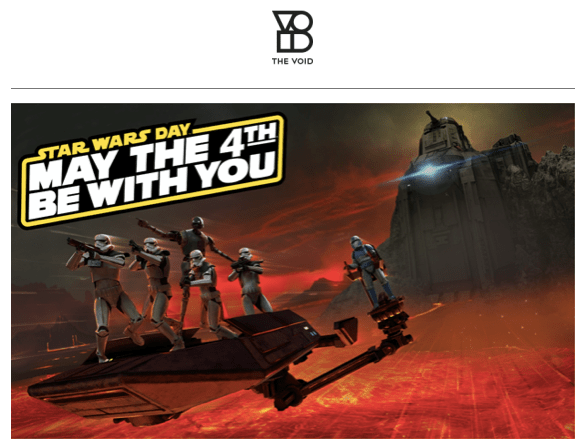
This came in an email. Below it were pictures of staff members and their reviews.
The Void virtual reality experiences are one of the most unique things I’ve ever done. The fifteen-or-so-minutes of virtual reality complete with sensations of heat, vibration, and smell are well worth the price.
Orlando has a location at Disney Springs and my oldest daughter and I have done the Star Wars experience (twice) as well as the Wreck it Ralph tour. Both are great. Both are highly recommended.
As the staff assists in removing the Oculus kit (it’s heavier than expected) they take your photo. Returning to the counter, guests can buy a print. From a numerical perspective, this is a great idea. Cameras are one-time costs and the additional time training staff and having them offer the service is zilch. This part of the business has great margins.
But it’s a mistake.
In college, I was a member of the ultimate frisbee club. It was tons of fun with great people but it was more fun to play than organize. One year I was goaded into being ‘club president’ which consisted of recruiting new players, requesting space from the university, and emailing other colleges to coordinate tournaments.
The recruiting part normally consisted of papering campus with fliers and table tents. But with limited funds and less interest, we passed on the paper and bought t-shirts instead. We created walking advertisements.
With limited funds, we focused on money’s fungibility.
That’s missing at The Void. Those photos should be free. The photos should be better. The photos should be the marketing. People can write about the experience and share word-of-mouth reviews but mediums matter.
Virtual reality could become the bowling alley of the next generation, a place to socialize, converse, and play. But places like The Void need to think long-term about marketing this, rather than think short-term about profiting.
Note: I don’t know what the rent costs, but it’s probably high given the locations. This, is something we addressed about restaurants.
“Our whole business is based on giving our artists and designers complete freedom to invent without limits.” Bernard Arnault (HBR)
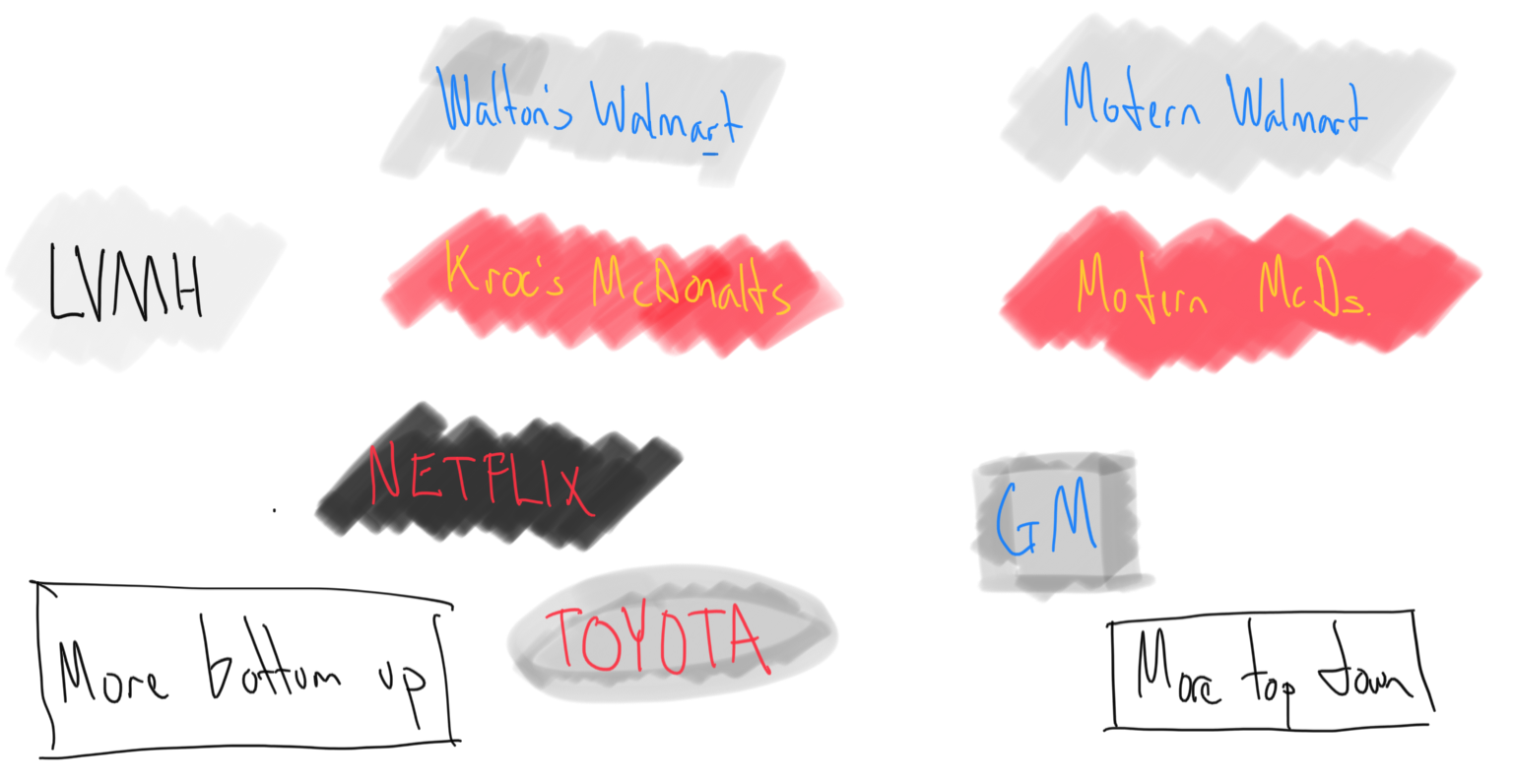
For a long time, we advocated for a decentralized command. It just made sense that as Ray Kroc wrote, the person closest to the problem should solve the problem. But reading Good Strategy, Bad Strategy reveals a wrinkle in this advice.
Richard Rumelt opens the books with an example from his classes. Rumelt asks his MBA students why Walmart went on to succeed where Kmart did not. The shiny pre-MBAs “are willing to throw anything into the bin, and I don’t stop them,” he writes. There will be boxes and lines and obvious answers, but where was the competition? Why wasn’t this obvious to everyone?
And early on we get a central idea to Rumelt’s work:
“Whenever an organization succeeds greatly, there is also, at the same time, either blocked or failed competition.”
Rumelt sees a synthesis between Walmart’s command and logistics. They weren’t just better, they were the only one doing it. It was Zero to One. With large stores connected to integrated supply lines and digital record management, Walmart was the largest buyers (at the lowest prices) and most efficient distributor.
One part of their strategy fed another which fed the original.
Had Sam Walton let his store managers dictate purchases, those supply and price advantages would have evaporated. However, store managers orchestrated local marketing. Walton encouraged just about anything to bring people to the stores, often a popcorn or ice cream cart was involved. It was okay that individual stores varied in applications that weren’t central to the synergy.
Part of the reason this blog has focused so much on DC is that we write about business in the earlier and smaller stage. For nascent businesses action trumps coordination.
The existing businesses which maintain a more bottom-up structure have a more ‘collection of parts’ vibe. Ted Sarandos said about Netflix’s non-notes: “We’re way better off taking someone’s creative vision and putting it through the service than us trying to go in and retool it. At the end of the day if the creator says, ‘That’s my show.’ we put it up.”
It doesn’t matter to Netflix that documentaries are shot a certain way or that some subjects are covered while others are not. What data could have, would have, suggested Tiger King?
When John Galliano created dresses from newspaper, Arnault wasn’t worried.
“I don’t have alarm bells when it comes to creativity. If you think and act like a typical manager around creative people—with rules, policies, data on customer preferences, and so forth—you will quickly kill their talent. Our whole business is based on giving our artists and designers complete freedom to invent without limits.”
Why didn’t it bother Arnault? What-if all of LVMH’s 75 brands did this? The don’t. Each of the ‘newspaper dresses’ is an experiment, it’s outcomes are (expensive) limited runs, and the mass-market has some of its DNA.
Finally we have the (maybe old) difference between Toyota and GM. Known as Andon manufacturing, the Toyota assembly system included a chord anyone could pull when they saw something wrong. GM, did not.
There are lots of ways to run a business. Arnault says just this. However for most business, some ways are better than others. Netflix’s hands-off-ness helps creators make great work and share the word about Netflix being hands off, which leads to better creators working with Netflix. This is what Rumelt teaches. That’s the art to it.
When Rory Sutherland recommends a book I do my best to find it. Even if it’s from 2006 and uses British English. Henceforth, I’ll be interchanging behavior and behaviour.
The Naked Jape was good for exactly the reason Sutherland said it would be: comedy reframes things.
Alchemy recasts one thing as another. Diets, wrote Penn Jillette are hard, but challenges are exciting. When he reframed his diet as something difficult but not-fun as something difficult and challenging it changed his attitude. Jillette had already learned challenging things – like juggling – so this was just another one of those.
Comedians are great at this.
“My father hugged me only once, on my twenty-first birthday. It was very awkward. I know now what it was that made me feel so uncomfortable: the nudity.”
That joke works well in a comedy set, less-well on a first-date, and terribly while talking to a psychiatrist. Change the context, change the meaning. Or, change the words and you change the meaning in the context.
Carr’s book offers lots of little jokes that prove this point. The ideas, these jokes are “anarchic, a little scrap of chaos from beyond the boundaries of the rational, a toe dipped in the shallow end of anti-social behaviour.”
Take the idea of jokes along with the JTBD theory and we get the start of the solution to a puzzle.
When Instagram was building out features an engineer told co-founder Kevin Systrom that he was building a polling tool. ‘That doesn’t sound like something I would use’ Systrom recalled. ‘Oh no, it’s going to be great,’ the engineer explained, ‘teens will love this!’
They did.
What was happening at the time was that teens were uploading solid-color backgrounds with a prompt on it. Their followers voted as comments. The users created a work-around, customizing the platform for their needs. Workarounds are also common in comedy. I saw a sign at an audiologist’s office that (loosely) demonstrates both JTBD and jokes; We don’t sell hearing aids, we fix hearing.
In the JTBD work, Bob Moesta changes his perspective. He enters customer interviews as an empty vesicle and lets them tell him about the product. He avoids jargon. He doesn’t lead them. Moesta is similar to Jerry Seinfeld who described comedians as people with a third eye. Here’s Seinfeld with the check after the meal.
“Went out to dinner the other night. Check came at the end of the meal, as it always does. Never liked the check at the end of the meal system, because money’s a very different thing before and after you eat. Before you eat money has no value. And you don’t care about money when you’re hungry, you sit down at a restaurant. You’re like the ruler of an empire. “More drinks, appetizers, quickly, quickly! It will be the greatest meal of our lives.” Then after the meal, you know, you’ve got the pants open, you’ve got the napkins destroyed, cigarette butt in the mashed potatoes – then the check comes at that moment. People are always upset, you know. They’re mystified by the check. “What is this? How could this be?” They start passing it around the table, “Does this look right to you? We’re not hungry now. Why are we buying all this food?!””
Let’s try this comedy idea with this reframing.
Instead of paying last, people pay first. A restaurant places a $50/100/200 charge just for stepping in. Customers get a menu without prices and order without influence. At the end of the meal, a waiter brings back their balance, if there is any.
There’s all kinds of consumer psychology at play here from menu design to mental accounting to the idea Seinfeld jokes about it. This may not even be a good idea but it’s a new idea and that’s what matters.
If something could be the premise to a joke, it’s on the right path.
Another Rory’s read is Schtick to Business by Peter McGraw. If you like this blog’s stories, you’ll probably like that book (a few overlap). McGraw’s big idea is that business people should think more like comedians and find the interesting weirdness around life. There’s areas where we’ve always done it this way has wallpapered over interestingness.
Our evolutionary advantage was to see cause and effect. This If this then that approach to life kept us alive. It was a simple rule that worked great in a simple system. Modern life is not so simple, but that doesn’t mean we need complicated rules (see Gall’s Systems Bible).
A modern simple rule with great effect is to ask and then what when faced with an intervention. There’s always cascading effects and asking and then what is a way to look for the larger effects.
Chicago, 2016-2017, offered a chance to see this question in terms of plastic bags at the grocery store. In sequential months, there was a ban on thin plastic bags, no ban or tax, and then a tax on disposable bags.
This legislative two-step occurred because the first bag ban was a debacle. Lawmakers gave the wrong answer to the and then what question. Instead of ‘people will use reusable bags’, it was ‘stores will get around this by using a slightly different bag.’
Asking and then what helps us find that when schools ban soda sales households buy more, when communities ban payday lenders pawn shop foot traffic booms, when governments limit cars one day a week the total number of cars rise.
From, Skipping the Bag: The Intended and UnintendedConsequences of Disposable Bag Regulations:
We find that plastic bag bans lead retailers to circumvent the regulation by providing free thicker plastic bags which are not covered by the ban. A regulation change that replaced the ban with a tax on all disposable bags generated large decreases in disposable bag use. Our results suggest that plastic bag bans—stricter, but more narrowly defined regulations—are less effective than market-based incentives on a more comprehensive set of products
There are a cornucopia of incentives to use to change behavior. Sometimes money works well (bag tax). Sometimes social norms work (the authors note that this may be present in their study). The best thing to try might be small bets.
At SSAC20, Rob Sine, Adam Grove, Kristin Bernert, Patrick Ryan and Shira Springer spoke about ticketing in professional sports, among other areas. A few highlights.
Do we measure what matters? When asked what the opportunities are in the industry, Sine said, “going from season ticket units to revenue which keeps the lights on.” We can imagine a time when season ticket sales were a good proxy for revenue but with the secondary markets, public spaces, and better televisions at home people go to games less. Plus, people are busy. The successful teams will head back to ‘first principles’ and re-focus on revenue.
Who is your customer? “When you look at the data, an account holder for a full season goes to thirty percent of the games, the half season buyer goes to about sixty percent, and the quarter buyer goes about eighty percent. So you’re kinda servicing the same person,” explained Bernert. It’s a case of JTBD. It’s a question of, what are they hiring me to do?
Are there latent needs? When asked if the season ticket is dead, one panelists wonders if they were ever alive. “Teams and venues have always had to recreate what the fans are looking for,” said Sine. Patrick Ryan suggested teams talk to the ushers to hear what the fans are saying—not necessarily what they are asking for.
What are the intangibles? “There’s a lot of pride in being a season ticket holder.” “There’s a great benefit to saying, ‘I was there.'” “A lot of the L.A. Dodgers season ticket holders said the biggest benefit was the person checking them in at the premium station knowing their name, and how that impressed the clients they were with.” The best returns on an investment are the ones with the smallest cost, intangibles are often just that.
Are there latent needs, part 2. One growing request from customers is something Rory Sutherland calls this the airport lounge problem. What some customers want is not one visit on each trip to the airport, but one visit on some trips and a family pass twice a year. Teams like the Orlando Magic are offering this, buying back unused tickets for full face value and allowing that money to be used in the gift shop, concessions, upgrading future tickets, or special events.
One thing that SSAC offers is the chance to hear from people on the ground who may not often speak about their experiences. This was certainly one of those panels. Thanks again to Jessica and Daryl.
Your random fact of the day: Only two college bowl games sold out last year (2019/2020) (45:45).
Well before he won The Sveriges Riksbank Prize in Economic Sciences in Memory of Alfred Nobel, Richard Thaler wrote The Loser’s Curse. Along with co-author Cade Massey (well before he hosted the Wharton Moneyball podcast), they found that NFL teams tend to trade too many assets to choose higher in the draft.
With the idea that it’s not what you buy, it’s what you pay we’ll revisit the paper. (Here’s a related 2018 work, also a gated 2020 analysis)
Also, Thaler spoke at SSAC20 about the paper in a panel with Bill James.
Thaler and Massey noticed that in-practice, NFL draft picks declined steeply in value. Top picks were worth a lot. Low picks were worth much less. The chart looked like a roller coaster’s first hill.
What they found was what’s known in the league as ‘The Chart’. The rule-of-thumb systems born in Dallas in 1991, and spread through the league. Thaler and Massey wrote that the chart standardized trades and created the norm to ‘gain a round waiting a year.'” It was the way things had always been done and few teams at the time considered why we’ve always done it that way.
“What our analysis shows is that while this chart is widely used, it has the ‘wrong’ prices.”
The chart suggested that the first pick of the first round in the draft delivered less value than the last pick of the first round.
Thaler and Massey found the ‘right’ prices by comparing draft slot against games started and pro bowls awarded. Lower drafted players scored higher.
Thaler and Massey wondered if there was a ‘star premium’. “Over their first five years, first-round draft picks have more seasons with zero starts than with selections to the Pro Bowl.” Busting was as likely as breaking out.
Thaler and Massey wondered how often one pick was ‘better than the next guy’ at the same position. “Across all rounds, all positions, all years, the chance that a player proves to be better than the next best alternative is only slightly better than a coin-flip.”
In the paper Thaler and Massey lay out a variety of reasons why ‘The Chart’ was so different from the results. Let’s add four more.
Possible explanation 1: Measurement error. Quarterbacks are tremendously important and the stats underrate their impact. On the Wharton Moneyball podcast Massey brings this up and hints at it on Twitter. In the paper Thaler and Massey do boost performance scores by 50% without seeing value returns shift.
However maybe there was a trend they didn’t or couldn’t quite measure. More and more quarterbacks throw for more than 4,000 yards.
Possible explanation 2: Ownership incentives. The NFL—or any sport—isn’t just about winning. Though Massey and Thaler write that people don’t tune in to see their team lose, they don’t address whether people view interesting as different from winning. We think there’s only one honest sport.
If owners see values rise, share revenues, watch mediocre play, and they themselves face little (social) cost, how strong is the incentive to ‘just win baby’?
Possible explanation 3: Luck matters a lot . Michael Mauboussin writes about guidelines for situations that are more dependent on skill and ones more dependent on luck. For situations with more randomness (and luck) people should trust the base rates more and give more weight to environmental rather than personal factors. By thinking they can find a diamond in the rough, teams are operating like drafting players is more skill than luck based.
However, there’s always a chance to develop better talent evaluation, incorporate new technologies, or coach players better. Those are all skills that could improve the 52% ‘better than the next guy’ success rate.
Possible explanation 4: Culture is king. The effect that Thaler and Massey find could be partially driven by bad organizations picking at the top of the draft. Imagine these were not football franchises but restaurant franchises.
The best chefs keep their jobs and the talent pool for the open positions is a mix of unproven leaders, bad situations, or people who have already failed ‘but learned the right lessons’. The ownership of these franchises are people who have already proved they themselves are bad talent evaluators, or else they wouldn’t be looking for a new coach/chef.
What’s great is that while the data is old the ideas from Thaler and Massey are still present. They’ve taken new forms and changed in many ways but good decision making is still something worth thinking about.
Always a fun conversation with the great @patrick_oshag. Among many things, I talk through a new hierarchy of marketplaces I'd been working on (will publish soon). We recorded this what feels like years ago, so think of it as a time capsule from a simpler time. https://t.co/mFcawsgcwq
Sarah Tavel spoke with Patrick O’Shaughnessy and in their discussion included five good questions. Perspectives from differing industries make these questions especially helpful, a change in point-of-view is worth forty IQ.
What weaknesses accompany competitor’s strengths? Ebay is a behemoth. They sell everything. So Tavel points to Goat, “and one of the founders had ordered a pair of sneakers off of eBay, opened the box up, and they were counterfeit.” That was their founding insight, eBay has all the supply, which includes fake products.
What business serves too many people? New companies arise to serve new needs. One helpful framing is to read is books from the late-90s an early 00s about technology and the remarkable respect for Microsoft. Everyone worried about them but large size brings weaknesses too. Why does TikTok work in a YouTube world? Why does Snapchat when there’s Facebook? Why Zoom with Skype?
Does this exist elsewhere? Tavel said, “It doesn’t really make much sense if you’re a real estate broker to be on LinkedIn. It’s not your network.” What if there were a network where brokers could share leads then share commissions? Poker does this when one player stakes another. “Real estate brokers do share leads with each other and if one of them converts they get a share of the commission, but there is no formal system.” There’s no such thing as new problems.
What job—and this may be different from what customers say they want—do customers really want? At Pinterest the power users wanted to rearrange pins on their board. This was a difficult engineering challenge and only requested by .1% of users—but that was still a lot of people so the Pinterest team built the feature. “It was a symptom of something else not working in the product, which was an inability to search your boards,” Tavel explained. They didn’t know the JTBD.
What choices reinforce our advantages? “Anytime a user clicks or taps they are using energy and you want to direct that energy in a way that creates the most value for the system that you have. Usually there’s a core action in your system that is most correlated with a user retaining, and creates accruing benefit for your product.” Richard Rumelt’s Good Strategy Bad Strategy is summed up by a different phrasing of the same question; what collection of choices is the most synergistic?
A gambling parlay is a bet where two or more things have to happen. Will you have coffee and eggs for breakfast is less likely—thus longer odds and higher payout–than just betting on one or the other.
And people love betting parlays. The most popular Super Bowl bet is the coin toss, and Americans bet seven billion dollars (legally) on the game.
And casinos love people betting parlays. According to UNLV, sports books earn five percent on bets, except for parlays. On those bets casinos take 30%.
Why do bettors do so poorly? It’s a little too much psychology and a little too little numeracy. Bettors, said Rufus Peabody, love to bet for things to happen. It’s easier to imagine one outcome than all outcomes. It’s why the ‘no safety’ bet almost always has positive EV.
Bettors also don’t consider the numbers in the right light. Two independent seventy percent events only both occur half the time. Let’s run with that.
According to smart air filters, a t-shirt-mask will stop 70% of an airborne bacteria which is smaller than the coronavirus. That’s good. But what if we parlay masks?
If I wear a mask a t-shirt-mask and you wear a t-shirt mask we’ve reduced the viral load ten-fold. Thirty-percent of thirty-percent is .09.
The same math that makes parlays good for Vegas and bad for gamblers is what makes masks good for all of us.
I wore mine to the store for the first time. It felt kinda foolish. But then I did the math.
UNLV explains the casino win percentage as “Win percentage, or win as a percentage of drop, AKA hold percentage, the percentage of money wagered that the casino kept.”
Peabody also tweeted about this:
The people who think a 0.2% mortality rate for 30-39 year olds means they have no chance of dying are the same people betting 8-leg parlays with true odds of 500/1 every weekend.



 The Waiter's Pad