Distribution Channels

Three stories, the same message.

How Glen Powell ended up with the role of Hangman in Top Gun: Maverick.

How Estée Lauder ended up in Harrods.

David Senra tells the story in Founders #217. First Lauder goes to Harrods. No one talks to her. So, she thinks a little media attention will help. She does some interviews, goes back to Harrods, no one talks to her. She returns to America.

Lauder returns a year later. She asks. ‘No’. More media, she asks again, ““she talks to the same buyer. This is a year later. She was not as quite as hostile, but she says, let me tell you, I have no room here as I told you before, she said, but perhaps I could take a tiny order and put it in with the general toiletries.”

More media, and the customers started to show up.

How Kind Bars ended up in Walmart.

Daniel Lubetzky’s path to starting Kind was long, wandering, and full of two-steps forward one-step back moments. One was the first time Kind got into Walmart. It wasn’t in the bar section. It wasn’t in the health foods. It was in the candy bar section.

This was disappointing but a blessing in disguise. Kind lacked the organizational structure required for serving large customers. The bars took a long time to take off – which was good. Once they did Walmart and Kind ended their partnership. It was too much too soon – but a lesson in what the company needed next.


Everyone is a genius in a bull market, but is it easier to choose bull markets than be a genius?
Goal Alignment

How Will You Measure Your Life? by Clayton Christensen and How To Change by Katy Milkman are different books with the common theme of goal alignment.

Do short-term choices, options, and incentives align with long-term aims, hopes, and dreams?

Christensen writes in business terms, specifically innovation. Disruption theory notes that when incumbents serve their best customers they miss new opportunities. It’s a dilemma because the opportunities have worse short-term outcomes than “business as usual” – but possible long-term rewards.

Milkman writes in psychological terms. “Doing the right thing,” Katy conveys, “is often unsatisfying in the short-term.” Instead, bundle working out with watching Netflix. Get Starbucks at the airport. Do your taxes and then go out to eat.

Easy choices, hard life. Hard choices, easy life.

These books exist for a reason: We are myopic!

But with reflection, intention, and design goals align.

Dice tails

Maxim two, from Richard Zeckhauser, is “when you are having trouble getting your thinking straight, go to a simple case.” This maxim came to mind listening to Michael Mauboussin and the Acquired duo discuss business valuation and the difference between tangible and intangible assets.

“(Intangible assets like brand, code, etc.) also makes you vulnerable. If your product or service does not work there’s not much there left. If you think of pushing out the tails relative to traditional business, that’s the way I think about it. There are more extreme good things and more extreme bad things than we’ve witnessed in the past.” – Michael Mauboussin, Acquired, October 2021

We’ve thought about this idea before, in the complex world and in the increasing returns economy. But it’s a big idea and like the lead in a story, we need to fill out this character a bit more.

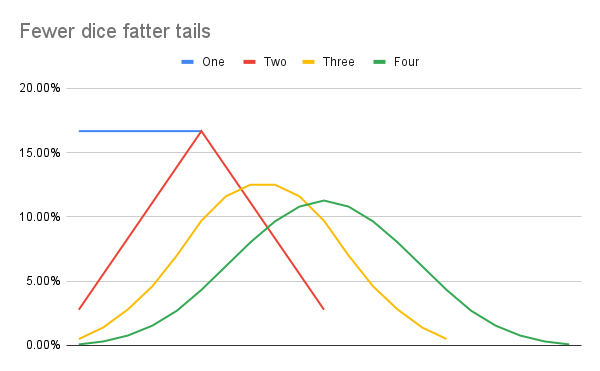
Here’s the distribution of results of one, two, three, and four dice rolls. For one, the results are equally likely. For two, as anyone who has played Catan knows, seven comes up the most.

one two three four dice distributions

Though it’s a basic Google chart, it is simple enough for Zeckhauser and satisfactory for Mauboussin. For a die, the chance of rolling the highest score is ~16%. In the case of two the chance is ~3%, for three it’s ~0.5% and for four it’s ~0.1%.

Different parts of life are more or less similar to different amounts of dice. Businesses with lots of intangible value are closer to the end of fewer dice, because those kinds of distributions have fatter tails. Business with more tangible capital are more like rolling many dice.

Now, dice distributions offer no mechanistic or explanatory approach about what kind of system a case may be. There’s nothing about “brand building” that makes it more like rolling two dice relative to something like pool construction. But the metaphoric fit is just fine.


Thanks to Michael Mauboussin for this post and all the others. He was one of the early podcast guests who was going around explaining things that seemed like really big ideas in a really basic way. He was so good at it I thought, hey, I should write some of this stuff down. Well, I’m still writing.