Reasoning from Extremes

“No one,” Zach Lowe told Bill Simmons, “is arguing for a longer season. No one wants more than 82 games.”

“I’ve never seen a study,” Dr. Longo told Rich Roll, “showing that if you do 12 hours of fasting a day you’re going to have a problem.”

Both of these November episodes fit within maxims for thinking analytically. Not all of life will include common ground, but when it does, we can start there and decide how much to move away from there.

Easy Diets

In November 2025, Rich Roll release a podcast about fasting. This compilation episode included an overview of why fasting works, how to fast, an additional details. But, what stood out was the importance of design.

Dr. Valter Longo spoke about the effectiveness of a 12/12 fast. That includes a twelve hour eating window and a twelve hour non-eating window.

Roll pushed back, asking is that enough non-eating time?

Yes, Longo explained, there are positive health effects but more importantly it’s easier to do.
Dr. Michael Greger said the same thing – only in reverse. Greger’s early advice was about a daily dozen set of foods people should eat. A dozen foods a day?

Inconceivable! Vizzini shouts.

That led to a lot of explaining by Greger. It’s aspirational. It’s a suggestion. It’s something to work towards.

Actions are based on frictions. How easy is something: to understand, to follow, to fit with my current worldview?

Better fits may not be perfect fits, but they’ll happen more.

Health is a verb

“I don’t know why we made health a noun. Think about it. When it’s a noun, it’s an object to be obtained.

It’s something tangible. It’s a destination. Health should be a verb.

How many of us have been in the best shape of our life? If we stopped doing what got us there, we would fall backwards. So we, it’s an action.

Health needs to be an action you do every single day of your life. If you are, if we keep setting it up, like I’m going on a diet, I’m gonna lose 30 pounds. What happens once you lose the 30 pounds?

What’s your next move? This is the ozempic. What’s your next move”

From The Rich Roll Podcast: Dr. Mindy Pelz On Women’s Hormonal Health, Cyclical Fasting, Health As A Verb, Reclaiming Your Body’s Intelligence & Transforming Menopause Into Empowerment, Jul 31, 2025

Don’t hire a noun to do a verb’s job.

JTBD at Whoop

Will Ahmed is the founder of Whoop, the fitness tracker. In July 2025, he told Rich Roll:

“So maybe there’s a focus group on a band and the focus group sort of leans one way versus another on which direction the band should go. And I feel an incredibly strong pull towards the other direction.

I might just do the other direction. That, though, is a very sort of trivial example, I think. What’s been more interesting for me in my life is these moments where I’ve felt a deep sense of knowing something, and a lot of people have disagreed with it.”

Ahmed was obsessed with the progress (this is Moesta’s JTBD language) a subgroup (elite athlete) wanted to make. It’s such a clear example of Jobs Theory – though Ahmed never explicitly says that.

Focus groups don’t work for many reasons: people don’t actually know what they want, people are obsessed with status, people only think in the existing solution space. JTBD (jobs to be done) theory gets around that by focusing on the progress individuals want.

Ahmed discover that HRV matters a lot for rest and recovery. That led him to discover HRV needs constant monitoring. That led to this breakthrough:

“You needed to be able to measure it (HRV) continuously. And that was another breakthrough in hindsight of the whole idea for WOOP, was this idea of continuous data. Continuous data is the reason that this doesn’t have a screen.

It’s the reason we invented a modular battery pack. It’s the reason that the bands have all sorts of different looks and feels and colors. It’s the reason we’re not a watch, because we don’t want to compete with other watches.”

Michael’s Monday Motivation

“You exist at home and everything is nice and comfortable, and stress has come in, but they’re in the form of emails and deadlines and things just get predictable. Go out into a place that is totally unfamiliar, do something that’s going to be challenging to you, go with the wind, you will find things that will really enhance your life, that will make you feel, as Joseph Campbell put it, the rapture of being alive”

The rapture of being alive.

From Huberman Lab: How to Grow From Doing Hard Things | Michael Easter, Jun 16, 2025

Outlive (book advice)

My thoughts of Outlive by Peter Attia revolve around two 80/20 ideas.

First, 80% of health outcomes derive from an absence. Don’t smoke. Don’t be overweight. Don’t under sleep. Don’t be sedentary. Avoid environmental contaminants. Avoid sunburns. Regardless of what someone does do, if they don’t do those things their health will mostly be fine.

Then 80% of the remaining 20% is about what people do do. My rough prioritization:

  1. Exercise, make it easy. Do enjoyable things. Do accessible things. Design it!
  2. Sleep better. Put the phone away through design choices.
  3. Continue the birthday cake diet along with tasty vegetarian foods.
  4. Poop in a box. It’s relatively costless and early prevention of colon cancer seems to matter.
  5. Avoid sunburns, especially in Florida!

To be accurate rather than precise the thinking looks like this:

0-80% of the effect is from avoiding the really bad things.

81-96% of the effect is from doing the basic good things: get stronger, eat better and less, sleep well.

97-99.9% of the effect is from optimization: finding spring water, taking metformin, and so on.

But, being a loss averse human being I don’t do any of the optimization. The chance it helps in a meaningful way is so small compared to the chance it mucks things up.

Food Metrics

Is this right? It is important.

A helpful question to regularly ask is: What do these numbers really mean? I used to love looking through the Sunday Best Buy ad and comparing computer hardware. RAM, hard drive, monitor size – all catnip to a teenage boy in the 90s.

But what did those numbers actually mean?

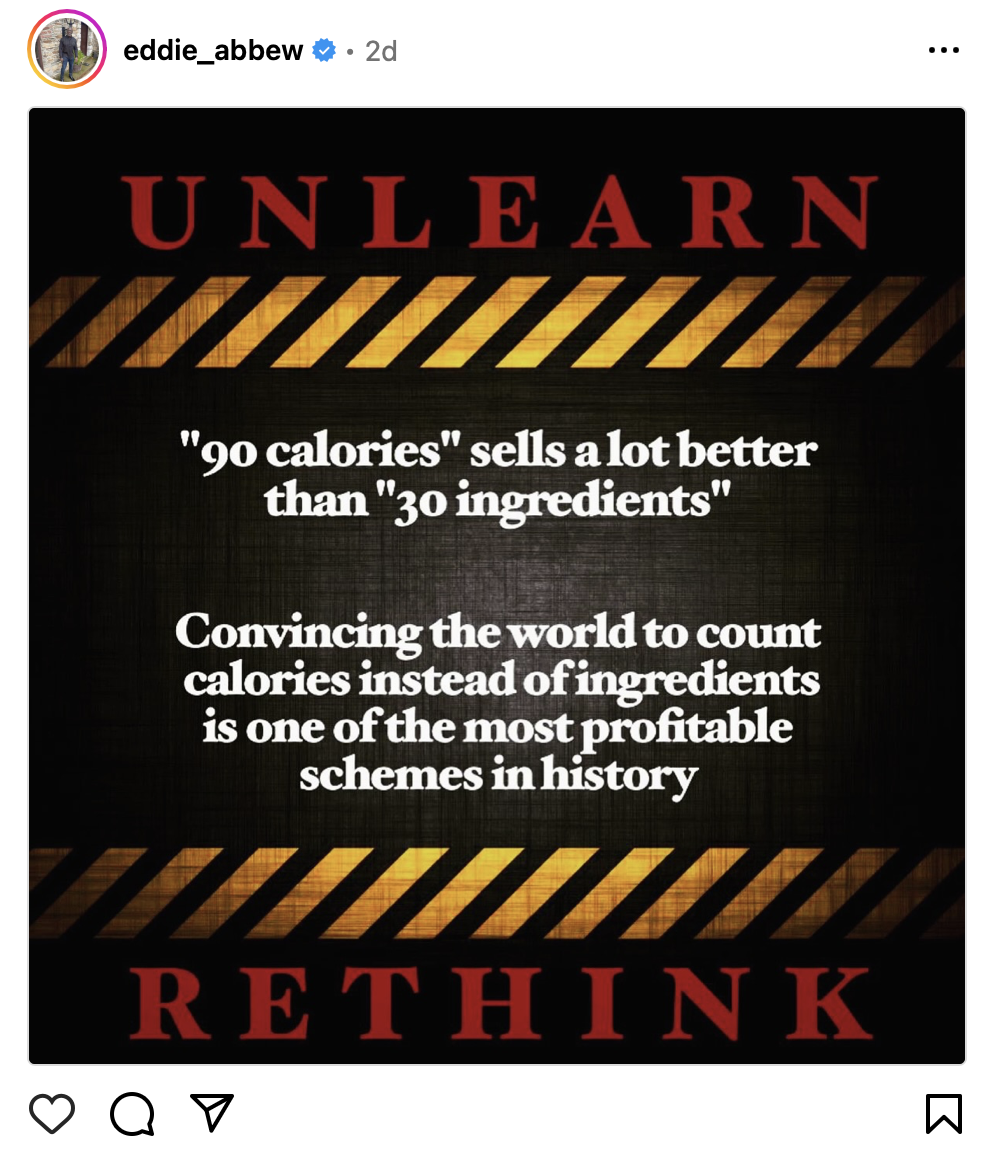
Jobs theory is about finding the meaning behind something. See “90 calories” and, click-whirr, must be healthy. That’s the meaning we associate. But is that the right connection?

Or is Eddie correct? Is number of ingredients a better signal?

Metrics, numbers, figures — whatever our attention catches is not accidental. Someone chose that, they framed the context around that scene. It’s up to us to ask, is this right?

Outlive (book review)

What’s the point of reading this book?

Peter Attia’s Outlive starts with the medicine: biology, physiology, chemistry and so on. There’s an excellent explanation on arterial plaque. I did not know that cardiovascular diseases were caused by the body trying to heal itself from within, dealing with LDL cholesterol as best it can. There’s also good explanations about our synapses and cancers.

But what’s the point?

Information does not change action.

Attia’s book is about the four modern horsemen of human mortality: cancer, heart disease, type two diabetes, and neurodegenerative diseases.

Like other areas of discovery, medicine follows the pattern: identification, react, ‘proact’. The Ghost Map tells the story of choleras identification in 1854. Covid-19’s cadence meanwhile was within a year: sequence, treatment, and bundled with the flu shot.

According to Attia, there is a lot more room to proactively address the four horsemen.

Channeling Michael Pollan, switching from hundreds of pages to a few words that address the action, the advice might be:

Get stronger. Eat your best foods. Sleep well.

The book is thick. Parts are dense. Even now, days later, I can’t explain parts.

But that’s okay.

The main point of the book is to be intentional. Like the vegetarian experiment and as good bayesians we should tinker. Attia is rarely absolute: Do this but not that! Instead it’s about you getting to this point of heart rate or insulin sensitivity or sleep.

One takeaway from Covid-19 was our heterogeneity (see: The End of Average). Outlive fits in this line of thinking. It’s your healthspan, it’s your lifespan, it’s your choice.

So get stronger, eat your best foods, and sleep well.

Don’t Bring an Educational Solution to a Design Fight

Dr. Henri J. Breault of Tecumseh, Ontario is a hero. Working as a pediatrician in a hospital, Brenault’s widow recalls him coming home from work one day and exclaiming I’m sick and tired pumping kids’ stomachs!

So he invented the childproof medicine cap.

At the time, Canada had about 100,000 cases and 100 deaths.

Breault came up with the palm-and-twist bottle. As an aside, how great is YouTube? This short video shows four different child-proof caps. I did not know how the pinch one worked! Breault’s creation is fourth.


Prior to Breault’s 1967 invention was a public education campaign.

We know that education affects behavior much less than systems affect behavior.

And our traditional punching bag is financial education.

“If someone says financial literacy at a party I basically give them a thirty-minute lecture. The idea is that in a perfect world if someone is taught about FICO and its impact on their life, they would take action to improve their FICO score. This is just not what researchers have found – and it’s really robust…the punchline is that environment matters.” – Kristen Berman, All the Hacks, October 2021

So, don’t bring an educational solution to a design fight.

Zone Two cardio

When not listening to podcasts, I can often hold a conversation while running, and conversing is a proxy for Zone 2 cardio. It’s a Goldilocks exercise. Is this a better way to run?

Between Instagram stories, Andrew Huberman emails, and runner scuttlebutt, Zone 2 is in the zeitgeist. Without getting into physiology, can we figure out if it’s a fad or worth our focus?

Metrics. We count what’s easy. Miles and minutes are easier to count than training zone sessions. Hurricanes are graded by their wind speed but it’s the water volume that does the damage. Speed is easier to measure and report. Daily users were standard but it was people who used the product that gave Pinterest engineers a better signal. Easy to count, collect, and combine metrics are overrated.

+1 for Zone 2.

Incentives. ‘Why am I seeing this?’ is a good question. Who is selling me something? Vegetarianism is underrated because the people who sell it don’t have that much to gain. Status points, sure, but if something’s not being sold it’s more believable.

+1 for Zone 2.

Barbell approach. Sometimes average measures are worse. Exercise may be like that. Every workout at 145 beats per minute is not as good as some workouts at 170 bpm and others at 125bpm, though the average is the same. Zone 2 is easier than the 145 average which goes against the ‘more is better’ mindset.

+1 for Zone 2.

Swept up. It’s easier to get swept up in something. Housing bubbles. Crypto. Or just the feeling of a local sports team playing deep into the playoffs. The internet feed makes it even easier. Instagram knows my age, interests, and engagements. Oh, a forty-year-old running dude, the magic math concludes, here’s a bunch of running videos promoting zone two cardio. Is this an echo chamber?

-1 for Zone 2.

Conclusion: I’ll do more Zone 2 training. Happy New Year.