Copywriting Lulz

“So it’s decided,” goes the commercial, “we’ll park even deeper into parking spaces so people think they’re open.” 

“Surprise.” Lolz.

Good copywriting, a subset of jobs theory, speaks in the customer’s language. And this commercial was not written from a rider’s perspective. It’s a driver’s perspective. 

Insurance is an interesting sale because people hesitate to consider premiums, claims, and losses. We’re ambiguity averse and that’s the whole enchilada with insurance. 

It wasn’t until the birth of the AFLAC duck in 1999, that insurance companies found humor as a path to awareness. Okay, customers thought, it’s not that serious, I can make a phone call

But it still had to be kinda serious.

During a rebrand, GEICO found customers saved about 23% and it only took about eight minutes on the phone. However, when they tested that messaging, customers thought it was too good to be true. Instead, “fifteen minutes to save fifteen percent” was born. 

Someone must answer the question: Why is this so cheap? That’s the customer language

Insurances sales (all sales!) start with a simple unintimidating prompt. It can’t be too juvenile, even the mayhem man wears a suit. Costs (higher or lower) must be part of a story: Bundle with us and we pass the overhead savings on to you. 
Don’t Bring an Educational Solution to a Design Fight

Dr. Henri J. Breault of Tecumseh, Ontario is a hero. Working as a pediatrician in a hospital, Brenault’s widow recalls him coming home from work one day and exclaiming I’m sick and tired pumping kids’ stomachs!

So he invented the childproof medicine cap.

At the time, Canada had about 100,000 cases and 100 deaths.

Breault came up with the palm-and-twist bottle. As an aside, how great is YouTube? This short video shows four different child-proof caps. I did not know how the pinch one worked! Breault’s creation is fourth.


Prior to Breault’s 1967 invention was a public education campaign.

We know that education affects behavior much less than systems affect behavior.

And our traditional punching bag is financial education.

“If someone says financial literacy at a party I basically give them a thirty-minute lecture. The idea is that in a perfect world if someone is taught about FICO and its impact on their life, they would take action to improve their FICO score. This is just not what researchers have found – and it’s really robust…the punchline is that environment matters.” – Kristen Berman, All the Hacks, October 2021

So, don’t bring an educational solution to a design fight.

Jurassic Park (book review)

Jurassic Park (1993) by Michael Crichton is a book about expectations. But first, we have to address the movie.

The movie was great. It was an amazing adaptation (and is connected to the Pixar story btw). But – it defines the characters. Hammond, Malcolm, Ellie, and Grant are the movie version in my version. Oh well.

Ok, back to expectations.

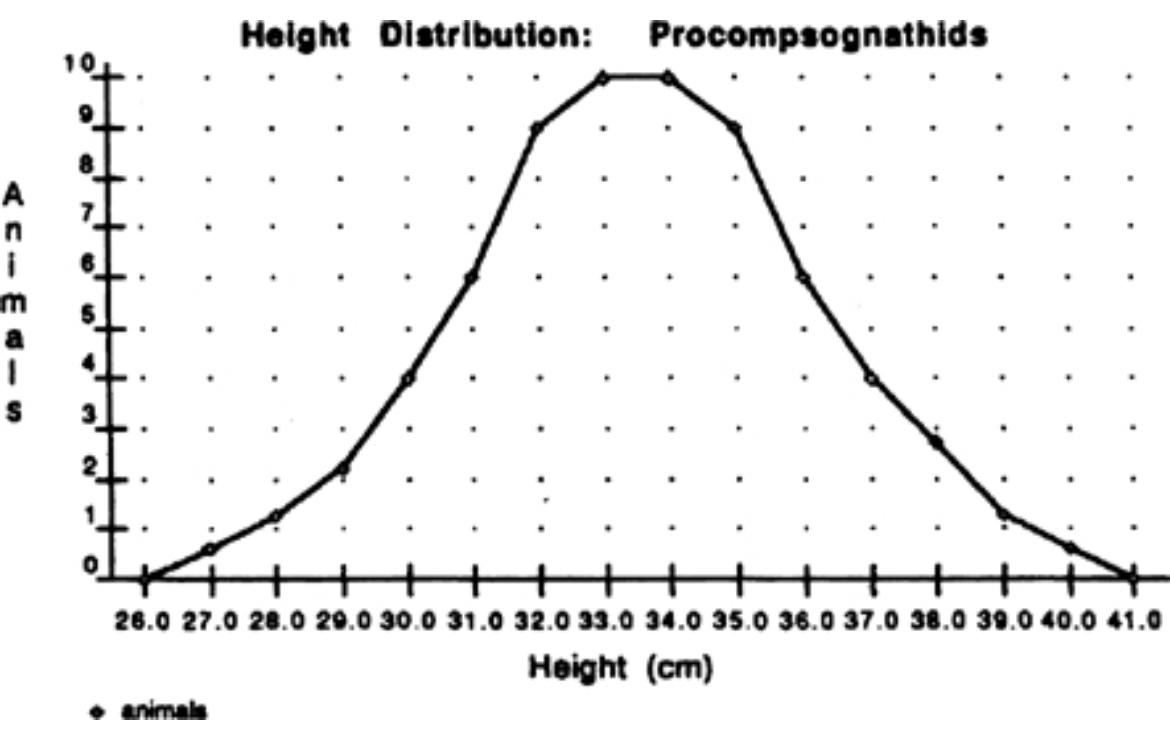
The Jurassic Park story turns when Malcolm tours the facilities and sees this:

See, Hammond says to Malcolm, everything here is normal!

But, Malcolm counters “that is a graph for a normal biological population. Which is precisely what Jurassic Park is not. Jurassic Park is not the real world.”

Normal distributions (and averages) are a specific tool. But they are the wrong tool for distinguishing between Snickers and Milky Way, student loan debt, or Aaron Rodgers touchdown passes. Or, tracking dinosaurs.

Jurassic Park is not the real world. It is a zoo. Cages. Fences. Pens. Controlled feeding. Controlled breeding (oops). Controlled everything.

Malcolm again, “Because the history of evolution is that life escapes all barriers. Life breaks free. Life expands to new territories. Painfully, perhaps even dangerously. But life finds a way.”

Life finds a way.

“Now you see the flaw in your procedures,” Malcolm said. “You only tracked the expected number of dinosaurs. You were worried about losing animals, and your procedures were designed to advise you instantly if you had less than the expected number. But that wasn’t the problem. The problem was, you had more than the expected number.”

Hammond expected to run a zoo.

Hammond expected a ‘normal number’

Hammond expected his problem to be ‘fewer’ not ‘more’.

Expectations are heavy, they are hard to throw off. I could only picture Jeff Goldblum as Dr. Ian Malcolm. Hammond could only picture Jurassic Park one way too.

This isn’t really a book about dinosaurs, they’re just a stand in. For what?

Also interesting that Waltrop’s Complexity came out around the same time. Something was bubbling in the early 90s. Something is bubbling now too.

Calendly’s CAC

Approximately seventy percent of Calendly’s new users come from using a Calendly link. That’s a crazy CAC.

But that’s not all.

Customer acquisition cost requires converting customers which requires building something that offers progress (the JTBD).

At first, Calendly’s users were broad. “What that means,” said Annie Pearl “is that product managers had a really hard time prioritizing.”

What the heck to build?

“We’ve made a clear distinction that while a lot of the feature work – that we’ll do to support our target personas of sales teams, customer success teams, and recruiting teams – will impact folks who are not in those personas. Those are the core ICPs that we’re going after. And so, historically, that would’ve always been a sort of trade-off decision and a question. And now I think we have a lot of rigor around our target market and the persona we’re going after. And so, teams can use that to prioritize and deliver better value for those users.”

A lot of people join, but the product may not be built for them.

Calendly’s actions represent Todd Rose’s three features from The End of Average.

We are jagged creatures. ‘Good’ executives are a collection of leadership, insight, and strategy skills. The average ‘good’ is a collection of jagged parts.

We are contextual creatures. We aren’t ‘jerks’, it’s just when we are driving. We aren’t ‘generous’, it’s just while tipping a server.

We are path dependent. The places we’ve been, affect the places we will go.

If a business serves “the average” they won’t find the jagged, contextual, or path-dependent parts that really matter. Calendly’s decision to build for sales teams, customer success teams, and recruiting teams show how their process embraces Rose’s observations.

Ben & Jerry’s: The Inside Scoop (book review)

Ben & Jerry’s: The Inside Scoop is an underrated business book. Traveling through the 1980s and 90’s it chronicles the growing pains of America’s favorite ice cream pints. 

It’s a business book with two parts. 

The fun stuff

Two hippies create, grow, and scale a super premium ice cream brand from a converted gas station in Vermont! That’s fun. 

On Black Monday 1987 the duo showed up on Wall Street with “That’s Life, vanilla ice cream with pieces of stale apple pie (the stale pieces held up better in the ice cream), and Economic Crunch, which was actually some leftover Nutcracker Suite from the previous winter, renamed for the occasion.”

Ben and Jerry drove around in a Cowmobile promoting the brand. On their one-year anniversary, they hosted a block party, with Ben and Jerry organizing, acting as characters, and offering free ice cream of course.  

The grind

“Amateurs talk about strategy,” said Omar Bradley, professionals talk about logistics.” 

Ben & Jerry’s wasn’t the only super-premium ice cream. Häagen Daz was the market leader and a bunch of me-toos. Starting in Vermont, a state with no Baskin Robbins franchise was probably a blessing. 

But the distribution was still a grind, sometimes literally as their beat-up delivery truck broke down delivering the pints. Once they contracted out to distributors it was a game of sharp elbows for shelf space, full of kickbacks, relationships, and lawsuits. 

Even the Beatles had a logistics machine! 

Oh, and the people. 

Every business is built on the foundation of its people. In a podcast with Brent Beshore, Anu Hariharan said she looks to invest in good teams with product-market fit. This is despite her technical and financial backgrounds. To paraphrase: It’s the people, stupid. 

But that’s also the hardest part of a business. 

While Ben & Jerry’s product line, market share, and revenue grew, the team’s expertise did not. They hired slowly. Not because of a great vetting process but because they were overwhelmed. They fired slowly too, a terrible combination. 

Oh, and the finances!

We won’t recount the story here, but in Shoe Dog, Phil Knight writes about taking all of his profits back to the bank to say, see, these things sell, now please give me another, larger loan.  That happened in Vermont too. Inventory. People. Facilities. Raw materials. New facilities. At least they could drown their sorrows in a fresh pint. 

Be your own boss with your best friend(s), but work like hell.

Sounds right.