Open 24 Hours

What do you want? is the wrong question.

Customers speak in the language of problems.
Businesses speak in the language of solutions.

When Netflix asked customers what they wanted, the customers said more new releases. So Netflix bought more. Then they looked at the data.

Engineers compared churn rates for customers who got new movies quickly with those who didn’t and the results were indistinguishable.

What customers wanted were faster movies. If customers got a movie within a few days of returning the previous they were less likely to churn out than customers who had to wait longer. Bingo. Netflix’s solution wasn’t more new releases, it was shorter shipping times.

Good for Netflix – but what about us? What about businesses that don’t have data engineers?

“From 1984 to about 1987, I proselytized about the wisdom of staying open for 24 hours,” Paul Orfalea writes in Copy This. Orfalea was a unique manager.

Rather than spending time at the office, Orfalea was on the road talking to Kinko’s partners, customers, and anyone who found something that worked.

“I’d met a convenience store owner who found his overall sales jumped 50 percent when he decided to stay open for 24 hours. At first, the increase seemed like a mystery. His foot traffic wasn’t great during the overnight hours. But his customers liked knowing they could patronize his stores any time day or night. They never had to worry when he was open or closed.”

Bingo.

Kinko’s business wasn’t selling copies – it was managing emotions. Customers needed help. Kinko’s helped them get jobs, celebrate moments, or create the brochure that needed done yesterday. Being open 24 hours helped.

Will and Mike’s 2023 Advice

One of the biggest ideas from 8 full years of writing this blog is Michael Mauboussin’s success equation.

Outcomes are a mix of skill and luck. Persistence is a measure of skill: coaches making the playoffs, sales staff hitting targets, or personalities in the news. Skills are things which can – and should – be controlled.

But sometimes life is luck too.

He’d (my dad) seen enough of the big time, so to speak, and we went to lunch one day, and I said to him, “I think I’m going to try this comedy thing. I think I’m going to give it a shot. Do you have any advice for me?” And his big gut talk to me was, “You know what? I think you have the skill, but it takes a lot of luck. If you don’t make it, don’t worry about it. You can just try something else.” Like, don’t worry if you fail, because it’s a crapshoot anyway. And so, from that point, I was like, Oh, I’m just playing the lottery here so I might as well just go have fun.

Will Ferrell, Sicker in the Head

That’s our advice for the year ahead: Work hard on skills and have fun with luck.

2022 Books

These are the books I finished. Each is an Amazon Affiliate link.

Reading is slightly underrated. Get the most out of reading by starting more books, quitting more books, and diving into themes.

Personal maintenance. Familiar subjects and books to “remind me”.

Atomic Habits I was late to this because it’s not too new. The book is built around adjusting the friction in our lives. Clear does a great job explaining these things and the book is a reminder to redesign gunky systems.

Never Split the Difference, a reread. Voss’s best-seller is heavy on his own stories and I skip these parts for the tactics like: two copies? or help me understand or that’s right or how am I supposed to do that? Be empathetic and talk to people in their world with their words.

Courage is Calling. Holiday adds stories to his stoic virtues series. I need reminders like the one above my desk: don’t be overheard complaining about life at court, not even to yourself.

Fiction used to feel unproductive because there wasn’t a story to write or a way to hack novel solutions into our daily optimization. I’m dumb. Fiction is fun. And if you need – like I still sometimes do – a rationalization, remember that these are stories written about people by people for people. The payoff is humanity.

All the Light we Cannot See. Good and I can’t wait for the Netflix series. The fictional account of fleeing families during WW2, personal growth and love, attention, and riddles and mazes.

The Nightingale. Like All the Light… and last year’s Alice Network this book follows a pair of women (sisters) during WW2. Why read historical fiction about women during WW2? I’ve no idea. This book, man this book had it all, even a few good sniffles at the end.

Fellowship of the Ring. At the Council of Elrond, the members are amazed at the dangers Aragorn has faced. “There is little need to tell of them”, said Aragon, “if a man must needs walk in sight of the Black Gate, or tread the deadly flowers of Morgul Vale, then perils he will have.” I think about this a lot.

Better off Dead (Jack Reacher). Each year Lee Child writes a new book, mostly the same structure, always focusing on Jack Reacher. Each year I read it.

Prey. A Patrick O’Shaughnessy recommendation. Written in 2002(!!!!!) the book holds up. This was the only aged passage: “I had a ten o’clock meeting with my headhunter, Annie Gerard. We met in the sunny courtyard of a coffee shop on Baker. We always met outside, so Annie could smoke. She had her laptop out and her wireless modem plugged in. A cigarette dangled from her lip, and she squinted in the smoke. “Got anything?” I said, sitting down opposite her.” I’ll only add that thermite makes a great white elephant gift.

JTBD books. JTBD is a problem-solving approach we’ve covered a lot.

Demand Side Sales. A collection of stories from Bob Moesta’s experiences. But my favorite story is from the introduction by Jason Fried:

I noticed that when people browsed shoes on a wall, they’d pick a few up and bounce them around in their hand to get a sense of the heft and feel. Shoes go on your feet, but people picked the shoe with their hands. If it didn’t feel good in the hand, it never made it to their foot.

Jason Fried

Start With No. Recommended by Chris Voss. It’s a little JTBD and a little Never Split… though Camp’s stories are as good as Voss’s or Moesta’s. A good book to ’round out’ these ideas but not essential.

The Sandler Rules. Recommended by Bob Moesta. Another ’round out’ book. Full review here.

Other

The Accounting Game. This a short fun read for an introduction to accounting. Though I still don’t ‘get it’. What I want is a holistic approach. How did Buffett understand float? How do I understand high fixed costs relative to accounts receivable? Accounting is a bathtub problem. Right?

Virus of the Mind. Richard Dawkins coined meme but this book (by one of the designers of Microsoft Word) goes into it. Through evolution, we developed preferences for messages built around danger, food, and sex. Certain types of those messages (stories, images, etc) spread better than others.

Status Games. There’s a set of books like Miller’s Spent and Hanson’s Elephant… that address the idea of status, mimicry, and imitation. Status Games was the best personal fit because of its evolutionary focus. Miller’s is more commercial (it was also good) and Hanson’s never clicked for me.

Parenting Teens with Love and Logic. My daughters’ school suggested this one. The warning for books like this is that most of parenting is making sure kids are physically, mentally, and emotionally safe from the big stuff. The rest is just tweaks. What I liked about this book was the contrast between parents being ‘helicopters’ or ‘consultants’.

Nomadland. Stories of people living as nomads. Usually, people didn’t intend to end up as nomads but if they did it was because they lost their health, house, job, or spouse. Instagram #vanlife isn’t real, and these stories are tough lives – but there’s something to this. Why do people live in one place? What are the limits? If jobs, insurances, paychecks, fulfillment, and family photos are in the cloud does that change how we live?
Handshake puzzles and Birthday bets

Warning: use these tools wisely, they can keep nieces and nephews busy for hours

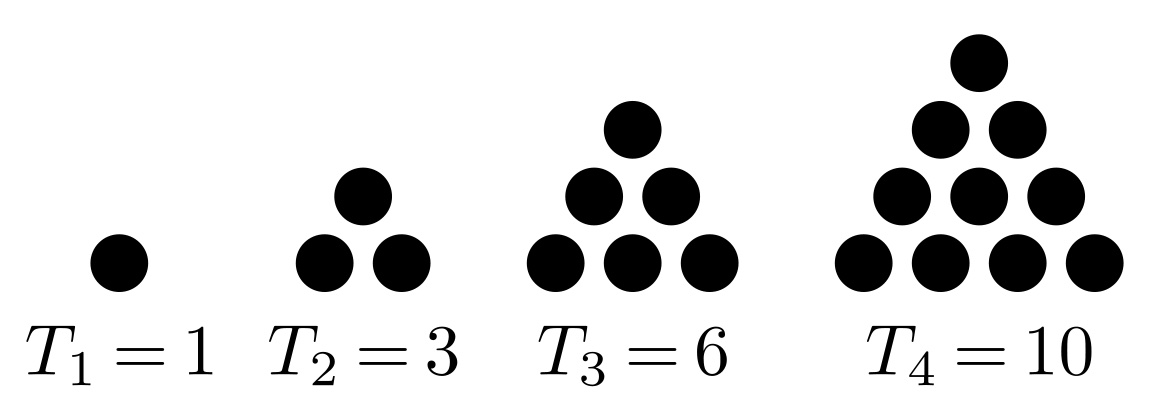
What is the sum of all the numbers from 10 to 1? That’s difficult.

One repeated theme – because it works! – is reframing. The same information but a new presentation changes our understanding.

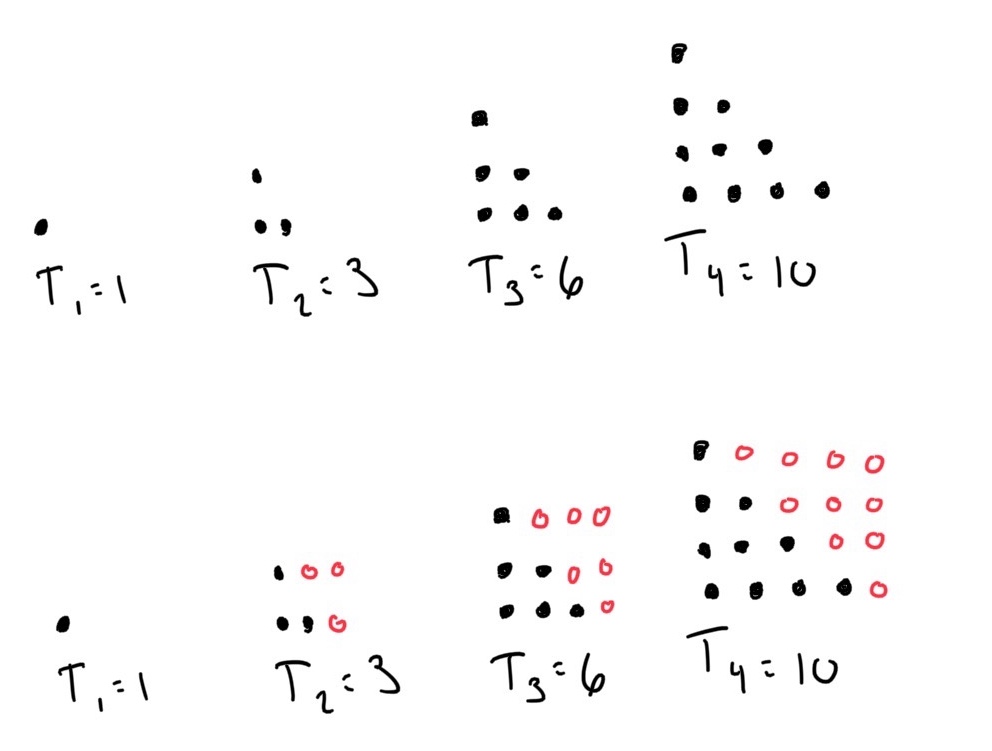
What is the sum of these numbers: 10, 9, 1, 8, 2, 7, 3, 6, 4, 5? That’s easier. Reframe again, this time visually.

Each what is the sum question can be framed as a triangle. But reframe again, first to staircases, then as pairs.

Doesn’t this feel like magic? The universe presents this little nugget (What is the sum of all the numbers from 10 to 1?) and rather than slog through we skip over. Reframing numbers into shapes changes our tool from addition to multiplication. Magical. We went from brute force to clever pairing to formulaic: (n*(n+1))/2.

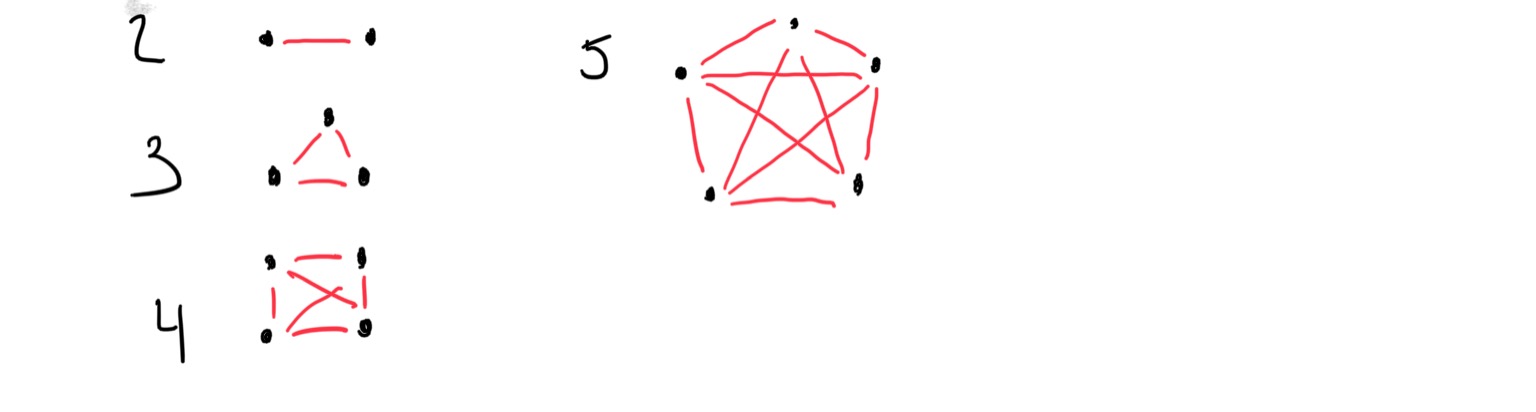
Another question: In a group, how many handshakes must occur for everyone to shake everyone else’s hand?

Two people have one handshake. Five have ten connections.

Like triangle numbers, it’s almost the same math! Rather than counting the dots, we want the connections. Rather than (n*(n+1))/2, the formula is (n*(n-1))/2.

It’s not only handshakes to count but games in a round robin, cables to connect computers, and shared birthdays.

In a group of 31 people, what are the chances any two people share a birthday? Thirty-one is a good number because it frames our thinking. “That’s like one month, so one-in-twelve”.

Ha!

The chances are closer to three-in-four thanks to our connections.

There’s a 99.7% (364/365) chance two people have different birthdays, (.997)1 (connection). The chance of five people having different birthdays, (.997)10, is 97%. Even the chance ten people have different birthdays, (.997)45, is 87%.

But keep going. Thirty-one people have 465 connections and a 25% chance of differing birthdays.


Every day on Twitter, the joke goes, someone is the main character – and you don’t want it to be you. Something is always happening because of this birthday/games/handshake structure. It’s easier not to get wrapped up in “this headline” knowing there will always be headlines.

Wanting, is this mimetic?

This is not a book review of Wanting: The Power of Mimetic Desire in Everyday Life. It is only a slice. Wanting should be subtitled ‘networks effects’. The book is based on network structure and connections but I can’t recall ‘network’ being used at all.

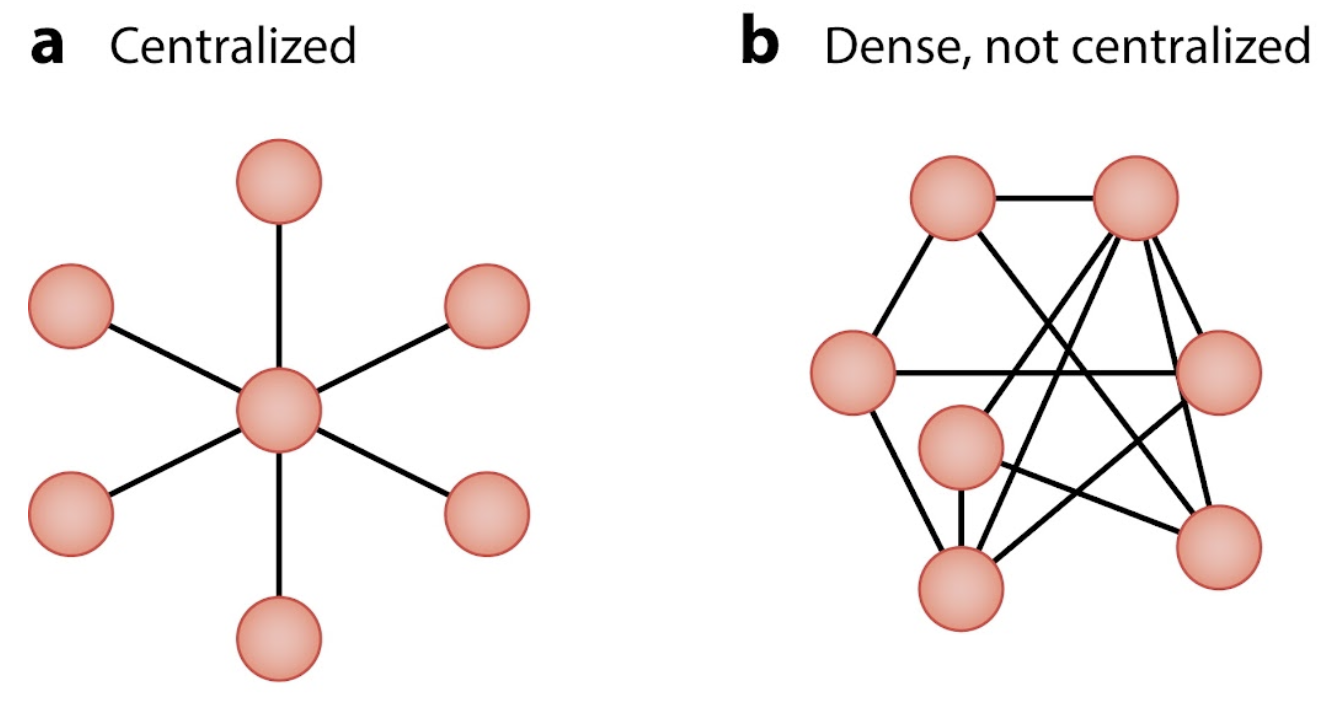
In mimesis, a centralized network is ‘Celebristan’. Our relationships with one-namers like Lebron or Cher is a centralized model. In mimesis, a dense, not centralized network is ‘Freshmanistan’, these are our relationships with roommates, neighbors, and colleagues.

2 networks

A network’s structure dictates information flow. Information is anything: ideas, vaccines, and so on. Lebron’s favorite salad dressing transfers widely, but only to us. He does not care about our top topping.

But, one-namers have dense networks with each other. Unacceptable: Privilege, Deceit & the Making of the College Admissions Scandal is an example of Burgis’s point. One-namers took the same trips, owned the same properties, bought the same toys. Though they were celebrity to us, their network was ‘Freshmanistan’.

The information in mimesis is status, rivalry, and desire.

Well, our best versions say, I don’t care about all that. This, mimesis OG Rene Girard said, is the romantic lie. Rivalry exists because we don’t really know what we want. “In the universe of desire,” Burgis writes, “there is no clear hierarchy.” It’s not that you want Ray-Ban sunglasses, it’s that someone else does.

This is my sticking point. I’m on board with the network structure and information flows. I’m okay with wants being fungible. But the conclusion feels wrong. Maybe.

There’s this dumb thing that happens to my wife and me. One of us suggests dinner, vacation, or weekend spot. The other mehs it. Time passes. A friend suggests that place to one of us. They go to the other and suggest it. ‘What the heck, I said that last month!’

Something is happening. Is it mimesis? I don’t know.

Status is an evolutionary advantage. Group membership helps us survive, and status games help the group because they are non-violent competitions. Draymond Green probably attacked teammate Jordan Poole because their status games were off. But the episode proves the point. Had Green’s punch landed, both individuals and the group would be hurt. Signs of status like cars, homes, jewelry, people, experiences prevent this conflict.

Is this mimesis? I don’t know.

Rather than rule on the mimetic ideas, we can triangulate them. In the spirit of looks like a duck, walks like a duck, talks like a duck. How does mimetic theory fit with…

Network theory? Great! Network theory is the underlying structure. All networks have information like covid viruses, neighborhood gossip, bumping electrons. Mimesis fits with our social networks.

JTBD? Surprisingly okay. In jobs theory people begin to ‘hire’ for solutions with “passive looking”. Maybe that stage is our social influences. If we are imitative then seeing one person with something might influence us.

Status games? Not bad. Mimetic rivalry creates the status hierarchy within a group.

Incentives? Less good. In the aggregate a bunch of people work to make as much money as possible. But does any one of them do that because they have a mimetic rivalry with any other? “The romantic lie” is great branding but incentives feel more right than mimesis.

The book confused me. It seems kinda right but not really right. But here we are, thinking about it, which may be mimetic itself.

A few network examples that didn’t make the post: The Zappos Holacracy was CEO Tony Hsieh’s attempt to recreate college, increase random interactions, and optimize “a return on collisions”.

The Theodore Roosevelt Covid outbreak as another example of network structure and information flows.

Intentional living – winning or otherwise

Good advice is tricky. The This Time is Different series is built around asking: Are these the correct lessons?

Part of the uncertainty is the truth and fit between the big idea and the story. In Start with No, the big idea is our ego, the story is sales, and the fit is: good salespeople have the right ego. Do people have egos? Are people in sales? Does the right ego for sales still matter? Yes – so the book is good advice. 

In Wanting: The Power of Mimetic Desire in Everyday Life, the big idea is network structure, the story is about mimetics the fit is: we are mimetic due to our network structure. That checks out too (though doubt the effect size). 

Winning by Tim Grover follows this pattern. The big idea is intentionality told through the story of winning a competition. Winning like Jordan or Kobe requires intentional actions. That checks out too. In Early Retirement Extreme, the big idea is intentionality but the story is financial philosophy. The same big idea but a different story. 

Grover focuses on intentionality in two ways: wants leading to actions and outsider status.

For Grover, wanting to win has to lead to acting to win. “If you don’t get on the same level,” Michael Jordan told one teammate, “It’s going to be hell for you.” Jordan was one of the first players to switch from carb-heavy meals to eating steak before games. Before Jordan, few players trained during and before the season. For Kobe, the actions were learning Slovenian to trash talk Luca Donic. In 2008, preparing for the Olympic Games, Kobe was going to the gym when the rest of the team came back from a party at five in the morning. 

Intentional living requires wants which require actions.

Grover’s second point is how it feels to be an outsider. Howard Marks popularized the idea that outperformance means being different and being right. Easy to say, hard to do. 

Investors, like Marks, can be different and right with good stakeholders. If limited partners don’t ‘get it’ the business plan can’t work. So investors look for LPs who will ‘stick with it’. It’s easier to be an outsider when surrounded by a collection of insiders. 

Grover’s clients are in the entertainment business and the ‘get it’ is social. Why succeed unconventionally when you can fail conventionally? 

To succeed as an outsider someone must have a plan and stick with it rather than stick your finger in the wind. “No,” Grover writes, “is a complete sentence.” Build up the don’t give a fuck muscle too. Some think it’s weird? Who cares! Successful outsiders will design easier paths. Kobe Bryant had the most ingenious form and LARPed as the Black Mamba. Winning wasn’t a great book. I hoped for more insider stories. But the big idea was a good reminder. 

Survivor Games

December 13 is the Survivor finale and a chance to highlight the different ideas of the blog.

Sampling. These people are not “representative samples“. Survivor hosts a casting call for people with good stories. Like Bob Iger’s big lesson, entertainment isn’t about reporting so much as stories.

Incentives. Like the many games of Jeopardy, Survivor has layers of games. When there are layers of games it’s difficult to judge actions. Is someone trying to win the game or claim later fame?

Business models. Thanks to MTV in 1981 and then Real World in 1992, one entertainment business model is to create value by editing rather than crafting (unlike Seinfeld). Put regular people with backstories (hence sampling) in interesting situations and things will happen. Edit a month of island living to a few dozen hours and viola.

Customer acquisition costs. Sequels – it’s season 43 for Survivor! – have lower CACs. Consumers don’t need to be educated.

Easy money

Q: How do you get people to pay more?

A: Don’t make them pay.

People and rivers both follow the path of least resistance. What is easy? That’s what people do.

But not junk food, binge-watching, and immediate gratification easy. It’s easy subject to our last choice. Switching jobs isn’t easy, but it is easy to show up at one. Ease has two challenges: the initial change and each small choice.

Jobs To Be Done addresses the first challenge. People change when the discomfort of the present and appeal of the new is greater than the anxieties of switching and habits of the present. JTBD interviews is the focus on the moment things flip. Free hotel breakfasts and donation alchemy are examples.

But I think it’s very interesting when you just think about what can be expensed on a corporate card and how that differs in terms of the pricing power that a business might have. And to me, if you can find a customer that’s going to be able to use their corporate card and you can give them a reason to use their corporate card, they are going to be much less likely to churn, willing to pay for more expenses because it’s always easier to use other people’s money than it is to use your money.

I think much of Manhattan between restaurants and sports teams is propped up on the corporate card dynamic there and a little different demand curve in terms of how that looks from a pricing perspective. So that is certainly the case here and what you have going on, and they’ve used it to their advantage historically.

Matt Reustle, Business Breakdowns

An HBR article’s contents aren’t clear, Matt remarked, there are no stars or reviews. It’s just the title and date. That’s the fear of the new – is this going to be good? But it’s Harvard, and the person buying isn’t the person paying. That’s great! That’s easy!

The challenge of ongoing action, is solved by design, crafting the path of least resistance. Want more vaccines? Schedule their application at each checkup. Want to eat less? Make it hard, or easy!, to count calories Want people to buy your Peloton? Don’t make them pay – let their future selves.

Organizations have many levers to pull to create behavioral change. Which ones are best depends on the context. For Harvard Business Review it’s branding and differentiating between the consumer and the customer.

Your product is the feta on the salad

This is from the Daily Entrepreneur, sign up here.

Operators live in their business. It’s nights, weekends, holidays, birthday parties, and vacations. 

Customers don’t care. 

To a customer, a business is just mustard on a sandwich. Nice, but not their life. To a customer, life is nights, weekends, holidays, birthday parties, and vacations. 

Hamdi Ulukaya immigrated to the United States when he was twenty-two years old. He signed up for an English class – Hamdi spoke Kurdish and Turkish – and was assigned a ‘how to’ paper. Hamdi grew up shepherding sheep in the Turkish hills, so he wrote his paper about making cheese. 

His teacher loved it. Not for Hamdi’s encouraging English, but for the content. She owned a farm upstate and needed help making cheese. Hamdi agreed to help. 

It paid enough to get by and continue his studies. Hamdi’s cheese was good, it was “old world”. Americanized cheeses, like feta, didn’t taste like the cheeses of his youth. After working on the farm, Hamdi opened a cheese factory with his brother. 

People liked their cheese, it was good, but the restauranters didn’t care. Pricey but good feta from a regional supplier wasn’t what operators wanted. It was just a salad component. Restaurant operators ordered from the major manufacturers because the price was low and the quality was consistent. That’s all they needed. 

Hamdi worked nights, weekends, holidays, and birthday parties, and didn’t take vacations. Hamdi lived cheese. He was a shepherd, a farmer, and a manufacturer. There was no one in the world better equipped to run a feta cheese business. 

But it was just ‘mustard’ to his customers. To Hamdi, it was his life. With a lot of hard work, he grew the business to be a regional success. 

In 2005 Hamdi got a letter about an adjacent business for sale. It was in Ithaca New York and the last owner couldn’t make it work. Let me take a look, Hamdi thought and he called a friend to tag along. Are you crazy, his friend marveled when they arrived, this factory was owned by Kraft and they couldn’t make it work! What makes you think you can? 

Hamdi thought he could, this time with yogurt. Like with feta, he made a great product. Unlike feta, people cared. His first distribution deal was with ShopRite. After two weeks, his contact said, “I don’t know what you put in this yogurt and I don’t want to know – but I cannot keep it on the shelf.” This new, thicker yogurt was a hit. Within five years Hamdi’s yogurt company, Chobani, passed one billion dollars in sales and was the leading American yogurt company. 

Businesses service customers and fit in their lives. No one cares as much about your business as you do. Customers want to live their lives with their mustard, cheese, or their Chobani yogurt. Entrepreneurs live the mustard, cheese, and Chobani yogurt.

Russian Markets

Competition’s effect is the “market mechanism”. This example is from 1996 Russia.

Bill Browder is looking at stock in a Russian oil and gas company. The country’s companies have just become public, and though MNPZ has slightly smaller reserves than British Petroleum, it’s trading for 100x less. Why?

I was convinced that there must be some other explanation for the deep discount and spent the next several days searching for it.

Did the preferred shares have different par values? No. Was the ownership restricted to workers? No. Could the higher dividends be arbitrarily changed or canceled by the company? No. Did they represent only some minuscule part of the share capital? No. There was no explanation. The only reason I could fathom for why they were so cheap was that no one had showed up to ask about them-until I had.

Amazingly, I found that this anomaly wasn’t restricted to MNPZ.

Nearly every company in Russia had preferred shares and most of them traded at a huge discount to the ordinary shares. These things were a potential gold mine.

If there’s a name, there’s a market mechanism. If the invisible is now visible, there’s a market mechanism. If something is weird, new, unknown, secret, there may not be.

Pricing power evaporates with the heat of the market mechanism. Sometimes though, in the far reaches, someone can, find a gold mine.