The JTBD of WINE

A group of investment bankers sat down. It was going to be a good night for Danny Meyer. That was good, it was three-months into his first restaurant.

The man at the head of the table asked for a chardonnay. Meyer delighted. He’d just got in a premier cru Rousseau. It was $45 a bottle. In 2015, Meyer joked, that might buy you half a glass.

Meyer walked out and proudly presented the wine.

“That’s not a chardonnay,” the big banker said.

“What I needed to have done at that very moment, which I trust I’ve done since. When he said, ‘This is not a chardonnay’, I should have said, ‘It sounds like you want a California chardonnay.'”

Danny Meyer, YouTube 2015

Instead, Meyer argued that it was. It went back and forth and the banker brought in the table, each member of which nodded in agreement that it was indeed not a chardonnay.

It was probably less than a minute. Meyer retreated and returned with a cheaper wine from California and that’s the story behind his most important lesson, the irrelevancy of being right.

Wine is odd. People buy wine for all kinds of reasons. The Barefoot founders figured out one way. But there always is a reason. That’s the lesson Danny learned. It’s their reason.

Part of the wine boom from 1980 onward was because wine was presented as doing one job: conveyed in an inaccessible language. Robert Modavi first communicated differently. The Barefoot founders did too. They found out there were other ‘jobs’ of wine.

When I delivered newspapers as a kid I loved the Best Buy ads where I could compare MB and GB and RAM on every new Dell, Compaq, and Gateway computer. But what really mattered was the job: will this play Warcraft II?

Apple figured this out.

Meyer figured this out.

This trips up operators all the time because it’s economic to use shorthand. But shorthand cuts out the magic, the feeling, the job—which is the soul of what a customer hires a product. Don’t be right, do your job.
The ‘Job’ of what is said

“I thought hard about what other people are trying to accomplish and I tried to shape my language in a way they could hear it. That’s half of what I talk to founders about. It’s just that, how to build the API to the other person’s brain. It doesn’t matter what you say. It matters what they hear, and it matters how they feel.”

Sam Hinkie, ILTB

That expression has a real JTBD-ness to it. It’s not the how something is done but the what, and if it’s the right what.


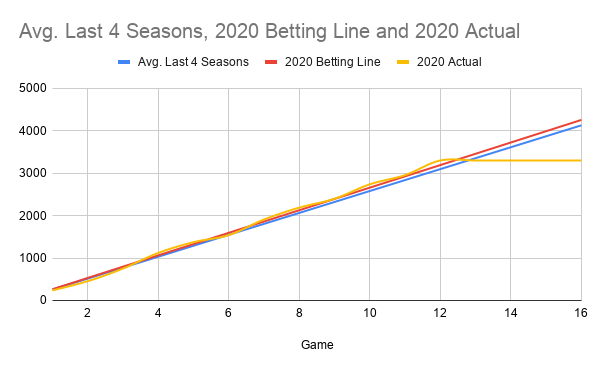
Tracking Tom. After a monster of a game, Tom Brady is 162 yards ahead of pace, his largest difference of the year. If Brady plays the rest of the games he’ll likely hit the over and our speculation will be wrong but our reasoning continues to hold, though maybe less than we should have suspected. One question comes to mind:

Did we think about base rates wrong? The key to base rates is to choose the right reference class. Brady seems fanatical about his health, and maybe we should have taken a page from Morey and made a cross-class comparison to Lebron James.

There’s still more ‘zero’ outcomes than not. Tampa could clinch a playoff spot, or be eliminated. Brady could be injured or rest before the playoffs.

We speculated at the start of the season there were a lot more zero to 200-yard games (injury, rest, offense, etc.) than 400+-yard games. That’s held in the data, Brady’s median yards per game is 11 yards less than his average. It feels incredibly odds, but we’ll be wrong for the right reasons.

Leave the selfie stick/mindset at home

“Well, my advice to everyone that goes to a national park is to leave your selfie stick behind and leave your desire to get that perfect selfie behind and just soak in the beauty of the park itself because that will stay with you a lot longer than this selfie kind of mode will.”

Tim Cook, Outside podcast

One theme of the podcast between Cook and Michael Roberts is the classic, am I using technology or is technology using me? Sometimes that manifests in taking selfies rather than enjoying spaces.

But it’s Cook’s framing that’s my favorite idea. Don’t want to take selfies, design the choice to be easy, and leave the selfie stick at home.

But, what if we apply this to the selfie mindset. Take the stick but leave the mindset?

The way we think about problems greatly affects the way we solve problems. One way to approach situations then is to ‘bring along’ a new mindset. For instance, someone can consider how to argue well or to learn something with Fermi Knowledge. Bringing that desire to a new project, situation, or group will affect how we act.

It’s easy to think of bringing along of tangible things but we can bring along ideas too, and framing them that way might make them easier to pack.

Fermi Knowledge

There’s the Fermi Paradox, which wonders where the aliens are. There’s also the Fermi Problem, which considers piano tuners in Chicago. These two are related to each other and also to what we will call Fermi Knowledge.

This story is from The Last Man Who Knew Everything and is told by a family friend who lent a teenage Enrico Fermi a book.

For instance, I remember that when he returned the calculus book by [Ulisse] Dini I told him that he could keep it for another year or so in case he needed to refer to it again. I received this surprising reply: “Thank you, but that won’t be necessary because I’m certain to remember it. As a matter of fact, after a few years I’ll see the concepts in it even more clearly than now, and if I need a formula I’ll know how to derive it easily enough.”

That’s a deep understanding to aspire to. Reading about Fermi, or Feynman, it makes me wonder how much of insight is due to seeing the world through first principles and then verifying a new idea works.

Mister…Horse Racing

From, An Economist Walks into a Brothel.

“The incentives are different depending on if you plan to sell or race a horse. If breeders raced their own horses instead of selling them, they might pair two different mares and stallions to breed. Selling well takes having the right pedigree and characteristics of a sprinter, both of which encourage in-breeding, but maximizing the odds of producing a good horse is more complicated. Ideally, breeders would match the male and female characteristics, balancing out weaknesses.”

Allison Schrager

What’s remarkable about Schrager’s description is the homogeneity of breeding. If outperforming in investing is about being different and being right there’s not a lot of being different at the track.

And this kind of makes sense. There’s better ways to “WIN BIG” than racing horses, where the returns probably aren’t financial but social.

To sell well, a horse shouldn’t just be (lineage) fast but it should look fast too. Like Munger’s fisherman, sales is a question of incentives, metrics, and framing.

Tracking Tom Update.

Tom Brady passed for a paltry 196 yards this weekend and is now only ahead of pace by 36 yards. However, the combined record of the remaining teams on the scheduled is 13-24 (Lions and Falcons).

Bad teams plus a rigid playoff picture means that our framework seems to be holding: more unknowns will inhibit rather than enhance Tom Brady’s passing yards for the season.

Homeotelic Responses

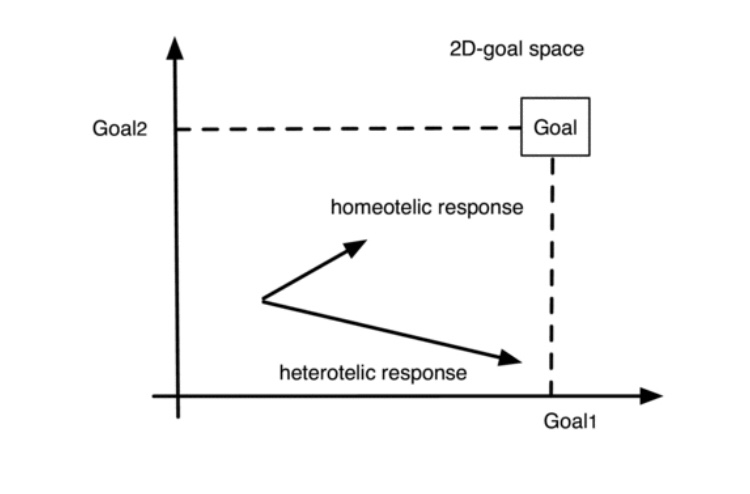
One of the themes to Early Retirement Extreme is the homeotelic process (two birds, one stone). Consider health and wealth, waste and waist, and live intentionally. FIRE really just has a branding problem.

Via Early Retirement Extreme.

With kids doing distance learning we are living this out as I take Khan Academy classes to stay a step or two ahead which also satisfies my curiosity and ties into a suggestion from Naval. One theme of the Navalmanack curation is to focus on foundational ideas: more math less macro.

Put another way: there’s a limit to what we can know in large enough systems with many moving parts.

One obstacle to the foundations is stories. Stories link cause and effect regardless of an and. For good, or not.

In The Night Circus, Celia (real magic) is farmed out by her father as a spiritual medium (non-real magic, but still Alchemy?). She tells clients stories of the great beyond. She sees no point, feeling worn out from the whole experience.

“These people mean nothing,” her father says. “They cannot even begin to grasp what it is they think they see and hear, and it is easier for them to believe they are receiving miraculous transmissions from the afterlife. Why not take advantage of that, especially when they are so willing to part with their money for something so simple?”

Fiction is good. Math and science are good. Social science is good, as Rory Sutherland puts it, by just knowing something works along with a willingness to tinker. Real life is good. Working with your hands, making things, is soulful. Combining these is extremely good.

What’s better is homeotelic. 

Touchdown Tom Update: No update this week on our gambling idea. However, it might be that Brady plays less games due to a relatively stable playoff picture and relatively weak end-of-year opponents. This is another feather in the cap of more under unknowns.

How to: Write a battery review

John Gruber on the iPhone 12 mini/max battery:

“Battery life is a bit hard to quantify, and in my opinion difficult to peg to a single number. Milliamp-hours or watt-hours don’t tell you the story. What you want to know is, in practical real-world use, how long the device lasts on a charge. An ideal test would involve, say, an iPhone 12 Mini and iPhone 12 used side-by-side, doing the same things in the same apps at the same time in the same places.”

When thinking about a job-to-be-done, numbers often get in the way.

This is not the first time Gruber has faced this conundrum, here talking with Ben Thompson about temperature.

Gruber) “I staunchly believe that Fahrenheit is the better scale for weather because it’s based on the human condition. Who gives a crap about what the boiling point of water is, it’s the most ridiculous thing I’ve ever heard in my life.”

(Thompson) “The other thing is that Celsius is not precise enough. In the car it adjusts it by point-five because a single degree of celsius is too much for the car. Fahrenheit is more finely grained in a positive way.”

Insiders suffer the most because it’s efficient to use shorthand, yet it abstracts what the customers want. To serve customers, forget the numbers and get to the really why. For instance, it’s often not about the acidity of the grapes but the story of the label.

One-Time
Monthly
Yearly

Make a one-time donation

Make a monthly donation

Make a yearly donation

Choose an amount

¤2.00
¤10.00
¤100.00
¤5.00
¤15.00
¤100.00
¤5.00
¤15.00
¤100.00

Or enter a custom amount

¤

Your contribution is appreciated.

Your contribution is appreciated.

Your contribution is appreciated.

DonateDonate monthlyDonate yearly

The Paradox of Skills Cascades

To rephrase the aphorism then: If I can’t spot the fool at the table then the fool at the table is me — if all that matters is this game.

In the chapter on The Poker Bubble, Nate Silvers writes that the paradox of skill can have a cascading effect. “The subtraction of fish from the table can have a cascading effect on the players. The one who was formally the next to worst player is now the sucker and will be losing money at an even faster rate than before and he may bust out too, making the remaining players’s tasks more challenging.”

We can revisit the post on Jeopardy James to consider this idea more fully. Broadly, success in Jeopardy is the outcome of four inputs said Ken Jennings:

  1. Trivia knowledge.
  2. Buzzer skills.
  3. Game board strategy.
  4. Luck.

However, these are not obvious at all times. Jennings, for example, says that once his winning streak approached ‘absurd’ levels the Jeopardy producers allowed new contestants more time on the buzzer. Then it was James Holzhauer who demonstrated the third component, looking for Daily Doubles.

Through each step: trivia, buzzer, and board, the weaker players filter out and the competition grows, forcing out further weaker players.

Here’s where our Jeopardy analogy breaks down. The goal of Jeopardy isn’t winning, the goal is entertainment. Much like The Only Honest Sport, the objective isn’t brilliance or bafflement but for the people at home to feel in the game.

Sometimes the game isn’t about winning, sometimes there’s a game within the game, and to win one game one only must stand out in another. Different games have different finish lines too. If someone says ‘best’ or ‘winner’ it’s only in that context.

Tracking Tom Update: We guessed that there’s more that can ‘go wrong’ than right for Tom Brady this season and so far that guess looks just okay. It might be wrong in the end, as Brady is +108 of passing yard pace, but it still feels like good reasoning for taking the under. At the right price, of course.

Framing Celebrity Photos

From An Economist Walks Into a Brothel:

“On April 1, 2002 Us Weekly first published it’s Star, They’re Just Like Us weekly series featuring pictures of celebrities doing mundane tasks like getting coffee or pumping gas. Before this, everyday pictures weren’t worth much but Us Weekly humanized celebrities by showing them looking less glamorous and people loved it.”

Allison Schrager

Just Like Us is fascinating. The most mundane media yet we scroll.

The context something is presented in changes the way the something is viewed. From power lines to work from home, context matters. That someone changed non-glamorous or every-day to just-like-us is a bit of Alchemy.

The Abilene, Fire, and Simpson’s Paradox

Names make thoughts legible. Here are a few recent paradoxes to consider.

The Abiline Paradox. Don’t rock the boat (YouTube). Or, when one person goes along with another because they think that I think that they think I want to go along. More from Rory Sutherland.

The Fire Paradox. The more successful humans are suppressing fire in one season, the more likely a larger fire in the next. May also apply to influenza.

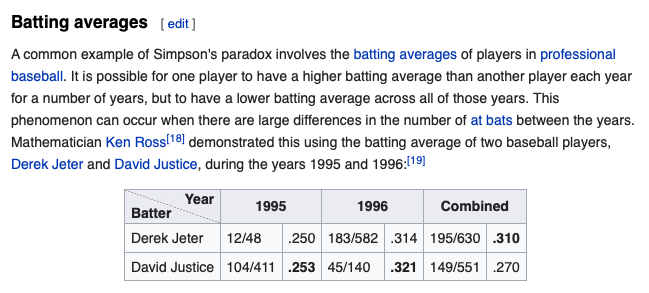
Simpson’s Paradox. On Wharton Moneyball , the hosts asked why women die more than men from Covid? It’s because there are more old women. How can someone have a higher overall shooting percentage but a lower percentage from near and far? A nice YouTube explainer is here. Via Wikipedia: