Multiply all potential WFH consequences by 1.2

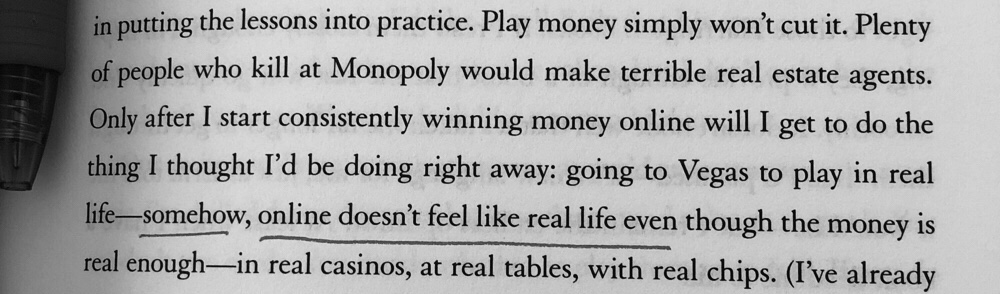
From Maria Konnikova’s The Biggest Bluff.

In the same way that mediums matter for content (why are there no good FinTwit YouTube channels?), mediums matter for work too. 

Much work is information exchange. The internet repairman comes to your, now home, office to install a better modem and upgrade the internet plan. The internist diagnosis that ‘thing’. The teacher teaches.

A group of researchers wondered how virtual chess might lead to different decisions. It is still chess; sixty-four squares, four rooks, two kings, but it is a different medium.

During the COVID-19 pandemic there was the Magnus Carlsen Invitational. The researcher wrote:

> “We use this event to compare the performance of the participating players to their performance in recent editions of the World Rapid Chess Championship as organized by the World Chess Federation in a traditional offline setting. Both tournaments are organized under comparable conditions, in particular giving players the same amount of thinking time during a game, and offer comparable prize funds.”

Researchers compared each of the 27,000 move across 441 games to the Stockfish 11 engine and found that while the number of mistakes was about the same, the quality of the mistakes was worse (16.8% to be exact).

One way digital work will be different than in-person work will be in how we interact with technology. For example, many writers print their words to proofread their work. They noticed differences in a different form.

Jason Blum and Rory Sutherland both work in creative fields and note the importance of a confidence boost–which is hard to do virtually. In his op-ed, Jerry Seinfeld wrote that New York City will bounce back, that broadband isn’t enough to do the same work. Why? “Energy, attitude, and personality cannot be ‘remoted’ even through the best fiber optic lines.” 

In the same way we might leave early if an upcoming drive is through a notoriously congested area, we should adapt our decisions, interactions, and intentions as we WFH.

Here’s the suggestion: When working virtually try to be 20% nicer, more supportive, and more cautious. There’s a psychological heft that’s lost in our virtual interactions.

Hey, you read the whole post, want more? I’ve got a new pay-what-you-want pdf. It’s a handful of ideas from Tyler Cowen about thinking like an economist. It’s here. It’s twenty-seven minutes ideas. 

Minimalism’s branding problem

Correctly framing a problem goes a long way toward solving it. Things seen in one light are solutions, while in another light become problems. For example, taking six days to get from Vancouver to Anchorage is a problem—unless it’s on a cruise ships and then it’s better to add stops. People now pay extra for the longer journey. Like me in 2015, hoping Denali peaks through the clouds. 

IMG_0518

Minimalism has a branding problem. People perceive minimalism as *get rid of your stuff*. However the value is not so much downsizing as prioritizing.

This same confusion is part of the FIRE movement. Participants choose to live with a large delta between what they earn and what they spend because they have a reasonably high earn and a relatively low spend. As a non-FIRE but equally thrifty friend told me, “I like the simple life.” Less consumption is not less life.

This obstacle exists in businesses too. If there’s a gap between what you think your business does, and what your potential customers think, then your business suffers. The world will not beat a path to your door.

In a good interview about her book, April Dunford speaks about the importance of product positioning. Dunford has a JTBD ethos. “A lot of times when your customer is a business and you ask them what they would do, they say they would use word or excel or hire an intern.” There’s a lot of non-consumption. There’s a lot of informing, which doesn’t work.

Instead, think of how your customer views your business. Think about how things that look odd (FIRE) make sense and consider why. 

Would Charlie Songhurst invest in Florida?

Florida has a bad reputation. Mostly this is swapping weird for bad, but that’s what you get with a state that’s basically 10 different communities. Part-of-the-reason Florida is this way is because of migration, starting in the early part of the century. At first railroads brought people to Florida. That was okay. But as automobiles improved an allowed for autonomy—I’ll go where I please when I please—Florida improved as well. Christopher Knowlton’s book, Bubble in the Sun is the story of the 1920’s Florida land boom but the precursor to speculation was transpiration: “The resorts towns would remain no more than winter retreats until better, more numerous roads could be built, freeing potential year-round residents from their dependency on the railroad.” A generation later another technology brought people to the sunshine state when air conditioning went from one-in-six homes in 1960 to three-in-six homes by 1980. Think of Florida. Think of the beaches, the bars, the boats. Think of white sand, blue water, and Mickey Mouse red. All that awesome stuff is thanks to asphalt and air-conditioning. Thanks to the boring. 

Charle Songhurst explained this idea to Patrick O’Shaughnessy

About recruiting: 

“You really don’t want to be sitting there in San Francisco trying to close your candidate when John Collison is trying to close the candidate as the alternative—because John’s going to win…Whereas if you’re hiring that person in Kiev and their other option is working in outsourced IT for Deutsche Bank it’s a much much easier win. What you want to find is the incredibly qualified people in weakly competitive labor markets.” 

About information:

“Trying to be smarter than other people is very hard and doesn’t work very often. Trying to have an insight that you get because you sit in a different information flow just seems exponentially easier.” 

About industries:

“If you pick two axes, boredom and complexity. You want highly boring highly complex because everything in the universe is a supply-and-demand curve and you get an insufficient supply of entrepreneurs in the highly boring, highly complex space and therefore elevated returns.” 

The central question to Songhurst’s approach is where? Where should we recruit? Where should I get my information? Where should we compete? There are places where things are easier. Non-consumption, new JTBDs, or the funny

Florida’s development was boring, and Songhurst would have invested. Now though? Nah, he’s looking elsewhere.


There’s no such thing as financial incentives

An observation so obvious 🤦‍♂️.
One thread through these posts is the idea of Jobs-To-Be-Done, that what we really want are quarter-inch holes and we drink McDonald’s milkshakes to stave off boredom (pre-podcasts at least). Incentives for action also depend on the JTBD, something Nobel Prizer winner Esther Duflo noted to Tyler Cowen:

“The traffic ticket, I think, is much more than the financial incentive. If you get stopped by a traffic officer, you lose your car right this instant. I think that it’s likely inconvenience is much, much bigger. The point that we are trying to make is not that people are not sensitive to incentives, because we can always construct incentives. If you construct the incentive boldly enough, then it’s almost always true.”

Duflo goes on to say that we probably overrate the effect of financial incentives because we don’t consider them relative to something. “People seem to be pretty inelastic to receiving money for sure that doesn’t lead them to go on vacation.”

This came up with my daughter whose neighbor based babysitting and dog-walking business has been booming (with an assist from dad). Between her complimentary rooming and board, she has no need for any additional money. Books come from the library, music from Amazon, and clothes and makeup are non-issues.

She has no JTBD, so she has no financial incentive.

Like businesses focus on JTBD for their customers, we can focus on the JTBD of the people in our lives. At the margin, evidence from Silicon Valley suggests employees would trade some salary for better work conditions. Work is more enjoyable, hence better, if we like the people we work with.


Taking Action

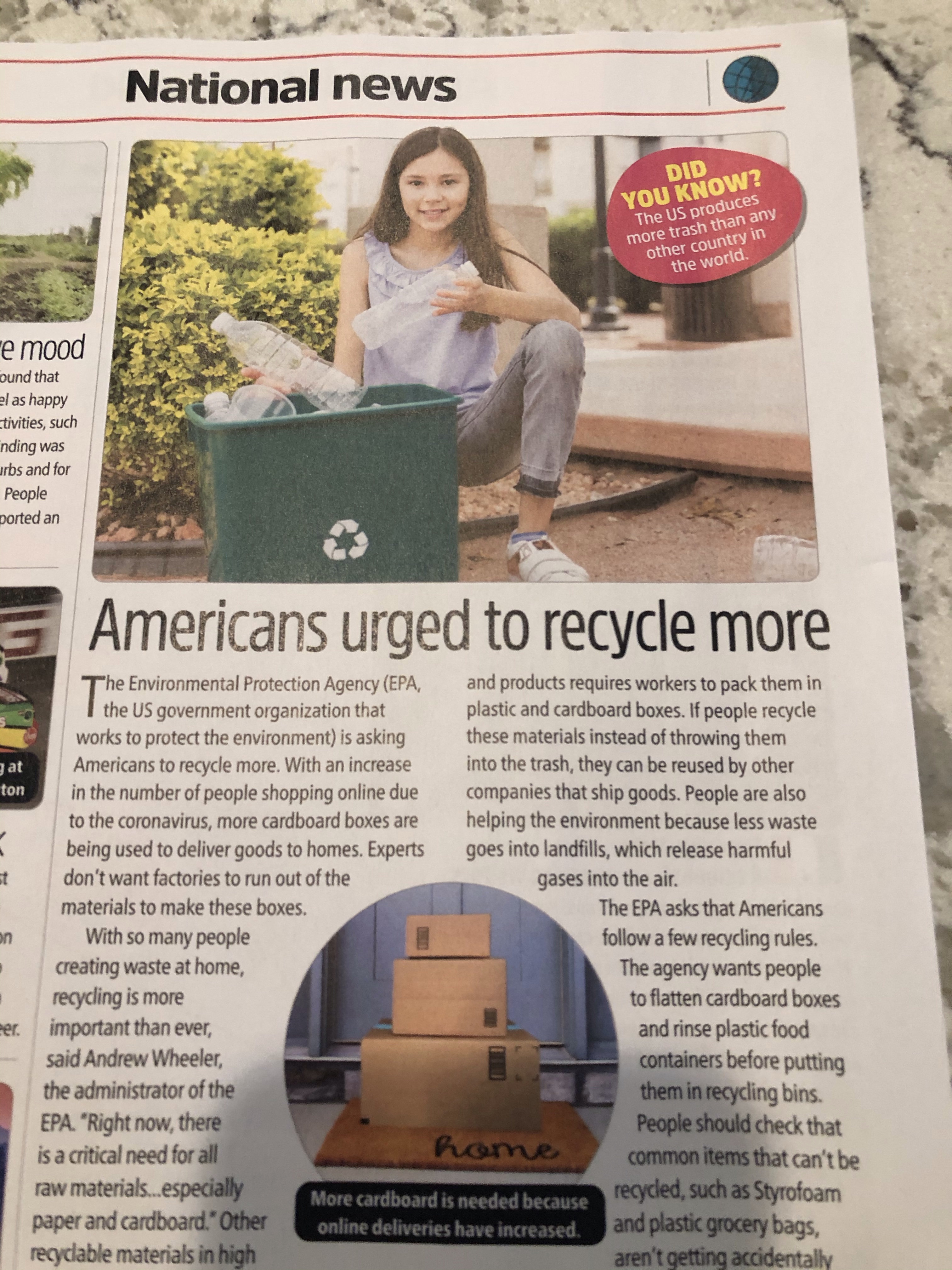
This was in a magazine for our daughters. The spirit of the article is fine, but the nature is worth discussing. When dealing with people, as we often do, it’s important to remember that people behave in certain ways, for example, by taking action.

In a Capital Allocators’ podcast, Annie Duke spoke about how she convinces people NOT to act. We have a tendency to think that change requires action. Like reading vs listening to a book, we assume effort is good. But sometimes effort is bad.

Duke appeals to identity. Instead of giving advice to do X, try framing things as ‘we are the kind of people who do X’. And prepare others, “You’re going to hear other people who aren’t in on it who don’t understand this kind of stuff.”

In talks about her poker coaching, Duke said that it’s hard to get people to pass on poker hands because folding feels like not-doing. Instead, she works with clients so they choose to fold, because that’s a kind of doing that their group (aka smart players) does.

This beautiful framing from Annie butts heads with recycling because between reduce, reuse, and recycle, it’s the last that the least efficient but most advocated. Buying half as many sodas equates to a recycling efficiency of 200%. Recycling fails compared to reducing or reusing. Yet, recycling sticks because it feels like it’s something.

Our problem with randomness

Beyond basic math, maybe units of ten, we don’t have a good handle on numbers. We are a story-telling species who likes to see cause and effect. The example of randomness demonstrates this as Maria Konnikova told Adi Wyner:

“I had a fascinating conversation with Frank Lantz at the Game Center at NYU who used to be a serious poker player and is currently a game designer. He explained that oftentimes their random number generator isn’t random because people complain, they say the game is rigged because if something is truly random we might be getting a bunch of these outcomes in a row. Game designers say it is bad game design to have an actual random number generator.”

It’s not true only for games but also for Jeopardy Daily Doubles, Spotify and Apple shuffles, and fraud.

One of the ways our storytelling species acts is as the protagonist of the parable. In one study, researchers told students they would draw random numbers and letters out of a can. If they matched what the students chose, the students would win.

If the students were assigned their random numbers, say from a draw of a different can, the students bet less. If the students were assigned their draw based on their name or college, they bet more. If the students chose their numbers and letters, they bet the most.

The students took the most risk when there was a connection because a connection allows for a story. When things are truly random though, stories are harder to tell.

In the world of Thinking Slow, this seems like a bad thing but there are advantages to every disadvantage. Our search for stories allows for magic. When there is a story we are willing to bet, do, and relate more. This allows for magic (see below) and the creation of value simply by using psychology. Put another way, words and choices are cheap ways to improve experiences.

Maria’s book is The Biggest Bluff, and Rory Sutherland explains magic in Alchemy.

A story of two investments

This caught my eye. 

https://twitter.com/sjosephburns/status/1028628288607019008?s=21

I like the 🤷‍♂️ so much that ‘shrug’ is a keyboard shortcut. (Make technology work for you.) The likes and the huh and the obviousness of it makes it interesting. There are three reasons:

Distance. The difference between college debt and stock investments is partially the difference in distance. College tuition, like casino chips or in-app-Uber-payments, is abstracted away. Students do not pay to enter lecture halls or pay each professor (there were no tips in academia when I was there). Unlike the local bistro, there’s a cause-and-effect disconnect. 

Investing meanwhile is immediate. Transfer funds, buy, sell, spend the money. Distance affects how people feel.

Stories. We hear about people swindled, stolen, and schemed against. There’s a villain, an arc, a conclusion. In One Shot, a work of fiction, we get to the heart of the matter. In this case, a former Army soldier was framed for a shooting rampage. 

“A story needs the guy to be still out there. A story needs the guy roaming, sullen, hidden, shadowy, dangerous. It needs fear. It needs to make everyday chores exposed and hazardous, like pumping gas or visiting the mall or walking to church. So to hear that the guy was found and arrested even before the start of the second news cycle was a disaster for Ann Yanni.”

Yanni goes on to be one of the protagonists, but our antagonists act this way because they want to kill the story. Act one, two, and three close the book. Investing has clear stories, education does not. 

Legibility.  Thanks to the workings of Mr. Market, there is a numerical price. Clean and easy to see. Up or down. My local paper goes so far to use a thumb up or down to show price changes, the implied goodness, and badness as plain as the nose on your face. 

College is more nebulous. How much does your education help or hurt your career? There’s no way to tell. Few people would change their past, but then again, we’re terrible at considering opportunity costs


There are a few ways to change this situation. With a few tweaks, we can change the system so that stocks seem slightly better and college a bit more costly. Here are three ideas. 

  1. Borrow a page from Zappos and make students pay for college before they even enter the hallowed halls. Part of the recruiting at Zappos (Amazon too) includes a buy-out. If applicants make it through the application and evaluation, they’re given one more chance to step off the train in the form of payment to quit. At Amazon, it’s once a year. 
    The effect forces people to consider the Why to their actions. Relatedly, companies like Betterment, do the reverse by showing the tax implications of a transaction. Three-fourths of investors, once they see the tax hit, choose not to sell. 
  2. Taking a page from the college playbook, investors can distance the payment process for investments. Pre-tax plans do this, once an employee sets up a contribution they don’t ‘feel’ the effects that money because it never really arrives. Similarly, there are programs like Save-More-Tomorrow where a portion of each future raise gets invested. 
  3. Glamorize the savers. Part of the problem of investing is that we mostly only hear the bad news. Instead, we can highlight the people who live a good life, but also make sound financial decisions. This seems to be a thread among the FIRE crowd, who recognize both the today and tomorrow versions of themselves benefit from the same set of actions. 

The solution to this is probably something weird. Or a combination of the above. Or none.  Whatever the solution is though, I’d bet my investments that it involves distance, story, and legibility. 


Made up start up: The Financial Game

Edit: this was drafted in late 2019.

I loved the movie The Game. The premise was that for his birthday, Michael Douglas’s character was ‘attacked’ in a real life adventure. It was part thrill, part horror. I can’t even remember how much of it was real.

‘What is real’ is a common premise in my favorite movies.

Part-of-the-reason I like it is because it holds a truth. Without skin-in-the-game we really don’t know what we would do. There are our stated and revealed preferences. There are our human biases. There are the ways something is presented.

It’s a real quagmire and something Sallie Krawcheck noted when she spoke on The Long View podcast:

“Ya’ll probably know this as well or better than I do, but when you ask someone what their risk tolerance is, nobody knows it until they go through an ’07 or ’08. They just don’t. Let’s call a spade a spade. But we answer it. Men will answer it and women will go, I need to figure out what it is.”

Sallie Krawcheck

According to Daniel Kahneman, we’re answering an easier question. Instead of what is my risk tolerance we probably answer something like how do I feel today or which column of returns looks good? We do the same thing when choosing college.

Here’s the pitch: Taking a cue from David Fincher and Krawcheck, we’ll create a company that coaches financial advisors on how to stage Doomsday Days with their clients. Like for Douglas, the clients won’t know when it will happen (and we’ll hide this feature in a bunch of legalese).

The plan would be to make up financial statements that mimicked actual downturns; 1953, 1981, 2008, etc. Clients would come in for their regular meetings, be presented with a fictionalized loss for twenty minutes, and then have a debrief session. It’s the financial equivalent of a false positve lung cancer diagnosis.

During the debrief the advisor could talk about real feelings of loss, of risk, and pain. Then, together, work out a new plan.

As advisors are already busy, the business would sell them a script. They could choose a level of pain, and we would provide the portfolio forms (printed on very formal looking paper) as well as suggestions on handling the psychology of it. As an upset we could offer “Confederate Coordination” as we called the wife and explained the plan to her. Yes, it would have to be, the wife.

The Three Design Rules at Facebook

According to Julie Zhuo (YouTube), there are three design rules at Facebook. 

  1. What problem do people really have?
  2. Is this problem real? 
  3. How will we know if we solve it?

These three questions have a very JTBD essence to them. Serving customers is not just about giving them what they ask for but giving them what they really need. 

For example, Zhou said, many people over many years have asked Facebook for a dislike button. If there’s a thumbs-up for things we like, why can’t there be a thumbs-down for things we don’t? 

But this isn’t really what people want. If the Facebook feed was too much thumbs-down material and not enough friend’s photos, easy recipes (Tasty anyone?), and photos from the past no one would log on. What people want, said Zhuo, is that “not everything in the feed is likable and I want to express other things.”

It’s odd to think that what people say they want may not be what they really want, but we can trust this idea because conditions matter. For example, when parents were collected and questioned in focus groups about what kind of medical information they wanted for a vaccine, they said they wanted more information. The thinking was something along the lines of: ‘this is science, let me weigh the facts.’ 

But when researchers created 84 Facebook posts that went on to reach three-and-a-half million users, the results were different. The most resonate posts were those with personal stories. 

In another example, people were asked if they would wear masks during the coronavirus pandemic. The yes/no split was largely along party lines. However, when people were observed out-and-about, political preference yielded to prudence. 

In finance, Nassim Taleb rails, ‘don’t tell me how to invest, show me what’s in your portfolio.’ Tyler Cowen says to look at your actions, and then tell me what you think. 

Zhou’s other good point to add to our JTBD quiver is to think not in terms of supplier language but demander. It’s not about the click-through-rate as much as it’s about engaging content. Financial advisors should never bring up words like theta, Sharpe ratio, or quarter-Kelly. None of those are about the JTBD. 

Downward sloping, downright lying demand curve

From Keith Harmon’s pricing Chicken Parmesan

What’s notable isn’t to question simple models, or as the first draft of this post noted ‘economic textbooks’ but it’s to think about things as they act in real life. People buy more and complain less when the Chicken Parmesan menu price increases.

As Rory Sutherland puts it, the opposite of a good idea can be another good idea. 

Find these weird but good ideas by making small bets