Easy Money, Student Loans

Student’s don’t really see the dollars. They see tuition vaguely. I remember my first year of school, which I was paying for mostly myself, with the attitude of, ‘these are the books I need, I’ll just put them on the account or whatever’. I remember the vague feeling of a physics textbook costing a lot, but that was just what you did.

At the end of the year I thought I could sell them back to the bookstore but they would only give me five bucks for it. I was so mad. From then on I was like, books are five bucks. I’d share books with friends because now it was my money.

Mr. Money Mustache

There are a number of reasons student loans may have grown over time. Most problems are part-of-the-reason problems, and it’s a good frame to begin the diagnosis. Why the increase?

  • It takes longer to work a hypothetical minimum wage job to pay for college. 14 hours a week in 1970, 35 hours a week in 2012.
  • Tuition costs have risen due to more students, more staff, more admin., more perks.
  • ‘Degree inflation’ has increased the ‘need’ to have a degree.

Though student loan debt passed $1.5T, the detailed picture may be slightly different. One-in-four borrowers owe less than $7,000 and a fair chunk of the highest bills come from graduate degree programs. The underwater-basketweaving story is mostly just that, a story.

However, many student enter a bad contract. Like MMM, they don’t have a clue until it’s too late.

These kinds of situations offer a chance to use friction as a dial. This shows up again and again. Mostly, people use heuristics to make good-enough decisions and as such sometimes an artificial nudge can help.

In the study, What are Student Borrowers Thinking?, the researchers found that the students aren’t thinking very much. Only about one in three students is accurate, plus or minus 10%, of their amounts of student loan debt. Only about half of all students are within five-thousand dollars of their freshman tuition.

The authors write, “There was ample evidence for a lack of knowledge about options for financing college.” Basically kids picked somewhere close by, that had a degree program they wanted, and offered some amount of financial aid.

Another factor was paying for living expenses using loans. Kids these days.

But this isn’t a sign of a weak generation. It’s an opportunity. What’s happened is that students have found some parts too easy and other parts too difficult. It’s too easy to borrow so much and know so little.

Lead or Follow

One difficulty of family gatherings is a lack of hierarchy. As a kid we would go to my dad’s mother’s house for Thanksgiving. She made the turkey and the rest of the family filled in the sides. She also made the rules for the house, they were good for grandkids, and everyone toed the line. Different holidays had different hierarchys.

The importance of leading and following was clear after a friend griped about his family’s trip to Disney World. They had a good, but not great time. That’s too bad becuase Disney survives on great times. Part-of-the-reason for the family failure was followers not following.

One person wanted the group (of fourteen people!) to stay together all day. One group wanted to go do their own thing. One nuclear family had reservations because they planned ahead, a crucial part of a successful Disney vacation, while other families did not

I was reminded of cryptocurrencies.

Depending on the structure (proof of stake, proof of work, etc), a cryptocurrency can fork the code. Participants choose which version to use. Asking then, are you willing to lead a new direction or obiently follow this one can be a helpfu way to better corrdinate many different people.

  • When my sister-in-law visited Disney with my family, she followed along, and because our kids have similar interests everyone got along.
  • When I made dinner one night my oldest daughter didn’t want it, so she made a grilled cheese sandwich and tomato soup.
  • When my mother-in-law joined my family on a trip she followed along, except for a day horseback riding and she planned her own excursion.

I think these are family examples because family lacks the lead/follow structure. Good organizations tend to ‘argue zell’ but after that comes the follow part. Ted Sarandos explained the Netflix way to Marc Andreessen, this way:

“It’s all credit to Reed. Reed created a culture where you’re free to ask questions, you’re free to push back – but support the outcome. Everyone has a strong voice at the table but once the decision is made everyone supports the outcome.”

Ted Sarandos

Leaders have to offer expertise on the task at hand and be willing for their followers to “fork”. Followers trade freedom for optimization. Lead or follow. Leaders walk the walk, followers don’t talk.

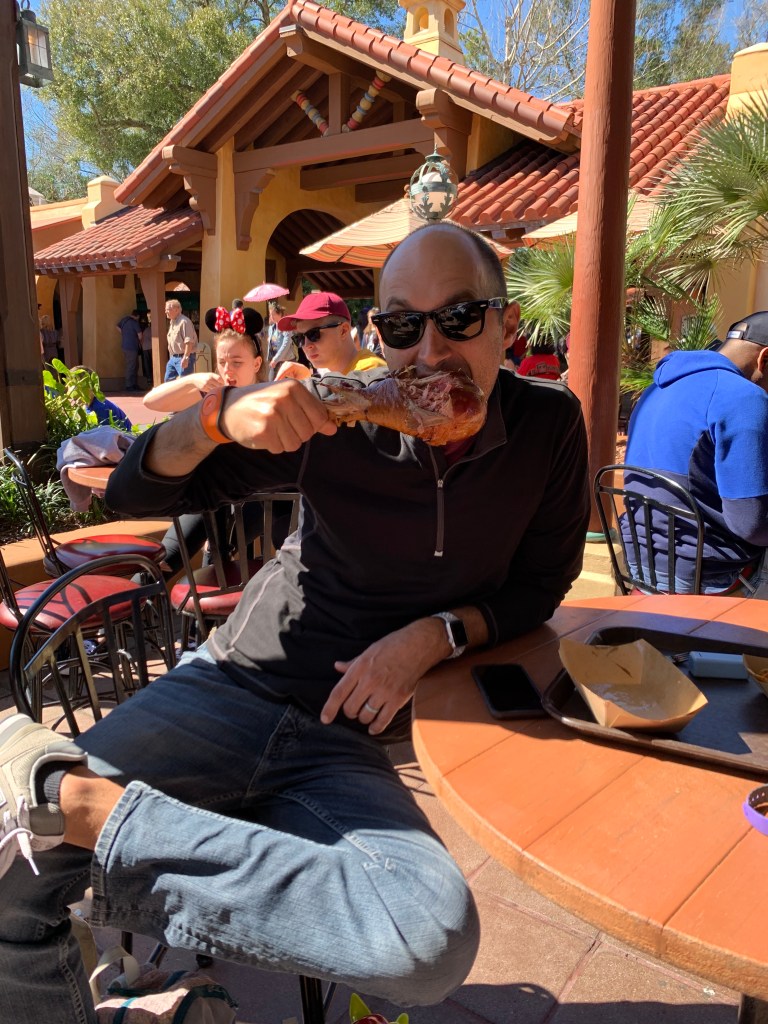
A Disney turkey leg and the lunch where this idea was discussed.

Design a minibar with Tim Harford

Like engineers, we sit around and think about ways to make the good easier and the bad harder. In December of last year this happened when I swapped a tray of cookies into the pantry and replaced it with dried fruit, fresh fruit, and nuts. Though the cookies were still an arm’s reach away, they were out-of-sight behind a door the cookie consumption crumbled.

As a fan of design, it was a treat to see Tim Harford’s approach in his FT article about adjusting his mobile phone usage:

Trying to get some work done with an internet-enabled device is like trying to diet when there’s a mini-fridge full of beer and ice cream sitting on your desk, always within arm’s reach

Tim Harford

Harford removed apps from his phone and installed software on his computer. Both actions increased the friction. It was a good nudge (Harford appreciates Thaler’s work), Harford had access, but had to work for it.

Design is not divine. Design is a messy process of interviews, prototypes, iterations, and all kinds of other stuff. Designing is like any other verb. It’s a skill people learn and like learning the guitar, it’s ineffecient at first.

Designs encourage the easy. There are no pull-up bars in hotel rooms. If there were, we’d do more pull-ups.

Designs encourage the easy. There are mini-fridges in hotels rooms. There are internet enabled devices in our pockets. To change an action, try to change the design.

Word-of-mouth, for-the-win.

“This kind of thing is manna from heaven, but nobody knows how to do it on purpose. At least, I don’t.”

David Ogilvy

As Ogilvy noted, word-of-mouth is divine. It’s a moment when culture quiets, someone speaks, and ideas spread. At it’s best, word-of-mouth follows the rules of a dream. At it’s worst, word-of-mouth runs afoul.

Part-of-the-reason WOM wows is that it’s targeted. We think of Facebook as refined, but WOM is even better. Jonah Berger said in his Talk At Google: “If you don’t have a baby, no one is going to tell you about baby products. Word of mouth is like a searchlight that lurks through your social network to find the person that might be most interested in a particular product or idea.”

In his research for Contagious, Berger talks about the STEPPS to raise your batting average. There’s no guaranteed way to create a sensational idea, but there are things that make it a bit easier. 

For example, though Disney is a great brand, they could do better in the WOM game. They could follow the STEPPS for better WOM: social currency, triggered moments, emotion, public, practical value, and stories.

Berger’s book, in a sentence, might be, remind people to tell stories of helpful and meaningful things

This means Disney’s problem is this: “The problem with Walt Disney World is that we don’t go very often and there’s nothing in the environment to remind us that the product exists. When people come back they talk about it a lot but they don’t keep talking about it because there’s no trigger to remind them of the product.”

A great WOM product was the Zestimate. This Zillow feature arrived after Bill Gurley challenged the team: market without a budget. That challenge, co-founder Rich Barton said, “lit the creative juices of the team.”

When Zillow.com launched, the site crashed. People had to know. People told their friends. Barton hoped for this, “We figured it was so practical, and also voyeuristic, that word of mouth would carry it for a while.”

According to Berger’s STEPPS program, the Zestimate was great. It provided social currency in an era when new websites were cool. It was attached to an emotion, the largest asset for many people. It was public data and it offered a practical value

According to Zillow Talk, the Zestimate’s accuracy was 14% at launch. In 2019 it was within 1%. Barton would go on to use the same contagious ideas when he founded Glassdoor. 

When Walt Disney started to build his theme parks, he told the Imagineers that they had to include a Weenie. These were landmarks people could use to orient themselves. Move forward fifty years and that Weenie-spot is now a selfie-spot. Create someone where people can take a picture. That’s something worth talking about. 

The incentives of salted roads

On NPR’s, The Indicator, listener Tara Harvey asks host Cardiff Garcia why we salt the roads so much. “Research shows oversalting increases the possibility of slipping, costs more for materials and labor, and causes property damage.”

The Indicator is an economics podcast and Garcia offers economic reasons. Salt is cheap and effective. Salted roads reduce accidents by 87%. Salted roads allow people to get to work, “and that is an economic activity that needs to be counted against the cost.”

Everything Harvey asks and everything Garcia says are logical statements. But while numbers convey authority, they aren’t always right.

An alternative theory focuses on incentives. Consumption and payment aren’t connected

Salt is purchased by governments and governments take heat for not being prepared. Their incentive is to salt more, not less. The consumer’s immediate incentive is excess too. Better safe than sorry.

Until however it comes time to pay. Garcia knows this, “It all costs money. Not just the direct use of the salt itself, which has to be found and paid for, but also the environmental and ecological damage that it leaves behind.”

However, consumers never connect consumption with cost. Sure taxes are too high, but does anyone know how much of their taxes go to salting the roads? Ditto for the environmental effects that follow overselling. Consumers pay, but later and indirectly.

This salty situation is similar to the psychology behind too much debt. Act now, pay later. If later is long enough away and opaque (how much does salt cost a taxpayer?) then the cost seems especially low.

Photo by Simon Matzinger from Pexels

Are you tired? Is that really the question?

“When faced with a difficult question, we often answer an easier one instead, usually without noticing the substitution.”

Daniel Kahneman

We probably do this a lot more than we think. Consider how many decisions we face in a day, how many are automatic, and how many switches go unnoticed.

It happens to everyone. In a recent post, Scott Alexander writes about an individual randomized control trial for a sleep supplement. Alexander wanted to know if the supplement helped him sleep better, or if it was a placebo effect.

Placebos are powerful and cheap. If they get the job done, all the better it seems. But Alexander is serious, smart, and curious—so he tested this idea.

A friend disguised the supplements and sugar pills in oversized capsules, flipped a coin to determine the order, and placed the camouflaged pills in a monthly pill planner. To test the effectiveness, Alexander recorded hours of sleep and subjective ratings on how he felt. The results shocked him.

But not for the reason he expected.

I think the active ingredient here was not letting myself look at the clock. Without external cues to tell me how tired I should feel, I was forced to rely on how tired I actually felt, which in many cases was “not tired at all”. 

Scott Alexander

In removing the alarm clock, Alexander removed the easier question. If it was before nine, it was too early. Obviously. Or not.

These kinds of tendencies work great for a lot of things, but occasionally work too much and we get interesting results like this.

Join 992 other subscribers

Photo by Aphiwat chuangchoem from Pexels

The Psychology of Rotten Tomatoes

In an article for Wired, @SVZWood writes about Rotten Tomatoes, the website one in five Americans use to inform their movie choices. Wood’s article showcases three helpful ideas:

Simple algorithms. Rotten Tomatoes has become a successful business and top website based on a simple algorithm—counting. Two movie curators read reviews each day, judge them as positive or not, and then count the totals. If a movie has more than sixty percent positive, it’s marked as fresh.

Numerical authority. There’s something about people, numbers, authority, and precision we just can’t get over. Wood captures this, writing, “There is an authoritative allure in the site’s numerical scores….(people) reflexively—and nonsensically—trust a fresh sixty percent Tomatometer over a Rotten 59%.”

In an age of big data and algorithms and random forests, it’s helpful to keep in mind that simple systems work. One example, football.

Numbers feel secure. They’re a rationalization blanket in a world of unknown things under the bed.

Jobs-to-be-done. Reviewers don’t like the binary nature of fresh or not. Wood notes that, “there is no Underripe or Overripe tomato.” In the terms of Bob Moesta, this is the difference between a supply-side orientation and demand-side orientation.

In JBTD theory, the goal is to find what customers want to do that rather than what a supplier wants or thinks the customer wants. Reviewers (supply) want to share their nuanced take rather than a 👍 or 👎 via their Twitter account. The customers (demand) just want to know if a movie is bad, potentially good, or very good. This plays out in some interesting ways that Rotten Tomatoes has plucked.

For example, a review which is glowingly positive and a review which is slightly positive are both coded as positive. This leads to extreme scores. This is a feature, not a bug. It’s the information people want to know.

Join 992 other subscribers

Morey thinking like Marks

It looks like Daryl Morey is thinking like Howard Marks. But, he probably always has.

On the Wharton Moneyball podcast, Eric Bradlow talked through why the Houston Rockets might think playing “five guys a large number of minutes that are all six-seven to six-four” to end the season and into the playoffs was a good idea.

At first this seems like a mistake.

Basketball has defined positions. Point guard, shooting guard, small forward, power forward, center. We’ve always done it this way.

Oops.

That expression is a red flag. Instead we should think from first principles, which is what Bradlow and co-hosts Adi Wyner and Shane Jensen do. If the Rockets play shorter players that don’t fit the traditional mold, what will happen. Bradlow summarized:

“Given they’re shooting threes and the higher variance of the rebounds, a lot more balls hit the floor because it’s not just dropping straight down so you might want faster players who can get to the ball quickly.” (though maybe not)

“And now you’re getting the other team to possible take less threes. That’s a good thing about the Rockets.” (by exploiting size mismatches down low)

“The other thing you might argue is that the other team is going to crash the boards and that might create more fast break opportunities.”

Wharton Moneyball podcast 2/12/2020

Small ball strategy might be something smart coaches pursue. Zach Lowe wrote that Toronto’s Nick Nurse will play weird defense, and will sometimes tempt the other team “into inefficient one-on-one battles.”

Two principles Marks hammers again and again is the importance of being right and different and the importance of second level thinking. Though it’s really no surprise that Morey and Marks take different paths to make similar results in unique domains.

Danger Word Search

My kids love Ellen’s Game of Games.

My kids love the mini-game Danger Word. The premise is for one player to get their teammate to guess a word. The wrinkle is that the winning word (sofa, ocean, etc.) is similar to the danger word (couch, sea, so-on). If a guesser says the danger word, they get smothered and covered. If a guessers says the winning word, the other team gets hit with it.

It’s an interesting game because the best clues have multiple levels. They give information about both the danger word and the desired word. One winning moment was when a woman gave the clue ‘otter’ and her partner guessed ‘sea’. It was a winning clue that also avoided the danger word of ocean.

Knowing something is this, and not that, will become more important as things move from single-issue-tangible to many-copies-digital.

  • YouTube is an amazing resource but the search options are mostly by name. The most challenging queries are for people who share names with pastors. One side effect from weekly sermons is regular content and what better way to reach the flock than via YouTube.
  • Websites used to have a .gov, .org, .com structure that hinted something was this and not that. In some recent research I found a dot-org domain that looked pretty legitimate. However, going to the About page showed that it wasn’t what it appeared to be.
  • Visual evidence used to be clear. Screens though are shaded windows. Rather than asking is something manipulated, the default is now to ask how something is manipulated.

In Ellen’s game, the goal is to give a precise clue.
In YouTube searches, the goal is to search a precise query.
In website scours, the goal is to find truthful facts.

As more information goes online there will be more, not less, statements about being at war with EastAsia. The skill we’ll all need, my daughters included, is separating one category from another. Danger words from winning words, helpful queries from unhelpful ones, real from fantasy.

Made Up Start Up: Upcoming Streaming

Movies are awesome. The next time you hear someone regret remakes, remixes, and redundancy please remind them to respect your review. No one complains about meatloaf, sequels are comfort food.

However, I don’t always remember who is who, who is alive, or who is in love. Here’s the pitch: a streaming service that offers a limited run of a limited number of movies based on the time of year.

Wharton professor Jonah Berger researched how ideas spread and part-of-the-reason ideas spread is timing. People are contextual operators. We need cues for action. How many times have you seen a trailer, heard about a restaurant, or found out about some music only to never followup. You need a nudge.

The Upcoming Streaming businesses would be just that. The week before Harry Potter X comes out, the last two movies from that universe are available to stream. The Rock has another Jumanji-like movie coming out, and so another Rock movie is available to stream. Actually, the Rock always has movies coming out. He’s a mainstay.

For movie studios this is a no-brainer. Some studios spend more marketing a movie than making one. This streaming service would be inverted marketing. People pay to get excited for the next movie. Free money.

There’s hope for this idea as smart contracts become more popular. Tyler Cowen notes that Hollywood and whaling were the VC OG. If Silcon Valley is into crypto and blockchains then maybe the theater business isn’t far behind.

Another advantage is that this business doesn’t interfere with the competitive advantage of existing streaming services. If a movie is offered in more than one location, few customers would cancel Netflix just because a movie or two each year were available somewhere else.

But wait, there’s more! This business has scarcity. If movies are only available for the week before a release people will feel the need to act now. It can’t hurt having psychological influences pushing this idea along.

Upcoming releases wouldn’t be the only available source of inspiration. How many studios would love to pump their old rom-com libraries for one more run as they return to our lives as a special Valentines week lineup? How great would it be to stream only the Thanksgiving episodes of Friends over the Thanksgiving holiday?

If someone knows Michael Ovitz, have him get in touch.