Why do I hire seltzer

Why do I hire seltzer?

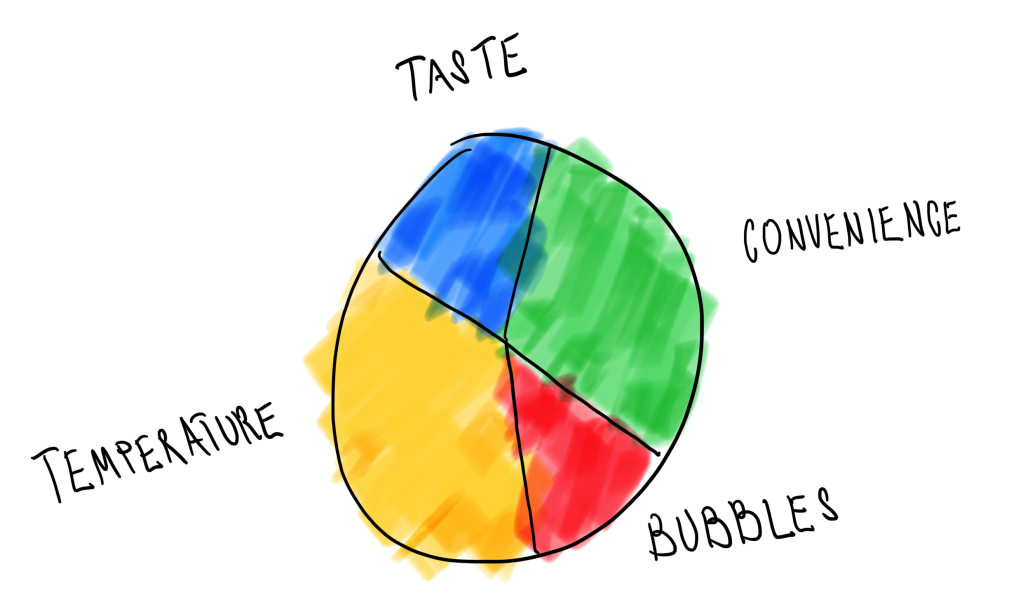
Why do I hire seltzer? After experimenting, these are the reasons.

A switch to refrigerated bottled water preserves the temperature and convenience but lacks the bubbles and taste.

But a Nalgene (filled the night before, designed into the evening routine), provides temperature, taste, and psychic income!

Jobs as a theory is like any other theory – use it or lose it. Apply it. Reflect on actions, choices, tradeoffs, and context.

There are so many podcasts, books, and articles. So many ideas, oh that’s a good one.

But without using it, it’s like we never knew it.

Resolutions fail because…

In her book, How to Change, Katy Milkman writes:

“We’re more likely to pursue change on dates that feel like new beginnings because these moments help us overcome a common obstacle to goal initiation: the sense that we’ve failed before and will, thus, fail again.”

New year, new week, new me. It’s a birthday. It’s a new job. This time is different. 

But it’s only different when the structure changes

Reliance on fresh starts fails because only the narrative changes, not the structure. 

Milkman writes about a study of college transfers. Some kids transferred from the local two-year school while others came in from out of town. The local kids made fewer changes – good and bad! Fresh starts with a different structure push the variance of the changes outward. Sometimes the changes are a desired direction and sometimes not.  

“When we hope to change,” Milkman writes, “we have an opportunity to try reshaping our environment to help us disrupt old routines and ways of thinking.” 

Successful resolutions are an issue of design, not mindset. Like the high jump, the physical surroundings matter!

Want to stick with resolutions? Change the rules.

Don’t Bring an Educational Solution to a Design Fight

Dr. Henri J. Breault of Tecumseh, Ontario is a hero. Working as a pediatrician in a hospital, Brenault’s widow recalls him coming home from work one day and exclaiming I’m sick and tired pumping kids’ stomachs!

So he invented the childproof medicine cap.

At the time, Canada had about 100,000 cases and 100 deaths.

Breault came up with the palm-and-twist bottle. As an aside, how great is YouTube? This short video shows four different child-proof caps. I did not know how the pinch one worked! Breault’s creation is fourth.


Prior to Breault’s 1967 invention was a public education campaign.

We know that education affects behavior much less than systems affect behavior.

And our traditional punching bag is financial education.

“If someone says financial literacy at a party I basically give them a thirty-minute lecture. The idea is that in a perfect world if someone is taught about FICO and its impact on their life, they would take action to improve their FICO score. This is just not what researchers have found – and it’s really robust…the punchline is that environment matters.” – Kristen Berman, All the Hacks, October 2021

So, don’t bring an educational solution to a design fight.

Door Knob Job

We focus on jobs to be done not because it’s the perfect solution but because it’s underrated.

Think like an economist or moneyballer and ask what is underrated?

The underrated tend to be cheaper for the same results or the same cost for more.

This is a local door. The sunshine hits (and heats!) the handle. The solution is to wrap it in a towel.

This is what jobs theory calls “supply side thinking”. Whoever chose that handle thought about cost, aesthetics, or anything besides use.

“Demand side thinking” starts with consumer progress – a simple cell phone. And that starts by opening the door.

How To Get Kids to Read

“Parents come up to me all the time and say, “I can’t get my kids reading.” I commiserate, then I tell them, “Hey, do you manage to get them to the dinner table? Do you allow them to track mud or snow onto your living-room carpet? Do you let them curse in church?” Then make this a rule: We read in our house.”

James Patterson

Simple, but not easy.

Start with design.

Make a rule.

Create a space: time and place.

Don’t rely on best intentions.

Seven days a week is easier than three.

“85% of problems are system problems, not people problems.” – W. Edwards Deming

Mary and Rory: Two Great Brits

If you want to change, writes Katy Milkman, consider the advice of Mary Poppins. In every job that must be done. There is an element of fun. And a spoonful of sugar helps the medicine go down.

But we don’t do this. “When committing to a healthy new eating regimen, we buy a basket of the most sinless foods – broccoli, carrots, kale, and quinoa – without regard for taste.”

Ahh, yes. Of course! Rory Sutherland enters.

We are rationalizing creatures. We ask, Why is this so cheap? If junk food tastes great then healthy food must taste bad. It’s the gross medicines that work best!

But, but, but, Milkman butts in. That’s what the research shows.

Think of things you want to change as chronic conditions. Diabetes is a chronic condition. Stress can be chronic too.

But so is shelter. That’s a recurring problem people deal with every day. So is food. And Milkman argues, so are your habits. So make them fun.

We have learned a lot from Milkman and Sutherland because they both share lessons that work. It’s not whether something works, but where, when, and with who. Monster Energy is large, full of caffeine and calories, and it tastes great. It found a where, when, and with who. Snickers found a context too.

Boiling water softens a carrot and hardens an egg. Solutions must match their contexts.

Pump Up the Incentives

One human mistake is psychological myopia – thinking our view of the world is the world.

When Andy Galpin trained future NFL players for the draft he noticed something “odd”. These players stood to earn huge sums of money, achieve the highest success in their lifelong pursuit, and had all the resources in the world behind them – yet they skipped workouts.

Rather, they skipped Saturday morning workouts.

Our view, as a non-NFL player is, “C’mon focus!”

Their view as NFL players is, “C’mon, Friday night!”

Fortunately, we can design our modern environment for our evolved brains.

Galpin wanted Saturday mornings to be recovery: massage, yoga, stretching. Hence the low attendance. But once he added biceps and triceps attendance increased. The guys loved the pump. After the athletes were in the gym it was easy to tack on the recovery session.

Galpin’s (3-hour!) Optimize Your Training Program for Fitness & Longevity podcast is about intentionality and that takes design. Want to live your best, strongest, healthiest life? Design it.

How to Run Your Brain

Sports psychologist Josephine Perry was on the Bad Boys of Running podcast to talk about the mental aspects of the sport and how to design your life to work with your brain.

Want to use your phone less?, asked Atomic Habits author James Clear, put it out of reach. The need to “check things” is small and easily clears any friction when the phone is in our pocket or on the table. But make yourself get up, a small but significant task, and we simply don’t do it as often.

A design approach works for our brains too.

1/ Your brain is a relative thinker, from Instagram to other runners, what we see sets the terms.

We prioritize information based on its availability. Change what’s easily available, change what we compare ourselves to, like a PR.

2/ Your brain is designed for danger, food, and sex (aka survival). Don’t you dare start into the unknown it sternly warns.

One solution is to deconstruct large problems into small ones. Writing a book is hard. Writing something every day is easier. Collecting ideas from a podcast is easier yet. Each big and scary attempt is a collection of small and doable attempts.

Another is to create a jar of wins. Write down accomplishments and put them in a jar. The visual is good – we’re visual creatures – and it uses the brain against itself. Rather than being fearful, our brain has evidence of hard things we’ve already done and we’re more likely to start.

3/ Your brain is lazy. Our how ya feeling language is limited. We only use words like: fine, angry, frustrated, tired, good, or excited. Limited words mean we have limited responses.

But precise language changes our description and consequently our reactions. Rather than be tired we can be worn out mentally from work. That’s different from I’m an introvert and need a break from people. Different triggers, different actions.

Personal growth is a challenge. We’re working on the thing while we’re working with the thing. But it’s easier with tips like these.

Easy money

Q: How do you get people to pay more?

A: Don’t make them pay.

People and rivers both follow the path of least resistance. What is easy? That’s what people do.

But not junk food, binge-watching, and immediate gratification easy. It’s easy subject to our last choice. Switching jobs isn’t easy, but it is easy to show up at one. Ease has two challenges: the initial change and each small choice.

Jobs To Be Done addresses the first challenge. People change when the discomfort of the present and appeal of the new is greater than the anxieties of switching and habits of the present. JTBD interviews is the focus on the moment things flip. Free hotel breakfasts and donation alchemy are examples.

But I think it’s very interesting when you just think about what can be expensed on a corporate card and how that differs in terms of the pricing power that a business might have. And to me, if you can find a customer that’s going to be able to use their corporate card and you can give them a reason to use their corporate card, they are going to be much less likely to churn, willing to pay for more expenses because it’s always easier to use other people’s money than it is to use your money.

I think much of Manhattan between restaurants and sports teams is propped up on the corporate card dynamic there and a little different demand curve in terms of how that looks from a pricing perspective. So that is certainly the case here and what you have going on, and they’ve used it to their advantage historically.

Matt Reustle, Business Breakdowns

An HBR article’s contents aren’t clear, Matt remarked, there are no stars or reviews. It’s just the title and date. That’s the fear of the new – is this going to be good? But it’s Harvard, and the person buying isn’t the person paying. That’s great! That’s easy!

The challenge of ongoing action, is solved by design, crafting the path of least resistance. Want more vaccines? Schedule their application at each checkup. Want to eat less? Make it hard, or easy!, to count calories Want people to buy your Peloton? Don’t make them pay – let their future selves.

Organizations have many levers to pull to create behavioral change. Which ones are best depends on the context. For Harvard Business Review it’s branding and differentiating between the consumer and the customer.

Winning’s Structure

Good advice is hard. Our This Time is Different series is built around asking: Are these the correct lessons?

Part of the uncertainty is the truth and fit between the big idea and the story. Start with No is an example. The big idea is our ego, the story is sales, and the fit is that good salespeople have the right ego. Do people have egos? Are people in sales? Does the right ego for sales still matter? Yes – so the book is good advice. 

Wanting by Luke Burgis is an example too. The big idea is network types. The story is about mimetics. The fit is that we are mimetic because of our network structure. That checks out too (though I had my doubts about the effect size). 

Winning by Tim Grover follows this pattern. The big idea is intentionality told through the story of competition. Winning like Jordan or Kobe requires intentional actions. That checks out too. An opposite story but the same big idea is Early Retirement Extreme. The big idea is still intentionality but the story is financial philosophy. 

Grover focuses on intentionality in two ways: wants and outsider status.

For Grover, wants like winning are preceded by actions. Kobe and Jordan wanted to win so they had to take actions that lead to that.  “If you don’t get on the same level,” Michael Jordan told one teammate, “It’s going to be hell for you.” Jordan was one of the first players to switch from carb heavy meals to eating steak before games. Before Jordan, few players trained during and before the season. For Kobe the actions were learning Slovenian to trash talk Luca Donic. In 2008, preparing for the Olympic Games, Kobe was going to the gym when the rest of the team came back from a party at five in the morning. 

Intentional living requires wants which require actions.

Grover’s second point is how it feels to be an outsider. Howard Marks popularized the idea that outperformance means being different and being right. Easy to say, hard to do. 

Investors, like Marks, can be different and right with good stakeholders. If limited partners don’t ‘get it’ the business plan can’t work. Investors then look for LPs who will ‘stick with’ a plan. It’s easier to be an outsider when surrounded by a (small) group of insiders. 

Grover’s clients are in the entertainment business so the ‘get it’ is social. Why succeed unconventionally when you can fail traditionally? 

There are ways to deal with outsider status. Have a plan and stick with it rather than stick your finger in the wind. “No,” Grover writes, “is a complete sentence.” Build up the don’t give a fuck muscle too. Some think it’s weird? Who cares! 

Successful outsiders design easier paths. We are wired to not stand out. Kobe Bryant had the most ingenious form and LARPed as the Black Mamba. Winning wasn’t a great book. I hoped for more insider stories. But the big idea was a good reminder.