What does AI make rare and valuable?

Cal Newport asks is: What skills are rare and valuable? The answer leads to a whole book of career and life advice.

Our neck of the woods has a lot of bike riders. There’s a large retirement community, with many people who have or get, new hobbies. Pickleball, water volleyball, and golf are the three largest, but we see plenty of riders.

And many of them are e-bikes.

Purists (in the jtbd world this is supply side innovation) scoff. They might even mumble: ‘that’s not real bike riding’. But e-bikes changed how people cycle. We used to see many tandem riders, almost always couples who wanted to ‘ride together’ but didn’t ride at the same speed.

Now we see almost none.

Similarly, a friend said that a guy from his group got an e-bike. At first, like friends do, they gave him a hard time. But the bike lets the guy stay with the group. Rather than aging out, and into another group, the e-bike lets him stay with the pack.

In what ways will AI/LLM change work? Will we see people ‘ride together’? Will workers be older or will the adoption curve be steep and young people’s skills accelerate?

No one knows, much like no one predicted the e-bike adoption.

But, work will come back to Newport’s question: What is rare and valuable?

Note: I tried to run an outline through a LLM to create a blog post. None of the versions were the desired voice. ¯\_(ツ)_/¯

AI taking our Jobs (to be done)

From Ben Thompson speaking on Sharp Tech in June 2024 about the Apple Intelligence demo from WWDC.

“No, what I found striking from the Apple event was it was a vision of how this will work in normal people’s lives, and it was a clearly articulated vision. Like if Siri cannot ingest all your old text messages and tell you what someone’s address is, or if Siri can work across emails and calendars.

That was the single best demo, was the woman who needed to pick up her mom…And there was information scattered across text messages and email. It was so relatable. Like we have all been in that situation.

What time is the flight? Where was the dinner reservation? Having to sort of go across apps and just being able to find the stuff.”

Thompson references this video, where Steve Jobs notes what Apple needs to do: “and the Apple brand has clearly suffered from neglect in this area in the last few years, and we need to bring it back. The way to do that is not to talk about speeds and feeds, it’s not to talk about bits and megahertz, it’s not to talk about why we’re better than windows.”

Food Metrics

Is this right? It is important.

A helpful question to regularly ask is: What do these numbers really mean? I used to love looking through the Sunday Best Buy ad and comparing computer hardware. RAM, hard drive, monitor size – all catnip to a teenage boy in the 90s.

But what did those numbers actually mean?

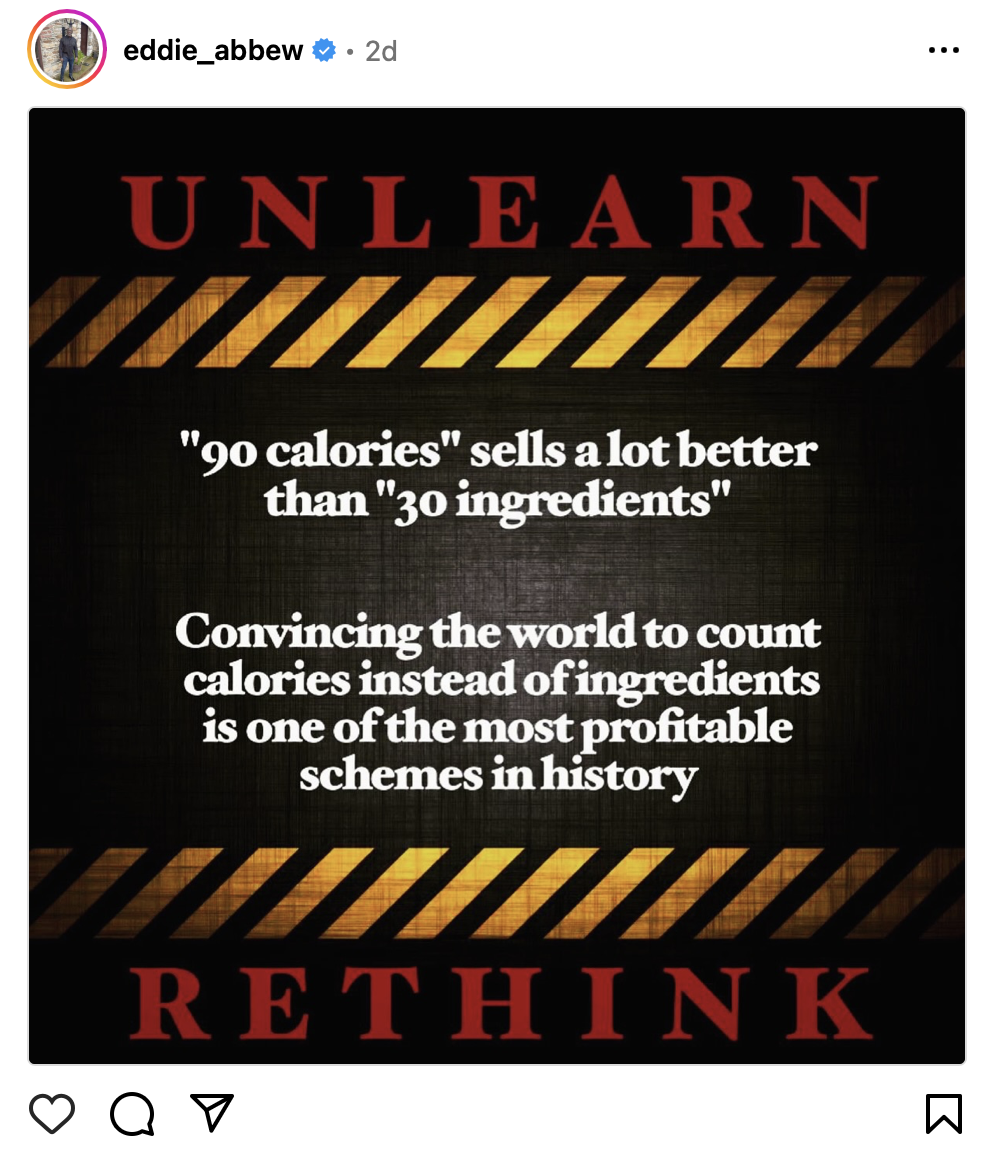
Jobs theory is about finding the meaning behind something. See “90 calories” and, click-whirr, must be healthy. That’s the meaning we associate. But is that the right connection?

Or is Eddie correct? Is number of ingredients a better signal?

Metrics, numbers, figures — whatever our attention catches is not accidental. Someone chose that, they framed the context around that scene. It’s up to us to ask, is this right?

Comedy Jobs Language

Jobs to be done is built on the customers language. How do they define problems? How do they frame Solutions? How do they interpret the context?

Comedy is the customers language. Laughter is customer language. Comedians, says MORGAN Housel, are brilliant. 

“Comedy is a way to show you’re smart without being arrogant…the best comedians are some of the smartest people in society.

They understand psychology.

George Carlin understood psychology, I think, better than Daniel Kahneman did. That’s a bold statement, but I think that is actually true. They are so smart at understanding how the world works, what makes people tick, how people think.

But they’re doing it in a way where they don’t want to just impress you with their intelligence. They want to make you laugh. What could be better than that?”

From The Knowledge Project with Shane Parrish: #195 Morgan Housel: Get Rich, Stay Rich, May 28, 2024
https://podcasts.apple.com/us/podcast/195-morgan-housel-get-rich-stay-rich/id990149481?i=1000657006147
This material may be protected by copyright.

Custom language

Florida Publix, February 2024

I used to return these shopping cart to the store. Not anymore.

One of our dog walking neighbors is Jewish and she turned us on to the idea of the Mitzvah. As she explained, it’s the act of doing (unrecognized?) good deeds daily. So on our dog walk we pick up trash around the neighborhood and at Publix we return some of the shopping carts.

It’s only some of the carts because this cart is exactly where it should be. It’s not in a coral or back at the store but it’s next to a handicap parking spot.

Sometimes people with handicap parking needs also have walking assistance needs. Hence the cart. The cart isn’t randomly there, it was purposely placed there by someone who “gets it”.

The same day as this picture, Seth Stephens-Davidowitz was on the Michael Shermer Shoe podcast.

He mentioned a viral tweet that got over a million impressions but only led to five book sales.

So much for “going viral”.

A few days later was Valentine’s Day.

Be curious.

Wonder about oddities, like stray carts.

Be curious.

Think beyond the metrics, like tweet impressions.

Be curious.

Listen to your partner, what do they really want?

Be curious.

Even governors use JTBD

From Arnold Schwarzenegger’s Be Useful.

It was November 10, 2005. I’d been governor of California for two years, and I’d just had my ass handed to me in a special election that I had called against many people’s advice, in order to present four policy ideas to the voters that I couldn’t make headway on by working with the legislature.

The issues?

Teacher tenure. State spending limits. Union dues and political contributions. Even redistricting reform failed to connect with them.

Simply put, I’d filled the bucket with a bunch of shit that most Californians weren’t interested in wading through at the time. It was my fault, and I wasn’t going to do that to the people ever again.

Arnold was speaking in terms of supply rather than demand. Customers won’t wade through anything – unless they really want it. Unless they understand and value it.

And you know what the key was to selling that infrastructure package to the people? Having learned my lesson from 2005, I rarely ever used technical words like “infrastructure” by themselves. Instead I talked about needing to fix our old roads and build new ones so parents wouldn’t be stuck in traffic for so long and miss their kids’ soccer practices so often.

People don’t care about the roads, they care about their time on those roads. That was the job to be done.

You’re not selling tires

From the Chuck Akre episode of the ILTB podcast. A reminder that categories are an abstraction which may conceal competition, customer criteria, and the job to be done.

Patrick: [00:10:15] I’m a quant, but I recognize the art in each of those three legs of the stool and I’d love to spend a few minutes on each. So I came across a really interesting story in preparing for our conversation about a company called Bandag and I’d love to hear that as an example of trying to identify the essence of an underlying business’ value creation, and why it’s ROE can be above nine or 10 for a long period of time.

Chuck: [00:10:36] So this was actually in the days when I was at a firm called Johnston Lemon in Washington, DC. It was a brokerage firm and I was a principal in the firm and we had some interns around and I took an inbox that was full of things I’d tear out of magazines and papers and put in a box and gave them to this intern and said, “Look through there and see if you find anything interesting.”

A week later he came back and he said, “Well, here’s a really interesting company called Bandag.” Why is it interesting? Well, it had very high returns on capital and had done well for a long period of time. And I said, “Great, what business is it?” And he said, “It’s the tire business.” And I looked at the returns and the capital and said, “Well, it’s clearly not in the tire business.”

“What do you mean?”

I said, “Well, take a look at the returns and then take a look at the returns of all the other tire businesses you find and see how they relate to each other.” And Bandag’s was three or four times what they were. I said, “Obviously, it’s not in the tire business. It’s in another business. Our goal is to figure out what business it’s in.”

So we went out to see them and a fellow by the name of Marty [Carver] was running the business. It had been founded by his father, it was in Muskatine, Iowa, and I got to the meeting and Marty had his feet up on the desk and was eating an apple during our interview. So you got a different feel right off the bat, and their business was retreating truck and bus tires. It’s something I really knew nothing about before then.

And we had been through the oil embargo in the United States in the early ’70s, where prices of gasoline went through the roof and one of the principal components of tire molding and recapping is, of course, petroleum based. So it had caused all of their dealers to have a huge increase in the cost of doing business and when prices began to come back down, Bandag took those savings and distributed them to dealers on the basis that they had to use the money in the business.

They couldn’t go buy new Cadillac’s, but they could build a new store. So their principal competition were the major tire companies, all of whom had company-owned stores. All the Bandag stores were franchised. So they were dealing with independent dealers who, as they say, got there at six in the morning and closed at nine at night, as opposed to the employee-dealers, who got there at nine in the morning and left at six at night.

And these people were motivated by their own profits and whatnot, so Bandag, very wisely shared the wealth, as it were, with their dealers, instead of passing it all onto their shareholders, at that time. And it created a huge dealer loyalty and the dealers were able to… They did very sophisticated things about identifying the cost of fuel to a trucking operation if they had a Bandag tread on their tire as opposed to some other kind of tread. And truck tires and bus tires are built and designed to be retreaded two or three times. Most people don’t know that. Automobile tires are not. Bus and truck tires are constructed that way.

At any rate, so they had built this huge loyalty network of independent dealers who continued to use the Bandag name and product in their business, instead of national tire companies and as a result of that, the company had much higher returns on capital than other tire companies

Porsche Jobs

In the late 1990s, Porsche was a great brand. The 911 and Boxster were cool cars. They were movie stars, appearing in Risky Business, Top Gun, and Scarface. 

One Porsche ad read, “it’s either an expensive sportscar or a very reasonable racecar.” Another said, “one ride and you’ll understand why most rocket scientists are German.” 

But Porsche faced a common business dilemma: Sell the same thing to new people or sell new things to the same people. Porsche needed a new thing. Porsche needed an SUV. 

The company built fast cars for sixty years. They knew what they were doing. So they didn’t let the “rocket scientists” design it. 

Instead Porsche went on a road show. They spoke with 911 and Boxster owners. What do you like? Not like? Where do you need more room? Less?

They collected data, built prototypes, and took the prototypes back to those people to collect more data. Drive this, sit here, load that.

Porsche didn’t ask what do you want? Customers are too busy living to answer! Instead Porsche presented tradeoffs like more and larger cupholders. They ‘ruined’ the design but the Cayenne sold well, surpassing the 911 in sales in just five years.

No matter how good a business, how wise and leader, how innovative a product – it always comes back to the customer. If they want more cup holders, give it to them

Interesting Listening Jobs

One aspect of Jobs Theory is when producers focus on one aspect but consumers prefer another.

Often this is in terms of measurable features: size, speed, cost and so on. But consumers think about their tradeoffs in a different language. Here’s an example from November 2023.

Bill Simmons: “To me audiobooks don’t seem that much different than podcasts. My wife likes audiobooks more than podcasts but it’s not like ‘I’m an audiobook person and not a podcast person.’”

Malcolm Gladwell: “There’s been a real blurring of that line – but these distinctions don’t matter to listeners who just want to hear something interesting. It’s only insiders who obsess over the differences between podcasts and audiobooks. It’s just interesting stuff to listen to.”