Tools for 2020

Recently I had to take our family golf cart in for service.

That seems odd, but we live adjacent to the largest retirement community in the United States. There are over 100 miles of ‘multi-use paths’ for walkers, runners, bikers, and golf-cart-drivers. Have you ever gone to dinner, the library, or home from elementary school on a golf cart? It’s awesome.

The service station was three miles from our house and so I ended up walking home. As I strolled, cars and carts zoomed past and I marveled at the efficiency of an internal combustion engine.

Later that same day I read this from The History of the Future:

“With web forums, chat rooms and a motto of “Learn, Build, Mod,” ModRetro sought to attract the world’s best, brightest and most curious portabilizers. And for the most part, Luckey’s community achieved that objective.”

Toward the end of 2019 on Twitter there was a thankfulness on the platform. I’ve met some of the most thoughtful, kind, insightful people. It’s really amazing.

Both the engine and the internet increased productivity.  Throw in some other major changes and we get a picture of the growth.
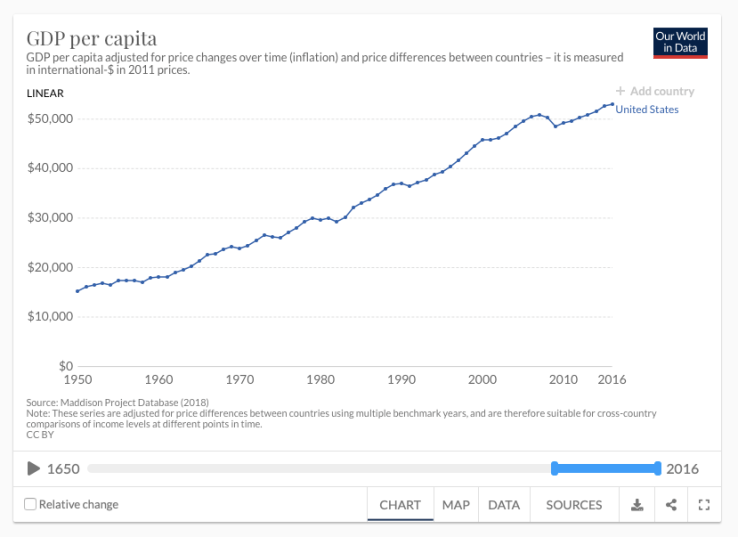
Screen Shot 2019-12-23 at 6.18.41 AM.png

That low hanging fruit has been picked, sorted, canned, jammed, and consumed. But here are some ideas for tools for 2020 and beyond.

  1. Your health. It’s amazing how much more someone can do when they optimize their physical and mental health. Some new tools will be easier than others because they’re adjacent to the things we already do but this is one area where anyone can develop and deploy better tools.
  2. Your writing. There’s something to writing that forces someone to think about an idea. Even superficial writing — I have an idea! — can be valuable because it creates a dot on an idea graph.
  3. Your technology. Those engines that zipped past me required some level of skill, so too does the technology in our lives. From no-code to real code, tweeting to a/b tests, technology is a tool to worth improving.

These three tools are guaranteed to help because there’s nothing here to sell. It doesn’t matter which health program, plan, or path. There’s no software for writing or specific code for technology.

I’m a sucker for the shiny new app, service, or technique for X. But the best results may come from the compounding of all the things we already do.

David Heinemeier Hansson

Supported by Greenhaven Road Capital, finding value off the beaten path.

Yes, we wrote that Katrina Lake had a good point about MBA programs, BUT I couldn’t help myself when this David Heinemeier Hansson (DHH) video titled “Unlearn your MBA” from 2010 came up on YouTube. This is our second post on DHH, the first is here.

Why should someone unlearn their MBA? For starters, it teaches you the wrong thing. In business school, you’re writing for professors. In the real world, you’re writing for customers. There’s a big difference.

DHH and his co-author Jason Fried are big on sharing their ideas via writing on their blogs and in their books. Josh Wolfe made the point that part of what makes a great founder is being a great communicator.

If that weren’t enough encouragement, writing well is a form of thinking well. Maria Popova put it best, “writing is thinking in public.”

Another problem with MBA program is the planning emphasis. Yes, DHH admits, planning is helpful for McDonald’s when they want to plan how many cheeseburgers they’ll sell in Q2 2020. But small businesses don’t need quite as much. MBA programs offer one thing, and rather than unlearn it we should reconsider it.

Hanson has choice words for venture capital too. “It’s a time bomb…the most harmful thing you can do to your business.” Why is that? Money becomes a crutch. Instead of relying on money, strengthen your creativity. Constraints are an asset. “Sometimes restrictions get the mind going,” wrote David Lynch, “sometimes you come up with very creative, inexpensive ideas.”

Instead, Hanson says; build a product with a price that generates actual profits. When Marc Andreessen’s number one piece of advice is to charge more I wonder if it means the same thing. You need the market to respond to what you’re doing.

For Hanson, the sooner the market speaks, the better.

Productivity advice. “Being a workaholic neither guarantees success or is a requirement for it.” Sure, Hanson says, there’s no such thing as an overnight success, but success comes from better choices, not more time.

Hanson lives in California and has co-workers around the world. “You can’t over collaborate seven time zones away,” he tells the class. He shared another smarter not harder choice with Lifehacker, saying his best time-saving shortcut was:

“Saying no. I’m always astonished by the tangled web of obligations most people manage to weave for themselves. I say no to almost everything. Then I can commit myself fully to the few things that I do truly choose to do.”

And about email.

“Most people’s inbox are overflowing because they waver, so they defer, which just makes the anxiety ever greater. Just make the call, which in my case is mostly “no,” then move on.”

Casey Neistat and Ryan Holiday teamed up to give similar advice in April 2018:

Hanson also believes in being there. Basecamp is a flat-ish organization because they don’t want to “disconnect the deciders and the doers.” One feature of Dead Companie’s Walking was absentee managers.

That Hanson spoke at all is surprising. As he says at the end, he’s afraid of alpha erosion.

“The companies that I look to that are doing well rarely get any PR at all. Most companies that are run like us are smart, they duck, they don’t talk about how much money they make. They don’t want to attract any attention.”

Eddy Elfenbein reminds us, “Always be aware that these advantages are not permanent.” And success attracts interest.


Thanks for reading.