There’s a lot of advantages to designing day-to-day decisions. It’s may seem unglamorous but changes add up. For instance, try to leave your phone out of reach.
But the internet is on there!
The heart of design is to change a situation so that something is more or less easy. The beauty of design is that the change is not always in proportion to the effect. And we need designs because as Byrne Hobart notes, we have a lot of muscle memory.
“There’s a lot of muscle memory typing ctrl-t Reddit dot com. It is really important to resist that stuff because it is a continuous tax on your ability to accomplish things. This is a good reason to buy physical books or magazines. If can force yourself to focus for awhile, you can get non-linear benefits from learning a whole lot about narrow topics and understanding new topics by using analogies from previous ones.” – Byrne Hobart, World of DaaS, August 2021
Here Hobart offers a couple of useful ideas in an interesting way. One is design but he also frames Reddit as a tax. This is clever.
Tax is normally associated with money and with being bad. Tax reframed here keeps the bad part but shifts the focus to time. That works with travel budgets too.
Personal productivity is another one of the Large N small p cases. It may not seem like we are ‘doing a lot’ but small changes add up each day.
Broadly there are 3 ways to spend a day online.
– trends, the algorithm or human generated headlines
– feeds, the self selected sources
– search, the internet queries of Wikipedia articles, travel plans, and what-is-my-kid’s-teacher’s-email
Articulating the ways helps distinguish when we are, or aren’t in a helpful place. On days when it’s time to work it isn’t helpful to spend too long in the trends. Naming also helps us establish healthy habits. Jason Zweig uses the fire hoses and tea cups system.
The 3 ways aren’t good or bad. They are more helpful or less helpful depending on the work to be done. Here’s some help for the feed type of work, two curated podcast feeds.
Periodically I cull through the blog for the MR Mentions podcast feed. These are guests or ideas mentioned by Cowen. It’s not a comprehensive list and it runs through my own filter, but it is a way to think a bit more like an economist.
Behavioral Science. Rory Sutherland is a wonderful thinker too. We’ve probably looked at his ideas even more: the room or Zoom, marathon lottos, and ambiguity aversion are just some places his ideas percolate. Sutherland has hosted Nudgestock, a B.S. conference since 2014 (the presentations are on YouTube!), a great index of thinkers.
The pitch. These feeds are free and both contain potentially valuable ideas. The main cost is the time to listen, however with the advantages of 1.5x speed, wireless headphones, asynchronous listening, and portability those costs are reduced. Plus there’s no psychological baggage (sunk costs) to make you stick around. This is my list, not yours, so passing on an episodes is a reflection of my (poor) choices.
Happy listening and cheers to the long-tail of content. Before the fire hose it felt good to “stay abreast”. In 2021 it’s about timing: what do I need to know and when. A good feed is one internet tool.
There are three ways to spend your day working in the knowledge economy.
The first day is to spend it trending. Follow the popular topics on Twitter, Reddit, and YouTube. This is good for serendipitous moments of discovery, awareness of the world, and to ‘keep-up’ with what the external algorithms suggest.
The second way to spend your day is to spend it in the feed. Cultivated email, RSS, and perennial podcasts. An infovore knows what they like and has is delivered. Often it will be confirmatory information from familiar sources, that’s okay if you’re honest about it.
The final way to spend your day is in search. There’s something to be curious about and you intend to do just that. Google offers the broadest service but new entries like Listen Notes and Twitter search modifiers have started to index novel parts of the internet.
Search operators I've been using a lot…
on Twitter, from:@ query, as in, from:@patrick_oshag "machine learning"
There’s no ‘best practice’ for the 3 Ways to Work, rather the work of the day dictates the way.
Much of what we call knowledge work focuses on decision making and much of this is a cycle between the exploration of the new and application of the familiar. It’s a balance between finding new things and digging into curio-seams.
Tyler Cowen is an example. His feeds at Marginal Revolution and Twitter offer the day-to-day goings-on, but searches on Listen Notes, YouTube, and the blog allow someone to figure out ideas like mood affiliation (my notes here), which is one way we make mistakes.
For example: Are plastic bags more harmful than paper? Are bag-bans beneficial? What’s the metric? We’ve already noted another Cowen-ism about solving for the equilibrium, but without search, we’d have missed the idea about mood affiliation. Cowen told Russ Roberts:
“Plastic is often more environmentally friendly than having a paper bag because it takes less energy to make and dispose of. Plastic is better for the world and can even be better than those reusable cloth bags unless you use them two-hundred times and up but that’s hard to do and that’s the break-even point. The environmental virtues of plastic compared to a lot of other alternatives is underrated.”
The question of bag bans for me was pure mood. Us good, them bad. I didn’t consider transport costs (paper is much heavier) and production costs (efficiency figures). Instead, I took the easy route of WYSIATI: what you see is all there is, and all I see in my laundry cupboard is plastic bags.
One of the challenges of an internet world is reading enough (and the right stuff), missing out, or failing to find that one thing. One solution is to maximize volume. Be online. Enable push notifications. Refresh.
One framing for our internet world is the world of Thoreau. Cal Newport advocates for Deep Work. This approach asks questions like are smartphones necessary anymore and argues for individual focus.
“but somewhere on the spectrum of being very online to being completely offline by Waldenpond, any measure of retreat along that axis is what I call Waldenponding. And the pieces I have been sort of developing as sort of a critical pieces advocating against that. There, I argue that Waldenponding is actually a bad thing and it’s sort of a misframing of a problem. It’s the wrong response to the, whatever is going on there; and there’s more effective ways of engaging with digital technology.”
Where you fall between the Newport/Venkat poles depends on your location, situation, disposition, and tool collection.
To combat my FOMO for missing interesting stories and internet advice here some of my favorite tools for balancing Deep Work with Against Waldenponding.
Google scholar, new citations. Books don’t update their results except for mostly small changes in the paperback edition. What works better is to find a bit of research on Google scholar and follow new citations. Read the abstract only.
IFTTT, Reddit. Reddit is the most helpful but least understood part of the internet. Using the IFTTT (free) service, anyone can create recipes to automate content delivery. My favorite is “r/science, flair:social science”. This means that when a piece of social science research is published in the science Reddit, I get an email with a link.
IFTTT, Twitter. Much like above, only for Twitter. Most tweets are sent by a minority of people. Twitter follows the pareto principle. IFTTT can create digests for never missing those rare-but-relevant people.
Twitter, from:@. Founded in 2006, Twitter has a nice history of information—if you can find it. Using this search operator a searcher can use ‘there’s always a tweet’ to their curiosity advantage. While Google offers generous and wide results, Twitter is a thornier haystack to search.
YouTube, -football, -pastor. The video site has a lot of great content with mostly good results. Sometimes however the person you’re looking for shares a name with a church pastor or high school recruit who uploaded all of their game footage. The ‘-‘ operator removes those items. This also works in many other search fields.
Google alerts, -car, -accident. A timely option. For one bit of writing, I wanted information on median and average comparisons. There was a lot of good median data but it was mostly about car accidents. Part of this research led to the note that average temperatures are higher in Phoenix than Tuscan, though the latter is one-hundred miles south of the former.
Recently I had to take our family golf cart in for service.
That seems odd, but we live adjacent to the largest retirement community in the United States. There are over 100 miles of ‘multi-use paths’ for walkers, runners, bikers, and golf-cart-drivers. Have you ever gone to dinner, the library, or home from elementary school on a golf cart? It’s awesome.
The service station was three miles from our house and so I ended up walking home. As I strolled, cars and carts zoomed past and I marveled at the efficiency of an internal combustion engine.
Later that same day I read this from The History of the Future:
“With web forums, chat rooms and a motto of “Learn, Build, Mod,” ModRetro sought to attract the world’s best, brightest and most curious portabilizers. And for the most part, Luckey’s community achieved that objective.”
Toward the end of 2019 on Twitter there was a thankfulness on the platform. I’ve met some of the most thoughtful, kind, insightful people. It’s really amazing.
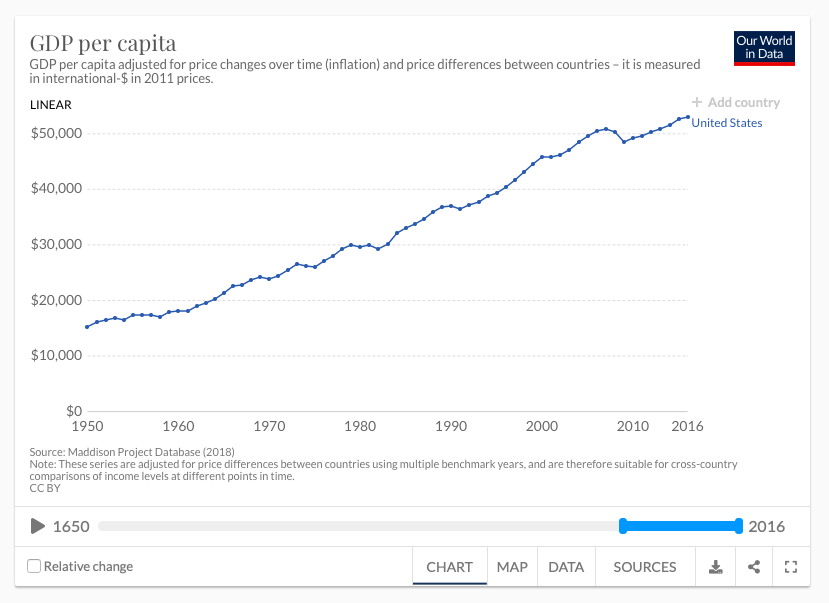
Both the engine and the internet increased productivity. Throw in some other major changes and we get a picture of the growth.
That low hanging fruit has been picked, sorted, canned, jammed, and consumed. But here are some ideas for tools for 2020 and beyond.
Your health. It’s amazing how much more someone can do when they optimize their physical and mental health. Some new tools will be easier than others because they’re adjacent to the things we already do but this is one area where anyone can develop and deploy better tools.
Your writing. There’s something to writing that forces someone to think about an idea. Even superficial writing — I have an idea! — can be valuable because it creates a dot on an idea graph.
Your technology. Those engines that zipped past me required some level of skill, so too does the technology in our lives. From no-code to real code, tweeting to a/b tests, technology is a tool to worth improving.
These three tools are guaranteed to help because there’s nothing here to sell. It doesn’t matter which health program, plan, or path. There’s no software for writing or specific code for technology.
I’m a sucker for the shiny new app, service, or technique for X. But the best results may come from the compounding of all the things we already do.
Yes, we wrote that Katrina Lake had a good point about MBA programs, BUT I couldn’t help myself when this David Heinemeier Hansson (DHH) video titled “Unlearn your MBA” from 2010 came up on YouTube. This is our second post on DHH, the first is here.
Why should someone unlearn their MBA? For starters, it teaches you the wrong thing. In business school, you’re writing for professors. In the real world, you’re writing for customers. There’s a big difference.
DHH and his co-author Jason Fried are big on sharing their ideas via writing on their blogs and in their books. Josh Wolfe made the point that part of what makes a great founder is being a great communicator.
If that weren’t enough encouragement, writing well is a form of thinking well. Maria Popova put it best, “writing is thinking in public.”
Another problem with MBA program is the planning emphasis. Yes, DHH admits, planning is helpful for McDonald’s when they want to plan how many cheeseburgers they’ll sell in Q2 2020. But small businesses don’t need quite as much. MBA programs offer one thing, and rather than unlearn it we should reconsider it.
…
Hanson has choice words for venture capital too. “It’s a time bomb…the most harmful thing you can do to your business.” Why is that? Money becomes a crutch. Instead of relying on money, strengthen your creativity. Constraints are an asset. “Sometimes restrictions get the mind going,” wrote David Lynch, “sometimes you come up with very creative, inexpensive ideas.”
Instead, Hanson says; build a product with a price that generates actual profits. When Marc Andreessen’s number one piece of advice is to charge more I wonder if it means the same thing. You need the market to respond to what you’re doing.
For Hanson, the sooner the market speaks, the better.
…
Productivity advice. “Being a workaholic neither guarantees success or is a requirement for it.” Sure, Hanson says, there’s no such thing as an overnight success, but success comes from better choices, not more time.
Hanson lives in California and has co-workers around the world. “You can’t over collaborate seven time zones away,” he tells the class. He shared another smarter not harder choice with Lifehacker, saying his best time-saving shortcut was:
“Saying no. I’m always astonished by the tangled web of obligations most people manage to weave for themselves. I say no to almost everything. Then I can commit myself fully to the few things that I do truly choose to do.”
And about email.
“Most people’s inbox are overflowing because they waver, so they defer, which just makes the anxiety ever greater. Just make the call, which in my case is mostly “no,” then move on.”
Hanson also believes in being there. Basecamp is a flat-ish organization because they don’t want to “disconnect the deciders and the doers.” One feature of Dead Companie’s Walking was absentee managers.
That Hanson spoke at all is surprising. As he says at the end, he’s afraid of alpha erosion.
“The companies that I look to that are doing well rarely get any PR at all. Most companies that are run like us are smart, they duck, they don’t talk about how much money they make. They don’t want to attract any attention.”
Eddy Elfenbein reminds us, “Always be aware that these advantages are not permanent.” And success attracts interest.