Don’t Bring an Educational Solution to a Design Fight

Dr. Henri J. Breault of Tecumseh, Ontario is a hero. Working as a pediatrician in a hospital, Brenault’s widow recalls him coming home from work one day and exclaiming I’m sick and tired pumping kids’ stomachs!

So he invented the childproof medicine cap.

At the time, Canada had about 100,000 cases and 100 deaths.

Breault came up with the palm-and-twist bottle. As an aside, how great is YouTube? This short video shows four different child-proof caps. I did not know how the pinch one worked! Breault’s creation is fourth.


Prior to Breault’s 1967 invention was a public education campaign.

We know that education affects behavior much less than systems affect behavior.

And our traditional punching bag is financial education.

“If someone says financial literacy at a party I basically give them a thirty-minute lecture. The idea is that in a perfect world if someone is taught about FICO and its impact on their life, they would take action to improve their FICO score. This is just not what researchers have found – and it’s really robust…the punchline is that environment matters.” – Kristen Berman, All the Hacks, October 2021

So, don’t bring an educational solution to a design fight.
Jurassic Park (book review)

Jurassic Park (1993) by Michael Crichton is a book about expectations. But first, we have to address the movie.

The movie was great. It was an amazing adaptation (and is connected to the Pixar story btw). But – it defines the characters. Hammond, Malcolm, Ellie, and Grant are the movie version in my version. Oh well.

Ok, back to expectations.

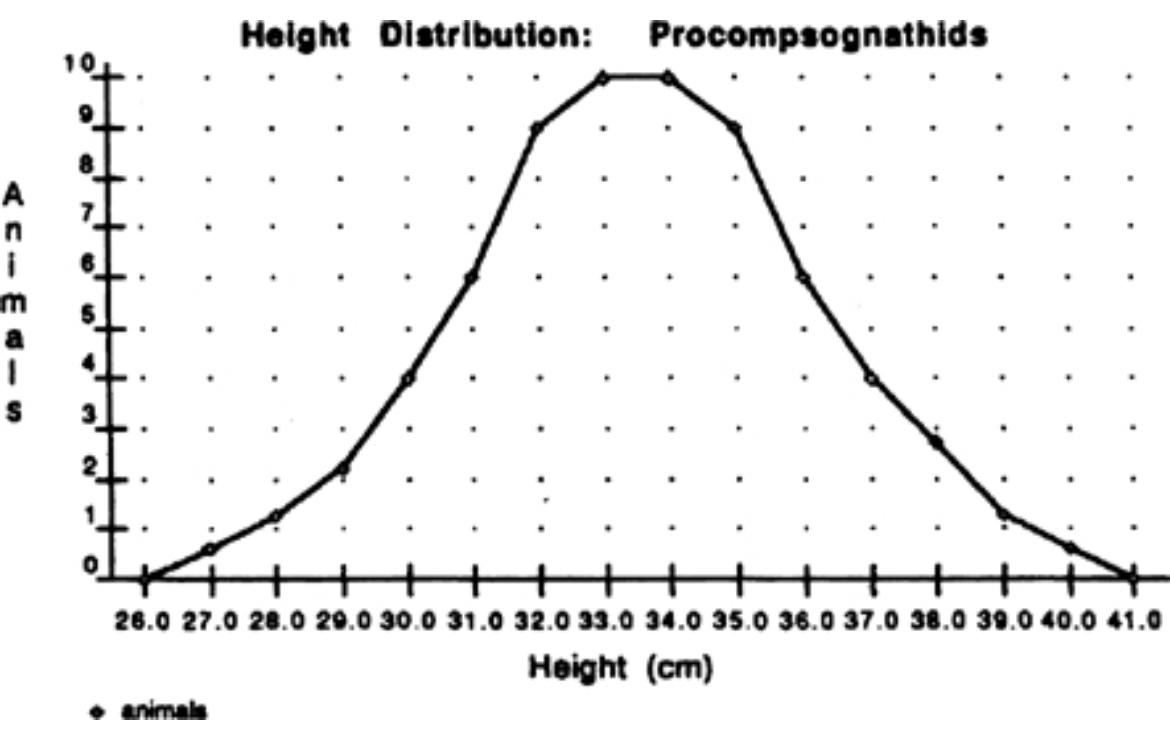
The Jurassic Park story turns when Malcolm tours the facilities and sees this:

See, Hammond says to Malcolm, everything here is normal!

But, Malcolm counters “that is a graph for a normal biological population. Which is precisely what Jurassic Park is not. Jurassic Park is not the real world.”

Normal distributions (and averages) are a specific tool. But they are the wrong tool for distinguishing between Snickers and Milky Way, student loan debt, or Aaron Rodgers touchdown passes. Or, tracking dinosaurs.

Jurassic Park is not the real world. It is a zoo. Cages. Fences. Pens. Controlled feeding. Controlled breeding (oops). Controlled everything.

Malcolm again, “Because the history of evolution is that life escapes all barriers. Life breaks free. Life expands to new territories. Painfully, perhaps even dangerously. But life finds a way.”

Life finds a way.

“Now you see the flaw in your procedures,” Malcolm said. “You only tracked the expected number of dinosaurs. You were worried about losing animals, and your procedures were designed to advise you instantly if you had less than the expected number. But that wasn’t the problem. The problem was, you had more than the expected number.”

Hammond expected to run a zoo.

Hammond expected a ‘normal number’

Hammond expected his problem to be ‘fewer’ not ‘more’.

Expectations are heavy, they are hard to throw off. I could only picture Jeff Goldblum as Dr. Ian Malcolm. Hammond could only picture Jurassic Park one way too.

This isn’t really a book about dinosaurs, they’re just a stand in. For what?

Also interesting that Waltrop’s Complexity came out around the same time. Something was bubbling in the early 90s. Something is bubbling now too.

Calendly’s CAC

Approximately seventy percent of Calendly’s new users come from using a Calendly link. That’s a crazy CAC.

But that’s not all.

Customer acquisition cost requires converting customers which requires building something that offers progress (the JTBD).

At first, Calendly’s users were broad. “What that means,” said Annie Pearl “is that product managers had a really hard time prioritizing.”

What the heck to build?

“We’ve made a clear distinction that while a lot of the feature work – that we’ll do to support our target personas of sales teams, customer success teams, and recruiting teams – will impact folks who are not in those personas. Those are the core ICPs that we’re going after. And so, historically, that would’ve always been a sort of trade-off decision and a question. And now I think we have a lot of rigor around our target market and the persona we’re going after. And so, teams can use that to prioritize and deliver better value for those users.”

A lot of people join, but the product may not be built for them.

Calendly’s actions represent Todd Rose’s three features from The End of Average.

We are jagged creatures. ‘Good’ executives are a collection of leadership, insight, and strategy skills. The average ‘good’ is a collection of jagged parts.

We are contextual creatures. We aren’t ‘jerks’, it’s just when we are driving. We aren’t ‘generous’, it’s just while tipping a server.

We are path dependent. The places we’ve been, affect the places we will go.

If a business serves “the average” they won’t find the jagged, contextual, or path-dependent parts that really matter. Calendly’s decision to build for sales teams, customer success teams, and recruiting teams show how their process embraces Rose’s observations.

Ben & Jerry’s: The Inside Scoop (book review)

Ben & Jerry’s: The Inside Scoop is an underrated business book. Traveling through the 1980s and 90’s it chronicles the growing pains of America’s favorite ice cream pints. 

It’s a business book with two parts. 

The fun stuff

Two hippies create, grow, and scale a super premium ice cream brand from a converted gas station in Vermont! That’s fun. 

On Black Monday 1987 the duo showed up on Wall Street with “That’s Life, vanilla ice cream with pieces of stale apple pie (the stale pieces held up better in the ice cream), and Economic Crunch, which was actually some leftover Nutcracker Suite from the previous winter, renamed for the occasion.”

Ben and Jerry drove around in a Cowmobile promoting the brand. On their one-year anniversary, they hosted a block party, with Ben and Jerry organizing, acting as characters, and offering free ice cream of course.  

The grind

“Amateurs talk about strategy,” said Omar Bradley, professionals talk about logistics.” 

Ben & Jerry’s wasn’t the only super-premium ice cream. Häagen Daz was the market leader and a bunch of me-toos. Starting in Vermont, a state with no Baskin Robbins franchise was probably a blessing. 

But the distribution was still a grind, sometimes literally as their beat-up delivery truck broke down delivering the pints. Once they contracted out to distributors it was a game of sharp elbows for shelf space, full of kickbacks, relationships, and lawsuits. 

Even the Beatles had a logistics machine! 

Oh, and the people. 

Every business is built on the foundation of its people. In a podcast with Brent Beshore, Anu Hariharan said she looks to invest in good teams with product-market fit. This is despite her technical and financial backgrounds. To paraphrase: It’s the people, stupid. 

But that’s also the hardest part of a business. 

While Ben & Jerry’s product line, market share, and revenue grew, the team’s expertise did not. They hired slowly. Not because of a great vetting process but because they were overwhelmed. They fired slowly too, a terrible combination. 

Oh, and the finances!

We won’t recount the story here, but in Shoe Dog, Phil Knight writes about taking all of his profits back to the bank to say, see, these things sell, now please give me another, larger loan.  That happened in Vermont too. Inventory. People. Facilities. Raw materials. New facilities. At least they could drown their sorrows in a fresh pint. 

Be your own boss with your best friend(s), but work like hell.

Sounds right.

Door Knob Job

We focus on jobs to be done not because it’s the perfect solution but because it’s underrated.

Think like an economist or moneyballer and ask what is underrated?

The underrated tend to be cheaper for the same results or the same cost for more.

This is a local door. The sunshine hits (and heats!) the handle. The solution is to wrap it in a towel.

This is what jobs theory calls “supply side thinking”. Whoever chose that handle thought about cost, aesthetics, or anything besides use.

“Demand side thinking” starts with consumer progress – a simple cell phone. And that starts by opening the door.

Freezer doors

There’s something mentally stabilizing, even encouraging, to know what’s going to happen.

Not precisely. Not like a crystal ball. Just generally, like a heads up.

At a parent meeting, my daughter’s volleyball coach said, the season is long and the work is hard, at some point your kid will want to quit, don’t let them.

That was good. It prepared the parents.

We don’t always get this information

Sometimes we get the “Instagram” life. That’s unhelpful.

In 1987, Ben & Jerry’s had their best summer ever: a year-over-year sales increase of 60% to 32 million dollars.

Financially things were good.

Functionally things were a mess.

At their brand-new plant, the freezer doors didn’t have “tolerance”. The sliding doors were only just large enough for a forklift to perfectly pass through. Sometimes it didn’t. The result was that after enough banging on the freezer frame, the staff left the doors open and relied on the plastic strips to insulate the ice cream as best it could.

“The term freezer door,” wrote CEO Fred Lager, “became a metaphor within the company for anything that wasn’t working and was being ignored despite a painfully obvious need for attention.”

Human resources, processes, and candy chutes were all freezer doors.

They had to address these growing pains.

At an all-hands meeting after the busy summer season wound down, Ben Cohen gathered everyone and gave a state of the company. To address the freezer doors he asked everyone to form groups and create a list.

There were a lot of complaints, but Ben took them all in stride. “It’s only an indictment of management if you think that a well-managed organization doesn’t have problems,” Fred recalled Ben’s comments, “This was just telling us what we had to work on and letting the employees know that we knew about it.”

It was a heads-up.

These wrap-ups that lead to heads-ups are post-mortem reviews. At the Rewired Group, they are a mandatory part of the process. But they don’t just successfully happen.

Our egos can get in the way. Post-mortems are NOT to assign blame. Howard Marks called this book, “a very interesting book on self-justification” – aka somebody f’d up and it wasn’t me.

What works better is a culture of extreme ownership. This starts at the top. Ben Cohen wasn’t a perfect leader. No one is. In Lager’s book, he comes off as demanding and not fully aligned with the rest of the ice cream crew. But what he does do is avoid the ego trappings of the top position.

“Eighty-five percent of all problems,” wrote Deming, “are system problems not people problems.”

Be wary of the ego. Address the system. Fix the freezer door.

How To Get Kids to Read

“Parents come up to me all the time and say, “I can’t get my kids reading.” I commiserate, then I tell them, “Hey, do you manage to get them to the dinner table? Do you allow them to track mud or snow onto your living-room carpet? Do you let them curse in church?” Then make this a rule: We read in our house.”

James Patterson

Simple, but not easy.

Start with design.

Make a rule.

Create a space: time and place.

Don’t rely on best intentions.

Seven days a week is easier than three.

“85% of problems are system problems, not people problems.” – W. Edwards Deming

Pappyland (Book Review)

Pappyland by Wright Thompson is a book about wistfulness and wishfulness.

Kentucky Derby visitors are wistful.

“The day-trippers wear gangster suits and outlandish patterns and hats inappropriate to the latitude, temperature, or setting. It’s amateur hour. They hold liquor like ninth graders. The homogenization of America has left people wandering the land in search of a place to belong. We are a tribeless nation hungry for tribes. That longing and loneliness are especially on display in early May in Kentucky.”

That feeling is in late-night bourbon too. We feel nostalgic, “which I only recently learned comes from the Greek words for home and pain.” Bourbon, Wright writes, “It’s a drink made for contemplating, and what is usually being contemplated is the easy and often false memory of better days.”

It’s Springsteen’s Glory Days. Youth is wasted on the young. It’s melancholy.

There’s also wishfulness.

The book is centered around Julian Van Winkle III, the caretaker of the bourbon brand Pappy Van Winkle. My impression was silver spoons, seersuckers, and bluegrass mansions. My impression was wrong.

David Chang once cautioned an interviewer that just because a restaurant was highly rated and busy did not mean it was also a good business.

Julian grew up well, running around the bourbon-born grounds. But like the Kentucky horses, bourbon’s success was short-lived. The glamorous inheritance from his grandfather couldn’t be salvaged by his father and the family business sold out.

That’s about when Julian wished for it back.

That’s about when Julian worked for it back.

Wright weaves a good story, which I won’t spoil. It’s about Julian’s past and present. Our past and present. Wrights too.

Can we be anything but wistful of the past? Is bourbon a conduit? We marvel at AI’s ability to generate the right information. Physical artifacts do that, bourbon does that.

“We make fine bourbon at a profit if we can, at a loss if we must, but always fine bourbon.” – Pappy slogan

Have You Heard the One About Ozempic?

Every idea arrives in a person’s life at a certain stage in the idea’s life. I heard about the cryptocurrency Luna on January 4, 2022. One-hundred days later it crashed. I heard about $LSF in August 2022. It’s fallen fifty percent since then.

Where am I in the investing lifecycle? Late apparently. My awareness negatively correlates with price.

That’s helpful information!

In late 2022 I heard about Ozempic (semaglutide). By February it was on the Honestly podcast with Bari Weiss. Let’s see where this goes.

Tracking ideas is just one meta-idea from Weiss’ work.

Why is this so cheap? Weiss wonders. The average weight loss on Ozempic is 15% of body weight. There must be side effects, right? Remember, we are storytellers. To sell something cheaply, tell customers it’s because we don’t offer any perks.

Too good to be true. A classic red flag, especially to avoid errors of omission. TGTBT will be helpful to AI.

This time is different, only when the rules of the system change. Weight loss is physiological, social, financial, and psychological. If enough of those rules change – for instance, Ozempic is covered by insurance for weight loss, it’s not currently – then things will be different.

Arguing well is difficult. In the podcast, Weiss hosts a trio of experts – who mostly talk past each other. For an organization to find the best path they must argue well and to do that they need to have a strong relationship.

This post was created in February 2023. It was published in August 2023. How did Ozempic do?

Haircut and Shampoo Jobs

One part of Jobs theory is that the category may not be the competition. In Competing Against Luck, Clayton Christensen wrote that V8 is in the juice aisle but it competes with the produce section. No one bought V8 instead of apple juice, but they may buy V8 instead of celery sticks.

Another grocery-based job is the Chobani Flip. The accidental yogurt company’s problem was that people saw yogurt as a morning food. Talking to customers, Chobani found that if people could mix in something else it was seen more like a snack. And the Chobani Flip was born.

Like V8, Flip doesn’t compete with other yogurts, it competes with what else parents might buy. Like Pirate Booty.

This is the Jobs insight: think of the job rather than the place or the product. Proximity (aka category!) is not the competition.

Dove shampoo brand gets this.

Framed as “person on the street”, shampoo reps ask women if they need a haircut. Yeah, it’s my split ends, the women say. Well, what if you try our shampoo first?

Naturally, the shampoo works wonders for treating split ends and the women are happy.

Naturally, it’s a great use of Jobs theory. Rather than compete with other shampoos, this company competes with haircuts.

You keep using that word, competition, I don’t think you know what it means.