Competing Against Luck (book review)

Clayton Christensen developed The Innovator’s Dilemma to help established organizations understand that when they serve their most profitable customers it leaves them susceptible to innovators who enter the low-end of the market but serve the customers better and move up the market to become the newly established organization.

There’s also a solution.

Why were innovators successful?

They’re undercapitalized, under-experienced, and underwhelming relative to the established company.

The answer was Jobs To Be Done, told in Christensen’s et al. book Competing Against Luck.

Jobs is a way to describe the functional, social, and emotional progress a person wants to make in a given context.

Christensen’s work includes the milkshake example, where he and a team found that people bought milkshakes first thing in the morning. They ‘hired’ the shake to entertain them on the commute and provide some calories. They also finished before work so as not to be judged by their colleagues.

Christensen’s experiences included buying his son a milkshake. This is a different set of functional, social, and emotional progress a person wants to make in the context of being a dad in the afternoons.

This contrast is Jobs.

It’s work to find, but worth it. The process of understanding the job, the context, the progress, and all the parts creates a sustainable advantage (aka profits and avoidance of the market mechanism).

Think about Netflix. If a capitalized and connected Hollywood mogul wanted to compete with Netflix, they could buy all the streaming rights but that misses all the work: physical networks, social networks, technology, production, and so on.

Jobs exist for solutions to enduring and persistent problems. Snapchat was preceded by the IM, which was preceded by the extra-long telephone cord which was preceded by passing notes in class.

Kids talking to each other without adults’ oversight is an enduring and persistent problem.

A large example from the book covers the Southern New Hampshire University online program. Once the staff adopted a Jobs perspective they noticed two sets of customers.

The first was conventional high school graduates who wanted a conventional college experience.

The second was adult learners who needed information, training, and accreditation yesterday.

SNHU found the context was a parent alone at the kitchen table at night and looking for immediate information. Their functional progress was training and certification. Their emotional progress was as role models for their kids.

A university seems like a singular thing. But in the context of these two customers, it must act differently.

With hindsight, Jobs stories are obvious – and we’ve shared plenty – but to find them takes clustering data. The interviews are hard, especially relative to the alternative innovations of: cheaper, faster, sooner, shipped, or a different color.

Some clustering insights:

GM’s OnStar division listened to customer calls and found that it was people who were in an unfamiliar place and wanted to feel safe. OnStar wasn’t directions so much as security.

V8’s product manager saw things through the eyes of their customers who wanted to “eat” their fruits and vegetables. V8 is a juice whose competition isn’t in the juice aisle.

Intuit found that customers didn’t want tax optimization so much as tax minimization. Make this painless, fast, and damn sure I don’t get audited we don’t have time for that.

Along with Bob Moesta’s books, Competing Against Luck is the best introduction to Jobs. Though a touch academic, the sections are fast and full of examples and theories.

Are You Ready to Push?

One outcome of self-education is “out of sample” connections. School’s structure favors efficiency and repeatability, not connecting dots. But those dots are out there, it’s just up to you. 

And it’s worth the work. 

If something is true in more than one condition place, or time it’s going to be true a lot. 

Walk in My Combat Boots is a collection of soldier’s short stories. Each runs a couple of pages from training to deployment, from the mundane to the disastrous. 

One theme is that military life is hard. Training is hard. Deployment is hard. It’s hard physically, mentally, and emotionally. The weather sucks. The gear is heavy. Our normal ambiguity aversion is supercharged. 

But everyone pushes. 

“I love the challenges.” wrote one soldier, in a reflection common to every story, “I love proving people wrong. And I love proving myself wrong, too—there are plenty of days when I hang my head and think, Man, I can’t do this. But then I wake up the next day and push myself more and more.”

Our normal state is not to push. 

Pushing takes fuel. 

How? 

“The first thing you have to do,” Dan Rose said of successful leaders “is you have to articulate why it is that you’re so insistent on this thing that you believe is so important. And that articulation has to resonate with the people who are going to go build it, and it has to resonate with people who are smart and thoughtful and are ultimately credible enough to make that happen.”

For the soldiers it was patriotism. That resonates. That’s fuel. 

When I taught in schools the hardest question was: When are we ever gonna need to know this? It was a hard question because I couldn’t articulate a resonating answer. The kids didn’t care. 

So, are you ready to push? 

95/5 Instead of 50/50

It’s 2004. Will Guidara is working at the Museum of Modern Art. Not in the esteemed gallery or adored restaurant. Will is in charge of the cafe: coffee, sandwiches, and snacks.

And he wants to create a gelato cart for the Sculpture Garden.

But first, he needs gelato worthy of the museum and his group, Union Square Hospitality. He finds Jon Snyder who sells it at a discount. He also convinces Synder to pay for the cart. It’s a nice cart.

Things are looking promising.

And then Guidara goes crazy.

He wants Italian spoons. “How amazing could a plastic spoon possibly be?” Will writes, “You’re going to have to trust me on this: they were paddle-shaped, extraordinarily well designed, and completely unique.”

But they’re expensive. His boss sees the cost and says “we’ll talk about this later.” But Guidara loves them. He gets them. He creates The 95/5 Rule.

“Manage 95% of your business down to the penny; spend the last 5 percent ‘foolishly’.”

This idea manifested later when Guidara was at Eleven Madison Park. While traditional wine flights had average wines, Will and his winos wander wider. Most of the samples were good, diverse, and less expensive. But one, the last one, was excellent. “The Rule of 95/5 gave us the ability to surprise and delight everyone that ordered those pairings, making it an experience they would never forget.”

It’s a good rule because averages are not good measures. Save where you can but splurge on one thing. That’s helpful. That gets past average thinking.

1400s Portugal’s Innovator’s Dilemma

It’s the late 1400s and Christopher Columbus needs money.

People know, (Gutenberg, 1440) the world isn’t flat. But people don’t know what’s out there.

Marco Polo (1295) reported that there’s a lot out there and it’s not that far. But there’s no consensus that westward from Portugal, Spain, and England is anything more than some rocky island.

“By late 1491,” Christopher Columbus, “is about ready to give up.” “England wasn’t going to (fund him)” said Dominic Sandbrook, “the most plausible alternative to Spain doing it is Portugal but their eastern ventures are successful.” Portuguese sailors found a route around the tip of Africa to India. They don’t need to explore.

The innovator’s dilemma exists within the explore/exploit dichotomy because of incentives: ESPN go brrrr. If it were obvious, there would be no dilemma.

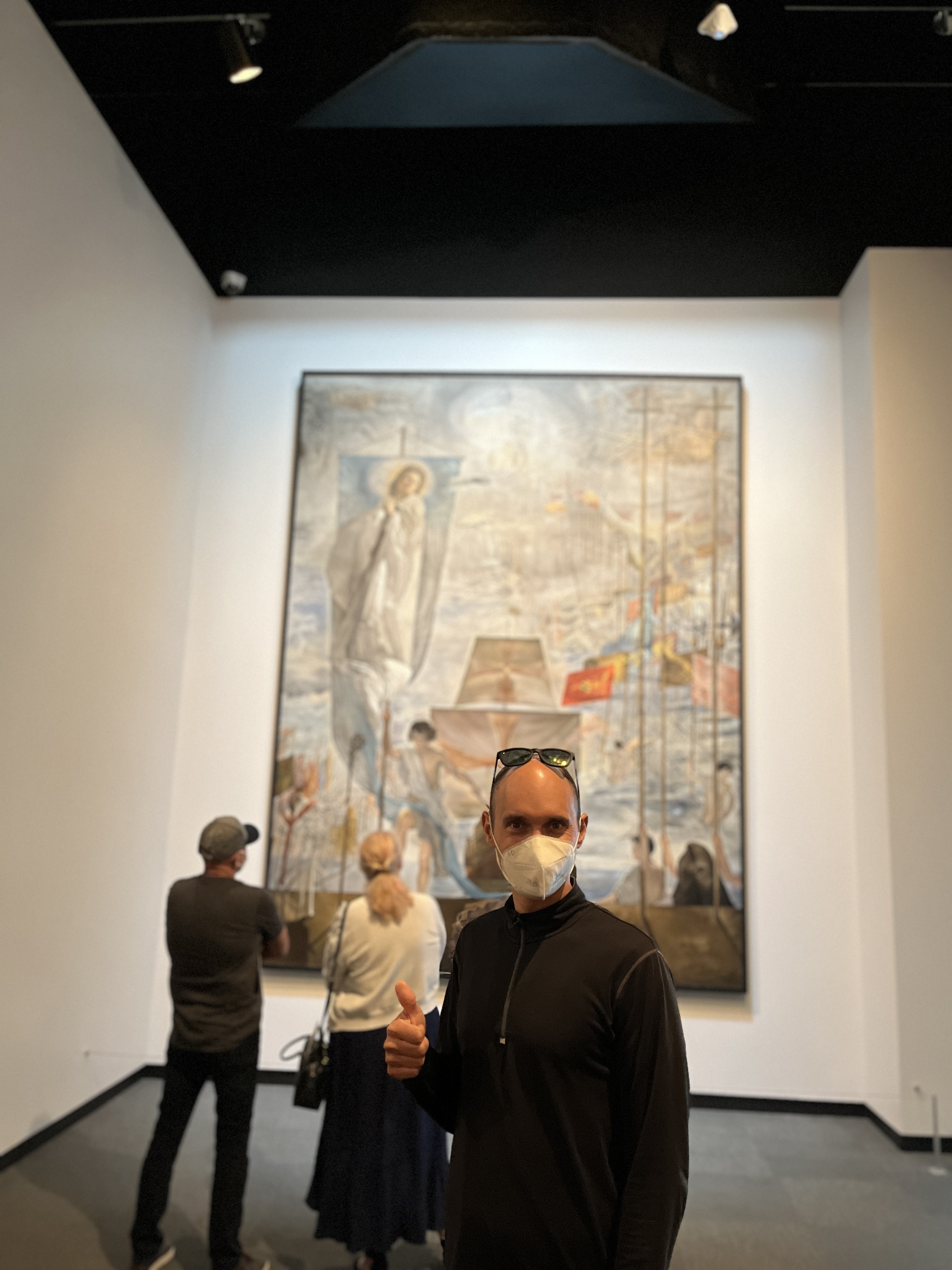
This is Dali’s The Discovery of America by Christopher Columbus at the St. Petersburg Dali museum (January ’22). It’s not a large museum but these paintings are huge – 14 feet tall!

Sandbrook says that Columbus embraced his namesake who carried the poor and weak across a river. Columbus felt like he ‘carried Christ’ across the Atlantic. That’s how he saw himself. That context gives that painting a different meaning.

If pre-1900s trade excites you, look up For All the Tea in China by Sarah Rose. It’s the of Scottish botanist Robert Fortune’s EIC’s sponsored trip to sneak tea out of China.

Picture Perfect Langauge

“It’s about having a conversation with the consumer,” said advertiser Linda Kaplan Thaler. In their language.

Legibility affects our understanding. In the alpha erosion, words mean competition and market mechanism posts we looked at this idea from a producer’s angle. If a business earns excess returns it attracts competition. It’s the non-repeatable processes that allow a business to remain dominant. That is, are the advantages legible to competitors?

Another application of this idea is product development. Customers hire jobs to be done to make progress in their lives and successful product development follows the legibility of customer wants.

Thaler recalls one night on The Johnny Carson Show when an actress commented about needing her camera for a “Kodak moment”.

I looked at my team and asked if we had used that before. No, everyone said, that’s brand new.

Bingo. That’s customer language. Linda’s team had the Kodak account and making Kodak moments legible is what they sold.

Successful businesses hide legibility from their competitors and find legibility in their customers.

All-Star Differences

“At some level, you have to rethink the all-star game in its entirety. If you think about its origins when barely any games were televised and you could only see American League or National League games if your local team was in that league. The all-star game was the only time you got to see players from the other league.” – Adi Wyner 

This time is different states that things are different when the rules change. The covid vaccine is different because the rules for vaccines changed. The 2010s technology boom was different because of accessible technology like AWS. But rules changes accumulate in ‘looser’ domains as well.

All-star games are different because the economic, social, and technological rules have changed. Major League Baseball held its first all-star game in 1933! How things have changed indeed.   

Now, Wyner wonders, how can we get players to care? – or the equivalent. The home run derby is fun, but the game is less so. The three-point contest is fun, but the game is not. We’ve always done it this way. So what! This time is different

Bourbon Jobs

We hire jobs to be done for three reasons: functional, emotional, and social. This is clear at the liquor store.

In college, we bought cheap beer. The function was to get buzzed and the social job was to have fun doing it. We might upgrade to Coors Light or even PBR which our favorite wing place always had on tap. Even the upgrade is social.

Liquors differ. They’re packaged more colorfully. The containers are shaped. Their origins matter. It’s more story. People like us drink things like this.

In his book, Pappyland, Wright Thompson discusses the bourbon’s brand:

“The reason Pappy’s office was built to look like Monticello, with the leafy grounds of the Stitzel-Weller plant made to feel like an oasis from modern life, was because he knew that bourbon drinkers were often motivated by nostalgia—It’s a drink made for contemplating, and what is usually being contemplated is the easy and often false memory of better days.”

If our core emotions fire on danger, food, and sex then bourbon serves anti-danger. Bourbon serves ‘southern comfort’. It feels like the good old days, with dad or grandpa. Bourbon ads are warm. It’s a drink to sip. We never drank bourbon in college.

Vodka sells sex. Rum sells fun. Gin sells sophistication. Tequila sells a little bit of everything.

“A bottle of bourbon,” Thompson writes, “is a coded way for so many unspoken ideas to be transmitted and understood.” Often jobs are coded, sometimes they’re an enigma. Sometimes not.

But to really understand bourbon’s job, we’d have to go deeper. What’s the context? If this were a documentary what would it look like and feel like? Who is there? What are they wearing and where did they come from?

Solving the EV Problem, 2

Paying 1,000 people $1 in interest is different, according to Credit Karma, from paying one person $1,000 in a lottery. 

That same thinking can be applied to electric automobiles.

Eighty percent of drivers drive fewer than fifty-five miles each day. Half of all trips are less than five miles. Yet vehicle range is a prominent selling point.*

We’ve tried to solve the EV problem before but here is another idea. 

Fuel Rods are rechargeable lithium batteries used for charging phones, bluetooth speakers or headphones, or whatever. But they can be swapped at any Fuel Rod location. You see these at airports. Here is the map of Orlando swap spots. 

Most of the time users can recharge on their own schedule. Sometimes users need a fresh swap. 

Can EVs do that? 

Previously, we focused on the subjective. The rules of chemistry dictate how quickly an EV can charge but it’s the rules of psychology that influence the enjoyability of the wait. 

But we can change ‘how quick’!

Swap the batteries. 

Gas stations sell diesel, unleaded, and propane fuels. They sell fat, carbohydrates, and protein calories. Sheetz has the best air pumps. In Florida, my state, an absurd number have car washes too. Why can’t they sell automotive fuel rods too? 

* There’s also the availability heuristic. Range is easy to understand and compare so it appears important. 

Greeting Card Competition

In Competing Against Luck, Clayton Christiansen‘s book about jobs to be done, he talks about the three jobs groups: functional, social, and emotional. Each depends on the situation.

Clayton’s classic example is the milkshake. It functions as nutrition and provides emotional entertainment during a commuter’s morning.

In the afternoon that same milkshake provides a functional snack and an emotional connection between parent and child as an after-school treat.

Lovepop co-founder Wombi Rose talked about the depths those jobs have.

“It’s about helping you with your occasions. We want to make sure you can quickly send a thoughtful and creative gift. We’ve found that everyone wants to be more creative and thoughtful but it takes time. We want to help you with those two challenges. We’ll remind you of those occasions and make it super easy to do something that is creative and thoughtful where what you do is based on your relationship.”

Meaningful messages are costly.

In high school, one of my made-up start-ups was a celebration card company that sent out cards on your behalf. Rather than your forgetful self, hire us to send Aunt Jan’s card on time every time. As my friends pointed out, it kinda took the charm out of the whole experience.

Rory Sutherland, the alchemist, points out that digital wedding invitations work – so long as they’re costly. A song works. A poem worlds. Something that demonstrates an investment works.

Lovepop’s attempt is to link people’s lives to the cards they buy. Does your special someone have a certain plant they love, like a Japanese Maple? Do they like a certain animal? There’s a card for that.

Jobs gives language to discuss the depths. It’s like the wavelength spectrum. We can only see so much. That’s our visual language. But our tools give us the ability to understand a whole lot more. Just like jobs.