Tools for the internet

One of the challenges of an internet world is reading enough (and the right stuff), missing out, or failing to find that one thing. One solution is to maximize volume. Be online. Enable push notifications. Refresh.

One framing for our internet world is the world of Thoreau. Cal Newport advocates for Deep Work. This approach asks questions like are smartphones necessary anymore and argues for individual focus.

Vekatesh Rao writes against ‘waldenponding’ and explained the idea to Russ Roberts:

“but somewhere on the spectrum of being very online to being completely offline by Waldenpond, any measure of retreat along that axis is what I call Waldenponding. And the pieces I have been sort of developing as sort of a critical pieces advocating against that. There, I argue that Waldenponding is actually a bad thing and it’s sort of a misframing of a problem. It’s the wrong response to the, whatever is going on there; and there’s more effective ways of engaging with digital technology.”

Where you fall between the Newport/Venkat poles depends on your location, situation, disposition, and tool collection.

To combat my FOMO for missing interesting stories and internet advice here some of my favorite tools for balancing Deep Work with Against Waldenponding.

Google scholar, new citations. Books don’t update their results except for mostly small changes in the paperback edition. What works better is to find a bit of research on Google scholar and follow new citations. Read the abstract only.

IFTTT, Reddit. Reddit is the most helpful but least understood part of the internet. Using the IFTTT (free) service, anyone can create recipes to automate content delivery. My favorite is “r/science, flair:social science”. This means that when a piece of social science research is published in the science Reddit, I get an email with a link.

IFTTT, Twitter. Much like above, only for Twitter. Most tweets are sent by a minority of people. Twitter follows the pareto principle. IFTTT can create digests for never missing those rare-but-relevant people.

Twitter, from:@. Founded in 2006, Twitter has a nice history of information—if you can find it. Using this search operator a searcher can use ‘there’s always a tweet’ to their curiosity advantage. While Google offers generous and wide results, Twitter is a thornier haystack to search.

YouTube, -football, -pastor. The video site has a lot of great content with mostly good results. Sometimes however the person you’re looking for shares a name with a church pastor or high school recruit who uploaded all of their game footage. The ‘-‘ operator removes those items. This also works in many other search fields.

Google alerts, -car, -accident. A timely option. For one bit of writing, I wanted information on median and average comparisons. There was a lot of good median data but it was mostly about car accidents. Part of this research led to the note that average temperatures are higher in Phoenix than Tuscan, though the latter is one-hundred miles south of the former.

Thanks for reading. 

Nothing is Above the Laugh

This is from the POV40IQ magical email series, with the goal of changing perspectives each week day because a change in how you view a problem is better than forty-more-IQ on the problem. 
Here’s an exchange from Marc Maron’s podcast with Jerry Seinfeld which articulates the difference between demand side innovation and supply side innovation.

“I like the laughs but I noticed with you, that there are moments in a bit where they might not be the biggest laugh moments, but they are your favorite moments.” (Maron)

“Yes, that’s fine but I’m very anti-indulgence. My job is to serve the audience. To make them really laugh because that I think is the only relevant currency in the end.” (Seinfeld)

“Just a laugh?”

“Yeah.”

“I always look for meaning in jokes. That’s the reason I got into comedy, because comedians make things understandable and manageable.”

“Yeah, but I never put anything above the laugh. Self-revelation, opinion, insight. I would never weigh those the same as the laugh.”

Comedy is a beautiful art form because it’s fast. Idea, joke, feedback. It’s the mayfly of the art world. Organization innovation cycles take longer, but it’s crucial to think about how they can serve the customers in the way the customer wants. In comedy, “nothing is above the laugh.”

Linda buys a bat and brand

There’s a quarrel in psychology research over Linda the banker. First some background. Most behavioral psychology is about crafting nearly identical situations with nearly identical composites of people who, despite the near identity, act in different ways.

One example is when employees are prompted with savings cues for their 401k. Imagine that with the annual corporate messaging about insurance, vacation adjustments, and outlook projections was a form that said “Did you know that your 401k contributions from October through December are eligible for a full employer match?” Employees who get the annual message with lines like that, raise their savings rates three percent. Employees who don’t get that message don’t change their rate.

What anyone saves is dependent on their own choices, right? However with the change in one line they aren’t.

Okay, now let’s talk about Linda.

Linda is 31 years old, single, outspoken, and very bright. She majored in philosophy. As a student, she was deeply concerned with issues of discrimination and social justice, and also participated in anti-nuclear demonstrations.

Which is more probable?

  • Linda is a bank teller.
  • Linda is a bank teller and is active in the feminist movement.

When this original research was done, most people chose the second option.

And it’s wrong.

This ‘conjunction fallacy’ goes like this: there’s no way that there can be more bank tellers who are active in the feminist movement than there are all bank telllers.

This is mathematical logic. But it’s not how people think. When people hear Linda’s story they take the contextual clues that come along with it. If we could peak inside a participants mind we might see thoughts like this, ‘If you’re telling me all this stuff about Linda then it must be true that she is both a bank teller and active in the feminist movement.’

Any information that people get, people use and numbers are a special kind of information.

Numbers carry an authority.

Home values increased.

Home values increased by 8%.

And numbers lead to fast thinking. 

In his best-selling book, Daniel Kahneman framed this idea in terms of thinking fast or thinking slow. For some things in life, Kahneman wrote, we tend to think fast. Brands are fast thinking.

pasted image 0

There’s no interpretation here.

Numbers are like brands. Though an 8% increase in home values is a complex computation of home sales, realtor surveys, incomes, and so on, we see that and think it’s true without really thinking.

Joining Linda in the pantheon of psychology phrasing is the bat and ball problem. It looks like this:

A bat and a ball together cost $1.10. If the bat costs a dollar more than the ball, how much does the bat cost?

Ok, now try it this way.

Bat + Ball = $1.10, the bat costs a dollar more than the ball.

Or, the same idea in a different way.

A Ferrari and a Ford together cost $190,000. The Ferrari costs $100,000 more than the Ford. How much does the Ford cost?

Each step down slows thinking. People see the bat and ball problem the same way they see brands or 8% increases: fast.

Most of the numbers we encounter in life is like brands, the bat and ball problem or Linda the banker—our default is to move quickly past them. But to get all the details we’ll need to slow down.

Foraging for BRKB

It was a nice coincidence that on the same day I bought BRKB stock I learned about the optimal foraging equation. What’s great about this is the ability to tweak different variables to affect the value.

From a decision making perspective, investing is super interesting. People like Michael Mauboussin, Shane Parrish, and Patrick O’Shaughnessy explain important ideas simply. However, investing is super difficult. 

The optimal foraging equation is why target date 401k funds work so well. The ‘calories gained’ value may be moderate but the ‘expended’ and ‘time’ values are also quite low. 

Crossing the know-do chasm

This is from the daily POV40IQ email.

For most situations in life we know what to do. Partner with aligned people, be kind, save more and spend less, and only eat one doughnut in the office conference room.
For some situations in life we don’t do what we know to do. We partner with the wrong people, we snap, we spend more on things we don’t want, and let’s not talk about doughnuts.

Jon Stein, like all of us, is human. Though he majored economics at Harvard and studied behavioral science, he still found himself day-trading and making short-term ill-advised decisions. He knew better but didn’t know how to do better.

Years later Stein founded Betterment and spoke on the Long View podcast about how Betterment helps their clients cross the know-do chasm. In short, it’s about information.

  1. Presentation. What colors do people see when they log in? Studies show that people act differently if the same trend line is in red or green.
  2. Relevance. Clients share what they want to do with their Betterment money, “this means we can tell you if you are on-track or not for that goal.” It’s not about how much money but what to do with that money.
  3. Salience. When clients choose to sell, Betterment displays the tax implications and according to Stein, 75% choose not to exit their position.

This is behavioral science at its best. Through testing ideas with real people, Betterment is able to scale thoughtful decision making—and anyone can.

Consider your personal, professional, and communal decisions. What information should you highlight and what should you fade?

The Right Proxies

Wharton Moneyball Super Bowl Show.

“I was blessed to know Bill (Belichick) back in college. We worked together for seventeen years. Bill can make complicated game plans but his general principles aren’t very difficult. He had three rules: be on time, pay attention, and work hard. Those seem like simple things but when you’re deaing with players who are entitled, who do things on their own, they have to buy into that system and fall in line. Bill didn’t care how many earings, how many tattoos, how long your hair was. That had nothing to do with discipline.

Scott Pioli

Using proxies can be helpful or not. It all depends how accurately they map to what matters. When Roger Paloff from Fortune Magazine looked into Theranos, he didn’t understand the science and talked to the board members instead. If these smart, accomplished, wealthy people think this makes sense, it must make sense the thinking went.

Other times, proxies are toxic. Often times, it’s for easy-to-measure things. People love the authority of numbers, regardless of how well they map to reality. Another proxy-tally-folly is mistaking action for effectiveness. Regarding productivity, Cal Newport writes, “busyness is not a proxy for productivity.”

It’s impossible to predict the future so we rely on things that, looking back, were present in good outcomes. Sabermetrics using numbers, not if someone looks good in jeans. Belichick avoids appearances too. Those things come to mind easily, but may not be good proxies. 

Mediums at School, of Words, in Ears

Three spring examples of the medium and the message.

  • Joe Rogan spoke with Eric Weinstein about what is ‘mainstream’ and wondered why Rogan isn’t ‘mainstream’ when thirteen+ million people watched his interview with epidemiologist Michael Osterholm.
  • Ben Thompson referenced his Books and Blogs post. It explains why Thompson hasn’t written a book and instead writes Stratechery.
  • Dan Carlin recalled going full ‘Mike Brady’ on radio and badly wanting to revisit that character, but didn’t because radio is different than podcasts.

It’s said that people get the government they deserve and a related expression might be that we get the content we incentivize. 

One perspective about reading books that I disagree with is that we need to read the sources. ‘Go straight to the stoics, or economists, or philosophers or whatevers’ someone will shout. Sure, eventually. It’s really helpful at first to start somewhere with some footing. It’s helpful to start first with a storyteller.

Before I read Darwin’s writings I read The Beak of the Finch. In that book the reader gets close enough to smell the Galapagos Islands. When author Jonathan Weiner writes about the beak sizes and the rain patterns and the berry growth it clicks. Of course there’s going to be variation.

Reading about finches made clear that there’s no better finch. When one type of weather pattern is more common then one type of fruit is more common and one type of finch is more common.

We get the finches the environment allows.

In the past Rogan, Thompson, and Carlin would have had a newspaper column, a television gig, or radio seat and sold books because that was the business model for ideas. It was the media the environment allows.

This works for school too.

Weather changed berries which changed finches. Technology changed media which changed models. Distance learning changed education which changes the learners. My daughter’s teachers were as out of sorts teaching digitally as a finch on the wrong island or radio personality in the wrong time.

The medium of school is the classroom. The format is seven to three. The schedule is forty-four to fifty minutes. For every class. For every student. Doesn’t that sound like radio? Like a newspaper column? Like a talk show?

What’s the incentive? Finches need to eat, producers need to earn, kids need to…

In that spirit I’ve started a daily email. It’s one story each weekday that might give you a new perspective on a current problem. Sign up.

This time *is* different.

“This time is different,” is often more wrong than right.

But sometimes, “this time is different” is.

This came up in the Super Pumped book about Uber. What made 2008-start-ups different from 1998-start-ups were new tools. Specifically, author Mike Isaac points out; AWS servers, consumers’ online habits (half of all homes paid for broadband), and the iPhone. That new environment meant that Uber had to do a lot to succeed, but not as much as companies of the previous generation.

Think about sports odds. Forget one team being better (in some metric), and instead, think of even odds. This highlights the importance of a bye round. A team with a first-round bye has the same chance of winning ‘both’ games as a team that’s a 70/30 favorite but with two games to play.

Tom Brady’s playoff record isn’t really the official 30-11 but rather 42-11. By winning so many games in the regular season, and earning byes, Brady effectively won twelve first-round playoff games.

This time might really be different if a business needs fewer flips of a coin. Uber succeeded because they needed less to go right.

FIRE Figures

While surveys are sometimes off, they can be helpful. Based on the data from 1380 (ninety percent men) FIRE participants, via Reddit, here are a few findings. Though all we can say for certain might be that men who follow FIRE fill out Reddit surveys.

  • Average salary household salary is $143,500, median is $104,000.
  • Average mortgage is $94,000, median is zero.
  • Average investment portfolio (everything) is $380,000, median is $100,000.
  • Average savings rate is 46%, median is 50%.

Part-of-the-reason that personal finance is difficult is the lack of experience making large purchases. A wise friend once told me how she counseled her her younger colleagues about bonuses: avoid the three-r’s, rims, rocks, and racks. Morgan Housel offers the same advice noting how homes, educations, and vehicles make up a huge chunk of a person’s budget.

The FIRE folks figured this out. Whereas the national average (and national suggestion) spend on homes is about about 29%, FIRE folks only spend about 10% on housing.

There are a lot of ways to be efficient. Make a left across traffic to buy cheaper gas. Stock up on groceries during a sale. But these are often regular and salient. However these “daily lattes” really don’t matter.

If someone spends less on the big (non-salient cost) things, they’ll probably be fine financially. 

Source: Google Docs.

Baseline data

Want a daily email with one idea? It’s quick, fun, and sometimes helpful. Sign up here.

One of the coronavirus problems, one of any system’s problems, is lack of good data. When data is precise and simple it’s just a math problem. This is why we have to gamble with coronavirus.

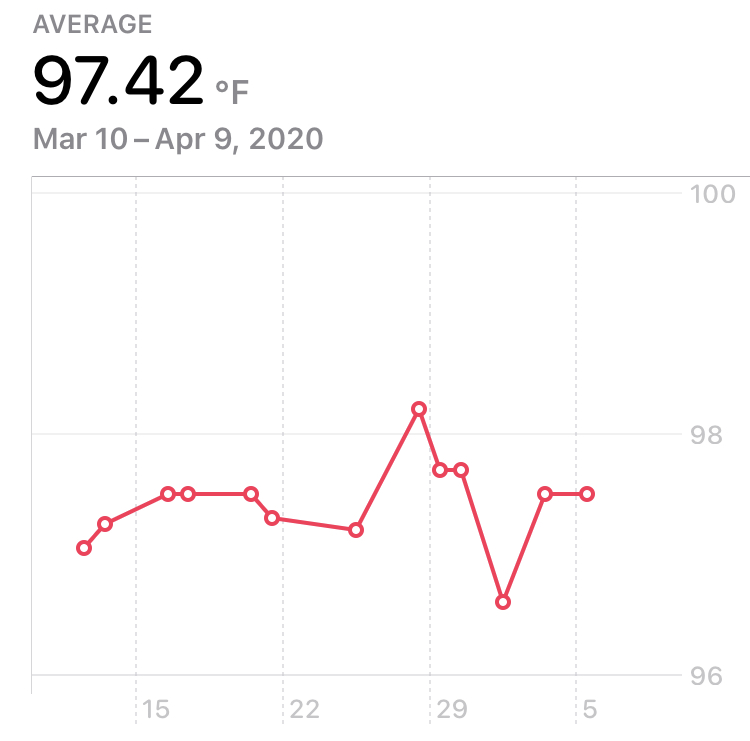
In mid-March I started to feel kinda ill. Did I have it? Everything pointed to yes.

I’d traveled through airports. I felt congested and achy. The news talked more about coronavirus than allergies. Wait. What? The noise of the news made me overlook the color of my car, which was a nicely tinged yellow thanks to an above average pollen count in central Florida. 

My problem was that the ‘fifth vital sign’ had overtaken all the others. Or put differently, the only data I was using was highly subjective. Instead of continuing my confoundedness I started counting. 

IMG_5490.jpeg

Regularly tracking my temperature showed nothing to worry about.

The other potential problem at the the time was toilet paper. 

Well before we were storming stores and short sheets I had stocked up. But watching the paper pandemonium I had no idea how long our stockpiles would last. So, I counted. Our  conservative count is two rolls per person per month. Prior to counting, I’d never have known.

Now do emergency funds

Good data is an objective tool to use alongside the subjective. If we kinda feel ill, we can take temperatures. If we see toilet paper rolling out of stores, we can use a rule of thumb. If we’re worried about finances, we can compare spending to savings. Good data is the base rate, our adjustments are the subjective. 

In any quantitative field three things matter: counts, computations, and communications.

Without accurate counts, we know nothing. 

Without accurate counts and computations, we infer nothing. 

Without accurate counts, computations, and communications, we do nothing. 

Sometimes we jump the gun. We build a model and share it to the world. #dataisbeautiful. Sometimes though we just need to start at the beginning and count. 

Thanks for reading.