Framing Employment

Framing is so important because it’s a way to get ‘free value’. Things well framed are perceived as well done—and perceived value is all there is.

I ran this one question poll on Mechanical Turk, Amazon’s data collection service, and Twitter to see how people perceive the same news. Each option describes the US labor market from mid-March to mid-April.

The question was, which one of these is the best (or least bad) way to describe what’s happened.
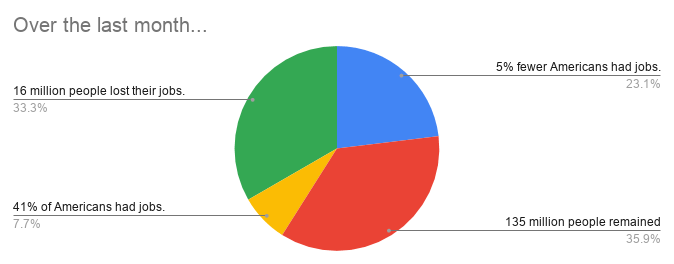
Over the last month..

The most important data isn’t that one section of the pie is larger than another but that there are sections of the pie. If  “135 million people remained employed” took the king’s share there would be nothing to figure out. In the many slices though we get many ideas.

Jason Zweig demonstrated this magnificently in a recent WSJ column. Imagine you’re of a certain age with a certain income and a certain promise of social security. It’s likely more than you realize. Zweig wrote:

The $2,000 a month that you and your spouse will each receive in the future has a present value of $772,235, according to OpenSocialSecurity.com.

That’s roughly what it would cost an insurance company to provide each of you with a guaranteed, inflation-adjusted $2,000 monthly payment for the rest of your lives (assuming you file for retirement benefits at age 70 and your spouse at 62).

So your expected Social Security payments are like a giant phantom annuity—a bundle of inflation-adjusted bonds you don’t own but whose income you have the right to receive. The same is true—usually without the ability to keep pace with inflation—if you are fortunate enough to have a defined-benefit pension plan.

Much of poker is played by the number. Professionals fold many more hands than they play because the numbers tell them that. But people don’t like to feel like automatons. They want action. When Annie Duke started teaching clients how to play poker she had to reframe how they saw the game.

Duke’s insight was to get her clients to choose to play by the numbers. She appealed to their meta side. They had to see the analytical next to the emotional and make a choice from those two options.

People are relative thinkers and many many decisions come down to framing one thing against another. It works for news, marketing, home purchases, dinner options, and dates. It works for everything.
 

Colossal Comprehension

IMG_5475.jpeg

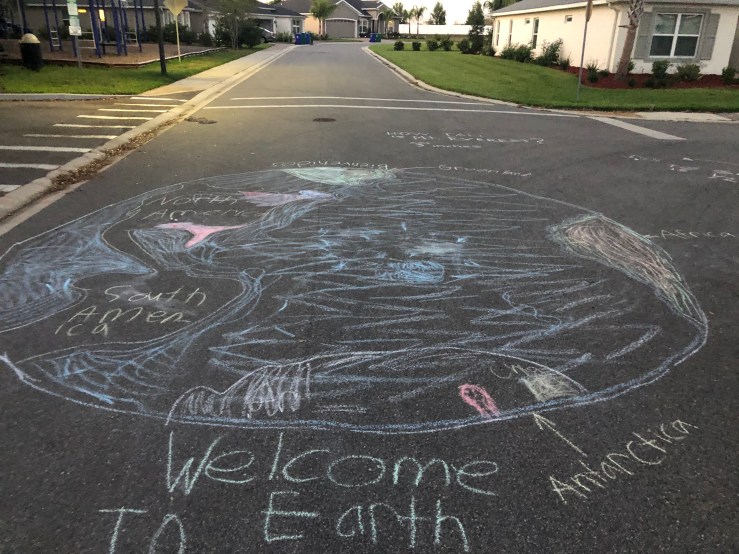
This is the earth.

Part of our quarantine education was to get outside and make some scale drawings of our solar system.

We made our earth one roadway wide, about twenty feet in diameter and paced off two hundred yards and drew the moon. It was five feet wide. The ISS was seven inches from the earth’s surface.

It’s always challenging to consider the scale of the universe. It’s huge. It’s so huge that Mars was sixty miles away in our little universe.

Part-of-the-reason Einstein marveled about compound interest is because scale is really hard to understand. Once things scale up or down past the human perspective we just don’t quite get it. This came up on two recent podcasts.

First, Peter Attia spoke with his daughter about the coronavirus. It was an excellent, simple, good-for-kids episode. So how big (or little) is the virus?

“If were to cut one of your hairs, and you can barely see the edge when it’s cut, how many coronaviruses do you think we could line up on the tip of your hair when it’s cut?” Attia asked

A thousand viruses. That’s beyond the human scale of understanding.

One the other end of the spectrum, and closer to the solar system situation was Cade Massey’s longhorn lament.

“One of the things that frustrated me most when I to talk with people was them saying ‘Well, you’re not going to get this if you’re young.’ We knew the probabilities are steeply related to age but there’s still a probability for every age group. Throw millions of people at a small probability and you’ve got some sick people. We just aren’t good psychologically with these kinds of probabilities.” Cade Massey

The percentage for infection, hospitalization, and ventilation are remarkably small.

New York City houses eight million people and the metro area is home to twenty-one million. Projections note that only .27% will need beds, and only .063% will need ventilators.

Right now my sixth grade daughter is learning percentages as parts of the whole. She answers questions like; “If sixty percent of a class of twenty-four are boys, how many children are in the class?”

That’s good sixth grade math but it gets hard with large numbers. One-fourth of a percent is really small but eight million is really large. How does someone make sense of that? We probably just need to think slow, not fast.


Precise Emergency Funds or Accurate Emergency Funds

The rule of thumb for an emergency fund is three to six months of expenses. The specifics depend on a host of  factors like fixed costs, number of incomes, and type of job. In the Need for Speed post we suggested how Variance Response Time might affect someone’s budget. The theory was that an excellent salesperson would have a faster and higher quality response (i.e. new job like the old job) faster than a teacher.

What was implicit in that post was the idea of being precise or being accurate.

At the end of March 2020 during the coronavirus pandemic I compared our family’s emergency fund to our previous month of expenses. Aside from travel for work and weekend activities, our monthly spending was flat.

Dollars devoted to dining out were diverted to stocking up. Weekend activities become home activities.

How long would this ‘as-is’ lifestyle last using our emergency fund?  The good news was that it would last five months.

But that begat more questions. If this were a true emergency how long could we last? Cutting out the extra expenses like Netflix, home repairs and maintenance, and Target and our runway ran up to eight months.

Okay, but how long could we really go? What if we tapped our home equity, liquidated a 401k (and paid the 35% penalty), and sold one car? That would mean things were really bad but we could still survive for a long, long time. A room, a roof, and rack in oven goes a long way in those conditions.

These calculations were all in a spreadsheet and so the numbers were nice and precise. And probably wrong. Here’s how James Allworth put this idea on Exponent 184: 

“Something I learned early on in consulting was when clients came to you with problems you needed to model them in some way or another and I remember, early on in my career, being really proud about building very sophisticated models with different variables. It could handle all kinds of things.

“One of the partners came along and started to use it, and he laughed. He’s said, ‘James, one thing that you really need to understand if you want to be effective in situations, especially ambiguous situations, is understanding the difference in precision and accuracy.”

That wasn’t in my spreadsheet. Our ‘needed’ 401k was unlikely to be worth as much as it is today, reduced as it is. That car I might sell couldn’t be given away. If things were that bad there were would be so many more sellers than buyers.

At the 2009 annual meeting, Warren Buffett was asked how he calculates value if he doesn’t use a discounted cash flow.

Warren whimsically recalls Aesop’s fable about a bird in the hand being worth two in the bush. Investing, Buffett said, is all about the exchange of the bird in the hand, “But the real question is, how many birds are in the bush? You know you’re laying out a bird today, the dollar. And then how many birds are in the bush? How sure are you they’re in the bush? How many birds are in other bushes? What’s the discount rate?”

He goes on to say, “we do not sit down with spreadsheets and do all that sort of thing. We just see something that obviously is better than anything else around, that we understand. And then we act.”

Charlie anything to add? Yes, Munger says, “I’d say some of the worst business decisions I’ve ever seen are those that are done with a lot of formal projections and discounts back.”

For an emergency fund then, more is better but anything is good. With so much uncertainty there are good ways to gamble. Ian Cassel told Patrick O’Shaughnessy that he tries to keep his fixed costs low and his variable costs variable. If someone has saved and can scale their expenses, then they have an emergency fund. Too much spreadsheeting leads to numbing numbers.

We’ve gotten quite creative with making breakfast.

Numbing Numbers

On Epidemic, Ronald Klain talked about how long a shutdown may last.
“I’m asked this question when I’m on TV all the time, what’s the date, what’s the date? But this discussion about the date is the wrong discussion, the question is, what are the preconditions that we need to have in place before we can reopen large swaths of economic activity?”
That’s a harder question. The CoVid19 situation is like a Sudoku board with very few numbers filled in. If that’s a nine this might be a four which makes that a two—shit that can’t work. There are so many interchangeable parts it’s easier to ask, ‘what’s the date?’ To get away from ‘what’s the date’ questions we can add one more small step, asking why. ‘Why’ gets us to answer. For example, why is social distancing six feet? Is this a case like a power law where the bulk of the results come from one source? For example, when researchers looked at what size particles passed through what size fabrics, “0.02 micron Bacteriophage MS2 particles (5 times smaller than the coronavirus)“, a surgical mask stopped 89% of the particles, a vacuum bag 86%, and a cotton blend t-shirt stopped 70%. Not bad. But when they doubled up, masks improved to stopping 89% and shirts to 71%. Small relative increases. Is social distancing like that? Six feet is like wearing a mask made from a cotton shirt? Maybe not. The gas cloud research rather than aerosol or droplet research—the six feet origin work was done in the 1930’s—hints that viruses could travel twenty-seven feet in the air. It’s hard to not recommend something other than ‘when we hear numbers we should ask why‘ but there’s so much ambiguity that’s all we can say with confidence. As for dealing with the here and now, here’s how to gamble with the coronavirus.

When a plan comes together.


One of my favorite day-time television shows as a kid was the A-Team. Though Mr. T. was the main attraction for most kids my age, I liked Murdock and his crazy-or-crazy-like-a-fox approach which always solved slightly more problems than it created. 

The brains of the group was “Hannibal” who muttered at the 80% mark of an episode, with a cigar in his mouth, I love it when a plan comes together. 

Plans have been top of mind a lot lately. 

  • During a pickleball practice my partner was insistent about a plan for handling lob shots. She wanted the ‘forehand’ player to get three-quarters of the lobs. I wanted to play it by ear. 
  • During the CoVid19 stock market kerfuffle Lawrence Hamtil tweeted, “Have a plan, but adapt to circumstances as they change. Don’t make rash decisions that could harm your long term goals, but also manage your cash covetously.” 
  • During a podcast with Hal Varian and Tyler Cowen, Varian said “In the textbook, there’s more exactitude than might be necessary in real life. There’s this line that no battle plan has survived an encounter with the enemy and when you look at how decisions are made in organizations, they’re often a lot messier than in the textbooks.” 

It was my pickleball experience when the message hit home. Playing with different partners without a plan led to more chaos and uncertainty. More often our team was out of position and lost points in the confusion. 

When I got back with my Planning Partner the game played smoother and not only was the lob defense better but the subsequent shots were too. We were less out of position. And we didn’t always follow the plan because the starting conditions weren’t ‘textbook’. At first I bristeld at the over-emphasis on handling lobs. Now I like the plan as a framework.

Plans are places to start.

One of Richer Thaler’s emphasises about nudging is that there has to be some kind of default. We can have random defaults, we’ve-always-done-it-this-way defaults, or we can have pro-social (nudge) defaults. All have advantages and drawbacks but they all offer a structure for starting. 

Gambling with CoVid19

Bias warning, My wife and I can work from home, my kids kinda like homeschool (but really miss their friends) and I wiped down the groceries in the garage. 

It’s always helpful to ask, has someone faced my situation before? The answer is often yes. Rory Sutherland thrives at this.

On recent podcasts from Deep Dive (#249) and Wharton Moneyball (April 1, 2020) there were two very good steps to understanding anything with uncertainty.

Wharton Moneyball takes its name from Michael Lewis’s Moneyball. That book shed light on using advanced statistics to find other ways to win baseball games, that walking to first after a full count was actually better than hitting a single to first on the first pitched ball. Moneyball thinking has extended to new areas like basketball, movies, and Jeopardy.

On Wharton Moneyball, Adi Wyner spoke with Alan Salzberg who mentioned that he’s starting looking at CoVid19 deaths rather than cases. The former takes longer to materialize in number form but is better than the former which is mostly a product of testing. It’s trading a sampling error for a time lag.

“It was what we would generally call ‘garbage data’. A confirmed case  might me it was confirmed because someone came to the hospital and was already sick.” Alan Salzberg

Ok, good so far.

We need good data (walks instead of hits) but then Alan goes too far. The virus is mostly airborne and mostly won’t bother someone if it lands on a surface someone might touch and then finds a path into their body. That’s a lot of ifs. “Is that enough,” Salzberg wonders, “It stays for a little while, but in my mind I don’t think that should be a worry. I think you should wash your hands, and I’ve been doing that and I try not to touch my face a lot. But I think being ridiculously uptight about it is kind of crazy.”

Ok, that’s fine if we had better data.

But we don’t. Instead of six feet we might heed caution and stand at least twenty-seven feet apart. What’s the R0? How long is someone infected and asymptotic?

Ok, those are good questions.

There’s a lot of unknowns here and on Deep Dive, Matt (@PlusEVAnalytics) talked through what we can do when there are so many unknowns.

Think of Tom Brady’s 2020 over-under passing line of 4,256 passing yards, or 266 yards per game. His last four years totaled; 4057, 4355, 4577, and 3554. But with Tampa Bay he’s got better receivers. And he wants to prove to everyone that he’s still got it! And he wants to do it without Belichick!! Yeah!!!

But how much do those things count for? Like how much we know about CoVid19, we don’t know. Matt gives us a guide though. Do the things we don’t know make one outcome more likely? With age, ambiguity, competition, injury and so on, the unknown makes the under much more likely.

Matt credits much of this thinking to Taleb but the concept of sports and gambling make it clear. It seems like the unknown parts of the CoVid19 pandemic tilt the outcomes in favor of what’s much worse. Good data is a necessary start but ambiguity must be considered too.

Latest book: Idea Trails, 50 ideas from blogging the last four years.

Jeopardy: Paradox of Skill

Michael Mauboussin introduced the Paradox of Skill as a condition where as skills improve luck becomes more important to determine who succeeds. For example, combine many very talented basketball players and you get something like Kawhi’s shot.

The simplest way to think about the spectrum of luck to skill is to ask, ‘can I lose on purpose?’ If so, it’s more skill and the chance for the paradox.

So what about Jeopardy? Ken Jennings spoke with Nate Silver (of 538) about what his original run was like, what the GOAT challenge was like, and some of the logistics of playing.

Jennings explained that there were four aspects of Jeopardy that made him become the GOAT.

  1. Trivia knowledge.
  2. Buzzer skills.
  3. Game board strategy.
  4. Luck.

Let’s go through those and see where the Paradox of Skill exists and where it doesn’t. Given Mauboussin’s theory, we’d expect it to be present less often given Jennings long run of success.

Trivia knowledge. Ken Jennings is smart in Jeopardy question terms but so is everyone else in Jeopardy question terms. Everyone on the show has self-selected to be there and has passed a quiz to demonstrate their acumen.

“Most of the players know most of the answers most of the time,” Jennings told Silver.

Buzzer skills. The biggest advantage is winning because it means you’ve experienced the game. Unless there is a break to check an answer, Jeopardy is filmed in nearly real-time. Each game is followed by a break to change clothes and onboard new contestants before filming immediately begins again.

Like a basketball player getting into a rhythm, Jennings synced his buzzer cadence with Alex Trebek’s voice. When the buzz-in window opened, Jennings was first in line. (This is also the reason he attributes to Watson’s success).

Game board strategy. It was James Holzhauer who took strategy to its ultimate mathematical end. Jeopardy James figured that if he had the most experience buzzing in, but his competition probably also knew the answer, his best chance was ‘shock and awe’. That meant going for large clues and finding Daily Doubles.

Which are not quite randomly hidden. Jennings said, “The Daily Doubles are not placed randomly. A human physically looks at the gameboard, reads through some clues, and sees what type of clue might be Daily Double friendly. They try to scatter them but pseudorandomness is not actually randomness.” This same thing occurred with Spotify, Ben Cohen told Barry Ritholtz (22:25).

Luck. Ken admits he got lucky. There were probably dozens of categories he could have gotten bounced on. But they didn’t come up or didn’t come up at a bad time.

Ok, so is Jeopardy a game of mostly luck or mostly skill?

Trivia knowledge is a wash with similar competition. Buzzing is a hard skill (once Jennings really got going new contestants were offered longer training sessions to find the rhythm). Strategy is a wash too, now at least. Luck, is, well, just luck.

When Jennings was asked if Jeopardy is a sport, he pauses. It doesn’t really seem like a sport, but it’s the coverage by sport writers that feels the most accurate to him.

Like Jeopardy? We’ve written more about James Holzhauer and Watson. There’s also my ebooks.

Edit, the first version of this post had goofed up formatting. Have fixed. 

Made up start up: Showzam

When the iPhone 3g came out, one of the most impressive apps was Shazam. Through some techno-magic, the app could identify a nearby song. This, was a big deal for me because I’ve always been terrible at knowing names and understanding lyrics. My most egregious sin, according to my wife’s family was mistaking Elvira for ‘hell-fire-up’.

Besides this mistake, my wife has only one other problem with me, interrupting television shows to ask questions. With different chronotypes, she will watch one more episode which after two weeks means she’s a season ahead.

Here the pitch: Shazam but for television shows. A person opens the app and the service detects which show is on in the room. Then it pulls up a synopsis of the plot, who the characters are, and where they’ve been. Like the recap shows run. After a skim, the second person can join in and know what the hell is going on.

The potential monetization is large. Like Roku or Amazon, the app can earn affiliate fees as people pay to sign up for other services. Showzam can also earn advertising dollars with dynamic advertising and with data collection on searches, see what is popular and monetize that information in a variety of ways.

Whether Showzam would work like Shazam I have no idea and it seems like a much more difficult technology problem. However, there’s a need and JTBD .

Quarantine Education

Shane Parrish asked, “What are some of the second and subsequent order consequences of covid-19 that you foresee with 80 percent confidence?”, how things would be different from the quarantine for CoVid19. It’s a good question to ask, if students participate in home school what else will change. A running list.

  • Better chronotype matching. Morning people get to do school in the morning, night owls at night. My oldest daughter gets two extra hours of sleep and goes to math class in her pajamas.
  • Better resources. We’ve taken drawing class from Mo Willems and learned about animals from the Cincinnati Zoo and Botanical Garden staff. My kids had great teachers but online they have access to the best ones.
  • Teaching young people. Though I haven’t seen much of this yet, it’s coming. Many instructors comment that they didn’t really understand something until they taught it. This can be true for kids at home too.
  • Learning technology tools. My younger daughter dictates her homework rather than typing it which she could do whereas in school she would use a pencil. If tools shape our thinking she’s thinking in new ways.
  • Plato’s cave and school. That same younger daughter needed help with answering why we have a leap day. That led to a talk about why we have the Georgian Calendar and not one that uses a leap week. Which also applies to why we do school-school and not home-school.
  • Asynchronous communications. If the future of work requires some asynchronous skill then this quarantine has been good practice.
  • Intrinsic motivations. My kids follow a program put forth by their school but this is mostly finished before lunch and they can move onto more enjoyable things. My guess is that a long-term homeschool arrangement would break the link between learning and school and create a hub where learning is connected to school, but many other things as well.

One week down and we are doing well.

Framing the Replacement (WWDC)

Great creative ideas are rare but when they do occur they offer a chance for Alchemy

One way to be more creative is to think about the strengths and weaknesses of a current situation, the opposition, and the contingencies. The CoronaVirus offers an opportunity to see how certain businesses are doing just that. First is Apple’s statement, then John Gruber’s comment: 

“Now in its 31st year, WWDC 2020 will take on an entirely new online format packed with content for consumers, press and developers alike. The online event will be an opportunity for millions of creative and innovative developers to get early access to the future of iOS, iPadOS, macOS, watchOS and tvOS, and engage with Apple engineers as they work to build app experiences that enrich the lives of Apple customers around the globe.” 

“Very Apple way to put it — not as a cancellation of the in-person conference but as an all-new online format equally accessible to all developers.” 

So good. 

The advantages of an in-person conference are many. It’s an event, and Apple has always been great at events. There’s buzz with people there. There’s also a sunk-cost-ness to it. If a publication is going to send a journalist, there’s going to be something written about it. 

However, in-person events are exclusive. They’re also limited in scale and scope. There’s different coordinations between a stream and a session. 

The CoronaVirus situation forced Apple to get creative. They had to find the strengths in “an entirely new online format.” 

Napoleon was doomed when he had to fight a defensive campaign. Clayton Christensen warns that capabilities become disabilities when disruption is afoot. Chuck Akre said that he doesn’t compete much with Wall Street because “Wall Street has a different business model than we do.” 

Without effort we all default to ‘the way we’ve always done things.’ Often this works fine. Sometimes outside forces force us to be creative. One path is to consider how strengths might be weaknesses and how weaknesses might be strengths.