Hand Washing Design

Update, April 25, 2020: The Behavioral Insights team researched which infographics communicated the best

John Gruber posted at Daring Fireball that when he washes his hands, he turns the water off and feels less rushed and more likely to wash for the CDC suggested twenty seconds. “It’s very clear to me after just two days that doing so makes it far more natural to spend more time actually sudsing your hands up. When you leave the water running, it subconsciously puts you in a bit of a rush, because you know you’re wasting water.” 

Rationally whether the water runs or not shouldn’t matter. The most important thing (mid-March 2020) is to kill the harmful viruses and bacteria people pick up during their (limited) social exposures. Though the chances are small, the consequences are the largest. However we aren’t rational and we don’t always wash our hands. 

At one teaching hospital, the best predictor of hand-washing was attending physicians. If they washed, the medical students followed. Multiple meta-analysis (meta-meta-analysis?) suggest the best option might be “multifaceted” nudges, educational materials, and bedside hand sanitizers. Another showed that performance reviews (personal wealth) and access to hand sanitizer (ease) had the strongest though-not-super-duper-strong effects. Incentives (personal health) also kept hand-washing levels high after the 2003 SARS outbreak.

What’s so interesting is that even though one path is clearly better, people need help following it. Hygiene is like diet or investments

This randomized control trial in India found a way to increase hand-washing 30X, even twelve months after the intervention. 

A study of 802 Kenyan households offers the model that makes the most sense to me for why people do anything. Those, “significant predictors of observed hand-washing behaviour: having the habit of hand-washing at particular junctures during the day, the motivated need for personal or household cleanliness, and a lack of cognitive concern about the cost of soap use.” 

Like finches, people are influenced by their environment. If we want to encourage actions like hand washing, social distancing, and factfullness we should design conditions that make those thing easy.
Disagreeing in a Crisis

Recently on Twitter there’s been a trend of “it’s not that bad” tweets gong around. One said that half of Italy’s CoVid19 fatalities were people with three or more existing illness while people with no other illnesses existed in less than one-percent of deaths. Among the ‘maybe it’s not that bad’ list are Elon Musk, Phil Hellmuth, and Bill Gurley.

No one is saying doing nothing, but many are saying to look at the costs. Many are saying to think like economists. 

With hindsight we’ll see that someone had the right model from day one. It likely won’t be you or me. However we get to sharpen our thinking (skill) rather than be right (luck).

So, what might account for these experts in one domain to be right in this one too? 

  • Data. It could be that there’s so little good data that we face an elephant problem. The Italy statistics look like this. The China statistics look like this. One country sees a pandemic, one an outbreak. 
  • Uncertainty. Maybe I’m too confident in my projections of outcome distributions. It could be way better or way worse than I expect right now. 
  • Salience. It could be we’re all caught up against a ‘common enemy’ with nonstop news fanning the flames. 
  • Opportunity costs neglect. People tend to overemphasize the importance of what comes to mind and dismiss what else they could spend money or time on.
  • Stock data. The stock market thinks that immediate future earnings will be significantly less. Could this be a bad proxy? 
  • Outcome severity. Maybe there will be many more with ‘zero effects’ than ‘death/ruin’. If that’s the case then CoVid19 edges more towards “driving across the country” and away from “contracting Ebola.”
  • Existing immunity. The virus has already spread through many people and those that have survived are resistant to antibodies. The influence like illness data that’s coming out might suggest this. 

It could be that Musk, Gurley, and Hellmuth were wrong in their consideration of all the details. However the process of considering why is right. Our Phantom Tyler Cowen suggests we write out why the opposing side is correct. 

There’s a lot here about arguing well and the critics of that idea say that doing is so much more difficult than discussing it. In this crisis is an opportunity.

(I use luck in the Mauboussin sense of anything out of one’s control. For example, if this were a physics problem like ‘where will planet X by at time t we would have the answer for the CoVid19 pandemic). 

Three differences between hurricanes and viruses

Worth noting, this is only based on one hurricane season (2019) and one viral pandemic (CoVid19). 

There has been a huge contrast in preparation for CoVid19 and for hurricane Dorian. Though both had the potential to do serious economic, physical, and life-threatening damage, people reacted in different ways. Why? I think there are three aspects. 

Data

Hurricanes generate a lot of data that’s not too difficult to collect and we’ve been collecting it since the 1870’s by Catholic missionaries in Cuba. With time and tech we’ve become more precise and practiced. Hurricane forecasts include when the winds will arrive. It’s also easier to share hurricane information with the people who need it most. 

Rarely do economists and virologists have these conditions. On the Bloomberg Odd Lots podcast, Claudia Sahm bemoaned that in this case they had good data, “This started overseas and it’s different because we don’t need the unemployment rate to tell us that something bad is working its way through the global economy.” 

With ample tests, this is a different kind of problem. But no tests, no data and no data, no action. 

Culture 

Floridians have a clear understanding of what hurricanes can do. The twenty-one million people who live in the state know someone or have themselves, lived through a storm. If culture is “what people do when you don’t tell them what to do,” then Florida has a pretty good preparation appreciation.

Part-of-the-reason for this culture is the cause-and-effect relationship. Storm comes through, storm destroys lives, storm leaves. Post hoc ergo propter hoc. This is harder to see with someone’s health. People look fine until they aren’t.

Actions

It’s clear what needs to be done for hurricanes. Bring things inside. Have food and water for some number of days for some number of people. Close shutters. Collect medicines. Pump gas. Pack a bug-out-bag. There’s even a tax-free weekend of shopping, where the state government encourages people to prepare. Planning for a hurricane is socially, economically, and timely easily done.

It’s hard to do anything for the virus besides take zinc. Sometimes the best action is to do nothing but that never really feels like enough, does it? Investors often say to ‘don’t just do something, sit there’ and that might be the best idea yet. 

So what? 

More tests solves the data problem. Experience affects the culture. Here we’ll focus on the actions and use the EAST framework to make choices easy, attractive, social, and timely. How would you get people to self-quarantine and practice social distancing? 

In my local area, Retirementville, Central Florida, residents should have been told how deadly this disease is to their age cohort (fifteen-percent for those seventy and older). Newspapers and radio could have emphasized the even elevated rates for people with conditions health conditions. In China it was men who smoked, but in the states it will be anyone with high blood pressure and cardiovascular conditions. 

Along with this public service announcement, we should have appealed to the patriotism of this particular part of Florida. We’d come together to defeat this microbial adversary. We could pass out stickers. It’s not Rosie the Riveter poster material, but it’s still a common foe.

Further, there’s enough technology to have virtual meetups. Let card games be on computers. Let people Facetime friends. With the right framing this would have been fun. People already have hurricane parties.

Had this been shared at the right time, things would be different.

Postscript, there’s probably something here too about distributions of outcomes. For the worst storms of the past thirty years, the median normalized damage is $26B and the average damage is $33B. How that data fits all hurricanes and compares to viruses is TBD.

Quarantine Psychology (HPTP)

One of our Quarantine Challenge items was to play every game we own at least once. Starting near the top of the this-will-take-a-while pile was Harry Potter Trivial Pursuit.

It’s typical for my wife and daughters to gang up on me. Mostly because I like the games so much, but in HPTP it’s them who have an advantage. Never-the-less, they pick on me and use a classic psychological study finding to do it. 

There’s a riddle that goes like this, a “A bat and a ball cost $1.10 in total. The bat costs $1.00 more than the ball. How much does the ball cost?”

Most people answer that the ball costs ten cents. People are thinking fast and thinking wrong. 

However, when the riddle is printed in a small or 𝔬𝒹𝚍 font most people answer correctly. When the riddle uses automotive brands, rather than a bat and ball, most people answer correctly. What gives? 

“A bat and ball…” leads most people to quick thinking that serves us well in many parts of our life but doesn’t do so well when we need to think slow. In HPTP this manifests in the way a person can ask the question. When my wife asked, “Which horcrux does Harry destroy first?” she emphasized the word “first.” She verbally bolded word. My twelve-year-old daughter slowed down and gave the right answer. 

The girls do this all the time.

But I have a few tricks too.

One that I use a lot is Gigerenzer’s recognition heuristic. Usually the first answer that comes to mind is the right one. But not always (see Austin or Fort Worth?)

I asked my wife, “In the first film, the library scenes were filmed at one of which famous English university’s library?” 

I only know two, Oxford and Cambridge. She only knows one, ‘Where the prince went’. Using the recognition heuristic, I’d have gotten it correct. 

HPTP is in the perfect zone of don’t-quite-know. For some answers I’m better off slowing down. For some answers I’m better off following recognition.

Hot crisis, cold crisis

*“Late-night hosts are like parents. Their job is to tuck us into bed at night, make us smile, sooth us. What I do is different. I’m not going to put you to sleep. I’m going to blast you awake. There’s a reason we drink coffee in the morning and not at night. I’m not warm milk. I’m caffeinated. I’m going to tell you everything is not all right. I’m not all right. You’re not all right. The world is not all right. What I do is too hot for television. I mean ‘hot’ in the way that Marshall McLuhan used the word.” – Howard Stern in Howard Stern Comes Again*

On Saturday night I drove past restaurants with outdoor seating and it was packed. Many people celebrated St. Patrick’s Day weekend, though maybe fewer than normal because parking was a bit easier to come by. 

In addition to the medical confusion and bottlenecks with CoVid19 are the psychological dissonance and hindrances. Some people preach and participate for self-quarantine to slow the spread. Some cite flu statistics killing such-and-such multiple more people each year. Like any situation, when we ‘don’t get it’ we get to ‘ask why?’ 

One theory is that crises, like content mediums, run hot and cold. War went from warm to hot with the introduction of television in Vietnam. It’s probably gone cold again with drones. Sports commentary went from cold to hot in the transformation away from writers and toward talking heads. It’s probably cooled a bit with podcasts.

Like tree, bush, and grass growth in a forest, each change from cold to warm too hot and back again is endogenous to the systems. It’s not that talking-heads are good but that talking heads are good for TV.

Central Florida provides a nice contrast between the cool crisis of CoVid19 with the warm crisis of hurricane preparation. With the former it doesn’t feel like self quarantine is ‘doing anything’ whereas hurricans have a flury of preparation. We even have a Disaster Preparedness Sales Tax Holiday. Hurricane damage everyone can see. Hurricane damage can be quoted in dollars.

None of these things are true for CoVid19.

What else runs hot and cold?

  • Saving is cold, spending is hot. 
  • Policy is cold, politics is hot. 
  • Research is cold, takes are hot

A friend reached out for help writing a note to their clients about what was happening, why it mattered, and what they could do. In effect, they wanted to know how to communicate cool things cool, hot things hot, or move people from one to another. Most personal wealth should be cool. Most personal health should be warm. 

This might all come back to McLuhan. People are relative thinkers, and after being blasted with a lot of hot (air) news we’re not sensitivite to change. It reminds of me my first pizza after my first Whole 30. It was sweet. I didn’t know pizza was sweet. I couldn’t know until I reset.

If framing matters, and it does, then CoVid19 needs better marketing. Like a brand it needs to go from cold to hot.

Preparation, panic, paranoia

I’ll admit it. I bought the extra toilet paper. And peanut butter. It seemed prudent.

It was Sunday, March first when I went to the grocery store and stocked up. The night before my wife and I had talked about what to do and what might happen if cases grew from the 87,000 globally and 62 in the United States. Grew they did, to 118,000 globally and 696 in the United States. Reasoning that this might get bad and that hurricane season lasts half the year in Florida, we should stock up on basics. We’ll use this eventually.

From the sounds of the news, it was a good choice. The investing community seemed to be quoting a lot of Nassim Taleb who wrote about taking a hint from nature and the advantages of redundancy. Eyes, some organs, fingers and so-on. Just-in-time deliveries may be optimized and function well when times are good but any kind of disruption and the potential for trouble arises. Taleb calls these ideas fragility, robustness, and antifragility. 

Preparation is the most like Taleb’s antifragility/robustness metric. The thinking goes that because we won’t need to worry about trips the store for food during two-weeks of social distancing, we’ll be more likely to remain healthy and that will be an advantage in our personal and professional lives.

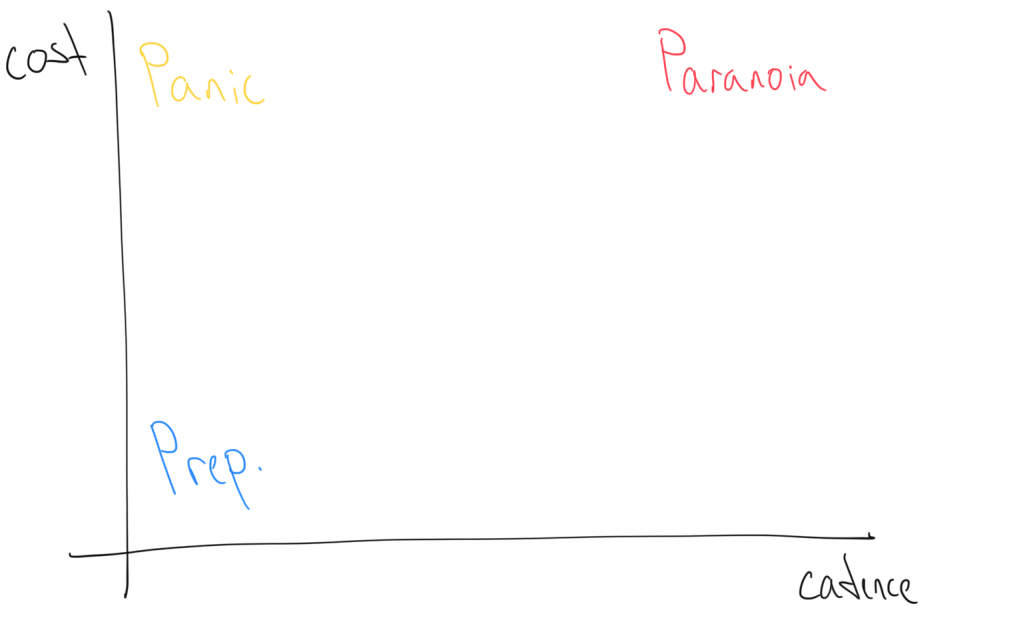
However, where is the line between preparation, panic, and paranoia? Here’s one crack at answering:

  • Preparation: taking infrequent actions with little costs but which may have slightly to very positive effects. i.e. stocking up on TP & PB.
  • Panic: taking infrequent actions with high costs but which may have small or no effects. i.e. searching for supplies but settling.
  • Paranoia: taking frequent actions with low to high costs and may have small, medium, or large effects. i.e. storing excess goods in physical and mind space.

With these definitions it seems like buying TP and PB was a smart step of preparation on our part. If our household were a business we might be criticized for a failure of ‘capital allocation’ by not deploying the few hundred dollars of supplies towards a couple of shares of Berkshire B stocks ($180 as of this writing). However the cost in efficiency is a benefit in redundancy.

An investing plan fits this model too. Preparation is having a plan to be an investor and not a trader. In an Infinite Loops podcast with Arthena CEO Madeleine D’Angelo, she distinguished between being an art collector and an art investor. They are different types, with the latter not “giving a shit about what it looks like.” D’Agnelo said most of her investors self-select, that means they have a plan and are preparers. 

In thinking this through though I realized that I was a bit paranoid. I spent a lot more time on Twitter rather than work which made the constant news-you-can-use consumption a medium cost for little effect.

What’s most surprising is how easy this is to see now. What’s most challenging is to remember it later.

‘Does this exist elsewhere?’

People change slowly. Think about your habits, your systems, and your patterns. Without a cause, most of us change very little even though we understand we aren’t fully optimized.

What probably has happened is that we’ve settled on a certain outcome in a range of outcomes that feels okay. Because people are relative thinkers, they find something slightly worse or better and compare themselves to that. In his Cowen Convo, Hal Varian thought people envied their prosperous neighbor more than a distant billionaire. And, because people tend to become more affluent over time, we can always compare how much better things are now. As a high school kid there were many times I only bought five dollars worth of gas.

We don’t change because change takes work. If it ain’t broke, don’t fix it. Good changes come from creativity and a cause. One silver-lining of March 2020 is ample cause:

“A friend of mine who works for ESPN was telling me that the whole concept of televising sporting events with hundreds of people, with broadcast teams flying in for the games, maybe can’t happen anymore. They might have to use people on the ground for the games. I think there’s a creativity level that has to go way up.” – Bill Simmons podcast, 3/11/2020. 

Before leagues cancelled games and suspended seasons there was shock—shock I tell you!—at playing in empty gyms. Before we get worked up we can ask, does this already happen? Kinda, and the answer is staring us in the face: mascots.

Sports has acknowledged and embraced the fact that in-person games are not pure entertainment. The last baseball stadium I was in had a playground for kids. During my internship in minor-league baseball I passed up the chance (another story) to be the on-field entertainment. Half-court-shots-to-win-book-for-the-semester-money are part of every college season. 

Live sports acknowledged the fluff and did good work to solve for it. Streaming just the games makes sense.

There’s also potential for redoing the broadcasts. What if there was an API where fans could comment on their own? What if the NBA offered a game to Twitch with comments? What if players were mic’d up? “The whole concept for how this stuff is covered will have to change,” said Simmons. 

It’ll be different, and maybe even better.

Asking does this exists in some form is a great way to remind ourselves that nothing is permanent. The NBA was founded, is thriving, but will also cease to exist again. For sports or any business, March 2020 will force operators to ask ‘why do we do things this way?’ One helpful trail will be to ask how working from home, social distancing, or productive Twitter are already successfully accomplished. Someone has already addressed your problem, go find that solution.

“Dad, can I listen to an audiobook instead?”

My twelve-year-old daughter asked that question. I said ‘Yes’. Then I thought, does it matter?

Most of the popular press pieces frame reading and listening as a difference of effort. The thinking goes that reading is harder so reading is better for you. If the brain is a muscle then a book is like a treadmill. Harder is better.

Is it?

I started looking. When college graduates in NYC read or listened to Unbroken, there was no difference in comprehension scores. When scientists used an fMRI, the same brain regions lit up for reading or listening. However, there are some things that do differ from form to form. Sequence for example, is easier to recall in a print book.

What might be most important is if reading is pleasing. If it sounds like writing, rewrite it. No one enjoys boring media. There’s only bad content, not bad formats.

Part-of-the-reason the results seem to be a wash is because of the opportunity cost. Both reading and listening to a book are great options. Reading offers encoding and a visual boost. Listening offers prosody, the rhythm of a voice. It’s like soup or salad for dinner, both are healthy choices.

This research was like mortgage choices. Is a fifteen year mortgage better than a thrity year where someone can invest the difference the lower payments bring? It’s a wash. For reading, make choices you watch.

Holy smokes, my kid is twelve!

3 ways to choose a college

This post first appeared on the POV40IQ newsletter.

We’ve written a lot about education: the XMBA, film school, and culinary un-school in France. There’s also the JTBD approach to choosing college. There’s so much written about school selection because there’s no great single metric. There are numbers like tuition, magazine rankings, and graduation rates and employment prospects. But there is no unifying or simple equations like when buying a television.

The TV sizing guide.

This makes college choice a funky problem. Most students optimize for cost, given some range from home. I’d imagine that comments like, it’s the same chemical atoms no matter where you go, is uttered many times in many places.

But just because there is a system doesn’t mean it’s a good system. Another way to choose in wicked environments is to select a single priority. Pro-choice or pro-life voters do a version of this.

When it comes to college then, here are three ways to think about one big thing that might matter more than all the other things and make a college choice easier*.

Are these the kind of people I wanted to be surrounded by? If someone is the average of the five people they spend the most time with, then this would be a good question to ask. Surfaced by Justin Mikolay, it’s not the kind of thing I thought about at eighteen, but seems obvious decades later.

At the time I thought college was college. One school was as good as another. However, certain schools like Mikolay’s Naval Academy are all together different. Think of this question as a form of positive-sampling-error.

Is this the fastest path? More young people now, than I remember as a young person, seem to want to optimize college like a weekend obstacle course race. If I can get this done first and take this shortcut I’ll be able to shave twenty-percent off my time. Morgan Housel tweets about the low-cost (time and money) aspect of this option.

This perspective makes sense. Colleges are still four years, even though students learn more in high school than ever before. Colleges are still going up in price, even though it seems like the supply should be optimized as well.

Is this the most educational? There are pockets of incredible opportunity in the college curriculum. Michael Mauboussin teaches at Columbia. Tyler Cowen teaches at George Mason and says how helpful the “Mason lunches” are.

The internet is amazing at information transfer but hasn’t (yet, will it ever?) offer the value of lunch in gif form?

That said, life life, college’s value is a sum of what someone puts into it. What these questions really might be is a forcing function. Answer and act.

Reviews then pics

Photo by Pok Rie on Pexels.com

Academic work can sometimes be inefficient. For example, people prefer to book hotels with nice pictures. Go figure.

In the paper, The role of photograph aesthetics on online review sites, the authors conclude that, “photos with professional aesthetics make a depicted destination appear more visually appealing, ultimately driving booking intentions.” Makes sense.

However, within this kind of obvious-in-hindsight research, wrinkles arise.

One group of participants was asked to imagine they were searching for hotels for a trip to Edinburgh. What was interesting was that, “if the review was positive, there was no significant difference in visual appeal between professional and amateur aesthetics.”

The difference between a professional and amateur photo is the difference in intention to book if just the pictures are shown. However, when people see reviews, the Kodachromae contrast doesn’t matter. Word of mouth type communciations matter.

The authors write in the discussion, “when the review was positive, participants viewed hotels as visually appealing in the amateur as in the professional setting.”

We believe in Alchemy and one way to do that is to create value for customers without changing the physical thing. In this case, that means past-guests conveying why something was nice.

We believe in JTBD approaches and one way to do that is find the goal of the customer. What is someone thinking when they book a room? It’s in that answer that the difference in photographs and reviews lies.