All Barkers, No Biters

Our local bank sponsored a stand at a local fundraiser. Use our debit card the barkers offered, and we’ll donate ten cents to the local school’s scholarship fund

Our local school is great. Every graduate gets a scholarship based on the number of years at the school. 

The bank didn’t have many takers. 

How to solve this problem? Ask Chat GPT!

Meh. Fees, poor service, better offers or rates elsewhere, relocation. 

Not that helpful. 

According to Jobs theory, the aim is to understand the context, casual structures, and forces of progress. “Don’t think it works,” says Greg Engle about Chat GPT, “just because it spits out an answer.” 

As of April 2023, the best way to think about Chat GPT (or maybe any answer!) is as the tip of the iceberg. Good copywriting is based on the part of the iceberg we don’t see. So is Jobs. It’s why the barkers didn’t get many biters. 

We’re just a bunch of blind men around the elephant. Be curious. Explore. Seek the other parts. Dig in. 

Want more Jobs theory? Subscribe to The Circuit Breaker Recap newsletter. 

Helpful Lessons & Directions

Why is India a good place to walk, Tyler Cowen asks Paul Salopek as he retraces the steps of the first human migration.

India is good, Salopek says, because the people there have walked the walk.

“Whereas in motorized societies — and I’ve written about this — it’s pointless to talk to somebody in a car — if you’re on foot — about directions because the scale of their sense of landscape is limited to these strips of asphalt that are a few meters wide that wheeled vehicles can go on. Beyond that, it’s just this moving tableau that’s an abstraction.

“In India, people can tell you shortcuts. They can tell you where the best tree is to take a break, where the best temple is to sleep at night, where the next jug of water waiting the foot traveler lies ahead. India was marvelous. I felt among a brotherhood and sisterhood of walkers there.”

Paul Salopek, Conversations with Tyler

Our This Time is Different is about understanding this idea. Walkers and drivers travel through the same physical space but travel through different temporal spaces.

When there are different rules then this time is different.

Looking Stupid

“As president,” David Brooks writes about Dwight Eisenhower, “he was personally willing to appear stupider than he really was if it would help him perform his assigned role.”

“I didn’t think you were that smart,” a friend told Bob Moesta, “because you ask all these, almost stupid questions. But those questions are how you understand contexts.”

We’ve looked at looking stupid before but it’s an idea worth repeating.

Is the goal progress or satisfaction?

These aren’t mutually exclusive. Often progress and satisfaction accompany one another.

But sometimes they don’t.

Arguments carry this tradeoff. Is the point to prove how smart you are, or something else?

It’s ego.

Annie Duke offers an alternative. When she coaches poker players they gripe that nothing is happening. Good players, Annie advises, sit out a lot of hands.

But, there’s still a lot going on! It’s in your head.

What’s happening is the decisions. Framing the ‘action’ as mental appeals to progressing players.

Looking stupid isn’t stupid. It’s a path to the destination, a choice even our ego can love.

The End of Average (book review)

If markets have a limited supply but high demand then prices will be high. Disney vacations are one example. Human capital is another. Computer science majors earn the highest salary out of college and humanities majors earn the least. Employers distinguish students (supply) by their degrees.

But how do you distinguish among the computer science majors? The answer is included in Todd Rose’s 2017 book, The End of Average.

Rose’s big idea is economic – society overpays for talent!

Throughout the 1800s and 1900s, modernization has been an experience of measurement. At first, the outcomes were crude because the measures were crude. Take the twenty years of Moneyball progress and stretch that through two centuries. In the same way that baseball teams overpaid for home runs, society overpays for talent.

Rose offers three explanations for our mistake.

1/ Jaggedness. What makes a good first baseman? That depends. What makes a good leader? That depends too. Unfortunately, nuance is neglected in our day-to-day functions. We tend to use loss-aversion-based heuristics. When you evolve from mammals focused on danger, food, and sex there’s only so much digging our default allows.

Winston Churchill is an example of a jagged leader. He excelled in oration and “stature” but less in collaboration. During the war, certain skills were more important than others. This brings us to…

2/ Context. Brent Beshore’s people are messy comment summarizes Rose’s idea. Instead, think of people as complicated creatures who act using If/Then statements. Someone may be honest or careful or diligent based on the situation.

We miss this, Rose writes, because our samples of other people aren’t wide enough. Jessica from the office may act snooty or kind at work – the only place we see her. But does that encompass her at church, at home, and with her family?

3/ Paths. There are not a million ways to do something, Rose writes, but there’s also not one. Think of a situation like being lost in the forest. The goal is to get out. One option is to find the path and follow it. But one could forge their own as well. Too often the focus is on the path and not forging a way out.

If a group undervalues these explanations then it restricts the possible outcomes. Imagine a rule that in order to start a business someone had to give up listening to podcasts. There are a lot of great business podcasts and the budding entrepreneur would be worse off – and so would we, missing out on the upside of their creation.

The End of Average is a Bob Moesta book suggestion and reading it from his point of view offers additional information.

Moesta is a product designer, researcher, and marketer. Put on that POV and we can see how products fit within Rose’s explanations as well. Our hunger is jagged, hence the difference between Snickers and Milky Way. Our purchases are context-based, Moesta comments that hot dogs and steaks are both the right meal for the right context. Lastly, consumers end up at a product in a variety of ways, there’s not a single sequence of “I need a new car”, but there’s not an infinite either.

My first impression of The End of Average was that I kinda already understood these topics and didn’t need to spend time on the macro-educational angle. Both impressions were true but there were deeper ideas too and giving names to jaggedness, context, and paths is and will be helpful.
Final Four Seeds 2023

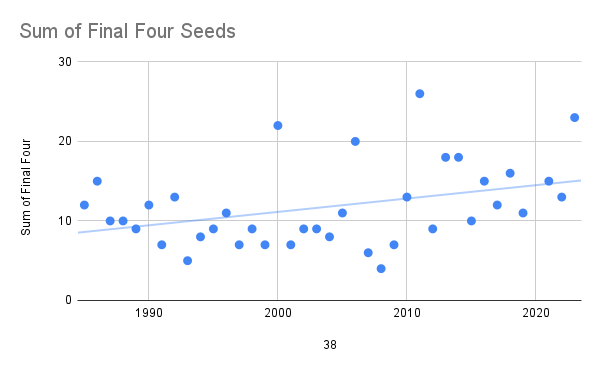
What is the sum of the seeds of the Final Four?

It’s madness baby!

We’ve previously asked this question as part of our numeracy series. As the high school kids say: Gotta get those (mathematical mindset) gainz.

“If you asked me right now to update my belief,” Wharton Professor Eric Bradlow said before the Sweet Sixteen, “about the sum of the seeds of the Final Four I’m trying to decide if I would be over or under 10.5.”

One seeds account for about 40% of the Final Four teams, and two seeds account for 20%.

The historical mean has been 12 and the average sum 11.

But things are trending higher.

Bradlow’s reasoning went on. A number of top seeds had lost.

Maxims for Thinking Analytically suggests we use extreme examples, like Bradlow. What’s the lowest possible sum? It sounds like 10.5 is a lot. But if one region’s best case is three and another is two how low can the total go? The book also reminds the reader, “the world is more uncertain than you think.”

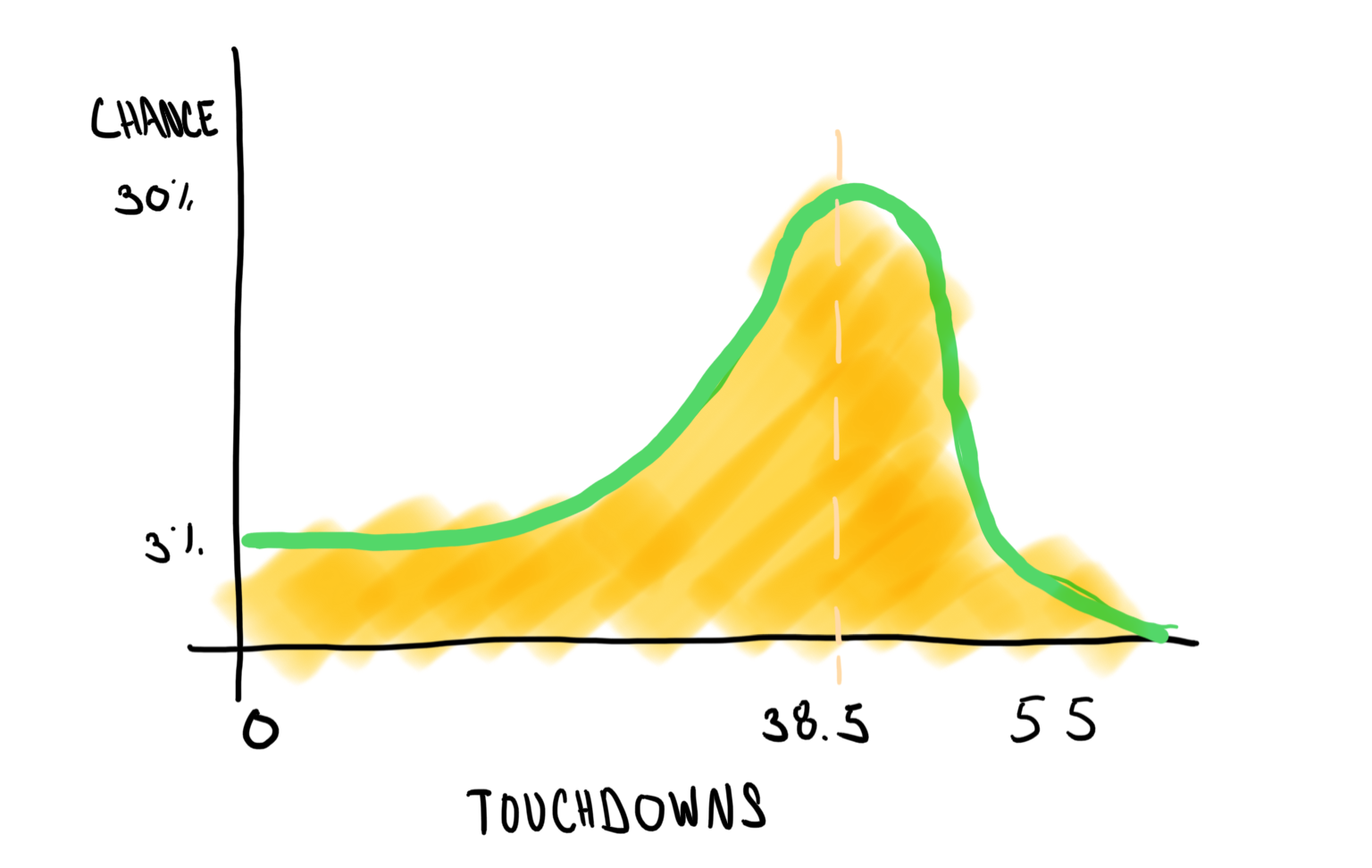
That thinking leads to something like the Aaron Rodgers touchdowns graph. Though more unlikely individually, there are many ways for the sum of the seeds to be higher than the historical average.

Measure What Matters (book review)

Measure what matters book review

There are two aspects – contents and context – to John Doerr’s 2018 book, Measure What Matters, a book about OKRs (Objectives and Key Results).

Content.

Objectives are “what is to be achieved, no more and no less.” Grow the blog, lose weight, or strengthen important relationships.

Key Results are ways to “benchmark and monitor how we get the objective.” List ways to grow the blog, lose weight or build relationships. “It’s not a key result,” Marissa Mayer would say, “unless it has a number.”

Straightforward enough. Is this a book that could have been a blog post?

Maybe, but Doerr offers a trio of cautions.

Warning 1: OKRs are not a way to show activity, they are to focus attention and weigh the opportunity cost. Organizational achievements, not ego appeasements.

Warning 2: Sometimes incentives hijack the Key Results (Goodhart’s Law). An antidote is paired counterparts. In the Wells Fargo cross-selling scandal the Key Result of open accounts could have been paired with monthly active accounts.

Warning 3: OKRs are a tool to use not a dogma to follow. If objectives change then OKRs change too.

Context.

Context is a Bob Moesta word encompassing who, what, when, where, why, and how? Steak and hot dogs are ‘good for dinner’ within the right context. The same goes for OKRs.

Doerr is a venture capitalist at Kleiner Perkins. OKR adopters include Intel – where Doerr learned from Andy Grove – and Google among other technology firms.

The OKR system, Doerr wrote, “was a great impedance match, a seamless gene transcription into Google’s messenger RNA. OKRs were an elastic, data-driven apparatus for a freewheeling, data-worshipping enterprise.”

Google was a perfect match. But your business may not be.

OKRs, as Doerr presents them, requires a certain culture. Part of their effect is to argue well. Andy Grove set the Intel culture for OKRs because Andy Grove was at Intel. Once he left the culture changed from bettering to bullying.

Doerr has many examples, one of which is Zume Pizza, but they’ve gone out of business. What’s the right lesson in that? What’s the context?

OKRs are lightweight, malleable tools. But their usefulness varies. Will OKRs be OK for you?

Cheerios JTBD

“Don’t eat them for the 100% whole grain oats. Don’t eat them because the oats can help lower cholesterol. Eat them for her.”

Cheerios commercial, 2023

The good. Jobs-to-be-done uses “Mario marketing”. Sell the power, not the flower. Why is ‘being healthy’ a goal? It’s to spend longer with your granddaughter.

This ad ran on a Wednesday morning in Florida. Who is watching television? Retirees. This CAC is money well spent.

The bad or the confusing. None, it’s a good advertisement.

🧐

One of the best ways to get better at something is to do it.

One of the best ways to get better at some thinking is to notice it. The human tendency to confirm beliefs is generally useful. So be curious. Give something a name and label to your experiences.

You stick your hand in shit…

This is from a daily email I write with my friend Aaron.

Mr. Cohen was at his summer job, waiting for his delivery truck to be loaded up for the day.  

“Yeah college is fun,” he told a mechanic while the two waited, “but I’m dropping out.”  

“Why?” the mechanic inquired.  

“Well, I don’t like it,” said Cohen. 

“Ahh, you stick your hand in shit you wash it off,” offered the mechanic.  

Mr. Cohen created one of the greatest brands in the United States. You know it. You’ve probably bought it. We’ll get to that in a moment.  

Cohen didn’t immediately apply the mechanic’s advice. He quit college. He mopped floors for a bit, but quit. He worked as an ER clerk, but left. He drove a taxi for a while.  

It wasn’t until Cohen had a partner and a plan that he persevered.  

The duo’s first store was an abandoned gas station. They slept there. They couldn’t pay their contractors in cash, so they paid in kind. They couldn’t afford equipment. Instead, they reached out to their friends and family asking them to check the classified sections for going-out-of-business sales.  

They faced obstacles and found solutions.  

They persevered. 

They opened Ben & Jerry’s Homemade Ice Cream in Burlington, Vermont.  

You stick your hand in shit you wash it off.  

You get knocked down, you get back up.

A Monster JTBD

One of the best-performing stocks of the last twenty years – a famed 100-bagger – is Monster Energy.

Why didn’t we see this?

If you want to succeed at investing, Howard Marks wrote, you have to be different and you have to be right. Embedded in that is the notion that being different is hard.

If different was without social, financial, political, emotional, or mental costs then everyone would do it.

😕

Monster Energy faced at least two of our common business headwinds. First is the TiVo problem. Can an innovator (like Monster) gain distribution before market leaders with distribution (Coke, Pepsi, Anheuser Busch) gain innovation?

It’s remarkable that Monster succeeded. Their competitors already made sweetened caffeinated beverages. They already managed brands and distributed millions of liters of fluid to every gas station, bodega, and grocery store across the country.

The second is category creation. If you can’t be first, notes the second Immutable Law of Marketing, create a category where you can be. Buy-now-pay-later, fast-casual, on-demand-storage, and hard seltzer are all examples.

But the ‘energy drink’ category had a market leader: Red Bull. Not only that, the market leader had existed for nearly twenty years before Monster Energy began.

So what happened?

🍸 🆚 🥤

Sometimes the category isn’t the competition. Snickers and Milky Way don’t really compete. Honey Baked Ham, Chinese restaurants, and ordering pizza are all holiday meals but not many consumers debate between those three. It’s homemade or Honey Baked.

“Red Bull and Monster consumers are unique. Red Bull went after the extreme consumer but early on focused on on-premise service: bars and restaurants. As a result, it morphed into what I would consider a white-collar beverage. Partly because of the premium price, partly because the smaller can…Monster decided on a 16oz can – the same price for twice the volume and marketed it towards more blue-collar workers. They also focused on palatability, especially from a sweet standpoint.”

Mark Astrachan, Odd Lots podcast

That ‘Monster’ can was a focus group suggestion.

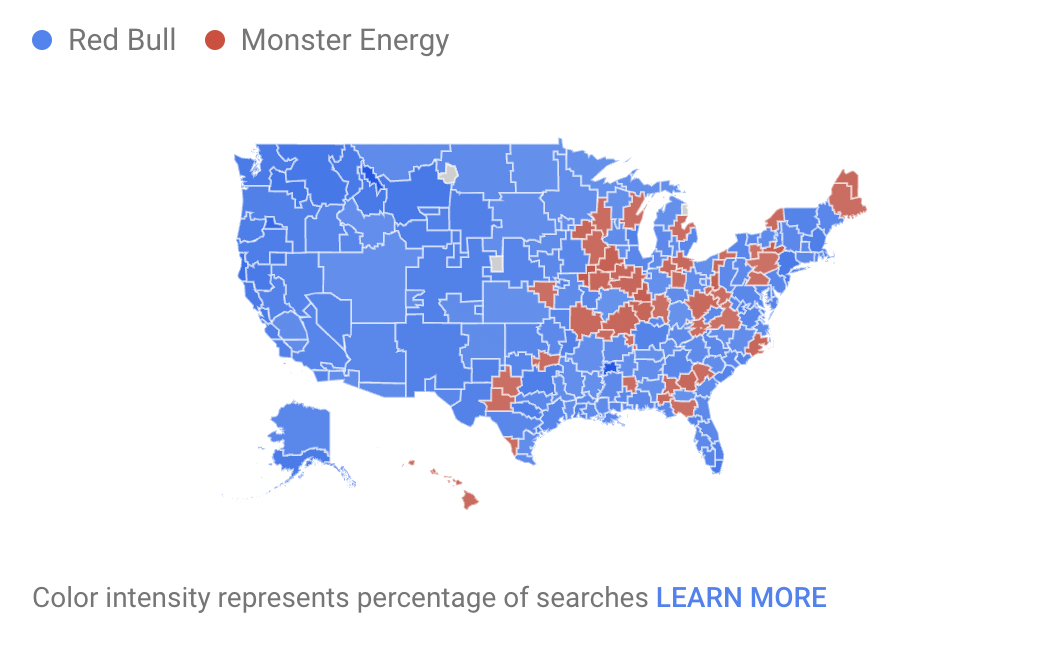
A canonical Job-to-be-done example is the McDonald’s milkshake. The five-minute clip of Clayton Christensen is worth watching and the explanation probably mimics hiring Monster. It’s sweet and caffeinated. It’s large, so it lasts. It also means something to the consumers. Here’s a Google Trends map from January 2023.

There’s something about Pennsylvania through West Virginia, Ohio, Kentucky, Tennesse, Arkansas up through Missouri, Iowa, and Wisconsin consumers. Monster Energy tapped ‘that thing’.

📚

Related: Bitter Brew tells the story of Anheuser-Busch’s history. For God, Country, and Coca-Cola tells the story of Coke and highlights the importance of distribution advantages as Coke employees were the rear guard of the Allied forces marching across Europe in 1945.

The birthday cake’s JTBD

One question within jobs to be done is: Are the consumer and the customer different? 

A manager who buys software or uniforms or food for their staff is the customer whereas the staff is the consumer. And this happens a lot. 

Homeowners use thermostats but HVAC companies buy them. About one-fifth of books sold are gifts. Physicians choose the medicines that patients take. And then there is the birthday cake. 

“We aren’t making nearly as many of our decorated cakes as we used to. When we do, it’s a half sheet instead of a full sheet or even nine-inch cakes. In our Chicago industry, we’ve seen a drop in decorative cakes mostly from the people who are in their twenties and thirties who don’t want to buy the same things for their kids that they got when they were kids. They want ice cream cakes or experiential things instead of having a birthday cake at home.”  – Ken Jarosch, Odd Lots, December 2022

If the customer and consumer aren’t aligned then a business gets what Bob Moesta calls “zombie revenue”. 

Gyms run on zombie revenue because the customer, the current me, is different from the consumer, the future me. 

Products are not: build it and they will come. There’s much more why, how, and when – even at a kid’s birthday party. 

Birthdays are common posts around here: The Birthday Cake Diet and The Birthday Bet.