You stick your hand in shit…

This is from a daily email I write with my friend Aaron.

Mr. Cohen was at his summer job, waiting for his delivery truck to be loaded up for the day.  

“Yeah college is fun,” he told a mechanic while the two waited, “but I’m dropping out.”  

“Why?” the mechanic inquired.  

“Well, I don’t like it,” said Cohen. 

“Ahh, you stick your hand in shit you wash it off,” offered the mechanic.  

Mr. Cohen created one of the greatest brands in the United States. You know it. You’ve probably bought it. We’ll get to that in a moment.  

Cohen didn’t immediately apply the mechanic’s advice. He quit college. He mopped floors for a bit, but quit. He worked as an ER clerk, but left. He drove a taxi for a while.  

It wasn’t until Cohen had a partner and a plan that he persevered.  

The duo’s first store was an abandoned gas station. They slept there. They couldn’t pay their contractors in cash, so they paid in kind. They couldn’t afford equipment. Instead, they reached out to their friends and family asking them to check the classified sections for going-out-of-business sales.  

They faced obstacles and found solutions.  

They persevered. 

They opened Ben & Jerry’s Homemade Ice Cream in Burlington, Vermont.  

You stick your hand in shit you wash it off.  

You get knocked down, you get back up.

Should you build *magic*?

When talking about Jobs To Be Done, Bob Moesta notes that there are two ways to innovate. Supply-side innovation is internally driven. Organizations know their capabilities, limitations, and business model and build from that position. This type of innovation is more efficient, has limited scope (and costs!), and uses the language of the organization.

Alternatively, demand-side innovation is externally driven. Jobs theory is demand side as is the Mom Test and IDEO’s invention through iteration. This type of innovation includes prototypes and feedback, lots of questions, and uses the language of the customers and consumers. 

“Any sufficiently advanced technology,” Arthur C. Clarke wrote in 1962, “is indistinguishable from magic”. 

That quote highlights this aspect. Technology users want it to feel like magic. Builders use advanced technologies.

Face ID is magic. 

“What Apple did with Face ID was take a really hard computer science problem, and using a lot of complicated technology, create something with a simple name. I intuitively know what Face ID is just from the name. It’s also intuitive to use. I looked at it and was in. There’s an opportunity to do something like that (for crypto). Multiparty computation is not the right marketing term for what the average person might use.”

Brian Armstrong to Ben Horowitz. 

Uber is magic. 

“At first glance Uber might just look like a simple app—after all, the premise was always to hit a button and get a ride. But underneath its deceptively basic user interface was a complex, global operation required to sustain the business. The app sat on a vast worldwide network of smaller networks, each one representing cities and countries. Each of these networks had to be started, scaled, and defended against competitors, at all hours of the day.”

Andrew Chen, The Cold Start Problem.

The wrong lesson here is to think customers want magic. It’s situational! Shopping and buying are different

There is no best way to innovate, only trade offs. But Clarke gives us a nice framing for technology.

Crazy Russian incentives

Around 1992 Russia privatized state companies. The government gave each citizen one voucher they could bring to an exchange for a share of that day’s company. A simple plan – until humans get involved.

Not all Russians wanted to own shares. Local markets emerged. A small fish bought all the vouchers in one neighborhood, a medium fish bought all the neighborhoods in a town, a large fish bought all the towns in a region. Eventually sacks of vouchers made it to the national exchanges.

Though unintended, these mini-markets worked. Free economies FTW. So far so good.

Each exchange had a schedule. A modern Monday might be 1,000 shares of Apple at nine, 200 of IBM at ten, 500 of Ford at eleven and so on. If only one person showed up Monday at nine they would get all the shares for their vouchers. It was the market mechanism at work. It’s cheaper (more valuable) to not bid against someone in an auction. When one companies shares went up they shut down the airport the day before their voucher offering. Another company ignited a tire fire on train tracks leading in and out of town.

Insiders were insistent on owning their companies because the valuations were way off. By one estimate, the voucher privatization program valued the entire Russian economy at ten billion dollars, or one sixth the market cap of Walmart. If you could buy a legitimate twenty dollar Amazon gift card for one dollar would you? Rather, how many? This economic transition was called a katastroika. A combination of the catastrophe and perestroika – Gorbachev’s politics.

George H. W. Bush has his last year as president, Achy Breaky Heart finishes the year as the fifteenth most played song, and there’s money to be made in Russia.

“I went to someone in the investment management division,” Bill Browder writes in Red Notice, “expecting him to hug me since I was sharing the most joyous jaw dropping investment opportunity he would ever see. Instead he looked at me as if I was suggesting the firm should invest in Mars.”
Russian privatization was a huge opportunity. Everyone at Salomon Brothers missed it. Why? Incentives.

On Browder’s first day, his first manager explained the system: generate five times your salary or you’re done.

“Nobody at Salomon Brothers could divorce themselves from their own narrow mindset. Perhaps if I had been more subtle and clever I could have pierced their myopia, but I wasn’t, I had no political skills. I presented my idea for weeks and weeks hoping that through repetition I would get through to someone.”

Incentives and culture form what people do when they’re not told what to do.

At the London office the formula – which worked wonderfully – was fees through consulting.

Eventually Browder’s repetition got through and he got a call from Bobby Ludwig in New York. Two days after a phone call with Ludwig, Browder pitched the idea. An hour later Ludwig delivered twenty-five million dollars and marching orders. At the New York office the formula for Bobby Ludwig was to make money.

When Browder returned to London he had to switch departments but couldn’t find a desk. “Bill, why are you bothering me with this?” Ludwig asked when Browder appealed to him, “If they won’t give you a desk just work from home, I don’t care where you work. This is about investing in Russia, not desks.”


There’s this idea that to understand what’s going on in the world someone has to know the history or stay on top of things. But sometimes we can come back to first principles. We’re all humans with incentives. Also, the Red Notice audiobook performance is amazing.

2022 Books

These are the books I finished. Each is an Amazon Affiliate link.

Reading is slightly underrated. Get the most out of reading by starting more books, quitting more books, and diving into themes.

Personal maintenance. Familiar subjects and books to “remind me”.

Atomic Habits I was late to this because it’s not too new. The book is built around adjusting the friction in our lives. Clear does a great job explaining these things and the book is a reminder to redesign gunky systems.

Never Split the Difference, a reread. Voss’s best-seller is heavy on his own stories and I skip these parts for the tactics like: two copies? or help me understand or that’s right or how am I supposed to do that? Be empathetic and talk to people in their world with their words.

Courage is Calling. Holiday adds stories to his stoic virtues series. I need reminders like the one above my desk: don’t be overheard complaining about life at court, not even to yourself.

Fiction used to feel unproductive because there wasn’t a story to write or a way to hack novel solutions into our daily optimization. I’m dumb. Fiction is fun. And if you need – like I still sometimes do – a rationalization, remember that these are stories written about people by people for people. The payoff is humanity.

All the Light we Cannot See. Good and I can’t wait for the Netflix series. The fictional account of fleeing families during WW2, personal growth and love, attention, and riddles and mazes.

The Nightingale. Like All the Light… and last year’s Alice Network this book follows a pair of women (sisters) during WW2. Why read historical fiction about women during WW2? I’ve no idea. This book, man this book had it all, even a few good sniffles at the end.

Fellowship of the Ring. At the Council of Elrond, the members are amazed at the dangers Aragorn has faced. “There is little need to tell of them”, said Aragon, “if a man must needs walk in sight of the Black Gate, or tread the deadly flowers of Morgul Vale, then perils he will have.” I think about this a lot.

Better off Dead (Jack Reacher). Each year Lee Child writes a new book, mostly the same structure, always focusing on Jack Reacher. Each year I read it.

Prey. A Patrick O’Shaughnessy recommendation. Written in 2002(!!!!!) the book holds up. This was the only aged passage: “I had a ten o’clock meeting with my headhunter, Annie Gerard. We met in the sunny courtyard of a coffee shop on Baker. We always met outside, so Annie could smoke. She had her laptop out and her wireless modem plugged in. A cigarette dangled from her lip, and she squinted in the smoke. “Got anything?” I said, sitting down opposite her.” I’ll only add that thermite makes a great white elephant gift.

JTBD books. JTBD is a problem-solving approach we’ve covered a lot.

Demand Side Sales. A collection of stories from Bob Moesta’s experiences. But my favorite story is from the introduction by Jason Fried:

I noticed that when people browsed shoes on a wall, they’d pick a few up and bounce them around in their hand to get a sense of the heft and feel. Shoes go on your feet, but people picked the shoe with their hands. If it didn’t feel good in the hand, it never made it to their foot.

Jason Fried

Start With No. Recommended by Chris Voss. It’s a little JTBD and a little Never Split… though Camp’s stories are as good as Voss’s or Moesta’s. A good book to ’round out’ these ideas but not essential.

The Sandler Rules. Recommended by Bob Moesta. Another ’round out’ book. Full review here.

Other

The Accounting Game. This a short fun read for an introduction to accounting. Though I still don’t ‘get it’. What I want is a holistic approach. How did Buffett understand float? How do I understand high fixed costs relative to accounts receivable? Accounting is a bathtub problem. Right?

Virus of the Mind. Richard Dawkins coined meme but this book (by one of the designers of Microsoft Word) goes into it. Through evolution, we developed preferences for messages built around danger, food, and sex. Certain types of those messages (stories, images, etc) spread better than others.

Status Games. There’s a set of books like Miller’s Spent and Hanson’s Elephant… that address the idea of status, mimicry, and imitation. Status Games was the best personal fit because of its evolutionary focus. Miller’s is more commercial (it was also good) and Hanson’s never clicked for me.

Parenting Teens with Love and Logic. My daughters’ school suggested this one. The warning for books like this is that most of parenting is making sure kids are physically, mentally, and emotionally safe from the big stuff. The rest is just tweaks. What I liked about this book was the contrast between parents being ‘helicopters’ or ‘consultants’.

Nomadland. Stories of people living as nomads. Usually, people didn’t intend to end up as nomads but if they did it was because they lost their health, house, job, or spouse. Instagram #vanlife isn’t real, and these stories are tough lives – but there’s something to this. Why do people live in one place? What are the limits? If jobs, insurances, paychecks, fulfillment, and family photos are in the cloud does that change how we live?

Wanting, is this mimetic?

This is not a book review of Wanting: The Power of Mimetic Desire in Everyday Life. It is only a slice. Wanting should be subtitled ‘networks effects’. The book is based on network structure and connections but I can’t recall ‘network’ being used at all.

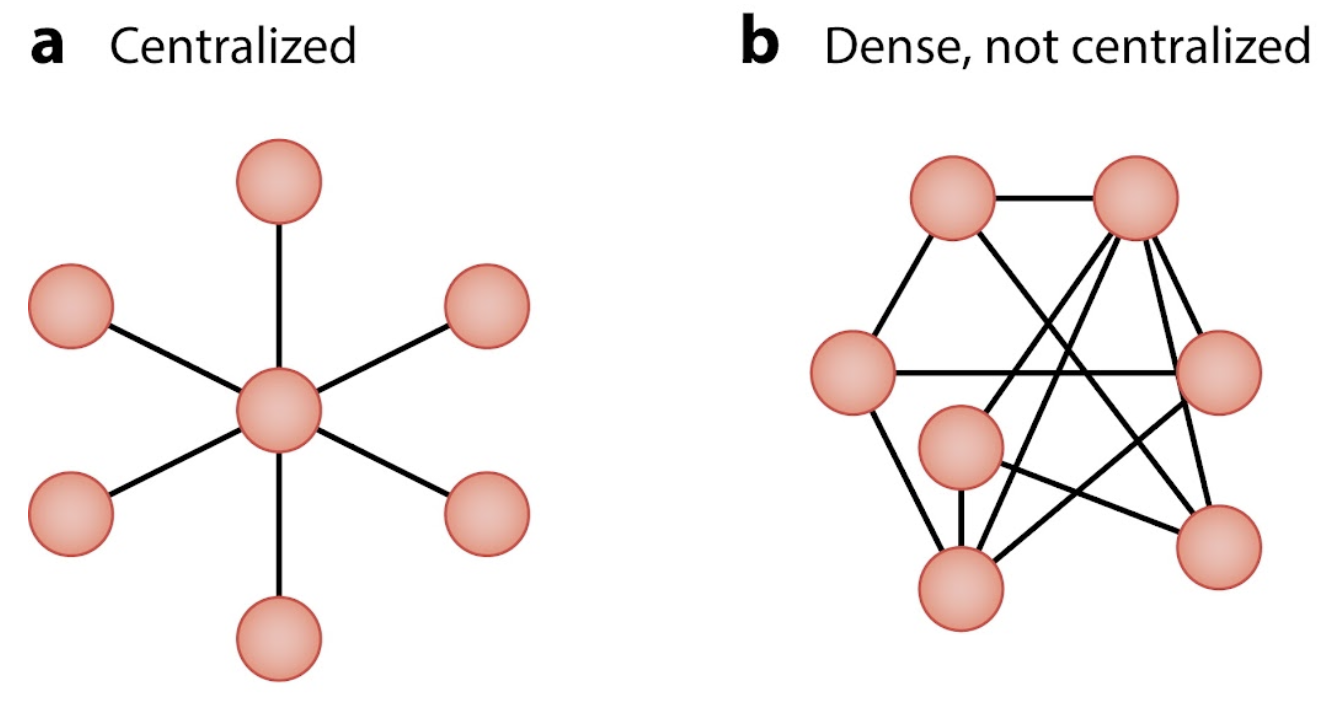
In mimesis, a centralized network is ‘Celebristan’. Our relationships with one-namers like Lebron or Cher is a centralized model. In mimesis, a dense, not centralized network is ‘Freshmanistan’, these are our relationships with roommates, neighbors, and colleagues.

2 networks

A network’s structure dictates information flow. Information is anything: ideas, vaccines, and so on. Lebron’s favorite salad dressing transfers widely, but only to us. He does not care about our top topping.

But, one-namers have dense networks with each other. Unacceptable: Privilege, Deceit & the Making of the College Admissions Scandal is an example of Burgis’s point. One-namers took the same trips, owned the same properties, bought the same toys. Though they were celebrity to us, their network was ‘Freshmanistan’.

The information in mimesis is status, rivalry, and desire.

Well, our best versions say, I don’t care about all that. This, mimesis OG Rene Girard said, is the romantic lie. Rivalry exists because we don’t really know what we want. “In the universe of desire,” Burgis writes, “there is no clear hierarchy.” It’s not that you want Ray-Ban sunglasses, it’s that someone else does.

This is my sticking point. I’m on board with the network structure and information flows. I’m okay with wants being fungible. But the conclusion feels wrong. Maybe.

There’s this dumb thing that happens to my wife and me. One of us suggests dinner, vacation, or weekend spot. The other mehs it. Time passes. A friend suggests that place to one of us. They go to the other and suggest it. ‘What the heck, I said that last month!’

Something is happening. Is it mimesis? I don’t know.

Status is an evolutionary advantage. Group membership helps us survive, and status games help the group because they are non-violent competitions. Draymond Green probably attacked teammate Jordan Poole because their status games were off. But the episode proves the point. Had Green’s punch landed, both individuals and the group would be hurt. Signs of status like cars, homes, jewelry, people, experiences prevent this conflict.

Is this mimesis? I don’t know.

Rather than rule on the mimetic ideas, we can triangulate them. In the spirit of looks like a duck, walks like a duck, talks like a duck. How does mimetic theory fit with…

Network theory? Great! Network theory is the underlying structure. All networks have information like covid viruses, neighborhood gossip, bumping electrons. Mimesis fits with our social networks.

JTBD? Surprisingly okay. In jobs theory people begin to ‘hire’ for solutions with “passive looking”. Maybe that stage is our social influences. If we are imitative then seeing one person with something might influence us.

Status games? Not bad. Mimetic rivalry creates the status hierarchy within a group.

Incentives? Less good. In the aggregate a bunch of people work to make as much money as possible. But does any one of them do that because they have a mimetic rivalry with any other? “The romantic lie” is great branding but incentives feel more right than mimesis.

The book confused me. It seems kinda right but not really right. But here we are, thinking about it, which may be mimetic itself.

A few network examples that didn’t make the post: The Zappos Holacracy was CEO Tony Hsieh’s attempt to recreate college, increase random interactions, and optimize “a return on collisions”.

The Theodore Roosevelt Covid outbreak as another example of network structure and information flows.

Intentional living – winning or otherwise

Good advice is tricky. The This Time is Different series is built around asking: Are these the correct lessons?

Part of the uncertainty is the truth and fit between the big idea and the story. In Start with No, the big idea is our ego, the story is sales, and the fit is: good salespeople have the right ego. Do people have egos? Are people in sales? Does the right ego for sales still matter? Yes – so the book is good advice. 

In Wanting: The Power of Mimetic Desire in Everyday Life, the big idea is network structure, the story is about mimetics the fit is: we are mimetic due to our network structure. That checks out too (though doubt the effect size). 

Winning by Tim Grover follows this pattern. The big idea is intentionality told through the story of winning a competition. Winning like Jordan or Kobe requires intentional actions. That checks out too. In Early Retirement Extreme, the big idea is intentionality but the story is financial philosophy. The same big idea but a different story. 

Grover focuses on intentionality in two ways: wants leading to actions and outsider status.

For Grover, wanting to win has to lead to acting to win. “If you don’t get on the same level,” Michael Jordan told one teammate, “It’s going to be hell for you.” Jordan was one of the first players to switch from carb-heavy meals to eating steak before games. Before Jordan, few players trained during and before the season. For Kobe, the actions were learning Slovenian to trash talk Luca Donic. In 2008, preparing for the Olympic Games, Kobe was going to the gym when the rest of the team came back from a party at five in the morning. 

Intentional living requires wants which require actions.

Grover’s second point is how it feels to be an outsider. Howard Marks popularized the idea that outperformance means being different and being right. Easy to say, hard to do. 

Investors, like Marks, can be different and right with good stakeholders. If limited partners don’t ‘get it’ the business plan can’t work. So investors look for LPs who will ‘stick with it’. It’s easier to be an outsider when surrounded by a collection of insiders. 

Grover’s clients are in the entertainment business and the ‘get it’ is social. Why succeed unconventionally when you can fail conventionally? 

To succeed as an outsider someone must have a plan and stick with it rather than stick your finger in the wind. “No,” Grover writes, “is a complete sentence.” Build up the don’t give a fuck muscle too. Some think it’s weird? Who cares! Successful outsiders will design easier paths. Kobe Bryant had the most ingenious form and LARPed as the Black Mamba. Winning wasn’t a great book. I hoped for more insider stories. But the big idea was a good reminder. 

Russian Markets

Competition’s effect is the “market mechanism”. This example is from 1996 Russia.

Bill Browder is looking at stock in a Russian oil and gas company. The country’s companies have just become public, and though MNPZ has slightly smaller reserves than British Petroleum, it’s trading for 100x less. Why?

I was convinced that there must be some other explanation for the deep discount and spent the next several days searching for it.

Did the preferred shares have different par values? No. Was the ownership restricted to workers? No. Could the higher dividends be arbitrarily changed or canceled by the company? No. Did they represent only some minuscule part of the share capital? No. There was no explanation. The only reason I could fathom for why they were so cheap was that no one had showed up to ask about them-until I had.

Amazingly, I found that this anomaly wasn’t restricted to MNPZ.

Nearly every company in Russia had preferred shares and most of them traded at a huge discount to the ordinary shares. These things were a potential gold mine.

If there’s a name, there’s a market mechanism. If the invisible is now visible, there’s a market mechanism. If something is weird, new, unknown, secret, there may not be.

Pricing power evaporates with the heat of the market mechanism. Sometimes though, in the far reaches, someone can, find a gold mine.

Russian Reading List

There’s a financial advisor axiom that the best plan is the one you’ll stick with. For trainers, it is exercises done through a full range of motion. The best endocrinologists find an achievable plan, not an ideal one. There should be one for education too. With that in mind, here’s a list of Russian resources optimized for consumption rather than comprehensiveness.

We’ve done this before with books about China and related, history books that are business books.

The Rest is History (podcast). Some podcasts are better than books because the host(s) add context. Dan Carlin is great at this. Tom and Dominic do too, and their series on Vladimir Putin is excellent.

Red Notice. A finance thriller? Yep. Bill Browder spent decades opening, running, and closing a fund in Russia during the switch from communism to oligarchy.

Muppets in Moscow A 2022 book, h/t Marginal Revolution about Sesame Street in Russia.

Exporting Raymond. We love Phil Rosenthal’s Netflix travel/food show Somebody Feed Phil. This is the story of taking the show Everybody Loves Raymond to Russia.

Koylma Tales via Agustin Lebron called it “a collection of stories of people who lived in the Gulag, possibly the most revealing book on human nature I’ve ever read.” Takes place through the 1930s and 40s.

Sandworm: A New Era of Cyberwar and the Hunt for the Kremlin’s Most Dangerous Hackers. Forgot this source. “The true story of the most devastating cyberattack in history,” notes Amazon, “and the desperate hunt to identify and track the elite Russian agents behind it.” 2,000 reviews averaging 4.7.

Winning’s Structure

Good advice is hard. Our This Time is Different series is built around asking: Are these the correct lessons?

Part of the uncertainty is the truth and fit between the big idea and the story. Start with No is an example. The big idea is our ego, the story is sales, and the fit is that good salespeople have the right ego. Do people have egos? Are people in sales? Does the right ego for sales still matter? Yes – so the book is good advice. 

Wanting by Luke Burgis is an example too. The big idea is network types. The story is about mimetics. The fit is that we are mimetic because of our network structure. That checks out too (though I had my doubts about the effect size). 

Winning by Tim Grover follows this pattern. The big idea is intentionality told through the story of competition. Winning like Jordan or Kobe requires intentional actions. That checks out too. An opposite story but the same big idea is Early Retirement Extreme. The big idea is still intentionality but the story is financial philosophy. 

Grover focuses on intentionality in two ways: wants and outsider status.

For Grover, wants like winning are preceded by actions. Kobe and Jordan wanted to win so they had to take actions that lead to that.  “If you don’t get on the same level,” Michael Jordan told one teammate, “It’s going to be hell for you.” Jordan was one of the first players to switch from carb heavy meals to eating steak before games. Before Jordan, few players trained during and before the season. For Kobe the actions were learning Slovenian to trash talk Luca Donic. In 2008, preparing for the Olympic Games, Kobe was going to the gym when the rest of the team came back from a party at five in the morning. 

Intentional living requires wants which require actions.

Grover’s second point is how it feels to be an outsider. Howard Marks popularized the idea that outperformance means being different and being right. Easy to say, hard to do. 

Investors, like Marks, can be different and right with good stakeholders. If limited partners don’t ‘get it’ the business plan can’t work. Investors then look for LPs who will ‘stick with’ a plan. It’s easier to be an outsider when surrounded by a (small) group of insiders. 

Grover’s clients are in the entertainment business so the ‘get it’ is social. Why succeed unconventionally when you can fail traditionally? 

There are ways to deal with outsider status. Have a plan and stick with it rather than stick your finger in the wind. “No,” Grover writes, “is a complete sentence.” Build up the don’t give a fuck muscle too. Some think it’s weird? Who cares! 

Successful outsiders design easier paths. We are wired to not stand out. Kobe Bryant had the most ingenious form and LARPed as the Black Mamba. Winning wasn’t a great book. I hoped for more insider stories. But the big idea was a good reminder.

The Sandler Rules (a short review)

It is helpful to think of The Sandler Rules: 49 Timeless Selling Principles and How to Apply Them like Parenting Teens with Love and Logic. Both books suggest shifting from helicopter parent or pushy salesperson to more of a consultant. For Sandler it’s principle 39. 

For Sandler, for sales, the customer’s progress is all that matters. It’s not how hard you worked. It’s not the feature. It’s not what you think. It’s not the last time this happened. 

It’s. Just. The. Customer’s. Progress. 

To find that the salesperson must be honest, a contradiction to the caricatures. “When interacting with prospects and clients, your objective is to uncover the truth, even if it’s not something you want to hear.” 

One obstacle, ironically, on the path from honesty leading to truth is knowledge. You can know too much. So, act like a dummy (Rule 17). Remember, selling is not about telling (Rule 14). 

Doctoring is a helpful analogy. Dermatologists don’t digress into the sciences  – they diagnose damage. The sales system differs from the medical one and strictly comparing the two makes the man on the moon mistake, but the philosophy is the same. 

Author David Mattson does a nice job of collecting the principles and assigning interesting ideas to each. My favorites: 

  • Rule 2: Don’t spill your candy in the lobby. Get information don’t give it.
  • Rule 4: Explain ‘no’ is okay. Aim to uncover the truth – even if it’s something you don’t want to hear.
  • Rule 13: No mind reading, don’t assume and clarify vague responses.
  • Rule 14: “‘Selling’ is not about “‘telling.’”
  • Rule 22: Defuse bombs right away – bring up the problem.
  • Rule 27: “You can’t sell anybody anything, they must discover they want it.”
  • Rule 37: “All Prospects Lie, All the Time… but why, and about what.”
  • Rule 38: The problem they bring you is never the real problem, “diagnosis is the salesperson’s responsibility”.
  • Rule 41: Whatever is happening is your responsibility
  • Rule 48: A life without risk is a life without growth

Sandler was suggested in Bob Moesta’s book Demand Side Sales. This book is an aligned sales system to the JTBD approach. Rules 37 & 38 (“all prospects lie, all the time” & diagnosis is the salesperson’s job) fit well with the curiosity inherent in JTBD.

The Sandler Rules: 49 Timeless Selling Principles and How to Apply Them is a fast read, best for the JTBD curious and those looking for some sales support. 

Here’s the review for Parenting Teens…

And the JTBD series