It’s odd to take photos in public bathrooms. But the example was too good.
Whenever there’s an additional sign, or instructions, or FAQ it means there’s design and jobs-theory work to do.
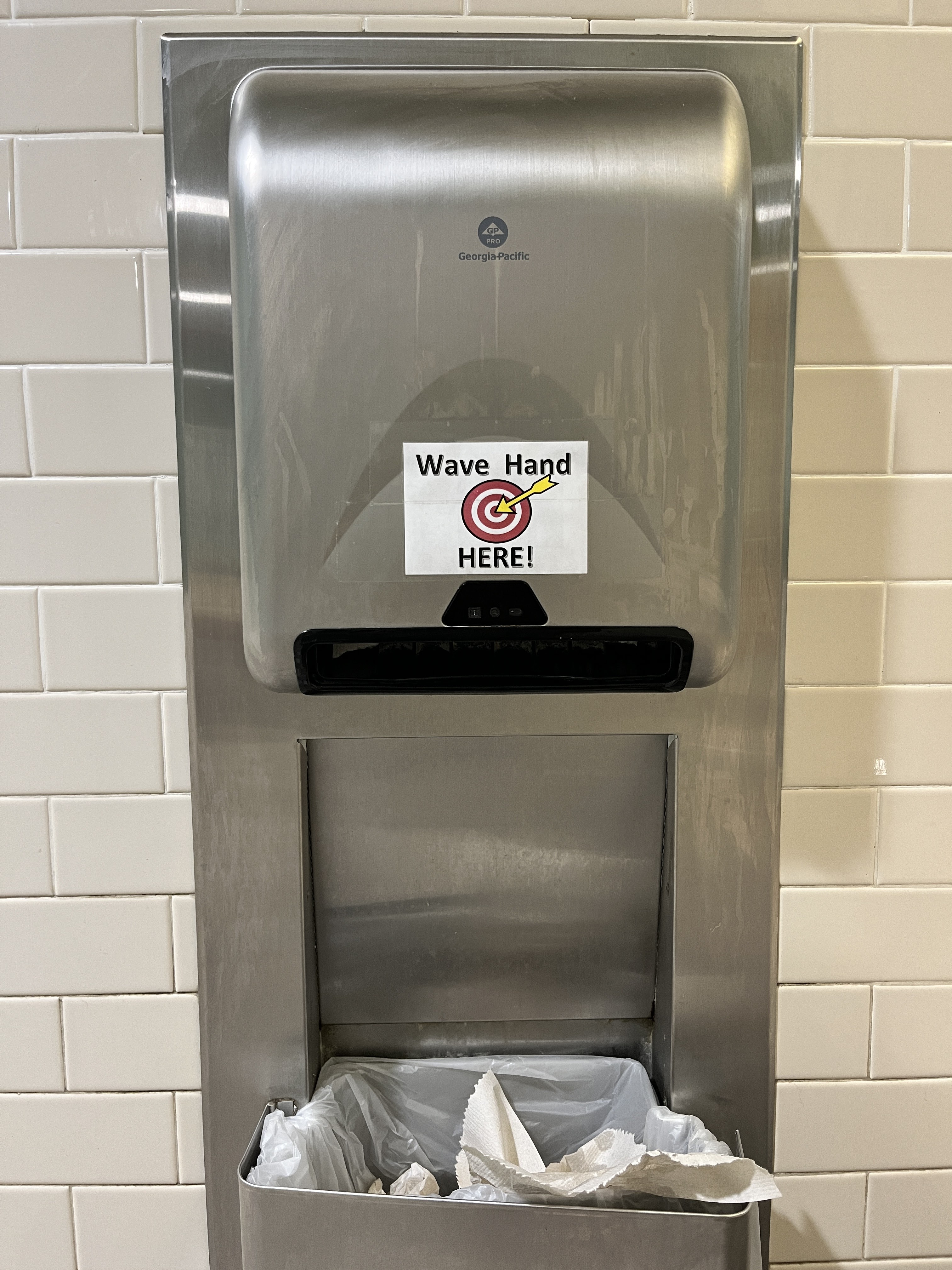
Mike's notes.
It’s odd to take photos in public bathrooms. But the example was too good.
Whenever there’s an additional sign, or instructions, or FAQ it means there’s design and jobs-theory work to do.
One part of Jobs theory, according to Bob and Greg, is the distinction between shopping and restocking.
shopping – evaluating choices
restocking – finding an item
Organizations must understand this because when market incumbents, (if this sounds related to disruption theory it’s because Bob was a colleague of Clayton Christensen), serve restockers they change nothing. If it’s not broke don’t fix it.
Whereas challengers need to break into the restocking mindset. They might articulate novel criteria: Our dips have no added sugar.
The incumbent’s dips may also be sugar-free, but the challenger creates the question and the incumbent responds.
Bob tells the story of shopping of needing a new shampoo and conditioner and making his choice because it was 2-in-1. It wasn’t the natural oils (or lack of). Nor was it how charitable the company was or the number of additives. It was convenience.
His original choice (the restocking) was unavailable and like the sugar-free hypothetical, Bob had to ask himself: What’s important?
Well, there’s this.

Take from July 2023, the shortage has proved to be a shopping “opportunity”.
We’ve settled on Tapatio (side-note: weird keychains, like this, are always a hit as gifts) and depending on how long the outages last, may switch from Tapatio shoppers to restockers
…
Related: hair care competes with haircuts. As Clayton Christensen wrote, your competition may not be in the same grocery aisle.
Why do I hire seltzer?
Why do I hire seltzer? After experimenting, these are the reasons.
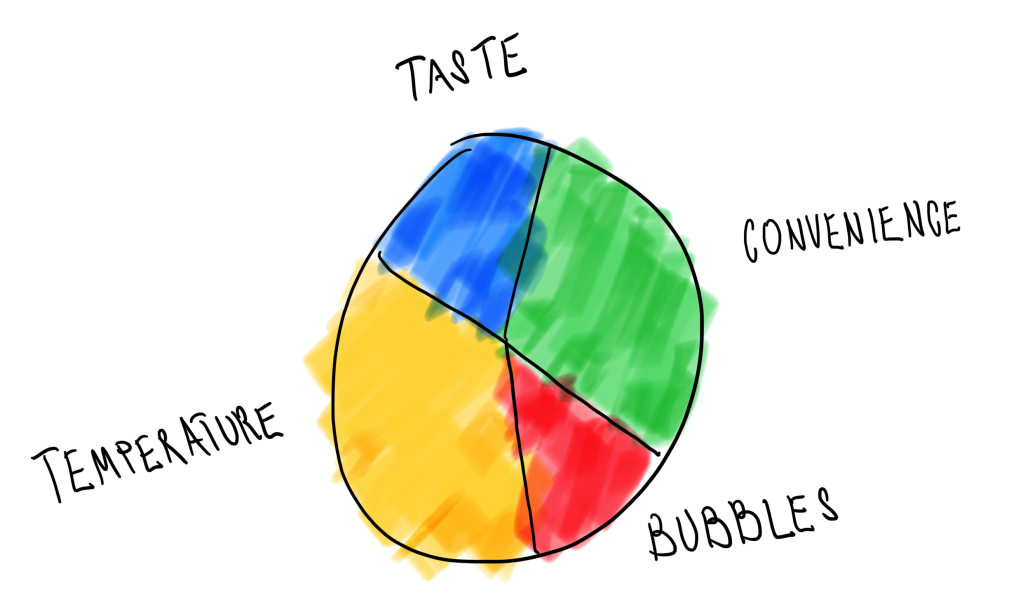
A switch to refrigerated bottled water preserves the temperature and convenience but lacks the bubbles and taste.
But a Nalgene (filled the night before, designed into the evening routine), provides temperature, taste, and psychic income!
–
Jobs as a theory is like any other theory – use it or lose it. Apply it. Reflect on actions, choices, tradeoffs, and context.
There are so many podcasts, books, and articles. So many ideas, oh that’s a good one.
But without using it, it’s like we never knew it.
In Uncommon Service the authors note that customers want businesses to suck at something. It’s a Never Split the Different vibe. Or in terms of a karaoke bar: Play the hits!
A visualization from the book:
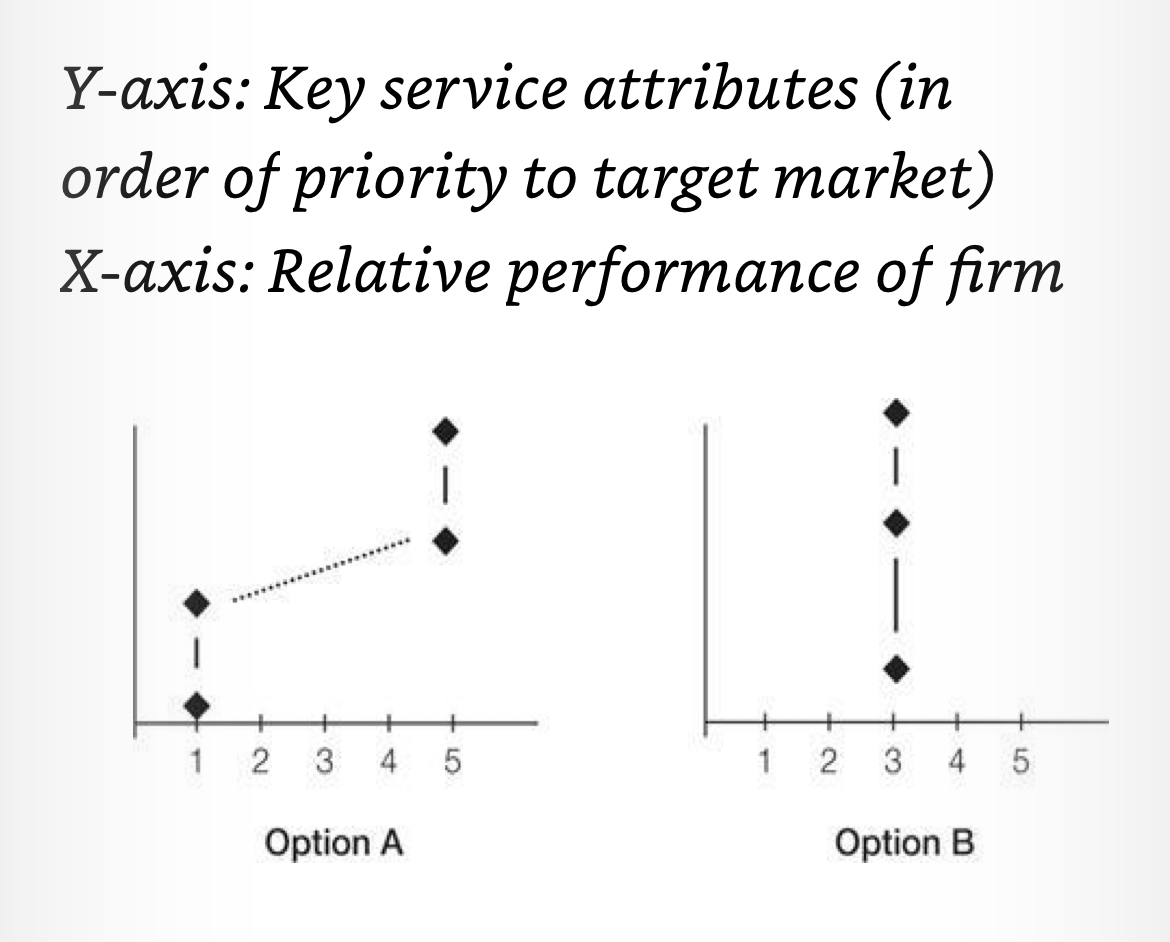
Restaurants have different attributes: food quality, pacing, pricing, ambiance, and so on. For a celebration, people are willing to trade price for service. This is the sort of “context” at the heart of JTBD.
“Our business,” listings read, “has 100 years of combined experience.” Well, that sounds like a lot. But is it two people with fifty years or ten people with ten? Then again, is fifty years of experience good? Do you want a doctor who went to medical school in the 70s?
There’s no answer, it’s all contextual.
But we do make trade-offs and must be honest about what they are and what that means.
How to Fly a Horse is one of the best books you haven’t read. It’s part inspirational (like Rosling) part instructional (like King) and part historical (like Dan Carlin).
Simply, we are capable but more importantly, we are responsible for the world we want. “Everything around you that you call life,” Steve Jobs said, “ was made up by people that were no smarter than you.”
But this ain’t influencer stuff.
Everyone has creative potential, Kevin Ashton writes, but it takes work. “Time is the raw material of creation.” As Steven Pressfield noted, put your ass where your heart wants to be.
That’s just Insta-advice.
The world does not want creation. The system is designed against it in two ways.
A me problem.
We block our creations. There’s the genius myth: Creation is for a select few. That’s just not right. The End of Average explains this nicely. ‘Genius’ (or ‘athletic’ or ‘industrious’ or ‘lazy’ and so on) are collections. There’s no genius metric because there’s nothing to have.
Ya got it or you don’t is not true.
But this isn’t enough. It takes work, work, work. For a species designed for ease, work is hard.
There’s a paradox too: The better we get at something the more efficient we get and the less likely we are to see novelty. Think of “expertise” Ashton writes, as “efficiency”. There is nothing more deceptive, wrote Arthur Conan Doyle, than an obvious fact. Tyler Cowen calls this “once and for all-ism.” Experts have been rewarded for seeing the world a certain way, why change?
The solution to the paradox is to bring experience but not beliefs. To have a light identity footprint. To see the unexpected, expect to see nothing.
A them problem.
They, the others, those folks don’t want to see it. Or they can’t see it. It’s helpful to remember Demings, “Every system is perfectly designed to get the results it gets.” People don’t randomly red-pill, laissez le bon temps rouler!
The status quo is humanity’s default (this is an assumption of JTBD).
‘Different is bad’ is evolutionarily good. Our ancestors were the ones who didn’t try the new berries.
Rejection, hesitation, and reluctance are good things. First creators must expect it. Knowing first drafts suck, progress is slow, and TK takes the sting out. Second, creators must use this for guidance. Feedback presents the soil to sew, the path to plan for, the itinerary to travel. Ashton advocates for the creator to utilize not internalize rejections. Ask, okay, so how could this be better?
–
The book is full of pithy quotes. Let’s end with two:
“We sell our soul when we waste our time. We drive neither ourselves nor our world forward if we choose idling over inventing.”
“The math of time is simple: you have less than you think and need more than you know.”
–
This book was mentioned in Bob Moesta’s Learning to Build.
Rather than a traditional review, think about Learning to Build in the context of jobs to be done.
We believe there’s no such thing as a bad book so much as bad timing. In some version of the multiverse, you need any given book right now!
Similarly, jobs theory is about finding the pushes and pulls, habits and anxieties, and contexts for when people act.
In that spirit, here are the Jobs books for this multiverse.
Learning to Build is an introduction to someone who wants to learn more about Bob Moesta’s work. It introduces the five skills: empathetic perspective, uncovering demand, causal structures, prototype to learn, and making tradeoffs.
Demand Side Sales is for someone in sales who wants a fresh idea. Never Split the Difference, Start with No, and The Sandler Rules also build the “talking to people” skill.
Competing Against Luck is for someone with a strategic angle. It’s for someone asking: What should we do here? The Mom Test is a faster, less academic path with similar idea vistas. How to Fly a Horse is a bigger and wider picture, with more history.
How Will You Measure Your Life is for someone who’s seen these ideas and needs a fresh – and personal! – perspective.
26 Jobs to be Done is my short e-book about grokking jobs.
Keep learning. Keep building. Keep growing.
One secret entrance to the job to be done is how people hack your product. There’s the way you built a thing – using supply-side innovation to scratch an itch or whatever. But then there is the demand-side innovation of what people really want. This manifests as hacks, like desire paths.
Peloton saw people hack their own social groups on Facebook and then built social tags within the app.
Instagram saw people hack photos to show white backgrounds with text and build polls.
Josh Wardle saw people share their Wordle scores and built the feature into the app.
🟩🟩🟩🟩🟩
There’s a cake icing tool called the “silicone icing spatula”. We bought this set, but any will do. Its “supply side innovation” is to ice baked goods. Its “demand side hack” is to scoop out jars.
Neither sauce, mayonnaise, nor store-bought icing can resist the sliding edge of this device. Tall container? No problem. Do you buy the peanut butter that separates? The good stuff but hard stuff. It becomes easy with this spatula.
🎁🎁🎁🎁🎁
Buy a set of these to give away for the holiday. Not only is it a thoughtful gift, but it’s also helpful and the colors stand out among the sea of black kitchen devices in the spatula drawer.
The only way to get better at a thing is to do a thing. Practice active copywriting, think about business models, and notice the different aspects of jobs to be done in your life. Find ways people hack products. Notice unusual go-to-market strategies. Think about when the customer and consumer are different people. Consider how requests are different from actions.
This Honey Baked Ham ad ran in December 2022.
The good. (1) Like the Ridge wallet, it shows contrast – but not of the products. We see the finished, polished, and plated, Honey Baked Ham.
Contrasted with the process. It’s not that your turkey, ham, or sides won’t look good but that it takes some serious effort – with tools you use once a year.
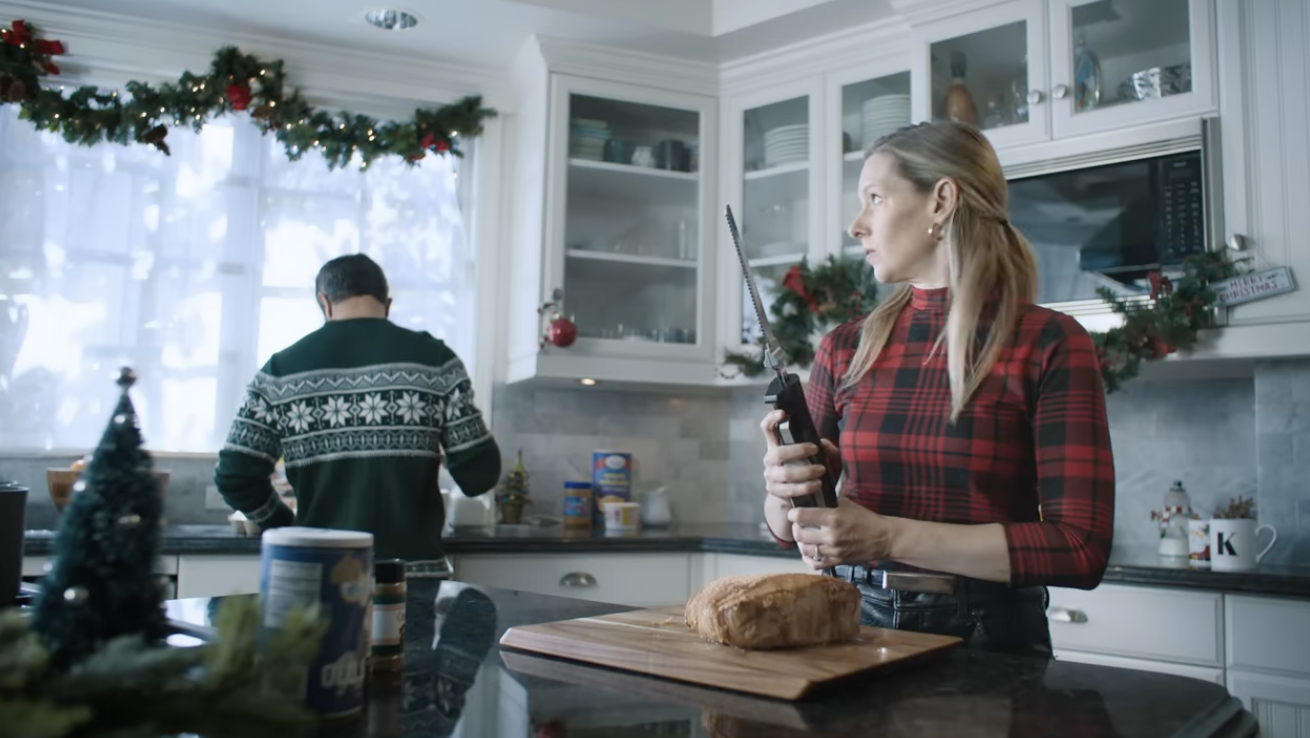
And techniques you use even less.

Buy a stick blender instead.
(2) Consumer spending is an example of median and average meanings. We average three thousand dollars a year eating out, but it’s not as simple as that number divided by 12 or 52. We only eat Domino’s Pizza with a deal. Similarly, during the holidays, customers are price insensitive.
Warren Buffett and Charlie Munger noticed this phenomenon in 1972 when they purchased See’s Candy. As Munger said, “I may see Wrigley’s gum alongside Glotz’s gum. I know about Wrigley but I don’t know anything about Glotz’s. If one is $.40 and the other is $.30, am I going to take something I don’t know and put it in my mouth?”
It was the same for See’s and for Honey Baked Ham where the pricing power comes from the holidays, food’s ‘intimacy’, and tradition. They never mention the price and they never should.
(3) Looking the part. When she started Haven’s Kitchen, Alison Cayne thought her cooking business was about food, but she found it was about appearance. Her cooking students (pre-Covid Cayne operated a cooking school in NYC) and sauce customers (the post-Covid pivot) wanted to appear competent.
The ‘job’ of a meal wasn’t filling bellies, it was filling expectations. Todd Snyder said that expectations drive his consumers too. You need to ‘look the part’ at the wedding, the interview, or the party.
Watch the ad. It’s not about the couple’s food, it’s about their appearance.
(4) What does Honey Baked Ham compete with? One part of JTBD is that products in the same category may not be competitors, like Snickers and Milky Way. Pizza, Chinese, and Honey Baked Ham are all Christmas dinner options, but the customers of one don’t consider the others.
Honey Baked’s competition is DIY – which is what this ad addresses!
The Bad. None!
The Interesting.
This ad is polished, like a Honey Baked Ham. At the end of 2022, ‘trending’ recipes were common. Hopefully, the Honey Baked Ham company avoids this and keeps bringing home the bacon with ads like the one above.
“How to Treat Other Human Beings” could be the subtitle to Will Guidara’s Unreasonable Hospitality. I loved this mix of stories, lessons, reflections, and mistakes. It felt honest. It read fast. I had a library copy but this is one of those put this on the shelf to page through later books.
Unreasonable Hospitality is going above and beyond to treat other human beings well. Take care of each other. Get out of your own head. Avoid your ego in favor of service.
It felt great to read, I’m still glowing.
And unreasonable hospitality is easy. It’s just three things.
First, a desire to do it. Your motivations may vary.
Second, a 95/5 mindset. Things cost money. It’s impossible to provide service without charging and even harder to be over-the-top. So the business model matters.
Guidara’s 95/5 approach is to watch ninety-five percent of the expenses like a hawk. At Eleven Madison Park this meant things like dishwasher racks to reduce breakage. While he managed the MoMA cafe it meant no fresh food an hour before closing time to reduce waste.
In his experiences at many restaurants, Guidara learned to manage costs. What could get cut? What couldn’t? What were the easy (and wrong) metrics? I pictured him like a wise carpenter. Rather than head to Lowe’s, he ripped a spare sheet of 3/4” plywood that was in the corner.
Now, what about that other five percent?
Third, the job to be done.
It’s about delight. Sometimes Guidara gave away the Tiffany champagne flutes to a newly engaged couple. Sometimes he fed the parking meters.
Sometimes it was complementary theater, sports, or concert tickets. Sometimes he served a classic New York City hot dog for a guest who hadn’t had one yet.
Sometimes it meant complementary cognac after dessert and with the arrival of the check. Sometimes it meant ten 100 Grand bars when a guest, preying on their hospitable reputation, asked for a million bucks. That guest loved it.
Why is this person here? What do they want? How can I serve them? What delights them?
–
Nothing about Unreasonable Hospitality is new.
But none of it is common.
The book is a chance to change that. With Guidara as a guide, anyone can put a little more hospitality into the world.
–
Note: Part of this book’s impact is its identification. We have plenty of posts about words: words mean competition, the new dictionary series, and words hiding value. Words are important because they identify something. They’re landmarks on our map of life.
In 2008, the story goes. A bunch of NBA players returned to their hotel after a night (and morning) of revelry, only to see Kobe going to the gym while they were headed to bed. Those players saw that and took their careers more seriously. Kobe’s actions were a landmark.
Will’s book is a landmark.
“So it’s decided,” goes the commercial, “we’ll park even deeper into parking spaces so people think they’re open.”
“Surprise.” Lolz.
Good copywriting, a subset of jobs theory, speaks in the customer’s language. And this commercial was not written from a rider’s perspective. It’s a driver’s perspective.
Insurance is an interesting sale because people hesitate to consider premiums, claims, and losses. We’re ambiguity averse and that’s the whole enchilada with insurance.
It wasn’t until the birth of the AFLAC duck in 1999, that insurance companies found humor as a path to awareness. Okay, customers thought, it’s not that serious, I can make a phone call.
But it still had to be kinda serious.
During a rebrand, GEICO found customers saved about 23% and it only took about eight minutes on the phone. However, when they tested that messaging, customers thought it was too good to be true. Instead, “fifteen minutes to save fifteen percent” was born.
Someone must answer the question: Why is this so cheap? That’s the customer language.
Insurances sales (all sales!) start with a simple unintimidating prompt. It can’t be too juvenile, even the mayhem man wears a suit. Costs (higher or lower) must be part of a story: Bundle with us and we pass the overhead savings on to you.
 The Waiter's Pad