Your *cost structure* is my opportunity

“Your margin is my opportunity.”

Jeff Bezos

Businesses evolve to be better for the consumer. That is, to better fit the JTBD. In many cases that’s by making the same thing easier, cheaper, better, etc. Sometimes though, the job changes and the new job can be done in a easier, cheaper, better, etc. way.

Cheaper means a structural change. We made X like this, now we can make it like that and now X costs 7% less. Sometimes a business will disrupt itself and find a better way to make something. Amazon did this. When they started work on digital products, the books, music, and video business brought in seventy-five cents of every dollar.

But the job of books, music, and video was about to change. Convenience rose in importance.

Sometimes a business will make things cheaper by finding a substitute that allows for a comparable or better product. Sometimes a business will find that consumers aren’t that into X and would rather have Y, which is cheaper anyway.

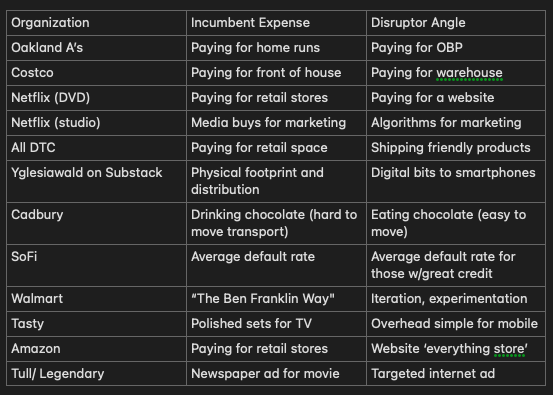
Here’s a list:

The Walmart example kinda fits least but it’s also the least technical focused. It’s on anyway because it fits the spirit. To innovate – as incumbent or disruptor – requires a mindset of experimentation and a clarity of the JTBD.

Alpha erosion and hot dogs?

Wharton Moneyball is a great podcast. The intersection of sports and business doesn’t do justice to the topics covered. Two events Moneyball does not overlook are the Kentucky Derby and Nathan’s Hot Dog Eating Contest.

During the July 2021 episode, co-host Shane Jensen asked if
it’s Joey Chestnut’s technique or some god-given gift that allows him to eat a record seventy-five hot dogs in ten minutes. Eating expert and co-host Eric Bradlow explained :

“They all do the same thing. Eat multiple hot dogs followed by buns dipped in water. Eat multiple hot dogs followed by buns dipped in water. Everybody, since Kobayashi started this strategy in the mid-2000s, uses this strategy.” – @EBradlow, Wharton Moneyball Podcast

Kobayashi’s creativity (and success) invited competitors. Alpha erosion is the idea that valuable advantages degrade with imitation. What was once scarce and valuable, is now abundant and worth less. Daryl Morey said that in the early days of basketball moneyball it was easier to draft players. By 2017 Morey noted how many other team’s draft boards looked a lot like the one in Houston.

But knowing alpha erosion exists and seeing it occur is not fait accompli. There are at least two paths: innovation and restriction.

Innovation occurs when an organization can deliver better products each year as judged by their consumers. Find the JTBD. The capacity for this is dictated by an organization’s culture. Does an organization allow for exploration, does it allow for an Innovator’s Solution. 

Restriction occurs when an organization can gain an advantage by acting in a way the competition cannot. Part-of-the-reason Dollar Shave Club and other DTC companies succeeded was because the distribution advantage of legacy companies was also a weakness. Gillette could not compete (as judged by the consumer) without upsetting the retail partners.

Restriction for an individual is to remove ego, which often opens new paths for competition success. Movie Producer Jason Blum demonstrated the success of the low-budget horror film and hasn’t suffered much alpha erosion. Part-of-the-reason, said Blum, is that people in show business like the rewards of the show part more than the business part. There are huge advantages for a person if they can look stupid.

Shoveling as many hot dogs into your mouth may not seems like a good idea. It’s probably not. But the lessons we get from it sure are tasty.

Zombie revenue

One tenant of jobs to be done is that people tend to be not great at articulating the scope of a purchase. For instance, in early June 2021 the lumbar support on my car seat broke. There are no plans to fix it, and this deficit will be some kind of non-zero explanation for when it’s time to get a new car. Will I reason with this later? Unlikely.

JTBD exists in these moments. One moment is when users hack a product. For instance 60 jail broken iPhone features became part of the iPhone. Or even Instagram, lauded for the design choices, drew from teenage boys taking screenshots of solid colors, adding text, and posting as the first polls.

Another according to JTBD father Bob Moesta is zombie revenue. Gym subscribers may make their model work but other businesses can find future fruitful funds in dead accounts. Basecamp, Moesta said, noticed that archived projects were zombie revenues. Customers didn’t need to manage something but they did need to access it and Basecamp created something for them.

Source: Bob Moesta
Full JTBD post.

Jazzercise? Job-ercise?

“I was teaching in the morning, which tends to be a time when a lot of stay-at-home moms take a class. They would come and take a couple of classes and then I’d never see them again. I wondered what in the world was going on. I went and talked to some of them and they said they like it but they said I was teaching it like they were going to be professional dancers. They didn’t want that, but they did want to look like professional dancers.

That is Judi Sheppard Missett on the How I Built This podcast.

There are a few ways to find the JTBD. One is to talk to current customers. Another is to talk to previous customers. Bob Moesta says to talk to both. What the previous customers told Judi was that they wanted to look great and have fun doing it.

The whole episode is good because it highlights a systemic need: non-weight lifting exercise. People wanted a thing, and as is often the case, couldn’t articulate it.

Everything in our life seems obvious now but there’s always a change around the corner. Phil Knight wrote in Shoe Dog that runners were considered weirdos. Nobody exercised. There was a need there, and Knight and Missett both filled it.

Moesta says that he likes to see things as sets. Jazzercise then might be the set between fitness-fun-novelty-and-groups. Whatever your customer’s set is, follow Judi’s steps and go ask them.

‘Peloton doesn’t offer discounts’

One of the challenges of running a business is seeing a business from the customer’s perspective. Internally your worldview is all website updates and payment processing, employees and benefits, and hiring and HR. Externally the customer wonders: does this do what I want?

Enter jobs-to-be-done.

Job-father Bob Moesta joined Customer Camp to conduct a mock-interview with Amanda about her Peloton purchase. It’s really good. You don’t even need to conduct ‘JOBS’ interviews to get something good from watching. For instance, framing.

Amanda wanted a Peloton. After getting and liking an Oura ring, and hearing her friends talk about Peloton she wanted one. It was better than a treadmill—if she wanted to run she could just run outside. So, Amanda and her husband watched for a Black Friday deal. None came.

A holiday deal? Nope. Is there any discount? No. There’s not really a Peloton discount, and Amanda was hearing about shipping delays (thanks Covid). So Amanda and her husband ordered one, financed with Affirm.

“Finance a stationary bike?!?!?” – Boomer

Well not really, it’s a 0% loan. It’s basically a payment plan. Actually Amanda notes, it’s like a gym membership.

Now here’s the magic trick business model: Peloton pays Affirm a commission for each bike sold and financed. 50M$ in Q3 2020. Peloton doesn’t offer discounts but it does offer 0% financing. And that’s the magic.

This, as regular readers know, is Alchemy. The financial picture is the same for Peloton: they have a retail cost and accept less than that to sell more units. The question is how much less and to who? Having Affirm be the who and the amount be vague creates value. Buyers hold Peloton in higher esteem and it just feels good to finance something at 0%. As one friend told me “it’s free money.”

To the accounting office it’s the same. To the market it’s different.

Translating JTBD

“At Twitter we had all the sales people in a different building and so we organized a margarita and taco event in the sales building. Of course all the engineers wanted margaritas and tacos so they had to go and spend time with the sales people and ask them around their roles.”

Kris Cordle

Cordle goes on to tell Shane Parrish that once a sense of community forms it’s easier for the sales people to go to the engineers, “rather than filling out a form that goes to the engineer who goes, ‘what is this person talking about?’.”

Jobs-to-be-done is like an elegant meal—but in the kitchen the cooks are hot and the chef is scratching her head wondering what will make it into tomorrow’s soup.

JTBD-ing is messy because we don’t have the language for it. The axiom to don’t ask the customer what he wants exists not because the customer doesn’t know but because the customer doesn’t know how to express it.

Here’s a question transcription of a sample interview Moesta conducted:

Look at the ground Moesta covers! For a mattress! Look at the language. “You moved?” “Who suggested sand bags?”

JTBD is elegant because of the hard work behind it and the hard work is the translation. Often this comes down to: what does the person need to feel.

Now we can circle back to Cordle and see how, like a game of telephone, the message ‘needs to feel this’ gets garbled going from one person to another. What makes the message clearer is good communication which exists in a good culture.

Margaritas and tacos seems unnecessary to the bottom-line but becomes axiomatic once we trace the process back. Like looking at the flurry of activity in a kitchen can give a sense how such a polished meal emerges.

For more, check out Moesta’s (2020) Demand Side Sales 101.

The JTBD of WINE

A group of investment bankers sat down. It was going to be a good night for Danny Meyer. That was good, it was three-months into his first restaurant.

The man at the head of the table asked for a chardonnay. Meyer delighted. He’d just got in a premier cru Rousseau. It was $45 a bottle. In 2015, Meyer joked, that might buy you half a glass.

Meyer walked out and proudly presented the wine.

“That’s not a chardonnay,” the big banker said.

“What I needed to have done at that very moment, which I trust I’ve done since. When he said, ‘This is not a chardonnay’, I should have said, ‘It sounds like you want a California chardonnay.'”

Danny Meyer, YouTube 2015

Instead, Meyer argued that it was. It went back and forth and the banker brought in the table, each member of which nodded in agreement that it was indeed not a chardonnay.

It was probably less than a minute. Meyer retreated and returned with a cheaper wine from California and that’s the story behind his most important lesson, the irrelevancy of being right.

Wine is odd. People buy wine for all kinds of reasons. The Barefoot founders figured out one way. But there always is a reason. That’s the lesson Danny learned. It’s their reason.

Part of the wine boom from 1980 onward was because wine was presented as doing one job: conveyed in an inaccessible language. Robert Modavi first communicated differently. The Barefoot founders did too. They found out there were other ‘jobs’ of wine.

When I delivered newspapers as a kid I loved the Best Buy ads where I could compare MB and GB and RAM on every new Dell, Compaq, and Gateway computer. But what really mattered was the job: will this play Warcraft II?

Apple figured this out.

Meyer figured this out.

This trips up operators all the time because it’s economic to use shorthand. But shorthand cuts out the magic, the feeling, the job—which is the soul of what a customer hires a product. Don’t be right, do your job.

The ‘Job’ of what is said

“I thought hard about what other people are trying to accomplish and I tried to shape my language in a way they could hear it. That’s half of what I talk to founders about. It’s just that, how to build the API to the other person’s brain. It doesn’t matter what you say. It matters what they hear, and it matters how they feel.”

Sam Hinkie, ILTB

That expression has a real JTBD-ness to it. It’s not the how something is done but the what, and if it’s the right what.


Tracking Tom. After a monster of a game, Tom Brady is 162 yards ahead of pace, his largest difference of the year. If Brady plays the rest of the games he’ll likely hit the over and our speculation will be wrong but our reasoning continues to hold, though maybe less than we should have suspected. One question comes to mind:

Did we think about base rates wrong? The key to base rates is to choose the right reference class. Brady seems fanatical about his health, and maybe we should have taken a page from Morey and made a cross-class comparison to Lebron James.

There’s still more ‘zero’ outcomes than not. Tampa could clinch a playoff spot, or be eliminated. Brady could be injured or rest before the playoffs.

We speculated at the start of the season there were a lot more zero to 200-yard games (injury, rest, offense, etc.) than 400+-yard games. That’s held in the data, Brady’s median yards per game is 11 yards less than his average. It feels incredibly odds, but we’ll be wrong for the right reasons.

How to: Write a battery review

John Gruber on the iPhone 12 mini/max battery:

“Battery life is a bit hard to quantify, and in my opinion difficult to peg to a single number. Milliamp-hours or watt-hours don’t tell you the story. What you want to know is, in practical real-world use, how long the device lasts on a charge. An ideal test would involve, say, an iPhone 12 Mini and iPhone 12 used side-by-side, doing the same things in the same apps at the same time in the same places.”

When thinking about a job-to-be-done, numbers often get in the way.

This is not the first time Gruber has faced this conundrum, here talking with Ben Thompson about temperature.

Gruber) “I staunchly believe that Fahrenheit is the better scale for weather because it’s based on the human condition. Who gives a crap about what the boiling point of water is, it’s the most ridiculous thing I’ve ever heard in my life.”

(Thompson) “The other thing is that Celsius is not precise enough. In the car it adjusts it by point-five because a single degree of celsius is too much for the car. Fahrenheit is more finely grained in a positive way.”

Insiders suffer the most because it’s efficient to use shorthand, yet it abstracts what the customers want. To serve customers, forget the numbers and get to the really why. For instance, it’s often not about the acidity of the grapes but the story of the label.

SFTE: College Admissions

This is from our pay-what-you-want collection of ideas from Tyler Cowen.  

Equilibriums and incentives exist everywhere but not always in the same forms because conditions matter. “The key question is no longer: What’s the incentive?” Cowen said, “But to understand the incentive, you have to ask: What do people believe is the case? Subjective perceptions of the objective incentives out there become the new starting point for economics.”

The 2019 college admissions scandal is a situation where incentives and equilibriums existed and produced odd behavior which became criminal. Why would wealthy parents pay tens of thousands of dollars for their children to be admitted to schools, where in some cases, the kids didn’t even want to go?

Let’s pause our pursuit of Cowen’s ideas and introduce a set of cousins: the paradox of skill and the paradox of signalling. 

The paradox of skill is the idea that if skills between people are relatively similar, then luck matters more. If Serena Williams shows up at a local racket club, she’ll win (in straight sets) against the local pro. However, at Wimbledon she needs every bit of skill and a little bit of luck to claim the championship. 

That same idea exists in the world of signalling status. Ask the same question, and we get different results. If the incentive is to stand out from your peers, but your peers are already famous, already rich, and already take vacations to French Polynesia then what do you do? 

You stand out through your kids.

The ring leader was Rick Singer, a once legitimate college counselor who found a side door for clients. Kids were flagged as recruits even though they sometimes never had or wanted to play the sport, but the coach was compensated by the kid’s parents through Singer. It worked because collegiate athletic departments didn’t actually check if the kids were on the team. 

The thinking at the time was that coaches were incentivized to win because that’s how they kept their jobs and paychecks. But the violators followed the JTBD theory to include non-recruits in return for, what they claimed, were non-quid-pro-quo donations.

Ryan Singer solved for the equilibrium. 

Parents wanted kids admitted. Coaches wanted compensated, and recognized. Singer wanted paid. Students wanted help. Like ingredients in a recipe, combining these things and it almost seems inevitable.

To solve-for-the-equilibirum means to also think about incentives, which we look at in the short piece from Cowen. It’s written as an alternative to Netflix or for the dentist who chronically runs late.