#108 Ryan Holiday

Ryan Holiday (@RyanHoliday) joins James to talk about hard work, meeting the right people, and creating win-win situations. Holiday has written three books; Trust Me, I’m Lying, Growth Hacker Marketing, and The Obstacle Is the Way. Holiday was a previous guest in episode #18. What I liked about Holiday’s interviews is that he tells James, “I’m a person who’s worked hard and had some success, I don’t feel like I’m some prodigy or something.” This matters to you and me because we can learn from the things he’s done in life. If you aren’t taking away life lessons from these interviews, you’re really missing out.

Holiday’s admission means that we can tease out natural talent as a reason he’s had success. Austin Kleon (episode #19) told James that “genius can’t teach you anything,” meaning that someone who didn’t need to work, hustle, and dig around to find nuances, has less to teach you than someone who did. Stephen Dubner (episode #20) told James that this is a tool he uses when writing the Freakonomics books. Dubner’s success is built on figuring out what might have been randomness and what was not. So what did Ryan Holiday do that we can learn from?

Their conversation turns to when Holiday just getting started. He was writing for a school paper and liked what Tucker Max (episode #80) was doing. So, he wrote an article about Max, “without needing anything” Holiday says.  He sent it to him, hoping it would lead to an interview but not dependent on it. Holiday wasn’t seeking money, or a job, but instead the chance to talk to Max. Tim Ferriss (episode #22) mentioned this idea in his interview with James when he said that we don’t need money for a lot of things. (And James modeled in when he interview Maria Popova (episode #89)) In fact, money probably couldn’t have bought a meeting between Holiday and Max, only his effort could.

And you can’t be fixed on the goals, because sometimes the goals don’t ever come. Jon Acuff (episode #106) tells James, “you can’t do it for the money, results, or affirmation because you’ll stop as soon as that stuff doesn’t show up.” And that stuff takes a long time to show up.

Astronaut Chris Hadfield might be the best example of this. Hadfield was a Canadian who needed to be accepted to test pilot school in America and then get launched into space on a Russian ship to the international space station. He had to stay healthy (and did barely) be better than many others and luckier than some. He had to actually survive, because each year he saw one of his peers die. About getting to space he writes:

“It’s probably not going to happen but I should do things that keep me moving in the right direction, just in case – and I should be sure these things interest me, so that whatever happens, I’m happy.”

Holiday’s internship with Max led to a connection with Robert Greene, who had hired Max to do some work for him. Creating nodes in a relationship network have proven to be fruitful to other guests as well. John Acuff told James that this was how he got featured in the Southwest Airlines inflight magazine. Ditto for Adam Carolla (episode #25) who never intended to become friends with Jimmy Kimmel, but did, and it launched both their careers.

Holiday went from his internship with Max to working for Robert Greene, about which he says: “I would not be here right now, I would not be a writer if I hadn’t been Robert’s research assistant.” That job meant sorting through Greene’s unread pile of books and finding things he might use for his work-in-progress. It was, “far and away my favorite job of all time.” Holiday says.

Now that Holiday has earned his own success, he tells James that he gets people coming to him in similar situations and saying they would be happy to work for him for free for the experience but “for me to train this person to do something for me is not free for me.” If you’re reading this thinking about having a mentor in your life you need to take a different direction. Do not email someone and offer to work for them. Tim Ferriss suggests helping other people and not expecting any return, a refrain that Adam Grant (episode #73) suggested too. Ramit Sethi (episode #36) told James that he wants people to come to him prepared, to read something he’s written, and bring value by asking a new question about it.

Greene’s mentorship to Holiday led to an introduction at American Apparel where Holiday organized the marketing division of the company. It sounds like this is where Holiday developed the idea of a story about the story. American Apparel did this with advertisements that featured naked porn stars. About this Holiday says, those ads only ran on two sites, but the story about them were picked up on hundreds. It was a campaign around the campaign and has been leveraged since; Tucker Max tried to sponsor a Planned Parenthood, Tim Ferriss talked about being excluded from Barnes and Noble, and even James Altucher got in on things when he accepted Bitcoin for his books. Click the image to watch him on CNBC.

Screen Shot 2015-04-24 at 6.16.35 AM

Holiday calls this “leaning into the problem” and it’s another thing to learn from.

At this point in the interview the pair dive into some rapid fire advice:

  • About Marketing Mistakes. “People don’t do the work beforehand because they get so caught up in their love of their own creativity and ideas.” Holiday says. They need to dive deep and figure out what people want, not only what they can provide.
  • Holiday’s Two Rules for Writing. “Who am I writing this for and how will it reach them?” Make sure you know what group of people is going to buy the first thousand copies Holiday tells James.
  • About Email Lists. Start small and slowly build it up. It’s the most valuable metric Holiday has because 1 email newsletter subscriber is more valuable than 100 page views for an article.
  • Write at Other Sites. Holiday says that “everyone needs content” and “no editor has ever said, ‘we have too much good content.’”

The interview concludes with the pair talking about the publishing industry and what it looks like. Holiday says that he hasn’t self published yet because the “constraints make me better and stronger.” Constraints helped David Levien (episode #85) write his most recent book series. Astro Teller (episode #81) told James that time constraints lead to better time spent with kids for divorced couples.

But Holiday is keeping his options open to self publishing. This is the sort of optionality made Nassim Taleb rich (but not smart) about that  billionaire business man Seymour Schulich writes “is a terrible thing to give but a wonderful thing to own.” Holiday owns his future writing options.

Thanks for reading, I’m @mikedariano.

One final note. A lot of what Holiday talks about sounds like it’s passion driven but what Holiday really has is control. He went from having no skills and no control (sleeping on Tucker Max’s floor) to have valuable skills and much more control (owning his own business, writing the books he wants. Holiday built up career capital that he traded in for control (and presumably a bed ;)) If you want to learn more about the ideas of control, capital, and why following your passion is bad advice check out http://gum.co/sogoodbookclub which teaches So Good They Can’t Ignore You.

#24 Mark Cuban

markcubanMark Cuban (@MCuban) joined James Altucher to talk about following your passion, leaving a trail, and finding success in life. Before we jump in, know that a lot of the conversation in this interview revolves around Cuban’s apps, Cyber Dust and Xpire. It’s an interesting conversation about big ideas, but not a lot of ideas you and I can apply to our own lives. But there are some good ones, like:

Why following your passion is bad advice. James begins the interview with a nice twist, turning things around on Cuban. James lists all of Cuban’s companies and experiences and asks him if isn’t going from building computer networks, to creating an audio company to stream basketball games, to buying an NBA basketball team a procession of passion?  No, it’s not Cuban says.

“It wasn’t because I wasn’t passionate about systems integrations. It wasn’t because I was passionate about computers, even though I liked them…The more I worked with computers, the better I got at it. The better I got at it, the more passionate I became about it. The more passionate I became at it, the better I got at it.”

On his blog, he’s a bit more blunt, writing, “What a bunch of BS.  “Follow Your Passion” is easily the worst advice you could ever give or get.

PassionSkill (1)Ramit Sethi (episode #36) told James something similar, “When you get good at something, you get passionate.”  Mark Ford (episode #102) took a stand against following your passion as well, noting that if you start a business with your passion, you’ll start to see its warts. If you find yourself stuck in this passion rut see the note at the end of this post.

Cuban tells James that his thinking was formed during college when he and some friends owned a bar. The bar was going to be shut down due to some violations but it imprinted on Cuban the idea of survival. He tells James, “I went through a period where I just wanted to survive month to month” and when he moved to Texas and started his own company, his short term goal was just to be profitable and survive another day. Jay Jay French (episode #75) told James the same thing happens with a band. If you can just keep playing, making enough money, and see another day – you’re doing okay.

When Cuban’s (profitable) company – MicroSolutions – sold, Cuban walked away with $3M in his bank account, which was more than enough. He tells James, “my goals was to retire, but my parameters were that I could live like a student.” Cuban was hoping for one million and live off ten percent of that. Tim Ferriss (episode #22) noted a similar mindset in his interview. Ferriss said that money was just “wampum” – a medium you used and that you don’t always need money for that. Cuban for example, bought a lifetime pass on American Airlines, which cost a lot of money up front, but for the rest of his life he gets to fly first class. Kevin Kelly (episode #96) echoed this too, once you figure out how little money you really need, you can focus on many other things.

Fast forward through the 2000’s where Cuban has more financial success trading stocks. Now he’s created Cyber Dust, and James says the name sounds kind of antiquated. Yeah, Cuban says, but “there’s no such thing as a good URL that’s going to work no matter what.” Cuban lists all the domains he owns, and some of them seem good, but he doesn’t have businesses that will work in them. Jay Jay French told James the same thing about writing music, “nobody knows why anything is a hit.”

At this point in the interview the pair talks about Cyber Dust and Xpire. If you’re not interested in any of this you can skip to the 34:00 mark, but there was one other point to add here.  Cuban notes that with all the data that exists about us, people can figure out quite a bit. Some people know this as the curly fry effect. Researchers at Cambridge looked at 60K Facebook users and found that, “their ‘likes’ alone, predicted a wide range of personal traits. The researchers could predict attributes like a person’s gender, religion, sexual orientation, and substance use (drugs, alcohol, smoking).”Another study was able to predict where people would be in twenty four hours. If you have an iPhone, it can do this.

James and Cuban move their conversation to what Cuban looks for on Shark Tank and Cuban says there are four things he aims for a company to have:

  1. Growth. Peter Thiel (episode #43) told James that every successful business has to find a secret. Secrets are areas where few people are and have more room for growth. An example Thiel often gives is to think in terms of atoms rather than bits. In bits (Facebook, Twitter, Uber) we’ve seen major changes but in atoms (biology, transportation) we haven’t. Thiel reasons that you’ll have a better chance of growing in atoms than in bits.
  2. Entrepreneurs that can run it. Jason Calacanis (episode #77) told James that he looks for entrepreneurs that “know this stuff cold.” They need to understand both their business, but their competitors too, and the industry at large. They need to understand the nuances as well as a comedian – like Carol Leifer (episode #66) knows about how to shut down a rowdy audience member.
  3. Differentiation.  Dave McClure (episode #98) told James that differentiation was how he started 500 Startups. He saw that in the domain of angel investing, very few people understood both marketing and engineering as well as he did. He was different in a good way.
  4. That Cuban can add value.

About selling his own companies, Cuban notes  “luck and timing have a lot to do with it.” Scott Adams (episode #47) compared success to pulling a slot machine handle and eventually getting lucky. Kevin Kelly said he “lucked out to be at this moment.” Jim Luceno (episode #60) told James that “sometimes hard work isn’t enough.” Noticing luck is important – says Stephen Dubner (episode #20) – because it helps us better evaluate our effort and skills. If you tried something and it didn’t work, it’s good to note why. If it was back luck, you know your effort and skill were good and you should try it again. If not, then something else needs to change.

James asks for a few predictions about what the next big things are going to be and Cuban says that he thinks passive sensors, like a heart rate monitor or cameras that can quantify data will be a growing area. He also thinks that personalized medicine will become larger and that our grandkids will ask, “is it true that everyone bought the same kinds of medicine.”

Thanks for reading. – @mikedariano

One more note, about So Good They Can’t Ignore You. I created a reading supplement to the book, offering updates on the examples in the book, providing case studies (from some guests here), and creating an email drip that can spur you along in your reading and get you asking (and answering the right questions). You can find more details here or on the Products page of this site.

#75 Jay Jay French

Jay Jay French joined James Altucher to talk about systems, playing fields, and the best business advice he ever got. I nearly didn’t do a set of notes from this interview but I’m glad I did. If you missed it, go back and listen to it. In this interview there were 5 main lessons.

  • Survey the playing field and know the rules.
  • Avoid the big risks to your survival
  • Use financial validity as a directional test
  • Have some ego and delusional thinking
  • Build up career capital

I’ve put them in bold, let’s go.

French is on the show to talk about the upcoming We are Twisted Fucking Sister documentary.

It sounds like the interview covered a lot of the same ground as the film and French starts out by noting “we were not a west coast, L.A. hair band.” It’s what they get identified as but they weren’t. Instead, “we learned our craft after years and years in the bars” French tells James. As the interview goes on French tells the story about coming up the bars. “The early days were a struggle, it was constant defeat. Constant rejection.” It wasn’t a lack of money, no that they actually had a bit of – it was getting signed by a record company. Back then, French says, you didn’t go out of your region without a record label. So they tried to get signed only to fail.

French took a look at what they were doing and “surveyed the playing field.” The best example was late in their career when French began to manage the licensing of the song, We’re not Gonna Take It. This helped make the song more universal and French implies that this has prolonged the band’s ability to tour. Rather than selling out with the song, it’s a method in the new economy. The new playing field isn’t about one song, but part of that song everywhere.

Starting out that economy and playing field looked different. French saw that a band could share a house, truck, and rent their lighting rig. If they played five or six nights a week and paid themselves “the bare minimum”, they could make it – and making it until tomorrow was all that matter. Today, he tells James, the economics of that process are totally different.

Another lesson was to avoid the big risks and just survive. Part of the risk in a band is incompatibility of bandmates. French tells James that Twisted Sister is on its eleventh iteration, in part because of the crazy people he worked with early on. One singer pulled a gun on their drummer, and the band broke up. Another time two band members stole French’s truck, and held it ransom, and the band broke up. Not until French met Dee Snider did the group survive. In part because of French’s and Snider’s abstinence of drugs and alcohol. “We became obsessive in our desires to succeed and not have anything stand in our way” French says. In the early iterations he saw the negative effects that things like that could have, and he wanted no part of them.

They also had to survive the nearly-made-its. French says that more than once the band was almost signed when something happened. One time they had signed all the papers only to have everything unravel when their German producer died of a heart attack on the plane ride home. French says you just have to, “mourn the setback, accept it, then you reapply and reinvent.”

Part of their survival was because Twisted Sister was validated. French says “we were validated in what we were doing and who we were by the fan base that we had.” French had financial validity. Even though the band hadn’t been signed, they were making money and had fans coming to see them. About knowing when to quit French says, “we knew we weren’t wrong…but it’s a tough call.” It takes time to get this, Stephen King advises writers, “And if you’re not succeeding, you should know when to quit. When is that? I don’t know. It’s different for each writer. Not after six rejection slips, certainly, not after sixty. But after six hundred? Maybe. After six thousand? My friend, after six thousand pinks, it’s time you tried painting or computer programming.”

Cal Newport writes about this too, noting that checking the financial validity of your ideas is a good way to test the temperature of the water before you jump in. Quoting Derek Sivers, “I have this principle about money that overrides my other life rules, do what people are willing to pay for.”

And you must have an  ego and bit of  delusional thinking all the while. “I don’t know if I’m brilliant or just stupid” French tells James. Alex Blumberg (episode #70) praises stupid optimism while A.J. Jacobs (episode #94)  like delusional optimism. You’re going to need this when you push into unfamiliar places. Peter Thiel (episode #43) told James that “imitation is very endemic to the human condition.” Thiel means that we need a new mindset if we are going to think about things in new ways.

After all the club shows, failed auditions, and setbacks of a rotating cast, Twisted Sister was signed to a record and made this music video:

We were “much more developed as a band than 99% of the bands on MTV” French tells James. Twisted Sister has developed career capital that helped them become a huge band. French compares their skills to an iceberg:

“The surface, the shiny tip you see that sticks above the water is beautifully formed and underneath it is a base that so broad, so large, so heavy and all encompassing and in that base lies our history.”

This story has been told over and over again. Tim Ferriss (episode #22) seems like an overnight success – until you look at his history as an academic researcher, startup employee, entrepreneur, volunteer, and event planner. Tim Ferriss isn’t Tim Ferriss without all this. Austin Kleon (episode #19) told James that overnight success is a good story, nothing more.

Then Twisted Sister made it and everything was good. Or not. French tells James that during their apex as a band they, “couldn’t stand to be in the same room” and soon after disbanded.

French soon found himself going from divorce, to bankruptcy, to divorce again, and working menial jobs. “Did I go through all that just to end up bagging groceries” he asked himself. French says that he opened up Tony Robbin’s (episode #62) book, Awaken the Giant Within. After the first page he tells James that he began to think differently. He began to think in terms of the systems he needed in his life. Systems work. For Kevin Harrington (episode #49) it’s tease, please, seize. For Marcus Lemonis (episode #51) it’s people, product, process.

French tells James that it’s been a long road, but that he wouldn’t change anything. About each thing that happens French echoes this video of a talk Alan Watts gave.

Now French is up to a number of different things. Twisted Sister still tours, and do a surprising range of audience ages. He tells James that in South America, “no one is older than twenty-two,” Europe has the next youngest group of fans, and America has the oldest. French also writes for Inc Magazine and speaks.

Thanks for reading. One final note:

What advice would French give? “I’ll give you advice, but whether that advice applies to you, I don’t know.” This quote sums up my recent thoughts from listening to the podcast, that there are common themes to all of the guests that James has on, and those are the things we can draw on. Some of the ideas the guests share will have little effect on most of us, others share big ideas we all can use. I’m collecting those big ideas for a book and would love to talk to others about the big ideas they’ve taken away. If this is you, let’s connect.

#107 Rich Roll

Rich Roll (@RichRoll) joined James Altucher to talk about running, addiction, and what you do when you get more energy than you’ve ever had in your life. Roll has a new book out The Plantpower Way and tells James that a lot of the interview was a similar story to his other book Finding Ultra.

When it comes to the fitness guests, I’m always a bit skeptical because they seem so sure of themselves and their systems. The it worked for me, it’ll work for you attitude was present at least in part with Dave Asprey (episode #68) and Dan Buettner (episode #105). Roll has a lot less of it, telling James, “we all have different ways we choose ourselves, and we all have different ways to express ourselves athletically.” It echoes what Brad Feld (episode #91) told James – experiment with what works for you.

Roll got to his place of athletic expression the hard way. In his late twenties and early thirties he was an addict. Addicted to drugs, alcohol, and – it sounds like – work. It was a gradual build up, Roll tells Jams, “suddenly you find yourself living someone else’s life, how do you break free from that?” Roll had what past guests Wayne Dyer calls and inciting incident – a night in jail. After a DUI and facing up to his boss at work, Roll entered a rehabilitation program and got clean. “It was my best thinking that got me institutionalized” and maybe that best thinking wasn’t really best. Rehab gave Roll a chance to pause his life and take the ten-thousand foot view.

After rehab, Roll attempted to repair the damage he had done, professionally. He tells James that he adopted a “window diet,” where you pull up to a drive-thru window and they hand you food. At thirty-five – an age James says, “where people feel it’s often too late for them” – Roll started over. One night, after a long day of work and his stomach full of fast food hamburgers, Roll got winded walking up the stairs. This moment of clarity, it turns out, was a blessing. “If you’re lucky enough to have a moment like that in your life, and you can make the decision, you change your life.” So he did.

But it was hard. “It didn’t seem responsible,” Roll says, to begin his push to get healthy. It’s hard to be selfish, but sometimes that’s the best thing we can be. Scott Adams (episode #47) wrote that “If you do selfishness right, you automatically become a net benefit to society.” Gretchen Rubin (episode #97) told James to seek happiness because, “happier people are more altruistic” and “when we’re unhappy we tend to get defensive and isolated and pre-occupied with our own situation.” Roll says that his wife “was a rock” during all this, and it’s further evidence on the importance of picking a great spouse. Brian Koppelman (episode #98) said it was the best decisions of his life. Even in the podcasts with Claudia it sounds like a spouse on the same wavelengths is incredibly valuable. It reminded me of the example Aaran Brabham used when he told James what he wanted in a spouse, some to “climb” with him. Brabham said that he envisioned marriage like a pair of climbers going up a mountain. Sometimes one was higher and the other was supporting them, sometimes the roles were reversed.

Roll’s wife suggested he try a juice cleanse. He was skeptical. “I didn’t really understand it, but I was willing to try something different to say to myself, you know, what I’m doing is not working, here’s something I can do.”

As Roll began to switch to a healthier lifestyle (mentally, physically, emotionally, spiritually) he drew on his experiences with removing drugs from his life. There is “a little discomfort, but after a few weeks, the feelings dissipate, that’s been my experience with drugs and alcohol and that’s been my experience with food.” Roll advises James.

OLYMPUS DIGITAL CAMERAJames notes in the interview that it’s often hard to choose to do this because supermarkets themselves aren’t set up for this. It’s an astute observation that I wished the pair had dived into more. Habits, routines, and the path of least resistance work powerfully on us. In his book, Mindless Eating, Brian Wansink notes that there are hidden persuaders all around us; from the size of the package to the name of the food, it’s tangled web we have to navigate. Wansink provides a great roadmap for avoiding these traps.

At this point in the path of “one of the 25 healthiest men alive” Roll is attempting a “junk food vegetarian diet.” He tells James that you can be vegetarian and still have Pizza Hut and Oreos. Don’t fall into the vegan = good trap, Roll says, instead, find something with true health benefits. Austin Kleon (episode #19) told James that “we’re big fans of the overnight success story” and “it’s a really good marketing myth.” Roll brings this up tangentially in his interview, telling James that a good cleanse needs to include nutrients, not just lemon water and cayenne.

As his diet got healthier, Roll says that he got more energy. “My body was vibrating” he tells James and he used this to “join my kids at their energy level.” One morning during this transformation Roll tells James that he just felt great. “Either I had unlocked this dormant gene, or something about this plant based living was agreeing with me in a way that I had not foreseen.”  Rich Roll had found a secret.

Peter Thiel (episode #43) told James that we need to look for secrets, “if you believe there are secrets to find, then you will work at them and be someone who finds them.” Roll never would have found that a vegetarian, highly active lifestyle was something that worked for him unless he was willing to look for things that might work for him. To try new things. To question his best thinking so far. To experiment.

Roll wanted to test what he was doing and began looking for a race. He found an ultra Ironman and finagled his way in. He hired a coach. He got serious. During this transformation he kept his day job, taking conference calls while on his bike.

As he engaged in more athletic adventures, Roll tells James that he began speaking to anyone that would have him. Jon Acuff (episode #106) did the same thing, taking vacation days to speak while working his main gig. Soon, Roll had a book deal and small advance. He went on the road to promote his book. Wayne Dyer told James a great story about his own decision to go on the road to promote his book. Dyer called so many media outlets to try and get on to promote his book that they began telling him, “if you call again the answer is no this time and forever.” So, Dyer tells James, he had to go to plan B. There’s another way to reach everyone, it’s a little more tedious but also a little more fun. Go to them. Dyer packed up his car with books and began a tour across the country. Roll experienced the same effect in the digital age, though going across the country just meant doing it digitally with a lot more Skype calls.

Now though, Roll has established a better routine. He tells James that most mornings begin with a smoothie (improvised with whatever is in the fridge) and he heads out the door to exercise. He also takes his workout stuff with him and “if I have a free hour I’ll get in a run.” That small line seems like nothing, but it’s everything. Roll fills the grout time of his life with the thing he’s trying to do. Stephen King suggests this too. King writes that if you want to be a writer, you need to do two things above all others, write a lot and read a lot.

“I’m a slow reader, but I usually get through seventy or eighty books a year, mostly fiction…I take a book with me everywhere I go, and find there are all sorts of opportunities to dip in. The trick is to teach yourself to read in small sips as well as in long swallows.”

Roll says that it’s not that hard to live a vegetarian life, “no one cares” about your eating habits he tells James.  Roll says that he sometimes had to go to meals with clients and, “I’d eat before going to dinner so I’m not starving and I’m not tempted to make a bad choice.” Preemptive planning like this is a big part of what got Chris Hadfield to the space station. In his book Hadfield writes that on one of his early flights he didn’t have anything to do during one part of the mission. Hadfield came up with his own list of things todo and writes that “having a plan of action, even really mundane action, was a huge benefit in terms of adaptations to a radically new environment.” For Roll is was planning what to eat, for Hadfield it was knowing what to do in space. When we don’t have these plans, we look for the path of least resistance and sometimes that path leads where we may not want. Like Rich Roll has found out.

Thanks for reading.  If you want to connect, let’s, @mikedariano.

And the final note with these health and wellness guests, do try it for yourself and take notes. I was actually so taken up by this interview I made a green smoothie to drink while writing this post. The best wisdom I can include here is the idea from Nassim Taleb, time is the best filter we have. Time is what separates good ideas from bad ones and does so almost perfectly.

#106 Jon Acuff

Jon Acuff (@JonAcuff) joined James Altucher to talk about starting over, always learning, and the one question you should ask a potential mentor. Acuff is on talk about his new book, Do Over: Rescue Monday, Reinvent Your Work, and Never Get Stuck but also brings up Start: Punch Fear in the Face, Escape Average and Do Work That Matters and Quitter.

Their interview begins with Acuff noting that he’s “doing a lot of stuff you wouldn’t consider dreamy.” Austin Kleon (episode #19) told James that “a job is still a job.” Sure, Acuff left a major organization to start out on his own, but that doesn’t mean he’s made it. His job still has meetings (over a kitchen table rather than conference table)  with support staff (his wife) and someone still has to buy the muffins at CostCo before a book signing (that someone is Acuff now.)

Acuff and Amanda Palmer (episode #82) – who calls them ninja gigs – will both have impromptu events where they announce that they’ll be somewhere and that people can meet up with them. Sometimes these events don’t go as imagined. Palmer tells the story that one time only a handful of people showed up and they hung out at the beach and then went for ice cream. Acuff to had a time with two people came in a ninety minute event. Things are bumpy when you do stuff like this.

But wait, there’s more “not dreamy” stuff that Acuff has to do. He tells Altucher that he really stinks at marketing through an email list. It felt like too much self-promotion and was hard he tells James. “Things I’m not good at I don’t want to do,” Acuff says, “It’s not comfortable but that’s where i’m going to push through and that and go. If I’m going to develop this skill I’m going to be brave.”

Acuff started this version of a choose yourself career while he still had a day job. He would do interviews during his lunch breaks and take vacation days to do speaking gigs. “Eventually you develop relationships with people who say hey, we have a handful of dollars, would you like to speak here” Acuff recounts. James says this is part of the process, “you need to go through the experience of having a crappy job while working on your dream idea.”

A lot of times we don’t want to go through that experience the pair note, “people think they’ll quit their jobs and then they’ll hustle” Acuff says, noting that it’s often more fun to think about the thing, rather than do the work. Amy Poehler wrote about her experience with this. Her show, Parks and Recreation, was nearly cancelled a number of times, so what did the cast and crew do? “We kept our heads down and did our jobs. We controlled the only thing we could, the show. We did the thing. The talking about the thing isn’t the thing. The doing of the thing is the thing.

These challenges only existed because Acuff left Dave Ramsey’s wings. He’s very complimentary of the people he worked with there and the things he did, but he tells James that he had to leave. “I didn’t sleep well for six months” around the decision Acuff says, “even if it’s the right decision, when you can’t go back it’s scary.” Ryan Holiday (episode #18) commented on the same thing in his interview. For Holiday is was turning his back on a year of college for a new opportunity.

So Acuff left Ramsey’s team and realized – painfully – that he had gotten entitled while working there.  He tells James he had many “learn how to do something moments,” like getting the muffins for a book signing.  Jairek Robbins (episode #96) told James the same thing. Robbins wondered at first why his dad didn’t give him a heads up that a problem might pop up, and then realized that he had to learn that lesson on his own to actually understand it.

James calls entitlement like this “a disease.” Former NBA basketball coach and current President of the Miami Heat, Pat Riley called it the “disease of more.” Riley describes it as everyone wanting more after a successful sports season. In the previous season, Riley notes, people will make sacrifices for the good of the team to achieve a certain goal. Once that goal is achieved though, people become more selfish, wanting more for themselves.

James and Acuff reveal that when they write, they try to leave room for two stories. The first story is the one that they are telling, the one about what happened to them. The second story is the story of the reader. How they can relate and empathize and commiserate or celebrate. This room for two is what makes a story good.

Listening to Acuff talk, it sounds like he’s got a lot figured out. Not so. “It’s taken a long time and I’m still figuring it out” he tells James. One thing he did was align himself to win-win directions. “You gotta find something where, if the money doesn’t show up as fast as you want or the results, or the affirmation, you keep going. You can’t do it for that because you’ll stop as soon as that stuff doesn’t show up” he tells James. Altucher says that “every single guest would have said that” and some non-guests too. In his book, astronaut Chris Hadfield wrote that he had to create a mindset that would provide balance if he never conquered the long odd of making it to space:

“It’s probably not going to happen but I should do things that keep me moving in the right direction, just in case – and I should be sure those things interest me, so that whatever happens, I’m happy.” – Chris Hadfield

acuffsformulaThe pair get into the contents of Acuff’s book, Do Over. Acuff says that we need a career savings account which is constructed by relationships, skills, character, and hustle.

  • Relationships. “The people you lock arms with.” Adam Grant (episode #73) told James about the value of weak ties and Acuff provides another example about how well they work. Acuff connected with the guy who runs the Southwest social media account and after one thing led to another, Acuff was offered a profile in the in-flight magazine.
  • Skills. “Relationships get you the first gig, skills get you the second.” Acuff says there are new and old skills to build and gives the example of an orthodontist who needs to work on email marketing and social media in addition to knowing how to affix braces. These are hard to build up because, “it’s not fun in that moment and your ego comes in and goes, you’re only supposed to do things you’re great at” Acuff tells James. Chris Hadfield writes about astronauts who were caught unaware that this might happen and struggled in their training. “Early success is a terrible teacher” Hadfield writes, “so when you find yourself in a situation where you must prepare, you can’t do it, you don’t know how.” Acuff had this experience when writing his most recent book. His editor told him that he couldn’t just throw in jokes (Acuff cops to this being his crutch) but that they should serve the audience or move the narrative forward.
  • Character. “Be generous.” Try meet-ups. Connect with people. Attempt new things. This is the mindset Acuff advocates. It was in this part of the interview he offered the advice about finding mentors. Don’t ask someone to mentor you, Acuff says, instead ask them for a book suggestion. Ramit Sethi (episode #36) told James that the best way to connect with him is to read something he’s written and ask a good question about it. Tim Ferriss (episode #22) noted that good connections take time to build and his might go on for years before he asks anything.
  • Hustle. “Focus, not frenzy.” Acuff says that to him, hustle means to be focused with your work, using a scalpel not a saw. In Essentialism Greg McKeown writes that “the essentialist sees boundaries as liberating.” Constraints – from ourselves or others – are often a good thing. Even “a lack of money is often an asset” Kevin Kelly (episode #96) told James.

Near the end of the interview the pair talk about how to deal with negative people in our lives. Acuff warns us to be wary of the gossip gang at work. If you spend too much time with them, he says, you’ll start thinking and feeling like them. Hadfield knew this all too well as an astronaut, think about having a horrible boss and stuck in the space station with them. In training then, Hadfield tried to never let a bad attitude start. In his book he highlights experiences like being hot and stuck in a capsule to pushing a sled through the snow in the cold. Those instances are prime for negative comments which can swell if they aren’t tempered immediately.

And about your horrible boss Acuff says, “every horrible boss is saying I dare you to leave. You get to be frustrated or accept that dare and do the things in the mornings, nights, or weekends that help you leave that boss.”

Thanks for reading. If I whiffed, waffled, or waxed too long about something, let me know. @mikedariano

If you didn’t pick up on it, I’m currently reading An Astronaut’s Guide to Life and Earth and it’s very good. One of the best biography I’ve read in the past few years. There will be plenty more to learn from it and included in these posts.
Acuff tells James he was nervous about talking with him because Altucher has so many good ideas – one of which was the idea list. If you need help starting your own idea list habit, you can find a pay-what-you-want option here. It’s a 21 day email series where I give you prompts, suggestions, and research to understand why it’s such a powerful habit.

#31 Jim Norton

Jim Norton (@JimNorton) joined James Altucher to talk about reworking his routine, being funny as a kid, and why Louie made it big when he didn’t. This interview with Norton proved the adage that you shouldn’t judge a book by its cover because while his comedy can be brash, his thoughts about it are quite refined.

The interview begins with a rundown of their time together in school. It all began – like most pre-teen relationships – over rock music, movies, and chess. Norton wasn’t in school long, he dropped out in high school and says, “I personally left myself with no safety net.” For Norton it was stand-up or bust. At first it looked like bust because “you bomb a lot when you start” he told James. Brian Koppelman (episode #98) said the same thing in his interview. Koppelman began doing stand-up to break out of a creative labyrinth he had wandered into. He told James that part of his success in stand-up was due to the good friends he had around him. Friends he bombed with.

Norton says that he also had to fight off the “voices in my head” that told him how bad an idea this was. A number of guests have hit on this idea of limiting beliefs; Tony Robbins (episode #62), Ramit Sethi (episode #36), and Mark Ford (episode #102) were a few.

The interview is a bit scattered, jumping around from boyhood stories to the current state of comedy, but within that were six tips for everyone.

  1. Build Relationships.

As Norton continued to climb the comedy ladder, he began to learn the nuances of comedy. For example, he learned that it takes a relationship with someone to make a joke. Telling jokes to James and other childhood friends was easy because they had years of history to draw on. When he’s on stage, Norton can’t start ripping off one-liners. It won’t work. He has to build up a connection to people and relate with them.

Norton also built relationships with other comedians. The interview is a who’s who list of current comedians like Louis CK, Amy Schumer, and Sarah Silverman. Norton has worked with these people on different shows, bouncing around like a pinball.

He also got the benefit of the doubt with HBO because of his relationships there. Norton tells James that he has always had a good relationship with HBO and when an executive that planned a project left, HBO ended up honoring that contract when that’s not necessarily how things are always done.

Good relationships are another common theme with the guests. James Manos (episode #39) says you may as well like the people you work with, since you’ll be with them more than almost anyone else in your life. Gary Vaynerchuk (episode #2) has the more explicit prescription: treat people as if you’ll be a dinner guest at their house tomorrow.

  1. Find Secrets.

Peter Thiel (episode #43) talked about finding secrets in his interview and said that secrets are usually found where fewer people are looking. Norton says something similar about comedy, noting that you don’t want to do the same stuff as everyone else. If you get ten men on stage, he tells James, you’re going to hear a lot of the same stuff about relationships. Norton, it sounds like, tries to avoid this overlap and focus on being funny in ways that people aren’t used to hearing. He’s finding secrets in the comedy world.

Dave McClure (episode #98) told James about the secrets he found because of his unique perspective. “I had both the engineering and marketing side and there weren’t that many people doing investing that had both disciplines.” McClure had found a secret, investing in companies that were getting a combination of engineering and marketing right.

  1. Work Hard on Your Craft.

Norton tells James that right now he’s working on removing the emotional delivery from his jokes. Rather than tell an angry joke in an angry tone, he wants the tone to be smoother and for the audience mentally construct the anger that’s in the joke. This is a filigree moment of the career craftsman. Brian Koppelman found another in stand-up, how to deal with hecklers, telling James, “can I be mean enough to dispense with the heckler without losing the rest of the audience.” Both of these little things are necessary improvements to getting better.

Norton also tells James that he watches very few things that he’s been in, choosing instead to keep busy working. Carol Leifer (episode #66) tells a similar story about Bryan Cranston, who would go out for interview after interview between his appearances on Seinfeld. Leifer would sometimes ask what he interviewed for and Cranston often couldn’t remember because there were so many.

Yeah, but that’s stand-up comedy, how does working hard at a job I hate help me? T. Harv Eker (episode #100) said that 67% of entrepreneurs start a business in the field they were in. Consider your current job then, a paid internship for your next thing. (If you really want to dive deep into this idea, do so here). Alex Blumberg (episode #70) told James that he started Gimlet Media because he’s one of the very few people with that set of skills, skills he built up from doing basic NPR reports.

  1. Be Realistic.

Norton has frequently worked with Louie CK and James asks why Norton can’t put out his own comedy show like Louis (or Aziz or Gaffigan) did and Norton says that he’s “realistic about my fan base.” It’s not that they are small, but he hasn’t hit the threshold yet for that level of success.

Norton also notes that he can’t do what Louis CK does on his show because he doesn’t have those skills. “He can do all the jobs on a set,” Norton says about Louie, “you have to have a certain amount of skills to do all that.”

  1. How to Speak to People.

James asks how someone can connect with the people they are speaking to, and Norton gives two bits of advice. Act confident and be honest. He says that people want to see that you are confident even though you might not be. Remember, they don’t know what is supposed to happen, they only see what is happening. If you make a mistake, they’ll only know if you admit you made one. About being honest, Norton says that people want to see that you are human, but only in certain areas. For example, he can be honest about how the lights or sound is off while performing, but not about how his act isn’t so great on a certain night.

Even if you are confident and honest, you’re still going to be nervous. “If you’re not feeling anything before you go on, there’s something wrong with you.” Norton tells James.

  1. How to be Antifragile.

The interview ends when Norton says, “doing stand-up is something I will always have.” Norton has keyed in on the choose yourself ethos and the idea that he doesn’t need HBO, SiriusXM, or Hollywood. Sure, it’s nice to have those things, but he could get by without them. Stand-up is antifragile because of its natural ebbs and flows. Nassim Taleb writes:

“Thanks to variability, these artisanal careers harbor a bit of antifragility: small variations make them adapt and change continuously by learning from the environment and being, sort of, continuously under pressure to be fit. Remember that stressors are information; these careers face a continuous supply of these stressors that make them adjust opportunistically.”

Norton could be a TV actor. Playing role after role on Law and Order or some such show. In many ways that career as a performer is similar, but they are different in one very important way, their fragility. Norton can continue to tour as long as he likes, where as the Law and Order character actor version of himself can’t.

For more Norton, see his list of books and movies on Amazon.

Thanks for reading. If I vandalized an idea, vetoed too much of the conversation, or vagabonded mentally, let me know. @mikedariano

The 21 Days to a Strong Idea Muscle summary is newly updated. It’s available as a pay what you want download and you get a pdf summary along with daily prompts. It’s only for people who will hand-write a daily idea list and who are open to learning about the habitual, psychological, and cognitive aspects of the value of idea lists.

#46 Chris Guillebeau


From the End of The World Party. Copyright Chris Guillebeau
On this episode James interviews Chris Guillebeau about his travels around the world, writing books, and having a quest.


Guillebeau runs the Art of Nonconformity website, where he blogs about much of the same things he and James cover in their conversation. Guillebeau also started Unconventional Guides, which include the guides “Get Rich Slowly”and “Frequent Flyer Master.” Chris also regularly shares travel hacking suggestions on his blog.


James begins the interview by asking about Chris visiting all 193 UN recognized nation states and realizes that Greenland is not a country. I didn’t know this either, but according to Wikipedia, since 2009 Greenland is slowly assuming more control in domestic issues while Denmark is still shouldering foreign affairs and defense concerns.  
After traveling to every country in the world, Guillebeau said Pakistan, Saudi Arabia, and Eritrea were the most difficult. As I listened to this episode I thought where in the world is Eritrea?
Right there:
Chris finished the quest to visit every country in the world in April 2013 with a visit to Norway.
After talking about his travels, they discuss the books Guillebeau’s written, including; The $100 Start-Up. Guillebeau wrote it “to say, like, look at all these so-called ordinary people, average people around the world who have been able to, as you say, create that lifestyle business which is essentially creating their own freedom. Like the business is what it is but it represents something much greater than that to them.  So they’re working for freedom and independence and that’s a value that I want to highlight and share with people.”   Chris continued, “I want to prod people toward a sense of urgency.  I want to prod them and say, like, “Hey, you know, life is short; let’s do something incredible.  We do have so many opportunities available to us, we do have so much possibility; let’s take advantage of this.”
They soon get to Chris’s most recent book, The Happiness of Pursuit and what it means to have a quest. This section of the interview reminded me a lot of Joseph Campbell’s idea of a hero’s journey. If you liked this part, try reading The Hero with a Thousand Faces or watching interview snippets. There is also this set of interviews with Bill Moyer and if you’re into how one company applies it, there is – of course – a Disney version.
Chris shares that his income during the 10 years it took to travel to every country his income ranged from $40,000 to $300,000. I’ve been reading Guillebeau longer than Altucher, and knew he had a number of projects besides writing books, which influenced that income. Even for traditionally published writers, like Chris, 80% of them make less than $10,000 per year.

They also talk about following your passion. This expression is loaded with meaning. On the one hand you have Cal Newport suggesting that rather than passion fueling what we do, it should be skills. There is no career for a bacon expert, even if you are passionate about bacon. On the other hand you have Robert Greene suggesting to look at passion, but examine it deeply. Greene might ask why you’re passionate about bacon. Is it local foods? Eating well? Cooking for others? Both Newport and Greene would agree that you need to build expertise in whatever it is, something Guillebeau agrees with, at least implicitly. For instance, his Unconventional Guide to Get Rich Slowly is written by J.D. Roth.

When talking about quests Chris brings up Robyn Devine. Her quest is to make 10,000 hats. She’s written a book about finding meaning in her life by knitting hats. From her site, “She Makes Hats is one woman’s story of finding meaning, purpose, and passion by way of an old-fashioned yet rediscovered craft. With a push from a friend, Robyn Devine, a thirty-something wife and mother, moved past her apprehension and began expressing herself through texture, color, and design, turning knitting into her hobby, her meditation, and a functional product that helps people all around the world.”
Altucher and Guillebeau return to the conversation about Chris’s journey to every country and discuss how it would have “sucked” to stop ten short. Altucher says, “like if you went to 182 you would actually be like an extreme disappointment.” He’s right, on an olympic level. Every two years a study of Olympic athletes from the 1992 games in Barcelona Spain marches out along with the opening ceremony. In that study researchers recorded a video of the medal ceremony where the contestants were donned with gold, silver, or bronze medals. Then college students were asked to rate how happy each contestant looked. Bronze medal recipients were rated as looking nearly twice as happy as the silver medal winners.  Psychologists hypothesize the difference in attitudes is that we compare our results to “what might have been.”  For the silver medalist, what might have been was gold. For the bronze medalists, what might have been was off the podium. We can scoff at at these Olympians, but when people are offered a choice between making 60,000 at a company where the average salary is 70,000 or making 50,000 where the average salary is 40,000 they more often choose the second. We like to look good.
Altucher and Guillebeau then trade stories about how long things take. They agree there is no one who will “bestow this business on me” because it is not easy. Altucher says he worked for 18 months on his side business. The iPod took four years to catch on:
The Post It note took ten, and only thanks to a church going co-worker. Dilbert took years of drawing and the death of a regional salesman. (Which as I was writing this post found out that Scott Adams is the next guest!)
For practical advice, Guillebeau says that he’s actually pretty boring in his routine. “I have a pretty standardized life.  I don’t know what your routine is like but I tend to do a lot of the same things every day” he tells Altucher, but a lot of successful people do. Daily Rituals is a collection of the routines of famous people. Ira Glass eats the same thing everyday for breakfast and lunch. These no-thought routines are actually hallmarks of the highly successful.
A bit later the pair bring up Jerry Seinfeld who Altucher says will still go out and perform stand-up to improve his craft. Seinfeld may be the next George Foreman. If you didn’t know, Foreman was a boxer turned grill’s salesman. Seinfeld was a comedian before productivity guru (or so his legacy seems to be). Altucher is a fan of his don’t break the chain approach but there’s also this video from The New York Times about taking years to write a joke about Pop-Tarts.
I’ve heard a similar story, though can’t remember the source, about Chris Rock. Rock will go to a club and just read jokes off a piece of paper. If something gets a laugh being delivered in a simple way he’ll note that and amp it up for a larger show. Joan Rivers used to pay people  for their jokes, but said only one out of ten thousand was good enough for a big show.
In the fall of 2014 Chris is on a 40 city tour for his new book. After which he’ll probably return to the pacific northwest to plan the next World Domination Summit for July of 2015.
Currently in a Miami laundromat wearing a sweater and no pants. Book tour is so glamorous.
— Chris Guillebeau (@chrisguillebeau) September 17, 2014

#105 Dan Buettner

Dan Buettner (@BlueZones) joined James Altucher to talk about blue zones, the right diets, and how to live – a good life – to 100. Buettner is the author of The Blue Zones Solution: Eating and Living like the World’s Healthiest People. It’s his attempt to “Identify pockets around the world where people live the longest.” Here’s a clip from the Today Show that explains what Buettner is working on.

Buettner says that in blue zones, older people are viewed as “repositories of wisdom” and that their social equity goes up, not down. Buettner calls this the Grandmother Effect, that they keep the smart people in their lives longer. It’s not just grandmothers we can surround ourselves with. Many other guests on the podcast have said that they are better with others. Tom Shadyac (episode #15) said that Jim Carrey made him better and vise versa. Adam Carolla (episode #25) told James he paired up with Jimmy Kimmel because “we’re funny together.” Tim Ferriss (episode #22) had a best-selling author (Jack Canfield (episode #90)) in the role of grandmother.

And these experienced advisors don’t retire, Buettner says. “In blue zones, where age is celebrated, older people feel a sense of responsibility.” They may not keep laboring, but they continue to work on something meaningful.

Buettner says that anyone can find this if they align things they do with; their values, what they want to do, what they are good at, and what you can contribute. Adam Grant (episode #73) makes a similar case in the way we give. Grant says that we should give in ways that gives back to us as well. If you have a skills, use that. Not only will you build your skill, but you won’t get burnt out as quickly as someone who gives in a way they don’t particularly enjoy.

bluezonesmap

Buettner says there are a handful of blue zones around the world; Turkey, Costa Rica, California, Italy, and Japan. James notes that a lot of these placed tend to have good weather, to which Buettner says, “you don’t have to live in a warm sunny place to live a long time, it may just make it easier.” That’s the key part to the blue zones, is that the people who live there aren’t trying to live a long time in the same way that you or I might go to the gym to workout so we become more healthy – it’s just part of their lives.

letshaveamomentofsilence_jamIn that Today Show clip, Buettner notes that people in Sardinia Italy will walk eight miles a day as part of their normal activity. And walking just may be a magical elixir. The number of people who walk is incredible. Amy Poehler wrote that she liked to just walk around New York with a friend and talk.

In Daily Rituals  Mason Currey wrote, “After a midday dinner, Beethoven embarked on a long, vigorous walk, which would occupy much o the rest of the afternoon. He always carried a pencil and a couple of sheets of music paper in his pocket, to record chance musical thoughts.” And Soren Kierkegaard, “Typically, he wrote in the morning, set off on a long walk through Copenhagen at noon, and then returned to his writing for the rest of the day and into the evening.  The walks were where he had his best ideas, and sometimes he would be in such a hurry to get them down that, returning home, he would write standing up before his desk, still wearing his hat and gripping his walking stick or umbrella.” Even in the interview James mentions walking in New York City.

Another environmental factor is how people in blue zones tend to eat. Buettner says that they usually eat off of smaller plates, and with the help of Brian Wansink, Buettner has found that this works for anybody. (Side note: This is some of the same research I apply in the 21 Days to a Stronger Idea Muscle.)

In one of Wansink’s studies he found that people scooped 31% more ice cream into a larger bowl than a smaller one. He concluded “As the size of our dishes increases, so does the amount we scoop into them.” That’s from the book, Mindless Eating, which applies the blue zone ethos to eating. Rather than choking down a kale salad, you could simply choose smaller plates to eat from.

Another blue zone feature is to eat a plant based diet, with beans. “The cornerstone to every longevity diet in the world is beans” Buettner tells James. But it’s not just that. Unlike the recent trend toward paleo, which followed the trend of high protein, which followed the trend of high fiber (etc), Buettner says you need to look across a wider range of what people ate. “If you want to know what a centenarian ate to live to be 100, you can’t just ask them what they’re eating today. You need to know what they were eating in their 20’s, 40’s, 60’s, and 80’s.”

Another tip Buettner has, is to be in situations where good food is to be found. If your friends go bowling and drink beer and eat cheese fries, you probably will too. Instead, if you host a potluck at your house, you’ll probably eat better. Wansink has tweaks for potlucks too:

  • Try to be the last person to start eating.
  • Pace yourself with the slowest eater at the table.
  • Avoid the ‘just one more helping’ by leaving some food on your plate.

In the interview Buettner has a lot of statistics, of which we can take with a grain of salt (if that’s okay). I don’t doubt the effort and intention to this data, just that it’s wrapped up too nicely. Saying that walking is good for you is one thing. Saying that walking makes you live 3.5 extra years is another. If we look at the trends, these numbers are probably pretty good indicators about what we should do (or not do).

  • The highest quartile of meat eaters are 4X more likely to get cancer.
  • A sense of purpose to your life lets you live 6 years longer.
  • If we got rid of heart disease, cancer, and diabetes (all of which are preventable) we could expect to live to 90.
  • Air pollutants are the 5th biggest killer.
  • People in blue zones tend to drink 2 glasses of wine a day (with a meal and slowly).
  • Genetics is only about 20% of how long you live.

Besides the environment, Buettner indicates that the people in your life matter too.

“The people who tend to make it to ninety and one-hundred tend to be likeable people with a good sense of humor, they tell jokes, they listen.” – Dan Buettner

They also know their friends a long time. It made me wonder if we can digitize this part of our lives. Nicholas Megalis (episode #104) and Austin Kleon (episode #19) both mentioned that connecting with people online has never been easier. If data exists on this, let me know.

The interview ends with Buettner sharing that the Seventh Day Adventists tend to have blue zone like communities and that most blue zones are austere, though not deprived. His book sounds like a place to begin if you want to create your own blue zone, with recipes and other tips.

Here’s a 2009 TED Talk, “How to live to be 100+” here’s another from 2013, “Longevity and Happiness.”

Thanks for reading. If I was vapid, vulgar, or vandalized an idea, let me know. @mikedariano

A note on health. In 2014 I got on a kick with one of the paleo-esque programs you can find online and it worked well for the time I was on it, but eventually I found myself buying into the wrong parts of the program. I was eating a lot of meat, no beans, and no bread. It felt like something had swung too far one way and I needed to stabilize my diet. There is a lot of conversation about what to eat buzzing about today and I’ve settled on the advice of Nassim Taleb (who doesn’t have a cookbook to promote); the longer people have been eating it, the better choice it is. To me at least, blue zone diets look to pass this test.

Two food notes: If you want to try a Kale salad, this recipe from Seth Godin (episode #86) is the best. If you like hummus, trying making your own. Google a recipe and replace Tahini with Peanut Butter.

#104 Nicholas Megalis

Nicholas Megalis joined James Altucher to talk about Vines, the creative process, and what’s the next big thing. Before you dive into 1,2000 words on my notes, consider that these really don’t capture the interview all that well. Listening was like high speed museum walkthrough and these notes are the equivalent of the museum map. With that in mind, let’s get started.
Megalis is on the show to talk about his new book, Mega Weird. He might be best known for his Vines and tells James, “I make stuff, it’s what I do. I create stuff so I don’t go insane.”

And he started young. Being fourteen and not “good at math or sports” he had to find something to do so he got into music. Here’s a 2010 interview with The Cleveland Plain Dealer. From music he went into social media and tells James he had “a few good years” making money, but that it’s never been about the money. “Money to me is like gasoline” Megalis says, “the priority was to make art.” He’s not the only guest to say this. Tim Ferriss (episode #22) said something similar, “money is an intermediate, it is wampum. It is something that you trade for possession, experiences, access to interesting people, resources. You don’t need to have money as that intermediary necessarily.”

They aren’t the only one. Sam Shank (episode #78) said he would turn down a $4M offer for his company. Marcus Lemonis (episode #51)said the money always follows good work, never the other way around. Tom Shadyac (episode #15)said that money doesn’t bring contentment. Jairek Robinson (episode #96)quoted Jim Carrey who said, “I wish everyone could be rich and famous to realize it ain’t it.”

Take an example from James, and think about what you want in the end and see if there is a way to get that without money. Altucher specifically mentioned this when he interview Maria Popova, (episode #89) which he said was a “totally selfish interview.”

“I feel like I’m on this planet not necessarily to make money but to make people happy.” – Nicholas Megalis

Megalis was inspired as a kid when he wrote to Shepard Fairey and got a handwritten reply with stencils and stickers in it. This is what communicating with fans really meant. Now, he tells James, “I probably spend five to six hours a day communicating with thousands of people. I know their pictures, I know their names, I recognize their hashtags.”  Amanda Palmer (episode #82) writes about the same thing in her book. If you haven’t read it, it’s a you can do it from your big sister who’s done it herself telling you that you can do it. Palmer writes about a time one of her Ninja Gigs fell flat, “Seven people came. I played on the beach and then we all went for ice cream” and “I chatted constantly online, and listened to the input and feedback from the fans. If they wanted high-end lithograph posters, I made high-end lithograph posters.”

Gary Vaynerchuk (episode #2) – who Megalis works with – has been preaching from this pulpit for years now. Vaynerchuk wants you to hustle, to listen, to talk shop where you need to talk shop and entertain where you should be doing that.

As the interview goes on Megalis notes that it was uncommon in his experience, for the interviewer to mention the book like James did and he mentions this exchange that Bob Dylan had with Time magazine.

Which is foreshadowing in number of ways.

Beyond promoting his book – with less than prepared interviewers – Megalis is still helping brands come up with cool content. These companies started coming to him right away and he tells James that a Vine they did for Trident might have been the first ever televised Vine. Whatever he takes on though, “has to make sense in my universe” he tells James.

Even though the Vines are only a few seconds, they aren’t easy to come up with. “A Vine takes about twelve hours” Megalis tells James, and there are thousands thrown away for every hundred that make it out. He might spend a day shooting with a friend and all that he has at the end of the day is the time spent with a friend, which isn’t that bad.

Recently – it sounds like this interview was recorded in March 2015 – Megalis was at a dinner with Gary Vaynerchuk who told him to “get on Meerkat tonight.”  His ear is “always to the soil” on what the next app is going to be and look like.

James wants to know what it takes to be creative and Megalis – in a very roundabout way – suggests two key ideas.

Get in a group.

“Find a group of people who are like minded who can help you achieve certain goals like production, composition, press. Everything is a team effort” Megalis tells James. Austin Kleon (episode #19) asked James much the same thing, “what is the internet but one giant scenius waiting to happen?” Megalis echoes this particular part, “it makes it so much easier now to reach out because of the internet.”

Be inspired to make things.

Step one is to make things. Step two, make things. Step three, make things. Make, make, make, Megalis says, and “fail a billion times.” And don’t expect the things you make to be great at first. Kleon says “there’s a big gap when you’re starting out between what you love and what you’re producing.”

Even when you make it or get big you still have to deal with stepping in the mud. “If I’m having a bad day, of course something will hurt me.” Meglis tells James when asked if the negative comments hurt. Amanda Palmer told James that one negative review can “overpower your psyche for a day.”

Meglis deals with creativity blocks too, though he’s found a neat trick to get around them, switch the medium. “Sure,” he tells James, he’ll be blocked for “days, and weeks on end.” When that happens he switches to working on a film project, a record, or book. David Levien (episode #85) told James “when you’re doing something creative, you have to find different ways to stay fresh.” And Megalis doesn’t feel the constant pressure to produce. “I’d rather do one every week and a half that’s awesome” than a Vine everyday he tells James.

In some ways Megalis was lucky. That he had a skateboarding accident that left him in bed for weeks and to study Vine was serendipitous. Add in that he was an “editor’s pick” on the site and that bolsters the claim to luck. But he had to have some modicum of talent at the very least (and it appears he has much more than that). His advice?  “If you make something really really good, it’ll stand out. You don’t need to be selected. There’s no committee to make you a star.” Simon Rich told James much the same, “Make something great don’t worry about whether it fits in any economic landscape”. (Tweet This)

Thanks for reading. If I used something wrong, understood something incorrect, or underemphasized a key point, let me know @mikedariano.

A penultimate note, if you missed the reference, go back and see who Shepard Fairey is. This is a developing Big Idea, that kind people succeed more than unkind ones do.

A final note, the Vietnamese restaurant James and Nicholas like is here.

*A previous version of this post misspelled Jim Carrey’s name. 

Some of Fairey’s art can be seen here: https://www.artsy.net/artist/shepard-fairey

#22 Tim Ferriss

Tim Ferriss joined James Altucher to talk about self-experimentation, asking the difficult questions, and what the heck happened to his television show. If you don’t know, Ferriss is a blogger, author of books like The 4-Hour Workweek, and online maven.

James begins their interview by telling Ferriss he had a hard time coming up with a single word to describe him and settled on possible in that Ferriss believes so many things are just that. “Some of the impossibles are negotiable.” Ferriss tells James. For example, learning how to speak a language isn’t as hard as people make it out to be. What you need to do, Ferriss suggests, is find people that are succeeding in that thing, that shouldn’t be. Take past guest Nassim Taleb as an example and his career as a writer. Taleb’s books are hard to get through, laborious tomes that include references to Lebanese wine, Greek Gods, and obscure financial products. He covers the same general areas of finance as someone like Michael Lewis, but Lewis’s books are like cotton candy to the the hard tack that Taleb packs. But, Taleb is a successful author. Ferriss would ask, why is that? Why in a field of business books that are short and light, does someone who writes long and dense succeed?

If you find an outlier like this, Ferriss says, you should try to be around them. For Ferriss this meant getting involved in Silicon Valley. There he was able to “learn before you earn.” It wasn’t about moving west (young man) and starting a startup at the start. It was about going west to slowly build up the skills he needed. This is a good attitude, James says, because “incremental things compound.”

Once Ferriss moved he began to develop loose ties. Adam Grant (episode #73) told James that these are the best types of ties for our careers. Loose ties are broad, close ties are deep, and it’s the former that can help us connect to new areas for work and friendship. One of the connections Ferriss made was with Jack Canfield (episode #90) who helped mentor him and help with his books.

Ferriss tells James that he’s used an experimental model for learning anything; deconstruction, selection, sequencing, and stakes.

Ferriss DSSS

Deconstruction. Take something large and break it down into its smallest parts. Stephen Dubner (episode #20)  advocated this too because small problem have smaller answers and often fit better. Gretchen Rubin (episode #97) told James about her friend that hated her job and couldn’t be happy while working there. After a few conversations with Rubin, she realized it wasn’t her job she hated, it was her commute, and by adding an audiobook as the soundtrack to her drive home she was a lot happier.

Ferriss uses the internet and interviews to collect all the data he needs, looking for anomalies. If Sherlock Holmes was a lifehacker, he would be Tim Ferriss. There are two interesting tips that Ferriss gives here, first you don’t need to find the best expert to talk to, any expert would do. In the interview he says that talking to a gold medalist after the most recent olympics would be difficult. However, a silver medalist from ten years ago would be much easier to track down. Second, find an outlet to write for. Pitch a story to a newspaper or popular blog and see if someone there will let you write it under their direction. Then you can include your own questions about the thing you are trying to discover and address what the outlet needs. “It’s about a foot in the door” Ferriss says to find the anomalies. You don’t want the geniuses, because as Austin Kleon (episode #19) “Genius can’t teach you anything.”

You can also deconstruct ways you might fail. For example, if you want to learn the guitar, think about how you might fail to practice. Want to be kind to someone, how might you get around it when they push your buttons. One way to do is this to conduct a “premortem”:

“When the organization has almost come to an important decision but has not formally committed itself, Gary Klein proposes gathering for a brief session a group of individuals who are knowledgeable about the decision. The premise of the session is a short speech: ‘Imagine that we are a year into the future. We implemented the plan as it now exists. The outcome was a disaster. Please take 5 to 10 minutes to write a brief history of that disaster.’”

Selection. “If you’re trying to learn anything, you have to test assumptions and the way you test the obvious is by asking seemingly absurd questions” Ferriss says. It’s closely related to what Peter Thiel (episode #43) notes about finding secrets. Thiel wrote, “the best place to look for secrets is where no one else is looking” and “every great business is built around a secret that’s hidden from the outside.” Note Sam Shank (episode #78) as an example. Getting a hotel room wasn’t considered a problem with the plethora of travel sites available, but hidden in that ease was a complex condition, getting a hotel tonight. That’s the secret that Shank found.

Sequencing. Ferriss says this is the “secret sauce” to learning anything new. Ask yourself, what if I did these things in a new order? He gives the example of chess player Josh Waitzkin learning chess closings before using chess openings. About this Waitzkin says that he became more comfortable in the chaos of a chessboard rather than the structure. If he opponents were focused on getting an opening right, and didn’t, they fell into a position where they didn’t know what to do. This happened – albeit accidentally – to Scott Adams (episode #47) who learned formal drawing much later in his career than other artists. Instead, Adams built up his material banks by working in corporations.

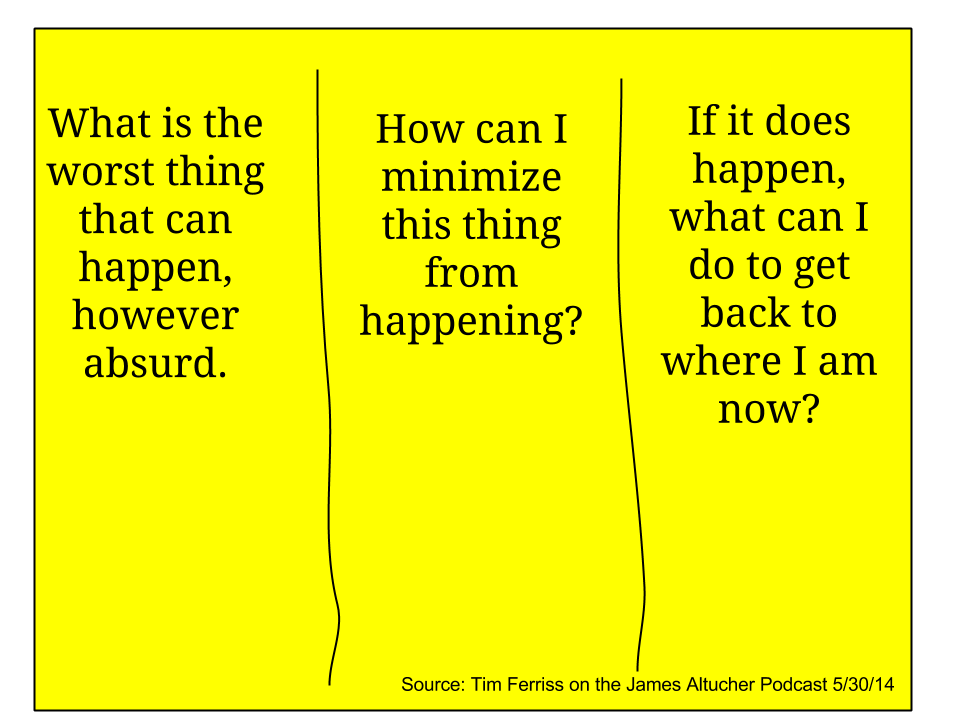
Stakes. People have to build consequences into their life, Ferris says, but not unrealistic ones. “People have a nebulous fear of a worst case scenario.” Ferriss tells James, and we don’t need to have that. He suggests instead that people take a three step approach to solve this problem.

FearresettingFerriss1. What are the worst things, however absurd that can happen?

  1. How can I minimize those each thing from happening?

  2. What can I do to get back to where I am now?

There are a spectrum of options, Ferriss tells James, not just success and failure. Mark Ford (episode #102) mentioned the same thing in regards to negotiations. Often there is an overlap in positions between two parties, find those overlaps he says. We tend to quantify things in listicles or charts but life is more like the broad strokes of a paint brush that colors a canvas but doesn’t stay in the lines.

Long before Ferriss was making television shows or writing books, he started a company called BrainQUICKEN but even this wasn’t all that risky. The stakes for it were low because “I did not just leap into the ether and cross my fingers” he tells James. Rather he was figuring things out for himself, taking the supplements he thought about selling and getting good results. When the product it wasn’t selling, Ferriss shifted the focus of it to a pre-workout aid rather than cognitive enhancement.

The conversation then turned to talking about writing a book and began with an interesting idea, testing your title. Both James and Ferriss mention that they tested multiple titles of their books and it speaks to their openness to getting things right rather than being right. A lot of times we think we know what’s best but many times we at the very least, overestimate the scope of our conclusions. In one example, a military official was asked to gauge the leadership credentials of a soldiers in training after an hour of observation. To an outsider like you and me, we might roll our eyes at how much one can really understand about that, but insiders tend not to. In fact, if you were the insider you would probably overweight your observations and their validity.

It’s been shown time and again that this doesn’t work for things like stocks. In one study, the correlation between the success of wealth advisors was zero. That is, if you took someone that made 15% returns in year one, you should not expect them to make similar returns in any other year. But if you talked to those stock pickers, they would spin great tales about why they were successful or not.

This relates to book titles in this way. In both the example of choosing army leaders or picking winning stocks, we think we have good intuition but we probably don’t. We think we know what a book title should look like, but we probably don’t. If we at least open to the idea that others may know better, we’ll gather valuable information.

Actually writing the book took a lot of work. Ferriss started by taking notes. He tested material in a class he spoke with. He continued his relationship with Jack Canfield and eventually The 4-Hour Workweek was published.

The core message to all of his books, Ferriss tells James, is to “take a completely lateral move” ask “have you ever tested this” and don’t believe any answer that sounds like well, we’ve always done it that way.

If you do create things, Ferriss advices, “focus on the people who get it, not the people who don’t get it.” He suggests watching this clip, from the end of Ratatouille.

In many ways the work of a critic is easy, we risk very little, yet enjoy a position over those who offer up their work and their selves to our judgement. We thrive on negative criticism, which is fun to write and to read. But the bitter truth we critics must face, is that in the grand scheme of things, the average piece of junk is probably more meaningful than our criticism designating it so.”

Ferriss has also spoken about how to deal with haters. It can be hard though. Amanda Palmer (episode #82) and James both said that a negative comment or review can stick with them for days. In his interviews, Brian Koppelman made it sound like an actual metamorphosis to go from a creative place and vulnerable place, to one where he could be strong and handle the critics (kind or not).

Ferriss’s criticisms birthed from the land of maligned mathematicians who said that Ferriss didn’t actually work four hours each week, he worked much more than that. “The point of the book,” he tells James, “is to maximize your per hour output” and then do what you want with that extra time.

It reminds of Mr. Money Mustache, an early retiree who focuses on living a life of “badassity.” Part of MMM’s ethos is to do stuff he likes, like building houses and writing on his blog. For each of these things he earns money from it and the critics like collectively shout “Ah Ha! Gotcha! You aren’t really retired.”

But even in these challenges we can find some good, Ferriss says, because they expand our sphere of comfort. Even starting his podcast was a derivative of a challenge. He filmed the Tim Ferriss Experiment but the show was stuck in television limbo while the teams at Discovery Channel and Ferriss figured out the final details. Rather than dawdle, Ferriss started hosting podcasts and he’s had some good ones. His advice is to “focus on the content first and foremost.” Check out Kevin Kelly’s (episode #96) 1,000 True Fans post, Ferriss suggests as a way to get an idea. Gabriel Weinberg (episode #54) told James that this influenced him as he was building DuckDuckGo.

It’s these small pieces, the essential parts of learning, the 1,000 true fans, and a “handful of posts have made my blog.” Ferriss says but he never knows which ones will resonate the most. Jairek Robinson (episode #96) told James the same thing Ferriss mentions, noting that it’s hard to figure out exactly what pieces will matter the most to people.

Ferriss hopes that his television show will feature some things that inspire, but admits to James that “if you’re going to question the impossible, you’re not always gonna come out looking like a superhero.”

The podcasting suites Ferriss he says, because it matches what he wants; digital and on-demand content. Plus, “it feels good to have complete dictatorial control.”

Besides podcasting and book writing, Ferriss also advises companies and tells an interesting story about getting in. He was living out west when an opportunity to invest in Twitter became available. He did, but not just for financial fortunes, but for the uncommon connections. Being at Twitter gave him access and relationships.

Ferriss wanted more, so he reached out to his blog audience to ask for advice on other companies that might be worth investing in. There he found Spotifiy and Evernote and this is the key to having a great blog. Taking time to connect with people is how blogs become business. About monetizing, James says, “the worse answer is advertising” and Ferriss follows up with, “if you’re in a rush to do it, it’s not going to work.”

And maybe it’s not the money that you need.

“Money is an intermediate, it is wampum. It is something that you trade for possession, experiences, access to interesting people, resources. You don’t need to have money as that intermediate necessarily.”

A.J. Jacobs is doing this (accidentally or not) is his great family reunion project. He couldn’t buy a picture with a former president, but, when he’s your cousin anything goes.

The interview ends with Ferriss telling James about his investing advice, and relaying heuristic he learned from Chris Sacca. Does the person you are about to partner with pass the beer test and mall test? That is, would you have a beer with this person for fun and would you talk to this person if you were passing them in the mall? These answers don’t have to be yes, but it helps when they are.

Thanks for reading. If I took something the wrong way, transcribed something incorrectly, or tested the wrong axiom let me know. @MikeDariano.