Money problems

We looked at three problem solving prompts: What happens at the limits? Is this a money problem? Is this a branding problem? Today two money problems.

Zynga had just done their earnings call, said Shawn Puri, and Draw Something “had taken away significant steam from Zynga’s games.” With a user shortfall Mark Pincus decides to buy Draw Something. Retelling the story, Puri says that the lawyers told Pincus the deal would take a month. Why? That’s the limit. So Pincus “hired two law firms, one for the morning shift one for the afternoon shift, so he could have a twenty four hour cycle working on the deal and got it done in half the time.”

Puri is recounting his conversation with Draw Something CEO Dan Porter and while the details may be wrong the big idea could be right: hiring twice the labor, even lawyers, demonstrates a money problem.

Crops are not a money problem. Ukraine’s top six crops cover about the same planting area as in Iowa and Illinois. Russian’s wheat production is about four-million Kansas’s said economist Scott Irwin. Crops take space. They also take time. The Southern Hemisphere can plant more winter wheat now – but there’s not that many great places to plant it. The Northern Hemisphere can plant more spring wheat now – but it’s a less productive crop relative to the winter version.

Irwin lays out some options for crop production solutions and it’s not a money problem.

One of the Zeckhauser maxims is to take ideas to the extreme. Thinking about money-as-a-solution does this. How would I solve this with a billion dollar budget? Or How would I solve this with no money? These questions and this thinking expands the solution space.

April 2022 update Odd Lots podcast that batteries as a carbon replacement are NOT a money problem but a time and government
This = that

A short list of our fast thinking.

Expensive = good. This is many places, one of which is the opening story in Robert Cialdini’s book Influence.

Action = progress. Used well when Headspace ‘embodied’ meditation. Used less well when helicopter parents hover.

The category = the JTBD. For example, the Leatherman was not a knife it was a tool, not a tool but a gadget. Similar, the 3M Command Strips solve the job rather than fill the category.

1×20,000 != 20,000x 1. This is the idea that averages don’t always convey the best information. A small bit of something regularly is not the same as all of something at once. The Credit Karma Save program for instance. Travel too, writes Rory Sutherland is like this.

Argument = dislike. Part of the obstacle to arguing well is our social and evolutionary norms. (Added 3/30/2022)

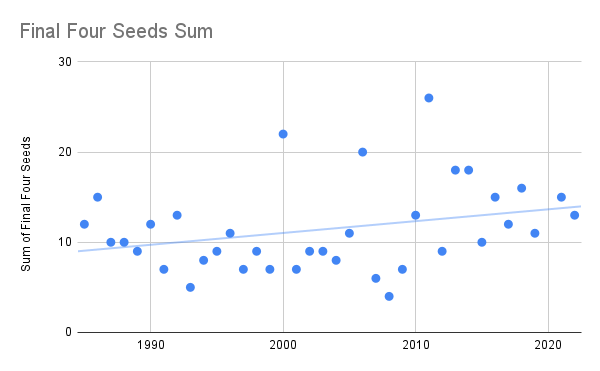
Unrelated, we can update the base rates on March Madness. The cumulative Final Four seedings continues its trend, this year the sum is 13. The first post on March Madness matchups is here.

The Madison Avenue Effect

Imagine a unique creature.

Now, imagine another unique creature. Make this one larger, like an elephant. Make it colorful, like a toucan. Make it smooth, like a frog. Give it a beak.

Imagining the second is a lot easier than the first because the second is familiar. About this big, about this color, etc. Familiarity changes the way we think. Familiar things are ‘more right’.

Here’s how to spot it: “I didn’t know that…”. People have to see it to believe it: Alton Brown in Italy, Richard Thaler saw value theory, Ezra Klein read a blog, and for Marc Andreessen it was Night Rider. For ‘Madison’ it was the movie Splash.

For, The Boy Who Played with Fusion, it was the C.L. Strong and Jearl Walker DIY articles. “When I got a hold of a secondhand CD-ROM collection of those columns, my life changed,” Taylor says. “I realized there were these world-class experiments that cost millions in top laboratories that you could replicate at home.”

The familiar is more accessible. Connections aren’t divine so much as they are historic. Exposure creates creativity seeds. For now we can call this the Madison Avenue Effect.

Words hiding value

Patrick O’Shaughnessy asks Gaurav Kapadia what makes a great business. It’s all the basic stuff, “but really when you go down to it, if you look at a lot of the great businesses, they’ve created niche monopoly things. No one likes to say it because you’re not allowed to say it.” Kapadia lists at least four monopolies: cable companies, software companies, aircraft engine manufacturers, and medical device companies – but the real insight is no one is allowed to say it.

Names mean competition. If something is unaddressed with words it’s less available as thought and underpriced in cost (the market mechanism).

Our new dictionary series highlights the opposite end of Kapadia’s point. New words new thoughts.

Later Kapadia talks about diversity and inclusion in the investing industry. “I don’t think anyone’s heart is in the wrong place, I think everyone’s heart is in the right place. So we have to stipulate that, people really care, but so many decisions are made by the network. And so the only way you can break down existing network effects is with data.”

For words like monopoly the network has agreed on one meaning, and it’s mispricing. For words like diversity, the network has agreed on one meaning, and again it is mispriced.

The same week Mike Prada joined Wharton Moneyball and was asked a kind of ‘what’s next in basketball?’ question. One thing Prada pondered was what if Memphis is playing the next form of basketball? There’s no fast break or half court offense, only running. Types of offense thinking, like monopoly and diversity, hides value.

Humans and ratings

How do we understand a thing? One way is price. More expensive = better mostly works so we use it. But other quantifications aren’t so clear. Temperature, for one. Avalanches too. Calories as well. There’s ‘the thing’ and the challenge is conveying information (and hopefully action!) about it. Here’s two quick examples then an idea.

At Airbnb ‘the thing’ is rating a guest or host. Rather than only stars, they use words too. “With each star,” Jiaona Zhang said “there is a word that accompanies that star, for example, five stars is great and four stars is good. What’s interesting is that something like three stars varies by culture.”

And.

“Predicting something is 3.2 stars is kind of fun if you have an engineering sensibility,” said Todd Yellin of Netflix, “but it would be more useful to talk about dysfunctional families and viral plagues. We wanted to put in more language. We wanted to highlight our personalization because we pride ourselves on putting the right title in front of the right person at the right time.”

Both Airbnb and Netflix use numbers and words to convey information which leads to better matches.

But I feel weird not assigning perfectly fine a perfect score. Like a Keynesian beauty pageant, I don’t want our server-driver-rep to score less relative to their peers! So a perfect score they get.

But what if there was an option for an 11? Besides Spinal Tap who else uses 11 on a 10 point scale? No one. That’s good. There’s no social norm. But sometimes something is an 11 out 10. Sometimes something is above and beyond. Restaurants have easy solution, tip more. But when it comes to rankings maybe humans actually need a way to turn it up to 11.

Thinking fast, associations

We think fast to understand the world. One form of fast thinking is associations.

One association is the person-institution. A Harvard epidemiologists, an Oxford trained economist, a board certified physician. It’s only through the association that we get the meaning. It’s all short hand. And we need it.

If I check to see if Marc Lipsitch knows what he’s talking about (he does) I’d read his journal articles, and study organic chemistry, and well, that’s the point.

These association are asymmetrical. There is the new thing (Marc) which we are associating with the old thing (Harvard). The new thing is relatively not understood and the old thing is relatively understood. People know a lot more about Harvard than about so-and-so epidemiologists.

An interesting version of this idea came up on NPR. It was about this sound:

This sonic logo was created via an association. HBO (new) wanted to associate itself with television (old). It did that through static. But, as times change so do associations. That old static, though totally irrelevant to modern-digital-cord-cutting-viewers, became associated with HBO.

“It’s become this incredible ritual of sitting down and watching something,” explained head of brand marketing for HBO, Jason Mulderig, “and having this powerful emotional trigger that sets you in this emotional space of anticipation and waiting for what’s going to come next.”

I’ve always disliked the term human biases. They feel more like tendencies. Sometimes those tendencies optimize for short term gains, sometimes not.

One example of the long term hacking of our tendencies is the Credit Karma program.

May 2022 update, Dan Carlin on this angle but for historical figures.

This time is different: housing

Forming macro opinions or listening to the macro or market predictions of others is a waste of time. Indeed, it is dangerous because it may blur your vision of the facts that are truly important. Warren Buffett 2014

The follow up to “this time is different” is to ask “Why?” Sometimes it is technology, the iPhone allowed location based apps. Sometimes it is the rules, like regulations. Sometimes it is the conditions of the system.

Conor Sen considered if the 202X housing market was like 2006 or if ‘this time is different’.

“The underwriting is so much better. We aren’t seeing the same construction as 2006 because of the supply chain issues. Builders are more conservative. The demographics are stronger. We have broader inflation. It’s harder to see what’s worse now versus then if you’re worried about a bubble situation. I don’t see it, yet. Maybe in a couple of years.”

Sen’s suggestion is that once the demographics change and there’s fewer people then the housing demand will change. The right framing for housing might be: what other ways is there a housing market collapse? We saw the 2006-2010 version:

“It’s impossible”

Kris surfaced this work and had some excellent notes.

“Impossible things happen fairly often. That doesn’t mean things are actually impossible just that we thought they were impossible. There’s a corollary to this: enough people relying on something being impossible makes that thing more likely in a perverse feedback kind of way.”

Agustin Lebron

We’ve covered this idea: something is always happening. But Agustin furthers the thought. If many people think something is impossible then it is underpriced. Agustin gives the example of the housing crash of 2008. Home values don’t go down, was one impossible pillar. Another was that home values don’t crash across the country. These two impossibles fed certain incentives.

Sports offer a good view on ‘impossible’. There’s always an inevitable team. It’s impossible they lose. Yet the better bettor ‘shorts the narrative‘. The Wharton Moneyball hosts regularly pillory “once in a generation talent” that arrives every other year.

Agustin is a trader but like with Bayesianism, we can adopt the philosophy. Impossible/Inevitable comments are signals of confidence not accuracy, and should be priced accordingly.

Three problem-solving prompts

1/ What is the asymptotic limit? To be a multi-planet species, says Elon Musk, people will need to design, build, and use reusable rockets. Okay. Is that possible? One way is to think to the limit. “Look at the raw materials of a rocket: aluminum, steel, titanium, Inconel, speciality alloys, copper. Now ask the weight and raw material value. That sets the asymptotic limit for how low the cost and weight can be unless you change the materials.” Musk calls this the magic wand number. What’s the cost if you had a magic wand to rearrange the atoms?

Another way Musk uses limits is to think about scale. Making many versions of a thing is much much harder than one version. This too is a problem for Disney imagineers, writes Kevin Rafferty. Coming up with attractions is fun but the hard work is what Rafferty calls ‘day two problems’. What happens when this thing has to be open for ten hours a day 365 days a year?

2/ Is this a money problem? Starting the cable channel Discovery, John Hendricks had a lot of challenges. One was content, but that was easy. The BBC was willing to sell their documentaries to Hendricks and enjoy the found money. Later Netflix would take this to detrimental consequences to the content providers, but in 1985 Ted Sarandos was managing eight video rental stores in Arizona.

But there was cable regulation working against Hendricks. The deregulation of cable (like with airlines) wasn’t a money problem. Host Guy Raz analogizes it to having a new iced tea and having to call every convenience store operator in America to get on the shelves. Hendricks then had one problem that was a money problem but another that was a political one.

3/ Is this a branding problem? One of the covid lessons ‘we clearly haven’t learned‘ according to Zeynep Tufekci is to follow best practice. “We have everything we need,” she told Ezra Klein, “not a day goes by that I don’t get a pitch for some gimmick, some new mask that is blah blah blah. Thank you, but I just need an N95. I don’t need your new potentially miraculous science.”

This, says Rory Sutherland, is a marketing mistake. Good marketing changes the perceived value without changing the thing. Good marketing is ‘being better than Superman‘. To Tufekci, we’ve not figured this out – yet.

2a March 24 update, winter wheat is the largest wheat crop in the world and that has to be planted in certain places at certain times. Russia’s invasion of Ukraine is going to influence how much the planted wheat can be harvested. This is not a money problem.

Alchemy in the office then at the pump

“The tricky part of incentive design is that there are noisy signals about what could work and what may not work. For example, when given a hypothetical choice between cash and non-cash incentives, people overwhelming choose the cash incentives but studies consistently show that giving additional compensation in the form of non-cash rewards can be more motivating than cash.”

Kristen Berman, The Science of Change podcast

The basis of Alchemy is to create a lot of of value for a small cost. Alchemy happens for donations, for interest payments, and even for paying for a Peloton. Non-cash incentives are another form of Alchemy: the value of the item is greater than the cost to produce it.

On March 9, 2022 gas in Florida cost $4.19 per gallon. A friend noticed this and stumbled into a bit of Alchemy. His company is creating a mileage reimbursement program for the employees.

A “mileage reimbursement program” moves past a basic cash benefit and into the realm of alchemy because it uses our availability tendency: what’s top of mind is most important. Gas prices are often top of mind thanks to their frequency (and SIZE), but with Russia’s invasion of Ukraine the availability is even greater. And that’s not all! Thanks to our mental accounting we perceive pain at the pump.

A “mileage reimbursement program” is a great idea. It delivers more value than it costs. Here’s a few more:

  • Mother’s Day. There’s no holiday that deserves status elevation more. What if an organization had flowers for moms (or husbands to take home to moms) or bulk ordered a delivery. Hey everyone, at lunch today there’s a signup form if you want to order flowers for your mom. This is kinda tricky because if gifts are too easy they lose some impact.
  • Annual bonus. There’s alchemy calling it a “Christmas” rather than “end of year” bonus.
  • Four day workweeks. Businesses have some quantity of work that’s divided into some number of days. Divide those two for a rate. Reducing the number of days means the rate must rise, but many employees find this a fair trade as evidenced by the work-from-home success.

The original advertising alchemist, Rory Sutherland, noted that organizations often optimize the wrong metrics. Don’t make the trains run faster, which is very costly, Sutherland said, if you can make them more enjoyable for much less. A place to sit, a plug to use, and a coffee to drink go a long way for a small cost. That’s alchemy. Find something to provide that has an outsized impact.