In the beginning, we measured the world one way. Then another way came. This way offered different fidelity, and we used that. Sometimes the thing we measured was a fixed supply, and the new fidelity changed demand and prices. Then a new new way came. The first two examples are this. Sometimes there is is no supply constraint and no change in price. The second two examples are that.
Investing. There are at least two areas where the invisible became visible. One is quantitative. It’s in the numbers, not the stories, where good investments can be found. A second is in scale. It’s the size of the company where there’s information which is invisible at one scale but very clear at another.
Moneyball. Like quant investing, Moneyball is a way to use numbers to find patterns and to frame our thinking.
Personal. “You work with a lot of teams”, Shane Parrish prompted, “what have you learned about making good decisions?” Well, says Diana Chapman, “people don’t practice nearly enough candor.” The whole episode (#130) is basically about this, making the invisible visible in our collection of relationships. How? Through candor.
Jobs to be done. The JTBD framework is a way of articulating purchase decisions. People take action to change what? We’ve many examples of this: Leatherman tool, Headspace meditation, and Instagram stores.
…
One way to find the recently visible is in words. What was so great about Chapman’s podcast with Parrish was the embodiment of her ideas. Chapman is physical: use notecards, stand here, dress like this and act accordingly. We are a visual species. Today’s prompt then: What is invisible here?
It is surprising there are not more anti-science beliefs.
1. Science isn’t static, there’s not much canon.
2. Science is mostly not a putting-a-man-on-the-moon problem.
3. Science communication persuasion is difficult, especially relative to cultures, norms, and habits.
4. Science belief doesn’t follow formal logic, it is contextual. There are plenty of people who don’t trust a medical engineering but trust engineered medicine, or vice versa.
One way to think about all the non-science beliefs is as three states of the world: -1, 0, and 1. Put another way: anti-science, ignorant, pro-science.
Sometimes science denial is an information problem. If people only knew…. But that’s not quite it. Yes, sometimes scientific knowledge is zero, ‘they just don’t know the facts’.
“The other thing I think is wrong about how the media portrays it (science denial) is as misinformation. Science denial is about disinformation. Someone has intentionally created the theory that rebreathing into a mask will give you CO2 poisoning. Someone has made that up and filtered it out through the internet where it hits someone’s cognitive bias and they start to believe it.” – Lee McIntyre, Behavioral Grooves, November 2021
Most of life is not a ‘they just know the facts’ situation. C’mon, how many things do you dear reader not hold an opinion on. More often, it’s not non-consumption, but belief in something else. Weight Watchers and financial education are also examples of this state. Plus, our views on science and medicine, finances, and diet-health-lifestyle all have a strong identity component. If someone said, “Look, I hear what you are saying but I don’t trust the experts and this online community are my people,” you would have no idea if they were a Boglehead, a CrossFit participant, or anit-vax father of two.
The case at hand is like an errant Sudoku puzzle, there’s something else in that spot and it’s attached to a person’s identity.
Around here we try to skip the ‘they just don’t know the facts’ stage and go right to designing change. Personal finance is about shifting what we buy, often time rather than stuff. Heath is about shifting what we eat and what we do, replacing one thing with a healthier option. Anti-science persuasion then must replace the anti-science beliefs with something else. The trick here, says McIntyre is to plant a seed. Rather than ‘the facts’, be empathetic and offer suggestions. Reframe your aim from conversion to combustion, be the spark but let them do the work.
–
It is wild how many things we do become part of our identity.
–
Update February 15, 2022. Even ‘hard’ sciences are hard. Only forty percent of cancer biology studies replicated and eighty percent of pharmaceutical studies in academic labs cannot be replicated in industrial ones. Also, plastic recycling has (always?) been a sham: NPR Planet Money.
The best analogy to understand Loretta Breuning’s book Status Games is calories.
For many years survival was difficult. One problem was calories. So ‘evolution selected’ creatures with a mutation where certain foods (fat, sweet, salt, etc.) released good brain chemicals. Those creatures did better than others and became dominant. In a world with plentiful food those same adaptations aren’t as helpful.
For many years survival was difficult. One problem was predators. So ‘evolution selected’ creatures with a mutation where certain social group circumstances released good brain chemicals. Those creatures did better than others and became dominant. In a world with fewer predators those same adaptations aren’t as helpful.
Evolutionary life was hard so species adapted. Tigers and orangutans have no predator and tigers and orangutans are the only mammals to live alone. Like five fingers on a hand, something about social was splendid for survival. These groups included a pecking order and status games – which have at least two advantages.
Status games as alchemy. In a nod to Rory Sutherland, status games are a form of marketing where there’s a large reward for a not very large cost. Actual fights among mammals are rare. This makes sense. Fights reduce survival chances. Having a way to find out who is right/strong/better/whatever without the fight is quite nice.
Status games protect the group. Status games trim the tails of an individual’s outcome but make reproduction more likely. Any individual mammal is more likely to survive somewhere in the middle of the pack rather than in a non-stop quest to be ‘top dog’. And, Loretta writes, “It enables weaker individuals to enjoy the protection of stronger individuals in the face of common enemies.”
Groups are good for survival and status games are good for groups. So status became part of our human operating system.
…
One analogy for the human brain is the elephant and the rider. The rider is our conscious brain and it is giving directions, narrating the story, and feeling in charge but really the elephant is going to go where it wants to go – and per Breuning the elephant wants to travel on well trodded paths. “Your animal brain just strives to repeat behaviors that trigger happy chemicals and avoid behaviors that trigger unhappy chemicals.” Thanks to the evolutionary advantage of being in groups, our brains have a simple set of chemical instructions.
Good: being in a group, ideally higher up.
Bad: being separate from a group, demoted in a group.
Groups are important so we seek groups. Everywhere are groups and everything is a status game. Fancy cars are status games. But so is ethics, morals, politics, house size, neighborhood, intelligence, partner, ability to drink, family heritage, even hardships. Find the chemical rewards and you will find the game. “Each brain sees the world through the lens of the neural pathways it has,” Breuning writes.
So, status games are normal but maybe not as helpful as they were. If we have to play, then we can play wisely. Remember, explains Loretta, it’s the dopamine that makes something feel good, not the thing. “The simple way to do this,” Breuning concludes, “is to put yourself up without putting others down.”
…
I have no idea how much of this book is true but I liked it for a two reasons. First, it acknowledges the world as it is. Animals compete and form cliques, just like us, because we are animals. Two, the book’s perspective is action oriented. This is how things are and this is what you can do, I imagine Breuning advising. Most of all this book reminded me of Spent, we are all signaling and we are all playing status games.
…
Comments: it is ironic that ‘pecking order’ is from domesticated chickens. Also, ‘evolution selected’ is just how we assign action and our brains like effects from actions. Examples include Headspace, poker, and international espionage and it is the source of the expression ‘don’t shoot the messenger’.
May 2022 Update. Scott Alexander’s review of The Gervais Principle offers an example of status games, and why they are helpful, in the context of Seinfeld.
Our this time is different examples have noted that when the overall system (airline regulation) or when the technology within the system (high jump pads) changes then this time is different. While confirming evidence isn’t a perfect indicator, it’s nice to note:
“If you have a mining business then base rates can tell you something. But over the past ten years there’s a new crop of businesses that have no historical analogs. This sounds like ‘this time is different’ but sometimes it kind of is. These businesses (software SAAS) grow fast, they grow organically. In a couple years they have global reach and no capital requirements. They can click a few buttons on AWS and suddenly they have more servers. They have expensive stocks so they can hire the best engineers, all around the world because everything is remote.” – LibertyRPF, Infinite Loops, October 2021
Often, TTID is used to support a narrative claim, and in general it pays to ‘short the narrative’. But sometimes TTID is right, the world changes. It’s a bit like finding a needle in a haystack (if there even is one).
The base rate for TTID is low. But when systemic rules or new technology allow the job to be done we can look closer.
Just because something looks like a job to be done doesn’t mean it is a job to be done.
Tim Leatherman was in Vietnam in the 1970s. He noticed that all the Japanese motor bikes had luggage racks for transporting goods but that all the Vespa scooters did not. So with the help of his brother-in-law, Leatherman designed and built one hundred racks for Vespa scooters. He arranged for consignment distribution and hired someone to pass out leaflets.
It seemed like a good fit. There was demonstrated demand. There were motorbikes everywhere! “But when we left Vietnam there were still 97 in the bedroom of our house. It turned out that the people who rode Vespas considered themselves a class above and they had maids who went out and did the shopping.”
The JTBD of a scooter was personal transport and something else. For some people the something else was goods transport, for others it was status.
Tim wanted to design a knife with pliers, patent it, and license the idea to the major knife companies. Once he had a working prototype he went to Gerber but they declined, saying it was a tool and not a knife. Everyone knows not to bring a tool to a knife fight. Ok, thought Tim, I’ll pitch this to the tool companies. “And the message I got back from them was, ‘Sorry this is a gadget and gadgets don’t sell.'”
In this case the knife and tool companies confused the category for the job. Much like a hardware company might think they are in the business of just making quarter-inch drill bits when really the customer wants the quarter-inch hole.
Considering the recency effect of inevitability, practicing with base rates, and reducing the solution space.
In early 2022, the men’s career grand slam standing were tied at twenty wins each between Roger Federer (age 40), Rafael Nadal (35), and Novak Djokovic (34).
For tennis fans, the big question is: Who will end their career with the most? For a while it looked like Novak Djokovic who was the youngest and playing the best. Djokovic had also won three out of the four majors in 2021 and his dominance looked inevitable.
But few things in life are inevitable, no matter how they look in the moment. Sports provides an example for other parts of our life and the Wharton Moneyball crew (in the 1/26/2022 episode) provide a way to think through probabilistic, inevitable, and recency related issues that come in any part of life.
“I was convinced Djokovic was going to end up with the most majors,” Wharton professor Eric Bradlow begins, “but let’s talk about what’s happened in the last six months.” Novak lost the last tournament of 2021 and didn’t play in the first tournament of 2022. Without getting vaccinated, Novak will not play in the French Open (and maybe U.S. Open) either.
But Djokovic not playing also means that someone else, like Nadal can increase his total. Rafael made the semi-finals at WON the Australian and plays best at the French.
“Six months ago I would have said Djokovic would be the top of all time. Now it’s 50/50. I give Nadal a legitimate chance to have the most majors of all time,” Bradlow says.
Tap the brakes, host Cade Massey says, remind us of the base rates. That is, what’s the oldest that someone great tends to win these major tournaments. “Federer hasn’t won one since he was 37,” Eric explains.
Djokovic and Nadal each have about 12 chances left. But Novak isn’t vaccinated so subtract the ’22 Australian, ’22 French, and ’22 U.S. Open. “You’ve gone from twelve good chances to nine. And you still have (to play) Nadal at the French!” Bradlow bellows. Plus, it’s not just Nadal and Djokovic but a field of players and like something is always happening, someone unexpected will win.
Rather than overreact to news, we found the base rate (oldest age to win a major) and opportunities left. Though men’s tennis is top heavy, there’s a lot that can happen.
But wait, that’s not all.
“I’m bummed for folks like him (Novak), like Kyrie Irving,” says Massey, “like any high profile athlete, that takes a no vax stance. There is so little room for changing your mind. Once you take that high profile a stance, with the politics of it, it really diminishes the chance of him shifting his position.”
Who will end up with the most majors? We don’t know. But we do know that using base rates, avoiding recency bias, finding simple examples, and not reducing our solution space are all good processes.
…
For football fans, there’s a section of fervor about the Allen-Mahomes game that speaks to the inevitability and our reactions to recent events.
Headspace, the mindfulness and meditation app had a problem. People came to the app under duress and wanted to feel better. Now. So, Rory Sutherland summarized, people didn’t persist for the long term benefits without a short term win. “That’s fair,” says Dr Clare Purvis. The company had to address the immediate need but also address the long term benefits.
A common idea around here is the Barry Ritholtz refrain: don’t just do something, sit there. The idea is that we equate action with progress but fail to assign inaction to progress too. Usually action=progress is negative, like with poker or architecture. But the action=progress mental model can be used for good. This, I think, is what Headspace did.
“One of the things that we tested,” Purvis pontificated, “was that rather than an eyes closed mindfulness practice was some eyes open embodied practices of stretching and breathing. We saw overwhelming positive responses to these.”
Traditional meditation (🧘♂️) doesn’t fit action=progress. But standing or standing and breathing is something. This isn’t sarcasm. I truly believe that part-of-the-reason this worked was because it made people feel like they were addressing the immediate issue.
What’s the job-to-be-done of Headspace? Make me feel better. ‘Embodied’ is action, action is progress. That’s what I want, especially right away.
Health is a good proxy, like with finance and fitness, for understanding systems because it involves personal choice, design, social factors, marketing, culture, and so on.
Part of the reasons diets, like the diet formerly known as Weight Watchers, work is design. One design is zero point foods, like bananas. Zero points isn’t zero calories but it is zero thought. The primal diets do the same thing. Carbs bad, meat good. Fasting also succeeds due to good design. Vegetarian too. The best diets combine easy rules and identity.
Here’s the pitch: the birthday cake diet or BCD.
The first product would be a book. Or, better, a self-help book! It would outline all the advantages of better eating, all the research of behavioral scientists, and all the philosophy around intentionality and purpose. Tolle meets Tversky to defeat Tollhouse. The pitch is: the only junk food you would ever eat would be birthday cakes.
People could just decide to only eat birthday cakes. But then again there’s a fasting app that’s essentially just a timer — and it’s a great idea! The BCD frames inaction (not eating) as action (waiting for a birthday cake). Annie Duke I know would approve.
‘Okay’ you’re thinking, ‘it’s not just birthday cake that’s bad for you.’ True. So after the first book about the why, comes the second book with the how. Taking a page from WW, the second book used slices of cake as the metric. One cookie? One slice of cake. Chips? One slice. A granola bar? Half a slice. Pizza? Half a slice. Bananas? Free! It’s not as clean as the points system, but framing things as a slice of cake definitely will change some consumption patterns.
The books will kickstart the funding needed for recurring revenue. Birthday cake as a service anyone? BCAAS! The BCD wouldn’t even need to create products. This business white labels ones from the big bakers or leverages the identity and design ease to create Keto ones or whatever. Plus birthdays are regular events. The Total Addressable Market is everyone every year.
The BCD is super social media friendly. Like cheat day posts on Instagram, the BCD sells the experience of blowing out the birthday. You haven’t had cake all year, how about one that’s five feet across? The BCD is shareable. Imagine the local, regional, and national news. This is so influencer friendly. Is a low CAC tastier than birthday cake? We will find out.
So email me to sign up and join the next great eating revolution: the birthday cake diet.
…
This posts are too much fun. Somehow this is the second Birthday themed post, here is the birthday bet. In college a friend framed regular beer as having a ham sandwich and light beer as not. I still think of that when I see a can of Budweiser.
If this blog has a core, at the moment, it’s about decision making. One way to change decision making is to change the initial conditions. One way to do that is to dial ease up or down.
Losing weight is about introducing new habits and breaking old habits. WW, formerly Weight Watchers, uses ease a lot. Make the good things relatively easy and make the less good things relatively difficult. For example, part of what makes keeping a food journal a successful dietary change is that it introduces a friction, writing down the food forces our focus: do I really want to eat this? There’s no noting bananas though.
“To introduce new habits you want to pick foods you can eat on autopilot. If you’re with WW there are zero point foods that you don’t need to pay attention to. Bananas are pretty healthy and you’re probably not going to overeat bananas.” – Julie O’Brien, The Science of Change, November 2021
The episode is full of behavioral hacks, for instance having slack in the system for an occasional treat (or lapse). Another is the idea of rules of thumb. WW has points, intermittent fasting has times, Whole30 has no carbs. Each also restricts booze.
As a teen I worked retail with a woman who did the points system. She ate popcorn all the time. I didn’t get it. Popcorn has calories. But it worked for her.
As a teen I thought the world was more black and white. Now I get there’s more shades of grey. Now I appreciate the aspects of designing ease.
–
Here’s a few more posts about the different ways ease works.
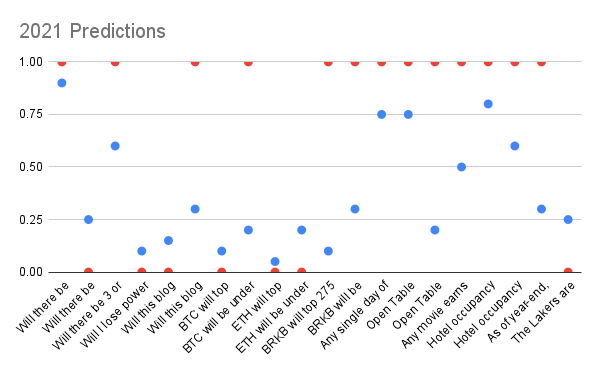
Here are the 2021 predictions graded. My average Brier Score was 0.227 whereas a coin tosser Brier is 0.25. A perfectly accurate forecaster scores 0 and perfectly inaccurate forecaster is 1. The big misses will be in bold.
My guesses are blue, outcomes are red. The closer the blue is to the red the more accurate I was. This chart makes the predictions looks okay.
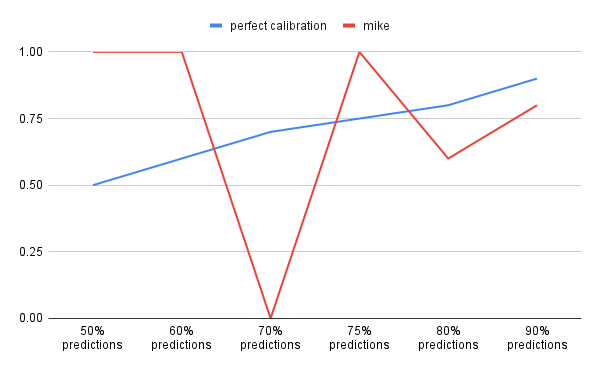
But when I bucket them it gets worse.
That looks terrible. Let’s see how.
Hurricanes. NOAA “An average season has 12 named storms, six hurricanes, and three major hurricanes.” Will there be more than 12 named storms? Yes, 90%. Will there be more than 30 named storms (the 2020 record)? Yes, 25% Will there be 3 or more major hurricanes (top winds of 111+mph)? Yes, 60% Will I lose power at my home in Central Florida for more than 3 days? Yes, 10%.
Overall there were 21 named storms and four of which were major and we didn’t lose power at all this summer. Mostly these were safe but relevant predictions. Hurricanes are one of those things I’d like to appreciate correctly. Like an alligator on the river bank, I want to know enough to take a good photo but also to keep my fingers.
Blog.
Will this blog have more than 41,000 views in 2021 (41k is the 2020 number)? Yes, 15% Will this blog have more than 800 posts by year end? Yes, 30%
The blog had 29,000 views and 908 blog posts and a whopping 335,000 lifetime views (!!). What’s surprising was my inability to predict myself. As things go, I got into a great writing streak in the summer and fall of 2021 and the posts reflected that.
Finance
BTC will top 75,000 at any point in the year? Yes, 10% BTC will be under 30,000 at any point in the year (started 2020 at this point)? Yes, 20% ETH will top 5,000 at any point in the year? Yes 5% ETH will be under 130 at any point in the year (started 2020 at this point)? Yes, 20% BRKB will top 275 at any point in the year? Yes 10% BRKB will be under 234 at any point in the year (started 2020 at this point)? Yes, 30%
First, in hindsight this was cheating. ‘At any point in the year‘ is a case of something is always happening. To get better at predicting I need to ask better questions. The biggest paired misses of the year were my guesses about Berkshire Hathaway stock ($BRKB). I thought there was a 10% chance of the stock being under 234 and 30% being over 275 (and that’s with the generous ‘at any point’ language).
I’m not quite sure what to think of this one. Robinhood and retail? The stock didn’t move more than 20-40 points in 2018 or 2019 and as a ‘value’ stock I expected tighter growth. Though mostly correct on crypto, with hindsight the range of outcomes is much wider.
Economic Recovery These will be graded per Bill McBride’s numbers on Calculate Risk. Any single day of the last week of the year will top 2M travelers (2019 was 2.0-2.5M)? Yes, 75% Open Table reservations will be down less than 10% YOY? Yes, 75% Open Table reservations will be positive YOY? Yes, 20% Any movie earns more than 250M on opening weekend during the year (highest grossing movies)? Yes, 5% Hotel occupancy tops 60% (graph)? Yes 80% Hotel occupancy tops 70%? Yes, 60%
Mostly got these correct and directionally too. Predicted 75, 75, 80, and 60% for events that all happened. Missed reservations being positive but grading it I can’t remember what this meant. Also missed on movie opening as Spider Man No Way Home earned 270M, partly from my two daughters and me.
Sports
As of year-end, Tom Brady averages +270 ypg? Yes, 30% The Lakers are NBA champions? Yes, 25%
Tom Brady continues to amaze averaging 313 yards per game. And our Aaron Rodgers saga comes to an end, with Rodgers just falling short by 1.5 touchdowns. This one is another head scratcher. Rodgers had two games with no touchdowns and missed a game due to Covid. Is this the variance that Plus EV noted or was it just luck?
 The Waiter's Pad