Tailing Rodgers (part two)

For each thing that happens there is a field of potential things which could happen. Those potential events fill out a distribution where some events are more likely than others. A daughter’s height for instance, could be between four and eight feet but it’s very very likely that her height will be between her mother’s and father’s heights.

Thinking about these distributions of potential outcomes can be helpful because the areas which are not compact, like daughter’s height, are interesting.

Our annual NFL example (last year was Tom Brady passing yards) is Aaron Rodgers over/under 38.5 touchdowns. Here’s how we visualized it in September 2021:
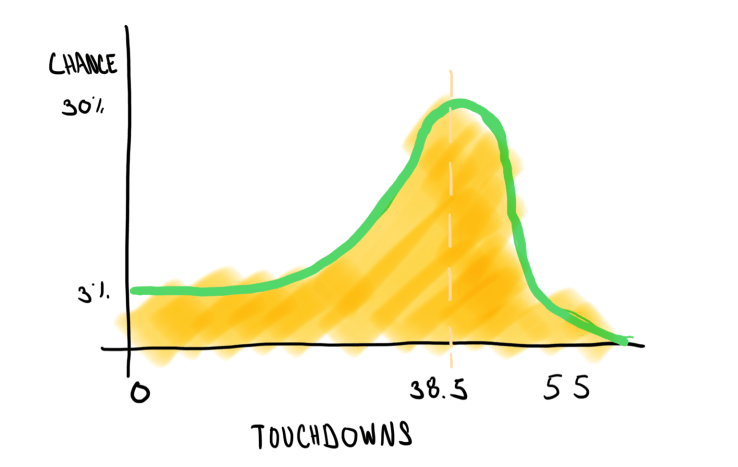
Rodgers chart

The thinking then, as now, was that Rodgers would throw between twenty and fifty touchdowns but not with equal odds. The number of touchdowns would be asymmetrical. It was much more likely Rodgers threw half of 38.5 than double it.

Five games into the season offers a chance to be Bayesians and update our forecast. In addition to the preseason line of 38.5, his career average is 33.4, and his current pace is 32. Mix in the chance of injury, and he could also finish the year with the ten touchdowns he’s tossed thus far.

Let’s tack this on to the 2021 predictions:
– +10 TD, 90%
– +20 TD, 85%
– +30 TD, 50%
– +38.5 TD, 10%

I wanted to go lower on the 38.5 percentage, but one lesson from Cade Massey is to be less certain about extreme events. So in the same way that online doesn’t equate to real life and we should adjust for that, I will adjust my percentages as well.


Daughter height is top of mind because I have eleven and thirteen year old daughters. 😬
Duty Oriented

Terri Gross asked, what image did you have of breaking the sound barrier. Chuck Yeager responded (1988).

“I didn’t give any thought to it to tell you the truth. I was duty oriented at that time. I’d been in a war where a lot of guys got killed and learned to concentrate on what I was doing and forget about the outcome because you can’t do a lot about it anyway. “

Chuck Yeager

Like Fermi Knowledge, this encapsulates a full idea. With Fermi Knowledge it was the question: do I know this so well I can figure it out again? For duty oriented the question is: am I focused on the things I can control to the best of my ability?

It was in 1947 that Yeager broke the sound barrier, Tom Wolfe wrote, “Yeager had always figured it was useless to try to punch out of a rocket plane.”

ps, it’s great that we can hear the man in his own words, with his steady confidence. If you create content, please consider that in 33 years someone will be looking for these ideas again and hidden behind a paywall those ideas will die.

Obama and Eisenhower

Some subversive decision making influences, like a cross breeze in golf, are the unnoticed dynamics. Social pressures, human tendencies (status quo bias for example), status, ego, and so on. But like with a vegetarian diet, it is possible to design around them.

One design choice is incentives. Incentives work as designed sometimes, but other times create yes men and women. YM&W are a completely predictable case of certain incentives within an organization.

To get around this, certain leaders argue well and vigorously debate an issue. The aim is a debate rather than a resolution.

Another path is to not state a perspective and enroll a (similar status) opponent, but to be more of a blank page. It may not be coincidence that at least two presidents followed this direction.

Speaking about his new book, Noise, Cass Sunstein said:

“President Obama was a master of not giving a clear signal of what he wanted to do because he wanted to get as much information as he could and that reduced the noise.” – Cass Sunstein

The book Ike’s Bluff, covered how Dwight Eisenhower used this tool too:

“Despite his open demeanor, at press conferences Eisenhower would from time to time pretend to know less than he did, leaving the illusion that he was distracted and ill informed about matters that deeply engaged him. Indeed, Eisenhower was willing to appear less than sharp, even a little slow-witted, if it served some larger purpose. Unlike most politicians, he was not driven by an insecure need to be loved and recognized. He possessed an inner confidence born of experience.”

There’s as many paths to success as there are organizations trying to succeed. To ‘argue well’ or ‘listen like Ike’ is one of many ways.

Predicting an AA A+

There’s this idea in sports that certain people are “ruining the game”. It’s those baseball people who favor home runs and defensive shifts. It’s the golfers who drive for show and dough.

And we can blame computers.

And us. We’re to blame too.

Computers compress time. I could have mailed this to you as a letter but that would take me buying paper (after a trip to the store of course) writing it…yada yada yada…and you walking to the mailbox. Computers compress all that.

Analytics is a type of compression. Rather than a lot of people and a lot of time to learn about the advantages of home runs or infield shifts in baseball or long drives in golf, a few people with computers thought it might work and ran the data.

This is an issue we will see more of: novel data making interesting predictions.

“We looked on Twitter for anyone who announced they were going to their first AA meeting and we followed what they tweeted after that. Did they stay sober for ninety days or did they go back to drinking? Did they complain about being hungover at work? Did they celebrate their sobriety? Then we took all the data we could model from their Twitter feeds to try to predict if they would be sober. Things like: who do you follow, do they talk about booze, are you over 21, how do you cope with stress? We can predict with 80% accuracy if someone will stay sober or not on the day they decide to go into treatment.” – Jen Golbeck, November 2020

This algorithm, Golbeck notes, is also pessimistic, it tends to say you won’t recover when you will. And it’s confounded by the sample: only certain people announce things on Twitter.

These algorithm approaches will grow in the decision making blend. Part-of-that means understanding the tools. We are time traveling, leaping to the future rather than walking there.

Daters, scammers, and Zeckhauser

Maxim Five: low probability events

When a low probability event occurs (say an underdog wins a sports championship), we tend to come up with reasons why we might have expected it. This phenomenon is often referred to as hindsight bias, a tendency to perceive past events as having been more predictable than they actually were. But if we consider that many events occur in a year, we should expect at least some to be low-probability events. For example, there are many championships in a given year, so we should not be surprised that every year there is a championship outcome in some sport (say tennis, golf, football, etc.) that no one expected.Dan Levy, Maxims for Thinking

Something is always happening because with enough parts, something happens. The odds that one low-probability event, a 100:1 long shot wins an event, occurs is low. But the odds that any low probability event occurs is fair. Tonight many people will go to many bars. To bet that Your Friend will meet their spouse is ridiculous. To bet that Anyone’s Friend will meet their spouse is a no-brainer.

The bar points out the mechanism we use everyday: a filter. Not everyone at the bar will be there to meet a spouse and those that are there for that will very likely leave without doing so, but being at-the-bar is the filtering mechanism. It’s the same mechanism the Nigerian Prince uses.

It’s well noted that scamming emails contain misspellings, outlandish claims, and hard-to-swallow facts as a filter. A scammer, like a dater, only wants to draw from an eligible pool. And the scammer and the dater both have the same reason: resources. A scam email has minimal costs. A visit to the bar has minimal costs. These filters have to exist because the follow up is expensive.

Something is always happening, but we often don’t want ‘something’. We want ‘this thing’. One tool is to increase the probability (p) it occurs. Go to the coffee bar. Send the email with mistakes. Another tool is to increase the number (N). Will Michigan ever lose again as a thirty-point favorite? Maybe. Will a division one football team lose as a thirty point favorite? Probably. Will any football team lose as a thirty point favorite? Definitely.

Low probability events will always occur and the mechanism of a large Number or rising probability influence how often. Maxim 5 is “the world is much more uncertain than you think.” Levy, writing about Richard Zeckhauser notes, “so the next time you find yourself thinking that some event will happen for sure or that some other event has no chance of happening, pause to remind yourself of this maxim.”


Thanks to Eric Bradlow on the Wharton Moneyball podcast for articulating the idea “large N small p”.

Does the bundle explain it?

Defaults are a design tool to frame thinking. One designed-default is mean reversion. For most situations, said Cade Massey, “Try regression to the mean on for size and see if that can explain it.” Another is to start with the base rate: what typically happens in situations like this? During the Summer of 2021 there were many comparisons of vaccinated and unvaccinated Covid infection rates. This was a case of base rate neglect.

Mean reversion and base rates are good starting ideas because they prevent our Narrative Spin Drives from jumping into high-output mode. For instance, there’s an annual NFL video game known as Madden NFL. There’s also a Madden curse. If someone appears on the cover they have a terrible season after. It’s happened to eighty-two percent of the athletes!

Or it is base rates and mean reversion. To earn the cover rights, a player must have an excellent season, and their “success equation” benefited from a few lucky bounces. That happens. But bad luck happens too.

To add to the value of starting with base rates and mean reversion we can add “The Bundle”: the idea that a JTBD is a collection of things.

Marc Andreessen talked about the bundle of education: a dating scene, knowledge, social interactions, signaling, potential professional connections, cheap financing, and so on. Part-of-the-reason education innovation hasn’t gained distribution is that online only addresses parts of the bundle. It’s hard to date or build friendships on a video call.

Another bundle is the meal. Every meal is a combo meal: social interactions, nutrients, calories, taste, and so on. We can see bundles further yet. Food is more than the sum of its vitamins and nutrients. Eating an orange is more than theVitamin C, fiber, and sugar.

Work is a bundle too. Economist Tyler Cowen often notes that part-of-the-problem with Universal Basic Income is that it doesn’t address The Bundle. From NPR:

“Companies, like those in the tech industry such as Google and Apple, built enormous offices and put them all right next to each other in Silicon Valley and the office expanded what it was in people’s lives. They became like a second home. They had fancy food, concerts, dry cleaning, free meals.” – Stacey Vanek Smith, Planet Money, August 2021

Okay, a confession. I love Ted Lasso. It’s my favorite show since Parks and Rec. What I admire about Lasso is that he sets a tone (assuming for a moment it’s a real football club but this ethos may exist in the real production). Players begin the day and “Believe”. That’s what starting with base rates, mean reversion, and the bundle does too. Starting with those prompts prevents the Narrative Spin Drive from generating primarily palatable explanations.


One thing I’ve changed my mind on is reading fiction. Fiction, like Ted Lasso, appeals to us because it is a fake premise sharing a human truth.
Also, the idea of online education needing distribution is from Alex Rampell, a colleague of Andreessen, who asks: Will disruptors gain innovation before innovators gain disruption? This is the “TiVo Problem.”

April 2022 update. Taylor Pearson highlights Kris Abdelmessih’s post.

The person in your network you might not get along with…

Purchases are admissions of value. The buyer values the item more than the seller. For minor purchases we mostly go with ease (see Peloton). For larger purchases we quantify earnings per share or dollar per square foot or miles per gallon. In these big areas, the largest gains come with the largest differences in value, and all value is perceived value.

But not just value between the seller and the buyer, but between the seller and all the buyers, the market.

“This is why you talk about the importance of a network. The person in your network that you might not get along with is probably the best person you want to be aggregating your opinions with. We just recorded another podcast this morning and George and I had the same picks on all but one of the games. We had been talking about the games for five months. We had whittled down our differences and come to a consensus, which can be great, but in life you need people who disagree with you.” – Eric Eager, Deep Dive, September 2021

Technology changed what is your network. Investors trade ideas on Twitter. Gamblers text group chats. Discords and Reddits and on and on. Organizations create accurate forecasts when leadership creates a culture to argue well.

Eager’s comments come in the context of gambling, a nice field for the success equation. One way that a gambler may evaluate their skill/luck split is to look at closing line value. That is, does the market think more or less like them? Another way is to talk to their network.

Envy, the least fun mistake

Maxim 17 from Richard Zeckhauser is “Strive hard not to be envious – see your friend’s success as your gain”. Envy is an obstacle to be recognized early in the decision making process warned Charlie Munger in his Psychology of Human Misjudgment speech.

A 2021 Sports Illustrated profile of Pete Sampras addressed his envy, or lack of. When Roger Federer broke his record of fourteen major wins. A friend recalled this conversation:

‘“I said, ‘It’s getting close. What do you think?’ ” recalls (Paul)Annacone.
“It’s pretty amazing!” Sampras replied.
“What do you mean?” pressed Annacone who, ironically, would go on to coach Federer.
“Well,” said Sampras, “I just know how hard it was for me. If anyone else can do it, that’s just too good. That’s amazing!”

Zeckhauser, Munger, and Sampras all express an idea seen every weekend at the local 5k race. There’s little envy because every runner is running their own race. The couch to 5k crowd is happy to finish and the elite runners are happy to see them finish too. Toward the front of the pack the attitude is that each person competes against the clock.

If envy is uninvited should it, like spam emails, be blocked and never surface in the mental inbox? Maybe not. Denise Shull advises her clients to accept and understand their emotions because emotions are information. But what kind of information? Shull said:

“Put your feelings into buckets. Which feelings are childhood repetition? Which ones are because the other guy is doing better? Which one is your market recognition? Which one is your intuition? People can learn this, but most men have been told to put all that stuff aside.”

When Hank Aaron was asked if he was going to give Barry Bonds the home run record, Aaron replied that he wasn’t giving anything, that records were made to be broken.

There’s this snarky idea that if you’re one in a million there’s still 8,000 people like you in the world. That’s true. But it only takes thirty-three binary variables to get to 8 billion unique answers. Do you like licorice? Y/N. Have you seen Star Wars? Y/N. And so on.

In that sense everyone is running their own race and envy is irrelevant. I think Shull is right about envy as information, the winning move is to play it like Munger, Aaron, and Sampras.

Machiavellian framing

“The thing that makes The Prince such a timeless and scandalous work,” explained Stacy Vanek Smith, “is the same exact thing, Machiavelli removes morality from the situation.”

Smith is out to talk about her book, Machiavelli for Women and the book’s seed came about when Smith was stuck on her salary. Rather, her salary disparity. In her first job out of college, Smith and two classmates both ended up at the same organization in roughly the same jobs. But, not with the same pay. Rather than plead her case, pound the table, and present data, “I was in an emotional spiral of unjustness and upset and I never asked for a raise.” Smith needed some unemotional advice.

“What Machiavelli does is remove all that. He would probably look at (the salary disparity) as great information to use. Now what’s the best way to go about getting a raise? What’s the best way to ask? What do I do now? That’s why it is timeless, because it’s so smart.” – Stacy Vanek Smith, September 2021

Good framing is a design choice that affects behavior. We can frame self talk by having multiple ‘jobs’. We can frame vaccines as better than being bulletproof. We can frame decisions by asking, would I want this even if it were free? Each prompt changes the reference point and possibly the behavior.

As needed then, maybe some people should be Machiavelli Bayesians. Be slightly more princely, if that works do it again until it doesn’t.

Just a monkey with a fasting app

The Matrix (1999):
Kung Fu

This came to mind when a friend asked my advice on fasting. I told her what worked for me, what I thought were best practices, and suggested the Zero fasting app.

The app has 330,000+ ratings. It’s in the top 100 Heath and Fitness apps. Which is kind of crazy because, it’s a timer.

Designs matter a lot in our actions. Using the app I make probably 90% of my fasting goals. Days without the app and the number is probably 25%.

One design theory is to consider appropriate information. If fasting is new to someone they need baby steps: an app that shows how much time has elapsed, guides to the ‘right’ fast, and advice, tips, community, etc.

Appropriate information feels like a weird concept until we see it. It’s like, oh, this other way of describing the world exists too Huh. Temperature is one of these areas. What’s the best way to convey information about thermal energy: Celsius, Fahrenheit , or Kelvin? It depends! What’s the gap between the individual and the information? Celsius and Kelvin work great for science and scientists because the information-individual gap has been narrowed by years of education. For the consumer though, Fahrenheit rules the day as the most legible.

Another is how to classify an avalanche. What’s the gap between an individual and the information? The US and Canada, for instance, use different systems. In the States avalanches have five levels according to “the path”: sluff, small, medium, large, major.

“These categories are in relation to path size, so a size or class number is not so meaningful without information on, or familiarity with, the path.” – Avalanche Institute

Locals have a small information-individual gap because they know the area. Compare the American system to the Canadian system, which also has five categories: relatively harmless, could bury or kill a person, could destroy a small building, could destroy a rail car, and largest known. There’s no information-individual gap when the warning is largest known.

It makes sense then that “just a timer” works for so many people. It’s not just a timer. It’s a tool to close the information-individual gap. Oh, I get it now. And even though the gap seems small (Siri set a sixteen hour timer), it’s large enough to matter.


per avalanche-center.org there’s also an international classification system.

the “just a monkey with a…” idea comes from Erik Jorgenson’s Navalmanack curation.