Traffic and automotive. This blog is annoyed by the automotive. Traffic and Happy City form the outline of my ideas about cars, roads, and how people use them. In general, they don’t bring out the best in us because of a poor feedback structure. However, looking at them through the lens of In-N-Out’s Cheeseburgers shows path dependent effects and lets us study a Chesterton Fence.
Mediums. This blog probably oversamples from people on podcasts. If someone doesn’t share their work we miss them. I’d wager we also don’t get everyone’s best ideas. Some also keep their head down so not to attract competition, avoiding alpha erosion.
Good enough. This blog probably overestimates the importance of ‘good enough.’ In marketing, it goes under satisficing, where we don’t maximize like economists but satisfice like humans. In Christensen’s disruption theory consumers switch from one product to another because the previously important area is now good enough and something else is paramount. In money, it lives in the FIRE movement, where people decide a lifestyle is good enough.
Conditions matter. This blog probably overestimates how much conditions matter. Network researcher Nicholas Christakis explained one experiment: “The gist of the experiment is that I can take you people and connect you according to one set of rules and you’re mean sons-of-bitches to each other. Or I can take you and connect you by a different set of rules and you’re sweet and kind to each other. It’s the same people, but different architecture yields different emergent properties of the system.” However…
Research and the real world. This blog probably overemphasizes the written and underemphasizes the done. Ironically, being there is advice that comes up again and again. Robert Cialdini gave one example when he said “I went into it (his first field project) to get some ideas for doing research in my laboratories. Say something this way versus that way…I realized that in a laboratory with college students I was missing the power of these techniques to really make a difference outside of the laboratory in the real world.” Facing the winds of the real world is also where you find thick data.
Kindness. This blog probably gives too much space to nice people – maybe. Here I’m selective, rationalizing more like Gerd Gigerenzer, that kindness is ‘rational’ because there’s more than the idea in a message.
Arguments. This blog probably overestimates the value of good arguments. It’s been a long time since I was part of a team working on a project so maybe people are doing this or maybe it’s a marginal benefit or maybe people don’t have the resources to disagree. But maybe not. James Mattis said:
“Take the mavericks in your service, the ones that wear rumpled uniforms and look like a bag of mud but whose ideas are so offsetting that they actually upset the people in the bureaucracy. One of your primary jobs is to take the risk and protect these people, because if they are not nurtured in your service, the enemy will bring their contrary ideas to you.”
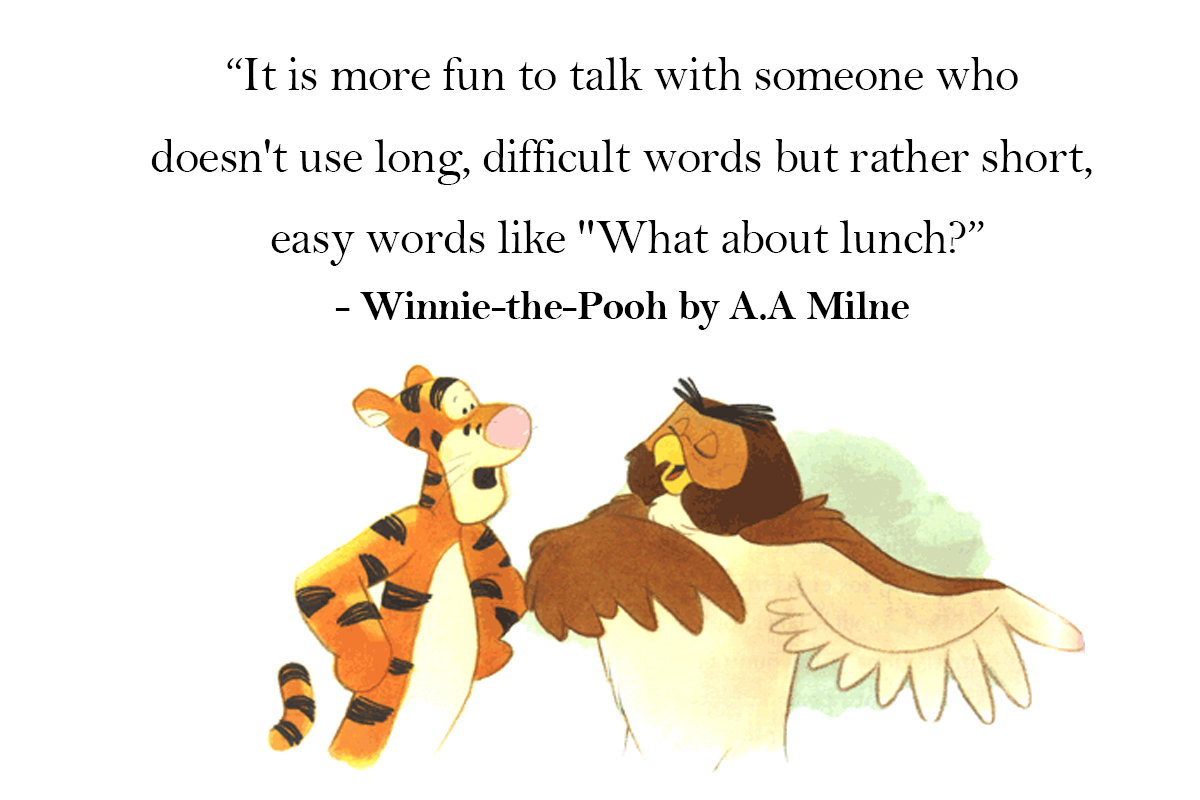
The (hindsight) theme for this year was continuing education. In years past I might read one book and bounce to another like Tigger the tiger might move through the Hundred Acre Wood. This year I was more like Pooh, childlike and curious.
Current economies. Though not a book, Brian Arthur’s paper was insightful and Modern Monopolies was a framework with examples. The Gorilla Game though dated is still helpful. Breaking Smart is page-for-digital-page the best book I read this year. Videocracy is the choice for wrapping your head around YouTube.
Single stories. A Truck Full of Money is the story of Kayak, but even better, it’s written by Tracy Kidder. Made in America is the story of Walmart. Springfield Confidential is the (partial) story of The Simpsons. Reacher Said Nothing is the (academic) story of Jack Reacher. At Work is a collection of Annie Leibovitz pictures and stories. To Pixar and Beyond is the (CFA) story of Pixar. Creativity Inc. is the (CEO) story of Pixar. The Long Haul is the story of America from a trucker’s perspective. Buffett by Lowenstein was better than expected, and I probably should have read sooner.
Marketing. Take your pick of a David Ogilvy book, my favorite is Ogilvy on Advertising. I also recommend Rory Sutherland on YouTube and Terry O’Reilly on the podcast Under the Influence. Win Bigly is ‘persuasion in a world where facts don’t matter.’ Hit Makers for the subjectivity of popularity. Hidden in Plain Sight by Jan Chipchase for finding thick data because “The best way to understand how a culture adopts (or doesn’t adopt) an innovation is to go there and see it for yourself.”
History. The Worldly Philosophers filled in a gap I’d had about Malthus, Mill, Veblen, and Keynes and their economic ideas. Ditto for Churchill and Orwell, a snappy set of stories about each. For only Churchill check out Hero of the Empire, about the Boer War. Chasing the Scream is a how we got to now story of addiction.
Misc. Mastermind by Maria Konnikova is what you’d expect if you enjoy her New Yorker articles and Sherlock Holmes (I do!). Best State Ever if you want to laugh at, and with, Floridians. Thinking in Bets for decision making from a poker perspetive.
Fiction. City of Thieves is written by David Benioff of Game of Thrones, advocated by Brian Koppelman and read by Ron Pearlman – I loved it. The Midnight Line – or any Jack Reacher book. Norse Mythology, Gaiman and the old stories.
The movie was better than the book. Factfullness was championed by Bill Gates but Hans Rosling’s enthusiasm sparkles in video. Gridiron Genius was good but Lombardi’s podcast is better. The Good Neighbor is the story of Mr. Rogers, and though I haven’t seen the movie I probably have in most of the alternative histories.
Andrew Ng has quite the resume to talk about AI, building the AI team at Baidu, cofounding Coursera, and leading Google Brain. His November 2017 talk on the Artificial Intelligence Channel is an overview.
We’re talking about AI now because we have enough data, passable algorithms, and people programming the two.
AI is a tool, like email and spreadsheets and it’s changing how we work. Ng gave this rule of thumb, “anything a typical person can do with less than a second of thinking we can probably now assume automate.” Ajay Agrawal said much the same, “AI doesn’t do workflow, it does tasks.” At Goldman Sachs for example, they figured out that an IPO has 146 distinct steps.
Ng gave the example of a security guard; notice, identify, categorize, respond, repeat. AI can do some of those things. AI will replace security guards, maybe. Jobs have always been about outcomes. People don’t want quarter-inch drill bits, they want quarter-inch holes. Job security will be about using new technology to create those holes.
And people adopt to adapt all the time. Blackboards became smartboards, books became digital, and grade books went online but teachers still teach.
To date, machines have vanquished only one occupation; elevator operator. Hal Varian said, “Automation generally eliminates dull, tedious, and receptive tasks.” AI, like other technologies, will make people better at their jobs. Accountants used to count, Computers used to compute.
Pedro Domingos told Shane Parrish, “People sometimes think the easiest jobs to automate are the blue collar ones but our experience is the opposite. It’s often white collar jobs that are easier to automate.” Computers don’t miss the gorilla inserted into lung scans.
Robots are not coming for our jobs but they will change them. Author of the book Humans+Machines, Paul Daugherty said, “The skills we see increasing in importance in the human plus machine age are creativity, reasoning, and socio-emotional intelligence.”
In Average is Over, Tyler Cowen proposes that income divergence will continue based on this qualifying question; can you work well with machines? The have and have-not trends “stem from some fairly basic and hard-to-reverse forces: the increasing productivity of intelligent machines, economic globalization, and the split of modern economies into both very stagnant sectors and some very dynamic sectors.”
If this were a movie about the changing economy AI could be a villain from central casting.
Ng compares AI to electricity, noting it will be ubiquitous thanks to more data and better models. Data accumulation is like the advice on planting a tree; the best time was thirty years ago, the next best time is today. That’s what Google did.
GOOG 411 began in 2007 as a directory information service. Google Economist Hal Varian said the call-in service, “learned how to recognize voices, learned how to recognize accents, learned all these different things in this very limited domain of directory information. That was enough to get started and now I think we have one of the best voice recognition systems in the world.”
We’ve been saying ‘Hey Google’ for over a decade.
Today, 2018, algorithms are less important than the data and people are more important than both. Varian said, “These days the scarcest factor by far is expertise.” Rory Sutherland worried that there are more data sets than mathematicians competent enough to handle them. But this prioritization may be shifting.
In a talk about his book AI Superpowers, Kai-Fu Lee suggests a shift of AI preeminence from the United States to China. The U.S. has the leading researchers but China has the best data, thanks in part to the number of people and the environment they live in. Mobile payments are one example, Lee explained, “People’s spending patterns are so much more valuable than their clicking patterns.”
Ng noted that more than 10% of Google and Baidu searches come through voice “because voice recognition is finally accurate enough.” Product adoption or abandonment is largely drive by if something is ‘good enough’, an idea at the heart of Disruption Theory.
AI like other tools, can improve the way people work but will never be perfect, just like other tools.
Data is the new electricity. Err, I mean oil, data is the new oil! Oops! Should have said gold, yes, data is the new gold! Wait, that’s not it either? Analogies can help but data is different.
Hal Varian said, “Some people say ‘data is the new oil’. My response is, they have one thing in common. To be useful they have to be refined. A barrel of oil isn’t worth much but turn it into gasoline, kerosene, or hydrocarbons and it’s worth something. It’s the same thing with data…(but data is non-rival)…It’s a mistake to talk about data ownership because it’s too narrow a concept.”
This is a divergence in AI opinion. People like Varian think data ownership is the wrong perspective. People like Ng believe data ownership is the only way to earn a competitive advantage, “algorithms from a company point of view are for the most part not defensible.”
Ng teaches his Stanford students about a virtual loop where data leads to a product that leads to users who generate data. 🔁 And, “after a period of time, you might have enough data to yourself have a have a defensible business.”
For example, Blue River Technology uses “cameras, computers, and artificial intelligence to allow Ag machines to see every plant in a field.”
Ng concluded his presentation with one lesson from his internet days; selling things online does not make you an internet company. “What defines the internet company is whether or not you have an architect at your organization to leverage internet capabilities to do the things that the internet allows you do really well.”
Things like a/b testing, short product cycles, and bottom-up actions. Internet companies had to “push decision making down from the CEO to the engineers and product managers because the internet products and uses are so complicated that a lot of knowledge about what needs to be done lives only in the heads of the engineers and product managers.”
In other words, it has to be a decentralized command. Pedro Domingos said, “Machine learning is computers programming themselves instead of having to be programmed by us…In general terms, tell them what you want them to do and let them figure out by themselves how to do it.”
The challenge then is to figure out what it means to be an AI company.
But there’s more to jobs than work. I won’t muddy up what those things are but The Long Haul and Shop Class as Soulcraft provide clear examples.
h/t Patrick O’Shaughnessy on Twitter.
A set of materials for those who want an introduction to machine learning:
Paul Daugherty has spent thirty-plus years at Accenture and with co-author, H. James Wilson wrote Human + Machine: Reimagining Work in the Age of AI. They emphasize similar ideas that Haskel and Westlake point out in Capitalism without Capital and Hal Varian addresses in his talk Bots vs Tots. Each author wants us to rethink how work is done and how work might be done with the rise of machines.
Actually, that’s bad phrasing.
The conquering of machines!
Wrong direction.
Seth Godin lamented that we missed a great opportunity to brand global warming. ‘Global’ and ‘Warming’ are two mostly positive words. As Scott Adams suggests, wording matters. Godin thought global warming should be called ‘atmosphere cancer.’ It’s why Paul Daugherty has “started using the term ‘collaborative intelligence’ rather than ‘artificial intelligence’. The problem with AI is it scares the public and it leads to the wrong discussions.”
We’re having this discussion now even though ‘artificial intelligence’ has been around for more than sixty years because of three changes. There have been advances in computing, there is data from new sources and at scale, and algorithms have advanced, including progress with voice and speech.
Daugherty starts one talk by saying, “If you forget the rest of my talk here’s the real thing to take away; the plus sign on the cover of the book. If you remember nothing else about what I say, just remember the plus sign because it’s the fundamental basis for the research we’ve done.”
AI is already at work. Wal-Mart has used VR to simulate Black Friday Mobs. At Accenture, someone built a system to track resumes, experiences, and current jobs openings to suggest when and where someone should considering retraining and transferring before their job becomes obsolete. There are amazing possibilities but, “the problem a lot of business executives have is ‘What do you do with it all?'”
Daugherty showed this Dilbert Cartoon where The Boss asks, “But why can’t we 3D print a blockchain and HTML it into a Bitcoin.” Rather than nonsense, Daugherty suggests baby steps.
We need to change our thinking. Robots are coming for us but as assistants, not adversaries. Machines will not take our jobs. Work will remain. With a little work in the right direction will change for the better.
“AI gives people superpowers.” Both Mercedes and Tesla tried mostly automated factories and both blundered.
Yes, excessive automation at Tesla was a mistake. To be precise, my mistake. Humans are underrated.
AI won’t be confined to the factory. It’ll be everywhere like electricity or wifi. It’ll be in brands. AI Personality Trainers are people who tune pop up chatbots in apps. “AI is your brand.” AI is also used to flag money laundering and in some cases moves from 70% false positives to 30%. Technology gives people superpowers.
“The skills we see increasing in importance in the human plus machine age are creativity, reasoning, and socio-emotional intelligence.”
The future is difficult to predict except to say that it’s going to be different. Tim Hartford talked about how we overlook the simple things and focus on the glamorous. It wasn’t just Gutenberg’s press in 1450 but paper too! Ditto for Bladerunner where the replicants look just like humans but the phones look just the phones.
But not even baby steps happen without organizational support, support that starts at the top. “One thing we see is a senior leadership driven mindset around applying AI differently to the organization. It’s not just AI at the edges and at the small things but taking on something that matters to the organization and changing some of the behavior and culture in the organization.”
Daugherty adds that it should be a C-suite job or direct report. “You want somebody in your business understanding the context and application of AI and be accountable for it.”
In surveys of 1500 companies for the book, Daugherty found that only 1 in 10 companies were applying AI in reimagined ways. He and Wilson also found that “two-thirds of executives believe their workforce isn’t ready for AI.” But don’t go out and try to hire a machine learning specialist. “That’s what people often say, ‘I need more machine learning experts,’ or whatever the technology might be. That’s important but the bigger issue is the talent that uses AI. How do you change the culture and train the people that need to use AI for these different types of jobs?”
AI experts won’t be silver bullets. It’s your culture that matters most. Adaptability is what precedes survival. “One of the greatest examples of this is Amazon. If you look at their Go stores, they started small, tested on employees first, improvised and innovated with the technology, and now they’re scaling it. That’s a great example of behavior we see consistently with leading organizations.”
After listening to Daugherty I felt optimistic because he’s optimistic. “I strongly believe, that the more human-like technology is, the more it enhances our ability to be human.”
Varian’s talk is titled Artificial Intelligence Economics and Industrial Organization. AI EIO, “kind of like old MacDonald had a farm.”
Varian represents the techno-economy as a pyramid with three layers. A base layer of data, a next layer up of information and the next layer of up knowledge. It’s only at the knowledge peak where we get action.
“There’s a lot of debate about the data economy, the information economy, the knowledge economy, but they’re all part of the same process, and no part can stand on its own.”
A series of recent breakthroughs is part of the reason the AI EIO conversation has entered the public sphere. “Many techniques have emerged that just a few years ago we thought were impossible.”
Data is our sand at the beach, models our buckets, and then it’s up to us. “These days the scarcest factor by far,” said Varian, “is expertise.” Rory Sutherland agrees, “One of my great worries about big data is that there are far more big data sets than there are mathematicians competent enough to handle them.”
Think of data as a raw material, like sand or oil – with one big difference. “Some people say ‘data is the new oil’. My response is, they have one thing in common. To be useful they have to be refined. A barrel of oil isn’t worth much but turn it into gasoline, kerosene, or hydrocarbons and it’s worth something. It’s the same thing with data.”
But data is non-rival. Two organizations can, and maybe should, have the same data. “It’s a mistake to talk about data ownership because it’s too narrow a concept.” Instead, maybe data is something to license.
Good organizations have people that argue well. Good economics have organizations that compete. Cordial clashes are fractal. “Usually pluralism is important because it allows a diversity of viewpoints and in many cases allows for a significant improvement in terms of unitizing that data.”
Varian emphasized the abundance of services for data. He also said that Google Home started as Goog-411. The call in service, “learned how to recognize voices, learned how to recognize accents, learned all these different things in this very limited domain of directory information. That was enough to get started and now I think we have one of the best voice recognition systems in the world.”
Maybe a better analogy is that data is like a river, we are the settlers, and models are the mill. It took a lot of effort to discover the data/river, and we had to be willing to venture out and harness it. Now we need to figure out how to use it well. “The challenge is finding the expertise to extract the value from the data.”
The goal isn’t perfection, just improvements. Robots won’t take our jobs but they can make our jobs better. “We think it has to be people plus machines to really be effective.” How well someone works with machines is a key part of Tyler Cowen’s book Average is Over.
The good news is that everyone is kind of figuring things out together. Cowen wrote that computers play chess moves no human understands. Varian said that computers find indicators of health (and sex) in the eye that no human understood – at least for a couple of weeks. The doctors did figure it out, and that’s kind of what we’re all doing on the banks of this river.
Varian has other good talks on YouTube, if you want more check out Bots and Tots.
Avi Goldfarb and Ajay Agrawal spoke at Google about Prediction Machines. They wrote the book because they noticed more AI startups in Toronto and more AI investing in the Bay. “We got to see both the flood of companies coming into our lab in Toronto and the excitement that was starting to percolate in the Bay Area.” They had a ‘that’s interesting‘ moment.
Like other AI presentations, Goldfarb and Agrawal articulate the nuance. “The reason we’re talking about AI in 2018 and not in 2008 is not because of C3PO or Terminator technology, it’s because of advances in machine learning.” What is machine learning? Better, faster, and cheaper predictions.
1/ When things get cheaper we use more of it.
2/ When things get cheaper we use less of substitutes.
3/ When things get cheaper we use more of compliments.
If the price of coffee drops (1) the value of tea also drops (2) but the value of sugar and cream increases (3). Now, what if that happens to something like arithmetic?
“Your computer does one thing, arithmetic. But once arithmetic is cheap enough we find all sorts of opportunities for arithmetic that we might not have thought of before.”
Like?
“Photography used to be a chemistry problem but as arithmetic became cheap we transitioned to an arithmetic based solution.”
And?
Like accountants, who used to specialize in addition but now focus more on inquisition. “There are still accountants because it turned out the people who are best positioned to do all the arithmetic were also the best positioned to understand what to do when a machine did the arithmetic for them.”
Humans are great at finding new ways to use new tools. Cheap coffee has knock-on effects. Cheap arithmetic has knock-on effects. Cheap predictions have knock-on effects. And we are making predictions all the time about loans, tumors, behaviors, anymore.
Goldfarb wants people to ask, “What are the core compliments to prediction? What are the cream and sugar that become more valuable when coffee is cheap.” He thinks it’s decision making. “Prediction is not decision making, it is a component of decision making.” Other components are data, actions, and judgment. These are the tasks humans are better at than machines whereas machines are better at the arithmetic.
Around 17:30 Agrawal takes the lectern and provides a helpful framework. Like Paul Daugherty, Hal Varian, and Nicholas Christakis pointed out, people are excited but perplexed about AI and Machine Learning. It’s Dilbert’s boss suggesting, “we 3d print a blockchain and html it into a Bitcoin.” Daugherty said, “The problem a lot of business executives have is ‘What do you do with it all?'”
Agrawal points us in the right direction. For starters, think small. “AI doesn’t do workflow, it does tasks.” At Goldman Sachs, they figured out that an IPO has 146 distinct steps. “When organizations show up and say where do I even start, this (The AI canvas) is a coarse description of how we start.”
This canvas is simple. “The key point here is that there are senior-level people who have never written a line of code but can sit down and start filling these things out.”
The big effects will come, Agrawal said, when the returns from AI create cascades. “A common vernacular for this type of phenomenon is disruption.” For example, right now Amazon’s business model is shopping then shipping but what if their AI becomes good enough where their model is shipping then shopping. (26:10)
This may not need to happen at perfect prediction, just some good enough level. “There’s some number, it doesn’t have to be a Spinal Tap level of prediction accuracy, but there is some number where when they get to that level of prediction accuracy that someone at Amazon says ‘We’re good enough at predicting what people want, why are we waiting for them to order it, let’s just ship it.'”
“Amazon becomes transformational when the recommendations get so good that they no longer have to have the same business model as the Sears catalog.”
But betting on predictions will only work – like any other strategy – in the right culture. “The allocation of scarce resources is what makes something a strategy.”
Like marketing and design, AI researchers face the trouble with selling this to the boss. Researcher Grant McCracken said, “When a senior manager says, ‘Fine, that’s what you think, where are the numbers?’ And the best we can do is say, ‘Just trust us.’ It’s like, yeah right, ‘I’m not trusting my career, my children’s opportunity to go to college on your impression. Where’s the data?’ By data, they don’t mean, I did an ethnography in someone’s kitchen. They mean, please could I have some numbers.”
Numbers let people appear rational but we don’t have a (good) rational answer for what the killer app for AI is. Agrawal said, “I think our barrier is imagining all the things that we’re going to do.” To reimagine is one of Paul Daugherty’s key points too.
“The person who asks good questions of their data has a higher return to that part of their skillset.” Seth Godin said there are two things we should teach in school, leadership and how to solve interesting questions. With some imaginative intelligence, AI can help with the latter.
In November 2012, Carol Loomis and Warren Buffett sat down with Charlie Rose to talk about Loomis’s book Tap Dancing to Work.
The first time Carol Loomis wrote about Warren Buffett (1970) she misspelled his last name as ‘Buffet’. By 1977 Buffett was writing his own (7,000 word) commentary in Fortune.
The first part of the conversation with Charlie Rose centered around Buffett’s suggestion for a minimum tax rate. “I’m suggesting that because the 400 of the highest taxpayers (in 2009) had average incomes of 202M, half paid below 20%, a quarter paid below 15%, and six paid nothing.”
Buffett is/was one of the richest people in America/the world. Part of what made him that was was that he “can hardly wait to get to work in the morning…there’s never been a day I haven’t looked forward to.” Even on the weekends, Buffett works because he loves it.
Neil Gaiman said something similar, “Amanda (Palmer) sometimes describes me as a workaholic and I don’t think I am, but I’m certainly somebody who loves what I do and it’s never felt like work.”Mike Lombardi said you don’t work in the NFL, you live in the NFL. Tyler Cowen answered on Reddit that he maintains his impressive productivity thanks to being born the right way and then persisting.
Buffett said he sees accounting as a language, and reading accounting documents, “It’s almost like playing music.”
Since 1977 Loomis has given feedback to Buffett on his letter to shareholders. Buffett said that when he writes “I’m addressing (the) partners. There’re 600,000 of them, but in my mind, I usually have my two sisters.” The first year Loomis gave limited feedback but over the years she’s become bolder. Buffett said, “She’s one of the smartest people I’ve ever seen, she’s objective, and in a very very nice way she tells when I’m full of baloney.”
Loomis added, “I do think I’m one of the few people who argue with him.” And, “I’d include Charlie (Munger) in the few people that argue with him.” Buffett’s smart but he’s not perfect and having good arguments has been a regular theme this year.
Howard Marks said about his partnership with Bruce Karsh: “It’s been a great partnership. Never an argument. Intellectual disagreements but never an emotional argument. The key is respect. Even when we disagree, we respect each other. The great thing about that is, you sit down, you disagree, and then you go back to your corners., and he may say, ‘You know what, Howard’s right’ and I say, ‘Maybe Bruce is right’ and then you can go back and have a productive discussion.”
Buffett said something almost identical, “Charlie and I never have an argument but we have disagreements and whenever we have a disagreement his clincher is, ‘Warren, when we get through talking about this you’ll agree with me because you’re smart and I’m right.'”
Those good arguments center around being approximately right rather than precisely wrong. “I only get into situations where I do know the value,” Buffett said, “There are thousands of companies whose value I don’t know but I know the ones I know.” It’s not pinpoint, “If someone walks in this door right now and they weigh between 300 and 350 pounds, I don’t need to say they weight 327 to say that they’re fat.”
Charlie Rose asked about an investment in John Deere and Buffet said that wasn’t me, it was someone else at Berkshire. And he doesn’t need to know. “I don’t want to know what they’re doing. They have the responsibility for managing that money, they’ve got to have full authority. They can’t look at me and see whether I’m smiling or frowning over it, and they get paid based on how those securities do.”
Berkshire has a Decentralized Command and few HIPPOs. Daryl Morey uses a DC for Houston basketball. Ed Catmull uses a DC for Pixar movies. Alex Blumberg uses a DC for Gimlet podcasts.
A decentralized command is even part of machine learning — which we’ll focus on next week. Thanks for reading.
“I went into it to get some ideas for doing research in my laboratories. Say something this way versus that way…I realized that in a laboratory with college students I was missing the power of these techniques to really make a difference outside of the laboratory in the real world.”
The real world is really all that matters. When Rory Sutherland spoke about the replication crisis he said it wasn’t a crisis outside of academia. “As a business person…I just need to know that the way you design a choice has a big effect on how people choose and I need to know also that the logical economic assumption isn’t true.”
“Moving from my university position in the avenues into the streets,” said Cialdini, “was the smartest thing I ever did.”
He beat the streets thirty years ago, so some things must have changed. Right?
Dr. Robert Cialdini author of "Influence: Science and Practice" has sold 3 million copies in more than 30 languages; @RobertCialdini
His most recent work, "Pre-Suasion: A Revolutionary Way to Influence and Persuade,"
“The tendencies that people employ to decide to say ‘Yes!’ have not changed. Those have evolved over eons and are still hardwired. What’s changed are the channels that are available for tapping those tendencies and the biggest change is the internet.”
Now we there’s technology to create social proof. But no matter how fancy the technology, the grey matter is the software that matters. We like seeing others doing the things we do. We like to be consistent, both to ourselves and others. “We prefer, for reasons of self-concept, to be consistent with ourselves. We want to see ourselves as reasonable, logical, and rational individuals. And, the people around us want us to be consistent too.”
As evidence of the timelessness, Adam Smith wrote, “Man naturally desires, not only to be loved but to be lovely.”
We follow tendencies because they are easy and they work. What’s easier than acting naturally? “Those things (like social proof, authority),” Ritholtz said, “are hardwired because they serve a purpose.”
“That’s a great insight,” responded Robert, “They’re hardwired because they typically lead us in positive directions.”
Cialdini also praises Buffett and Munger for all they’ve taught him. The Berkshire Hathaway annual shareholder letter, Cialdini said, “is brilliant psychology.” It’s not just what Warren thinks that makes him a great investor, but what he says too. “Buffett is not just a brilliant investor, he’s a brilliant communicator about being a brilliant investor.”
Buffett communicates well to his stakeholders.
Among (many) other good ideas, Charlie Munger encourages people to invert, something we’ve seen people like Bill Belichick apply. Ritholtz said, “Very often (once you invert) it’s pretty clear that ‘Oh, I’m looking at this from the wrong angle. Once I flip it, it becomes clear.'”
Tyler Cowen said that Bloomberg Tyler and Tyrone are his ways of doing this. Rory Sutherland reminds us that “The opposite of a good idea may be another good idea.”
Campaigns (political and for products) may pass, but the principles persist. “During the (2016) campaign, there will be a lot of volunteers to call, solicit, and register. What others have found is that if that person can say to the recipient of the message, ‘I’m your neighbor or I live in town too.’ The connection allows the recipient to say, ‘This person is like me,’ and can move in that direction.”
Cialdini suggested we read Aristotle’s Rhetoric. “It was the first time anybody took a systematic look. He was talking about orators about how to make a case convincingly.” Hidden Persuaders is also good, and was the “first time anyone has looked at the advertising industry and what makes commercials psychologically successful.”
“I also like Dan Ariely’s Predictably Irrational. It has the terrific insight that though we may be irrational (compared the theory) it’s in these rational ways.”
Tom Standage is a deputy editor at The Economist, author of a slew of books, and on Twitter (@TomStandage).
The Economist, according to Tom Standage, aims to be “a trusted filter on the week’s events. We make it finish-able, we package it up for you.” How? “We do this with a global perspective. I sometimes call it ‘the view from the moon’.” Rather than a lot of London, The Economist spotlights spacious stories. POV matters. Tom Wolfe tried to do this too, entering situations as the man from Mars.
When Pixar was transplanted – like a healthy heart – to Dinsey, Ed Catmull noticed that his point-of-view was blocked like an obstructed view concert seat. Catmull reflected, “Gradually, snarky behavior, grousing, and rudeness disappeared from view – from my view anyway.” Where we stand affects our stance.
Readers should know which way their news is bent, and writers can take this idea one step further. In an interview on the Not Unreasonable podcast, Tyler Cowen explained how he uses ‘Bloomberg Tyler’ and ‘Tyrone’ to flesh out ideas. Different medians, Cowen said, make him adopt different angles. Cowen’s colleague Brian Caplan calls this the “ideological Turing Test.” Can you explain issue X so that supporters of X believe you are also a supporter of X?
The Economist, Standage said, is a profitable magazine. About half their subscribers choose the print + digital option. About a fourth choose print only. About a fourth choose digital only.
But, the print only group skews younger and the digital-only group skews older. Huh? Standage guessed that older people want the digital version so they can make the font larger while younger people want the print version as a badge. Like white headphones, brown Uggs, and black Benton Springs jackets, the red Economist binds form and function.
Signaling isn’t only for college students. We all do it. Accounting for this we can act appropriately. Rory Sutherland suggested this:
“If you want a good recommendation for an Indian restaurant, you are far more likely to get a good recommendation from a scaffolder called Terry than from the editor from the Times literary Sunday edition. Because scaffolders are perfect recommenders. They have quite a bit of cash but they want good food. They’re not interested in showing off their sophistication. They want a pretty good meal for a reasonable money.”
One place without signaling is The Economist bylines. In one interview Standage is asked about the lack of them, and he said that historically bylines were the abnormally. In another interview, Standage says to think of the classical-natural British landscape. Most people imagine a few sheep, a house or two, and wild grasses.
But, that’s not right. The classic landscape was wild boars and oak trees. A theme throughout Standage’s conversations is that history has no starting line. Everything is a tweaked version of its predecessor. This is especially true for food.
“Almost nothing that we eat is natural.” Go back twenty-five thousand years and there’s no chicken, no corn. “The point is, we forget how engineered the food and landscapes are.”
The potato was never mentioned in the bible and didn’t immigrate to Europe until the 1700’s. Oh, and it grew in the ground. No one wanted it. It was only a series of famines and wars, Standage explained, that brought the potato onto the plate. Romans didn’t grow tomatoes, so no red sauce for pizza. Corn – to make polenta – had to be imported to Trento too.
Much of Standage’s work is built around food and drink and how they tell the history of the world. That continues today, “Food coming from a farm and food coming from the internet are both basically technology delivering food. The farm is very much a man-made technology like the internet and the delivery truck.”
Life then is like life’s always been, evolving. The Economist evolves too. Standage said they try to make small bets. It’s not Skunk Works or Xerox Park, but the magazine has people tinkering. Sometimes it’s a couple of interns, sometimes it’s a full-scale internal product.
The film adage that no one knows what will work is universal. Fred Rogers tinkered on TV when it arrived. Ed Catmull drew it into the Pixar culture. Chris Blattman experimented with chickens in poor countries. There are so many moving parts, he told Russ Roberts, that it’s hard to know what will work until you try it. Tom Kelley of IDEO tells people to present things as experiments. “Framing things as an experiment is really important.”
Emily Dufton spoke at Politics and Prose about her book, Grass Roots. Tyler Cowen blogged, “It is sure to make my best books of the year list, and if she had ten other books I would buy them all sight unseen.”
With marijuana investments growing, (That’s my trade, short Tesla, long pot – Danny Moses) we’ll look at pot and then parables.
In the 1860’s, marijuana was available at corner pharmacies and was used by new mothers to calm colicky babies. In 1886 Coca-Cola was born and would be one of the few to survive the patent medicines era. Salesmen traveled from town to town, sold their elixir, and left us with the expression, ‘snake oil salesman’. By 1897, marijuana’s medical use was well documented.
Köhler’s Book of Medicinal Plants, 1897. From Wikipedia.
As the century turned over – from the Gilded Age to the Progressive – the federal government took a larger role and issued The Food and Drug Act, and Coca-Cola became more like the drink we know today. Prohibition ran from 1918 through 1933.
Fast forward to 1968 and with Richard Nixon’s election, there’s more government expansion. He wants marijuana listed as a schedule one drug on the Controlled Substances Act. The Shafer Commission, tasked with judging this request, recommended decriminalizing small amounts. Instead, marijuana was listed as a schedule one drug. The knock-on effects today include academic research being nearly impossible.
But states write their own rules. In 1973 Oregon decriminalizes it, making smoking a joint equivalent to running a stop sign. In 1976 the first parents against marijuana group forms in Atlanta. Around this time, one in ten high school students reported smoking dope and a dozen states have decriminalized small quantities.
In 1980 the lumbering giant known as the federal government takes another step as First Lady Nancy Reagan encourages kids to ‘Just Say No.’ In research for this post I was surprised to see that Nancy Reagan’s is often compared to Lady Macbeth, in both kind and criticizing tones. Around this time another strong California woman enters the saga.
In 1981, ‘Brownie Mary’ was arrested. She reportedly told the police, over the 18 pounds of cannabis on her kitchen table, as they entered her home, “I thought you guys were coming.” Her crime was making ‘magically delicious’ brownies. Her customers were – mainly – HIV invalids.
During the eighties, the war on drugs continues. Marijuana is seen as relatively less harmless when viewed next to cocaine. By 1990, marijuana arrests account for 30% of all drug arrests. By 2002 it’s 50%.
In 1996 Prop 215 allows medical cannabis sales in California. Fast forward to 2017. Thirty states allow medical marijuana. Nine states allow recreational marijuana. It’s estimated the legal marijuana business will have sales around ten billion dollars – that nearly the sales totals from all the Dunkin’ Brand stores.
…
So what?
Stories rule our lives. Humans aren’t absolute oracles, we compare this to that. ‘This’ is whatever is here and now. ‘That’ is whatever is easy to recall. Our conclusions ca be accurate and erratic, like a driver in the snow or a parent who yells at their kid.
Stories are like candy, and once we hear one we keep it because we’ve already digested it. It’s hard work to avoid what Tyler Cowen calls the philosophy of once-and-for-all-ism. Marijuana is a complicated subject with a sundry history. And in these five hundred words we didn’t address the elephant in the room; race.
Living life by simple stories is like asking, ‘Is the Wifi on?’
Asking questions about simple stories is like asking, ‘How is the Wifi on?’
It was two Republican presidents that restricted individual freedom. How does a party that defined the ‘nine most terrifying words of the English language’ add so much scaffolding, facade, and concrete? It was because of the stories we tell.