Ed Thorpe

Supported by Greenhaven Road Capital, finding value off the beaten path.

Ed Thorpe joined Barry Ritholtz on Masters in Business to talk about his life – via book form. What an interview this one was.
pablo (16).png


1/ Two-jar model. Thrope has a TJM view of life. He wrote, “Chance can be thought of as the cards you are dealt in life choice is how you play them,” and explained to Ritholtz:

“And then there are things you can’t control like; who your parents were, what kind of economics circumstances you were brought up in, where you started, did you start twenty yards behind the start line or twenty yards ahead of it or right on it. People start in different places, those are card they’re dealt.”

Good decision making, noted Chris Blattman, requires good data. It’s why Judd Apatow and Joe Rogan focus on writing good jokes (how they play the cards) and not how the tickets are selling (the cards they are dealt).

Good data increases the relative weight of the skill jar scores. These data repeat. Joe Peta found that strikeouts, base on balls, and home run rates were skill jar scores for major league pitchers.

2/ Choose games with good odds (both ways).  “I also believed then as I do now, after fifty years as a money manager, the surest way to get rich is to only play those gambling games where I have an edge.” Andy Rachleff started Wealthfront because he read Howard Marks and thought, how can I be non-consensus and be right. Charley Ellis said about his early work, “It was not very skillful work but compared to the competition it was fine.” For Jeremy Liew it was realizing his odds were worse as an operator than an investor.

Sometimes games can have good odds because you’re the only one playing. Thorpe said that overpriced warrants, “someone eluded the market.” Rishi Ganti told Patrick O’Shaughnessy that a market needs two buyers. If there aren’t two buyers, there is no market, if there isn’t a market there isn’t a pricing mechanism.

Whether it’s the NBA finals or investing like Charlie Munger playing in the better areas is better than not.

Then you have to figure out how much to bet. It’s hard said Thorpe:

“That was one of the early things that I learned, fortunately, how much to bet on good situations. If you bet too much you could be wiped out. If you bet too little it takes forever to make any money. There’s a happy medium in there and that was one of the things I came across quite early.”


Matt Patricia said about coaching for the Patriots, “We talk a lot that before you win you have to learn not to lose.” Seymour Schulich asked whether decision missteps would be painful or fatal.

Wilbur Wright wrote, “The man who wishes to keep at the problem long enough to really learn anything positively must not take dangerous risks. Carelessness and overconfidence are usually more dangerous than deliberately accepted risks.”

3/ Serendipity. Thrope found himself in Las Vegas with his wife for a “cheap vacation” and to see the roulette wheel in action. He wanted to beat roulette and needed experience in the casinos.

“I wanted to verify by close up observation that what I was doing would work. On the way I heard about a blackjack paper some statistician as written so I thought, I’ll get a little casino experience if I’m playing roulette, so I sat down at the blackjack table and played for forty minutes and I learned enough in that forty minutes that I could probably beat black jack and I went to work doing that.”

One deck blackjack was solvable! If you tracked the cards and knew if the deck was heavy (or light) in tens then there would be better odds. Not only that, but the payouts were favorable (#2).

Thorpe wrote his book – Beat the Dealer – and the advantage eroded away. Casinos changed the rules and began to deal “what they called – professor stoppers; two, four, six, or eight decks and deal them out of shoes because it’s hard to hold eight decks in your hand.”

4/ Rapid fire.

“Every edge has a scale limit and can only get so big.”  Microcap investors like Sean Iddings and baseball bettors like Joe Peta see this too.

Thrope has a “let’s see if I can figure it out,” attitude.  He has what David Salem calls “intellectual integrity.” Probably Grit too.

“Any edge in the market is limited, small, temporary, and quickly captured by the smartest or best-informed investors.” Daryl Morey had this happen with player evaluation. His alpha has eroded.

And these last two quotes were my favorites.

“Success on Wall Street was getting the most money, success for us was having the best life.”

Ritholtz asked, “How do you keep your ego in check?” after all these accomplishments. Thrope said, “All you have to do is look at all the other things people do.”


Thanks for reading, I’m mikedariano. If you don’t want to miss out on these posts, sign up for a weekly email here, http://eepurl.com/cYiwTP.

Grab Bag #2

Supported by Greenhaven Road Capital, finding value off the beaten path.

Bad news, this is the last grab bag post. Good news, grab bag is moving to email. If you’d like a weekly email in this style subscribe here.

headphones.jpg

Julia Galef on The Ezra Klein Show talked about how to change your mind. The short answer; it’s not easy. The long answer; but it is possible. Galef suggested to reduce your “identity footprint” and mentioned this post from Paul Graham where he wrote:

“I think what religion and politics have in common is that they become part of people’s identity, and people can never have a fruitful argument about something that’s part of their identity. By definition they’re partisan.”

Or to quote Bob Sutton, “strong opinions. weakly held.”

Sanjay Bakshi also liked this episode.

Rejection Proof on The Investors Podcast. To go along with decoupling our identity from a rejection, Stig and Preston talked about the book Rejection Proof.

Sam Dogen on Noah Kagan presents. Dogen and Kagan talk about investments but two non-asset ideas stuck out. First, there can be a lot of reasons to fail but one that’s always in your control is your efforts. That fits with our two-jar model. The second was to ask, ‘what am I working toward?’ Dogen recounts playing tennis with a friend who, while he had an order of magnitude more net worth, he could only play tennis at certain times.

Thomas Delong on Capital Allocators. How well do you know yourself? Do you have an inner scorecard or outer one? Three quotes that stuck with me.

“Talk to yourself about what’s going on inside yourself to try to settle yourself down so you don’t screw yourself over by creating pain for other people and yourself.”

“If you live a more curious life, you’re going to listen more, you’re going to be more interesting, you’re going to learn a lot more and you need to move your lives from certainty to curiosity and that would make a big leap.”

“I believe our need to cross things off our list is an addiction.”

Wharton Moneyball on 7/27/17. This episode was all about figuring out how current statistics predict future ones. For example; can Justin Speith continue to win twenty-five percent of his majors, can Kyrie Irving succeed without LeBron James, and can Aaron Judge continue his high BABIP even though that figure is mostly based on luck? These kinds of predictions are hard but not impossible. Important follow-up questions are; what’s the base rate, what’s the sample size, and how have things changed?

Under the Influence – Influencer Marketing. Terry O’Reilly’s podcast is one of the best per-minute shows. This one was about how companies are using influencers for marketing. One example was about Universal and J.K. Rowling reaching out to bloggers to open a new Harry Potter attraction.

Dave Rubin joined Tyler Cowen to talk political correctness and the duo concluded that the biggest problem isn’t being able to say too much, but too little. This episode reinforced my view that comedians understand deeply and that’s key for success. A deep understanding was central to Jason Calacanis’s advice.

Jocko Willink #86 & Alex Guarnaschelli on food on EconTalk. Both Willink and Guarnaschelli know that there are two parts to an outcome; native and creative skill. Willink said that stronger people can win in Jui Jitsu match to a point. A purple belt, Willink said, is tough for anyone to defeat no matter how strong you are. Guarnaschelli said that a cook shows their worth once they can use overly ripe produce. Of course, you and I can make delicious bacon, eggs, and toast but what about using the other parts?

Dan Schorr on Capital Allocators with Ted Seides. Schorr was like an unending storyteller and he could probably give you a brain freeze faster than his ice cream. What Schorr guessed was that ice cream was ready for a different company and he started Vice Cream.


Thanks for reading. That link again is http://eepurl.com/cYiwTP if you want to get these delivered.

Jason Calacanis 2

Supported by Greenhaven Road Capital, finding value off the beaten path.

Jason Calacanis talked with James Altucher about his new book, Angel.

pablo (15).png

There’s a part of Danny Meyer‘s book, Setting the Table where he’s dining in a restaurant with a mentor. Meyer asks for advice and the mentor moves the salt shaker on their table, and asks ‘What do you see?’.

Meyer returns the shaker to the center and says the table is ready. The mentor moves the shaker again. Meyer returns in again. The mentor’s point has been made.

Meyer wrote, “Wherever your center lies know it, name it, sticks to it, and believe in it.” Pay attention to where the salt shaker is and always return it to where it should be.

https://soundcloud.com/twistartups/twist-e749

1/ Know the costs. Calacanis said something that echoed my findings on failed start-ups, failure isn’t a total loss.

“Let’s say you were to lose 5% of your net worth (in an angel syndicate). It would be a bummer. But if you think about the network and the education you would build, it would be much greater than 5% of your net worth at any given time.”

Time is our only cost. Time to earn money. Time to network. Time to learn. Another way to express this is the DIY-MBA. When people like Troy Carter, Ezra Klein, and Elizabeth Gilbert skip school to live – they do so because of the time costs. The kind of investing Calcanis proposed in exchange for (possible) financial, relationship, and educational returns is the same thing Tim Ferriss did early on.

Even if the financial part goes to zero, there are other rewards for your time.

2 / Know the odds.

“Most people over-estimate the downside risk.” Elon Musk.

That’s from someone building rocket ships and cars. Calacanis echoes what people like Joe Peta have said know the odds.

Calacanis said, “If I took ten people and said, here’s a deck of cards, it’ll cost you a thousand dollars, but if you pull the ace of spades I’ll pay you a million.” People who pay attention will play that game all day. This instinct from poker has contributed to a shift in Calacanis’s thinking.

Calacanis has transformed from a what can go wrong? mindset to a what can go right? one. “When I invest in a startup I’ll write down five reasons why it might fail – and then rip the paper up. Then I’ll write down the one or two reasons it will work.”

Bill Gurley learned this lesson after missing on Google:

“I think it came down to the price at the time was remarkably high and the team was remarkably self-confident in a way that would cause you to question whether they could pull it off but they did. I go back and the learning is that if you have remarkably asymmetric returns you have to ask yourself, ‘how high could up be and what could go right?’ because it’s not a 50/50 thing. If you thought there was a 20% chance you should still do it because the upside is so high.”

Marc Cohodes knew the odds with an early investment in high-fructose corn syrup. If the HFCS market didn’t metastasis, his investment would be flat. But if HFCS was replaced sugar in nearly everything, well, as Gurley said, “the upside is so high.”

3/ Know the customer. Who is Airbnb for? Serial killers and meth heads. That line got Calacanis a laugh but that thinking made him miss investing.

“One of the secrets of angel investing is separating your limited capacity to understand ideas and be able to read the passion of the person creating the product and why it’s going to work and (see) the crazy first five customers.”

Peter Thiel wrote to be different. Alton Brown created a different TV show. Scott Norton created a different ketchup.

What each of them also did was understand what their customers wanted. Norton hosted a taste testing party. Brown worked in media for a decade. Thiel lived in technology. It’s not what you think is a good and different idea but what others think is good and different.

That understanding only comes from talking to your customers. One way to be a  Dead Company Walking is to be a distant owner, someone who doesn’t know their customer.

Calacanis said that being a journalist help him understand the market conditions.

“When you’re a journalist and understand the playing field, businesses, technology and cycles you know how to ask the questions of which founders are full of shit and which ones are actually going to change the world.”

Like animals exist in ecosystems, businesses exist in markets.

4/ Know how to communicate. The better a founder communicates with a funder, the better the situation will be. Calacanis is clear about this from the start:

“What I tell them in the beginning is; most startups fail. When/if we have that shut down conversation I’ll say, ‘it’s okay, most companies fail therefore all I ask is that we shut this down gracefully and after you recover I’m your first phone call when you have your next idea.'”

The idea of good communication permeates the podcast. Investors are like spouses, investments like marriages and the suggestions for both are the same, communicate well.


Thanks for reading, I’m mikedariano

Andy Rachleff

Supported by Greenhaven Road Capital, finding value off the beaten path.

Andy Rachleff was on Going Deep with Aaron Watson and if the podcast could be described in one image it would be this:

andy

That’s from Howard Marks. We like Marks around here; Howard Marks 1, Howard Marks 2, Howard Marks’s ‘Expert Opinion’, and Howard Marks 4. Wow. That’s a lot of Howard Marks. Let’s jump into what Rachleff had to say.

In a revisitation of Zero to One, I guessed that what Peter Thiel really wants is for ideas to be in the “Tyson Zone.” Rachleff tries to be “non-consensus” too. The Wealthfront service is different, it’s access to a service (financial advice) they couldn’t previously afford. At Wealthfront they hire differently, choosing engineers rather than bankers and giving them interesting problems to solve. Rachleff said about this:

“To be non-consensus and right you have to have tremendous knowledge of your domain…When we started the idea of people trusting their money to be managed exclusively by software was a radical idea.”

A radical idea, that’s the Tyson Zone.

The idea is mainstream now and could be the default in the future but it hasn’t always been that way. In fact, Rachleff hasn’t always felt this way. The first iteration of Wealthfront was a hybrid approach between apps and appointments. It didn’t work. “They (customers) consistently told us they would prefer we manage all their money adequately and inexpensively rather than a portion of it superbly.”

Wealthfront redirected their efforts and found a better product market fit. This, Rachleff said, “trumps everything else. If dogs don’t want to eat your dog food you’re not going to succeed.”

A good product market fit also solves the story-telling problem startups face:

“The biggest challenge a startup faces is it cannot afford to educate. Startups have to preach to the converted. We can’t convince of the merit of our approach, we have to rely on others.”

How do you start to think about this? Rachleff suggested the books The Innovator’s Dilemma and The Innovator’s Solution by Clay Christensen. “Clay’s original theory of disruption is worthy of a Nobel Prize…These two books are unbelievable.”

Those books say that customer’s preference migrate. Where speed once ruled the day now it’s about brand. Brand will give way to size and size to cost. It’s an evolution. Applying this theory isn’t so easy. Established companies have to serve their existing customers. New ideas – which may or may not be what the customers want – aren’t worth pursuing. Sometimes they are parts of the buiness an established company is all too happy to be rid of. Reading the Christensen’s books won’t tell you what to do, but they can give you a lay of the land.

To get beyond market returns you have to be non-consensus. Sometimes the market returns are fine. Low-cost index investing is a good path for many people. Other times like when drafting NBA players (Daryl Morey, Sam Hinkie), creating TV shows (Brian Koppelman, Alton Brown), or investing — being different is the only way to succeed.

Being different requires a deep understanding of customers, competition, and markets. Scott Norton provided a nice example in, of all places, ketchup.


Thanks for reading, I’m mikedariano.

Daryl Morey 2

Supported by Greenhaven Road Capital, finding value off the beaten path.

Daryl Morey talked with Bill Simmons about the 2017 NBA offseason and managing a team. We’ve written about Daryl Morey in a post around his appearance in Michael Lewis’s book The Undoing Project.

https://soundcloud.com/the-bill-simmons-podcast/rockets-gm-daryl-morey-and-music-legend-jimmy-iovine-ep-233

Ready?

1/ Options options options. Morey credited his success with not being locked-in to any situation. Future draft picks and favorable contracts are key trading pieces. Teams with more good assets have more options.

Not long after this podcast, Kyrie Irving requested a trade from the Cavs. It makes sense why.

The only problem is that the Cavs don’t have good options – or – the teams Irving wants to go to don’t. This is what Morey told Simmons he tries to avoid, getting stuck. The opposite example of this? Kevin Arnovitz said it’s the Boston Celtics.

2/ Edge erosion. One of the most valuable assets an NBA team can have is a great player on a good player’s contract. Drafting players is one way to do that. The 2017 Sports Illustrated article on great contracts notes “Note: For obvious reasons, rookie-scale deals are not included here.” Why? Because they’re so good!

Morey understood this and lamented that the Rockets draft edge has been eroded.

“It’s a real problem with the draft…and this year again it was straight down our board…the draft is more efficient.”

Where there used to be an edge for a team there is no longer one.

Ed Throp talked to Barry Ritholtz and said: “The surest way to get rich is to only play those gambling games where I have an edge.” Thorp found an edge in blackjack. Morey had an edge in scouting players for favorable (rookie contracts). Joe Peta had an edge betting on baseball. Sam Hinkie combined basketball and investing:

“You need to put a staff and system and way you make decisions in place that gives you an edge. Otherwise, you’re indexing, taking whoever is next on the board in the eyes of the public. You need to have some edge that you’re applying to these set of decisions.”

3/ Favorite foods. Joe Peta‘s first restaurant failed. His second succeeded. The difference? In the first he thought mostly about what he wanted to eat, in the second he thought about what his customers wanted to eat. Morey has his own version of this:

“Every GM has a soft spot for players and I have a soft spot for big guys who can play tough..it’s been tough for me to realize that role is fading.”

It takes a certain self-knowledge to understand where you make mistakes, but Morey is self-aware.

“I’d be the worst coach ever, screaming on the sidelines, no one would like me.”

Jeremy Liew said that he’s a VC and not an Operator because there are a lot of people who are better operators than he is. Andy Weissman said that people who get VC capital need to know if they can scale 25X.

Our perceived reality overlaps actual reality in some ways. The more accurate someone maps this the better decisions they can make.

4/ Chesterton fences.

“As with everything it’s an accident of history, it’s why we have 82 games…if they had randomly decided 64 games we’d still be playing 64.”

Other such fences? Danny Meyer says tipping. Greg Popovich says pre-game shootarounds. Aziz Ansari says twenty-two episodes in a season.

5/ Small bets. Simmons has proposed an “entertaining as hell tournament” and changing the home/away split of the first round to 4/1. Morey said some of these ideas have been talked about at the league level and for NBA fans that’s good to hear.

Though hard to do. Despite an if it isn’t broke don’t fix it mindset small bets are still good bets.

Aziz Ansari and Judd Apatow and Joe Rogan all talked about making TV shows by using small bets. Try this instead of that. Improvise this scene. Now try it again with a different mood. Apatow said that it’s really hard to know what’s going to resonate with people and it’s trying things as a stand up that keeps his movie chops funny.

Small bets are micro-experiments that give feedback on how the world really is.

Thanks for reading, I’m mikedariano.

Zero to One (revisited)

Supported by Greenhaven Road Capital, finding value off the beaten path.

What important truth do very few people agree with you on? That’s the gist of Zero to One. Right?

That’s what I thought but I may have missed the point. After the 2016 election cycle – where Thiel was in the news – I understand the book differently.  Thiel entered what Bill Simmons calls “The Tyson Zone.” A place where someone’s reputation is so bizarre any story is believable.

I would believe any news story about Theil – and that’s the deepest truth of Zero to One. If your idea isn’t in the Tyson Zone it’s too conventional. That’s how weird you have to be and being weird is hard.  Alton Brown said about doing the work for his show:

“It’s almost like it’s going to hurt too much. If I let it out. If I do all this work and it doesn’t happen, then I suck even worse than I suck already…It’s building the Frankenstein monster and he won’t come to life.”

In Grab Bag #1 both Jack Vogel and Rishi Ganti said this. Being different makes this easier. Being really different makes things really easier. Scott Norton asked, “When everyone else is zigging, how can you benefit by zagging?”

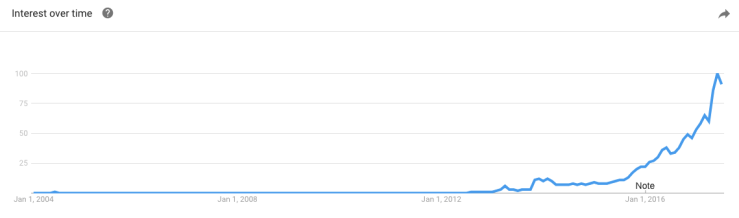
How different? Thiel suggests 10X. That’s big but not impossible. Andy Weir‘s book was 10X. Jim Koch‘s beer was 10X. Aziz Ansari‘s comedy was 10X. Each of them filled an unfilled need. They looked in the negative spaces. Ask, ‘What do people not talk about?’ It might even help to use new languages. ‘Blockchain’ is a good example….

Here’s what negative space looks like.

Screen Shot 2017-07-23 at 7.45.54 AM.png

That’s the Google Trends for “blockchain”.

Eddie Izzard had this definition:

the future = (history + change in society) * change in technology

One model for Zero to One thinking (do as I say, not as I do) is the burglar. In A Burglar’s Guide to the City, Geoff Manaugh wrote: “burglars use cities better.” Or, they found secrets.

Burglars think different. One of my favorite examples from the book was the burglar who set a dumpster next to his target building. From inside the dumpster, he worked his way through the wall and looted the store. The metal receptacle provided the perfect cover – no one thought to look inside. In the book, Manaugh has story after story about seeing the world differently.

If you’re going off the road – heck, off the map – you’ll want accomplices.

IMG_0679.JPG

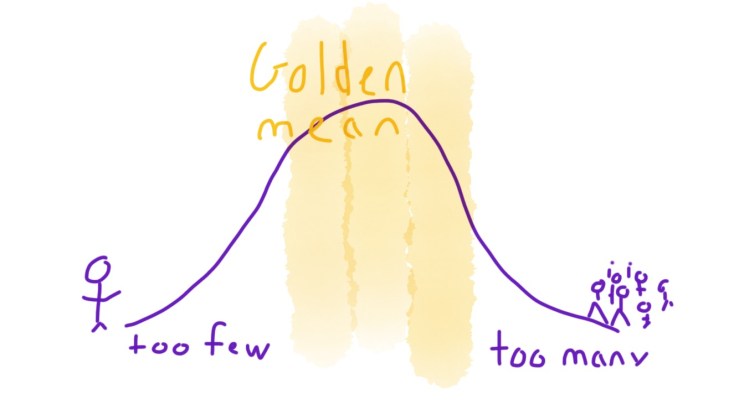
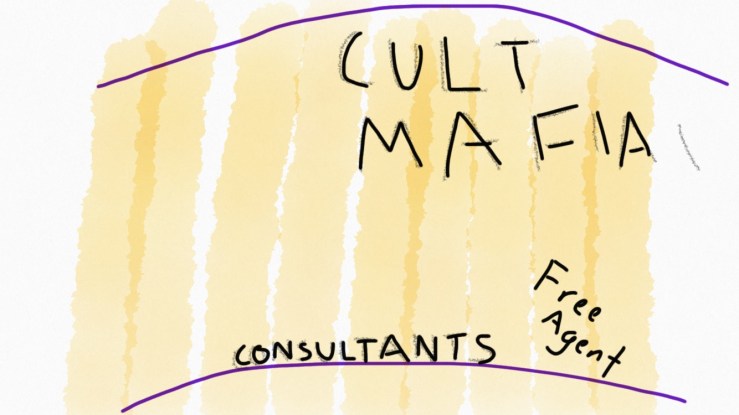
Thiel suggested a “golden mean” number of people for a zero to one situation. Of that group, writes Thiel, everyone is a builder or seller. And among them there should be more mafia less consulting.

IMG_0690.JPG

The level of work should be “referee quality.” It’s so good you don’t even notice how good it is. Healthy arguments should be inherent in the culture. We’ve seen this advocated by Marc Andreessen, Charles Koch, and Bill Belichick.


Thanks for reading, I’m mikedariano.

Atul Gawande

Supported by Greenhaven Road Capital, finding value off the beaten path.

Atul Gawande joined Tyler Cowen in a conversation about good data, good directions, good music, and good results. Here are my notes.

1/ What kind of data do you have? Cowen opens the interview asking, “How far are we from having an AI that is capable of actually doing diagnosis to people?” Gawande says pretty far actually.

We aren’t very good at explaining things. “It’s more of a narrative than it is a straight set of data,” Gawande said. This is the prerequisite to crunching (big-data-the-shit-out-of-it). Data have to be usable.

Joe Peta noticed this when he studied baseball. Morgan Housel calls bad data “expiring knowledge.” Nate Silver calls it noise.

There’s lying which you may need a field guide for. Of course, there are biases here too, sneaking in like unpopped kernels. When Michael Mauboussin asked Daniel Kahneman about big data Kahneman said, “You have to be open to surprises and there will be surprises.”

Data isn’t a panacea. Data is like a garden. Vegetables need to be seeded, watered, pruned, picked, washed, peeled, and cooked.

2/ Ambiguous strengths, questionable weaknesses. How important is gene editing?

Cowen and Gawande discuss George Church’s narcolepsy. At first glance, this is something a parent would choose to edit out. But dig deeper, and we see that, “he attributes a lot of his insights and capabilities to the fact that he falls into a deep REM sleep at the drop of a hat and then wakes up with ideas.”

Gina Martin Adams said being a woman on Wall Street was good — and bad. Rorke Denver wrote that being a Humvee gunner was the most dangerous position – but the only one to shoot back from. The Chicago Black Sox were so disorganized they never got paid for the fix (weakness) but couldn’t be convicted of colluding (strength).

3/ Checklists, we don’t need no stinkin’ checklists. Tim Ferriss jokes that he’s going to be known as the “four-hour guy.” Gawande could have been the checklist guy but his work has expanded well beyond that. The podcast revisited some of those ideas. Including:

  • Counting mistakes. Hanlon’s Razor explains forgotten sponges. Gawande started bar coding and scanning the equipment which solved this problem.
  • Short and sweet. Don’t turn a 19-item list into an 81-item list. More is worse. “We’d specifically designed it to be something you could run through in 60 seconds or less at each pause point,” he said.
  • Admin, sheesh. People that aren’t there tend to make worse decisions than people who are. Charles Koch noted that you do want someone involved at the macro level, not every surgery gets all the bells and whistles, but in general, the decision makers should be the people involved.

4/ “If information were the answer we’d all be rich and have perfect abs.” Derek Sivers

Gawande notes that some of our health research data (see point #1) is missing important parts. Maybe the problem isn’t what we spend, but what happens after. The CVS health study he references includes this line:

“It’s a complex behavioral challenge, one that becomes exponentially more difficult for patients with multiple diagnoses, disabling illnesses or challenging life situations.”

Maybe the problem isn’t information (take this pill twice a day). Maybe it’s behaviors.

We’ve seen that important easy things that feel good to do are done more often than unimportant difficult things that taste bad. This idea in itself is another example, it’s just information. Doing is harder than knowing.

5/ Rapid fire.

“The clinicians of the future, really need to be oriented in a counselor mode, where they are not just telling you what the options are, but also eliciting from you very clearly what your goals are.” Every service/business does better when they understand what their customer wants.

“Kenneth Arrow’s 1960s essay on asymmetry of information used healthcare as its prominent example that sellers are more powerful than buyers when we not only control the decision set, we control the option set.” Sometimes the best course of action is don’t just do something, sit there. At the very least we could let doctors prescribe placebos.

“I think that there are important insights in nudge units and in that research capacity, but when you step back and say, What are the biggest problems in clinical behavior and delivery of healthcare?’ the nudges are focused on small solutions that have not demonstrated capacity for major scale.” Do the big things first.

“Wearables. I think underrated.” Louis Passfield said on the Wharton Moneyball podcast that he too thinks wearables and big data could lead to leaps forward. Strava has released data about Boston Marathon Qualifiers.

6/ The Atul Gawande Production Function.

COWEN: So you’re decisive? [laughs]
GAWANDE: Well, I’ve learned that I say yes too much, and so I’ve learned to say no a lot to various things.

The most effective people do the most effective work. They often adopt a “Default No” stance. Cal Newport wrote, “I am incredibly cautious about my use of the most dangerous word in one’s productivity vocabulary: ‘yes’”

“The path to superior results,” wrote Seymour Schulich, “is to accept only the best ideas.”

7/ Small bets in big areas. Gawande runs Ariadne, “a center for health system innovation.” They do “large experiments.”

“We now are running about 20 projects in surgery, childbirth, and end-of-life care, improving how you come into the world. The surgery—the average American has eight operations in their lifetime. It’s the highest-risk, highest-cost, highest-failure moment in your lifetime. And then how you leave the world, end-of-life care. And about half of our experiments are in the United States, and half are abroad for demonstrating ways to get better and better.”

And in that one description, we have the gist of what works. For as high as Atul’s production function is, he doesn’t know what will work. Instead, he created a group of people to do small experiments on the most important things using good data.

Thanks for reading, I’m mikedariano.

Grab Bag #1

Supported by Greenhaven Road Capital, finding value off the beaten path.

So many podcasts, so little time. Let’s go through some notable ones. I listened to each of these at least once, but none will get the full set of notes.

Alex Moazed on Invest Like the Best. Re-listened to this one after reading the book Modern Monopolies. Platforms businesses must be like a casino poker table; create a place people come to where they can do things they enjoy. Sometimes assholes will drink too much and expose themselves or try to cheat, so you need some rules, but not too many. Make sure there’s a dealer, cards, chairs and that if people want food you build a kitchen.

Thomas Russo on Capital Allocators. This one was great. Russo had a natural curiosity about what made people do the things they did. A curiosity of people led to investing and now he looks for family owned companies willing to invest for the long term and suffer through doldrums. Part of what’s kept Russo in business is aligned capital (read: stakeholders). He said:

“and when I explain our (long-term) goal it’s quite familiar to what they felt as owners of businesses.”

Jack Vogel on The Meb Faber Show. Vogel demystifies ‘quant’ investing as using a computer to do calculations that reduce the entire universe of securities to only the best options (based on your criteria; value, momentum, etc.). Vogel wasn’t too worried about spilling the beans because:

“For each investor, the most important thing is understanding their own behavior.”


Mark Bowden on Longform. Bowden, the author of Black Hawk Down, talked his newest book, Hue 1968. He explained that he tries to tell a big story in a moment. Soldiers don’t land on virgin soil. There are attitudes, expectations, history, anger, love, kindness, danger and apathy all waiting for them. Bowden tries to tell both sides. Having empathy and knowing history help.

Freakonomics. When Helping Hurts. Stephen Dubner goes through a social study that found the treatment actually hurt the recipients. It’s another example of the some is good so more must be better fallacy. The episode ends with an encouragement toward more research. It echoed what Chris Blattman said about small experiments.

Edward Glaeser at London School of Economics. What makes cities great? People. Building higher keeps costs down. More people, more ideas, more idea pollination. Ironically Silicon Valley/ San Francisco has some of the highest cost of living despite creating technologies for working anywhere.

“Cities have always been built around the transportation technology that was dominant in the era in which they were created.”

“You can’t build your way out of congestion. If you build it, they will drive.”

Morgan Housel on North Star Podcast. Slow down. Think more. Read things that don’t change. In honor of Housel we’ll keep this short.


Joe Norman on The North Star Podcast. Systems can grow (preferred) or be designed (not-preferred). If we design we’re making assumptions that what happens at one scale will happen at other scales. This isn’t always so. “We’re bad at predicting emergent properties,” said Norman. Systems that grow, like evolution, tend to work better and “does things you wouldn’t expect.”  Like this:

Pasted Image 0.jpeg

Adam Blitz on Capital Allocators. When Blitz looks for the right hedge fund manager he’s looking for Bryan Mills. “I have a very particular set of skills.” He wants these people to be aligned with his motives (stakeholders) and have a high intellectual integrity (like [David Salem](https://thewaiterspad.com/2017/05/29/david-salem/) talked about). He also want’s to ‘be there’ and talk to the managers regularly.

Rishi Ganti on Invest Like the Best. Ganti said that there are a lot more “Bait Shops” (introduced by Trish and James Higgins) out there than we realize. If you get off the highway and be more like Indiana Jones you may find one. Ganti also talked about getting the right stakeholders on board.

“If you find a gold nugget on the ground you could be rich for a day. We don’t do that. What we do is pick up the gold nugget, look around, and say, ‘who owns this land?’. We buy all the mineral rights and put an expert mining operation on that land and mine that seam until it gives up….We’re building alpha factories.”


Thanks for reading, if you liked this Grab Bag edition let me know on Twitter, @mikedariano.

Joe Peta

Supported by Greenhaven Road Capital, finding value off the beaten path.

“Something was bothering me about the Tampa Bay Rays, the winners of the division in 2010,” wrote Joe Peta, and his journey from Wall Street to the warning track began with a That’s Interesting moment.

Peta, a former sell side market maker at Lehman walked off the curb and got hit by a bus, literally. Temporarily disabled, fired, and stranded away from his family, Peta found himself drawn back into baseball. His book Trading Bases tells the story.

Peta had always been a baseball fan, but in 2010 thanks to advances in statistics and (unwelcome) time on his hands, he slid back in. Looking around, seeing the results for the Rays, he realized that there were secrets here.


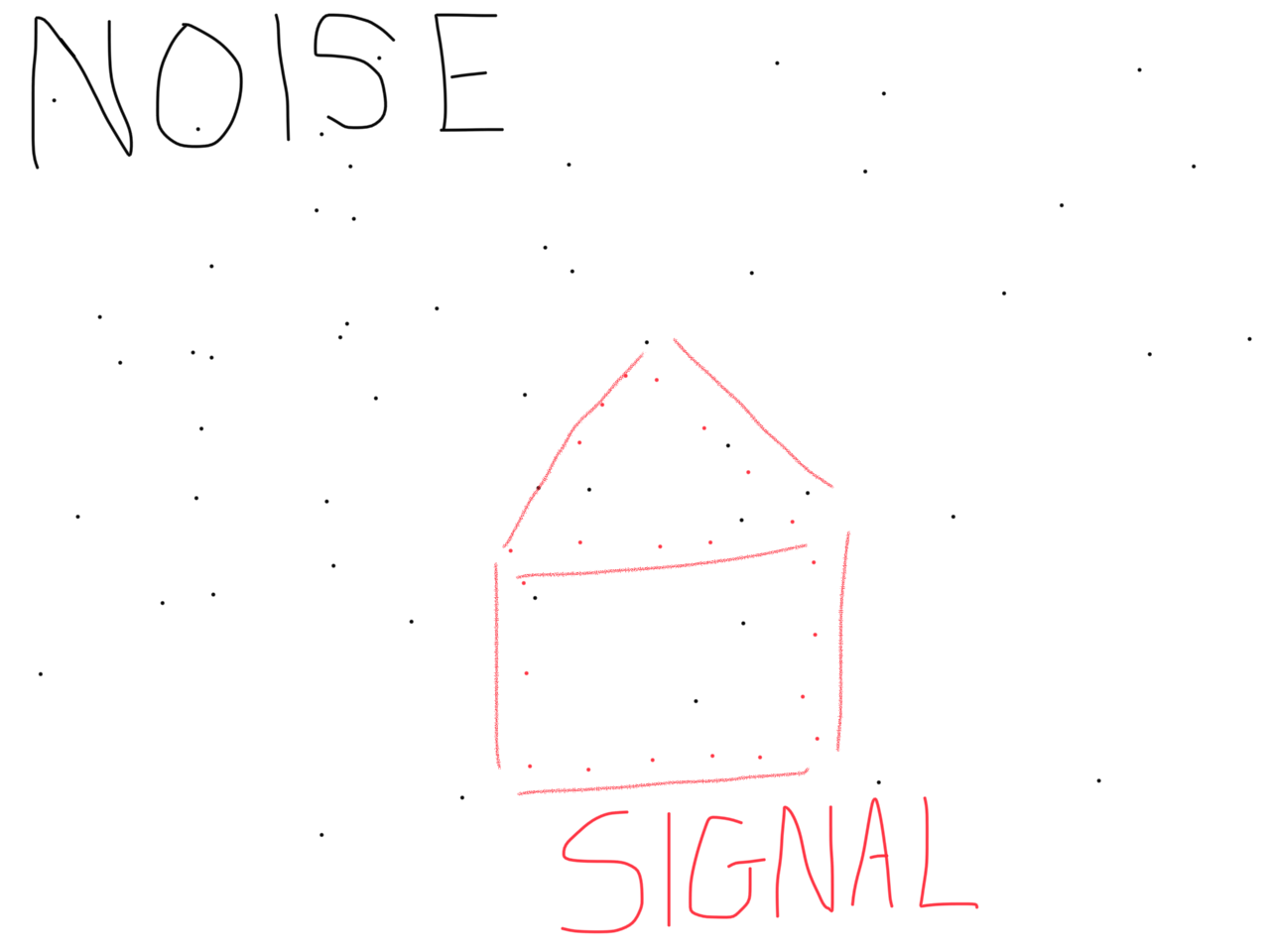
Finding the signal in the noise is like finding secrets. Successes come from finding truer things.

  • Morgan Housel points out long-term vs expiring knowledge.
  • Economist Chris Blattman spoke about cumulative vs messy data.
  • Nate Silver gave us the signal and the noise.
  • Peter Thiel calls the good stuff ‘secrets’.

Whatever metaphor, the outcome is the same. If you can see the red house, you’ve got an edge.

Peta got his edge by building models. These were thanks to ‘standing on the shoulders of giants’, and Peta thanks them in the book. Constructing a model is like building a snowman. Gather as much raw material as you can and start to put it together based on what you know. “Resources plus skill,” wrote Peta, give you an advantage.

But a pile of snow isn’t a snowman and data isn’t a model. Peta tinkered. One recurring mistake was small sample sizes. “In general, anomalies are more likely to show up in small samples,” wrote David Levitin.

Peta found “cluster luck.” If a team had especially good results with runners on base, they had cluster luck. He knew it was luck because the results didn’t repeat. He created his own two-jar model.

It turns out that some things in baseball are skill based and some rely more on luck. Hitting home runs is more skill. Hitting doubles is more luck. Starting pitching is more skill. Relief pitching more luck and is so variable that the most accurate predictor is to assume the league mean for every team.

Starting with the base rate of the previous season’s results and making adjustments because of luck (clustering, relief pitching), Peta had a model. Now it was time to head to Las Vegas.

Once Peta started, there were five things he kept in mind. Summed up in one quote it was this:

“It’s very difficult for most people, even many professional traders, to invest in an outcome they don’t think is going to happen. It’s impossible to be an options trader with this mindset.”

  1. Win money, not hands. The aim wasn’t to be right most often, it was to make money on his bets.

  2. Don’t implode. No single bet should imperil the capital. Peta saw Lehman Brothers failed and fell because they floundered here.

  3. Check the engine, do routine maintenance. Each month he checked the model to see what worked and what didn’t. He didn’t want to become the ball player who attributed to skill what was actually luck. As the season went along he increased the reliance on current stats and decreased the emphasis on starting ones.

  4. Don’t get behind. There is a psychological burden – in betting baseball futures and making trades – when you get behind and have to make up a difference. Peta quotes Warren Buffett in the book, but not this line, “Rule number one, don’t lose money. Rule number two, don’t forget rule number one.”

  5. Don’t forget life. Peta compares life’s ‘tops’ to market tops. No one rings the bell at the top of the market (one of the Buffett quotes) and no one does it for your life. You don’t get an alert on your phone that this is the last time you read a book to your kids. Remember that too.

Rather than my review, here’s the blurb from Tyler Cowen on the back of the book:

“Joe Peta has a wonderful story to tell and precious insights into the evaluation of talent, investments, and risk. This is a great book for anyone with capital to allocate. But if you love baseball half as much as Peta does, you will find Trading Bases absolutely irresistible.”


Thanks for reading, I’m @mikedariano.

*Actually he got hit by an ambulance.

Alton Brown

Supported by Greenhaven Road Capital, finding value off the beaten path.

The Alton Brown podcast with Brian Koppelman was right up my alley. Brown said he gets thanked most for making a show that the entire family could watch without anyone getting bored. I agree.  But mine and Koppelman’s affection aside, Brown has some good lessons for us. Ready?

In college, Brown spent a semester in Tuscany. There he had a see it to believe it moment with pizza.

Screen Shot 2017-07-12 at 11.32.36 AM.png
Cortona Italy

“Off on the edge of this town was a gypsy guy that lived in a hut and he had a little wood fire oven and three little busted up tables outside his place. You went and he made pizza. You didn’t order it. It was whatever the heck it was he was making. He would put it down and you would put down money, and he would take some money. There would be some wine and that was it. This pizza was misshapen and there was nothing on it but olive oil, shaved Parmesan cheese, and baby artichokes. It was transformative. In that one slice of pizza I became culinarily awake.”

Joe Rogan said this happened to him when he saw Richard Pryor. We just need a glimpse, a smell, a taste. Oh, I didn’t know about this!

Brown finished school and got a job. He told Koppelman, “it wasn’t like I was working in an oil field waiting to find a chunk of gold.” So when he heard that R.E.M would be returning to Athens Georgia to make a new video at a studio they used Brown got a job at the studio. He piddled around for a few months, and the band showed up.

They made this:

The song (and video) were a success and Brown’s career was off. No, no, no, it’s never like that. Rather, Brown’s experiences led him to ten years of filming commercials and working for others. Eventually, he got the chance to make Good Eats.

His idea congealed when another episode finished and he hadn’t learned a thing. Brown wanted to make something that was different. Thanks to Brown’s ideas, his experiences with a single camera, and occasional fanaticism, the show started to form in his head. “The mission statement was a mix of Mr. Wizard, Julia Child, and Monty Python,” said Brown.

Scott Norton was different with a ketchup brand. Brian Chesky was different with Airbnb, “it felt like the world was laughing at us,” said Chesky. Casey Neistat‘s one piece of advice to aspiring YouTubers is to be different.

Brown’s idea was different, but ideas without execution don’t mean a thing and execution required money. Brown traded his career capital for cash. In those ten years of work between The One I Love and Good Eats, he built skills and relationships. Like casino chips, he exchanged one asset for another. This is a key part of Cal Newport’s work and he wrote that rare and valuable jobs require rare and valuable skills.

With money in hand, Brown was on his way out the door when his backers say, oh, yeah, and we want you to be the host. Huh, said Brown. “I was so used to identifying myself as a behind the camera director that I did not see myself in front of the camera.”

Brown stars. The show gets made. Success ensuses. No, still not yet.

Brown stars. The show gets made. Crickets chirp. Yes, that’s betters.

Brown waits. He does other work.  He told Koppelman that he should have kept working on the show. He could have written more. He didn’t. Why not? Fear.

“I don’t want to have that level of hope. Should I be the guy that’s sitting down writing these scripts? No. Not until I know. This ended up being a very stupid decision…It’s almost like it’s going to hurt too much. If I let it out. If I do all this work and it doesn’t happen, then I suck even worse than I suck already…It’s building the Frankenstein monster and he won’t come to life.”

Thanks to a lucky break because of Kodak film and a Food Network executive surfing the internet, Brown’s show is purchased. Now he really needs to get to work. He wrote and cooked. The show grew. He bought a studio. They did more. Brown said that people still come up to him and ask how they filmed certain parts.

As the show grew from infancy (let’s just keep it alive) to adolescents (let’s push some boundaries) Brown would get lost. His crew created a safe word where they would call his wife and explain that Brown was making Faberge eggs when he was supposed to be making deviled ones.

This was an interesting transformation. Before the show was ordered Brown did almost any work but as the show took root he pruned it with a Bonsai intensity.

What’s kept him going was curiosity “the most powerful force on the earth,” said Brown.

Jill Lepore said she had a moment like this when she was researching children’s literature.

“And I was shocked. I really was shocked. And I was staggered that these histories of childrens literature couldnt even identify the story. I got really interested in that question, and I did what I do when I get a little too curious about something, I become obsessive about finding out everything that could possibly be found out.”

As Lepore notes, this isn’t superficial curiosity. This is I feel this in my bones curiosity. Elizabeth Gilbert explained why:

“The tricky bit is starting from a place you are very curious because in six months it’s going to feel very boring and tedious because making things is very boring and tedious. Another idea is going to come along very seductively and do the dance of the seven veils in the corner of your studio and say ‘I am a much more interesting, much more exciting idea.’”

It helps to be curious when you don’t know it all. “I no longer want to be the smartest person in the room,” said Brown, “The best thing is the be the dumber person – which doesn’t mean you’re dumb – but the real thrill is to be around and learn things from the smarter people in the room. I want to be the weak link in the chain. I want to fight to keep up with the brilliance of everyone else.”

Curiosity and catching up require a checked ego. This is a dichotomy. You don’t know it all, but you think you can.


Thanks for reading, I’m  @mikedariano.