Sam Hinkie

Supported by Greenhaven Road Capital, finding value off the beaten path.

People don’t want quarter-inch bits, wrote Theodore Levitt, they want quarter-inch holes.

Readers don’t want blog posts, they want knowledge that leads to action. There were 6 things I think Sam Hinkie did well as General Manager of the Philadelphia 76ers.

  1. Be different but don’t start from scratch.
  2. Find helpful base rates.
  3. Get information by being there.
  4. Have the longest view in the room.
  5. Use inversion.
  6. Argue well.

On April 6, 2016, Sam Hinkie’s resignation letter from the Philadelphia 76ers was released. I read it. I was hooked.

The letter explained the how and why of his decisions. It explained the theory behind the actions. This is good. While actions are domain specific, theories are agnostic.

Hinkie’s letter itself is evidence of the theories he writes about. In a world where skill and luck both influence results it’s better to build good processes than focus on good outcomes. If you subscribe to that you also have to be willing to be wrong but for the right reasons. That’s what happened to Hinkie. You have to be willing to fail unconventionally. That happened to Hinkie too.

We won’t let Hinkie’s sacrifice be in vain. Let’s look at how Hinkie was different.

“If you want to understand the entrepreneur, study the juvenile delinquent. The delinquent is saying with his actions, ‘This sucks. I’m going to do my own thing.’” Yvon Chouinard

If you want to succeed beyond your peers you have to be different from your peers. This requires the skill and persistence to see things others miss, do things others won’t, and argue well.

The NBA, unlike many other industries, is zero-sum. If one team gains a win, another loses one. It’s a pie that never grows. Hinkie realized this:

“A competitive league like the NBA necessitates a zig largely in an effort to stay true to the idea of having the longest view…A league with 30 intense competitors requires a culture of finding new, better ways to solve repeating problems.”

You can’t just be different. It’s different to stay in a burning movie theater. It’s different to sell milkshake mixed drinks. It’s different to only sign short players to an NBA team. Those things are all different, but they’ll all fail. To succeed you must be different and you must be right.

Hinkie knows this and wrote, “We should attempt to gain competitive advantages that had a chance to be lasting, hopefully, one unforeseen by enough of our competition to leap from them from a seemingly disadvantaged position.”

Not only does Hinkie want to be different, but he wants to be different in a sustainable way. If Hinkie tried to build Golden State Warriors East he would fail because he’d never be better than the original.

Warren Buffett addressed this at the 2016 Berkshire Hathaway annual meeting. “We don’t look at something like that (Amazon) and try to beat them at their own game. They’re better than we are at that, and we aren’t going to try to out Bezos Bezos,” said Buffett.

Be different, but don’t start from scratch

One mistake is to be different from everything. That doesn’t work. There are some things that work. Hinkie wrote:

“Whenever possible, I think cross-pollinating ideas from other contexts is far, far better than attempting to solve our problems in basketball as if no one has ever faced anything similar…. Get back on defense. Share the ball. Box out. Run the lanes. Contest a shot. These things are real and have been measured, precisely or not, by thousands of men over decades of trial and error.”

Rather than, ‘blow it up’ or ‘start fresh,’ a leader should question why things are done one way and not another. A story about fences articulates this.

In The Thing, G.K. Chesterton wrote:

“There exists in such a case a certain institution or law; let us say, for the sake of simplicity, a fence or gate erected across a road. The more modern type of reformer goes gaily up to it and says, ‘I don’t see the use of this; let us clear it away.’ To which the more intelligent type of reformer will do well to answer: ‘If you don’t see the use of it, I certainly won’t let you clear it away. Go away and think. Then, when you can come back and tell me that you do see the use of it, I may allow you to destroy it.’”

Only after consideration should we remove something. Gregg Popovich knows this. For ‘Pop’ the pregame shootaround was a fence that needed to be torn down. Popovich said: “I just think it was the modus operandi for every organization. It was a habit. It was what everyone did. If you didn’t do it, you were recalcitrant or you weren’t doing your job.” There is career capital risk if you do something different and fail. Pop continued:

“Some owners would look and say ‘Why aren’t you doing a shootaround?’ If you were a young coach, you have to have a shootaround because you’re doing what you have to do. And, basically, half of them are total crap – a total waste of time….In general, shootarounds could be kaputskied.”

The pregame shootaround began in 1972, a different basketball era. Popovich noticed how much things have changed in forty years and stopped doing it.

“To do science is to search for repeated patterns.” Robert MacArthur

David R. Oliver was a nuclear submarine commander who found a Chesterton fence knows as “Condition Baker.” Condition Baker was a surfacing maneuver for diesel submarines. These subs needed to surface to recharge their batteries and bring on oxygen. Due to a limited range, these subs often surfaced in shipping lanes. Condition Baker was an order to partition off the sub in case of impact. If a surface ship sheared the sub only some compartments would flood and the ship would remain buoyant. It made sense.

As the United States Navy became nuclear, Condition Baker wasn’t needed. Nuclear subs rarely surfaced in shipping lanes and did so only a fraction as often, but submariners still ordered the maneuver.

Oliver was running a battery charge one day when Condition Baker was ordered and he realized the danger. His compartment required cooling airflow and during the maneuver, that air flow stopped. Baker was to make the ship watertight. It was to do exactly what Oliver didn’t want to happen. If cooler air didn’t get into his section, the entire submarine might explode.

Oliver didn’t explode, and he took his intact self to his commanders and pointed out that they didn’t need to do this anymore. Eventually, nuclear submarines stopped doing this. The fence was cleared away.

How do you do this? How do we figure out when not to ‘reinvent the wheel’ and when to clear away the fence? If it were obvious and easy you wouldn’t be here and Hinkie would still be in Philly. It’s not easy, but there’s an easy place to start, with base rates.

Base rates

The base rate is what happens in similar situations. The base rate for summer weather is warm with a blue sky. The base rate for dinner out is $60. The base rate of investment return is 3.5%.

Of course, there are exceptions. It can rain in the summer and dinner at Walt Disney World will be more expensive. Base rates help us figure out what to expect and then, how much we can change the situation. Weather is out of my control, dinner is not.

Hinkie started with the base rate from day one. He told Zach Lowe that during his interview for the job he asked the ownership group what their goal was and then found similar situations for how to achieve that. Hinkie said:

“One of my big things is to survey base rates any time you can. You go back to facts whenever you can. You go back to finding what has worked. Often things have changed…but at the same time, you should be starting with some base rate. What does this look like? What did these (championship) teams have in common? Where was the value driven from?”

Lowe asked what are the odds that their draft pick Joel Embiid becomes an all star. Hinkie goes back to base rates, and says, “we don’t know.” It depends on Embiid’s skill ceiling and ability to stay healthy.

Lowe asked about free agency too, and Hinkie returned to base rates. Assume the base rate of success for free agents is five percent, Hinkie tells Lowe. “If it’s five percent – you should be expecting to look at twenty or so to find one of those. The hit rate is not fifty.”

“You have to turn over a lot of rocks to find those little anomalies. You have to find companies that are off the map — way off the map.” Warren Buffett

When Hinkie notes base rates for teams that win championships, rookies who become stars, and free agents who succeed, he’s looking for what works and how often it does. Hinkie wants to find the ‘right’ part of ‘be different and be right.’

In Michael Lewis’s book, The Undoing Project, Lewis explained the base rate as, “What you would predict if you had no information at all.” Sometimes this is all you need. Daniel Kahneman – the book’s subject – summed up his findings for Lewis and explained:

“When no specific evidence is given, the prior probabilities are properly utilized (people use the base rates); when worthless specific evidence is given, prior probabilities are ignored.”

Knowing this and doing it are two different things. It’s hard to use the base rate because we think we are so smart.

“I used to think that the brain was the most wonderful organ in my body. Then I realized who was telling me this.” Emo Phillips

One misstep is to favor the visual over the mathematical.

When David Quammen was tromping around the south Pacific to research his book The Song of the Dodo, he wanted to know why certain animals lived on some islands and not others. One such subject was the Komodo dragon. Quammen’s first exposure was at a feeding at the Komodo National Park. It was a sight. The tourists, which includes Quammen, gather in a fenced enclosure (for their safety) and the animals enter. Quammen wrote:“They walk high on their legs with a steady, surging stride. They surround the corral. Expectant but calm, they pose obligingly for everyone’s camera.

“They walk high on their legs with a steady, surging stride. They surround the corral. Expectant but calm, they pose obligingly for everyone’s camera. They nose up to the fence like puppies. This calmness, combined with their pleasant, old-boot faces, is misleading; they appear amiable and harmless.”

Then “the goat carcass suddenly flies overhead,” and the animals feast. “They stir up one hell of a ruckus,” Quammen wrote. Once the goat is gone – Komodo dragons eat everything – they “splay out onto their bellies…content for the moment.”

Quammen, unlike the dragons, isn’t content. He hires a guide to take him through the jungle. He’s studied the animal. He knows that it tops out at about ten feet in length, but that people who see it overestimate the size. Quammen knows the numbers, yet he encounters one up close, and:

“Exactly how big is it? I couldn’t say. If not for the likelihood that I’ve been deluded by its aura of power and strength, I would tell you twelve feet, maybe fourteen, roughly four hundred pounds.”

David Quammen knows it’s not fourteen feet. He’s read books about how people think it’s that big, but the base rate is otherwise. And yet, here he is, thinking well past the base rate.

To outperform in any domain, but particularly in a zero-sum environment, you will need to do things differently from others. That said, don’t go overboard and ignore tried and true methods. Find relevant base rates and when you come to a Chesterton fence ask why it was put there in the first place.

Be there

Hinkie didn’t start from scratch, but he did need to find an edge. One way is to go where others don’t.

As basketball follows baseball deeper into data analysis, it’s good to remember that computers can’t do all the work. In his interviews, Hinkie is quick to prove his basketball knowledge. Part of that comes from seeing a lot of players. He wrote:

“There is so much about projecting players that we still capture best by seeing it in person and sharing (and debating) those observations with our colleagues. What kind of teammate is he? How does he play under pressure?”

Hinkie’s former boss, Daryl Morey, told Michael Lewis that being there was something he initially undervalued. Morey was an early adopter of analytics in basketball, and like many innovators, his early model was good but needed work. Lewis explained that Morey missed DeAndre Jordan who had “grown up in Houston under the noses of the Rockets scouts.”

That didn’t mean that Morey went ‘Office Space’ on his models and hired a flock of scouts. No, he adjusted the focus of the model and the scouts. Lewis wrote, “Models were bad at knowing that DeAndre Jordan sucked his freshman year in college because he wasn’t trying.”

Being there gives you an advantage – a way to be different – because you see things other people don’t see.

Samuel Zemurray built the largest banana business in America because he understood every detail. Zemurray began by buying the ‘ripes’ – bananas with one or two spots – from ships docking in New Orleans. Those bananas were worthless to the importers because they wouldn’t last through transport to the northern states.

For Zemurray, they were perfect. On his first foray, he spent his savings on a load of bananas and part of a boxcar. Zemurray road the rails north through the south and built relationships as he went. Soon he had each train station calling ahead to the next to announce that the banana man was coming.

Zemurray succeeded and got deeper into the banana business. He bought a boat, then two. He scouted plantations in Central America. He dealt with governments. He lived and breathed bananas. In the wonderful book, The Fish That Ate the Whale, this is what Rich Cohen wrote about Zemurray:

“Zemurray worked in the fields beside his engineers, planters, and machete men. He was deep in the muck, sweat covered, swinging a blade. He helped map the plantations, plant the rhizomes, clear the weeds, lay the track. He was a proficient snake killer. Taller than most of his workers, as strong and thin as a railroad spike, he shouted orders in dog Spanish. He believed in the transcendent power of physical labor – that a man can free his soul only by exhausting his body. A life in an office, desk bound, was for the feeble and weak who cut themselves off from the actual. He ate outside – shark’s fin soup, plantains, crab gumbo, sour wine. His years in the jungle gave him experience rare in the trade. Unlike most of his competitors, he understood every part of the business, from the executive suite where the stock price was manipulated to the ripening room where the green fruit turned yellow. He was contemptuous of banana men who spent their lives in the North, far from the plantations. Those schmucks, what do they know? They’re there, we’re here!”

That passage excites me each time I read it. It’s a reminder to get out of the office and feel the winds of the real world. Andy Grove gives this advice too.

Grove wrote that leaders tend to be insulated from the real world. Middle managers are filters and sometimes the wrong information gets filtered out. There is value in some of this information. Grove wrote, that middle management, “usually know more about upcoming change than the senior management because they spend so much time ‘outdoors’ where the winds of the real world blow in their faces….I feel much safer back here in California than he does in ‘enemy territory.’ But is my perspective the right one? Or is his?”

The first job Tim Ferriss had out of college was with a software company. He was in sales. The job was okay. He was employed in technology during the late 1990’s, what could go wrong?

Ferriss often ate lunch with the engineers and started to notice something. They would talk about an upcoming software release and told him there was no way it would be done on time, under budget, and as expected. Those engineers knew before anyone else that the company wasn’t going to make it. Knowing this, Ferriss started his first side business. Soon thereafter he was let go but he had a side business to support him.

For another example, let’s return to the Caribbean. We’ll head east from the banana plantations to the island of Haiti to meet Dr. Paul Farmer. Farmer is an amazing man; Harvard graduate, best-selling author, charity founder. Did I mention a MacArthur fellow? Part of the reason Farmer succeeds is that he has better information. How? Farmer spends half his time in rural Haiti.

Farmer’s fascination with the country started when he was a Duke undergraduate and met some Haitian workers. Then he went there. He worked in the poorest parts of the poorest country in the western hemisphere. What he saw didn’t click. Haitians infected with tuberculosis or HIV didn’t fit the pattern taught at Harvard. That theory assumed that people infected with TB/HIV engaged in ‘high-risk behaviors.’ They were intravenous drug users and had multiple sexual partners at the same time.

Bullshit thought Farmer. He had been to Haiti. He walked the streets, he drove the roads, he served the people. There wasn’t enough money in Haiti for anything, much less for drugs. He also saw that the people he treated didn’t have multiple concurrent sexual partners. Sequential ones, yes, concurrent ones no.

The real cause, Farmer discovered, were truck drivers and military officers. Those two semi-stable jobs attracted women. Those men were the hub on the wheel of infection. So Farmer thought, how do you keep women away from those men?

Well, why were they there in the first place? The answer was jobs. The answer was money and security. If you gave women those things they’d be less likely to seek them from the men. That’s what he did. Farmer had to be there to find this out.

Just like ‘starting from scratch’ takes ‘be different’ to an extreme, being there can be taken to extremes as well. This happens if you get lost in the weeds.

Jocko Willink recalls one of his early training sessions with Leif Babin. The two Navy SEALS were in preparation for deployment and Willink asked Babbin about leading an assault. Babin said he led from the rear and Willink asked how that worked for getting information and giving orders. Not great, said Babin. It took time for information to travel back to him and equally as long for an order to travel back. Babin needed to be more forward.

But not all the way. Babin’s role wasn’t to knock down doors, clear rooms, or take prisoners. His job was to lead. That meant a balance between collecting information from the front and understanding the entire situation.

Being there is one way to be different. Note that each example took moderate, not complete steps, toward this. Babin moved up in the assault column, but not to the front. Farmer doctored in Haiti, but was educated and still works at Harvard. Daryl Morey created a model, but adjusted it and relies on plenty of humans.

Being there reveals information that can differentiate you. Like most things, don’t get stuck in the weeds or see the trees and not the forest.

Long-term horizons

“To take the long view,” Hinkie wrote, “has an unintuitive advantage built in – fewer competitors.”

If “Trust the process,” wasn’t the slogan for Hinkie’s strategy “The longest view in the room,” might have been.

We see this in how the 76ers got players. They didn’t get the best players of 2014 or 2015 or 2016. Their strategy was to have the best players of 2020 – and beyond. Trading down in the draft did this. Choosing young foreign players did this. About Dario Šarić, Hinkie wrote:

“Dario is a 6-10 forward with a guard’s skills and a big’s toughness. Twice voted as FIBA European Young Player of the Year, we were in a position to draft him in part because he required something you’ve had in ample supply: one part courage, two parts patience.”

Not only is Šarić young, but because he plays in Europe he doesn’t occupy a roster spot. He’s an asset the 76ers didn’t have to immediately pay or play. Hinkie was one of the few who planned to win in 2020 and there was less competition for that.

If you listen to sports talk radio you’ll hear a lot of hyperbolic discounting. That means that people favor the present – by a lot, well more than what they think. We’d all take $100 today rather than next year. That makes sense. Situations become more nebulous when it’s $100 today compared to $120 next year. In broad strokes, this is what Hinkie attempted. He observed the need for some teams to ‘win now’ because their ‘window was closing.’ Hinkie tried to collect options for $120 in the future. In the NBA that goes by the name ‘pick swaps.’ Hinkie accumulated a lot of these future options. He wrote, the 76ers accumulated:

“more than 26 new picks or options to swap picks over and above the two per year, the NBA allots each club. That’s not any official record because no one keeps track of such records. But it is the most ever. And it’s not close. And we kick ourselves for not adding another handful.”

A lack of long-term thinking can hamstring our future selves. Have you ever financed a car for 60, 72, or 84 months? (Don’t shake your head, I checked, 84 months is a real option). Those plans sound great when you sign and drive off the lot in a new car. Four years in and your net worth still dawdles along and the truck has lost its shine. Distant finish lines – choosing $120 later over $100 now – requires discipline. Investors know this.

Peter Lynch said, “Everyone in the room is a long-term investor until the stock market goes down.”

“As much as hedge funds talk about being long-term owners, it is ultimately an aspirational sentiment,” wrote Jeff Gramm.

Let us pause again and note the other side of this argument. Much like starting from scratch and being there, a long-term obsession goes too far. In More Than You Know Michael Mauboussin wrote, “there is a tradeoff between the short-term and the long-term, and the appropriate focal point shifts as conditions warrant.” Mauboussin compares it to driving a car. Both the distant destination and immediate conditions are important.

“The secret to great success in business is to choose competition that’s not very good. The same thing works in sports, it works in lots of different things.” Charley Ellis

The value of long-term thinking is that it allows you to be different in the future. How many other teams will be competitive in 2020? Hinkie tried to get to a place where the competition wouldn’t be as good because few others were doing that. Long-term horizons are one way to solve the ‘be different’ challenge. Another way is to invert the question.

Inversion

Some problems are very difficult.

  • How do you have a happy marriage?
  • How to run a business?
  • How do you win more games?

Each question has many possible answers. Some lead to more questions. It can be endless. What can help more is asking the opposite.

  • How do you fail at marriage?
  • How do you fail at business?
  • How do you lose more games?

Inversion is to answer those questions, and then do the opposite. Hinkie knows this, and wrote, “What basketball axiom is most likely to be untrue? Take it on and do the opposite.”

Inversion is a great tool for problem-solving and some of the best leaders demonstrate this.

One of Bill Belichick’s first jobs in the NFL was to coach offensive players. This was not what Belichick hoped or expected – but it was incredibly valuable. David Halberstam wrote:

“Though Belichick’s instinct was to coach defense – it was where he was pulled as if by some kind of magnetic force – he was also beginning to understand that if you were going to coach defense, you had to master the offense as well, otherwise you were only half a coach.”

Years later, after coaching offense and defense, Belichick was running laps around the football field with fellow coach Ernie Adams and he was amazed that more coaches didn’t know both sides of the ball. “And he would tell Adams,” Halberstam wrote, “that he did not understand how some of the other coaches in the League had decided they were only going to understand one side of the ball….it absolutely amazed him.”

Belichick solved problems with inversion. He thought about how to stop a player and then reasoned how to not. He knew the opposite because he had coached it. Former colleague Mike Lombardi said:

“One of the adages Belichick always subscribes to is called the inverse theory by Charlie Munger. Instead of saying, ‘What will it take to win?’ you ask the question, ‘What can we do to avoid losing?’ and Belichick always takes that approach.”

“If you want to understand something, take it to the extremes or examine its opposites.” John Boyd

In his own words, Munger said, “Many hard problems are best solved when they are addressed backward.”

Investor Mohnish Pabrai has studied Warren Buffett and Charlie Munger and has his own stellar investment record. In a talk at U.C. Irvine, Pabrai explained the inversion strategy of Coca-Cola. Part of Coke’s success, said Pabrai, was because they used inversion. Instead of asking, ‘how do we succeed?’ They asked, ‘how do we fail?’

Failure would come from a loss of market share or brand erosion. To prevent the latter, Coca-Cola offered their vendors coolers, umbrellas, and everything short of a living room set in Coca-Cola red. To prevent the former, they tried to never leave a country. When American forces moved through Europe in World-War-Two, Coca-Cola men were in the vanguard to support the troops and re-enter markets.

Inversion works because knowing what not to do is sometimes more valuable than knowing what to do.

Argue well

Good organizations argue well. There must be a way to have constructive, balanced, combative conversations without ego, empire building, or ad hominem attacks. Organizations that do not do this will fail because some truths need to be excavated by the spade of argument and the rake of curiosity.

Hinkie wrote, “We talk a great deal about being curious, not critical.” Curiosity is important because we don’t always know what to do. Hinkie wrote, “Sadly, the first innovation often isn’t even all that helpful, but may well provide a path to ones that are.”

If we knew what to do, we would just do it. Building an NBA team is not easy, so we need to be curious. We need to be like filmmaker Brian Grazer, who wrote:

“I worry, for instance, about becoming complacent—I worry that out here in Hollywood, I’ll end up in a bubble isolated from what’s going on in the rest of the world, from how it’s changing and evolving. I use curiosity to pop the bubble, to keep complacency at bay.”

Grazer uses curiosity to figure out what to do – in his case, tell good stories. In his book, A Curious Mind, Grazer explained his system for curiosity; pay attention to the answers and be willing to act.

Grazer schedules curiosity. His assistant arranges regular meetings with people he’d like to meet. There is no agenda, no film plans, no alternative motive. Grazer is there to learn. Each conversation is a node in a network, like a star in the sky. Only with connections do we make constellations. Here’s what Grazer wrote about making Apollo 13:

“My conversation with the astronaut Jim Lovell certainly started me on the path to telling the story of Apollo 13. But how do we convey, in a movie, the psychology of being trapped on a crippled spaceship? It was Veronica de Negri, a Chilean activist who was tortured for months by her own government, who taught me what it’s like to be forced to rely completely on oneself to survive. Veronica de Negri helped us to get Apollo 13 right as surely as Jim Lovell did.”

A bonus to all this, Grazer wrote, “curiosity is free.”

Curiosity means to pull on a string and see where it leads, and be open to the idea that it may lead nowhere. “There has to be a willingness to tolerate counterarguments,” wrote Hinkie. This doesn’t mean disagreement for its own sake. It means finding a way to be different. Here are three ways to argue well.

1/ Counterfactuals

Counterfactuals are outcomes that could have happened but did not. A roulette pill may land on red three but any other number – red seven, black thirty-five – was just as likely. Problems begin when we forget this. We mistake the thing that happened was the only thing that could have happened.

Hinkie’s strategy was to collect draft picks and accumulate salary cap space. Some people thought this was wrong. They thought he should sign veteran players. Maybe. Maybe not.

In the summer of 2010, the Miami Heat signed LeBron James and Chris Bosh. They joined Dwyane Wade and a good roster. That group would appear in four consecutive NBA finals and win two of them. That’s a model some people thought Hinkie should follow, but let’s ask ‘What else could have happened?’.

Zach Lowe did and Hinkie said:

“They (Miami) pulled it off, and I bet there are only a few people on the planet who could do that, Pat Riley being one of them, but let’s not forget there were a whole bunch of other teams that year trying to do the same that failed; Chicago, New York, New Jersey, the Clippers that were all trying to do the same thing.”

Add Dallas to that group. That team has tried to get a second superstar to play with Dirk Nowitzki. They failed too and that situation is fantastic. It’s a well-run team with a good coach in a major city and they’ve failed to ‘pull off’ the kind of deal that some suggested for Hinkie.

Hinkie’s team was bad. The process has been difficult. There is a real stress to this. But different actions don’t guarantee a different outcome. “Counterfactuals are hard because we don’t think about what is on the other side,” Hinkie said, “What if we had done nothing; How many games would we have won?”

2/ Avoid hindsight bias

Please sit down for this. Okay. Ready? People remember more of the things they got right and less of the things they got wrong. The only reason I step onto a golf course is that of hindsight bias. I remember the good shots and forget the bad.

This idea comes home with us from the 19th hole. We tend to misremember things in our favor. Hinkie said they developed a system to row against this current.“You should have been trying to get the draft order right. Not just the one or two that popped up like whack-a-mole. You should be trying to get them all right, even the ones you couldn’t have picked, didn’t pick, the ones you never got an opportunity to pick – that doesn’t matter. What matters is your actual board and what that looked like. We go back a lot. We talk internally a lot and create a lot internal discussion with our staff and owners alike and redraft.”

“You should have been trying to get the draft order right. Not just the one or two that popped up like whack-a-mole. You should be trying to get them all right, even the ones you couldn’t have picked didn’t pick, the ones you never got an opportunity to pick – that doesn’t matter. What matters is your actual board and what that looked like. We go back a lot. We talk internally a lot and create a lot internal discussion with our staff and owners alike and redraft.”

Redrafts are a chance to remove hindsight bias. You can’t say you knew so-and-so was a bust if he was high on your draft board. You don’t get to cherry-pick your decisions, said Hinkie. These kinds of reviews need to be baked in. This means regular reviews and writing things down.

3/ Red teams

No single person knows all the answers. Red teams are often a strategy for good arguments. Hinkie said they would:

“Divide into two groups and you guys argue for and you folks argue against. I’m in for that kind of stuff, I’ve always been in for. I’m not in for the opposite. The way you make a decision is to collect as much information as you can and weigh it as properly as you can.”

Groups are good because they spread blame and reward. It’s hard to empire build when you’re part of a group. At his venture capital firm, Marc Andreessen says he always takes the opposite side of his partner, Ben Horowitz. Why? Because you don’t want people siding with the boss because he’s the boss. Andreessen said:

“It’s the responsibility of everybody else in the room to stress test the thinking. If necessary we’ll create a red team. We’ll formally create the countervailing force and designate some set of people to counter argue the other side….Whenever he (Ben Horowitz) brings in a deal, I’ll trash the shit out of it.”

That’s what good red teams do

“A good scrap….brought out new ways of looking at things… it helped round the corners.” Wilbur Wright

Red teams are part of the culture at Amazon too. In his book about the company, The Everything Store, Brad stone wrote, “Amazon’s culture is notoriously confrontational, and it begins with Bezos, who believes that truth springs forth when ideas and perspectives are banged against each other, sometimes violently.”

Counterfactuals, avoiding hindsight bias, and red teams are three ways to argue well. Good arguments exhume truths.

Discomfort

It’s one thing to read this, another to do it. All this ‘tawk’ about being different, arguing well, inversion, and being there are good strategies but not easy ones. Hinkie wrote, “But to call something that could be wrong (‘failed draft pick’) right (‘good decision’) makes all of our heads hurt, mine included.” And, “Seth Klarman talks about the comfort of consensus. It’s much more comfortable to have people generally agreeing with you.”

“I lost twenty pounds from stress,” Hinkie told Lowe. “It’s not easy emotionally. It’s not easy for everyone to go through. It’s not easy when you struggle in the standings.”

In addition to outside force are mental obstacles too. We tend to equate ‘this is hard’ to ‘this is bad’ and we do it without even knowing it. Daniel Kahneman explained this in Thinking Fast and Slow:”When you are in a state of cognitive ease, you are probably in a good mood, like what you see, believe what you hear, trust your intuitions, and feel that the current situation is comfortably familiar.”

“When you are in a state of cognitive ease, you are probably in a good mood, like what you see, believe what you hear, trust your intuitions, and feel that the current situation is comfortably familiar.”

Kahneman noted that we lend more trust to things that are easy to digest. This means that easy to read fonts convey more meaning than we realize. It means that repeated ideas are more believable. It means simple words and rhyme are remembered more. Because Hinkie was being different he had to fight against the association that he was wrong.

It’s difficult to be different in the NBA. After his resignation, Hinkie was interviewed by Chris Ballard for Sport’s Illustrated. Hinkie said that the Silicon Valley culture was quite different:“When I meet someone out here, I’ll say, ‘I’m kind of between gigs,’ Or, if I’m being cute, sometimes I’ll say, ‘Oh, I’m like a founder that got pushed out for professional management,’ and they’re like, ‘Oh, first time? That happened to me in ’85 and ’93 and ’02.’ There’s not the sense of shame for failure here that there is some other places.”

“When I meet someone out here, I’ll say, ‘I’m kind of between gigs,’ Or, if I’m being cute, sometimes I’ll say, ‘Oh, I’m like a founder that got pushed out for professional management,’ and they’re like, ‘Oh, first time? That happened to me in ’85 and ’93 and ’02.’ There’s not the sense of shame for failure here that there is some other places.”

The way culture accepts being different influences how people act. This is why Hinkie created a team culture that allowed for arguments and curiosity. A place with harsh conditions like the NBA is the Pentagon.

John Boyd is probably the greatest innovator you never heard of. Boyd was a fighter pilot in Korea. An instructor at the Fighter Weapons School at Nellis Air Force Base. An engineering graduate from Georgia Tech, and, for good measure, developer of the military tactic known as OODA loops.

None of this came easy.

Boyd, like Hinkie, fought the status quo. Difference means change and change means losers. Boyd’s fight cost him promotions and medals. The animosity wasn’t only for Boyd. The people who worked with him were guilty by association. When one returned from a brutal meeting Boyd said, “So you got your reward; you got kicked in the teeth. That means you were doing good work. Getting kicked in the teeth is the reward for good work.”

Being different is hard but necessary.

Thanks for reading, I’m @mikedariano.
Chris Blattman

Supported by Greenhaven Road Capital, finding value off the beaten path.

Chris Blattman joined Russ Roberts on EconTalk to chat chickens, cash, and development economics. The entire interview is good and we’ll highlight four parts.

1/ Decisions must weigh costs and benefits. The podcast begins with Blattman explaining his open letter to Bill Gates about the problems associated with buying chickens for people in poverty. Blattman and Roberts note that Gates is pretty smart and he likely understood the nuances associated with bringing a lot of chickens to one area.

Forget about chickens, but don’t rule them out, says Blattman. Maybe chickens are what people need. But we should experiment first.

2/ Experimentation works.  After hearing Scott Norton talk about ketchup I started to think about experiments as means to the better answers, not the best ones.

Investors do this when they rank choices from best to worst. Go long the choices at one end and short the other and – in the aggregate – you’ll do well.

Charles Koch (and others) have pointed out that experiments should be done with both a central and decentralized team. The people on the ground (those that talk to the customer) should bring ideas but so should the people detached from the immediate issues.

In our example of chickens that might mean talking to the women in a village but an ecologist too. If people won’t eat eggs or if a parasite will infect chickens then this is a terrible choice.

Plan all we want, we still need to experiment to get a better idea. Experiments also help because…

3/ Data is cumulative or not. In some fields data accumulates neatly; medicine, engineering, Newtonian physics. In other fields it’s messier; nutrition, quantum physics, macroeconomics.

Doing experiments gets us to an idea Michael Mauboussin wrote about this in The Success Equation. Mauboussin introduced the two-jar model as a way to think about situations.

In areas where randomness leads the dance, we will see things that fast mean reversion, randomness, and lots of variances. In areas with more guidable, we will see identifiable cause and effect and tight correlations of persistence and prediction.

4/ Change the person or the system? A person’s conditions (poverty, wealth, health, relationship) exist within a system. A finch can be genetically great but if there’s a drought it will die. Similarly, people can be the hardest workers but without the rule of law, they will fail.

Change can come top down with a system-wide change or bottom up at the individual. Top down sounds nice. Sweeping changes! But are difficult to get right. Judd Apatow told Joe Rogan about a peer who was drilling wells. After one installation the neighboring villagers invaded and took control of the well.

Gilbert Gall’s book about systems has many good lines about the top down approach. One of which:

“SYSTEMS RUN BEST WHEN DESIGNED TO RUN DOWNHILL More briefly formulated: AVOID UPHILL CONFIGURATIONS —or, in the vernacular: GO WITH THE FLOW”

The “THINGS YOU DO” (TYD) system runs a certain way for a reason. More sleep, fewer books, sweeter salty softer food all word because there are biologic rewards. To change the TYD system means changing the parts of it.

The other approach is to help the individual. This is what Blattman proposed. Give some people chickens, give others cash, and then see what happens.

Russ Roberts: That’s great. And I think Adam Smith would be happy about it. Maybe I’m wrong. I like to think of Adam Smith–maybe I’m romanticizing, which I am prone to–but I do think of him as open to the richer understanding of human activity than our sort of blackboard theories; and obviously was a student of many aspects of human life, not just the financial and monetary side.

Roberts and Blattman want people to roll around in the world. Maybe we need more chickens, maybe not. What we do need more of is people asking interesting questions – and following through with difficult answers.


Thanks for reading, I’m @mikedariano.

Charles Koch

Supported by Greenhaven Road Capital, finding value off the beaten path.

Charles Koch was on the Freakonomics podcast – Why Hate the Koch Brothers?.  Hate doesn’t preclude learning. Charles Koch does some things right, things we can learn from. Let’s look at three.

1/ Create good conditions to argue well.

“A critical part of our management philosophy is building a challenge culture. We find this is one of the biggest problems in acquisitions we make, in many of them if you challenge your boss it hurts your career. Here if you don’t challenge your boss …(because you see a problem in what’s being done)…if you don’t challenge you’re not really doing your job.”

“We partner with people and look for people who disagree with us on most everything…my philosophy on partnerships is you need three things; vision, values, and bring complementary capabilities.”

Challenge culture is great phrasing. Good organizations create the right conditions for people to argue well. Some of those conditions include.

  • Checking your ego at the door.
  • Not taking sides with a boss, or, splitting the bosses on each side.
  • An expectation for sound arguments.

Michael Mauboussin put it this way in his book More Than You Know, “A final dimension of learning is creating an environment where everyone in the organization feels they can voice their thoughts and opinions without the risk of being rebuffed, ignored, or humiliated.”

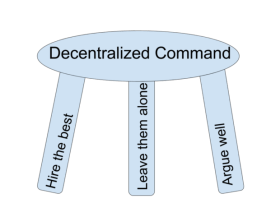
2/ The dichotomy of centralized and decentralized command.

“The way we look at it is that certain things need to be centralized,” Koch says it’s the people who can see how one business affects another. “But there are other things where the people at the plant have better knowledge…we’re very centralized on some things and decentralized on others. It’s not perfect. It’s a constant balance and rebalances and reworking and trial and error.”

The person pulling the lever should be the one with the best view.

SoulCycle has a certain process for building stores, training staff, and creating a brand. These are centralized decisions because one thing affects the others. They want people who go to a class in Texas to be familiar with the class in New York.

But the actual classes operate in a decentralized way. Melanie Whelan “Here’s the format for the class but you’re free to lead it however you’re inspired. What’s meaningful in Seattle is different from what’s meaningful in Coral Gables.”

3/ Systems or goals. When asked about his principles, Koch said that he tries to think in terms of principles rather than policies. Ideas like the division of labor, creative destruction, the rule of law, benefits of trade, earned success, and experimentation tend to work well.

Scott Norton also weighs ideas against principles rather than policies.

Systems work better than goals because they have flexibility. Seth Klarman said that rather than have a goal based approach (benchmarked returns in a specific sector) he uses a systems-based approach (no benchmark and investments in any sector).

This system approach is a process without silver bullet answers.

“Don’t get sucked into hubris, that I know all the answers,” said Koch. Better is to be “out here experimenting, fumbling around, trial and error, to try and find a better way.”


Thanks for reading. If I missed something you can let me know on Twitter @mikedariano.


Anastasia Alt

Supported by Greenhaven Road Capital, finding value off the beaten path.

Khe Hy interviewed Anastasia Alt on Rad Awakenings. It was good. This set of notes will be more rapid fire. All unattributed quotes are from Alt. Ready?

https://soundcloud.com/radreads/anastasia-alt-ep-5-the-business-school-of-the-world

1/ Your place defines your point-of-view. “I grew up in the New York City ecosystem where career is not something that people do but something people are.”

It’s difficult to see our system from the inside. On a bike ride, my daughter and I rode out into the wind. When we turned for home she asked what happened to the wind.

Tailwinds are hard to account for. We guessed that what happened to Yahoo? was that Melissa Mayer was a good leader in a great organization rather than the other way around.

At the end of the episode (56:00) Khe added, “its fucking bullshit” to only have the working or vacation modes. That’s the modes of a system people will wear.

New ideas can bump us out of these kinds of tracks. For Scott Norton, it was biking around Asia.

I found a bump in the book Early Retirement Extreme. In this podcast episode, we talked about reframing serial ownership, bike riding, cost of living, and needs and wants.

Knowing your ecosystem doesn’t mean you have to change. Ben Carlson wrote about ERE and FIRE and noted, “This doesn’t mean it’s not the correct priority for other people but that’s the whole point — you have to understand yourself before making huge financial decisions and define what having a rich life means to you.”

2/ Listen, question, think, teach. My daughter takes horseback riding lessons one day a week. She loves it. I think it’s okay. One of the first things she learned was how to move around a horse. The key, said her teacher, was to keep your hand on the horse’s rump as you walk around it. That way the horse knows where you are. Her teacher understands the system known as “horse.” I don’t.

Alt understood the system know as “oil futures”

“Being in a trading role put me in the center of action surrounding all these global events and I was very excited to be there, to spend my days reading the news and seeing how everything that was happening in the world culturally and politically was getting translated into some kind of tangible measurable outcome.”

Alt said that the best traders would “put together a graph or a landscape” of the system. Then a regular questioning of “how can I be wrong” produced successful results.

Khe said, “When I was in finance I told people that understanding options were such a valuable skill because thinking in non-linear terms and second order effects is very difficult. Options are one of the few places where you can actually think that way.”

Alt added, “I absolutely agree.”

Once Alt listened to a system, questioned her understanding, started thinking within the system she began to explain it to others. Teaching was “a way to synthesize information”

It was also a reflection of how well she understood her condition.

“The litmus test I used was – if my intern doesn’t understand then that reflects my own poor understanding. If I don’t have seventeen different ways to explain this concept then I don’t understand it deeply enough.”

3/ See it to believe it. “It was very possible to be successful as a trader where the environment was one more people didn’t necessarily look or think like me… it meant a lot to me to normalize the presence of women in these roles.”

Wait, I can do that? is a powerful effect. The see-it-to-believe-it moment is like getting that one color in Candy Crush or Tetris that unlocks a new level.  Reed Hastings said about his moment:

“The lucky break of my life was that I got to serve coffee in a teaching lab for computers.  If I hadn’t gotten that first job serving coffee and been so exposed to very this alternative style computer architecture it would never have occurred to me. That changed my life.”

4/ Good quotes.

“Frustration doesn’t arise when there’s clarity.”

“How are you complicit in creating the conditions you don’t want?”

5/ XMBA.  “Typically someone at this age might go to business school and invest in further education, I’m going to treat this time as a business school of the world. I’m going to go out and experiment.”

Elizabeth Gilbert had this same idea and she too wanted to roll around in the world.

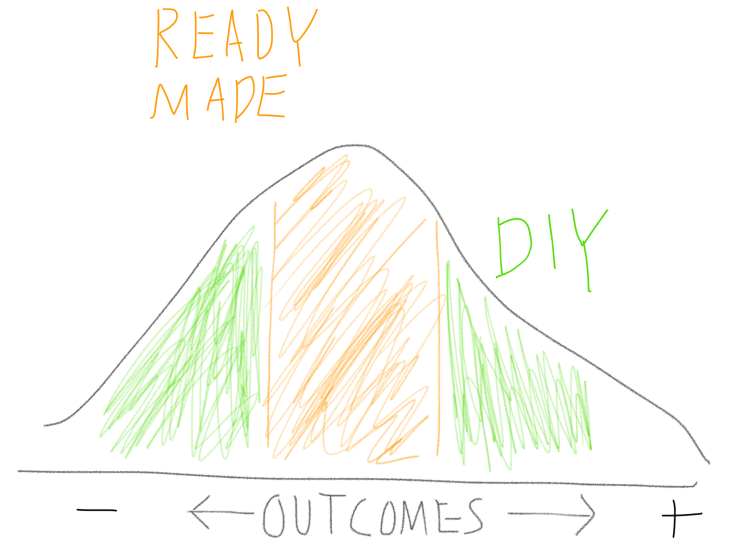
Graduate schools are like the meal delivery services; a packaged way to solve a problem. It’s fine.

846632F7-8466-475E-8BF3-F3AF5A5DD5DB-1-2048x1536-oriented.png

The DIY approach will bring different results. Thanks to the internet, it’s become easier. Tim Ferriss invested in companies. Gilbert wrote. David Chang started a restaurant. Ty Warner sold plush. Ken Grossman ran a bike shop.


Thanks for reading. I’m @mikedariano.

Scott Norton

Supported by Greenhaven Road Capital, finding value off the beaten path.

Scott Norton (@SWNorton joined Patrick O’Shaughnessy on the Invest Like the Best to talk ketchup and it was great. These notes are just a portion of the conversation.

“In any market, it’s all about the attention war and you need to win the attention war if you want to win customers and bring a product to market.”

This means to be different. Sir Kensington’s bottle is different. Their story is different. “If they (Heinz) are synonymous with Americana, let’s be British…When everyone else is zigging, how can you benefit by zagging?”

Norton added that this is easier (though not easy) in the in the “ordinary and overlooked” areas. Rory Sutherland noted that marketing/psychology is an effective/cheap tool, especially compared to building things.

Norton calls this the “me I want to be” approach and says that Tesla would never switch to hybrid cars, and “Would Toms have taken off if they didn’t give a shoe for every pair they sold?” Stories matter because we are storytelling creatures. Even small stories help.

Norton noticed the IKEA Effect when he recruited friends to give feedback on early ketchup recipes. This effect, wrote Harvard researchers, increase the valuation of self-made products. But it only works, “when labor results in successful completion of tasks.”

Joe Rogan saw this kind of ownership during his days on New Radio. During readings, said Rogan, cast members were encouraged to add suggestions and the good ones were worked into the script. Other creatives like Judd Apatow and Aziz Ansari do the same thing. Intelligent Fanatic business owners will do this too. Apatow said, I’m not so brilliant that I didn’t fuck something up.

This storytelling actually goes by another name, sales. “There comes a time in every entrepreneur’s life,” said Norton, “when they go, ‘Oh crap, I’m actually a sales guy. I need to learn to sell.'”

“You can’t justify your pricing based on features, it’s gotta be on benefit and people aren’t going to be willing to hear the benefit unless they trust you first.” Norton said that despite mutual friends he was ghosted. What gives? A lack of relationship.

“Even if something makes sense for someone you can’t just skip to that logical point, you have to spend the time building a relationship,” said Norton. Patrick added, “As someone who’s sold on things by others all the time, it’s amazing how infrequently someone starts with you, asking ‘what do you care about?'” When we looked at Sam Hinkie we guessed that a lack of relationships was part of the reason he failed.

After reading The Startup (which Jerry Kaplan commented on!) it was interesting to see that many ideas are too early or late. Blockbuster was too late getting into streaming. Many of the dot-coms were too early. Patrick frames ideas as waves and wonders, ‘are there as many surfers as expected?’ Norton added, for any entrepreneur, “you’re wrong, it’s just a matter of degree how wrong you are and how quickly you can get less wrong.”

The way to get more right, less wrong, and the secret to all business success – according to Brent Beshore is to experiment and then do more of what works and less of what doesn’t. It’s that easy.

Norton did this. “We threw a party. We put invitations in our friends’ mailboxes saying Sir Kensington invites you to a ketchup tasting. People thought we were crazy but they came over and tasted all these ketchups.”

Norton had multiple recipes with multiple vehicles. “We knew if we had one and invited all our friends they would be ‘this is amazing.'” This is the what do you think Grandma? effect that doomed many startups. Grandma’s love blocks honest feedback. Friends can be too nice too, but Norton had a clever way around it – rankings.

After the party, they tinkered with recipes. Norton said they have a growth mindset, ready to ask ‘why’ five times. Curiosity is a form of “intellectual integrity” said David Salem. Norton said, “Everything is a work in progress…(and ask)  ‘what’s working about this, what’s not working about this, and how can we make it better?'”

“Culture is about values,” Norton said, and at Sir Kensington they have four.
1. Our secret ingredient is people.
2. Act with honor even when no one is looking.
3. Make condiments with character.
4. Think long-term.

At key decisions they consider these values. It’s an interesting idea. Daniel Kahneman said to slow down at important decisions. Maybe this articulation is a way to apply a long-term orientation to day-to-day decisions.

Attitudes can be asymmetrical because “The best part of culture is it’s free. It’s free to show up to work fifteen minutes early…It’s way cheaper than beanbag or ping-pong tables.” Ben Horowitz would point out that perks (ping pong) are not culture. Culture said Horowitz, “is what people do when you don’t tell them what to do.”

“A lot of the most interesting outcomes,” Patrick said, “are unplanned,” Norton added that once there are manuals it’s a colony, not a frontier. You know you’re on the frontier once things are kind of scary. Norton said, “I have this mantra, seek to learn that which cannot be taught.”

This is well and good advice but don’t just head out into the woods. Even children learn the rules of the game. This comes from imitation. Mentors and models. Apprenticeships and study. Start on solid footing.

Eventually you can get out there and find “that point where you’re going from the known to the unknown …so you can mentally prepare yourself to be the right amount of afraid.”

Teaming up also helps. “I’ve been tremendously lucky,” said Norton, “to have someone that pushes me and pushes the organization.” Founders should be like sine and cosine waves. Some overlap of strengths, but unique peaks.

Toward the end of the episode (56:00) Norton talks about his time “http://asiawheeling.com/”. Without a daily routine, you can train yourself to be readier for the messier. To rephrase it, introducing volatility makes you more robust.

Thanks for reading,
Mike

Ben Sasse

Supported by Greenhaven Road Capital, finding value off the beaten path.

Ben Sasse (@BenSasse) joined Tyler Cowen to talk about his book, and living in small towns and Neverland. As expected, this is truly a “Conversation with Tyler.”

Here are the notes:

1/ That’s interesting, maybe I should measure it. Our That’s Interesting post looked at examples for when people observed something that didn’t match their reality. 🤔 When this happens it’s a signal to start digging.

Sasse had this experience as president of Midland University. Their student to faculty ratio in the accounting program was a slim 40:1 compared to the bloated University of Nebraska number of 330:1. Ha! That’s a perfect fact for campus tours. But it turns out it doesn’t really matter that much.

“There are five nerds that talk all the time in a 40:1 class or in a 330:1 class. And in both cases, the feedback loop of the professor, so that she or he understands what students are learning or not, is not well represented by the five kids who talk all the time.”

Sasse dug further and found out that models like hybrid online/meatspace were better.

Later in the interview, Cowen asked about what Sasse is good at and he mentions “strategic vision” and “building a menu of choices about what strategic choices we should be making.” Prerequisite to that though is “a minimum threshold of how smart people need to be.”

Knowing minimum thresholds and effective class sizes both come from interrogating figures. Ben Carlson tweeted:

But I liked this updated (homage) version, A Field Guide to Lies. Both books do a good job of inspiring the type of thinking Sasse engaged. That’s interesting!? Now, what do those numbers mean?

2/ Don’t let school get in the way of your education. “School,” said Sasse, “is one kind of tool and we need lots of kids of tools in our education.” Jeff Annello used a similar analogy. He pointed it out for mental models. 🛠

There are two buckets; mental and physical travel.

We call mental travel ‘reading’. 📚 Between Cowen’s blog, Marginal Revolution, and podcast book suggestions you should be good. There’s also the “St. Johns reading list“.

Beyond learning facts, Sasse said, reading also creates empathy:

“One of the reasons why it’s critically important for our teens to read fiction is, they need to be transported to other times and places. They need to actually be able to see through the lenses of other protagonists.”

I finished [A Burglar’s Guide to the City}(http://amzn.to/2ts6I8A) and was struck by how interesting architecture is. Like Geoff Manaugh, I found myself wondering about burglary. “How would I rob my house?” I’d never considered this point of view without reading this book.  📖

Another way to learn is physical travel. 🇻🇳🇹🇰🇸🇾🇸🇿

“It wasn’t until I started to learn Spanish that I understood English at all. And I think that’s what travel is. This is not the grand European tour for rich kids. This is about going 10 miles from your own home and spending time with people in another neighborhood, or this is about going from the built environment where our kids are almost exclusively being raised and going and living in nature for a while. I think you acquire eyes to see where you’re from the first time.”

A 🐟 can’t explain to you what 💦 is, like because he’s never been out of 💦.

Another form of physical education is an apprenticeship. “We haven’t figured out in most professional schools how to create apprenticeship models where you cycle through different aspects of what doing this kind of work will actually look like.”

Medicine, Sasse said, does this okay, but other fields can adapt it too. Mentorship is a light version of apprenticeship.

Whether with books or people, “you have to engage people who’s ideas are different than yours,” said Sasse. Good organizations argue well. Phil Jackson‘s tenure as President of the New York Nicks failed because he failed to heed his own advice. “What impressed me about Bill (Bradley) and Cazzie (Russell) was how intensely they were able to compete with each other without getting caught in a battle of egos.” What the 1972 Knick learned the 2017 Knick did not heed.

Sasse and Cowen encourage people to know both sides of a position. So do Eric Maddox, Charley Ellis, and Dan Carlin.

3/ The greenhouse phase. “It’s a pretty glorious thing to get this kind of 18-months to four-year greenhouse phase as you transition from dependent childhood to independent adulthood.”

An early job I had was mowing lawns. I created flyers on my parent’s computer, used their lawnmower, and drove to each customer’s house each week. One day I explained to my dad how much money I was making per hour. ‘Why did I ever flip burgers?’ I wondered. ‘Well,’ he said, as all dads do, ‘are you sure you’ve accounted for all your expenses.’

‘Huh?’ I said.

He went on to explain that my capital outlays of $0.00 for equipment weren’t quite accurate. Neither were my expenses. I paid for gas but not insurance. I didn’t have a clue about taxes. I was a guppy. I lived in the greenhouse without even knowing it. (Hence #2).

Adults fall victim to this too. I still fall victim to this. Investors who do great in a bull market only really know that they can do great in a bull market. It’s hard to separate the fish;🐟 like great NBA players or technology executives  from the water.🌊

Similarly, young people need to grow in a greenhouse, but not think a greenhouse is all there is.


Thanks for reading,
Mike

If these emojis were annoying, let me know on Twitter, @MikeDariano.


Rogan and Apatow

Supported by Greenhaven Road Capital, finding value off the beaten path.

Judd Apatow’s book, Sick in the Head is full of good advice and we’ve done two posts here about it, to recap.

When you start, your work will be shit. That’s okay, do it anyway. During this time keep your commitments few so you can practice. Find a boot camp. Eventually, a good opportunity will come up, take it. Try to find good people to work with and projects that sip at whatever got you started in the first place. You’ll need luck along the way. Don’t forget to appreciate what you have. Stop at certain diminishing returns.

In his conversation with Rogan, Apatow offers more advice.

Focus on what you can control. Apatow asks Rogan if he gets nervous about slow ticket sales. Rogan says, “no.”

“I try to tune in to as little as I possibly can other than doing the jokes, doing the shows, I don’t tune in anymore…there’s things to think about and there’s things to not think about.”

Time spent worrying about things out of your control doesn’t help. Dan Harris said he was always worried about catching his flight. Eventually, he realized he could worry once but beyond that it didn’t do any good. We all have 168 hours each week, spend them on skill jar activities.

Take your job seriously. Apatow said:

“When I started I was opening for Larry Miller and he would have these incredible bits, some of them were like ten minutes long…they would get funnier and funnier. One day he said to me, ‘you know, this is a job, you got to sit down every day and write jokes. You don’t just go to the mall and watch a movie every day. If you just sat down for two hours at a desk and treated this like it was a job that deserved your respect you’d be a hundred times better than everybody else. Now, I didn’t listen to his advice at the time, but I do now.”

Excellence requires – about – 10,000 hours. Comedians are fortunate because they get immediate feedback – laughs – as they practice. Steven Pressfield said, “put your ass where your heart wants to be.”

You can’t do one thing.

“I was talking with this very famous actor who does a lot of charity work around the world and he said, I was working on this project to dig wells in a community in Africa and he dug the wells and it was incredible for this community. Then the neighboring community came and murdered everybody for the wells. That’s what it’s like to help people in the world. There’s always something that results that you did not anticipate that makes it more complicated.”

A similar thing happened to Anthony Bourdain:

Even the smallest stone in a pond causes ripples.

Stakeholders.

“Because I make movies and TV, my standup career is all about getting to hangout with everybody and that particular crowd on that particular night…I don’t need it to pay the rent and that frees me up to be a little more daring.”

The more bosses, kids, spouses, co-workers, peers, agencies, etc that you have to answer to the fewer degrees of freedom to make good choices. Seth Klarman said he tries to only bring on investors who trust his process because he needs the freedom to invest in a variety of issues.

Talk to your customers.

“Oh yeah. When you don’t talk directly to the crowd you get stale as to what people are thinking about. I can tell when I bring up certain topics, what peole’s concerns are…it’s weird to write jokes, make a movie and then two years later find out if they’re funny”

Apatow’s customers are the people seeing his standup show and it’s great to hear how he and others test jokes. Patrick Collison went to the bay area before starting his company. Ty Warner talked constantly to his customers to create Beanie Babies. Paul Graham wrote, “If you can’t understand users, however, you should either learn how or find a co-founder who can. That is the single most important issue for technology startups, and the rock that sinks more of them than anything else.”

Experiment.

“With any scene I’m always like ‘well that’s where the joke’s supposed to be, here’s my favorite, let’s get eight more and we’ll move on.”

“I do not have the courage to assume that when I hit editing that I’m such a genius that I will have not fucked up any of this in the writing.”

“I’ll say, ‘hey let him change it, but tell him to hit the same idea,’ half the time he beats the joke (if you have the right joke).”

Rogan adds that when they did this on News Radio people felt invested. Aziz Ansari said they do this on his show too. Brian Koppelman and David Levien said that they do it on their show too. Apatow et al. have humility.

Walking.

“I write better after I do any physical activity. What I do is I walk really fast around my neighborhood in circles for like forty-five minutes every day.”

“They say that when you write you should go over everything you wrote on a walk,” Rogan added. Walking, Eric Weiner wrote in Geograhy of Genius, “quiets the mind without silencing it.”

See it to believe it. Rogan said:

“The one that kicked in for me was my parents taking me to see Live on the Sunset Strip, I remember being in the audience while Richard Pryor was on stage. I looked around and was like, (never seen real standup before)…that planted a seed that this is possible.”

Holy shit that’s possible?!?! moments can have huge effects. Whether it’s the neighbor tinkering in the garage or an explorer in the Canary Islands. Once you see it it makes another world possible.

Reps. How to get better, Rogan says do it over and over.

“I think the only way is constant repetition. You have to be on stage all the time. You have to always be trying to improve it. You have to always be listening to your recordings. You gotta listen to bad sets too.”

Jeff Annello compare it to chess, “I think an efficient decision maker is like a chess player that has studied a lot of games, and can very quickly call to mind other moves that have been made and what the best moves are.”

Jim O’Shaughnessy said, “If it’s art, you want to look at tons of art.”

Thanks for reading,
Mike

Jerry Kaplan

Supported by Greenhaven Road Capital, finding value off the beaten path.

Technology startups are hard, blah, blah, blah.

When I finished writing about failed startups, my overall impression was that technology startups were like running marathons. You could prepare, but like any novice, there was a lot to learn and only so much you could do. If that weren’t enough, you’d compete against seasoned veterans who knew all the tricks.

Bill Gurley suggested the book, Startup: A Silicon Valley Adventure by Jerry Kaplan as a type of training for entrepreneurs. It was a prescient book about technology companies.

Michael Lombardi said that once you get to the NFL you have to draw on whatever knowledge capital you have because there won’t be time to “get ahead” when there. So too for tech. entrepreneurs. What do you need to know?

You will never be ready for this. Leaving the hospital after my first daughter was born my initial thought was, ‘Wait. What? I just leave?’ It’s more difficult to leave IKEA than the hospital. But that’s a big part of an uphill life. You won’t ever be fully ready. Kaplan found this out right away.

“But after the meeting broke up, Mitchell (Kapor) took me aside, ‘Jerry, I’ve been thinking. Why don’t you try to do this project yourself? You’re a smart guy…’ I was shocked. I thought of myself as an engineer, not a CEO. Mitchell had a reputation as a deft manager and business strategist. ‘But I’ve never managed squat.’ ‘You think I had more experience when I founded Lotus? Just remember, political history is written by successful entrepreneurs. All you have to do is make a pile of money and everyone will think you’re a genius.’ He chuckledd and shrugged. ‘C’mon, I’ll introduce you to some VCs.'”

Jeff Bezos wrote in his 2017 annual letter to make decisions with 70% of the information you wish you had. In his book on Amazon, Brad Stone wrote:

“By the first weeks of 1996, revenues were growing 30 to 40 percent a month, a frenzied rate that undermined attempts at planning and required such a dizzying pace that employees later found gaps in their memory when they tried to recall this formative time. No one had any idea how to deal with that kind of growth, so they all made it up as they went along.”

Start before you’re ready, okay, what’s next. Well, issues quickly fall into things you can and can’t control areas. For things, you can’t control take your best guess and move on. For Kaplan, this was hardware, chips, and programming languages. He wrote:

“All computer products are hopelessly interdependent, stacked like faces carved in an endless technological totem pole…so resources are allocated on the basis of promises and reputation, not observable facts – like oceanfront condos sold on the strength of a developer’s rendering.”

For areas subject to more control, Kaplan took his time. Culture for example:

“Companies are not conscious in the human sense, but each one nonetheless has its own personality…The culture may be explicitly acknowledged as a credo or mission statement, but more often it exists as an unexpressed set of accepted procedures, practices, and behaviors that may at times be at variance with the professed goals. This underlying code is not visible in inventories or income statements, but it is the soul of the company.”

This soul is not “created by fiat, mandated, manufactured or bought.” It comes from the early employees, starting with the founder.

Culture is fractal. Whatever “shape” the founder is that’s the “shape” that will repeat. Ben Horowitz said, “culture is what people do when you don’t tell them what to do.” Get this right, said Pete Carroll and, “people will function at a higher level. They’ll come in earlier. They’ll stay later. They’ll be more on it. They’ll inspire those around them. That’s the subtle way of improving an organization.”

Okay; start before you feel ready, hire excellent people early on – what else? Ah yes, a warning about the elephant, Microsoft.

It’s striking how the beats to Kaplan’s song and dance are the same today. Microsoft was to Go as Instagram is to Snapchat. Kaplan wrote, “If we so much as threatened to sue, it would rain lawyers on our office like the plagues of Egypt.” Big companies aren’t as agile as smaller ones but they will bound after their prey to catch up.

For Kaplan it was Microsoft but it’s any big company really. Amazon, Google, Faceflix, etc, ad Infinium. There will always be some giant that can swoop in at any moment and cut you off. Once issue Kaplan faced was developers who had been softly encouraged to not write code for him. ‘We’d love to help, but…”

Brian Chesky found this out when starting Airbnb. His advice to future entrepreneurs was to fly as low as possible for as long as possible but once you were discovered to grow as fast as possible. One possible path is to have a Disruptive Innovation as Clayton Christensen defines it.

Alright; start before you are ready, hire excellent people, be ready to fight the Seattle Elephant. Are we sure this is a good idea?

Kaplan’s father asked him this. “‘I can’t believe you quit a real job to go do this. They’ll skin you alive if you can’t pay the money back.’ He spoke in an urgent whisper, leaning in as though to warn me…(but)…The individual is legally insulated from personal disaster, a circumstance that encourages risky projects like GO.”

His father didn’t understand that in systems like the United States Technology Sector, Kaplan had a limited downside. Better yet, Kaplan had “Star Wars Convexity“. Chris Cole wrote that George Lucas traded short-term payoffs for long-term ones when he traded salary for rights. That’s what Kaplan did too. Rather than a normal job with normal rewards Kaplan took an abnormal job with abnormal rewards.

Whew, back on track. At least we have the opportunity for a big payday and contributions to something meaningful in return for what, at this point, seems like a rather dubious project. If you’d like a happy ending, stop reading now.

What does it feel like to run a company, raise money every six months, try to out-design Apple, out penetrate Microsoft, and convince IBM not to screw you? It feels like having cancer.

“It struck me that this must be what it’s like to have an incurable cancer. You wake up every morning wondering if it’s a dream. Then you remember: there’s something horrible that is slowly killing you, and you’re helpless to do anything about it. So you go on acting a normal life as though it makes a difference…I felt a larger obligation to the team: the only decent thing was to do what was best for them, not for me…I now understood what it meant to be an adult.”

In another part of the book, Kaplan writes that running the company is like going to the top of a tall building and jumping off with the supplies – thanks to the latest fundraising round – for a parachute. If they can assemble it on the way down they get the reward of trying it again.

Of course, it doesn’t seem that difficult. When you test parachute assembly in the office it only took a few minutes. The engineers computed that it took seven minutes to fall the length of the building and special wingsuits were designed to combat cross winds and birds. The team is trained for RDPA (rapid descent parachute assembly) daily. NBD.

Planning like this helps but only to the point of being generally accurate. Too much precision comes from too many assumptions. Kaplan wrote:

“The formal techniques for decision analysis that business schools teach are fool’s gold, a vain and misguided attempt to systemize the chaotic. The mere existence of these methods betrays a darker truth: we harbor a desperate desire to believe that the world is ultimately predictable. But anyone who has managed a startup knows that predictability is an illusion.”

Later in the book he put it this way:

“As a five-year-old I watched a story about Africa and saw the animals running around but then went to the zoo and saw them laying around.
Sitting in the briefing rooms of AT&T thirty-five years later, watching staffers project spreadsheets, graphs, and slides from their portable computers onto the large screen monitors, I realized that computers mislead managers just as television misleads kids. Fed a steady diet of numbers and charts from the comfort of their conference room chairs, senior executives experience only a desiccated version of the powerful forces that shape and grow their organizations. Mistaking these two-dimensional reflections for reality, they shadowboxed their way through complex decisions, unwittingly jostled in one direction or another by self-interested emissaries, who can spin a tale of threat and opportunity as skillfully as any Hollywood screenwriter.”

Numbers are not the real world.

For a variety of reasons, Kaplan’s startup didn’t make it. It was time for layoffs. “‘Remember that people are likely to be pissed,’ Bill (Campbell) said, For the most part, they just wanted to talk.” People often just want this. One big part of our How to Negotiate Well post was about listening.

We’ll end this post with the start of the book:

“The last of the obsolete personal computers, engineers’ cubicles, and other debris of a corporate shipwreck was finally liquidated, sold piecemeal to a crowd of hopeful entrepreneurs.”

Thanks for reading,
Mike

Aziz Ansari

Supported by Greenhaven Road Capital, finding value off the beaten path.

pablo (14).png

https://soundcloud.com/the-bill-simmons-podcast/aziz-ansari-on-master-of-none-hosting-snl-and-kanye-studio-session-stories-ep-212

Aziz Ansari joined Bill Simmons to talk about creating Master of None, his show on Netflix. Aziz was on my favorite show – Parks and Recreation. This interview had many ideas about making comedy that applies to making anything.

Ready?

1/ Distraction free writing.  “I write the best on airplanes.” – Simmons

“I get so much done on airplanes, especially if there’s no wifi.” – Aziz

Going overseas “was really good for the writing.” – Aziz

“What happens when I’m writing is I’ll hit a point where I don’t know where to go. In those moments I’ll check my email or New York Times, and then I’ll go back to it. But when I don’t have my phone or I don’t have the internet I’ll hit that moment and I’m forced to come up with an idea but that idea is gone when you take that break.” – Aziz

“When I was running Grantland I had like five jobs and when I wrote I called it going to the bunker. I’d say, ‘I’m going to the bunker to the bunker for five hours, email me when I’m out.’ When I’d get out of it I’d always be scared something terrible had happened and nothing happens.” – Simmons

When Aziz or Simmons duck out of the feed they begin Deep Work. According to Cal Newport’s book this features:

  1. An environment conducive to the work.
  2. Embracing boredom.
  3. Quitting social media
  4. Draining the shallows.

BUT YOU MIGHT MISS SOMETHING! Aziz said when his book, Modern Romance, was being finalized there was a question about the cover. He was filming that day and couldn’t take a break to weigh in on the problem. But by the end of the day when he checked his email, he found that the situation worked itself out.

2/ Teaming up. “We were both young single guys, but Alan and I were both about the same age and we started hanging out. I remember thinking, often when people are on these shows (from Ansari’s time on Parks and Rec) they find a writer they get along with and they end up creating their own show together. I could do that with this guy. We both get along really well. He’s very fun. He’s really the best partner you could have because he’s so disciplined, he’s really hard on stuff, we really complement each other.”

Good people partners – likeBuffett and Munger – complement each other. People can also team up with machines. Tyler Cowen thinks that the future of work will depend on working well with software.

3/ Gordian knot, Chesterton fence? “There’s no reason for twenty-two episodes of anything.” Aziz and Simmons both say that shows are too long. With the switch to the infinite internet, we see this.

Blogs don’t have the page constraints of a newspaper. Posts can go on forever, always updating. Master of None ranges from 21 to 31 minutes in length. ‘We’ve always done it this way’ should be a nudge to get curious.

Chesterton fences – 13/22 episode seasons – can be studied. ‘Why was this put here, what role does it serve, is it still needed?’ Sometimes the answer will be ‘this still serves’. Rory Sutherland said doormen serve more roles than just opening doors and London’s black cab drivers do more than just drive.

Other times we can cut it out like a Gordian knot. Tipping and pre-game shootarounds for example.

4/ Experiments.  “In the first season, the very first scene a condom breaks and we have to decide if we’re going to get a pill. We wrote one version and I went to Noel and said, ‘let’s also improvise this and treat this as if it’s real,’ and she made choices that were interesting – more interesting than what we’d just written. So I used that to rewrite the script.”

Just as Aziz experiments within the show, Netflix experiments with shows. Reed Hastings said, “Every year is an experiment.” Intelligent Fanatics  had a tinkerer’s mindset. Brent Beshore said the secret in business is to experiment and do more of what works and less of what doesn’t.

5/ Reps, reps, reps. “I would just do as many as I could. I would do eight, ten, a night. Just running back in forth. I was in L.A. and would just go boom-boom-boom-boom, one after another. At the comedy store someone would just grab me and go quick-quick-quick-quick and I would do all the rooms. The key to any standup that you’re trying to get really good is repetitions.”

Mastery (#10,000hours) requires feedback, do more of this and less of that. As a standup comedian, Aziz got instant feedback; did people laugh or not. In addition to writing jokes, he got practice directing episodes for his show. Louis C.K. said that once you do enough of something you get psychic “merit badge” and you can do that thing.

In their conversation, Simmons said the same thing happened to Jimmy Kimmel. “This is why Kimmel was good at the Oscars, he’s hosted a kajillion shows, he was hosting roasts and all this stuff.”

It’s Arnold Schwarzenegger’s advice too:

but those reps have a cost.

“Sometimes when I’m living my life I wonder, ‘What if I had a kid right now. Oh shit!’ I would be such a bad dad. I’m never around, god I’d be bad.” – Aziz

#10,000hours has a high opportunity cost. Typically we are terrible accountants for this metric. Dan Ariely went to a Toyota dealership and asked people, “what are you giving up if you buy this car?” This question stumped most people and when prodded for an answer they said, “if I buy a Toyota I can’t buy a Honda.”  No one said, ‘I could pay down my high-interest loans.’

There’s a tradeoff to have a family and a career. Aziz has no kids (“I would such a bad dad”) and can spend time getting better at comedy.

6/ Detachment. “When we do Masters of None we screen the episodes for people as we’re editing because it helps. You’re the craziest person to watch and judge this thing because you’ve been living in it, you’re in too deep.”

Richard Thaler pointed out that Humans and Econs are different decision-making species. As Humans we need help getting a different perspective. Sometimes this means physically changing your point of view. Jocko Willink was leading a training exercise for soldiers and one guy couldn’t participate because he was injured. Instead, he observed the situation from where Jocko sat – only a few feet away – and commented how easy everything looked from that vantage.

We all approach the world with a perspective that influences how we see things (“you’re too deep”) and detaching yourself or getting someone who is detached can help see things for what they are.

Thanks for reading,
Mike

What if Jeff Bezos was an NBA GM?

Supported by Greenhaven Road Capital, finding value off the beaten path.

Would Jeff Bezos be a good NBA GM? As Zach Lowe talked to Kevin Arnovitz in June 2017 about the NBA draft and offseason I kept thinking, ‘these ideas sound familiar. Oh, yeah, that’s Jeff Bezos!’ Specifically:

  1. Wait for the right pitch.
  2. Have top down support.
  3. Make good, not perfect, decisions.

Let’s see how Kevin Arnovitz and Jeff Bezos think a basketball team should be run.

1/ Optionality (does your ship have enough life boats?)

About the Boston Celtic’s plans, Arnovitz said: “we could pivot relatively easy.”

Bezos said: “We will make bold rather than timid investment decisions where we see a sufficient probability of gaining market leadership advantages. Some of these investments will pay off, others will not, and we will have learned another valuable lesson in either case.”

The optionality that Arnovitz (praising Danny Ainge) and Bezos want to “harvest” is trading a little now for (possibly) a lot later. The Celtics traded down in the 2017 draft to get more options for the future.

Warren Buffett says this is like waiting for the right pitch in a game of baseball with no called strikes. In his podcast, Bill Simmons said that the Celtics must have seen something they didn’t like to trade back with their first round pick. Danny Ainge didn’t like what he saw. When you do see something that could be great, it’s time to take a big swing.

Bezos said, “In business, every once in a while, when you step up to the plate, you can score 1,000 runs. This long-tailed distribution of returns is why it’s important to be bold. Big winners pay for so many experiments.”

2/ Decision makers at problems.

Why can Danny Ainge do this asks Arnovitz? “It’s a good case study for why stability and trust in your front office is really important.”

At Amazon Bezos likes to have “two pizza teams.” That is, if a group is working late on something, there shouldn’t be so many people that they can’t be fed by two pizzas. In The Everything Store, Brad Stone quoted Bezos;

“‘A hierarchy isn’t responsive enough to change, I’m still trying to get people to do occasionally what I ask. And if I was successful, maybe we should have the right kind of company.’ (said Bezos). Bezos’s counterintuitive point was that coordination among employees wasted time, and that the people closest to the problems were usually in the best position to solve them.”

Putting people close to problems they can solve happens in two ways. One option is for the existing decision maker to go to the front lines to see what is happening. Sam Hinkie and Daryl Morey both travel to see prospects. Intelligent Fanatics talk to their customers.

The other way is for decision making to be delegated down to the person at the problem. This is part of the decentralized command that Jocko Willink, Eric Maddox, and The Outsiders.

3/ Threading the needle. Arnovitz said that the teams who can sign Paul George; have the assets to trade for him, believe they can resign him, and will be competitive with him. “This Venn diagram is a nail hole.”

In his 2017 letter to shareholders, Bezos wrote; “Most decisions should probably be made with somewhere around 70 percent of the information you wish you had. If you wait for 90 percent, in most cases, you’re probably being slow. Plus, either way, you need to be good at quickly recognizing and correcting bad decisions. If you’re good at course correcting, being wrong may be less costly than you think, whereas being slow is going to be expensive for sure.”

Royce Yudkoff said this is just as true for small businesses too. You’ve got an ideal punch list and you’ve got reality. How much compromise can you make between the two?

This is why we see that people are never ready for their next role. It was true for Kara Swisher when she moved to TV. It was true for Troy Carter when he started managing Lady Gaga. It was true for Ty Warner when he started the greatest toy company of the 1990s.

Thanks for reading,
Mike