Peloton Strategy

Peloton is great. Do I own a bike? No. Treadmill? Nope. Do I even use the app to get pickleball workout coaching? No. Peloton is great as an example of a business strategy. Peloton doesn’t offer discounts and Peloton makes it easy are two quick observations. Let’s add two more.

“At Peloton we are very inspired by behavior that already exists and then making that easier. It’s like all human technology that finds a human need or something already happening and making it easier to do. With stacking there were already people doing it, even calling it stacking, so when we launched the feature not only did it make the lives easier for the people doing it, but the people who hadn’t thought about it said, ‘might as well tack on a ten minute stretch’.” – David Packles, The Science of Change October 2021

A Peloton Stack is a workout playlist: run then add a stretch, core then add some yoga. Like Instagram, Peloton noticed their users doing something else to get a JTBD done. And one way to serve customers better is to make the hacks part of the product.

A second portion of Peloton’s success is their CAC attack. “Once you have a Peloton,” Packles said, “you are using it for years, it’s the most engaged fitness product of all time.” Part of a good customer acquisitions strategy is “going for the no”. It’s good to rule out customers so not to allocate extra resources to unproductive efforts.

Peloton has high engagement because they get ‘no’. Engagement, and lack of churn and cheap customers and all-the-other-interconnected-parts is an interconnected solution. Peloton uses the fresh start, social influence, and more.

Nice work Packles and all of Peloton. It’s a treat to observe businesses that offer a slew of of tactics that form a thoughtful strategy.


Thanks for reading.

Filters for thought

The best way to make decisions is to collect information most related to the system at hand. Touch a hot stove. Drop a pen. Kiss a lover. Each of these offers a direct action-feedback-action loop.

But these aren’t the interesting parts of life. The interesting parts of life are multiple people functioning at different times towards a goal that’s only shared in the sense of each person’s understanding.

Life is messy.

But we know that. Like driving across Interstate 80 with the prospect of a blizzard, we can plan accordingly. In talking with Cleveland Browns General Manager Andrew Berry, Annie Duke noted how difficult the decisions are within a team. Teams are messy! There are sunk costs, biases, entrenched interests as well as the alignment (or not) of stakeholders . But Berry knows this.

“There’s a couple things we try to do. Number one is to do the hardcore analysis removed from the emotion of the season, the player, the decision maker….

“The second part is getting a number of independent perspectives and letting them state their case. It’s easy as the decision maker to be in your own cocoon and only consider your viewpoint on a player…And the last thing we try to do is have a third-party perspective. There are a couple of things we use that aren’t in our building. As much as you try to weed out every type of bias with your internal evaluation methods, it’s to some degree impossible.” – Andrew Berry, The Alliance for Decision Making podcast, July 2021

That’s a lot of specific, helpful, in-practice advice but it is really just one thing: distance.

Distance is the idea behind base rates. It’s switching to “the outside view“. Distance is the idea behind sleeping on it. If the input to good decision making is the best information, then distance changes the information.

Berry recognizes, first, that he alone won’t make the best choice. Berry recognizes that his team will make better choices with training. Berry recognizes that no matter how much work he puts into himself and his team that they’ll still use some suboptimal information, so they get outside information too.

A friend went to a wedding and proudly said he wasn’t hungover because he alternated drinks of beer and water. That’s good design. Berry probably has good design too, don’t evaluate players within one week of a season. Maybe they do it like the Olympics, and throw out the best and worst scores. Whatever the Cleveland Browns system is, they definitely have a system for making good decisions.


Life is messy is one of Brent Beshore’s expressions and it’s a wonderful “default”. If our thinking is framed by the starting state then to start with the idea that life is messy makes a lot of other parts less so.

The ball bet

What are the odds of more than twelve named Atlantic hurricanes in 2021? That Bitcoin will top 75K in 2021? More than 2M travelers through TSA in a single day?

These, and more, were part of the 2021 predictions. That post built on the ideas of Superforecasting, which offers ideas towards better predictions. Julia Galef adds another.

Here’s one of the prompts: Will I lose power at my home in Central Florida for more than three days? I figure these odds were about 10%, and would wager that, no, we will not lose power for more than three days.

Imagine another prompt. In this bag of twenty balls there is one red and nineteen black, pick the red one and win. Okay, simple enough. There’s a five percent chance to win the red. And here’s Galef’s guise, you can only play one game.

Do I feel more confident about the hurricanes making landfall or the finding of the red ball? The hypothetical ball bag bet can slide up or down: 5%, 10%, 30%, etc.

“You just ask yourself, do I feel more optimistic about taking that bet or [the other]…You can play with the ratio of balls to kind of narrow down the number you put on your confidence in the original question.” – Julia Galef, BBC’s More or Less, August 2021

With my kids we use coin flipping. One day I had an appointment and told them there was a 5% chance they would have to go to after care at the school. “That’s like flipping a coin and landing on heads four times in a row” I told them.

Probabilistic thinking is difficult but it can be helping in making good decisions. Poker’s appeal highlights this idea too.


The TSA’s nadir was 87,000 travelers the week of April 13 2020, down 95% from the same week in 2019. In 2021 that number was more than one million. The week of June 11, 2021 there were more than two million travelers. I guessed there was a seventy-five percent chance that would happen.

Dice tails

Maxim two, from Richard Zeckhauser, is “when you are having trouble getting your thinking straight, go to a simple case.” This maxim came to mind listening to Michael Mauboussin and the Acquired duo discuss business valuation and the difference between tangible and intangible assets.

“(Intangible assets like brand, code, etc.) also makes you vulnerable. If your product or service does not work there’s not much there left. If you think of pushing out the tails relative to traditional business, that’s the way I think about it. There are more extreme good things and more extreme bad things than we’ve witnessed in the past.” – Michael Mauboussin, Acquired, October 2021

We’ve thought about this idea before, in the complex world and in the increasing returns economy. But it’s a big idea and like the lead in a story, we need to fill out this character a bit more.

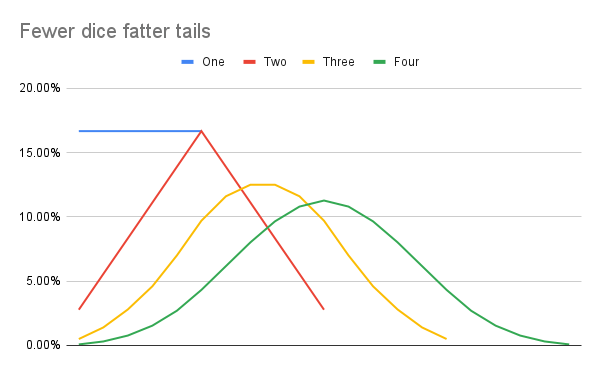
Here’s the distribution of results of one, two, three, and four dice rolls. For one, the results are equally likely. For two, as anyone who has played Catan knows, seven comes up the most.

one two three four dice distributions

Though it’s a basic Google chart, it is simple enough for Zeckhauser and satisfactory for Mauboussin. For a die, the chance of rolling the highest score is ~16%. In the case of two the chance is ~3%, for three it’s ~0.5% and for four it’s ~0.1%.

Different parts of life are more or less similar to different amounts of dice. Businesses with lots of intangible value are closer to the end of fewer dice, because those kinds of distributions have fatter tails. Business with more tangible capital are more like rolling many dice.

Now, dice distributions offer no mechanistic or explanatory approach about what kind of system a case may be. There’s nothing about “brand building” that makes it more like rolling two dice relative to something like pool construction. But the metaphoric fit is just fine.


Thanks to Michael Mauboussin for this post and all the others. He was one of the early podcast guests who was going around explaining things that seemed like really big ideas in a really basic way. He was so good at it I thought, hey, I should write some of this stuff down. Well, I’m still writing.

Slack, in the black

One way to think about how life works is that it’s a series of events in pieces of time. A business’s cash flow is one example. An operating business will succeed if their expenses are less than their incomes. If incomes were stashed away, then a business can weather moments of swelling outflows.

We looked at this with flooding too. Locales flood when the net additions outweigh the net subtractions. Florida’s coastal flood warnings occur during hurricanes, when an “exogenous” event shocks the local system.

Company culture can operate this way too:

“The key to making hard decisions at the top is being ‘in the black’ with your emotional bank account with the culture. As a leader you have to build that bank account and make deposits every day to build trust and credibility with the people who work there, knowing, there are days where you make a giant withdrawal because you’re going to screw up. And you will! It’s just too complicated, but you know that when you have that big withdrawal you’ll still be in the black.” – Doug Conant, The Knowledge Project, August 2021

Conant was head of Campbell’s Soup and at Nabisco during the KKR takeover. In his conversation he’s candid about how to achieve this emotional slack. This isn’t something everyone does all the time, or gets a certification for, but rather it is something that happens in bits in pieces every day.

Conant also frames this idea nicely. Much like a travel budget in time not dollars, Conant compares the cultural balance of an organization to the financial budget. These analogies help our understanding.

Slack is most important in systems with dynamic change. Driving is a physical system where slack is important: how much space is between you and the car ahead of you?Financial slack is having an emergency fund. Levies, barriers, and pumps are slack for flooding. Meditation, peace, or religion are all personal slack for stress.

Marc Andreessen had an interesting take on this idea of events in time. Water cooler conversations, he said, have never really worked well for him. Off-site events though, have been good. It’s a similar amount of interactions: five minutes, five days a week, fifty weeks a year, at the water cooler. That’s twenty-one hours, about one one off-site.

Slack is a way to change the balance of event in time.


Hurricanes are not really exogenous shocks. I mean, we have days where business don’t charge sales tax to encourage people to buy hurricanes supplies. But thinking about systems at different levels: the home, the community, the region, the nation, the world, can change the way we see things.

What’s this place optimized for?

Everything around us, notes Jason Crawford, is a solution. It may be a ‘local maxima’ rather than a ‘global maxima’, but everything around us is the best idea we’ve had yet (given the culture and incentives).

And these solutions all influence our decision. The punchline to behavioral sciences, says Kristen Berman is environment, environment, environment. The question to ask then is: A solution for who?

“If you go to a mall how could you not spend money? People have thought deeply about how to get you to spend money, they’ve thought deeply about getting you to buy something. It’s a hard fight, and it’s getting harder. Amazon Prime is the gold standard for this. They’ve figured out something about human behavior and it’s going to be hard to fight that.” – Kristen Berman, October 2021

Cinnabon is a tasty brick and mortar example of how place matters. The stores are in places of captured traffic and infrequent visits. Da Buns, said Kat Cole, are treats. So the frequency of customers affects the type of product.

Another instance is that oh-you-know-it smell. That wonderful waft was an accident. The first location lacked enough room for the oven to go in the back – per best practice prescription – so it was jammed in the front. Learning their lessons, the second location prioritized moving the oven out of the way. Whoops. Luckily for us all, they fixed that.

I’m not as strongly behavioral as Berman (though I did update) but her idea of wise designs hits home. In 2014 our family went on a Disney Cruise. We had a blast. But one evening my wife scheduled dinner with a Disney Vacation Club (their timeshare component) representative. It was there, in that office, sweating bullets that I realized something about myself. I’m bad at ‘No.’

This guy was good. Each objection he countered. Each escape he blocked. Each obstacle he climbed. Somehow, like Aladdin, we escaped.

Now I know about ‘No’ and good design and Berman’s advice.

Just the first day of camp

Stand up comedy is the fruit fly of the comedy world. Comedians can think of an idea in the morning, expand it in the afternoon, and perform it that night. Nothing is above the laugh and the feedback is fast and firm. Jokes work or they don’t.

Covid, no laughing matter, has been similar. Though not as fast or firm, the cycle between idea, test, and results has been pretty good. Though clear-ish now, vaccines, hand washing, masks, social distancing, lockdowns, etc. etc. etc. have been a figure-it-out-as-we-go kind of thing. There’s a lot we didn’t know, and still don’t know.

Another area where we know more is our sense of costs and benefits. For instance:

“Send your kid to camp the first day. When they come home they won’t have Covid, because they didn’t get Covid on the first day of camp and they will be like, ‘Wow, camp was amazing.’ The normalcy makes the other pieces vivid.” – Emily Oster, September 2021

What Oster does nicely here is frame the Covid camp trade off for people who overweight the risk from Covid for kids and underweight the reward from camp. During ’20 & ’21 Covid has been all we think about, and we need a reminder about this other stuff. A small step – the first day – is a good approach for highlighting this balance.

We haven’t always known that kids are mostly okay. We haven’t always known that camp is mostly ok (maybe up to 20,000 people?). We’ve learned that being younger is better. We’ve learned that local conditions matter – a lot! We’ve learned a lot.


Framing information one way rather than another is one of my favorite themes.

Mayors jumping queues

One benefit (with distance!) of living through the first year (2020) of Covid was the lesson in ambiguity. Never forget, the thing we did the most of was stock up on toilet paper. It’s silly with hindsight, but at one time the zeitgeist was making up songs so we all washed our hands the appropriate amount. With those actions as a reference, it makes a bit more sense that issues like masks, contact tracing, limited gathering, and vaccines were confusing. How might things have gone better?

One potential solution to vaccine hesitancy is a skin-in-the-game approach. Don’t tell me what to do, Nassim Taleb might bark, tell me what you do do. But that can lead to the suggestion that someone is jumping the queue. This pushback came up, rightly, but there is at least one potential solution.

“I think there is a way to do it. We advised mayors and their communication directors to approach it more like: ‘We are opening up a new site, let me show you how safe and effective it is, here’s the shot in my arm.’ Definitely don’t do it in the moment when there is extreme vaccine scarcity, do it as a symbolic moment that the floodgates are opening. It’s about the time, place, and moment.” – Carolina Toth, Inside the Nudge Unit, June 2021

What I liked about this example was the second-order thinking Toth offered. It’s not the line jumping per se but it’s line jumping and-I-can’t-get-mine. Lines aren’t about waiting. Lines are about fairness.

Imagine queueing up for a spring training baseball game. You’re in sunny Florida. It’s March. It’s seventy-eight degrees, Fahrenheit. The sun is out. It’s a beautiful day.

Being a well-prepared baseball fan you bought tickets ahead of time. Section C, Row 4, Seats 15-18. They’re behind the third-base dugout. You told your thirteen-year-old not to be on their phone when a left-handed batter is up. Who knows if they listened. Amid these happy thoughts you see that two groups ahead of you in line a party of two has become a party of six. The duo was saving spots for their friends. Do you care?

Probably not? Your seats are your seats.

There (probably) won’t be another 2020. However any situation can be helped by getting to the first principles: how do viruses transmit, what’s wrong with mayors jumping queues? It’s these answers that remove the ambiguity of a situation and get us all sorted.


Queues exist to solve allocation problems, like the New York Marathon.

Sampling wine

“Let’s say you want to learn about trade in the ancient world. If you’re using archeology I have good news. We know a lot about trade in olive oil and wine in the Roman world. Olive oil and wine both moved in clay (Amphora) vesicles. They were disposable. When a giant pot of wine reached its endpoint, you poured it into bottles and chucked the big transport pot. Pottery survives, you can shatter it but the pieces are still there.” – Bret Devereaux, EconTalk, August 2021


By Ricardo André Frantz

Grain meanwhile was transported in sacks. “Imagine what parts of your life,” Devereaux asks, “are archeologically visible.”

This example highlights a bigger question: how do I know something is true? Big right? We can’t know everything, so we use samples. And Amphora highlights two caveats.

First, is that easier-to-find data may overstate the case. Covid19 in 2020 had a lot of early data that was easy to collect but not necessarily a good sample. During the first six months we talked a lot about the number of cases, maybe we still do depending on when you read this. Cases are okay, but the best predictors in the early days looked at hospitalizations and deaths. Not to stop there, Covid19 also affected ages quite differently, a fifty year old was fifty times more likely to die than a fifteen year old.

Second, easy data is usually ‘expensive’ because many people use it. If they use it in the same way then, like an auction for a Beanie Baby, prices rise. If the information turns out to be wrong, then prices fall. The heart of moneyball was to find data that was also good, but ‘cheap’ because fewer people used it.

Archeological visibility is a neat analogy to use for thinking about sampling. Though an ancient effect, we can use it still today. The next time we see data, we can ask, is this data more like a clay pot or a cotton sack?


The fifty/fifty/fifteen ratio was an estimate based on CDC data. Also, “Today’s persuaders don’t want you to stop and think,” writes Tim Harford in The Data Detective, “They want you to hurry up and feel. Don’t be rushed.”

It’s all solutions

A Chesterton Fence is the idea that we should understand a thing before we change it. Marc Andreessen tells the Chesterton Fence story of Airbnb. Prior to online marketplace for homes and rooms were hotels and prior to hotels were bed and breakfasts. These bnbs varied and so hotels created brands and brands gave consumers information. It’s this kind of hotel. Brian Chesky et al. figured out that rather than brands, the same information could be in reviews and ratings.

“I want to change the way people see the modern world. I want people to look out at the world around them: at the steel, at the concrete, the glass, the computers, the washing machine, the automobile and jet plane and I want them to see everything made by human beings and understand it as a solution to a problem. There was some problem that we had in the past and we solved it. I think when you start to see the modern world as, ‘I am surrounded by solutions to problems’ you start to appreciate it a lot more.” – Jason Crawford, June 2020

That’s awesome. Everything around me is a solution frames the world as such a cool place.

Everything framed as a solution also nudges people towards a bit more curiosity. If a 401k or a mask policy or an expressway interchange is a solution then why was it that rather than something else? If we use hotels or stores or cars why was that the solution?

Solutions, all the way down.


Crawford’s episode came up on a curated podcast playlist I source from Tyler Cowen’s posts. Cowen is one of the most influential thinkers. Here’s a pay-what-you-want thirty-minute read about a few things I’ve learned from Cowen. Or, if you’re really into the coolness of ‘stuff’, try the book Stuff Matters on Amazon.