Tailing Aaron Rodgers

First, the New England Patriots pre-season win totals…

“If you forced me to make a play I’m circling the under at 9.5 (wins) at -120. I think there is a longer tail to the under here; if they stick with Cam Newton a little too long, if Mac Jones is a little farther away than people realize, if there are injuries in this relatively aging defense, if the offensive line isn’t quite as good, if the offensive weapons don’t really make a contribution. There are a lot of ifs that are potentially negatives for the Patriots and I am perfectly fine playing the win total under.” – Drew Dinsick, Deep Dive Podcast, July 2021

During the 20/21 NFL season we ‘Tracked Tom‘ to see if Tom Brady would hit the over on his passing yards for the year. The theory at the time was the same that Drew describes: more can go wrong than go right. The question wasn’t about how well Brady played, per se, but rather what big events might happen and which way would they break? For Tom, everything was terrific and he hit the over.

It’s Plus EV Analytics who thinks this way, in part from reading Nassim Taleb. And from him we’ve got another for the 21/22 NFL season!

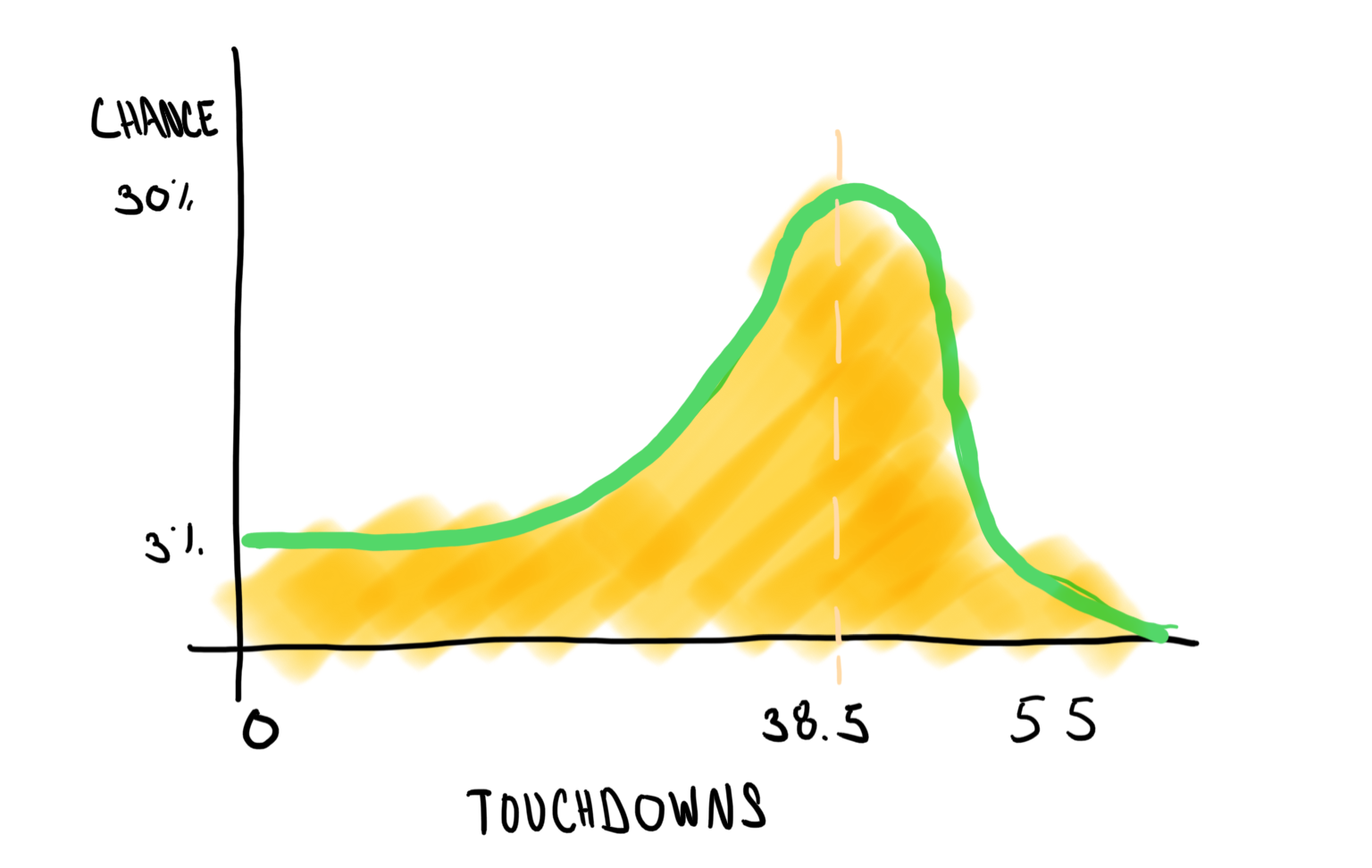
There’s a chance Aaron Rodgers says chuck-it, and goes on to host a game show and he throws 0 touchdowns, a 100% decrease from the line of 38.5. There is no chance he Proves them All Wrong™️ and has a 100% increase to 77 touchdowns (the league record is fifty-five, only three players have thrown more than fifty).

Visually the idea looks like this:
Graphically

Take the under on Rodgers.

But not all systems are like this. Sports can be under on the idea of injury alone. Financials can be under too. Cryptocurrencies, for instance, can be hacked, regulated, or fall out of fashion. If someone put the over/under line of Bitcoin at $38,500 at the end of the NFL season, a similar set of arguments and conclusions flow.

To a point.

Unlike Rodgers, Bitcoin could double. It’s a different system. Businesses are more like Bitcoin than NFL lines. Most of the Amazon services started out as bets: will this thing work? Amazon’s wager was the outlay in resources but Amazon’s winnings, unlike Aaron’s TDs, could easily double, triple or more. Here’s how Jeff Bezos put it.

“We all know that if you swing for the fences, you’re going to strike out a lot, but you’re also going to hit some home runs. The difference between baseball and business, however, is that baseball has a truncated outcome distribution. When you swing, no matter how well you connect with the ball, the most runs you can get is four. In business, every once in a while, when you step up to the plate, you can score 1,000 runs. This long-tailed distribution of returns is why it’s important to be bold. Big winners pay for so many experiments.” – Jeff Bezos, Invent and Wander

Fat bottom tails make the complex world go ’round and a basic understanding of distributions, curves, and areas helps.

Three star recruits

The success equation notes that results are combinations of skill and luck. Some parts of life have a larger luck outcome than others.

So, to improve, we look at the skill slice. Poker’s appeal is this idea. Play more hands with positive expected value. But not every sport is as clean as poker. Football, for instance, is messier.

One way to work around the football outcomes is to focus on the football inputs. For instance, recruiting is important, how many highly rated recruits does a coach get each year? That seems like a nice input as the percent of “Blue Chip” recruits correlates well with wins.

Ah, but incentives are tricky.

“There are stories you hear, anecdotal but I’ve heard more than a few, about how different coaches may have a financial incentive to have higher ranked recruiting classes, and they may be involved in the process of lobbying to get guys higher stars.” – Bruce Feldman, Wharton Moneyball, September 2021

Incentives are like the weather. Just like a bunch of measurable aspects (temperature, pressure, wind, humidity) combine to form ‘the weather’, a bunch of measurable aspects of a job combine to form the incentives. A football coach has incentives to win, but also to pay his daughter’s tuition and take his family on vacation. And it’s not just football coaches, it is all of us.

What to do? Work is a combination of financial and non-financial rewards. Alchemy offers a way to tweak the non-financial rewards. Culture works well too, and that comes from the top.


Here’s a story on auto incentives (thanks Stephen!). Incentives were one of my favorite ideas, get all 62 as a daily email drip on Gumroad. Find them on Amazon too.

Using Drafts

The problem with Notion and Roam is aesthetics, and the design consequences. Notion looks polished, like a webpage. Roam’s thought graph looks like art. Apple Notes lacks features. Evernote has too many, which get in the way. If you use text expanders, keyboard navigation, or have browser extensions like Vimari or Vimium installed, then Drafts is the note system you should use.

The design choice of Drafts prioritizes keyboard input, usage, and output. Rather than a ‘How to…’ post for Drafts, this is my macro case for taking notes. There’s not much specific advice because keyboard-heavy-users will thread their own note system in no time.

Note everything. Any idea that comes up when watching, listening, or reading gets a note. Any bit of interestingness is a signal from the (sub)conscious that there’s a there there.

For instance, on the Circle of Competence podcast, Colin Keeley said that his first act after buying a business isn’t to swoop and poop but to conduct a sludge audit on the business’s processes as well as clean up marketing.

Swoop and poop is a great expression, so it gets a note.

Tag everything. Tags are the digital organizer, but unlike ‘sock drawer’, notes can be multiple things. Tags are the drawer. Which tags?

Medium. Tag notes by the content medium: book, YouTube, podcast, audiobook.

Person or podcast. These tags are good for searching but not important for the actual note.

Activity. This is the secret tip. The thing you’re doing will be a recall trigger. Some of mine are dog walk, run, home, and car.

Idea. It doesn’t have to be well thought out, sometimes looking back mine make no sense at all, but ideas like incentives, business model, and marketing are pretty common as well as more abstract ones like year (1980s, etc), nudge, numeracy, retail, and TiVo problem.

Learn Markdown. (for blogging) As someone who knows no other code – but has attempted many times! – Markdown is the no code code. Rather than ctrl-b for bold, it’s a double asterisk. Markdown is easy because of the repetition. There’s not that much html and it doesn’t take long to straighten out if the brackets or parentheses come first for a link.

Wonka

Srsly. A more frequent meme than Mr. Wonka is the dating couple where one says to the other, I do have a blog/podcast/newsletter. That’s fair. But have one for you and your internet friends. Writing on the internet is a way to learn in public and writing is consistently praised as a great way to learn.

“For me, writing is an act of finding clarity and it’s an iterative act. You try to write. You realize don’t understand. You go back and try to figure it out. You try to write again. You realize you still didn’t figure it out. But it’s all a process of finding clarity.” – Bethany McLean

Share something. We’re out here together. Share the work.

Most things are not read. Write online and you soon find there is no connection between time plus interesting-to-you and page views. Fine. Page views aren’t an appropriate proxy for what we are doing. There are only two goals: learn yourself and contribute to the fat tail. Most of my internet searches end up in the fat tail part of the internet. Help me and future me’s and write online.

Notes are also crucial to the three ways to spend your day.

How much coding do you *really* need?

There are some ideas where I feel more or less confident about being true, this is one where I am confident it is a thing, but I am not so confident I understand it.

How much should someone code? Is “=CORREL” enough? What about HTML? I use RSS and Markdown and emojis all the time but I don’t code any of those things. Yet, there’s a lot of talk about needing to code. You need to code to get ahead. You need to code to keep up. We need to code the code’s code! But coding is situational. Replace “code” with “cook” and its like, oh yeah, that’s pretty varied.

What we really mean when we say, “people should know how to code” is that people should be able to use tools to deliver value. Code is a tool that does a job. The appeal of code, says Richard Feynman, is that it’s so dumb it’s fast. Code can also be copied. Code is a tool that delivers value unrestricted to time or place.

There’s a lot of ways for code to be a tool, it depends on the level. Sometimes =CORREL in a spreadsheet cell is the right amount of code. A spreadsheet is code too. There’s a bunch of math behind =CORREL that someone doesn’t need to know. That function is a tool within a larger function, the spreadsheet. All these functions within functions are the User Interface (UI).

“Consciousness is more or less the UI for how your brain works. Much like a UI, it wouldn’t help if Microsoft Word made me code in the structure of a document. There are programs, like LaTeX, that allow you to do that, but they are a pain in the ass to deal with because you have to specify the underlying details. The whole point of a UI is that it is an abstraction that sits on top of all the stuff underneath. For the most part our conscious is the UI for what is happening in our minds.” – Kyle Thomas, Stoned Studies August 2021

This nesting-doll nature of code is to be expected according to Brian Arthur. Yes, he tells Jim Rutt, that it has gotten more difficult to repair the things we use but this is because, like code, we create sub-systems for convenience of use.

“One of the things that happens is that if some sub-system is used often, it might have say 54 parts to it. If it’s used again and again and again, over several models and years it becomes modularized, becomes its own thing and it’s separately manufactured and it may have a cover on it. It may not be accessible to amateur mechanics, and it may only be accessible if you’re trained by Mercedes or Audi or whoever it is. And you’re properly trained. You have the proper tools. So as the lesson here is that as inner parts are used again and again, in the same configuration, the tendency is that they become modules.” – Brian Arthur, The Jim Rutt Show, August 2021

What is code? What does it mean “to code”? It depends!

This is good news. Rather than “learn to code” we should focus on “learn to solve problems”. Many of those problems will require tools. Some of those tools will be code. It is these kinds of problems: needs repeating, needs scaling, fits-with-existing-modules where code will be the tool for the job. Sometimes that code will be deep in the nesting dolls. Sometimes that code will be a simple spreadsheet cell. How many layers of UI depends on the problem to solve, the job to be done.


Arthur is famous for his comments on the Increasing Returns Economy.

Also, this. It gets good around 7:00.

Day to day designs

There’s a lot of advantages to designing day-to-day decisions. It’s may seem unglamorous but changes add up. For instance, try to leave your phone out of reach.

But the internet is on there!

The heart of design is to change a situation so that something is more or less easy. The beauty of design is that the change is not always in proportion to the effect. And we need designs because as Byrne Hobart notes, we have a lot of muscle memory.

“There’s a lot of muscle memory typing ctrl-t Reddit dot com. It is really important to resist that stuff because it is a continuous tax on your ability to accomplish things. This is a good reason to buy physical books or magazines. If can force yourself to focus for awhile, you can get non-linear benefits from learning a whole lot about narrow topics and understanding new topics by using analogies from previous ones.” – Byrne Hobart, World of DaaS, August 2021

Here Hobart offers a couple of useful ideas in an interesting way. One is design but he also frames Reddit as a tax. This is clever.

Tax is normally associated with money and with being bad. Tax reframed here keeps the bad part but shifts the focus to time. That works with travel budgets too.

Personal productivity is another one of the Large N small p cases. It may not seem like we are ‘doing a lot’ but small changes add up each day.

Being better than Superman

Maxim four from Richard Zeckhauser is: “When trying to understand a complex real-world situation, think of an everyday analogue”.

Alex Tabarrok has been using this strategy to communicate about vaccines.

“To me the vaccines are like a superpower. Superman is immune to bullets and I tell people: ‘Wouldn’t you like to be immune to bullets? The virus has killed many more people this year than bullets have, and the vaccine makes you immune to the virus, it’s better than being immune to bullets!'” – Alex Tabarrok, July 2021

In Dan Levy’s book about Richard Zeckhauser he includes a section from Gary Orren who used the everyday analogy strategy to describe the AmeriCorps service program. AmeriCorps, Orren told legislators, is like a Swiss Army knife, it does many things well though it’s never the perfect tool. A few weeks after addressing the governmental staff Orren returned to their offices. “Oh yeah, I remember you. Swiss Army knife.”

This strategy helped, Orren explained, because it focused his thinking and the audience’s understanding. A lot of times our thinking is FAST and analogies shift complex concepts into simpler situations.

Simplification isn’t the end though. Extremes, like questioning the Ohio vaccine lotto, are not the final answers but a first foothold. If we can understand an issue’s basic components first, it can be easier to build up to the rubber-meets-the-road challenges of IRL.


My year of AmeriCorps was health based, and I remember many vision screenings .

Selling shirts, planning planes

We’ve looked at a few different customer acquisition cost strategies : F1 racing, Zappos’s mistake, and P.S. I love you, from Hotmail.

The CAC ideal is to acquire the best customers for free. That’s ideal. L.L. Bean started when Leon Bean mailed his catalog to out-of-state hunters. Michael Dell sold newspaper subscriptions, but sourced his leads from the “Just Married” records. Both men found pretty-good customers for a pretty-good price.

Customer acquisition might be the most interesting puzzle in business because the lower the CAC the more flexible the business model. Today we’ll add two more.

About Mike Wolfe, of American Pickers:

“He would go from barn to barn and buy some cheap stuff, something sold in the store for fifty bucks. We would buy something like an old motorcycle that was art which we could sell for twenty grand. And each day all these people, from all over the country, would come into the store and we would probably sell five-thousand-dollars worth of items and probably thirty-thousand-dollars worth of t-shirts.” – Sam Parr, My First Million, August 2021

The American Pickers television show is the customer acquisition vehicle for selling merchandise. Brilliant right? Okay, the second one.

“Growing a financial services company is so brutally difficult, and the growth is so restrained by customer acquisition costs that it is literally worth it to start flying people around the country. That is the most cost effective way to sign people up for credit cards, and the credit card business is so lucrative it is actually worth it.” – Byrne Hobart, World of DaaS August 2021

The business model of airlines is to operate a hub location that allows for network effects and to maximize the capacity of each plane because each additional customer costs, per Hobart, a drop of fuel and bag of nuts. Hobart’s whole interview is wonderful.

Finding customers has evolved over time. When customers were rural, catalogs ruled the day. As customers moved to cities, it was the department store. Then customers got cars, and the mall and big box retail came to be. The most recent step then is to the internet. It’s the same question Bean bandied in 1912: where the customers for what I am selling?


bonus: look for ‘lost’ monetization opportunities, like Matt Levine’s Money Stuff Bloomberg email.

The many games of Jeopardy

January 14, 2020. Double Jeopardy Daily Double:
What is Chad?

Jeopardy is incredibly instructive. It has come up a number of times on the blog. The best summary is the June 2021 NPR Planet Money podcast.

First, Jeopardy is not a trivia game. Jeopardy is a television show. It’s a game within a game within a game within the game of life. Life is a game in the sense that there are rules (hard like physics, soft like psychology), consequences, and randomness.

Penn Jillette notes the gaminess. ‘Winning’ a game like Jeopardy or The Apprentice, wrote Penn, meant being interesting not being champion. His victory is selling tickets to the Penn & Teller theater show, not to make the best beans.

Like all games, the game maker can change the rules. Jeopardy is a pretty clean operation, but games like Survivor change the rules all the time. Governments change rules like “interest rates” or “bailout”. Regulators change rules too, maybe that’s their chief job?

Until 2003, Jeopardy contestants could only win five times. Then the rules changed and Ken Jennings showed up to win seventy-four games. Jennings has a very particular set of skills. Jeopardy was one of the few American shows Jennings watched growing up in South Korea and Singapore. But it wasn’t the clue collection, it was the cadence.

Jeopardy really isn’t a trivia game so much as (per the NPR episode) “a really crappy computer game.” Just as Jeopardy is a game within a game, there are three games within the game of Jeopardy too.

Before addressing the three games, it’s helpful to remind ourselves about the skill and luck spectrum. The “success equation” is to disentangle what games within games are skill based and which are luck based. Skill based games, wrote Michael Mauboussin, are games where some set of actions consistently returns some set of results. Another way to find skill based games is to ask: can you lose on purpose? Most games are a mix.

The outcome of this arrangement, says Mauboussin, is the “paradox of skill”. As each game within a game optimizes, the impact of luck grows.
Kawhi Shot

Jeopardy’s Three Games.

Jeopardy is a series of sequential games. If a contestant wins one, they get to try at the next, then the third, until the process resets. The first game is the buzzer.

Buzzer. “A crappy computer game”. There are a lot of ways to practice the buzzer, the most common among fans is the toilet paper roll holder.

During IBM’s Watson appearance some fans thought that the computer was too fast, though the engineers note the accommodations. Humans, wrote David Gondek, have the ability to anticipate when the buzzer window will open.

Like a basketball free-throw is preceded by a foul, winning the buzzer is precedes a chance to answer.

Trivia. Jeopardy screens contestants via a written test, then (a randomly selected) audition. Everyone that’s on Jeopardy is already good at trivia and getting much better is difficult. Not only that, Jeopardy as a sampling issue: it’s only full of people who really want to be there and do well.

The potential contestants (by now) know that not all trivia is important. The United States (capitals, geography) and its history (presidents) are important. Literature and Science are important. Professional wrestling and heavy metal are unimportant. Jeopardy’s trivia topics are wide but not deep, except for a few areas.

This used to be a data problem. Besides watching each night, how might a potential contestant figure out what mattered? Since 2004 there is a J-Archive, a fan curated collection of all things Jeopardy. Thanks to the internet, this part of the game within a game has shimmied from the luck end of the spectrum to the skill portion.

Though luck still matters. James Holzhauer only knew Sadie Lou was a nickname for Sarah Lawrence College because he and his wife considered ‘Sarah’ as a baby name.

Game-theory-optimal.
In the season before James Holzhauer, the top ten Daily Double bets ranged from seven to fifteen thousand dollars. Holzhauer raised that to eleven to twenty-five. Holzhauer nearly doubled the Daily Double bets.

It’s not just the betting. Daily Doubles are tactical. If a player finds one early in the round, they won’t have enough to bet to make it ‘a true Daily Double’. Bet too little of a big stack and it lets the other players ‘stay in the game’. Bet too much of a big stack too late and a lead will evaporate.

It was gambling that let Holzhauer to reframe the Daily Double. Think of a coin flip. What is the price and payout someone would play? A dollar to win a dollar is kinda boring.

Or not? At our house we play this dice game called Left, Center, Right. At the start, each player has three chips and they roll three dice, one for each chip. If the dice say left or right, a player must pass a chip left or right. Center and the player adds a chip to the pot. A player can also roll a dot and they keep that chip. It’s a fun game, especially for the younger-non-gaming-gamers. But there’s no skill. The “successes equation” of LCR is: have fun.

The bet a dollar to win a dollar coin toss is meh. What about bet a dollar to win two? That is interesting. That’s how Holzhauer saw Daily Doubles. It cost a dollar to win a dollar but rather than the payout being skewed the odds were.

Jeopardy seems simple. It’s fun to feel smart, that’s part of the big game too, and play along at home. Like poker’s appeal maybe there’s more to it. What is, a richness of thinking?

Timestamps in the episode:
A jarring style, First 20 years, Trivia’s paradox of skill, Finding Daily Doubles, J-Archives, Betting Daily Doubles.

Unlocking the restricted actions section

There are (at least) four ways actions are restricted: macro-culture like society, micro-culture like an office, job mandates, and personal psychology. For Andrew Sullivan, the obstacle was the last one, the self.

“What I find that marijuana does, and to some extent — mushrooms definitely do, meditation does as well — is that they suppress the ego. They weaken the ego.” – Andrew Sullivan to Tyler Cowen, August 2021

Psychedelics, for Sullivan, offer a change in perspective., “You’re less attached to your own pride. Your mind is taken out of its normal rut,” he explained.

How much THC is TBD, but Sullivan’s point is healthy. Ego, for instance, is part of the reason Jason Blum is successful making horror movies. Ego, is part of the reason, Bank of America succeeded. The proletariat, it turns out, is profitable. “I don’t care where an idea comes from,” said Gregg Popovich, “You have to be comfortable enough in your own skin to realize that an idea can come from anywhere.”

A healthy amount of ego helped make Friends. An unhealthy ego meanwhile leads to dentists opening restaurants or financiers on movie sets.

This is one of those that-kinda-makes-sense ideas but a regular dose certainly helps.

Hurdling past covid

One way to think about “adoption” is as series of hurdles. If something is “adopted” it has succeeded by crossing the set of hurdles. There are few food bacteria “adoptions” because of hurdle technology: hot, cold, salt, and acid all make the process harder for food bacteria to survive.

Another metaphor for this approach is Swiss cheese: one layer has multiple holes but if the layers are independent, then stacking one on top of another removes the holes.

Part of the problem with studying, treating, and living with Covid is that it’s hard to figure out what works. There are models, but we’re still kinda guessing. As of August 2021, more than one-fifth of all FDA approved drugs were tried as off label treatment for Covid. Ironically, there’s not enough Covid to study it.

“What should give us reason to be hopeful is that there’s this cumulative effect that if you give the right drug at the right time along the way…there are these 15-30% reductions at each step so if you are someone that gets a monoclonal antibody early on, if you get fluvoxamine, you get remdesivir on admission, you get dexamethasone once you are on oxygen. We should model out where this puts you at.” – David Fajgenbaum, Wharton Moneyball, August 2021

Ah not so fast, Eric Bradlow follows up. How independent are these? Is this like a piece of Swiss cheese? “It’s shocking,” says Fajgenbaum, “they all seem to hit it from a different angle.” That angle appears to be time. Vaccines are like sunscreen, David explains, and that’s the pre-infection prevention. Then it’s one drug to stimulate the body’s immune response, then it’s another to slow that response way down.

Abraham Lincoln is attributed as saying, give me an hour to chop down a tree and I will spend the first fifty minutes sharpening an axe. Rather than trees and axes we can ask: Is our situation a hurdle condition? With Mr. Lincoln and the suggestion of Charlie Munger to invert, always invert (!), we can come up with a simple situational:

For deceleration, we want to create a series of independent hurdles an agent must cross. In the case of covid this might mean that a place mandates masks, vaccines, and social distancing — or maybe just be outside.

For acceleration, we want to create fewer hurdles for an agent. If not possible, we want homogenous hurdles. Smartphones did this for ride sharing: the who (payments), where (location), and when (on-demand) were all integrated into an app. Another way to consolidate hurdles is find the JTBD.


Even 17 months into it still feels early to say these are the treatments. While they may not be this approach still feels okay.