Thinking like an Economist: Costs

With computers, “the stories were coming in at six or nine-thousand words,” rather than the three thousand words courtesy of typewrites, “but there wasn’t much more story.” What was happening, recalled Neil Gaiman, “if you’re typing, putting stuff down is work. If you have a computer, adding is not work. Choosing is work.”

To think like an economist is to think about costs. Cheaper tends to equal more, not only price but ambiguity, uncertainty, time and whatever frame a person looks through. To consider costs broadly is to think about design.

Gaiman’s writing shed has no Wi-Fi. This raises the cost. This is the same idea that James Clear told Ted Seides: even though your phone is 10 seconds away that 10 seconds is a huge cost compared to remaining on your couch.

← Back

Thank you for your response. ✨

Anchor Skills

Bob Hamman is the greatest bridge player ever. So what’s his advice for learning how to play bridge?

“Similarly in bridge if you have some baseline to work off you’re dealing with a lesser set of problems. That doesn’t mean you can’t start from scratch, you can. If have an anchor it helps. If you have a few anchors then solving is simplified.”

Think of a sudoku board, says Hamman. The minimum necessary numbers is 17. Typical ‘difficult’ boards will have twice that many. The more numbers the easier the board, but not all numbers are equally helpful. A board full of fives removes fives but leaves a lot of ambiguity.

For bridge, Hamman suggests, start with a game of trick taking (euchre, hearts) rather than a game of bidding. If someone gets tricks first it’s easier to teach bidding.

Ben Horowitz offers a corollary to this: it’s easier to teach an engineer how to be an executive than it is to each an executive to be an engineer.

Hamman was mentioned by Bill Chen (mentioned in Kris‘s newsletter). Chen plays chess and some bridge but he addresses the same idea. When someone tells Chen he’s really smart he says that he’s not really that smart, he just gets math-and math is the best baseline, at least for what Chen does.

There’s a lot of names for this idea: first principles, baselines, anchors, foundations. What’s helpful in this advice is the idea that some fundamental ideas are more helpful than others.

Hamman has played with Bill Gates and Warren Buffett. Two “regular guys with a bunch of bodyguards.

Home Run King and Zen Master

I had hit 750-some-odd home runs, and Barry Bonds was slowly snipping at my heels — and people were saying that the reason that he was getting so close was because he was doing some things illegal. I didn’t know he was doing anything illegal, I’ve never known him.

But that’s what they were saying. And they were saying that, ‘Are you going
to give him the record?’ I said, ‘I’m not giving him anything.’ I said records are made to be broken. And no matter who it is, somebody is going to break somebody’s record, you know.

Hank Aaron, 2018

A CAC of $18,500

When former Zappos CEO Tony Hsieh heard about selling shoes online he thought the business would never work only to be told by Nick Swinmurn that already, at that moment, millions of dollars of shoes were sold via catalogs every year.

In 1999 Zappos was a rough business. It was the early days of the internet. People were getting used to buying things online, in a limited way. eBay was there. Amazon existed, but those were different. Amazon was hundreds of listings, but every copy of Who Moved my Cheese was identical. eBay was full of Beanie Babies, but only one for each listing. Zappos might’ve had the richest library of offerings.

That early Zappos used a now common DzTC strategy: arbitrage. Find a thing being made or sold in one not-online and sell it online. That’s what Zappos did, but with no mark-up. In those early days whatever someone paid for shoes on Zappos was the same price Zappos paid for those shoes.

It was a terrible business model. They had to find the sweet spot: acquire customers cheaply and get them to stick around.

At first Zappos whiffed on the “cheaply” part. Here’s how Hsieh told it:

> “We did what all the other internet companies did back then, we got high profile advertising. For example, we bought the billboard behind home plate for a Giants game. That cost us $75,000, we tracked it and we got four customers out that. We did it all in the name of market share. That’s a good strategy if your goal is to go out of business as quickly as possible. We stopped that when we realized that even though every other dot-com at that time was doing this, we realized that we couldn’t make the numbers work. Instead of worrying about new customers we just focused on what we could do to make customers we already have repeat customers. How do we make them happier? How do we get them to come back again and again?” – Tony Hsieh

The answer was service.

Hsieh thought there were three competition arenas for Zappos: price, selection, service. The first two were devilishly difficult. The third though, that might have legs.

It worked. Zappos worked.

One thing that’s so much fun studying businesses is seeing the different ways a company solves a problem. Gillette’s CAQ was WW1, where each GI got a razor and blades. L.L. Bean started with out of state hunting licenses. Michael Dell got his chops selling newspapers. His cheap customers? Newlyweds.

CAQ :Customer AcQuisition.

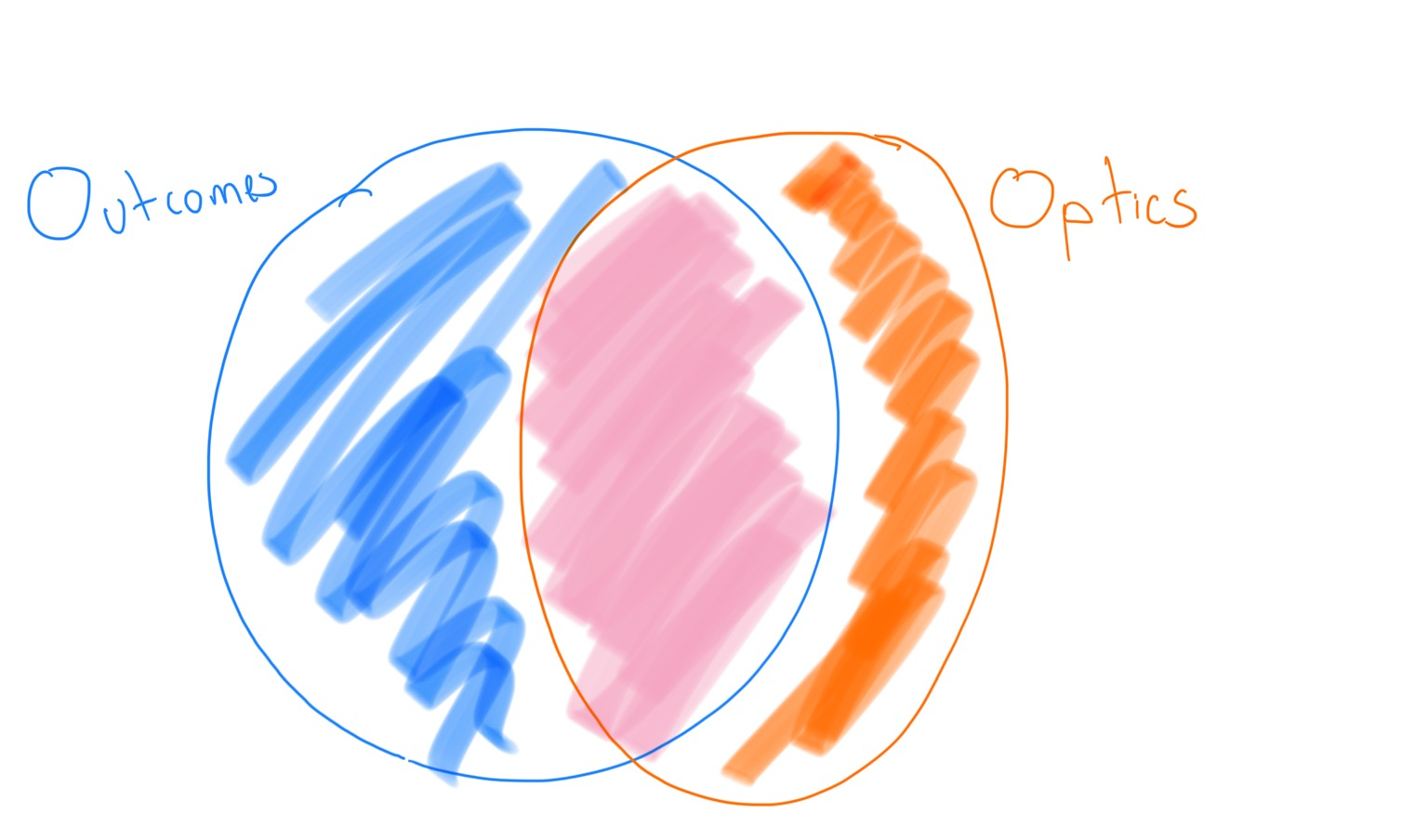
Incentivizing outcomes or optics?

These circles overlap to some degree in every situation. A minimal overlap situation might be the coder who wears sliders and hoodies and the banker who wears suits and slacks.

Outcome (noun): something which matters, is measured and measurable. Examples: sabermetrics, code, sales.

Optics (noun): something which might matter, however is unmeasured and unmeasurable. Examples: appearance, attention, cultural expectations..

Things which are difficult to measure will be evaluated by optics. In these conditions it’s best to maximize optics.

Things which are easy to measure will be optimized on their measured quantities. In these conditions it’s best to optimize.

Batman & BATNA (podcast)

This is a repost of this Substack: POV40IQ.

An inflation-adjusted chart of Global Box Office + Home Video compared to budget. All in millions. 

The inspiration from this episode was Tyler Cowen’s response to Tim Ferriss’s question: What would you put on a billboard? 

“If you look at billboards we actually have, what do you see on those billboards? The billboards I see a lot of them are advertisements for insurance. Some of them are, “Don’t drive drunk.” You see a bail bondsman on billboards and suicide hotlines. I guess I would study the market and pick one of those four things like, “Buy this insurance, bail bondsman, suicide hotline, don’t drive drunk.”

It’s to ask, what’s the business model? 

This episode covers a 1975ish onward look at the movie business model. Briefly sequentially, the movie making business model looked like this:

  1. National advertising plus national distribution (Jaws)
  2. ^ plus merchandise (Star Wars)
  3. ^ ^ plus home video (VHS then DVD)
  4. ^ ^ ^ plus more movie screens (everything’s bigger in _____)
  5. ^ ^ ^ ^ plus international 

The number of movies made and the kinds of movies made are the direct results of the underlying business model.

If you want EVEN MORE, there’s this pre-1975 look at movies as well as the John Cena apology.

Hurdle Technologies for Consumer Goods

“The truth was, we sold health and safety first, environment second and as an add-on, these products worked as well as traditional products,” said Jeffery Hollender, co-founder of Seventh Generation on HIBT, “We believed that in order to set ourselves apart, especially to new moms – health and safety was critical as well as the environmental benefits.”

In food safety there’s an idea called ‘hurdle technology’. Rather than a single preventative measure for keeping food safe, there are a series of ‘hurdles’ that pathogens must clear to make it into the human body. Preservatives, temperatures (extreme high or low), and acidity are all hurdles that can and are used.

The same idea applies to consumer products, though we don’t quite have the language to think this way. Each consumer has a series of questions they want answered before they decide to buy a product, though we don’t quite have the language to articulate this.

Winning wines, for instance, showed that people want something that tastes good (average), something with an interesting label, and some guidance about how to, or what to serve with. Every time I walk past the 19 Crimes wines I smile, they get it.

Rx Bars demonstrate that same idea. Are there grains? No, okay, next hurdle. Is it tasty? Yes, okay, next hurdle.

Framing a problem this way helps a lot because as companies develop products they can narrow down the issues. Also notable, like Barefoot Wine and JTBD of wine, there was a new set of consumers (young moms) that Seventh Generation served.

The Overrated and Underrated DTC strategies

In the book, Billion Dollar Brand there are two ideas which are widely misunderstood. The first is the idea that billion dollar direct to consumer brands like Warby Parker, Glossier, Tuft and Needle, Casper, Quip, Hello Fresh, and so on depended on viral marketing. This, is overrated. Many of the brands relied on traditional media to generate buzz, like the 2010 Warby Parker profile. Yes, there was the viral Dollar Shave Club video, but it’s not clear how much ‘virality’ kept an idea top-of-mind as much as legacy media plus the low-cost but high-effectiveness of social media advertising.

The more important aspect, and underrated part each brand’s success has to do with the stakeholders in each industry. One consistently good (though hard to execute) business strategy is to compete where incumbents cannot. Dollar Shave Club sourced low-cost razors and shipped them direct to the door, whereas Gillette could not upend the retail apple cart. Ditto for mattresses, cosmetics, and eyewear. The strength of retail distribution was also a weakness in the world of online-ordering-last-mile-delivery-services. Stakeholders affect the restricted action section.

But this isn’t the story. It’s easier to count views. It’s fun to flaunt the fabulous. It’s harder to structure an organization and create a culture.

There’s no single moment to point at and say: see there, that was the key pivot for Billion Dollar Co.. Rather, it’s a lot of little things. But some moments are overrated, which means expensive. And the underrated are cheap, which makes them valuable.

Why Hank Aaron’s father didn’t want a better house.

“I tried to get my father to move to a house I bought for him. There was one morning he was outside, trying to crank start his car,” Aaron recalls what his father said:

“Listen. I know what you’re trying to do. You’re trying to get your mother and I to move to that house you just bought. But we’re not going anywhere. All these people here, there’s not that many, maybe five or six families, these are friends of mine. I can wake up in the morning. I walk down. I can say hello to Stella, or whatever. These are friends of mine. I’m not going anywhere. So, you can take that money you paid for a house and get a refund.”

Aaron’s estimated net worth was twenty-five million dollars when he passed away, but this comment from his father shows value.

Jazzercise? Job-ercise?

“I was teaching in the morning, which tends to be a time when a lot of stay-at-home moms take a class. They would come and take a couple of classes and then I’d never see them again. I wondered what in the world was going on. I went and talked to some of them and they said they like it but they said I was teaching it like they were going to be professional dancers. They didn’t want that, but they did want to look like professional dancers.

That is Judi Sheppard Missett on the How I Built This podcast.

There are a few ways to find the JTBD. One is to talk to current customers. Another is to talk to previous customers. Bob Moesta says to talk to both. What the previous customers told Judi was that they wanted to look great and have fun doing it.

The whole episode is good because it highlights a systemic need: non-weight lifting exercise. People wanted a thing, and as is often the case, couldn’t articulate it.

Everything in our life seems obvious now but there’s always a change around the corner. Phil Knight wrote in Shoe Dog that runners were considered weirdos. Nobody exercised. There was a need there, and Knight and Missett both filled it.

Moesta says that he likes to see things as sets. Jazzercise then might be the set between fitness-fun-novelty-and-groups. Whatever your customer’s set is, follow Judi’s steps and go ask them.