Venn Thinking

I didn’t feel great. I knew why. I’d been eating like crap. It wasn’t the less meat. It was the summer junk food.

In Florida, under the guise of ‘hurricane preparedness’, we buy junk food. It lasts forever. It’s delicious. It never makes it to Peak Hurricane Day, September tenth.

So I cleaned up my diet, kept up the exercise, and got a good night’s sleep. After a day I felt great.

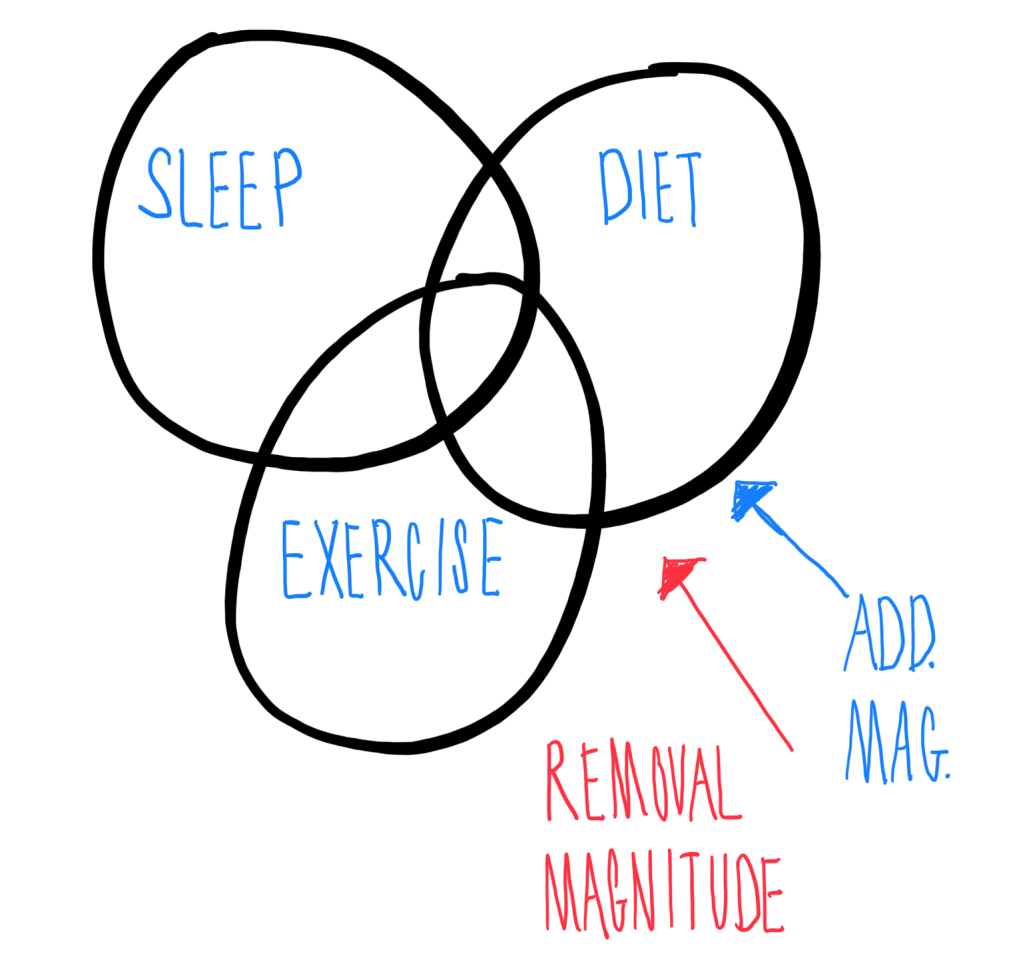
But this got me thinking. How many ideas are like this? How many Things in life are the culmination of a few different inputs? Marriage is some combination of money, resentment/enjoyment, love. Business is some combination of stakeholders, value delivery/value capture, and innovation.

Maybe each way to feel good, be married, or run a business is different, but each one probably has three or so legs to the stool with a sweet spot in the middle.

My other observation was the power of via negative. This is the idea that we can gain from not-doing rather than doing. Avoiding the wrong foods is more powerful than consuming the best ones. But removal is a brute force weapon. It does a lot of work but it only works to a point.

In the book Moneyball, Michael Lewis wrote that during the filtering phase of baseball draftees, Billy Beane would scarlet-letter-style mark players. If someone had a bad attitude or a run-in or some other glaring issue then they were a straight ‘No’. After removing those players, Beane et al. had to get to work on saying yes.

Venn Thinking is a visual metaphor: combine 80/20 thinking with via negativa. Ask, what are the key factors that drive an outcome (be careful of optics vs outcomes), then consider the brute force work of removal before optimizing on addition.

Alpha erosion and hot dogs?

Wharton Moneyball is a great podcast. The intersection of sports and business doesn’t do justice to the topics covered. Two events Moneyball does not overlook are the Kentucky Derby and Nathan’s Hot Dog Eating Contest.

During the July 2021 episode, co-host Shane Jensen asked if
it’s Joey Chestnut’s technique or some god-given gift that allows him to eat a record seventy-five hot dogs in ten minutes. Eating expert and co-host Eric Bradlow explained :

“They all do the same thing. Eat multiple hot dogs followed by buns dipped in water. Eat multiple hot dogs followed by buns dipped in water. Everybody, since Kobayashi started this strategy in the mid-2000s, uses this strategy.” – @EBradlow, Wharton Moneyball Podcast

Kobayashi’s creativity (and success) invited competitors. Alpha erosion is the idea that valuable advantages degrade with imitation. What was once scarce and valuable, is now abundant and worth less. Daryl Morey said that in the early days of basketball moneyball it was easier to draft players. By 2017 Morey noted how many other team’s draft boards looked a lot like the one in Houston.

But knowing alpha erosion exists and seeing it occur is not fait accompli. There are at least two paths: innovation and restriction.

Innovation occurs when an organization can deliver better products each year as judged by their consumers. Find the JTBD. The capacity for this is dictated by an organization’s culture. Does an organization allow for exploration, does it allow for an Innovator’s Solution. 

Restriction occurs when an organization can gain an advantage by acting in a way the competition cannot. Part-of-the-reason Dollar Shave Club and other DTC companies succeeded was because the distribution advantage of legacy companies was also a weakness. Gillette could not compete (as judged by the consumer) without upsetting the retail partners.

Restriction for an individual is to remove ego, which often opens new paths for competition success. Movie Producer Jason Blum demonstrated the success of the low-budget horror film and hasn’t suffered much alpha erosion. Part-of-the-reason, said Blum, is that people in show business like the rewards of the show part more than the business part. There are huge advantages for a person if they can look stupid.

Shoveling as many hot dogs into your mouth may not seems like a good idea. It’s probably not. But the lessons we get from it sure are tasty.

Search Tricks

One effect of all the great content creation is the long-tail effect. Most of what’s created, from business breakdowns to that seventies show, will only be consumed by a small number of people. The long-tail idea is also true for an individual. Any given day my consumption is family news, then local and regional, then a national service or two, my favorite feeds (related: The Three Ways to Spend Your Day) and then the long tail stuff.

I used to feel bad when good episodes appeared in my feed and I skipped them. That’s fine, it’s just a query away. Which brings us to today’s point: a few of my favorite internet tricks.

Twitter search is not great, but with a few search operators it gets better. Mostly this is from:@mikedariano “jobs”, which returns tweets mostly about jobs-to-be-done. This is especially helpful to do before tweeting at someone to see if it’s been addressed already.

https://twitter.com/davidklaing/status/1404314465403752450?s=20

Wikipedia. Google (IMO) has suffered due to the incentives. It’s not a big deal, but rather than having a higher trust threshold I now go right to Wikipedia for Wikipedia-style searches.

Reddit. In 1994 I was twelve and one of the best feelings was visiting a video rental store. There were super-interesting sections I could plumb all day, there were areas I had no interest (at that time), and a restricted section I did not investigate for fear of what was behind the beaded curtain and whether or not I could unsee what I saw. That’s Reddit. The best Reddit communities might be the best places on the internet.

Listen Notes. Nowhere is the long-tail evident more than Listen Notes, a podcast search engine. Recent deep dives into Sears, DTC, MTV, and behavioral science all yielded results I could not have Googled. After creating an account, add your query results to the Listen Later playlist and add that RSS to your podcast app. If that sounds complicated it was a bad explanation rather than a difficult process.

Crudely the future of work will be some dichotomy of I give computers instructions or Computers give me instructions. During the Sears research (via Listen Notes) I found out that their first mail-order system was terribly bad. One customer wrote to Sears asking for the sewing machine she’d ordered, she’d received four wrong ones. It was only when Sears centralized their operation in Chicago that the mail order businesses succeeded. In 2021 there are companies like Locus Robotics.

In the future Cal-Newport-Style-Work will be doing things computers don’t do. Computers solve predefined problems really well.

But computers aren’t creative. Computers can’t handle a bunch of conditionals. Computers can’t frame things. Computers don’t in Bob Pittman’s words, understand when this is another one of those. Using the internet well is using computers to do non-computer work.

There is a 70’s show, The Long Seventies Podcast, that’s pretty darn good. I listened to the oil crisis and MPAA episodes.

Will there be another “2020”?

Probably.

“The fact is we are a more interconnected world. The two main drivers of new pandemics are the two things that are being debated about the origin of this one: animal-human interface and dangerous laboratory work.” – @DrTomFrieden, Wharton Moneyball

But let’s consider the case for why there won’t be another 2020. Tyler Cowen writes as at least three different people: an economist on his blog Marginal Revolution, a contra-Tyler as Tyrone (also on the blog), and from a business perspective on Bloomberg. He aims to understand the same story from different sides.

Cowen’s colleague Caplan (Bryan) coined the ideological Turing test (ITT). Like the Turing test asks: can a person distinguish if an output is from a machine or a human. The ITT asks: can a person distinguish if an argument is from a person who believes X or not-X?

The legs of my argument point in the same direction as the March 2020 argument to ‘flatten the curve’. If everything I note moves 10% away from “2020” then the chances of another pandemic are greatly reduced. Only rather than lots of talk about flattening people will do it anyway.

Why there won’t be another 2020:

Technology. Teenagers are driving less and doing fewer drugs. There’s less movement across state lines. Look at screen times: they’re going up and time is a zero sum game.

Work has become remote, or at least can be. In the 1990s I first heard of “Blizzard Bags”. If there was an anticipated snow storm headed for Ohio, schools made up a day of work for the kids to take home. Now there are 40 million Google Chromebook in education.

I’m not sure the move digital all bad. Audiobooks for instance are a fine addition. YouTube teaches almost anything, maybe everything by the time you read this. “My internet friend” feels less and less weird each time I tell my wife. Some jobs are more productive online.

Salience. Experiencing a thing makes us overrate it (relatively). After a serious car crash I was a very conservative driver. Even now when it rains I slow way down, especially on the drag strips known as ‘Florida highways’.

Most people know someone who passed away due to Covid, who had their lives seriously stressed as a medical professional, or who (might) have long-Covid symptoms. It’s one thing to hear about an experience and another to live it and we all lived “2020”.

Experience. It’s crazy looking back. We did what?!?!? It reminds me of a grandfather-ism: good decisions come from experience and experience comes from bad decisions.

When someone starts they often copy someone. That’s fine. That’s how humans learn basic things. Then as that person figures things out they change their game (sports), pitch (sales), interactions (relationships).

That’s how the 2020 pandemic feels looking back. We had no idea what to do. Taking a page from a long-time Florida family member, we prepared as if a hurricane was coming through. Now though, we know more than we did. It’s hard to imagine personal, local, regional, and national reactions that are worse.

Medicine. March 2020 through March 2021 was not a good stretch for most, but look at the medical field and it’s pretty dang amazing. The virus was sequenced, the vaccine was created, tested, produced (!), and distributed (!!). Treatments improved. There are probably relevant discoveries we don’t even know yet.

Each of these areas: technology, salience, experience, and medicine offers the bare minimum case. Isn’t there even a good chance medical or technological advances leap forward? Even if they don’t, a small reduction in actions (more work from home, more masks, better medicine, more experience, etc.) will flatten the future curve.

Good organizations know there’s value to argue-well. James Mattis says to be “hard on the issues, not on the people”. Ben Horowitz said you want to be friendly but not so friendly you don’t ask the opposition difficult questions.

After writing this I believe this case more. How much more is hard to say. Maybe I’ve moved from from very likely to likely.


Eric Jorgenson has been writing a lot of about leverage and I guess this post is about leverage. My main idea here is that if many people change in a small way then there will be a substantial change. Erik tweets about leverage as people, time, or money. On the blog we’ve addressed this idea too but under the name Large N small p.
Protected Hours

Reading note, a bit over my skis on the banking culture here. Caveat emptor .

Researchers looked at how ‘protected hours’ (Saturdays off) worked for investment banks in New York City. Analyzing 16 million taxi rides, researchers found that bankers worked the same total number of hours, but did have Saturday’s off. There’s a few lessons in this.

1/ The feedback loop between outcomes and actions for aspiring-junior-bankers is loose. Unlike a coder, or salesperson, there’s not a clear pile of work or numbers to say ‘I did this’.

1a/ “Landers, Rebitzer, and Taylor (1996) argue that some firms may use willingness to work long hours as an indicator of some valuable, yet hard to observe, characteristics of employees.” So for starters, we might have the wrong proxies.

2/ Without outcome measures people substitute. Often this is looking the part. Punting on fourth down is optics. Suits are optics. Words rather than deeds or money, is optics.

2a/ However society is getting more numerate. That means we’ll measure outcomes more tightly: Amazon review, Uber ratings, credit scores, Zillow estimates, predictions.

3/ So we have loose feedback and have to do something. Okay, let’s use long hours. But not too long. And not on Saturdays. So we get a decree. However, we can’t do just one (eco-,social-, economic-) thing. An increase in one area cascades to others.

3a/ According to Nassim Taleb, small effects occur in Mediocristan (normal bell curves) and large effects will occur in Extremistan (fat tails, power laws, networks, complexity). There will be fallout from change and the system dictates the size. .

4/ You can’t do just one thing, part 2. In banks that didn’t adopt a protected weekends policy, there was also a decline in taxi rides to the banks on weekend. They guessed at a socio-culture effect. If they aren’t, I guess I won’t either.

5/ You can’t do just one thing, part 3. After a certain time, say 10pm, banks reimburse employees for taxi rides. Guess how late the employees decided to stay? Or maybe they just always finished after 10?

6/ Even though there are side effects, protected weekends aren’t bad. For one, it solves for ambiguity aversion.We don’t like not knowing.

7/ Mad Libs news is the effect which ambiguity aversion causes.Stonks are ________ [up/down] based on ________[news/tweets]_______ from [Elon/Mark/The President/The Speaker] about __________ [International issue, domestic issue, spiritual issue, political issue].

8/ Protected weekends solves for this. Junior bankers know more now than they did when they started: I’m probably working till at least 10 and I’m not working Saturday.

9/ The long hours also filter out people who really don’t want to do the job. Long hours in investment banking are the Peloton Christmas commercial: not for you. Unless it is. Then it’s really for you.

10/ Bottom line: protect hours are probably good, but like any intervention have unexpected consequences.

Zombie revenue

One tenant of jobs to be done is that people tend to be not great at articulating the scope of a purchase. For instance, in early June 2021 the lumbar support on my car seat broke. There are no plans to fix it, and this deficit will be some kind of non-zero explanation for when it’s time to get a new car. Will I reason with this later? Unlikely.

JTBD exists in these moments. One moment is when users hack a product. For instance 60 jail broken iPhone features became part of the iPhone. Or even Instagram, lauded for the design choices, drew from teenage boys taking screenshots of solid colors, adding text, and posting as the first polls.

Another according to JTBD father Bob Moesta is zombie revenue. Gym subscribers may make their model work but other businesses can find future fruitful funds in dead accounts. Basecamp, Moesta said, noticed that archived projects were zombie revenues. Customers didn’t need to manage something but they did need to access it and Basecamp created something for them.

Source: Bob Moesta
Full JTBD post.

Creativity, Conflict, and Choice

One skill rising in importance is choosing when to use technology. Circa June 2021, it’s pretty clear that technology does two things really well: repeated calculations and reductions in space. Rory Sutherland credits the Covid pandemic with normalizing video calls, a service wrongly pitched as the poor man’s travel rather than the rich man’s call.

Covid has also highlighted scientific accomplishments. What used to take a graduate student (or twos) career, now takes minutes. Via the BBC:

“When I was a young scientist we did this manually and it was very laborious. To get the sequence of a Coronavirus it would have taken at least a full graduate student’s career and maybe more. Now we can do it in a few minutes.” – Marilyn J Roossinck

But just because we can use tehcnolgoy to reduce distance or make calculations doesn’t mean we should.

In the room or zoom we noted Jason Blum’s opinion that to support creative things it helps to be in the room. That’s true for movies-creative but also for technology-creative. Ben Horowitz said:

“One of the things that has become clear is that remote work is more efficient than in-person work. But, there’s kinda a couple of things it’s probably not as good at. One is creativity and the other is tough conflict resolution.”

Work from home is different.

When explaining the idea of jobs-to-be-done, JTBD, Bob Moesta asks his interviewer if they like steak or pizza. ‘Well I like both’ they respond. ‘Right!’ Moesta says. Sometimes the situation calls for pizza and sometimes it calls for steak. That’s the kind of mindset good technology use calls for. What about a situation makes it better for the room or using Zoom?

Compromise or Coin Flip?

“And so the general mathematical way of thinking about this,” explained Vitalik Buterin, “is if you have A and B, and you had to choose between a compromise between A and B or a coin flip between A and B, would you take the compromise or the coin flip?”

Convex situations are x^2 conditions. These are coin flips. War, says Buterin, is a convex condition. It’s better to fight at A or B rather than A and B (Jack Reacher style). Travel during Covid is another. Host Julia Galef adds another, “as someone who took only two thirds of her course of antibiotics for strep throat at one point in college, I can attest to the all or nothing approach.”

Concave decisions are compromise. Omnivores are concave. Iatrogenics is concave.

Concavity filters advice. Any really great idea is too expensive to pay for.

There are always trade-offs. A or B vs A and B won’t always work, but it’s another idea to add to the mental toolbox.

Summer 2020 definitions

These are the additions to the full list below.

Advice (verb). A suggestion based on unstated conditionals.

Breath mint (noun). Candy with branding. See also: muffin/cupcake and flower/weed.

Groupthink (verb). Interpersonal incentives plus culture.

Reality index (noun). Via Dana Gioia. About his best teachers Gioia said, “They were older men who had served in the military in World War II. That had given them a kind of reality index about what the purposes of literature were.”

Two tickets and twenty dollars. (expression). From Thomas Tull noting that good marketing is to the people who are convinced. I could give my mother two tickets and twenty dollars and she wouldn’t go to this movie.

Sampling bias (psychological state). When a spouse asks, have you ever lied to me and you reply No, not that I can remember.

Previously:

We put a man on the moon but…. (expression). When people confuse the rules of one system for another. We put a man on the moon but we can’t fix the summer reading gap.

“If you really study it”. (expression) a signal someone hasn’t changed their mind but is willing to capitalize on the current trend. 

Assumption (noun): To make a theory into a law. This is not an issue because of Moore’s Law.

Middleman (noun). (1) the person who facilitates a transaction (2) the person screwing you in a transaction (3) the previous person who screwed you in a transaction, not this new innovator, no-sir not this new person, I will NOT ever complain about this new person. 

Sludge Audit (verb). Evaluating the red-tapes, hoops, and frictions in a process. I’m going to batch these customer feedbacks and see if there’s a theme, then I’ll conduct a sludge audit to see how our processes can be improved

Performance architecture (noun). The design of “structures to make better decisions and perform at optimal levels.” The last thing I do each day is write in my decision journal because it’s part of my performance architecture. 

Crash (verb). A drastic change in the market with negative effects due to one’s time horizons. The market crash means Bob won’t be able to retire in two years. See also: Correction.

Correction (verb). A drastic change in the market with neutral effects due to one’s time horizons. The market correction means Alice will be buying more Bitcoin and hodling. See also: Crash.

Franchise Fees (noun). Customer acquisition cost. Chipotle for example..

Konnikova’s Data

Park of poker’s appeal  is that people balance consequences and rewards. Thoughtfully in the best cases. But the lessons aren’t always obvious.

Nate Silver notes that live poker can be boring because participants don’t play that many hands. Yes, Maria Konnikova replied, that’s one way to look at it.

“There’s a perception that live poker can be boring because if you’re playing well you shouldn’t be playing that many hands. There is a lot of time you are just sitting there. But something I learned from Eric Seidel is that the times you are not in a hand are some of your most valuable opportunities to gather data.”

Konnikova recounts to Silver a time she was disposed as chip leader by an opponent who, after a day of play complimented her on her previous tournament. Why? It was televised. He picked up on her over aggressive style (something Konnikova notes in her book, I highly recommend The Biggest Bluff) in that tournament, and he used that against her in this one.

So rather than play as the thing-to-do, observe and learn are the things to do. Konnikova (and Seidel) reframed poker folds from something passive to something active. This is the same trick Annie Duke used for her poker clients. Duke reframed the action from playing hands to making good decisions.

Barry Ritholtz calls this the don’t just do something, sit there challenge. It’s hard to break the action-progress association. Yet there are situations, beyond poker, where not doing is more important that doing.

The basic level of learning a new thing is the advice to “just do it”. Just exercise/save/invest/read more. That’s difficult, especially without an anchor. A better way might be to substitute something of the same class. In the case of poker, Duke and Konnikova substituted one verb with another, and gave a reason for doing so.

I’m on a big pickleball kick right now and this advice, along with Winning Ugly from Brad Gilbert points in a clear direction: my game isn’t so much about hitting winners first but hitting winners second. A lot of my level is about setting up n+1 shots. Rather than beat an opponent down the line, with varying success, my aim should be to hit feet high down the line, move them, wait for a ‘green light ball’ and then hit winners. 

onward and upward