Practical engineering presented this video about the Hawaiian islands power grid. Like a lot of questions of the form: Why can’t we just… the answer is, it’s complicated.
Host Grady Hillhouse offers a new definition that helps to frame the issue (Words matter!).
Instead of talking about reliable power, talk about redundant power. If we frame things this way it sounds a lot better, and things that sound good are perceived as more true. Redundant power needs a rebranding. Rather than think about waste, the people of Hawaii can think of it as reliable.
This is Jared Dillian taking a brief detour in a post about Resentment.
I want to take a brief detour here and talk about how unproductive it is to try to control the entire universe with our minds. We worry about bad things happening, thinking that if we worry hard enough, that if we pray for a bad outcome, then it won’t happen. We resent other people, thinking that if we resent them hard enough, they’ll change and we will get what we want. Virtually all forms of non-heritable mental illness come from a desire to control other people and our surroundings. Virtually all forms of non-heritable mental illness come from an inability to accept other people and the world as they are. You can’t control your kid dropping out of college. You can’t control your husband letting out a loud fart when he gets out of bed in the morning. You can’t control the county when they hand you a property tax increase. You can’t control the airport that just rerouted flight patterns over your house. You can’t control who becomes president. The number of things you actually can control is shockingly small. You take the action, and you leave the results up to somebody else. That’s how this game works. Read this paragraph a few times. If you understand it and internalize it, you will never need a therapist again
–
Mike again, I just love that framing, control the entire universe with our minds. Right out of Maxims for Thinking Analytically.
My grandmother used to say call a spade a spade a lot. And she did. By the time I knew her, she was not afraid to speak her mind. She probably always was that way, only getting ornery as she got older.
One of our themes around here is to talk about the thing we want to talk about. Like Wharton professor Cade Massey interjects in his podcast, “let’s be precise“.
Another one of our themes is to think of things conditionally. Is something good or bad? It depends. Weaknesses are strengths and strengths are weaknesses (WAS A SAW).
Those ideas meet in Andrew Huberman’s podcast with Kelly Starrett, who (speaking about the human body) said:
“And I wouldn’t even say that weakness isn’t even the right idea. Just like here is a pattern that I’m not as effective at, as efficient at. So when we go into the gym sort of with this great curiosity, then it’s a really rich place and a really, frankly, the only safe place because there isn’t contact and sport and we’re not fighting and dancing and moving and we can really do this controlled formal movement where we can really see inputs and outputs.”
He’s talking about physical training but what a great idea!
It’s not that I lose my temper, but my impatience is a pattern that I’m not as effective at.
It’s not that I’m bad at math, but it’s a pattern that I’m not as effective at.
It’s not that my relationships at work are bad, but it’s a pattern that I’m not as effective at.
This framing also applies some ownership (another form of being precise). To take things back to Starrett’s conversation: our tight hamstrings are not a genetic pattern but something we can control.
For a science podcast, this episode (implicitly) covers a lot of spiritual ground as well as systems theory.
A helpful question to regularly ask is: What do these numbers really mean? I used to love looking through the Sunday Best Buy ad and comparing computer hardware. RAM, hard drive, monitor size – all catnip to a teenage boy in the 90s.
But what did those numbers actually mean?
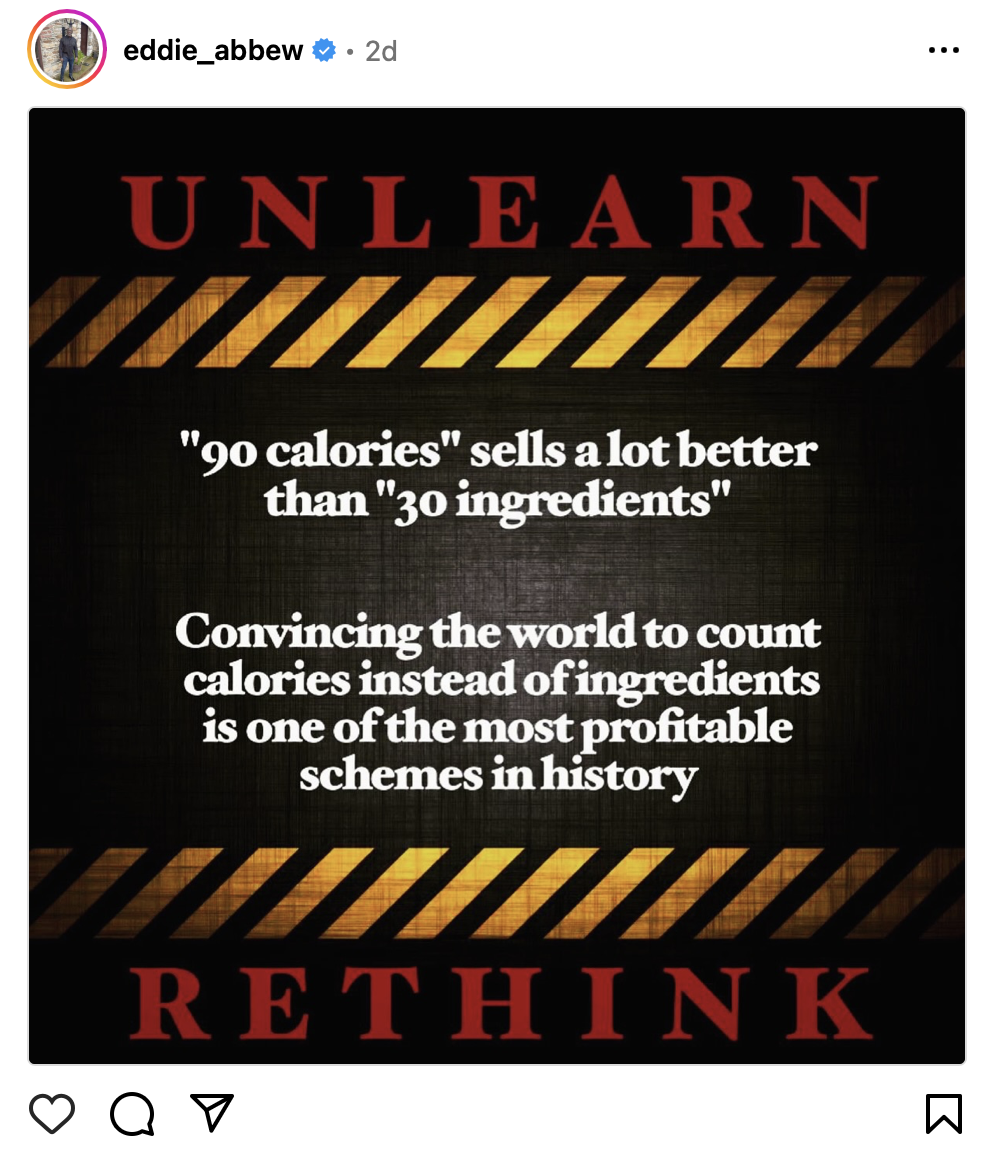
Jobs theory is about finding the meaning behind something. See “90 calories” and, click-whirr, must be healthy. That’s the meaning we associate. But is that the right connection?
Or is Eddie correct? Is number of ingredients a better signal?
Metrics, numbers, figures — whatever our attention catches is not accidental. Someone chose that, they framed the context around that scene. It’s up to us to ask, is this right?
On June 20 1975 Jaws was released in theaters. The iconic movie broke ground in a lot of ways. Most notably, it was the first summer blockbuster. After 1975, summers in America would never be the same.
And it almost never happened.
Jaws was a difficult movie to film, mostly thanks to the shark animatronic.
Some people know that Speilberg named the shark ‘Bruce’ after his lawyer – but that’s not what he called it on set. There it was known as “the great white turd”.
It didn’t work.
And when it did work it looked terrible.
It was a blessing in disguise.
Sitting in the editing bay with so little usable footage, Speilberg had to rely on mystery, ambiguity, and John Wiliams’s stunning soundtrack. Viewers were left to imagine the shark and in their imagination is where the danger lies.
Obstacles arise. Problems grow. Things are not the way we imagine.
That’s okay. It’s just another problem we can solve.
I only failed one obstacle and fortunately the penalty was a loop through muddy slop rather than burpees.
It was a dumb mistake.
One of our human tendencies is that we think we’re pretty good about solving related but different problems. But we often overrate our skills. Someone makes a lot of money but that doesn’t mean they can make more money in a different way. Doctors are not good investors.
But there’s an easy solution.
My mistake at the Spartan Super was The Box. The “deceptively simple” obstacle is an eight foot wall one pulls themself over.
Or so I thought.
And here’s why it was a dumb mistake.
For another obstacle, the Rope Climb, advisors teach the j-hook. A certain ankle swoop, lift, and step makes a rope climb like walking up stairs. I was worried about the rope climb – a not “deceptively simple” challenge – so I practiced the j-hook with a blanket while laying on the couch.
And it worked. The Rope Climb was easy.
But did I use the j-hook for The Box? Nope.
Why not? Because it was a box, not a rope climb.
How we frame a situation sets how we see the situation – and how narrow we can be! During the same race, maybe 25 minutes apart, I didn’t connect the dots. I was stuck thinking in the wrong box.
Another point-of-view can be worth forty IQ. So the next time I’m stuck, I’ll get out of the box, and try to see things differently.
The mechanism might be framing. Look at the same situation from a different set of experiences, expertise, or mindset, and the possible solutions shift.
The not us but them point of view. Peter Attia used to be a very angry man. In his podcast with Andrew Huberman, he doesn’t elaborate on how just that he had a “raging” fire inside. He’d be hardest on himself.
Try this Attia’s therapist suggested when you make a mistake, record a voice note on your phone about what you would say to a friend if they made that same mistake. Bingo. Peter’s comments softened. He was kinder to a friend than he was to himself. The effects were immediate. What had been a (hurtful) lifelong trait was gone in a few weeks.
The not us but it point of view. Clayton Christensen wrote, “We are here to explore not what we hope will happen to us but rather what the theories predict will happen to us, as a result of different decisions and actions.”
What does the theory predict? It’s a helpful abstraction in our personal lives because we err toward the fundamental attribution error. We dismiss luck in our successes and credit it in our failures. It’s never us.
Theory removes that. Our ego stands on the sidelines as the theory moves up and down the playing field.
The not us but an engineer. The best part about being a good engineer, teaches Mark Rober, is that it makes you a good anything. Engineers are another profession problem-solving example.
That’s what Katy Milkman found too. As an engineering major, she complained to her fiancé about going to the gym. He suggested she pull a Watney and engineer the shit out of it. Milkman started with the basics, If/Then statements. If I go to the gym, she told herself. Then I get to listen to this audiobook or watch this television show.
…
Framing works. It works for others. It works for us.
Framing works. It’s easy. It’s free.
Framing works because it forces new thoughts. I never thought of things that way.
In Thinking Fast and Slow, Daniel Kahneman writes about the planning fallacy. He’s in a group of professors tasked with writing a textbook. Each proposes a timeline. Each is confident. These are well-established professors after all.
But then Kahneman asks a group member who actually contributed to a textbook: How long did that take? Hmm, he thinks, never less than our longest guess.
It’s a ‘textbook’ planning fallacy. We error to optimism. Michael Mauboussin thinks of a home remodel. The neighbor’s project has delays and cost overruns but ours?
I know this. I’ve written about this for more than seven years. I make this mistake.
Our daughter’s high school is planning choir trips. The possibilities include Pigeon Forge, New York City, and Northeast Ohio.
Ohio, I exclaimed, that really stands out.
Yeah, my oldest said, we might go to Cedar Point.
Cedar Point? That’s awesome! How is that on your teacher’s radar?
Maybe, my wife said, he’s from Ohio or a member of the coaster club.
Oh, I said, If you’re going to Cedar Point I bet he’s a member of a coaster club.
…
I started with my inside view. Another approach is starting with the outside information and shifting from there: Kahneman’s textbook author, Mauboussin’s neighbor.
I grew up in Cedar Point. We know people in coaster clubs. That was my inside information. Upon inspection, it looks like <10,000 people are members of such clubs.
Thinking in base rates (or like Fermi) prevents my error. Are there more people from Ohio who move to Florida than people in coaster clubs?
Change the framing, change the process.
…
I can still hear the ‘thank you for visiting America’s roller coast’ before clacking up the Magnum hill, feeling excited, enjoying the view and the breeze, marveling that something so tall can be so narrow, and feeling my stomach lift through my torso.
Alice runs her team conservatively and finishes with 17 wins, 17 draws, and 4 losses.
Bob runs his team with more variance and finishes with 19 wins, 11, draws, and 8 losses.
Which is better?
Let’s reframe, like the ball bet. Is it better to exchange 2 wins for 6 draws and 4 fewer losses?
Haralabos ‘Bob’ Voulgaris bought a soccer team because he knows these answers because he’s seen these questions.
After Moneyball but before Morey-ball, Haralabos discovered and gambled on basketball inefficiencies. The best known now is the three-point shot. Voulgaris thinks that soccer is similar. Teams earn three points for a win, one for a draw, and zero for a loss. Rather than three or two points in basketball, it’s three or one points in soccer standings.
Soccer’s business model is like the music business model. Artists lose money recording an album, break even touring, and profit from the merchandise. This had to be Pixar’s business too. Division three soccer teams lose money, division two teams break even, and La Liga or Premier League teams “print money”.
Soccer teams can move up (promotion) or move down (relegation). Bob’s team, CD Castellón is in the third division and they need about sixty-eight points for a chance at promotion.
Both Alice (17/17/4) and Bob (19/11/8) earned sixty-eight points – but they don’t seem equal. This is Bob’s point – it’s worth risking more for wins than less for draws.
The big question is: What are the right metrics for this system?
Hurricane wind speeds are probably the wrong metric. Though easy to measure they don’t convey the potential storm damage which comes from the rain, surge, and flooding. Moneyball and Morey-ball are both descriptions of systems where the important metrics shifted.
‘Draws’ is a wolf in sheep’s clothing. It seems fine – splitting the difference between a win and a loss – but the unique point system shifts the weight.
Risking more – Bob’s approach – focuses on what matters. It’s the points stupid.
Humans are loss averse but the soccer standing scoring rewards bucking this trend. Alice and Bob own soccer teams, let’s see what happens.
Warning: use these tools wisely, they can keep nieces and nephews busy for hours
What is the sum of all the numbers from 10 to 1? That’s difficult.
One repeated theme – because it works! – is reframing. The same information but a new presentation changes our understanding.
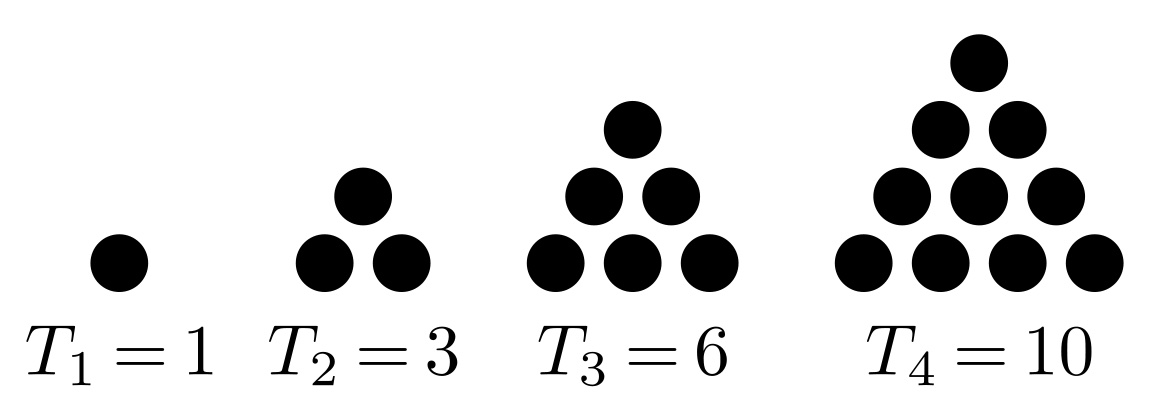
What is the sum of these numbers: 10, 9, 1, 8, 2, 7, 3, 6, 4, 5? That’s easier. Reframe again, this time visually.
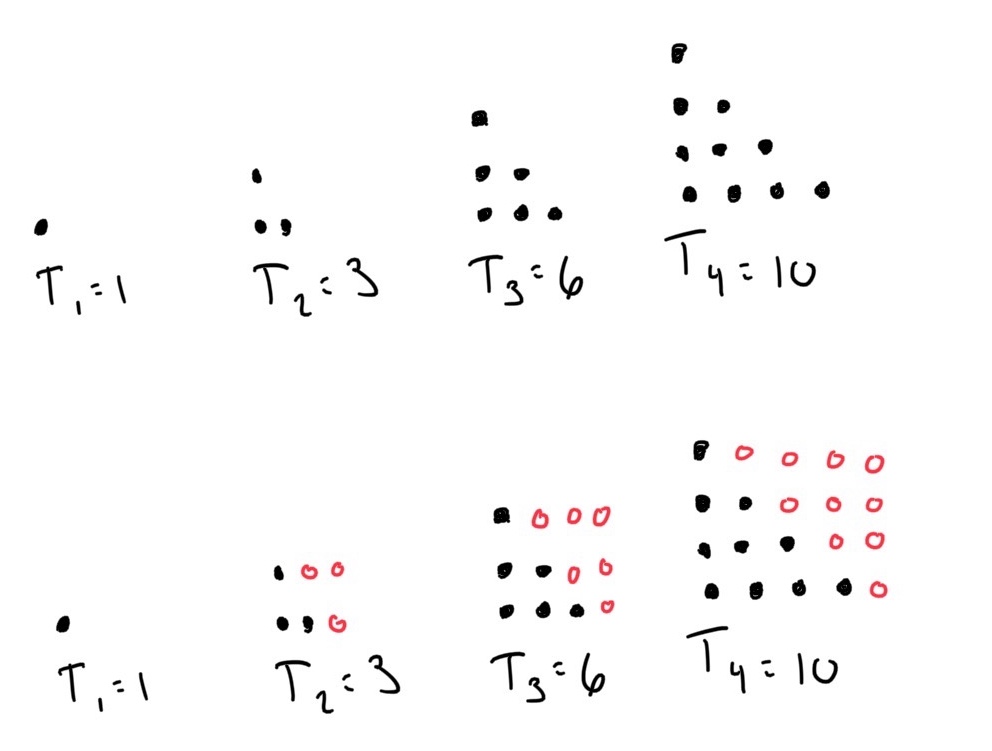
Each what is the sum question can be framed as a triangle. But reframe again, first to staircases, then as pairs.
Doesn’t this feel like magic? The universe presents this little nugget (What is the sum of all the numbers from 10 to 1?) and rather than slog through we skip over. Reframing numbers into shapes changes our tool from addition to multiplication. Magical. We went from brute force to clever pairing to formulaic: (n*(n+1))/2.
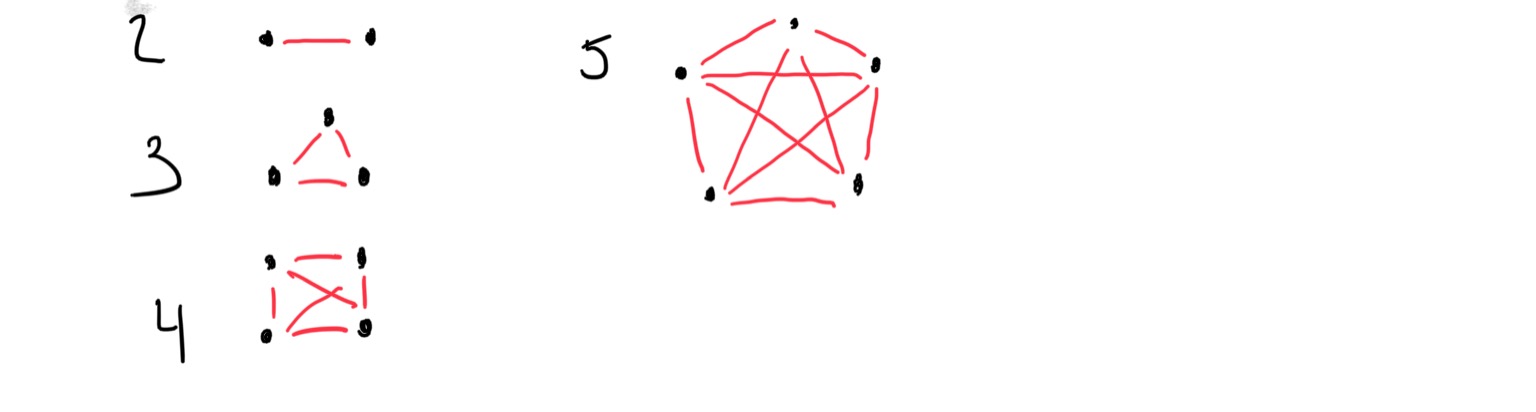
Another question: In a group, how many handshakes must occur for everyone to shake everyone else’s hand?
Two people have one handshake. Five have ten connections.
Like triangle numbers, it’s almost the same math! Rather than counting the dots, we want the connections. Rather than (n*(n+1))/2, the formula is (n*(n-1))/2.
It’s not only handshakes to count but games in a round robin, cables to connect computers, and shared birthdays.
In a group of 31 people, what are the chances any two people share a birthday? Thirty-one is a good number because it frames our thinking. “That’s like one month, so one-in-twelve”.
Ha!
The chances are closer to three-in-four thanks to our connections.
There’s a 99.7% (364/365) chance two people have different birthdays, (.997)1 (connection). The chance of five people having different birthdays, (.997)10, is 97%. Even the chance ten people have different birthdays, (.997)45, is 87%.
But keep going. Thirty-one people have 465 connections and a 25% chance of differing birthdays.
Every day on Twitter, the joke goes, someone is the main character – and you don’t want it to be you. Something is always happening because of this birthday/games/handshake structure. It’s easier not to get wrapped up in “this headline” knowing there will always be headlines.

 The Waiter's Pad