Rotten and Fresh Jobs

It was May 16, 1999 and Star Wars: The Phantom Menace arrived in theaters.

The return of these Jedi is told in the Batman Batna post. This anniversary is a chance to celebrate a JTBD example from that era.

“Nineteen ninety-nine is when things really began coalescing…(Star Wars) episode one was a big kickoff point for the website because that’s the movie that everybody was anticipating, and coincidentally reviews-wise it was riding the line between fresh and rotten leading up to its release. People were sharing the Star Wars page in anticipation of its release.” Stephen Wang

The public asked, is it good?

The critics answered….

Movies, Roger Ebert wrote, “are a machine that generates empathy…movies let you understand a little bit more about different hopes, aspirations, dreams, and fears. It helps us to identify with the people who are sharing this journey with us.”

That’s true!

But it’s not what people want.

Movie critics, like Ebert, understand movies in supply language.

Movie viewers, understand movies in demand language.

Rotten Tomatoes succeeded by translating one language into another. Businesses have to find a fit between the supply and demand aspects, between what they can do and what people want done.

🍿

Three Bob-isms

This is from The Circuit Breaker reset email. It’s my tribute to Jobs theory using the podcast by Bob Moesta and Greg Engle as a base. When their podcast is on, the newsletter will recap, summarize, and provide additional links. When their podcast is off, like now, it will keep the good times rollin’.

Subscribe here -> https://thecircuitbreakerpodcast.substack.com/

Unpack here -> https://thecircuitbreakerpodcast.substack.com/p/postseason-2


The Secret Language Of “Bob-isms” introduced three Moesta mantras. These are BIG ideas with later explanations. 

Your product is the mustard, not the sandwich. Bob met with members of TransUnion who were proud of their product: credit scores. No, no, no begged Bob. People do not care about their credit scores. They care about buying a home or a car – for that, they need a credit score. After this Moesta meeting, TransUnion teamed up with businesses that helped customers make those purchases. 

Context creates value. Baby carrots were created to help with cooking but when the product was tested, consumers wanted them for snacking. That context: I’m at home and want something healthy, easy, and tasty to eat or serve created a category and most carrots sold today are baby carrots. The End of Average discusses this idea further.

Contrast creates meaning. Consumers are okay-ish at communicating importance. Asking “What do you want” isn’t helpful. Instead, Bob and Greg use contrast and bracketing. Is this for you or you and the family? Did you drive or fly to the hotel? So this was too expensive/cheap or long/fast or sweet/salty? When people eliminate options they share what’s important. 

Homework: Continue to do Jobs thinking. Reply to this email or share in the comments with the slightest idea.

Mother’s Day Gifts

American households spent $175 on Valentine’s Day.

I gave cash.

A stack of twenties seems like an odd and impersonal gift for a valentine, mother, or a friend but even cash serves multiple jobs.

My wife appreciated the cash not for the money but for the convenience. It meant one less trip to the ATM, one less IOU when a co-worker’s kid had a fundraiser, and one easier way to pay at McDonald’s.

Thinking about convenience is a way to think through jobs to be done.

Buying a shirt for dad can be a gift of convenience as well. If dad doesn’t like shopping then a new shirt and no trip to the store is a double gift.

Okay, but I don’t know what to get. That’s fine. Practice your jobs-to-be-done thinking and consider the context. When does someone feel rushed? Is it early or late in the day? Is it before work, church, or something else? Who else is there? What creates the pressure? Is rushed the right antonym for convenience?

Explicit digging may not work, instead, inquire softly. Act like a documentarian. Be curious, not judgmental. Get mom a great gift and practice jobs thinking. That’s a gift for both of you.

All Barkers, No Biters

Our local bank sponsored a stand at a local fundraiser. Use our debit card the barkers offered, and we’ll donate ten cents to the local school’s scholarship fund

Our local school is great. Every graduate gets a scholarship based on the number of years at the school. 

The bank didn’t have many takers. 

How to solve this problem? Ask Chat GPT!

Meh. Fees, poor service, better offers or rates elsewhere, relocation. 

Not that helpful. 

According to Jobs theory, the aim is to understand the context, casual structures, and forces of progress. “Don’t think it works,” says Greg Engle about Chat GPT, “just because it spits out an answer.” 

As of April 2023, the best way to think about Chat GPT (or maybe any answer!) is as the tip of the iceberg. Good copywriting is based on the part of the iceberg we don’t see. So is Jobs. It’s why the barkers didn’t get many biters. 

We’re just a bunch of blind men around the elephant. Be curious. Explore. Seek the other parts. Dig in. 

Want more Jobs theory? Subscribe to The Circuit Breaker Recap newsletter. 

Cheerios JTBD

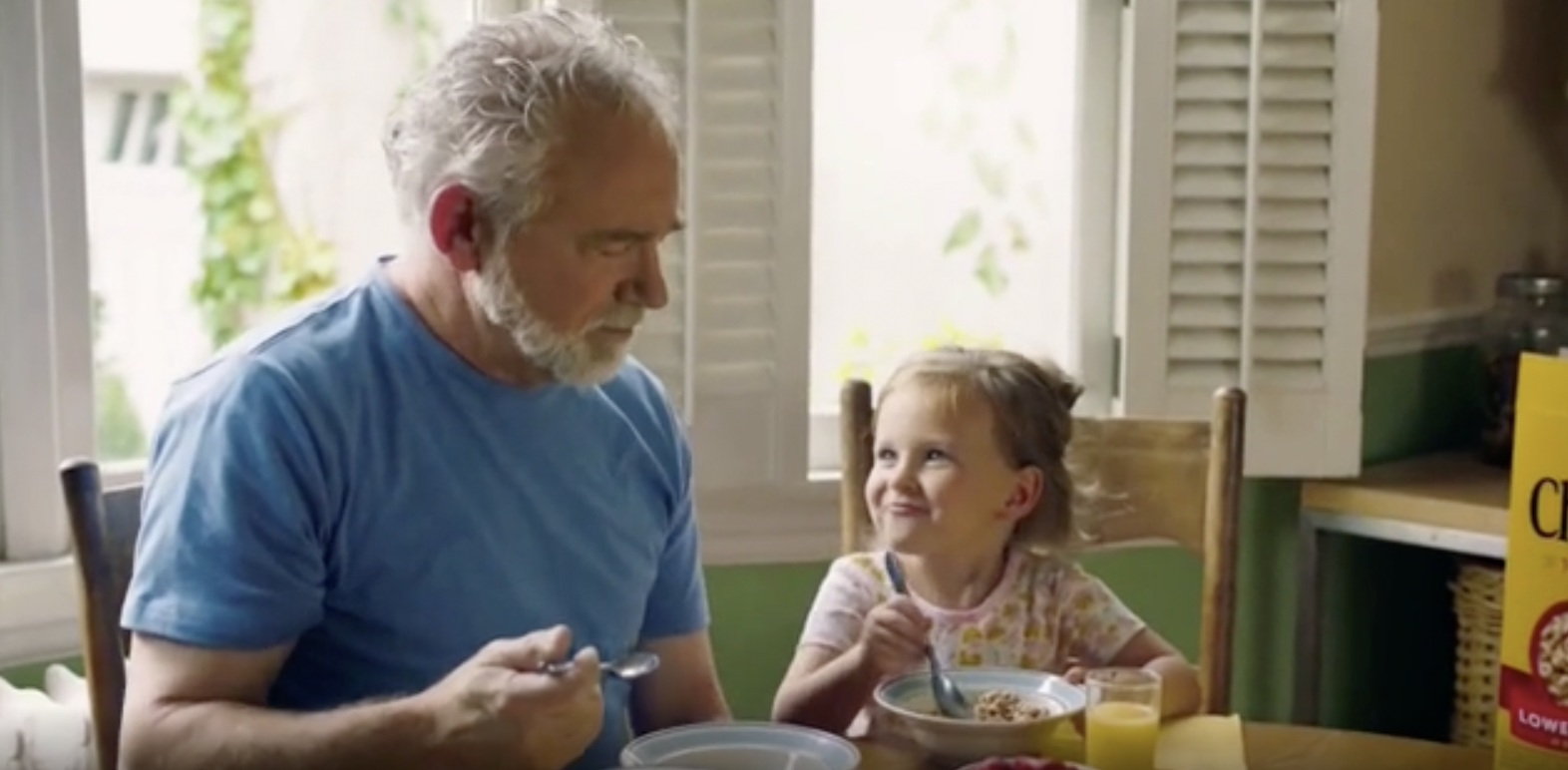
“Don’t eat them for the 100% whole grain oats. Don’t eat them because the oats can help lower cholesterol. Eat them for her.”

Cheerios commercial, 2023

The good. Jobs-to-be-done uses “Mario marketing”. Sell the power, not the flower. Why is ‘being healthy’ a goal? It’s to spend longer with your granddaughter.

This ad ran on a Wednesday morning in Florida. Who is watching television? Retirees. This CAC is money well spent.

The bad or the confusing. None, it’s a good advertisement.

🧐

One of the best ways to get better at something is to do it.

One of the best ways to get better at some thinking is to notice it. The human tendency to confirm beliefs is generally useful. So be curious. Give something a name and label to your experiences.

A Monster JTBD

One of the best-performing stocks of the last twenty years – a famed 100-bagger – is Monster Energy.

Why didn’t we see this?

If you want to succeed at investing, Howard Marks wrote, you have to be different and you have to be right. Embedded in that is the notion that being different is hard.

If different was without social, financial, political, emotional, or mental costs then everyone would do it.

😕

Monster Energy faced at least two of our common business headwinds. First is the TiVo problem. Can an innovator (like Monster) gain distribution before market leaders with distribution (Coke, Pepsi, Anheuser Busch) gain innovation?

It’s remarkable that Monster succeeded. Their competitors already made sweetened caffeinated beverages. They already managed brands and distributed millions of liters of fluid to every gas station, bodega, and grocery store across the country.

The second is category creation. If you can’t be first, notes the second Immutable Law of Marketing, create a category where you can be. Buy-now-pay-later, fast-casual, on-demand-storage, and hard seltzer are all examples.

But the ‘energy drink’ category had a market leader: Red Bull. Not only that, the market leader had existed for nearly twenty years before Monster Energy began.

So what happened?

🍸 🆚 🥤

Sometimes the category isn’t the competition. Snickers and Milky Way don’t really compete. Honey Baked Ham, Chinese restaurants, and ordering pizza are all holiday meals but not many consumers debate between those three. It’s homemade or Honey Baked.

“Red Bull and Monster consumers are unique. Red Bull went after the extreme consumer but early on focused on on-premise service: bars and restaurants. As a result, it morphed into what I would consider a white-collar beverage. Partly because of the premium price, partly because the smaller can…Monster decided on a 16oz can – the same price for twice the volume and marketed it towards more blue-collar workers. They also focused on palatability, especially from a sweet standpoint.”

Mark Astrachan, Odd Lots podcast

That ‘Monster’ can was a focus group suggestion.

A canonical Job-to-be-done example is the McDonald’s milkshake. The five-minute clip of Clayton Christensen is worth watching and the explanation probably mimics hiring Monster. It’s sweet and caffeinated. It’s large, so it lasts. It also means something to the consumers. Here’s a Google Trends map from January 2023.
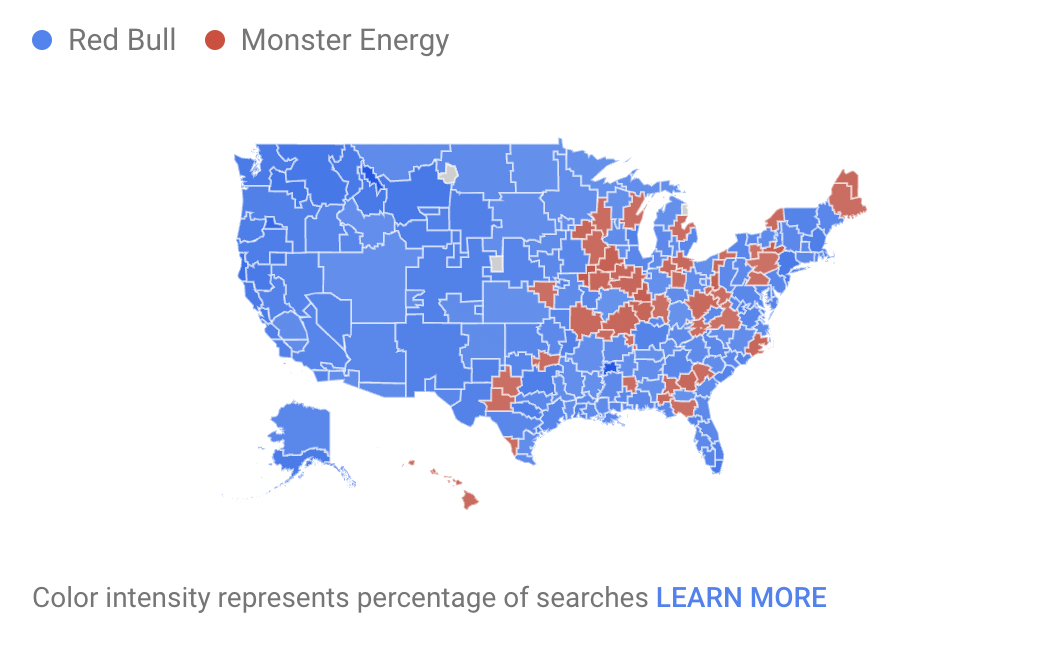
There’s something about Pennsylvania through West Virginia, Ohio, Kentucky, Tennesse, Arkansas up through Missouri, Iowa, and Wisconsin consumers. Monster Energy tapped ‘that thing’.

📚

Related: Bitter Brew tells the story of Anheuser-Busch’s history. For God, Country, and Coca-Cola tells the story of Coke and highlights the importance of distribution advantages as Coke employees were the rear guard of the Allied forces marching across Europe in 1945.
The birthday cake’s JTBD

One question within jobs to be done is: Are the consumer and the customer different? 

A manager who buys software or uniforms or food for their staff is the customer whereas the staff is the consumer. And this happens a lot. 

Homeowners use thermostats but HVAC companies buy them. About one-fifth of books sold are gifts. Physicians choose the medicines that patients take. And then there is the birthday cake. 

“We aren’t making nearly as many of our decorated cakes as we used to. When we do, it’s a half sheet instead of a full sheet or even nine-inch cakes. In our Chicago industry, we’ve seen a drop in decorative cakes mostly from the people who are in their twenties and thirties who don’t want to buy the same things for their kids that they got when they were kids. They want ice cream cakes or experiential things instead of having a birthday cake at home.”  – Ken Jarosch, Odd Lots, December 2022

If the customer and consumer aren’t aligned then a business gets what Bob Moesta calls “zombie revenue”. 

Gyms run on zombie revenue because the customer, the current me, is different from the consumer, the future me. 

Products are not: build it and they will come. There’s much more why, how, and when – even at a kid’s birthday party. 

Birthdays are common posts around here: The Birthday Cake Diet and The Birthday Bet.

NBA’s broadcast innovation dilemma

Disruption theory (2:00 minute YouTube HBR explainer) describes how leading companies serve their customers through product improvements rather than invention.

Keurig’s innovation was capsule coffee and sustains their company with ideas like Brew ID which “recommends recipes with easy step-by-step instructions.”

It’s an innovation dilemma because sustaining innovations makes the money printers go brrr, like at ESPN.

These sustaining innovations fail when the customer Jobs-to-be-done changes.

“We started doing it for free,” Nate Duncan said on Wharton Moneyball in December 2022 about his NBA Strategy Stream show, “with the idea of eventually doing something like this back in the 2016/2017 season. We did it pretty much unpaid – our Patreon subscribers would throw us a few bucks but they weren’t obligated to – and we just built up a lot of reps doing it in the bad old days.”

Think about that. Duncan and his partner Danny Leroux worked “pretty much unpaid” to broadcast NBA games.

But they found an audience. They found an adapting JTBD.

Disruption theory also describes how leading companies can create both sustaining and disruptive innovations. One aspect is a separate P/L. But that takes financial, temporal, and status capital. Within any organization, what executive is going to suggest an unprofitable bet to create something people might want? No way.

But that’s disruption theory.

Should you build *magic*?

When talking about Jobs To Be Done, Bob Moesta notes that there are two ways to innovate. Supply-side innovation is internally driven. Organizations know their capabilities, limitations, and business model and build from that position. This type of innovation is more efficient, has limited scope (and costs!), and uses the language of the organization.

Alternatively, demand-side innovation is externally driven. Jobs theory is demand side as is the Mom Test and IDEO’s invention through iteration. This type of innovation includes prototypes and feedback, lots of questions, and uses the language of the customers and consumers. 

“Any sufficiently advanced technology,” Arthur C. Clarke wrote in 1962, “is indistinguishable from magic”. 

That quote highlights this aspect. Technology users want it to feel like magic. Builders use advanced technologies.

Face ID is magic. 

“What Apple did with Face ID was take a really hard computer science problem, and using a lot of complicated technology, create something with a simple name. I intuitively know what Face ID is just from the name. It’s also intuitive to use. I looked at it and was in. There’s an opportunity to do something like that (for crypto). Multiparty computation is not the right marketing term for what the average person might use.”

Brian Armstrong to Ben Horowitz. 

Uber is magic. 

“At first glance Uber might just look like a simple app—after all, the premise was always to hit a button and get a ride. But underneath its deceptively basic user interface was a complex, global operation required to sustain the business. The app sat on a vast worldwide network of smaller networks, each one representing cities and countries. Each of these networks had to be started, scaled, and defended against competitors, at all hours of the day.”

Andrew Chen, The Cold Start Problem.

The wrong lesson here is to think customers want magic. It’s situational! Shopping and buying are different

There is no best way to innovate, only trade offs. But Clarke gives us a nice framing for technology.

ESPN’s innovation dilemma

One pant leg on is a local maximum. One problem is solved but the larger set is not.

Clayton Christensen’s series on disruption and innovation is about local maximums.

Money machine go brrr is a strong incentive to keep printing. Maximizing a profitable business makes sense, which is the dilemma! Organizations find themselves looking good in one pant leg.

The solution to local maximums is exploration. But this is costly – money, status (uh oh), time, reputation. Plus the stakeholder’s opinions.

The solution, Clayton Christensen writes, is separation. Different groups with different strategies, finances, and when possible physical locations.

Solutions via exploration are important because customer and consumer preferences – their JTBD – change.

“We are all under the Disney umbrella,” Brian Burke said, “ESPN.com is a huge enterprise with an army of people and is a revenue generator in so many ways. It’s difficult to change course. FiveThirtyEight is agile, nimble, and experimental so (publishing there) was a great opportunity”.

ESPN.com go brrr.

Which is the dilemma, and Disney/ESPN uses FiveThirtyEight as the exploration solution. Who knows if Burke’s writing approach is better, but the publishing strategy is a solution to the innovator’s dilemma.

“The next ESPN.com” will be different. Whatever is next will have a different business model than the current Great Firms (Christensen’s subtitle). Whatever is next will have a different maximum. It will be a short vertical video or the degradation of the sport monoculture or something we can’t predict today.

Or even an analytic forward analysis from Brian Burke.