Reliable means redundant

Practical engineering presented this video about the Hawaiian islands power grid. Like a lot of questions of the form: Why can’t we just… the answer is, it’s complicated.

Host Grady Hillhouse offers a new definition that helps to frame the issue (Words matter!).

Instead of talking about reliable power, talk about redundant power. If we frame things this way it sounds a lot better, and things that sound good are perceived as more true. Redundant power needs a rebranding. Rather than think about waste, the people of Hawaii can think of it as reliable.

Airport tradeoffs

Every ten minutes someone spends in security reduces spending by 30%. The WSJ video goes on to explain how airports are redesigning to include more commercial spaces.

But what I really enjoyed about this video is the emphasis on trade-offs.

Airports have to manage a whole bunch of things. Safety and security. Movement of giant entities and human beings. Navigation by experienced and inexperienced users. There’s a lot!

Which means there are choices to be made. Denver International Airport has three island concourses. This is great for planes. But not as great for passengers. How aesthetically pleasing can an airport be (which makes people feel better) relative to how efficient so that everything operates more quickly (which also makes people feel better). Don’t forget, it’s all about feelings.

Jobs Theory requires a laser-like look at the tradeoffs. Classically Bob Moesta asks: why do I want a hot dog and when do I want a steak dinner? Those answers are the first step along the path to what destination: the tradeoffs being made.

What are you reinforcing?

Chef John said something interesting while making Turkish scrambled eggs.

During the final phase, he added an extra bit of olive oil. “Since it looks good and it tastes good, and you can’t use enough olive oil in your ________.”

Now, what is the next word? How does he fill in the blank?

He says cooking, and I expected diet.

I’m reading a lot of Justin Skycak (long live blogs as rabbit holes) for a class I’m teaching and he emphasizes our long-term memory connections. Things we regularly recall become encoded more strongly.

One way or another, I’ve encoded olive oil is good for your health rather than, olive oil is good for your cooking. 

It’s good to bump into the edges of our reality. It’s good to be reminded of new things. And it looks good to eat Turkish scrambled eggs.

Distribution Channels

Three stories, the same message.

How Glen Powell ended up with the role of Hangman in Top Gun: Maverick.

How Estée Lauder ended up in Harrods.

David Senra tells the story in Founders #217. First Lauder goes to Harrods. No one talks to her. So, she thinks a little media attention will help. She does some interviews, goes back to Harrods, no one talks to her. She returns to America.

Lauder returns a year later. She asks. ‘No’. More media, she asks again, ““she talks to the same buyer. This is a year later. She was not as quite as hostile, but she says, let me tell you, I have no room here as I told you before, she said, but perhaps I could take a tiny order and put it in with the general toiletries.”

More media, and the customers started to show up.

How Kind Bars ended up in Walmart.

Daniel Lubetzky’s path to starting Kind was long, wandering, and full of two-steps forward one-step back moments. One was the first time Kind got into Walmart. It wasn’t in the bar section. It wasn’t in the health foods. It was in the candy bar section.

This was disappointing but a blessing in disguise. Kind lacked the organizational structure required for serving large customers. The bars took a long time to take off – which was good. Once they did Walmart and Kind ended their partnership. It was too much too soon – but a lesson in what the company needed next.


Everyone is a genius in a bull market, but is it easier to choose bull markets than be a genius?

MRI Jobs

An older story but still good and still important.

Doug Dietz spent the last two years designing a new MRI machine and he goes to the hospital to see check on it.

“I noticed a father lean down and tell his daughter, ‘Remember, we’ve talked about this, you can be brave.'”

Doug follows the family into the room, with his new machine. “And she just freezes.”

The walls. The lights. The machine. The warning signs. “The little girl just starts to cry.”

Jobs to be done implores creators to create things from the perspective, needs, goals, and wants of the consumers, not the suppliers. From Doug’s angle, the hospital is the supplier. *Make something bland, generic, efficient.* There’s no flare – that’s expensive.

Yes, the consumers want some things that the hospital also wants: Make people better.

But these parents also want their daughter to stop crying. They don’t want her to be afraid. They want to her smile. They want the same thing we all want for our kids.

After seeing this scene, Doug got back to work and made this MRI machine next.

From IDEO U

Kelly Baked (ham) Copywriting

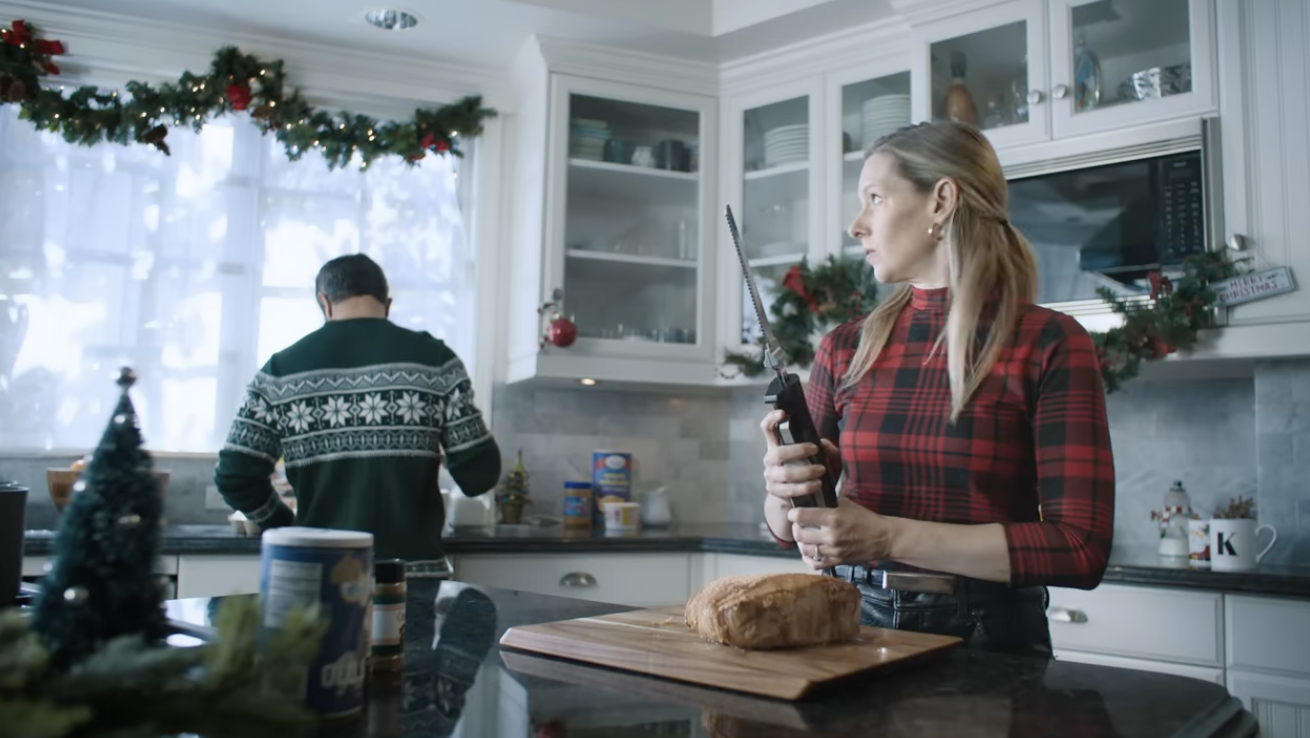
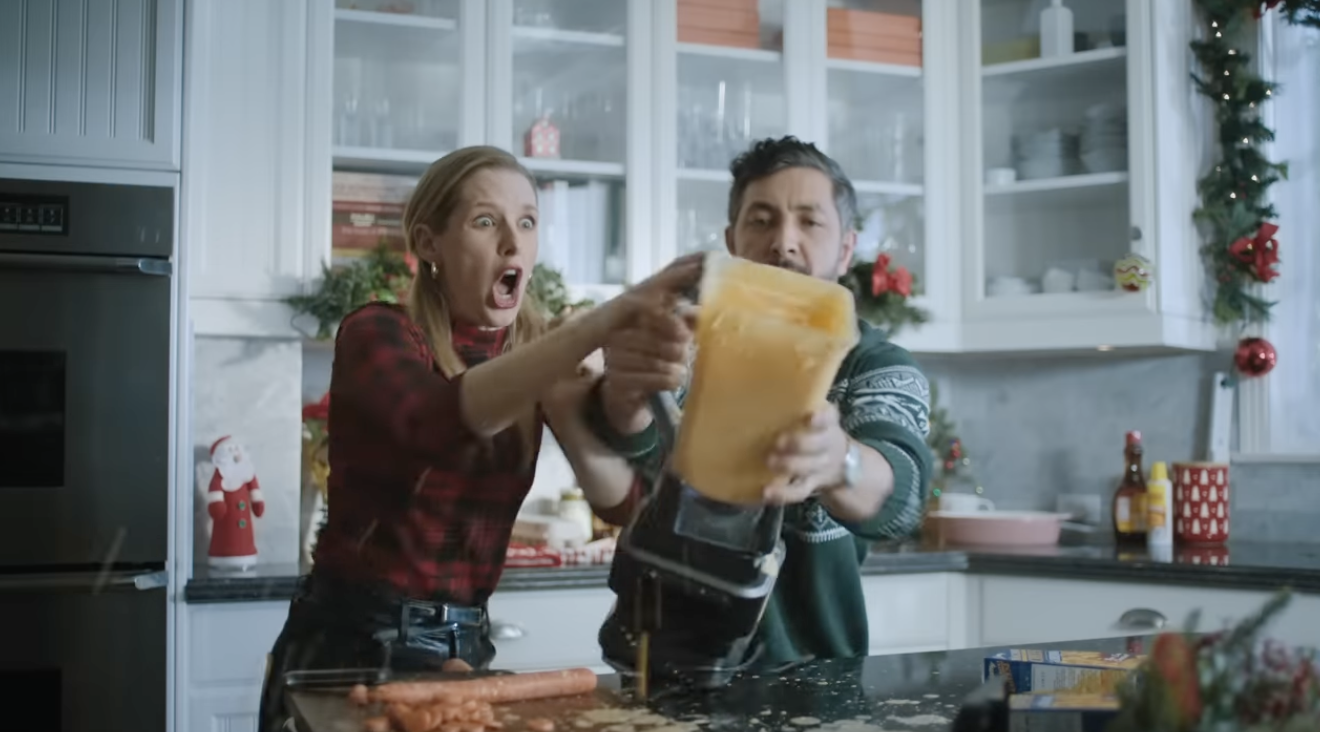
This Honey Baked Ham ad ran in December 2022.

The good. (1) Like the Ridge wallet, it shows contrast – but not of the products. We see the finished, polished, and plated, Honey Baked Ham.

Contrasted with the process. It’s not that your turkey, ham, or sides won’t look good but that it takes some serious effort – with tools you use once a year.

And techniques you use even less.

Buy a stick blender instead.

(2) Consumer spending is an example of median and average meanings. We average three thousand dollars a year eating out, but it’s not as simple as that number divided by 12 or 52. We only eat Domino’s Pizza with a deal. Similarly, during the holidays, customers are price insensitive.

Warren Buffett and Charlie Munger noticed this phenomenon in 1972 when they purchased See’s Candy. As Munger said, “I may see Wrigley’s gum alongside Glotz’s gum. I know about Wrigley but I don’t know anything about Glotz’s. If one is $.40 and the other is $.30, am I going to take something I don’t know and put it in my mouth?”

It was the same for See’s and for Honey Baked Ham where the pricing power comes from the holidays, food’s ‘intimacy’, and tradition. They never mention the price and they never should.

(3) Looking the part. When she started Haven’s Kitchen, Alison Cayne thought her cooking business was about food, but she found it was about appearance. Her cooking students (pre-Covid Cayne operated a cooking school in NYC) and sauce customers (the post-Covid pivot) wanted to appear competent.

The ‘job’ of a meal wasn’t filling bellies, it was filling expectations. Todd Snyder said that expectations drive his consumers too. You need to ‘look the part’ at the wedding, the interview, or the party.

Watch the ad. It’s not about the couple’s food, it’s about their appearance.

(4) What does Honey Baked Ham compete with? One part of JTBD is that products in the same category may not be competitors, like Snickers and Milky Way. Pizza, Chinese, and Honey Baked Ham are all Christmas dinner options, but the customers of one don’t consider the others.

Honey Baked’s competition is DIY – which is what this ad addresses!

The Bad. None!

The Interesting.

This ad is polished, like a Honey Baked Ham. At the end of 2022, ‘trending’ recipes were common. Hopefully, the Honey Baked Ham company avoids this and keeps bringing home the bacon with ads like the one above.

Can someone be, like MKBHD?

Can someone become like you now Guy Raz asked Marques Brownlee?

It’s different today. “I’ve noticed that in polls of younger people their dream jobs used to be firefighter or movie star, but they all say YouTuber now”, said Marques, “this is fascinating to me because when I started that did not exist.”

If something is legible it’s something to compete on. But illegible things – becoming a YouTuber before it was a thing – make the competition harder.

Legible means playing according to the rules of the game. Illegible means making up the rules as you go. “I just wanted to make the kind of videos I liked to watch,” Marques notes. Illegible also means there’s time to find your rules. Brownlee spent years making videos. He admits that the early ones are hard to watch because they’re so bad. That’s fine!

With value comes competition, and the market mechanism whirls to life. “Your margin,” Bezos believed, “is my opportunity”. Alpha erodes.

Except in some places like the new, the foreign, the unaccounted, the unfavorable, the silly, and so on. Not every new thing ‘works out’ but every new thing has less competition.

Copying the Inflation Buster

I don’t check my home equity every day, goes a joke among the Vanguard-Buffett-DCA crowd, why should I check my stock portfolio? It’s a riff on the availability heuristic: if I think it, it’s important.

‘Home’ is super available. Vacation rentals, of someone’s home. A chunk of net worth is home. Neighbors move. During Covid we were stuck in our homes. People began to work from home. After Covid the home market exploded. After that rates ran up. ‘Home’ is everywhere. 

Good copywriting, said Bob Bly, “enters the conversation people have in their mind.” Let’s look at a good Rocket Mortgage ad.

Transcript: “Buying a home? Rocket mortgage will cover one percent of your rate for the first year at no cost to you, saving you hundreds even thousands. With Inflation Buster that means more mini-vacations, a lot more lattes, and more date nights. Now imagine if rates drop within three years of your home purchase. You get exclusive savings when you refinance at that new lower rate. It’s more cash in your pocket. Save when you buy today and refinance tomorrow. Visit inflationbuster.com to get started.”

The good. Rapid fire: It’s not a house, it’s a home. One percent is a nice whole number, and worth more (psychologically) than 0.99999999%. First year… appeals to our myopia. More mini-vacations… highlight the opportunity cost. At no cost to you, and if rates drop… avoids our ambiguity aversion. Visit… as a call to action. 🧑‍🍳 😘

The bad. None!

The interesting. A picture is worth a thousand words, and this video is good. 

We’ve tracked ‘average’ monthly home payments (1971-2022). On a four-hundred-fifty-thousand dollar home, Inflation Buster saves about $200 a month. Put another way, it’s a year of payments on a four-hundred-thousand dollar house instead of the more expensive one. None of that factors into this ad. It’s not the customer’s language. 

Interest rates and home prices are not the important metrics. Only monthly payment matters. That’s the conversation in this ad.

1 math trick for better predictions

Warning, this is “I watched one YouTube video” level of expertise. Also, some graphs have truncated y-axis.

Predictions are fun. Will a dice roll four or greater? Will it rain tomorrow? Will this company be worth more money tomorrow, next month, next year? An event does or doesn’t happen. We get to predict an outcome.

If an NFL team wins six of their first seven games how many games will they win in total? Well 6/7 is ~85%, and there are seventeen games therefore they’ll win ~14.5 games. But in 2021 there was a team that won six of their first seven games and one math trick could predict it.

Pierre-Simon Laplace gives us the “rule of succession”. That sounds complicated but it’s simple: For any number of outcomes add one to the observed cases and two to the total cases.

Here are four coin flips: heads, heads, tails, heads. The observed rate for heads is 0.75 (3/4). The ‘Laplace’ rate for heads is 0.66 (4/6). Laplace’s addition shifts predictions away from ‘never’ and ‘always’. This is the secret. ‘Never’ and ‘always’ are rare for sequential events.

Here is what the Laplace rate looks like compared to the observed rate for eighteen coin flips.

Here is what the Laplace rate looks like compared to the observed rate for the “six of the first seven” football team, the 2021 Tampa Bay Buccaneers.

Laplace starts at .500. Tampa wins six of their first seven games (.857) but Laplace only increases to .777. Their final winning percentage was .764.

Then there’s the 2021 Detroit Lions, a team that lost their first eight games.

The Laplace rate doesn’t know anything. It doesn’t know coins are 50/50. It doesn’t know about Tom Brady. It doesn’t know the Lions are bad. It’s just a formula that slowly adjusts to extreme events.

Laplace (b. 1749- d. 1827) didn’t have the NFL, so he made predictions about something else, the sunrise. The observed rate is 1.00. The Laplace rate, after 10,000 observed sunrises, is 0.99990002. So you’re saying there’s a chance?

No. That’s a simple wrinkle. Laplace called the sunrise a special “phenomena” which “nothing at present moment can arrest the course of.”

Coin flips, dice rolls, and drawn playing cards are random and have an expected rate.

Sunrises are special phenomena and Laplace’s rate is less helpful.

Football outcomes are a mix. They’re like the sunrise, in that teams have inherent principles. They’re like coin flips in that predictions are difficult, a sign of randomness.

Math helps: relative vs absolute saving rates, people live longer the longer they live, what the mean age means, the vaccine friendship paradox, how many ants long is Central Park?, or how many rolls of toilet paper do the residents of Columbus Ohio use in a week?

Math can be simple. Technique (add one to the numerator, add two to the denominator) and a bit of explanation (extreme events are rare without explanatory phenomena) is all we need.