TKP2 – Michael Lombardi

Michael Lombardi joined Shane Parrish to talk about the four elements of leadership, good systems, and what a week in the NFL is like.

Just a programming note, this was not a James Altucher podcast. James consistently has great interviews, but I’d like to expand to more smart people figuring things out. If you know of someone, do get in touch.

Lombardi is an NFL executive, currently with the New England Patriots though he’s been throughout the league, from Oakland to Cleveland. He tells Shane that he started small, playing football at Hofstra and attending any coaching clinic he could find. That led to an unpaid position at UNLV and he was off. Slowly for sure, but off none the less.

When you want to accomplish big things – Lombardi was looking up to Vince Lombardi of all people – it’s hard to start small, but that’s the only place to start. Sam Shank (episode #78) started Hotels Tonight with only a handful of properties. Rick Ross (episode #115) started selling crack on the street before he was ever on top. Maria Popova (episode #89) began Brain Pickings with an email to seven people.

Stephen Dubner (episode #110) writes that starting small has four specific benefits:

  1. Small questions are less often asked and may be virgin territory for discovery.
  2. Big problems are dense and intertwined small problems that have to be solved first.
  3. Small problems have a smaller mass and easier to change.
  4. Thinking big leads to more speculation, small problems can have a more accurate observation.

It was #3 that was especially true for Lombardi. “There’s a fine line between producing work and learning,” he tells Shane. At the highest level, there’s always work to be done and finding time to get better can be hard. The NFL, according to Lombardi, “is similar to chess.” You have to dive deep and have a rich knowledge of the three key aspects of the game (offense, defense, special teams) as well as the nuances of the different positions.

Alex Blumberg (episode #70) is a good example of diving deep. Blumberg is a skilled radio reporter, working for shows like This American Life. But when the TAL team tried to take the show to television, it wasn’t as successful. Blumberg says that they failed to achieve the same relevancy because storytelling on the radio is different from storytelling on television.

Comedians have shared this insight in a more specific way. Carol Leifer (episode #68) and Brian Koppelman (episode #98) both told stories about hecklers, and how each learned to shut them down without losing the audience.

Lombardi says leadership is the one skill that solves these small problems and good leadership has four elements.

  • Management of attention. You must be able to get people to follow you because you “have a plan.”
  • Management of meaning.  You must be able to “explain your plan clearly and concisely.”
  • Management of trust. You must “be consistent, and not have double standards.”
  • Management of self. You must be able to “self-correct.”

Within these four areas is the key to a successful system. The west coast offense (a popular and successful NFL system in the 1980’s*) worked within these four areas. Bill Walsh, Lombardi explains, had the plan and a way to explain it. When it was time to practice the system he did so consistently and when the team lost there were procedures to identify why.

Each of these things, says Lombardi, “have to be time tested.” This is one of the favorite tools of Nassim Taleb as well. Taleb applies this from the simple (drink only things that have been around a long time like water, wine, and coffee) to the complex (everything will blow up, make sure you don’t blow up with it).

Not only does this team philosophy need to be time tested, but it can’t be in a state of constant change. Lombardi’s implied message is this; study history to find something that consistently works and do that thing with only minor adaptations.

Another part of a successful philosophy in the NFL is to draft the right players. “Scouting’s not about finding players,” Lombardi says, “Scouting’s about eliminating players.”

In a world of constant lifehacks, pro-tips, and new blog posts – sometimes all we need to do is not do something. If you avoid the bad eggs (in life and football) you’ll often be just fine. Gary Vaynerchuk (episode #2) proved it was true for marketing, Astro and Danielle Teller (episode #81) found it was true for parenting.

When you get the right players (or avoid the wrong ones) you still aren’t quite there Lombardi says. “You have to have a team that can play right or left-handed,” and if you can’t do this you have to hope to get very lucky. In a sense, that’s what happened to Scott Adams (episode #112). Adams would have had to get lucky if he were just a cartoonist, businessman, or MBA graduate. Instead, Adams is all of these things and so he can play right or left-handed. Adams rephrases Lombardi when he writes, “every skill you acquire doubles your odds of success.”

The end of the interview focuses mostly on the last part of leadership, management of self. “Control what you can control,” Lombardi says, and be able to ask yourself what went wrong. He stresses to Parrish that it’s important to separate the process from the product.

It comes down to figuring out:

  • Did I have the right plan but bad luck?
  • Did I have the wrong plan and good luck?

This distinction is important. If luck is a component of an outcome, we should figure out how much luck there was to see how much of an effect it had. If it was bad luck, we need to get over it. Adam Carolla (episode #25) likened it to getting a traffic ticket. It doesn’t mean you’re a bad driver, just an unlucky one.

Part of the analysis between process and product is finding the urgent and important data points. One example Lombardi mentions is scouting. Twenty years ago a scout might go to a school to watch film, talk with coaches, and meet the players. Lombardi says that while this took a lot of time and there wasn’t much film, you at least got to glean a few nuggets about the player. Maybe how he stood, shook your hand, or acted on campus. That was all data.

Now, the data is every snap a players plays (all available as on demand video) but less time on campus meeting people. This is a change in the data. The successful coaches need to adapt how they evaluate players Lombardi says.

Coaches aren’t the only ones who need to adapt, Lombardi says, players do too. There’s a lot less structure in the NFL than there is in college, Lombardi points out, and some players have a hard time adjusting. New conditions are a great time to begin new habits, writes Gretchen Rubin (episode #97). When Rubin got her job as a Supreme Court Clerk, she wanted to make sure she exercised. Rather than wait until she got a feel for the job, she started working out the first day. “Start like you want to continue” she writes in her book, Better Than Before.

Shane ends the interview by asking Lombardi for some reading recommendations. Lombardi says that “anything you can get your hands on” will help. Some specifics he suggests are; The Life and Times of RFK, When Pride Still Mattered, The Rabbit Hunter, Win Forever and The Wright Brothers.

-Thanks for reading, I’m @MikeDariano.

  • One interesting little nugget from this interview was how much history of football Lombardi knew. Bill Belichick was featured in an interview and showed how much he knew as well. Even the term “west coast offense” has a rich history that explains the origin that you would have to know.

#115 “Freeway” Rick Ross

Ricky Donnell RossJames Altucher was joined by “Freeway” Rick Ross (@FreewayRicky) to talk about organizational management, career reinvention, and what to do when someone gives your counterfeit bills for a kilo of cocaine. This has to be the most unexpected guest of the James Altucher podcast and the interview – while short – doesn’t disappoint.

The actual interview took place at Jayson Gaignard’s MastermindTalks.com. In the introduction before the interview James tells Gaignard, “I never go to conferences unless it’s a hell yeah,” and this one apparently was.

This sort of decision making – wait for situations that have clear benefits- is one that a lot of people advocate. In his book Get Smarter, billionaire businessman Seymour Schulich prescribes “the Decision Maker.”

“On one sheet of paper, list all the positive things you can about the issue in question, then give each one a score from zero to ten – the higher the score, the more important it is to you.”

Then do the same for all the negative things you can think of.

“Then you add up the scores on each sheet. If the positive score is at least double the negative score, you should do it – whatever ‘it’ is. But if the positives don’t outweigh the negatives by that two-to-one ratio, don’t do it, or at least think twice about it.”

It sounds like this is what James did when he was considering whether to attend.

One note before we get started.  Right before listening to this interview I finished reading Gang Leader for a Day. The book is about the decade Sudhir Venkatesh spent with the Black Kings gang in Chicago. The book is wonderful and a form of gonzo journalism similar to Neil Strauss (episode #113). There were enough parts of the Ross interview that overlapped with the book, that it’s featured a lot in this post.

In his conversation with Ross, Altucher begins by asking what the cocaine business looks like exactly. Ross says that he got started by having a connection – a teacher and tennis coach – that connected him with the Nicaraguan gangs importing the cocaine. From there, Ross and his friends would cook the cocaine into “rock” (crack) and then sell it.

Unlike Tucker Max (episode #80), Ross says that he told his friends and dealers never to eat your own dog food. It’s very clear that Ross learned a set of best practices, ones that he says he “stumbled and bumbled upon.” He tells James that he had to deal with a lot of conflict resolution and that he would “take care of it.”

In Gang Leader for a Day there is the story of an dealer (low level) cutting the cocaine to make it it more diluted. This was lower quality crack, but it let the dealer skim some money his handler didn’t know about. When J.T. (the mid-level handler) showed up to ask the dealer about this, he had to take care of it, but in a certain way. He couldn’t beat the crap out of him or kick him out of the gang.

“J.T. explained that this decision couldn’t be so straightforward. “Most guys wouldn’t even think of these ways to make money,” he said. “Here’s a guy who is looking to make an extra buck. I have hundreds of people working for me, but only a few who think like that. You don’t want to lose people like that.”

When Ross had to to take care of things, my guess is that there were other factors similar to this.

Part of what helped Ross become a good leader is that he came from the streets. “I started on the street,” he tells James, “I had to stand on the street when it was cold and hot. Police would come by and strip search you.”

Peter Thiel (episode #43) told James that the same thing is true for startups. The best people – in Thiel’s view – are the ones who see things as “difficult but possible.” The people who come from easier circumstances (Microsoft or Google in Thiel’s case, the suburbs or another big city in the gang’s case) don’t seem to succeed in the same ways.

Ross tells James that as he learned the business from the streets, he saw that violence often wasn’t a good thing. “Most of the smart drug dealers don’t want violence.” he tells James.

In Gang Leader for a Day, our mid-level protagonist reiterates this point.

“Once in a while, a war began when teenage members of different gangs got into a fight that then escalated. But leaders like J.T. had a strong incentive to thwart this sort of conflict, since it jeopardized moneymaking for no good reason…I had never seen a war last beyond a few weeks; the higher-ups in each gang understood that public violence was, at the very least, bad for business. Usually, after a week or ten days of fighting, the leaders would find a mediator,to help forge a truce.”

A lack of violence led to stable – and profitable – times for Ross. He started investing his money in legitimate businesses but none of them made any money. “Why not?” James asks. “I didn’t run them.” Ross says. He lacked what Jason Calacanis (episode #77) said is essential in your work. “There’s  level of deep, deep obsessive knowledge you need to have of all your competitors. Of all the nuances of their products. Of the history.” Calacanis said in his interview.

Ross had that knowledge about drugs, but not other businesses. Ross says that he also enjoyed the parts that came along with selling drugs. Drug money allowed him to provide bond, housing, and help the community. In Gang Leader for a Day it happened too. J.T. gave money to help run events in the community, to families when someone from the gang died, and volunteered his lower gang members to run errands for the elderly.

James asks Ross, “why didn’t you get out?” If the money and the power were the carrot, then there was no stick.  Ross says that he never knew how to get out. “I was totally illiterate, never read a book” he says.

This didn’t stop him from learning though. He tells James that he knew early on about the value of collecting email, phone numbers from people. He says he would show up at someone’s house with some crack. Then tell that person, if you can get ten friends to show up, this is yours. When those friends came, Ross would collect their phone numbers and become their dealer.

Eventually Ross ended up in jail, something he says that he knew was coming all along. Only when he started down the legal road though, did he realize that it might be for longer than he thought. When things looked worst, Ross started really paying attention. “I knew more about my particular case than anyone in the courtroom” he told James. (Calacanis would approve)

When Ross got out he started to make his legitimate businesses work (he’s a speaker now). “I had studied so many people that were doing business and I learned how to transfer my drug dealing skills over to things I’m doing right now.” he tells James. Like Trip Adler (episode #61) who tried many things before creating Scribd or Andy Weir (episode #92) who wrote a number of bad books before one great one, Ross had to have a certain set of experiences before he could find the best path for him.

James ends the interview by asking what are some essential skills someone has to have.

  1. “Want for the people around you, what you want for yourself” Ross says.  This doesn’t mean they’ll get it, they have to want it too.
  2. Be Honest. Ross says that if someone came to him with the wrong amount of cash or counterfeit bills, “I would take the loss” the first time it happened. He gave people the benefit of the doubt. The next time though, “I would take more precaution in dealing with them” he says. Adam Grant (episode #73) said much the same thing. We should act as givers until someone burns us, then we should be more tempered in our interactions.
  3. Don’t do it for the money. “I wasn’t doing it for the money” Ross says. It’s one of our Big Idea here. No one who is successful has ever said, I wanted to get rich. Everyone has bigger motivators than money. Well, except Mark Cuban (episode #24).

Finally, James asks him, “why are you a vegan?” Ross says that he wanted to prove that he wasn’t addicted to eating meat. He quit eating it for some time, tried chicken, got sick, and never went back. The book that started this for him was Eat to Live. Ross was experimenting to find what worked for him. Another of the Big Ideas here.

For more Rick Ross, check out his episode on the BET series American Gangster.

Thanks for reading. I’m @MikeDariano.

#113 Neil Strauss

Neil Strauss (@NeilStrauss) joined James Altucher to talk about self experimentation, writing, and what real estate agents know about picking up girls. Strauss is the author of The Game, Everyone Loves You When You’re Dead, and Emergency. Strauss is most famous for The Game, and that’s what a lot of his conversation with James is about. In that book he writes about the pickup scene, where men use specific tactics to find, attract, and seduce sexual partners.

James starts the interview by telling Strauss that he watched other interviews to prepare. One they touch on is this Jimmy Kimmel appearance when Strauss was asked to pick up Jessica Alba.

Those pickup skills aren’t just for late night TV shenanigans. Strauss tells James that a government agency asked him to work with their field agents. Which is somewhat ironic considering these posters from 1943.

James says that the same ideas apply to good copywriting too. “It’s straight out of Richard Chiladini’s Influence.”

One of the tips that Strauss found useful for pickup is one that real estate agents use too. Strauss says that in real estate, agents keep up their relationship with home buyer so they don’t feel like they were used. In pickup it means to talk to someone even after getting their phone number.

Strauss isn’t the only one who brings domains together like this. Ramit Sethi’s (episode #36) first project was about combining psychology and finance. Ted Leonsis (episode #53) told James that AOL used marketing techniques of the shampoo world to better distribute free copies. Bringing together things that work in different domains seems to be something that works.

Strauss says that he “had no idea” The Game would be huge. “In retrospect” he says, “things always look perfectly planned and marketed.”

It sounds like Strauss’s projects start with his own problems. He wrote The Game, to learn how to pickup women. He tells James that some great stories didn’t even make the book because they don’t serve the overall story. Jon Acuff (episode #106) told James much the same thing about writing. For Acuff it was jokes, that while funny, didn’t add to the book.

Strauss writes these kinds of books in part to provide an alternative to what he calls, “the TED Talk culture” where “the loudest voice wins.”

An older example – but one I just came across – was Gang Leader for a Day. This book from 2008 is the story of what happens when a graduate student at the University of Chicago befriends a local gang leader. This is not the story you see on the news. I found myself empathic to the (lawbreaking) characters and wanting to know more about the nuances of their world.

For these authors – Strauss and Venkatesh – research wasn’t the only data point. When they jumped into a situation, they saw things the data didn’t show. Strauss goes far enough to say that the things he sees are more important to him than the things he might read. “The burden is, does it make my life better.”

Strauss is repeating common advice here, find what works for you. A.J. Jacobs (episode #94) is the most extreme example when he tried to be the healthiest man alive. From paleo diets to plastic contaminants, Jacobs tried nearly everything. From that swatch of experience he took the things that worked best for him (stand, don’t sit – eat slow, not fast – 3,4,1, & 2(plastics) all the rest are bad for you). James too in his daily practice of physical, mental, emotional, and spiritual growth is his system. If that works for you, that’s great. If it doesn’t then what are you trying?

Chris Hadfield (episode #111) told James we all should be trying something:

“If you’re not studying something at all times to improve your ability to do things, then why not? What’s the other thing you’re doing that’s more important than getting better at life?.”

Part of finding things that work is knowing who you are. “It’s important to know who you are” Strauss tells James. Gretchen Rubin (episode #97) writes about exactly the same thing in her book Better Than Before. Rubin wanted to improve her habits. She knew she wanted to be healthier, but didn’t like competition or intensity. Long, slow runs were perfect for her. The same goes for figuring out if you like being around others, what time of day you work best, and more.

One thing Strauss knows, is that he doesn’t like selling. It’s a feeling of “horribleness” he tells James. Many guests who are selling things seem to share this attitude. Some mention, often while laughing, that you have to be a bit egomaniacal to feel like something you write is worth other people to read. Strauss goes so far to say that he feels shameful.

What might help is to remember Anne Lamott’s advice about detachment.

“And then learn to be more compassionate company, as if you were somebody you are fond of and wish to encourage. I doubt that you would read a close friend’s early efforts and, in his or her presence, roll your eyes and snicker.”

Strauss would surely encourage a peer to promote her most recent book, so he should try to extend the same encouragement to himself.

Once you get comfortable giving yourself this permission (to Choose Yourself as some might say), realize that the comfort isn’t permanent. “Breaking outside your comfort zone is where learning and growth happens” Strauss says. This was true for Brian Koppelman (episode #98) who had to dive into stand up comedy before figuring out how to finish writing Solitary Man.

Other guests too have said that discomfort is where growth happens. Peter Thiel (episode #43) said that the best entrepreneurs come out of situations where they were challenged. Dave McClure (episode #99) said that he had to learn a lot of lessons the hard way to begin to solve his problems.

Strauss gives a good test to figure out where we can find areas; look where you are making excuses and attaching negative consequences where there aren’t any. Tim Ferriss (episode #109) calls this “a nebulous fear of failure.” Ferriss says that too often we overestimate how bad something will be.

Even Strauss suffers from this to some degree he says. There’s a want to make something as great as the first thing, but rarely is the situation that same. When you start you have the power of nothing to lose but with success that’s exactly what you lose. James says that this happens to him too, especially when someone he respects emails him and says “I love your writing.”

The end of the interview talks about Strauss’s imprint, Igniter books. One of the books published there is about Satan is Real who have “the greatest album cover of all time” Strauss says.
You can be the judge of that.

James asks for some reading suggestions, and Strauss (like many other guests) does not disappoint. Some of his suggestions are; The Fan Man by Kotzwinkle, anything by Dennis Johnson, Ladies Man by R. Price, Last Exit to Brooklyn, and James Joyce’s Ulysses.

Thanks for reading, I’m @MikeDariano. If you like a good reading list like this post ended with check out some of the other posts here. If you want even more book suggestions, I share a monthly list of what I’ve been reading.

#112 Scott Adams

Scott Adams (@ScottAdamsSays) is back to talk to James about success, going viral, and why he’s never had writer’s block. Adams’s first time through he talked about his book, How to Fail at Almost Everything and Still Win Big in episode #47.

The interview begins when Adams tells James that success “is a trap.” He means that even though Dilbert may get larger, it doesn’t proportionally get more fulfilling. It’s a bit like the teenager that gets their first car. They’re excited. A second car, cool, but not as much as the first. A third? Well, even a teenager doesn’t need three cars (unless they were of the same quality my first car was, then you may need some spare parts).

In her conversation with James, Gretchen Rubin (episode #97) said that this deadening of emotions can be both a good and bad thing. Rubin said that if we have habits we don’t particularly enjoy, but want to adopt, we should keep this in mind. Sure, you may not like running, but as you do it more, the dislike you feel will lessen. For Rubin this meant that driving became a less harrowing experience. The flip side is that our positive emotions will dull too.

I take my daughter’s to school each day, and it’s a small moment of relative quiet after a hectic morning. Do I appreciate that? Not really. Unlike, say a divorced or busy parent who might only get to do it once a week. That parent may seize the chance to enjoy that time.

This isn’t saying you should take your kids to school because it’s a chance to bond. Adams will be one of the first to say not to take his (or my) advice. Instead you want to experiment to find what works best for you.

Experimentation is fast becoming one of the big ideas here. Many of the podcast guests advocate personal experimentation as a means to find a better way to do things. Brad Feld (episode #91) found that traveling less for his business led to running a better business. A.J. Jacobs (episode #94) experiments so much he calls himself a “human guinea pig.” Ditto for Tim Ferriss (episode #109) who even created a show about his self-experimentation.

For Adams the tipping point came when he realized how bogus a lot of the nutrition advice was. Instead of following the diet du jour, he began to experiment with what foods made him feel better. He suggests we build up our own toolkit and bank of experiences to draw on. Two of those tools are willpower and habits.

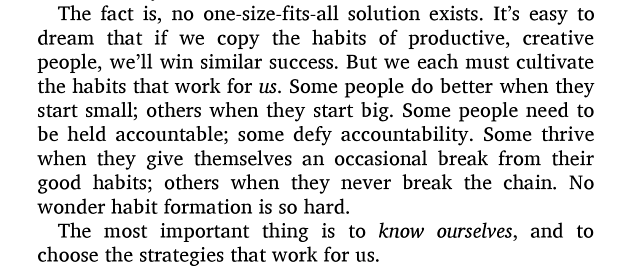
Gretchen Rubin wrote about this in her book Better than Before, writing that one size does not fit all:

Screen Shot 2015-05-20 at 9.13.07 AM

A lot of this round of conversation between James and Adams is about what it means to go viral, and Adams has a lot of opinions (through experimentation, no doubt) about what that means.

#1 To go viral you need familiarity. Adams says that some of his content that’s gone viral has been old content. He attributes this to people knowing a little bit more about what he’s saying. Ryan Holiday (episode #18) leveraged this technique when he wrote about stoicism. Stoic ideas have been around for 2,000+ years, but Holiday took modern examples (things we are familiar with) to promote the old ideas.

#2 To go viral you need contradictions. Adams says that he see this work by combining “science” and “failure” in the title of his post, Science’s Biggest Fail. This post restated his thoughts about how often we (science) has whiffed (failed) in getting nutrition right. If you are confused about what to eat, it make sense. From Dave Asprey (episode #68) to Dan Buettner (episode #105) there is a lot of advice. Nassim Taleb gets through the noise by using the filter of time. Taleb says, if it’s been around a long time, it must be fine. This is hardly a contradiction, but Taleb doesn’t seek virality.

#3 To go viral you need to connect with small groups. Adams says that he doesn’t split test Dilbert comics because he doesn’t need them to widely popular. He doesn’t want to necessarily find the comic that is best overall, but the best within a group. He says, “when I was trying to build up Dilbert in the early days I would target specific micro areas.” One example might be a comic about being a Ham Radio operator.

Adams says that he did things like this on purpose in hopes to connect with that group. If he did, he might get them reading his comic on a regular basis.

#4 To go viral you need to understand your medium. I can only imagine that Gary Vaynerchuk (episode #2) and Nicholas Megalis (episode #104) are excited to hear that Adams is focused on the medium as well as the message. Vaynerchuk has an entire book about why the medium matters and Adams says that he’s figuring out why videos work better on some platforms than others.

In each case that something goes viral, Adams has a goal. If he can get people to laugh at one in every five comics, then he knows he has a fan. When James presses Adams about why it’s this ratio, Adams doesn’t have a great answer, so I’ll take a stab at it.

When we remember things, we actually do a pretty bad job. What we often do is remember the best or worst, most unique, and last parts of something. Then we fill in the blanks around that.

Think about the last vacation you took. You can probably recall if your flight was delayed, but otherwise not many details around the actual travel. You can probably recall the best thing you did, though not what you had for breakfast that day. You can probably recall what you did on the last part of your trip, but not day two.

My guess is that when Adams creates something that that draws in readers it’s because of they remember the highs, uniques, and ends.

Adams also tells James that he’s never had writer’s block, though this is hindsight of 26 years worth of cartooning. Early on he was afraid he might sit down to draw and come up with nothing so he keep a pipeline full of ideas. A.J. Jacobs and Ryan Holiday also say that they keep ideas squirreled away for future projects.  Adams says that he doesn’t do this much anymore because there’s often a better idea – whatever he’s feeling.

Another tip Adams has is to start moving. “If your body does it, your brain will follow” he says. A.J. Jacobs says this works for him too and not just with writing. Jacobs quotes Millard Fuller, who said, “It’s easier to act your way into a new way of thinking than to think your way into a new way of acting.”

James and Adams end their conversation with some ideas about what Adams can do to share more behind the scenes processes for Dilbert.

Thanks for reading, I’m @mikedariano. Adams’s book has been one of my favorite books of the past two years. If you want to see more about what I’ve been reading, you can sign up for my newsletter. It’s a once a month summary of books I’ve read.

I also run book clubs here. If you want to purchase the last round, a reading guide to Cal Newport’s So Good They Can’t Ignore You.

#111 Chris Hadfield

Chris Hadfield (@cmdr_Hadfield) joined James Altucher to talk about going to space, living on earth, and what anyone can do if they fail to reach the stars. Hadfield is the author of two books; An Astronaut’s Guide To Live on Earth: What Going to Space Taught Me About Ingenuity, Determination, and Being Prepared for Anything and You Are Here: Around the World in 92 Minutes: Photographs from the International Space Station. James says that An Astronaut’s Guide to Life on Earth is, “a great book, I highly recommend it.”

If you recognize Hadfield, it’s probably because of this:

What’s interesting about that video, which has been viewed over 25M times, is that the confluence of things that made it popular. Hadfield says, “I didn’t change. The space station didn’t change. Why does covering a Bowie tune suddenly get people interested?”

James suggests that it’s because how relatable that, and Hadfield’s other videos are, but there’s a deeper answer there too. Sure, it’s cool to see food float around and the views out the windows are amazing. Mix in our fascination with space and you get a certain level of neatness. But that doesn’t account for 25M views.

Hadfield tells James that the deeper answer is that he knew what people wanted to see. His experience speaking to thousands of schools, groups, and businesses told him what people wanted to know.  Like an author who gets the same questions while promoting her book, Hadfield gets the same set of questions about space. Going to space then, he knew what people wanted to know about. Add in an internet connection, and that’s how you get 25M views.

And the crazy thing is, being in space isn’t all that different from many places on earth. Hadfield says there are labs all across America and the world doing research and the space station is just another lab. But people care most about the one in space.

Hadfield’s journey to space began when he saw Neil Armstrong walk on the moon. “It was hugely permission giving,” Hadfield tells James, “to see that impossible things can happen.” As a kid in Canada, who lived on a family farm and whose father flew planes for Air Canada, it didn’t seem like Hadfield had much of a chance to ever get to space – but there was still a chance. Hadfield is like the polar Lloyd Christmas: 

Tim Ferriss (episode #109) told James much the same thing, saying that impossibles are often negotiable. The next step in thinking from Hadfield and Ferriss’s advice is not to think in terms of perfection. When we look at something from the outside (going to space, lifestyle entrepreneur, best-selling author) we don’t see all the details that go into it. Mark Ford (episode #102) told James that when you start a business you begin to see “the warts and all.” When we see something big, we need to remember to start small. Hadfield had to crawl before he could walk, and then fly.

At thirteen he got his glider’s license. To which James said he would never let his thirteen year old do because it sounds too risky. But that’s not the only risk.

“The other risk is that you will not reach the potential that you’re capable of, which to me is the ultimate loss.” – Chris Hadfield

But It’s not about doing crazy things for the sake of crazy things. It’s about taking measured risk that lead to real rewards. A current example is the family in Maryland who is under investigation for letting their kids walk to the park.

The conversation turns from Hadfield’s history to his marriage and he credits his wife Helene. In his book he speaks more about her and echoes the words of Brian Koppelman (episode #98), who said that the best decision he made was marrying the right person.

Having the right people in his life helped, when Hadfield didn’t get an advancement as he hoped. He was ready to quit the path to becoming an astronaut and instead become a pilot. It wouldn’t be a bad thing, just not his dream thing. It was his wife who asked why rush to change? “We don’t need to change anything right away” Hadfield recalls her saying.

Sometimes the best thing to do is to do nothing. Brad Feld (episode #91) learned this when his body broke down. Feld was rushing around to startups, putting out fires, and figuring out problems when his “inner introvert threw a shit fit.” Feld started traveling less and discovered that things actually worked better than way. Things took a bit longer to figure out, but the tradeoff was worth it. Time brought data and clarity, two things that helped him make better decisions.

Helene told Chris that they had enough money, they had a job. Why rush off the path they were on. Give it time.

The overnight success, says Austin Kleon (episode #19), “is a really good marketing myth.” That overnight success myth is present in a lot of places, but we might see it best in Hollywood.

Seinfeld was a very successful show, to say the least. It was appointment television in the last years of appointment television and launched the careers of many actors, including the one who played Tim Whatley. Whatley was the the dentist who pretended to be Jewish so he could tell Jewish jokes. The actor who played that character was in 5 episodes of Seinfeld from 1994-1997. But also had 35 other roles during that same period. Those other shows included the television movie Extreme Blue and the show Teknoman.

Not exactly appointment viewing.

But that actor kept working. He was working so much, that one day when one of the writers on Seinfeld asked about what he had auditioned for, he told her he forgot because there had been so many.

Three years after his last appearance on Seinfeld that actor was cast as a lead on a network show and his other roles became more selective, working on bigger shows like The King of Queens and Family Guy.  But not until 2008 did Bryan Cranston reach the upper echelons of his field and win an Emmy Award for playing Walter White on Breaking Bad.

But often we don’t see this progression. We forget the years of work an actor might put in. Adam Carolla (episode #25)says that “I don’t think people can intellectually understand that there was  time when Jimmy Kimmel wasn’t Jimmy Kimmel.”

Carolla tells the story about meeting Kimmel for the first time, who was just a morning show sports radio guy. The two paired up and began working together. Then, when Carolla was offered a contract for a show he said the guy should hire Kimmel too. “There was never someone off to the side saying you’re gonna be big someday” Carolla says, instead it was a lot of work, time, and luck.

There’s also the bad breaks. Hadfield thought he had wrapped up a great position, being a test pilot in France. He was moving from Quebec to France. From white snow to blue waters. It was a great move for his carer. Except he wasn’t. Due to some bureaucratic maneuvering, his spot was given up to someone else.

James asks if this was hard, and Hadfield says that it was, for a week or so, but he moved on. “Everything is a gamble in life” Hadfield says, “but there’s almost always another hand coming.” And that hand would pay big for Hadfield, who was accepted into the American Test Pilot School. This outcome, America instead of France, may have been the ultimate tipping point that got him to space years later.

A third crossroads that James and Hadfield discuss is when he needed an ultrasound to see if an old injury had healed correctly. If it didn’t, he was going to lose his spot. And it wouldn’t be a hard decision. In the book Hadfield outlines the completeness of a backup crew. This shadow crew is was ready to step in if anything went wrong, and something might very well be wrong for Hadfield.

James asks what do you think about and talk about with your spouse when your future hinges on a short procedure and a doctor’s opinion? It’s easy, Hadfield tells James. Don’t think about what you’re going to do do if things go the way you want, that’s easy to figure out. Instead, think about what you’ll do if things don’t go the way you want.

During that car ride, Chris and Helene talked about what would happen if the test was negative and he couldn’t go so space. And they figured out a nice set of options. He could teach. He could write. He could speak. He would see more of his family.

Hadfield didn’t have a nebulous fear of failure, an expression that Tim Ferriss coined and provided a framework for.FearresettingFerriss

Remember, Hadfield says, “Things always break, but how you act is up to you.” This is a very stoic idea, a philosophy that Ryan Holiday (episode #18) talked about in his interview.

Marcus Aurelius wrote about this idea two thousand years ago, and suggests that if someone tells you, “It’s unfortunate that this has happened” you tell them no, not so.

“No. It’s fortunate that this has happened and I’ve remained unharmed by it – not shattered by the present or frightened of the future. It could have happened to anyone. But not everyone could have remained unharmed by it.”

And even in the hardest moments you can act the right way. Aurelius asks:

“Does what’s happened keep you from acting with justice, generosity, self-control, sanity, prudence, honesty, humility, straightforwardness, and all the other qualities that allow a person’s nature to fulfill itself? So remember this principle when something threatens to cause you pain: the thing itself was no misfortune at all; to endure it and prevail is great good fortune.”

Besides dealing with misfortunate, Hadfield has a great mindset about how to be “a zero.” In the book Hadfield writes about his history as a fighter pilot, and he comes off as a fighter pilot.

But this isn’t how you want to act, especially in new situations. Hadfield says that “even when you are confident in your abilities, when you come into a new environment there are all these subtleties that you miss.” He saw this in his dad, who would come home from a ten day cycle of flying and start to tell people what to do. Rather, we can all remember that the people in a situation have been doing things that way for a reason. That’s not to say it’s the best way, just that you need to figure out why it is before you change what it is.

The ultimate goal an astronaut, Hadfield tells James, is to be competent. The only problem is that you have to be competent at so many things. Hadfield worked at a hospital to prepare for his mission to the International Space Station. He had to get this experience because he was flying up in the Russian Soyuz, a ship that only carries three people. Trips using the Space Shuttle could carry more people and allowed a broader spread of skills. Now though, one of those three people had to know basic surgery, and that person was Hadfield.

But you and I don’t need to know about surgery, we just need the mindset to look for those types of things in our own lives. Hadfield puts it this way:

“If you’re not studying something at all times to improve your ability to do things, then why not? What’s the other thing you’re doing that’s more important than getting better at life?

But remember, these things you do, they never happen fast. You need to think of projects in terms of years, not days or weeks. People ask Hadfield if he picked up the guitar while in space. Ha, he’d been playing since he was nine. He’s being studying Russian for what seems like nearly as long. He’s been flying things since his early teens. Things take time, and this mindset helps. When you get a setback, and you will get setback, don’t worry.

“The day to day stuff is variable when you have a long-term goal” Hadfield says. And make that day to day stuff, stuff you enjoy doing. “If you’re waiting to win the lottery in order to feel like anything worthwhile in life, then you’re setting yourself up for misery.” The advice he writes about getting to space is the same, “it’s probably not going to happen but I should do things that keep me moving in the right direction, just in case – and I should be sure those things interest me, so that whatever happens, I’m happy.”

The interview ends with James asking about intelligent life and Hadfield says that it’s probable. Using a Tony Robbins (episode #62) technique, let’s figure out some big numbers. Hadfield says there are a septillion stars. Okay, sounds big, but how big? Let’s use time to get some perspective:

  • One thousand seconds is 16 minutes.
  • One million seconds is 11 days.
  • One billion seconds is 31 years.
  • One trillions seconds is 31,688 years.
  • One septillion seconds is 1,004,129,344 years.

If you were to count a star a second, that’s how long it would take.

Thanks for reading. I’m @MikeDariano if you want to connect. I also thought this book was excellent. I didn’t read it at first because I wasn’t interested in space. This book is about space only in the setting. It’s a book about life, solving problems, and seeing the stars.

#6 Wayne Dyer

Wayne Dyer joined James Altucher to talk about writing books, quantum moments, and self-reliance. Dyer is the author of over forty books including; The Power of Intention, Wishes Fulfilled, and his most recent, I Can See Clearly Now.

The interview begins with Dyer relating some interesting experiences about his first book, Your Erroneous Zones. He tells James that the book was banned in Poland. To get orders there, he shipped orders to London and the books were smuggled over the border.

Before he wrote Erroneous Zones, Dyer was the author of three textbooks. A future in academics was laid out before him but in a “quantum moment” on the Long Island Expressway, Dyer realized he couldn’t take tenure. He felt an urge to teach people, to teach many people, and it wasn’t through academics. He had bigger plans, and hit the road.

“I was told there was only one way to reach everybody in America,” he tells James, “get on the syndicated shows.” But he was turned away again and again. No one wanted to have him on. Dyer faced a challenge to his self reliance. There might be another way to reach everyone in America, he tells James. “It’s a little more tedious, but it’s also a little more fun. And that’s to go to everyone in America.” Packing up his car and his books, Dyer was off.

Dyer tells James that a quote from Virginia Woolf that helped his thinking, “arrange whatever pieces come your way.” For Dyer this meant not be discouraged, dissuaded, or dissatisfied that he wasn’t getting on television. It meant to take this as an opportunity, not a problem.

Ryan Holiday (episode #18) told James a similar thing. Holiday’s examples come from stoicism and in his book he quotes Marcus Aurelius:

”The impediment to action advances action. What stands in the way becomes the way.”

Dyer tells James that he’s had a burning desire to teach people these ideas. He picked up this idea from Napoleon Hill, who wrote, “There is one quality which one must possess to win, and that is definiteness of purpose, the knowledge of what one wants, and a burning desire to possess it.”

A more example is modern metaphor is Eric Thomas who compares the desire for something to the desire to breathe.

Dyer tells James that when he looks back, he saw he had this attitude when he was younger. “I’ve never been unemployed” he tells James. He was always able to hustle for something, from yard work to bagging groceries. The idea that work can be found if you’re willing to work isn’t an antique of Dyer’s youth. It’s still happening today. In episode 11 of the Upvoted podcast u/huckstah tells his story about being a vagabond. He notes that in ten years of traveling, he’s always been able to find work.

Getting this attitude/mindset/POV takes a bit of work, but anybody can do it. Dyer asks hypothetically, when I got up this morning and brushed my teeth, poured a glass of orange juice, and took my vitamins, did I think about those things? No. Those things are subconscious actions that we just do.

Tim Ferriss (episode #22)  says much the same thing, noting that “some of the impossibles are negotiable.” So too says T. Harv Eker (episode #100) who told James, we have these pre programmed beliefs, “and we don’t even recognize the program running us.” This trio, Ferriss, Eker, and Dyer offer the inspiration if you want to change your thoughts.

When he started writing I Can See Clearly Now, Dyer says, “I wanted to get people to step back and look from a distance at these things that have taken place in their lives. The good, the bad. The diamonds and the stones.” He wanted people to look back and see that those things were directing you to a life you were meant to live. A life you were aligned for.

Dyer tells James that he’s felt this way ever since he was a boy. He used to go down to his basement and watch the show Life is Worth Living, which he jokes to James, could be the subtitle of any of his books. And thanks to YouTube, anyone can watch.

Dyer’s education culminated in graduate school where a friend gave him, A Guide to Rational Living. “It was completely life changing for me,” Dyer says, “I don’t think I went anywhere without it for three years.”

Another transformative moment was watching an experiment that’s recounted in Bruce Lipton’s Biology of Belief. You can see Lipton explain some ideas here:

And Dyer has been writing ever since. At sixty-five he was getting signs that he should begin reading the Tao Te Ching. “Some call it the wisest book ever written” Dyer tells James and wanted to live it. Each week Dyer says, he would read one passage and meditate on it for four days. Then he would sit down and write what he felt. That experience became the book, Change Your Thoughts – Change Your Life.

The common thread to the stories of Dyer, James, and other guests is that each of them take life as it’s presented and make the best of it. They recognize that the struggles are part of who they are. “I can look back to when I went dead broke and lost my house and talk about how this was ultimately a positive thing, even though it felt really horrible at the time” says Altucher.

This was what happened to Rich Roll (episode #107). Roll was overweight, an addict, and struggling in his relationships. He had to go through that to get to this

Astro Teller (episode #81) told James this was true for his marriage. His first one wasn’t great, but he had to go through that, get divorced, and remarried to be in the happier place he is now. Former NBA coach Pat Riley wrote, “Sometimes the breakthroughs aren’t the pretty moments. Sometimes losing is more constructive than winning.”

But the suffering can be helpful because it’s one Dyer’s paths to enlightenment.

  • Enlightenment through suffering. Dyer says, “You go through these experiences and ten years or so go by, and you look back and you say, I know why I had to have them.” He’s not the only one. Megan McArdle wrote The Up Side of Down where she notes that many people come out of bad situations better than they went in. “Handle it right, and failure can be the best thing that ever happened to you” McArdle writes, and give examples from divorce, incarceration, video games, and economic markets.
  • Enlightenment in the present moment. This sounds like an awareness of being able to look around and learn in the most chaotic of times. Dyer says that on this path you say, “whatever it is I have to learn from this, I’ll accept.”
  • Enlightenment by getting out in front. This is a “honed intuition” where you can see how a situation might play itself out and you act to get the best outcome. For example, rather than be right in a fight with your spouse, be kind.

James asks what Dyer would suggest to get unstuck and Dyer says that he should find something that makes him feel good. He tells the story of meeting a flutist who told him that she had always been moved by the sound of a flute. She told Dyer, “I began to play, I began to write about it, I became an expert, I joined an orchestra.” It was the thing that made her feel good, and if you find something that makes you feel good, but doesn’t infringe on someone else’s ability to feel good, take that as a sign Dyer says.

And don’t think you ever stop learning and growing. James says that too many people feel like they are done learning in school. No, keep going. Maria Popova (episode #89) has built her career around this very idea.

Their conversation ends when Dyer says to think about your physical self. It’s your only physical self. You won’t ever be taller or shorter. You won’t look like a model or you’ll never have less hairy arms. This is the you, you get. But doesn’t say anything about what you can do. Jack Canfield (episode #90) told James the story of a friend who always wanted to be in the NBA, and now he is. But he’s not playing. He’s in the front office and loves it. He found a way to make it using his mind rather than his body.

“Extend this metaphor to the other parts of your life” Dyer says. If you can take your body and do your best with it, can you take your thoughts, attitudes, and perspectives and do the best with those too? That’s the question he wants you to answer.

Thanks for reading. If you want to connect, I’m @mikedariano.

Two extra notes, Dyer mentions the book The Top Five Regrets of the Dying. Second, notice the details of the examples for people who do things that make them feel good. Dyer’s own experiences begin with years of adversity, followed by years of schooling, followed by years of writing and research before he wrote a bestselling book. Dyer had the collection of experience to do that. The flutist he mentions also takes the path of building up skills before following a passion. Following your passion the right way is one of the big ideas here.

#110 Stephen Dubner

whentorobabankStephen Dubner is back. Dubner joined James Altucher to talk about writing a book, the bittersweetness of it, and when to rob a bank. Dubner was a guest on episode #20 and his ideas are woven through many other posts. If you haven’t read any of his books, you may as well start with When to Rob a Bank, the one he’s promoting on the podcast.

The book, Dubner tells Altucher, is a “curation and organization of over ten years of posts” from Freakonomics.com. There, Dubner, his co-author Steven Levitt, and others have written about the freaky conclusions they’ve found interesting. The book is a collection of not only the best posts, but the most applicable too. “The best posts are not about a thing that happened,” Dubner tells James, “but about an idea.”

This book has been brewing a long time time Dubner says. There were over 8,000 posts that a team of people whittled down to 1,000 and that Dubner chose 132 from. He says that sometimes they looked at metrics like comments, (“you figure 300 people comment on something, it’s worth looking at again”) but mostly it is things that Dubner found most interesting.

Some of the posts that made the cut include, The Cost of Fearing Strangers, Terrorism, Part III, and 10,000 hours later: the PGA Tour?

Dubner tells James that some of the posts have brought more criticism than others, notably the terrorism one. The pair joke that terrorists finally know what to do after reading Freakonomics. In their jokes and the criticism is a bigger idea, that people aren’t thinking in broad enough strokes. Michael Mauboussin brought this idea up (in macro and micro terms) when he talked with Shane Parrish. For Mauboussin it meant thinking about Colonel Blotto, a game theory exercise. The macro takeaway from Blotto is that if you are the weaker player in a game, you should aim to have more places to compete. Dubner says that this example can be seen in terrorism, and gives the example of the Washington D.C. sniper attacks. There, two people terrorized the greater D.C. area for three weeks in October of 2002. Rather than be outraged, aim to understand the logic behind the application.

Not many people think in these terms and Dubner says his co-author, Steven Levitt, “doesn’t get the person who would be upset by it.” Thinking about these sorts of issues can be uncomfortable, but it’s thinking about them that helps us find solutions. Astronaut Chris Hadfield wrote that when we see a loose thread, we should tug on it to see if the whole shirt unravels.

This outrage is just part of being a bestselling author Dubner says. “The bigger the audience the more likely you are are to have variance in your reactions.” This comment is notable because of how economic his thinking has become. I’ve been reading Dubner since the first Freakonomics books, and he wasn’t always thinking like this. His transition is one that we all can have because it’s an evolution of thinking. Dubner has taken a new lens, fit it over his proverbial glasses, and found a better way to look at the world.

He goes on to tell James about the evolving title for this most recent book. The first iteration was, “Hooray for High Gas Prices” but Dubner says that didn’t work for the British publishers who said a cultural translation would require clarification that they were talking about petrol, not flatulence. The next attempt, “We were only Trying to Help” was rejected by marketing as too passive. Altucher tells Dubner that he should have just bought some Facebook ads and had people vote on it. Yeah, we could have done that, Dubner says, but it wasn’t about getting the most appealing title. It was about saying what he wanted.

“Freakonomics was twenty times luckier and one hundred times bigger than I could have imagined” Dubner says, it changed his life. “Once I realized that I was going to continue having a career writing what I wanted, that was it.” For Dubner it was about being financially able to live in NYC and not have someone tell him what to write. Mark Cuban (episode #24) said the same thing, noting that he was willing to “live like a student” if it meant not having to work. “It’s not about the money, honey.

Altucher says that he’s re-read Freakonomics many times looking for clues and he thinks that he’s boiled down what’s made it so successful.

  1. There is an “ah-ha” moment.
  2. There is a crisp story built around that moment.

Dubner says this sounds about right, and says that he writes in stories because “we remember stories.” Dubner paraphrasesAnton Chekhov’s advice to, “start in a place, in a way, that brings the reader in with an investment.” You don’t have to start at the start of a narrative arc. A better spot may be somewhere in the middle.


James moves on to ask Dubner about the path to mastery and they talk about Dan McLaughlin, who is trying to be a professional golfer by practicing for 10,000 hours. Dubner says that his progress is going well, but wonders if he’ll really make the PGA Tour. The problem, Dubner says, is the non-linearity of progress. If it was the case that 1 hour of practice = .05% improvement, then yeah, maybe. Unfortunately most of our skill development is closer to the Sigmoid Curve. During the early parts we build up a lot of skill quickly but plateau. Tim Ferriss (episode #109) says that he’s trying to figure out how to do this the most efficient way possible. Josh Kaufman also tackled this idea in his book, The First 20 Hours. If you’re looking not to go from the 5th to 95th percentile, but 95th to 99th, Ferriss recommends Josh Waitzkin’s book, The Art of Learning.  To really dive deep, Dubner suggests The Cambridge Handbook of Expertise and Expert Performance.

James ends the interview by thanking Dubner for his hard work, “you guys did all the work and I get to read it and in a couple of hours get all the knowledge.”

Thanks for reading, I’m @mikedariano. That two really intelligent people share how much they value reading is telling. I’m a big fan too, and so are many other people. If you need suggestions, I send out a monthly list of what I’m reading. You can also sign up for a book club I run or browse the many other posts here, almost all of which include something good to read.


TKP Michael Mauboussin

This post is going to be a little different. I started this blog because of the quality of guests on the James Altucher podcast. There was just so much to learn from people like Ramit Sethi (episode #36), Gretchen Rubin (episode #97), and  Peter Thiel (episode #43). But there are other great people to learn from too. This post is derived from The Knowledge Project, a new podcast from Shane Parrish, author of the Farnam Street Blog. If you enjoy this post, it’s only a small glimpse of the sort of thing that Parrish shares.

Meet the Author: Michael MauboussinMichael Mauboussin (@MJMauboussin) joined Shane Parrish to talk about decision making, reading, and how to make your kids – or anyone else – better thinkers. Mauboussin is the author of three books; The Success Equation: Untangling Skill and Luck in Business, Sports, and Investing, More Than You Know: Finding Financial Wisdom in Unconventional Places, and Think Twice: Harnessing the Power of Counterintuition and is the managing director and head of Global Financial Strategies at Credit Suisse.

The interview begins when Mauboussin shares his daily routine and he notes that he really needs a good nights sleep and exercise. “Physical activity is important to me” says Mauboussin. I don’t know if you need your physical health to find success in life, but it might make it easier. Dan Harris nearly killed himself and his career when he was snorting cocaine. Rich Roll (episode #107) found that even though he kicked a drug and alcohol addiction, he wasn’t successful and happy until he got himself in a good physical state. Even Carol Leifer (episode #66), who has to look at twenty-something Hollywood actresses, hasn’t lost her motivation. If anything, looking at the young people around her has spurred her on to value her physical health too.

Besides sleeping and exercising, Mauboussin tells Parrish that he reads, a lot. Most of the reading he does is related to his job and when Parrish asks how he remembers so much, Mauboussin says, “when I need to write about it or speak about it, I tend to know the material reasonably well.” You don’t need to be the “head of Global Financial Strategies at Credit Suisse” to use this technique to learn things. Anyone with a blog – even me – can use what’s known as the “Feynman technique.” Maria Popova (episode #89)  told James Altucher, “Learning to read well and to write well is really learning to think well.” In taking information, turning it around in your head, organizing it, and then writing about it you learn it.

The main course of the interview between Parrish and Mauboussin is about decision making and Mauboussin notes that “there is often a role for intuition, but it’s generally overestimated.” A lot of his thinking comes from Daniel Kahneman’s book Thinking Fast and Slow.

Mauboussin says that a lot of our intuition is domain specific, in part, because it takes time to train ourselves to think about things following certain rules. Take the game of chess as an example. My daughter is learning how to play chess and I’m constantly reminding her which pieces can move in which directions. It takes a lot of active thinking for her play the game. My thinking on the other hand, is almost completely intuitive.* Flip the roles though, and have someone more advanced than me play me, and I’ll be as plodding as she is. Chess then is a domain I have a certain level of intuition in.

Mauboussin’s suggestion is that we lean on our intuition only when we have enough expertise. “An expert is someone who has a predictive model that works. Just because you’ve been doing something a long time, doesn’t mean you have a predictive model that works.”

To start developing your own intuition you need to get good feedback. This is something we talked about in the last TWP Book Club. If you want to be good at something, you need to practice the key parts to that thing and practice them well. James Altucher likes to talk about watching stand-up comedians before giving a talk. That’s good, but what would be even better is if he could watch a comedian and then have a comedian watch him. It’s not practical in every instance, but it’s what would make him better. You could also try to find a mentor.

It’s not easy to develop the right level of intuition. The bad news is that becoming intuitive takes time and a stable environment.  Luckily there is a model that anyone can use to become a better predictor. In Thinking Fast and Slow, Kahneman suggests we first start with the base rate. That is, 50% of small business survived four years, there is a 70% chance of rain, there is a 15% chance your stock portfolio will go up this year. This is the base rate that we should begin our thinking with. Paraphrasing Kahneman, you are not a special unicorn that poops rainbows, so don’t think of yourself as such. You. Are. Not. The. Exception. After the base rate, think about what you think the chances are once you get involved. Maybe you think the odds for your business rise to 85%, the chance of rain is 50%, and your stocks have a 40% chance of rising.

Now, Kahneman suggests, ask how much of an influence you might have. You do have some influence on your business, but not entirely. Lots of people work hard and fail. In regards to the rain, you can hope all you want, but your influence there is nill. Finally, move the base rate based on that influence. For example:

  • The divorce rate is 30% (base rate).
  • You think your marriage has a 10% chance to end in divorce.
  • You give yourself those odds because you go to church together, had been friends a long time before getting married, and you both like Game of Thrones. Those seem like strong influences.
  • Your best-guess divorce rate is moved to 14%.

The hard part to this, writes Kahneman, is checking your ego at the door and trusting the system enough to use it. Mauboussin and Parrish talk about this too. If you are the senior person on a team, it’s not just ego, but experience, that leads you to trust your intuition rather than a model. Suggesting you try models and experiment – which Mauboussin says is a good idea – is hard to do.

Getting people to experiment is difficult. Stephen Dubner (episode #20) recounts a story when he and Steven Levitt were consulting with a retail company. The company wanted to know how effective their advertisements were, but weren’t willing to change the ad levels in any meaningful way. Even when Dubner and Levitt found a market, through a mistake, where ads didn’t run, the company wouldn’t replicate it.

But there is value in experimentation. Ramit Sethi suggests you “test your way to it” and Tim Ferriss (episode #22) says that he tests almost everything in his life. Trip Adler (episode #61) says that he and co-founder tested, experimented, and integrated for 18 months before they started Scribd.

Parrish and Mauboussin also talk about the value of technology and Mauboussin says that technology does two things well. It computes big data and it builds models without emotion. If you do this when you’re clear headed, and then follow through during a stressful time, you’ll avoid some mistakes. Models are like a bridge you build to cross a river. Put in the time and effort during construction, and then trust your work when the wind is blowing and rain is falling.
The second half of the interview between Mauboussin and Parrish moves from decision making to thinking in general. Mauboussin says that he uses the Colonel Blotto game to teach his kids, “how we might act in various contest.” Here it is explained:

There is a nice collection of videos like the one above that come before and after that one if you want to dive deeper.

One of the big lessons from Colonel Blotto is that if you are the the stronger position, you’ll do better with fewer battlefields. If you are in the weaker position, you’ll do better with more battlefields.

After hearing this, I began to see it more places. In technology you can see it in the number of screen sizes. Apple offers tables with two choices, their competitors see this as two battlefields, neither of which they will be “win.” But, they reason, what if we add more battlefields (tablet sizes), then there is a chance other companies can win.

Another example is that of Samuel Zemurray, the man who might have been most responsible for bringing the banana from Central America to the United States. Zemurray began his career as a “fruit jobber” the lowest position in the fruit trades. These jobbers, mostly immigrants, would line up at the docks and bid for produce to sell in their carts. After doing this awhile Zemurray found a new battlefield, ripe and nearly ripe bananas. “The importers were happy to get money for what, in other towns (Zemurray was in Mobile Alabama), was considered trash.” writes Rich Cohen in his book about Zemurray.

In the framework of Blotto, Zemurray didn’t many resources. He was a bit wiser, stronger, and more driven than his fellow “fruit jobbers,” but much smaller than the big fruit companies. But it was in selling the ripes that Zemurray found a new battlefield, and it was one that let him get the footing that would lead him to become the largest importer of bananas many years later.

For other learning moments, Mauboussin suggests that people adopt the right mindset, noting Carol Dweck’s work on growth versus fixed attitudes. Lewis Howes (episode #88) brought this up in his interview with Altucher too.

Mauboussin also wants his kids to consider different points of view, take fun bets to learn things, and talk about things like the solution to the Monty Hall problem.

And this is why I write these things. I heard Mauboussin say that his 7th grader knew the solution to this, and I felt a little bit dumb. I’m old enough to have a 7th grader as a son, but don’t know the answer. So let’s figure this out together.

Rather than me explaining it in words, watch this video from Numberphile. Even if you don’t get it, stick with it because the second half makes it very clear.

Mauboussin also said that he doesn’t “tell my kids what to do.” He gives them suggestions, but doesn’t provide specific instruction. In his book, The Secrets to Happy Families, Bruce Feiler writes that for money, this is pretty good advice. This is his conversation with financial advisor Byron Trott.

“One of the biggest problems I see in families,” Trott said, “is a reluctance to let your kids make decisions for themselves.” As an example, he cited the story of Jack Taylor, the founder of Enterprise Rent-A-Car, who with a net worth in excess of $ 9 billion has been ranked as high as the eighteenth richest American. When his son turned thirty-two, Taylor handed him the company and never looked back. “Most parents meddle,” Trott said.

He chided me for not letting our girls make enough decisions for themselves. For example, he said, Linda and I should not force our daughters to divide their money equally into the four pots. We should let them choose the percentages, even if that means one pot gets less. “You’ve got them on their training wheels, now take the training wheels off and let them ride by themselves.” “But if they ride into the ditch?” I said. “It’s a really good idea to bike into the ditch with a $ 6 allowance instead of $ 60,000 salary or a $ 6 million inheritance.

Mauboussin also wants his kids to be “bayesian updaters.” That’s a fancy term for changing your mind when you get new information. But, Mauboussin says, “it’s extremely difficult. Even if I get you to move in the right direction, I can’t get you to move the appropriate amount.”

The interview ends with Parrish asking for some book suggestions and Mauboussin doesn’t disappoint. Besides the other books mentioned, Mauboussin suggests:

  • Creating Shareholder Value by Alfred Rappaport. An “influential book” from Mauboussin’s mentor.
  • Darwin’s Dangerous Idea by Daniel Dennett. “A fascinating book.”
  • Consilience by Edward O. Wilson. This book inspired Mauboussin to say, “many of the problems we face are going to have solutions at the intersections of disciplines.”
  • Complexity by M. Mitchell Waldrop. A book that’s “extremely fertile. It gets you to think about systems, be they business, markets, what have you.”
  • Work Rules by Laszlo Bock. A good book for managing people from the HR Director at Google Mauboussin says. When he was coach of the Los Angeles Lakers, Pat Riley said “the major part of my job isn’t to tell the players what to do. The most important thing I do is to create a great setting for them to work in.”
  • Creativity Inc. by Ed Catmull. “One of the books I enjoyed the most in the last few years.”
  • Tales From Both Sides of the Brain: A Life in Neuroscience by Michael Gazzaniga.
  • Intuition by Dave Myers.

If book reading seems overwhelming, do check out what Shane Parrish has written about reading. If you want to see what I’m reading, you can sign up here.

Thanks for reading. If you want to connect, I’m @mikedariano and at 559-464-5393.

One extra note, I’m actually not that intuitive playing chess against my daughter. With her I’m trying to keep the game going long enough she doesn’t get discouraged, effectively playing both sides of the board, which is not intuitive for me. When I play my nephew though, I crush him like a bug, a role all uncles need to serve in from time to time.

#109 Tim Ferriss

Tim Ferriss (@TFerriss) joined James Altucher to talk about dealing with big organizations, meta learning, and what it takes to film a television show. This is Ferriss’s second interview with James, appearing first on episode #22.

This interview begins – and is dotted throughout – by the story about what happened on screen and behind the scenes with the Tim Ferriss Experiment, a show he describes as “Jackass meets Mythbusters.” What surprised me this story was how long this process has taken, nearly a year before Ferriss was talking about the show and promoting it. “It took a long time to make the show in the first place” Ferriss tells James. That things take time is prudence we can exercise. The overnight success is a good marketing story says Austin Kleon (episode #19) and Trip Adler (episode #61) said that companies fail because they fail they forget this.

Not only does making a show take time, but Ferriss wanted to work with Zero Point Zero Productions to film a non-fiction television show rather than a reality television show. This is a notable difference, even though it may not appear so on the surface. Real tv isn’t all real and knowing the difference is valuable. Alex Blumberg (episode #70) saw this working for This American Life. Blumberg tells James that he thought telling good stories on the radio meant he could tell good stories on television. Not so.

James notes that Ferriss must have been busy while filming, and “these episodes were not four hour work weeks.” Ferriss agrees that he was very busy, acting as co-executive producer, actor, and actually learning the things he’s attempting. He’s also quick to point out being busy fits within the 4-Hour ethos. Because he’s optimized, arranged, and organized his life around a 4-Hour type of system, he can do things like film television shows. The 4-Hour Workweek isn’t literally about only working four hours, it’s about promoting a system that lets you get the required stuff done in four hours so you can do something else. As Austin Kleon told James, “every job is still a job” meaning that each job has parts that just need to get done. Ferriss wrote the book to teach you ways to get those parts done in less time.

In this attempt to avoid a scripted product that was closer to reality than reality tv, Ferriss says that they had to plan their shoots very carefully. He tells James they had a bunch of If/Then propositions ready, like, “if Tim breaks his leg, then we do this.” It reminded me of Ramit Sethi’s (episode #36) interview with James when he mentioned his theory of preeminence. Sethi approaches his projects by trying to figure out everything that needs done ahead of time. He tries to figure out a customer’s objections and have answers, find their problems and build in solutions, and translate their misunderstandings and explain things more clearly.

Despite the work, Ferriss got through all the filming (though not unscathed). During this he was hearing rumors about unrest at Turner Productions, but was hopeful that his show would get released, and it did, on HLN. This was a bad fit Ferriss said. His audience wanted on-demand options, not appointment viewing. They wanted digital, not broadcast. They wanted portable, not televised. It was a bit of bad luck.

Lady luck plays a lot of rolls in the lives of the interviewees. Mark Cuban (episode #24) and Seth Godin (episode #86) both told James they got a bit lucky selling their companies when they did. Scott Adams (episode #47) and Kevin Kelly (episode #96) makes the strongest case for luck their lives. But we all get lucky and unlucky and rather than curse it, quit, and lick our wounds, we should just keeping going. Seth Godin told James it’s like getting up to bat over and over again and to just keep swinging. Scott Adams compared it to a slot machine that doesn’t require any money to play, just that you put forth a bit of effort to pull the handle.

Ferriss saw this programming arrangement as a bad break and took a page of freaky thinking from Stephen Dubner (episode #20) and asked himself: Did my show not do well because it’s a bad show or did it not do well because of bad luck? He reasoned that it was probably luck since all the other pieces were competent at what they were doing.

Ferriss eventually found out that the branch Turner Production that included his show was closing and he moved in to get the rights. He reasoned that the people who were now in charge of his show wouldn’t want it because it was a lose-lose situation for them. If the new executive came in and relaunched The Tim Ferriss Experiment and it worked, his predecessor would be praised for the success. And if the show failed, the new executive would bear the burden. Ferriss then began the process of buying back his show, telling James, “large organizations are often not properly incentivized to cooperate.”

The pair then get into the different experiences Ferriss has had, beginning with being a rock and roll drummer for Foreigner to learning Brazilian Jiu Jitsu from Marcelo Garcia.  Ferriss says he was connected to Garcia through mutual friend Josh Waitzkin, who ironically James met “briefly on a street corner.” (Though this is an interview I would love to hear)

The conversation moves to dating and, Ferriss tells James he worked with Neil Strauss on his cold approaches, that is, going up to someone without any reason to talk to them other than getting to know them. Ferriss tells James, “I was nervous every time I did it.” But with some tweaks from Strauss (stand laterally, don’t overthink it, don’t start with “sorry”) he was able to get over his initial fears.  In Choose Yourself Altucher writes that “rejection is probably the most powerful force in our lives.” And because we can’t avoid it, we may as well get used to it. Ben Mezrich (episode #84) for example, told James that he got 180 rejections for his writing. He probably faced a similar experience to Ferriss where the first few were hard, but it got easier. Gretchen Rubin (episode #97) told James that if we make this sort of thing a habit, it can “dampen our emotional reaction to things.” For Rubin it meant driving a car and becoming less anxious about it, for Mezrich it was writing rejections, for Ferriss it was cold shoulders on cold approaches.

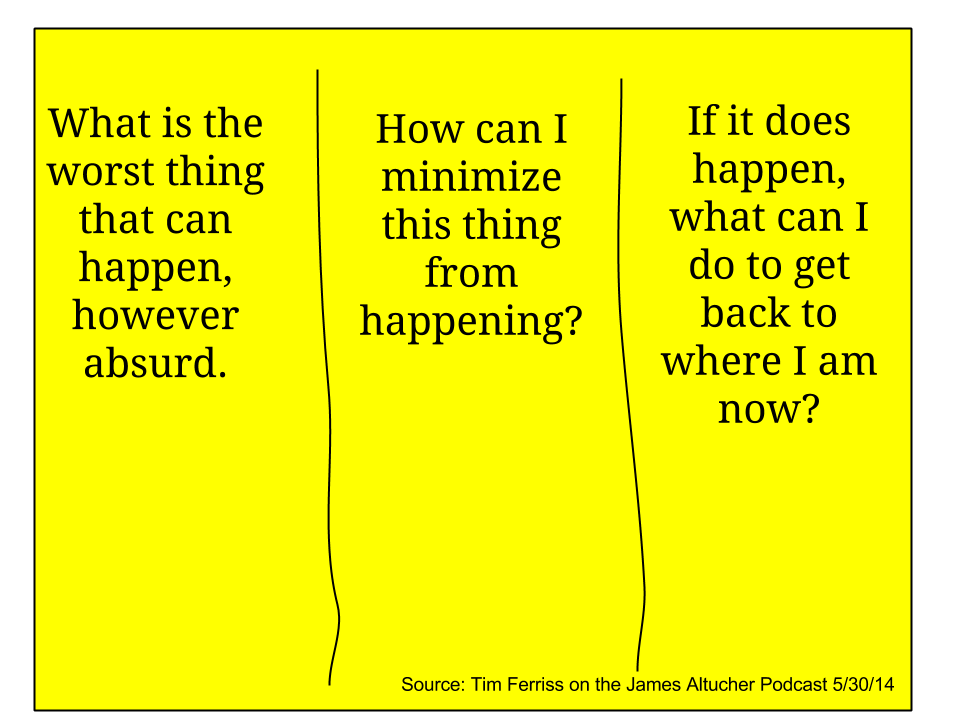
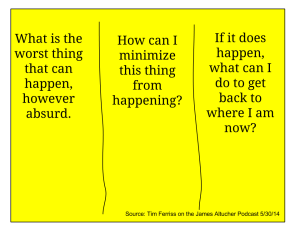
Hearing all this James says that he could never approach women like Ferriss did, but Ferriss responds, “none of the rejections were that bad.” Ferriss said something similar in his first interview, noting that we often have a “nebulous fear of failure.” Instead we can ask ourselves what’s the worst that can happen, how can I minimize this thing from happening, and if it does happen, what can I do to get back to where I am now?

In his experiments Ferriss looks to deconstruct the key elements to understand them. He wants to dive deep into the details to figure out each one. James has had other guests mention this as well. Brian Koppelman (episode #98) and Carol Leifer (episode #66) both have great stories about how comedians have to figure out the chemistry between, funny, harsh, gross, brash, TMI and LOL.

Ferriss says that his systems involves a lot of experimentation and James says this is a great idea, not just for best-selling authors on television shows but anyone, “take investing in startups, almost nobody knows in advance what’s going to make a successful startup” Altucher says because each startup goes through some iteration and experimentation to be something better. Jay Jay French (episode #75) told James the same thing about playing in a band and writing songs. You just have to keep doing it, learning something, change it, and do it again.

And don’t be afraid to mess up during these experiments. “I screw up more than most people I know, but when you see the highlight reel in a bio or a book that’s the end product, you don’t see all the work that goes into it” Ferriss tells James. Ramit Sethi had similar counsel:

“If you look at someone from the outside and they have a successful business or blog and a podcast and you’re like, wow, there’s no way I could do that. Know that I felt exactly the same way.”

Another experiment for the show was to get better at poker, and Ferriss says, “your psychological state is very different when you’re playing with your real money.” Past guest Nassim Taleb writes that English bridge builders used to have to spend time under their bridges to ensure their incentives were in line with those using the bridge.

Ferriss said that some types of poker require a good player to fold a lot of hands and that can lead to boredom, “I don’t have a problem with being bored for long periods of time if I have a system that supports it.” A lot of the guests talk about letting systems guide their thinking. We need systems, argues Ramit Sethi, because we are “cognitive misers.” Chris Guillebeau (episode #46) for example, told James that “I do a lot of the same things everyday.” These aren’t boring to Guillebeau because he knows that those actions will help him get what he wants. Ditto for T. Harv Eker (episode #100) whose entire framework is built on reframing our systems and thought patterns.

Some of Ferriss’s other shows focus on urban evasion and escape (hot-wiring a car, getting out of duct tape handcuffs), open-water swimming, and golf. In all of these things Ferriss tells James that the learning got easier because he began to understand the meta learning aspects with each experiment. He also recognized his own patterns in life and began to adapt those to what was required for filming a television show. He looked at when he was getting tired and tweaked his sleeping schedule. He looked at when and how he was getting hungry and changed what and when he ate.

Near the end of the interview James tries to draw analogies between learning chess and learning anything. It sounds like Ferriss is on board with this connection, but that he doesn’t have the same understanding of chess as James. He can’t give examples to connect the two as easily as he might in one of the experiments. Ferriss does say that one key part is chunking the big aspects of something. In another clip he says that if you learn twelve basic sentences in a foreign language, you can start to cobble together a bunch of other things. He tells James, that once we build a model for doing something in our brain, we don’t need to make a lot of effort the next time. For example, look at this text. You can probably read it easy enough even though someone learning to read would have great trouble with it.

garbledtext
But once we get those chunks established, it’s hard to override them, even when it’s something as simple as riding a bike.

Riding a bike that steers the opposite way is evidently really hard and Ferriss tells James that “there are definite skills that allow you to fake it sooner than others.” If you want to learn to play the guitar, you might consider learning four chords:

Ferriss says that he’s doing these things because “the skill that I’m refining is meta learning.” Ferriss is looking for the best ways to go from being at the 0 percentile and improving to the 95th percentile. He tells James that it Logistic-curve.svgonly takes about six months of constant work to do this. Learning anything, Ferriss says, progresses like the Sigmoid curve. Slow at first, then a rapid ascent of skills and then another plateau in the final stages.

James asks for specific techniques about how Ferriss has learned about meta learning and Ferriss goes back to DSSS: deconstruct, select, sequence, stakes.

Ferriss says that the show cost him “blood, sweat, tears, and money.” James says he’s going to force his children to watch it as part of their education. Ferriss ends the interview quoting Thomas Edison, “When you have exhausted all possibilities, remember this – you haven’t.”

Thanks for reading, I’m @mikedariano.

One final note: In the interview Ferriss talks about Josh Waitzkin’s book The Art of Learning and Joshua Foer’s book Moonwalking with Einstein. I’ve read both and would recommend them to anyone interested in learning. I have a newsletter where each month I share what books I’ve been reading. I’ve also created a Slack group for people to talk about what they’re reading, get help reading more, and find your next book. So many of the guests talk about reading as part of their success. James talks about reading almost all the time. Get in touch for an invitation.

#61 Trip Adler

640px-Trip_AdlerTrip Adler (@TripAdler) joined James Altucher to talk about startups, lessons learned, and starting small. Adler is the cofounder of Scribd and Forbes has listed him as a 30 under 30 to watch.

The interview begins when James asks Adler what Scribd is, and he says it’s like “YouTube for documents” and that their goal is to be “one of the the broadest and largest libraries of content on the internet.”

Adler began trying to figure the problem of sharing documents when he dad, a doctor at Stanford, was frustrated by the eighteen month delay in medical publishing. Instead he wanted a place to share his work online. This proximity led Adler to find what Peter Thiel (episode #43) calls a secret. “Every great business is built on finding secrets” Thiel writes and the secret that Adler found was a missing connection between readers and writers. In the same way that Uber connects riders with drivers, Scribd connects readers with writers. He tells James that they’ve found a way to preserve the formatting, get documents indexed by Google, easily embed them, and monetize them for the writers.

Uber is a fitting analogy for this, because that’s the company Adler wanted to start. “I met my founder Jared and had an idea for a totally different company. It was basically the idea for Uber but I was a few years too early.” Mark Cuban (episode #24 ) told James much the same thing about his experiences in the streaming music industries. “It pisses me off,” Cuban says, that they were doing that sort of stuff years before Spotify, Pandora, or anyone else. You have to be a little lucky with your timing. Jim Luceno (episode #60) was lucky to get a chance to write for Star Wars and told James, “sometimes hard work isn’t enough.” Seth Godin (episode #86) and Mark Cuban admit to lucky timing when they each sold their companies.

But it’s not just luck. Stephen Dubner (episode #20) told James that we should look at luck as one ingredient, like raisins in a cookie. If you make a batch of oatmeal raisin cookies and don’t like them, it doesn’t mean you don’t like cookies, just that you don’t like those. Luck is an ingredient to experiment with and quantify as best you can. If your effort and skills were good but something didn’t work out, you can figure in a bit of bad luck.

So, instead of the ride sharing service, Adler says that he and Jared spent “a good year, year and a half iterating on ideas.” And then, “after trying and failing at a bunch of ideas we had the idea for Scribd.” Sam Shank (episode #78) did the same thing with his career. When he saw that becoming a Hollywood director was a long shot, he looked for other areas he might have creativity and control.

When they decided to start down the path of building Scribd, Adler tells James they built a minimum viable product. Guest after guest on the podcast have advocated for starting small on big projects.

  • Jon Acuff (episode #106) spoke anywhere for free before being paid as a public speaker.
  • Maria Popova’s (episode #89) Brain Pickings was first an email to eight people.
  • Lewis Howes (episode #88) did instructional videos for LinkedIn projects before expanding.
  • Ramit Sethi (episode #36) said not to look at what people have built, because built things are far from starts.

Adler started small, building up the Scribd community, which turned out to be a good move. Before launching he tells James, they were “picking off internet users one by one” reaching out to anyone what might be a good fit for the service. It’s always striking to me how often technology companies start with so much non-automated activities. Scribd didn’t have a base of customers so they had to email people one by one. Sam Shank tells James much the same thing about Hotels Tonight. When they started they had to call each of their participating hotels each day to see how many rooms were available and at what price.

Scribd had a successful launch though because they manually built a community. Since then the company has grown and started to compete with SlideShare and Amazon. Throughout the interview Adler really seems to know his industry, talking knowledgeably about both his own company and his competitors. Jason Calacanis (episode #77) told James that he looks for founders who, “know this stuff cold.”

As Scribd has grown Adler has learned some valuable lessons, things he had to go through. “Getting advice is only going to help you so much, ultimately you’re going to have to learn these things on your own” he tells James about the bumps along the way. Jairek Robbins (episode #96 ) told James the same thing about his coaching business, noting that his dad Tony Robbins (episode #62) could have warned him about so many things – but that those lessons wouldn’t have been as valuable.

One of those hard lessons was in 2011 when, “a lot of things were not working out at the same time” Adler says. We’re all going to have our moments like this. Alex Blumberg (episode #70) has had a lot, figuring things out as he goes along. Ditto for Ben Mezrich (episode #84)who didn’t know if he’d ever be a full time writer.

James asks if Scribd had a “Lazy Sunday” moment (ala when the Adam Samberg video Lazy Sunday went viral and people began to discover YouTube.) No, Adler says, their model is more like the long tail. Kevin Kelly (episode #96) termed the coin and talked to James about it. Amanda Palmer (episode #82) has lived the long tail as a career.

James paraphrases Stephen King and asks, do you do it for the money, honey? Adler has a King like remark and says, nope. “The trend to start a company and make a lot of money is on the way out” Adler says. Sam Shank told James the same thing and Peter Thiel recounted the same story about Mark Zuckerberg. There’s more than money to life because some guests have had all the money they could ever need, and still weren’t happy. Tom Shadyac (episode #15) found himself sleeping in a closet and dealing with a disconnect between an actor making $20M for a movie and the janitor on set making $20/hour. Brad Feld (episode #91) tells a similar story of going through depression even though his financial health was great.

The interview ends with Adler sharing three lessons he’s learned:

  1. Focus. “Decide what you need to be” Adler tells James.
  2. Communicate. “I didn’t naturally communicate as frequently as I had to as CEO.”
  3. Effort and Determination. “The main reason companies fail is because they give up.” Jay Jay French (episode #75) told James about as it related to Twisted Sister. It took French 11 attempts to form a band with competent members and 6,000 shows before signing a recording contract.

Thanks for reading, if you want to connect, I’m @mikedariano.