#98 Brian Koppelman

Brian Koppelman (@BrianKoppelman) is back! He joined James in episode #59 and in this one they  talk about getting over your creative hurdle, the value of good partner, and how easy it is to find success.

Koppelman is no podcast newbie either, he has his own show – The Moment – which has featured guests like Altucher, Seth Meyers, and Phil Hellmuth.

Their interview begins with a short discussion about how podcasting is a different sort of interview. They comment that no one would watch them sit in a room and talk, but there’s something about the mic, your speakers or headphones, and the captive nature of podcasts that’s different. Koppelman wrote about an example of this when Jim Breuer was interview by Mark Maron on his WTF podcast. It’s a good article. Really good and I don’t care for Breuer, Maron, or SNL but read the entire thing.

In Wired, Roman Mars (another great podcaster) said “It’s weird, but I love the closeness that people feel to me and to my show. Public radio once cornered the market on the closeness. Listening to NPR became the definition of who you were. And podcasting is a hundredfold more intense than that. Podcast listeners are so, so dedicated.”

Gary Vaynerchuk suggested something similar, but in regards to marketing channels. When Koppelman does his Vine videos, Vaynerchuk would probably applaud what Koppelman is doing. The videos are short and inspirational and appeal to people in a way that an article, a longer video, or even his podcast episodes can’t. It’s like a coach bringing a player over the bench, offering a few encouraging words, and then sending them back out there. It’s all about matching the medium and the message. Podcasting is still so new though, that there’s a lot to figure out.

For one thing, it’s not a quick way to make a buck. “It isn’t clear that there’s real money in it.” Koppelman says about podcasting. Jason Calacanis (episode #77) has been there, done that. He told James he tried to start a network and it doesn’t really work. He found that you need people with established bases, fans, skills and those people don’t want to work for anyone.

But Koppelman and James continue at it and begin talking about Solitary Man, about which Koppelman say, “that’s the movie of ours that means the most to me.” In part because he was stuck on it for so long. It took over three and a half years to write and another year and a half to get funding.

Part of that struggle was because Koppelman got stuck writing part of it and had a brief interlude as a stand-up comedian. I couldn’t help but that think that part of this was advice from Koppelman’s writing partner David Levien (episode #85) who told James, “when you’re doing something creative, you have to find different ways to stay fresh.”

And each iteration, each adventure, each small story is part of the bigger one. Koppelman reminds feeling that if he didn’t do something, he’d never do it. “When you’re thirty you do think to yourself, if I were going to do it, I probably would have” he says. Carol Leifer (episode #66) thought something similar when she had a chance for her own show. She had written on Seinfeld, on SNL, and for the Emmy awards. This. Was. It. Her own show! But it wasn’t. In her book she tells the story of Jerry Seinfeld coming over during filming for the pilot and saying:

“You know, there’s not just one thing, Carol. Take the pressure off yourself. It feels like the most important night of your life , but it’s really just another night in the bigger picture of everything you do. Now, go have fun out there .”

Each thing you do is just another fence post in the work of life, and that never ends. Koppelman said that you have to “keep moving forward, it’s always scary.” This is another theme the podcasts guests have hit on, success isn’t a destination but more like a mindset. You don’t arrive, land, or end-up successful. You “keep moving forward.”

Stand-up began a change within Koppelman, partly because he was surround with good people. “There’s an incredible power in having a creative partner” he tells James.  Adam Carolla (episode #25) met Jimmy Kimmel and thought “hey, this guy’s funny” and “we work well together.”

Solitary Man continued to be Koppelman’s white whale. As he trawlled through comedy clubs, the project swam untamed. Not finishing it made him feel like “a fraud.”

To break through the creative block he tried The Artist’s Way, but was stymied. He needed stand-up because it “could let me fail in a certain way.” He had to build up a set of skills and “pass a club” and slowly his fear abated. His fear of failing was melted away by the warm stage lights. Gretchen Rubin (episode #97) told James that repetitive actions like this can “dampen our emotional reaction to things.”

Ready to face his fears, Koppelman began writing and let his rough draft be rough. Jacques Barzun wrote, “let that first sentence be as stupid as it wishes.” But not forever so. Koppelman advocates for a band, a range, of creativity to fall in. You want to be vulnerable early and write anything, no matter how bad. But you need to be tough later on and welcome feedback that might rip it apart. It’s been these landings, between soft as cotton and hard as stone that the really good work is found.

Koppelman said he cranked away at the script and one day on the bus he realized what the missing part of the movie was. He said he rushed into his office and told Levien “I need five minutes” and he transcribed what he had written. Ryan Holiday (episode #18) mentioned something similar, saying he would finish a run and walk into his home, telling no one to bother him while he jotted down an idea.

Once the script was done, it was time to make the movie. Slowly. Koppelman faced resistance from the studios about the tone of the story and age of the characters. To combat this he had custom shoes made that reminded him he had to take one step each day to get the movie made. Doing one thing, no matter how small, was something Jack Canfield (episode #90) said he proposes too (though he suggests five).Slowly Koppelman’s movie got reeled in. Steven Soderbergh thought it was good. Michael Douglas agreed to star. But it took over a year to get the money.

James asks what is becoming his stock, but wonderfully open, question; “what would you tell someone who’s listening and sitting in their cubicle?”

Koppelman doesn’t disappointment and sounds excited to give five pieces of advice:

  1. Have good people in your life. “I luckily married the perfect person for me.” he tells James. Tom Shadyac (episode #15) said that he worked well with Jim Carrey because they each made each other better.
  2. Ask what you want. “What is most important to you?” he tells James. I’m guessing he got this from Tony Robbins, which means that Jairek Robbins probably got it from him when he told James that people need to learn what they want in life.
  3. Be selfish. If you don’t have a good dream, Koppelman says, “you become toxic.” This is what Scott Adams calls the right kind of selfishness. One that makes you and everyone around you better.
  4. Say no. “I cut it all out of my life years ago.” Koppelman tells James. There’s no obligations that don’t bring him good feelings.
  5. Don’t listen to experts. Experts don’t have the incentive to find a gold in the river, it’s to make sure the pan doesn’t get full of stones. Stephen Dubner (episode #20) used a soccer metaphor to explain why you should act toward your real interests, not perceived ones.

James follows up with another good question, but how do you know when to quit, when you won’t make it. “The line between being an artist and being delusional is very thin.” Koppelman says. Stephen King has his own suggestion:

The biggest part of writing successfully is being talented, and in the context of marketing, the only bad writer is one who doesn’t get paid. If you’re not talented, you won’t succeed. And if you’re not succeeding, you should know when to quit. When is that? I don’t know. It’s different for each writer. Not after six rejection slips, certainly, nor after sixty. But after six hundred? Maybe. After six thousand? My friend, after six thousand pinks, it’s time you tried painting or computer programming. Further, almost every aspiring writer knows when he is getting warmer – you start getting little jotted notes on your rejection slips, or personal letters . . . maybe a commiserating phone call.

Instead of making it as a writer, entrepreneur, spouse, think about pivoting. Jack Canfield told James that he sees all kinds of people succeed in areas related to, but exactly what they dreamed of. Sam Shank (episode #78) lived this when he pivoted from Hollywood to start ups.

In the end Koppelman offered this advice:

“I knew that those two hours in the morning that Dave and I were writing Rounders, were the two hours that I felt most alive in my workday. And it wasn’t a bullshit thing that lasted one day, even when the writing was hard, the actual doing of it is hard…and I wanted that all the time.”  about it feeling good even though it was hard.

And that it was hard matters a great deal. “You have to cover that difficult terrain yourself.” Koppelman says. Jairek Robbins said the same thing, that his dad could have saved him some time and money but without learning on his own he would be short the lesson.

experienceandmoney

Beyond their enjoyment of podcasting, Koppelman also has a Vine channel,  #319 is quite popular.

“I’m sure there are days when you think the haters are right and you’re not good enough. Days you know it’d be easier to quit. But then you’ll never know what would have happened if you gave it one more push.” – Brian Koppelman

Nassim Taleb calls this the sandpile effect, and it’s a key part of his theories of non-linearity. Imagine you are building a sandcastle (Taleb is “on a beach in Copacabana, in Rio de Janeiro”) but you can be anywhere. One bucket at a time, you add to the castle. Until finally one bucket is one bucket too many, and the whole thing topples.

Taleb’s point is that in life, sometimes that last bucket is random. His example in Fooled by Randomness – appropriately enough – centers on an actor who gets selected for a role and then another role because of the first and so on. That initial selection,the one more push that Koppelman says, or last bucket that Taleb dabbles with could be random. Research has shown that judges can be predicted to be more or less lenient based on their eating habits.

Koppelman likes the Vine videos because of how loose and free they are. A decade ago Jason Calacanis thought this unedited nature was unprofessional but he quickly saw that this was exactly what appealed to people. Maria Popova (episode #89) told James that “allowing yourself the uncomfortable luxury of changing your mind” is one of the things she’s learned running Brain Pickings.

Koppelman’s current project is Billions, which is starting up production now. You can see all the Variety tags for more. He also Vines from the set.

Koppelman wraps the interview telling James that it’s okay to hear people tell you to chase your dreams but that “you have to work ferociously hard.” This is theme of our April 2015 book club choice, So Good They Can’t Ignore You. For example, do you know how Steve Martin became so funny?

He was born that way, no that’s not it. He was passionate and used the law of attraction to will success to him. Wait, wait, that’s not it either.

Martin got a job at Disneyland and spent his summers doing tricks. Then he worked on his magic which transitioned to comedy. But being a Grammy Award winning banjo player, that was a gift right? No. No. No. He played banjo records at half their normal speed so he could play along with the song. Success takes work, super success takes super work.

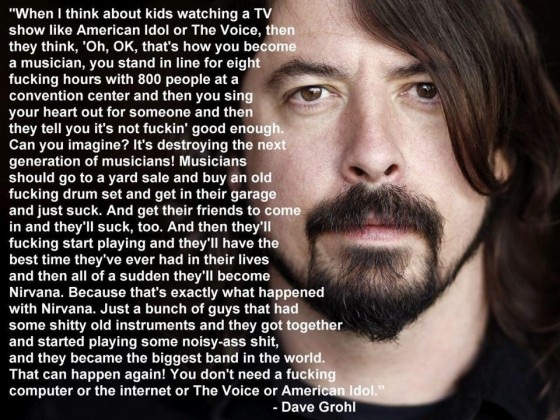
Dave Grohl also has a bit of wisdom:
davegrohl

Koppelman was on Seth Meyer’s show, you can watch the clip below.

Thanks for reading. If I messed up something other than writing “vine channel” please let me know via text, (559) 464-5393, contact, comments or @mikedariano. There was one great bit that didn’t seem to fit. It was around 33:00 when Koppelman talked about learning comedy. He says that he had to learn to “be mean enough to dispense with the heckler without losing the rest of the audience.”

This shows how deeply he had to understand the craft to do it well and he estimates that it would have taken years and years of late night shows and touring to be able to earn a living from it. To succeed you have to understand things deeply. Jason Calacanis said you have to “know this stuff cold.”

It’s ironic that a post featuring a Michael Douglas movie would lead to another Michael Douglas movie – Falling Down – which is an extreme example of the straw that broke the camel’s back.

*A previous version of this post misspelled Jim Carrey’s name. 

#77 Jason Calacanis

Jason Calacanis (@Jason) joined James Altucher to talk about startups, podcasts, and how surfing is like business. Calacanis is the founder of Inside.com, host of This Week in Startups podcast, and an active angel investor at AngelList.

Their interview begins with Calacanis’s history. He started Silicon Alley Reporter in 1996, as a trade publication focused on New York’s Silicon Alley. Calacanis said that while he was running the company, he felt like he “was the Silicon Alley Reporter” and this identity bothered him. Seth Godin (episode #86) said in that he felt the same way about his company and noted that after he sold it, he felt like a loss of part of himself.

Eventually, Silicon Alley Reporter failed and Calacanis began laying people off. It wasn’t fun but Calacanis tells James that it also wasn’t something to get upset over. He said, “okay, it’s low tide, let’s find another beach.” Like a surfer might drive along the coast and look for parked cars, Calacanis looked at where his Silicon Alley reporters landed – at blogs. At first he was dismissive, thinking that because they weren’t edited, they wouldn’t be good. Once he took some time to examine them more deeply though, he saw that this was exactly why they worked. So he started doing what Gary Vaynerchuk (episode #2) calls “the most important word ever.”

He hustled. Looking at him now it seems like he had hit after hit, but that’s never how it really works. Calacanis had to build up his skills at business building. Jairek Robbins (episode #96) told James that this was something he too had to learn. Jairek was almost perfectly following in his father’s footsteps (Tony Robbins, episode #62) but he had to learn things the hard way, to make his own mistakes and said that he “learned more by figuring it out on my own.” The same was true for Alex Blumberg (episode #70) who told James that he doesn’t know how he solved the problems that come up other than by solving the problems. Ramit Sethi (episode #36) said, “don’t wait for inspiration, test your way to it.” Kevin Kelly (episode #96) said that if you have money you buy solutions, if you don’t you figure them out and learn something along the way. There’s value in the experience of figuring things out.

For Calacanis this meant beginning Weblogs, Inc. a blog network with some notable names then and now, among them, Engadget, Joytstiq, and Download Squad. Finding sites to form a network was easier then Calacanis said, because there was less noise to parse through. You could look at some of the new products on Delicious and find something of value. Now though there are sites like Product Hunt where hundreds are released each week. Calacanis is echoing what Kevin Kelly  mentioned about being lucky. Kelly said, “I lucked out to be at this moment when the digital culture and the nerdy stuff I was interested in became mainstream.” For Calacanis, it was luck in the timing. Five years back and there’s nothing to see. Five years forward and there’s too much.

Part of the avalanche of options is thanks to the access technology provides. “There’s a zillion things you can just do and that’s pretty fantastic.” Calacanis told James. You could setup a blog, an e-commerce store, and a podcast in half a day. Things that took weeks takes days. The cultural gatekeepers are gone – Godin’s idea, not mine – but they are gone for everyone – Vaynerchuk’s idea, not mine. You have to “put up or shut up” as Adam Carolla (episode #25) told James. In the past fewer people could get book deals, start companies, or build websites. Those limits are gone but it means larger crowds. A decade ago Andy Weir (episode #92) tried for three years to get a book deal and got nothing. Now his book is becoming a movie. For every Andy though, there’s a Randy out there that missed.

James asked Jason what someone in their cubicle might look towards as a growing area? Calacanis says whatever you create, he looks for two things in your work.

1. Know your space. “There’s  level of deep, deep obsessive knowledge you need to have of all your competitors. Of all the nuances of their products. Of the history.” He says to James that you shouldn’t be in the smartwatch business if you don’t know the in and outs of the Apple watch and about Pebble’s Kickstarter. “Know this stuff cold.” he says. He likens it to this clip in Rounders, which David Levien (episode #85) said is based on something he really saw and Levien was only able to include this in his movie because he knew his space.

Calacanis calls this “asymmetrical advantage of information.”

2. Do good work. The other thing he looks for is good work, in general. If you have a  well-designed site or good technical programming, then you probably won’t forget that overnight.

The conversation moves to angel investing and Calacanis returns to these ideas. When James asks how someone can get featured on the AngelList (another crowded market) Calacanis says that you should just partner with someone. He goes on to say that if you research one of the syndicate heads you’ll have a better chance. Carol Leifer (episode #66) mentioned the same expectation to James. She said that if someone connects with her and knows that she likes animals, a bit of her history, and has good things to say, she’ll be more likely to work with them.

Calacanis said that one crowded space people shouldn’t worry too much about is reporting and press. Instead of hoping for coverage, people should “take ownership of communicating their ideas.” Build a blog or newsletter and use those mediums to communicate he said.

James and Jason speculate about the future of IPO’s and wonder what role they might play. Facebook was down to almost half of their valuation six months after their IPO and that may have scared some companies away from their own IPO. That’s true, but for the people not involved in the initial investment, it’s valuable to look at the bigger picture.  Two years later the Facebook stock was triple the low. More evidence to not read the daily news which included headlines in the fall of 2012 like “Is this the beginning of the end?” An article at Bloomberg said, that “It might be fatal to your career to be viewed as the last chump to get out.” Ladies and Gentlemen, your daily news.

The problem in the daily news isn’t that the news is bad, it’s that the good stuff is hard to find, especially among the hyperbole. In Fooled by Randomness, Nassim Taleb wrote, “For an idea, age is beauty…For an idea to have survived so long across so many cycles is indicative of its relative fitness. Noise, at least some noise, was filtered out.” Which is a less than applauding introduction to…

Inside.com, Calacanis latest company. It started when he asked, “if people on mobile could read news more efficiently, that would be a great thing for them.” Inside.com then is a snippet view of news stories, organized around themes like Disney or Podcasts. To their credit though, they’ve avoided the “salacious” headlines that typically drive news.

James picks Jason’s brain about his experience building a podcasting network, but Calacanis says it’s really hard. You could “do it as a loss leader” he says. Or as a way to learn from people. But as a business, that situation is harder to figure out.

The end of the interview circles back to Calancanis’s situation when his other startups shuttered and it reminded me of something Marni Kinrys told James. She said that when it comes to being confident, it’s not about being confident all the time. It’s more like a self awareness, an ability to self-diagnosis when you aren’t confident, but want to be, and the know how to build your confidence back up. For Calacanis it wasn’t confidence, but business health. He didn’t always run a successful business but knew when something wasn’t working and what might work instead.

The interview ends with some book suggestions from Calacanis, who says people think he’s smart, but he says he’s just well read. As Charlie Munger said, “I have known no wise people who didn’t read all the time — none, zero.You’d be amazed at how  much Warren(Buffett) reads — at how much I read. My children laugh at me. They think I’m a book with a couple of legs sticking out.”

Jason’s suggestions:


Note: You can now sign up for The Waiter’s Pad Book Club.

Thanks for reading. One final word on luck. Luck is hard to figure out. I’m sure that Jason pursued Weblogs, Inc. because he had the skill to recognize a trend, but there is no success without a bit of luck. As Kevin Kelly said, it’s not that successful people don’t work hard (they do) or aren’t smart (they are) it’s just that they get a bit lucky too.

The Andy/Randy dichotomy will continue on this site after reinforcement from Thinking Fast and Slow and Fooled by Randomness. Both books talk about our mistake in looking at the numerator rather than denominator (availability bias). That is, we take notable examples, like Andy Weir and we think that he represents a class (part-time fiction writers). Rather, he’s the exception. There are many people writing space fiction who didn’t make it, we will call them Randy.

#97 Gretchen Rubin

Gretchen Rubin (@GretchenRubin) joined James Altucher to talk about habits, happiness, and answer why she was so unhappy in the first place (she wasn’t, and gives a good reason).

Rubin is the author of a trio of books that James seems to have enjoyed. The Happiness Project, Happier at Home, and her latest, Better than Before. In that final book Rubin says that she discovered that there is no one sized fits all approach to solving our habit (or any) problems. It takes a lot of experimentation and mindfulness, something that Brad Feld (episode #91) mentioned in his interview too. It’s a theme among the podcast guests that you have to experiment to find your own solutions. In her interview Rubin admits that she found that novelty and challenge made her happier while adventure and travel did much less for her.

One of Rubin’s discoveries during her exploration of habits was that people have range of aptitudes for creating habits. Like some people are better at cooking, or building websites, some people will be better at creating habits. Taking a moment to think about the habits you want to build is good, and it’s what Scott Adams called the right kind of selfish.

If you do selfishness right, you automatically become a net benefit to society. Successful people generally don’t burden the world. Corporate raiders, overpaid CEOs, and tyrannical dictators are the exceptions. Most successful people give more than they personally consume, in the form of taxes, charity work, job creation, and so on.

runningmommyRubin says that beyond that “happier people are more altruistic” and “when we’re unhappy we tend to get defensive and isolated and pre-occupied with our own situation.”

This conversation reminded me of a recent Facebook post from a friend. She’s one of the many parents who faces the trade-off of personal well-being and taking care of your kids. It’s important to have some kind of good selfishness.

Rubin began this journey of habits, health, and foremost happiness not because she was unhappy, but rather “I was taking my happiness for granted.” She wanted a better sense of appreciation for the things she had. Past guest Wayne Dyer has built his books on this idea, noting that even if all you have is your breath, or your mind, you still have something to be thankful for.

So, Rubin began a year long project of building up a collection of habits that would let her “have a greater appreciation for what I already had.” One discovery was that when she built habits, time would either speed up or slow down. It can “dampen our emotional reaction to things” she tells James. For Rubin this meant that the anxiety producing act of driving became less angst filled when she did it more often. Examples like driving were some of the low-hanging fruit examples that brought her happiness.

She also saw that “energy makes everything easier.” She noticed that if she had good energy levels, she could act in the way she wanted much more easier. Daniel Kahneman writes that “self-control and deliberate thought apparently draw on the same limited budget of effort.” We want to take a certain course, the one of least resistance as worn smooth by our habits. If this course isn’t what we want though, it takes some effort to change.  It reminds me of sledding with a young child. You get on, aim away from the tree/creek/other people, only to have your sled turned by the well worn grooves of other riders. You dig your heels in to change course. That mental heel digging takes energy. Willpower takes energy in the same way that solving a difficult problem would. If you want to do something different, you need to summon a surge of energy or build new habits that don’t require that surge.

Rubin also found that the acting and feeling dichotomy echoes what A.J. Jacobs said. In episode #94 Jacobs quoted Millard Fuller saying, “It’s easier to act your way into a new way of thinking than to think your way into a new way of acting.”  Rubin found her experiences similar, telling James, “a lot of times people feel we act because of the way we feel, but in fact to a very great degree, we feel because of the way we act.” Kahneman also found that just smiling or frowning can affect your thinking.

nestledlistRubin continued her experiments, picking up pieces and seeing their fit like a child might put together a Lego house, then a boat, then a castle. She found that children know how to make friends easily but adults find hard it more difficult. “It’s really hard to make friends as an adult” she tells James. Our problem, Rubin suggests, is that we don’t take a moment to ask why it’s so hard. She says that we don’t – in the words of Jack Canfield (episode #90) – take our whacks at the tree. “Keep asking why,” Rubin says, and you’ll find an answer.

James addressed this in a very specific way in episode #223 of his Ask Altucher podcast; “How Do I Execute?”. He said that execution “is just a subset of ideas.” James goes on:

When you have a good idea, the next day make your list of ten possible next steps to execute on this idea and all of these steps should be stress free.

A more explicit tip Rubin suggests is to find triadic closure, which I had to find on Wikipedia because it sounded too wild to believe (the term, not the principle). The idea is that you should make friends with your friend’s friends. If you know Kim and Kim knows Dan, then you should try to become friends with Dan. Rubin admits that it seems odd thinking about friendship in anything less than organic terms, but if it’s your best thinking that’s got you where you are, maybe you need to change your thinking.

Another tip that Rubin has is to start a group. It doesn’t matter if it’s a children’s literature book club. If you do choose a group, make sure it’s something you’re really interested in. Adam Grant (episode #73) told James that people who volunteer for causes they don’t care about, or aren’t invested in, get burned out much faster.

There was the month – NaNoWriMo – where Rubin wrote a novel. There was a month of trying to be better in her marriage and with her kids. She found out that nagging doesn’t work, that six second hugs are great, and that it takes thoughtfulness and mindfulness to fight right. After her experiments she tried to be more mindful of things, to the way she talked with her kids to the way she postured her body during writing. She experimented her way to four big ideas for happiness.

  1. Growth
  2. Feeling Right
  3. Feeling more good things
  4. Feeling less bad things

James asks what a “cubicle dweller” might do to make their life happier and Rubin suggests that you start to list out the things in those four categories that would make you happier. What are some of the more good things and some of the less bad things? If you’re reading this and listening to the podcast there are a whole host of of shows you could dive into. Here are a few of my current favorites.

  • Gary Vaynerchuk (episode #2) also has a Q/A podcast.
  • Build and Launch. Justin Jackson launches a product every seven days.
  • Stephen Dubner has a Freakonomics podcast.

Finding podcasts actually became a solution to a friend of Rubins. At first her friend thought she hated her job. After diving deeper into the problem though, she realized that it wasn’t her job as much as it was the commute. Filling that time with audiobooks and podcasts changed her view. This is what Stephen Dubner (episode #20) calls solving a small problems. Small problems are easier to solve because they have easier solutions. He’s putting the same ideas of Rubin and Canfield into effect.

A personal story of my own was when my first daughter was born. I realized – in hindsight of course – that there were certain days I lost my temper. Why was that? It turned out, the reason I was so short with my daughter and wife was that my legs hurt. My hips were misaligned because my hamstrings were too tight. My hamstrings were too tight because I was sitting down too much. If this were a corporate flow chart it would look like this:

tight hamstrings > crooked hips > back pain > general pain > discomfort > short temper

Only after I realized this sequence did I begin to understand how to solve my problems. Diving into deeper good solutions like this is told in the story of cholera in 1850’s London. A middle of the century outbreak was causing hundreds of people but no one knew the answer. Not until Dr. John Snow began asking questions, diving deeper and deeper, did a solution appear. The problem was the water. By disconnecting a single pump handle, the outbreak was squelched.

If you takeaway anything from Rubin’s interview, it’s that you should start tracking something because “anytime we start monitoring something we do a better job with it.” she tells James. Track, experiment, change, tweak, repeat. Also, pick up a book or two from Rubin for a good idea on where to begin your own happiness project.

Thanks for reading. Mike – @mikedariano.

If you want to join a group, The Waiter’s Pad book club will be starting soon. If you have book suggestions or requests, let me know.

#49 Kevin Harrington

James Altucher interviewed Kevin Harrington (@HarringtonKevin) to talk about marketing, infomercials, and the nuts and bolts of selling nuts and bolts.

Altucher begins the interview by asking about all the products Harrington has been involved with, and it’s a lot. Like James, I was struck by the number I recognized considering that I don’t watch late late night television. Kevin’s been involved with the George Foreman grill, the NuWave Oven, Ginsu knives, Tony Little’s products, Paris Hilton, the Medicus golf club and the list goes on. Kevin pegs the number of infomercials he’s been involved with at nearly 700.

One of Harrington’s early partnerships was with Tony Little. He was so successful that he was “buying homes and real estate and, you know, unbelievable things and, you know, antiques and art and all that kinda stuff – fancy cars.” One of the guys on Kevin and Tony’s team sees this and thinks that he wants to do it too. So he goes off and starts a company called Beachbody – the company behind P90X – which now does over $400 million a year and that man’s name was Carl Daikeler.

Then James and Kevin talk about the Flying Lure, a 500 million piece seller (this phrasing slipped past me until later in the interview, just wait). The Flying Lure inventor, Alex Langer, says that the idea came to him after he “got skunked for 2 straight days of fishing.” He then cut up a Coke can and glued the pieces together for the first iteration of the lure. Three years later he met Jim Caldwell who took the idea to National Media Corp. where Harrington was president. From there Kevin put together $75,000 worth of TV spots, but tells Alex he needs one hundred testimonials. He needs; consumer, professional, editorial, celebrity, and documentation testimonials.

This range of testimonials works well because it corners the market on a psychological idea known as the availability heuristic. “The availability heuristic is a mental shortcut that relies on immediate examples that come to mind. The availability heuristic operates on the notion that if something can be recalled, it must be important.” Marketers like Kevin want to provide enough examples, that one of them will come to mind when thinking about a product, like The Flying Lure.

Imagine a hypothetical situation where you need to buy a new computer. You check Consumer Reports, The Wire Cutter, you look around at coffee shops. It’s clear after your research that Apple is the clear choice. You then tell your brother about this and he tells you about the lemon of a computer his Apple was. His review should have very little impact, it’s only one experience of many. What research has found though, is that because this information is more recent and comes from someone we interact with, we are more likely to weigh it heavily in our decision. For Harrington – I’m supposing here – the idea is that if your brother is a fisherman that doesn’t like the lure, they provide a better fisherman who does. If he is an engineer that explains it can’t work, they provide a better expert who says it does. Whatever area you might face an objection, they want a more available, and favorable, suggestion that says it works.

Before any of the testimonials can work though, Harrington says you have to “tease, please, and seize” the person who is listening. In the interview he gives the example of the meatball sandwich. “If I’m selling a cleaning product, you’re gonna see a guy eating a meatball sandwich with a big drop of sauce all over his beautiful $100 tie. Has this ever happened to you? And that’s – and, yes, it has, and by the way, I’m gonna watch to see how they solve that problem. So show me a problem, hit me upside the head, tease me.”

After getting their attention, you need to please them, and show the benefit, the magical transformation. “In acne, it’s pizza face to clear skin. In weight loss, it’s 280 pounds to 120 pounds. It’s, you know, show me somebody that was poor, now they’re rich.”
After the testimonials are arranged and the tease, please, seize sequence coupled together, it’s time to buy TV time, which can be expensive. Harrington says that it’s 30-50% of the cost of goods. With all the numbers he gives on the episode my best guess for the cost breakdowns on The Flying Lure are; $10 to TV, $1 to Alex the inventor, and $4 for the packaged goods. Harrington says the rest goes to the lawyers, accountants, and other people behind the scenes that make it all happen. About that “500 million piece” language, that’s how many total pieces. In all only 25 million kits were sold. Still a staggering number but something about the funny expression made me wonder about the other things Harrington was saying.

Then James and Kevin get to the celebrity endorser that I was most interested in hearing about, George Foreman. I remember looking up Foreman the boxer after seeing Foreman the grill salesman. At first Foreman didn’t want to do it, saying he wasn’t “interested in toys.” His wife was the one who tried the grill and convinced him after cooking a burger for him on it. The grills bearing his name went on sale in 1994 and in 1999 Foreman was bought out for $137 million bringing his estimated total compensation for the grills to almost $200 million.
The other media mogul from Foreman’s generation is William Shatner, the spokesperson for Priceline.com who was initially paid in Priceline Stock. The details on Shatner’s fortunes are more ambiguous than Foremans, but here is what the Priceline stock has done.
Harrington hasn’t been on Shark Tank in a long time – that I can remember at least, and I watch most weeks – but he’s been doing his own shark tanks. “You know, like I go into corporations and I do – I create Shark Tank style events. You know, I went into a major corporation like AT&T, had 300 senior executives, break them into 30 teams of ten and we take 30 pitches over the day and we come up with new ideas for AT&T. That’s one style of event, so that’s cool. I’m planting a seed, building a whole new business enterprise corporately. Then I do the same for commerce kind of events and I do entrepreneurial organizations.”
Then they bring up Gary Vaynerchuk (a past podcast guest) and Harrington says he’s made millions of dollars on investments in companies like Uber. Somehow I didn’t get any of this when he was last on Altucher’s show.

Harrington ends the interview by telling Altucher to keep his eyes on the NuWave Oven which uses infrared technology, and the Ronco vertical grill. If you want more from Kevin Harrington he has a new book out, Act Now: How I Turn Ideas Into the Next Million Dollar Product.

#96 Jairek Robbins

Jairek Robbins joined James Altucher to talk about habits, heuristics, and what he thought when 98 pages into writing a book, he couldn’t finish it.

To start, as Altucher says in their interview, they need to get the elephant out of the room – Jairek is Tony Robbins’s kid. Jairek says “we get that a lot” and gives a nice thanks for asking answer. He tells James that his dad actually suggested he not become a coach, and instead do something like join the FBI. Jairek says that he had to become coach, but that he started out only coaching things he knew anything about. “I was 5’9″, 225 pounds in high school” he tells James, not a small guy. So he got in shape, in part by alkalizing.

Alkalizing is the theory that suggests you mimic the natural pH of your body and eat foods that counteract the acidity in life. This means less cheese, poultry, and grains and more fruits and vegetables. The medical literature on this diet is ambiguous at best and slightly harmful at worst. The American Institute for Cancer Research in particular had a warning about cancer patients and alkalizing, “What you eat can have a profound affect on your cancer risk, but the acidity or alkalinity of foods is not important.”

But Jairek had to try this (and it worked for him) because he had to explore this idea before he could help other people do it. “You only go into coaching when you have a passion for people” he tells James.*

Jairek says that he started out coaching 52 clients each month, with two phone calls and many emails back and forth between them. He worked from six in the morning until midnight. Hours that Gary Vaynerchuk (episode #2) was also working. For Vaynerchuk this worked as long as he unplugged on the weekends and focused entirely on his family. Jairek needed something else. “The reason I wanted my own business in the first place was to have more freedom, to have the life I wanted.” Working like crazy wasn’t it.

It echoes what Sam Shank says in episode #78 when James asked him what he would sell his company for. No amount. Shank said. Because what would he do if he had $400M, he’d tried to get right back to where he was.

Knowing he wanted a business, not a practice, Jairek began to refine his system focus on what would bring his clients more value in less time.  He began teaching time management. To get started Jairek says, “I timed out my grocery shopping” and “how long it took to make juice in the morning.” He found through his own experiences and reading, that a few things stood in the way of good time management. And another example of his coaching philosophy, that you need to do it before you can tell someone how they should.

One issue that cropped up with time management were the number of interruptions that happened in a regular day. Jairek told his biggest client at the time to buy a “Be back Soon” sign and put it on his office door. Another issue was The Myth of Multitasking, and “the more responsibility you have, the more hats you wear, the more likely you are to become inefficient.”

If you do want to multitask well, Elizabeth Saunders suggests in her book, How to Invest Your Time Like Money to layer your actions. You can walk and talk on the phone or listen to an audiobook while driving a car, but you can’t talk and listen to an audio book. Correct layering means matching the right tasks. A.J. Jacobs (episode #94) has a treadmill desk. He can walk and write at the same time.  But be careful because Daniel Kahneman writes that our cognitive tasks – conscious or not – add up. He suggests this experiment: the next time you are walking with a friend, ask them to add 25 + 57. Chances are they will continue their pace. Then, ask them to multiply the same two number, and dollars to doughnuts, I bet they slow down or stop completely. Kahneman writes that we have two mental systems, the first is one that can handle things like walking, talking, and simple addition. It runs in a low energy state and keeps us moving forward. The other system is the one we use more like a super-computer, we engage it only for the harder problems. These two systems draw on the same resources and to use more of one will at some point, take something from the other.

Jairek began coaching in areas like health and productivity because he built a skill his father emphasizes, asking good questions. He tells Altucher that when he was coaching a lawyer at a London law firm he began asking them, “tell me about your day, what happens then, what happens next, what do you do from there?”  Asking many questions reduces a situation like a simmer reduces a sauce, and eventually all that’s left is all that matters. Stephen Dubner (episode #20) wrote that asking why like a child is quite handy for solving problems because smaller problems are easier to solve and give better answers.

When he was coaching a lawyer on time management, James asks if Jairek was worried the lawyer might steal his intellectual property during these coaching sessions, but Jairek says no, not really. He began this business to focus on people who could help others. Seth Godin told James in episode #87 that he has much the same metric for his book sales. He doesn’t care about copies sold or the NYT list, but instead about how many lives he’s changed.

During his coaching experiences Jairek wrote a book about these ideas but realized after about 98 pages he couldn’t finish it because he hadn’t lived it long enough, seen enough of it. He kept working, and collecting life lessons. He mentions that there have been a few that he could have avoided had his dad stepped in to help him out, but he realized that he learned more figuring it out on his own.

One of those things was conferences, another is making good online content. He tells James that his team is still trying to figure out, “how do you deliver this message in a way that people want to receive it, that they are going to be entertained and educated at the same time.”

Do you hear that? What’s that sound? That’s the Gary Vaynerchuk social media train that comes through. Gary wrote in Jab, Jab, Jab, Right Hook that social media has to “actually be their entertainment.” You need to “be generous, be informative, be funny, be inspiring, be all the characteristics we enjoy in other human beings.”

Jairek tells James that one of his favorite books is The Power of Habit by Charles Duhigg. He uses the template of trigger – action – reward to suggest people to change their action for better results. It doesn’t need to be a big thing either, and if you want to get started, the de facto source for this is BJ Fogg’s Tiny Habits course.

The conversation eventually turns to Jairek’s book, Live it!. and he explains the different parts:

Learn it. “Figure out what you want to be in life.” Jairek says. He gives four good questions to ask yourself that reveal the true you. A more simple system that I’ve found helpful is to create two options and then rest the fate on a flip of a coin. Then do what it says, but only after to gauge how you’re feeling. Want to tell someone you love them? Heads you tell them now, tails you tell them never. Flip the coin, see how you feel.

Live it.  What does your perfect day look like? Try it, experiment, refine, try it again. What people are in that day? Where are you?

Give it. Jairek spent time in Africa and realized the abundance that people have compared to them. So he tried to educate people on this. It didn’t work. What if, he asked himself, I helped people achieve what they think will bring meaning, and then be there for them when they want something else. James says this is a great idea because, “people need to move from ambition to meaning in their lives.”

“I wish everyone could be rich and famous to realize it ain’t it.” – Jim Carrey.

To start growing in any of these areas, Jairek suggests you start small. What daily habit can you begin that will lead to you learning, living, or giving?

Then you can face your opponent. “You can have the best plan in the world,” Jairek says, “but at some point one of these opponents is going to show up.” There is the outside, intimate, and self opponents.

James says that a framework like this is a great model to help people, and it makes solving problems a lot easier. Try it the next time you face a challenge and see if it brings clarity to solve what’s next.

The interview begins to wrap up when Jairek shares some great advice from his dad, “train yourself to find a way” he tells James. Ryan Holiday said much the same thing in his conversation with James in episode #18. About facing obstacles, he told James, “This is what successful people do. Period. They don’t get impeded by things, in fact, when bad things happen, they get better.”

The rest of the interview is about how Jairek is building his coaching business rather than his practice. A business is something that can run without him, a practice is one that only runs with him. Much deeper than I first realized.

Thanks for reading. One ending note. There have a been a lot of people on the podcast suggesting what you should eat or avoid eating. From the coffee to the carbs to the composition of the foods. Two pieces of advice, first take a suggestion from Nassim Taleb, the older something has been eaten, the safer it is. Taleb writes that he only drinks three things, water, wine, and coffee because of how long they have been around. The second bit is from Scott Adams and that is to experiment with what makes you feel your best. There’s a good chance that alkalizing will make you feel better, but not because of any such alkalinity, rather because of what you are eating. If you switch pretzels for parsnips you’ll probably feel a lot better.

*A previous version of this post misspelled Jim Carrey’s name. 

#25 Adam Carolla

Adam Carolla joined James Altucher to talk about rejection, patent trolls, and how to podcast. Carolla also has a book out, President Me: The America That’s in My Head.

Their conversation begins by Carolla telling James how he met Jimmy Kimmel. Carolla wanted to get into doing radio and heard that the morning sports guy – Kimmel – was going to fight in a boxing match with another guy at the station. It was the typical morning radio shenanigans and Carolla says, “I didn’t go there to meet Jimmy.” It was a lucky moment of serendipity that the two hooked up and began working together. A bit of luck has been a common theme of some of the other guests too. Recently Kevin Kelly (episode #96) said he “lucked out to be at this moment when the digital culture and the nerdy stuff I was interested in became mainstream.” Scott Adams likened it to being in a casino.

“I find it helpful to see the world as a slot machine that doesn’t ask you to put money in. All it asks is your time, focus, and energy to pull the handle over and over. A normal slot machine that requires money will bankrupt any player in the long run. But the machine that has rare yet certain payoffs, and asks for no money up front is a guaranteed winner if you have what it takes to keep yanking until you get lucky…All you need to do is stay in the game long enough.

Carolla and Kimmel began the game, working together, sharing hotel rooms and cutting their teeth in show business. It took a lot of work for them, but Carolla says not a lot of people see this. “I don’t think people can intellectually understand that there was a time when Jimmy Kimmel wasn’t Jimmy Kimmel.” Carolla says.

None of the guests have manifested their way to success like a magician’s spell. Rather, they work their way there like a bricklayer would build a house. Tony Robbins (episode #62) wanted to first be a truck driver. Jim Luceno (episode #60)was a carpenter during the first three years of his writing career. Andy Weir (episode #92 )needed a sabbatical for writing, then return to work, and then a start in blogging before he finally assembled the set of tools he needed.

Carolla’s advice then might be, don’t assume there’s no hard work involved. He also tells James that “we also need to figure out what we suck at.” Too often this is overlooked with kids, Carolla says. It would be foolish to tell a sixth-grade basketball player that they’ll make it in the NBA if they just try hard enough. But that’s sometimes what we do with kids.

Maybe instead of telling our kids they can do anything, we should give them more salient suggestions. Seth Godin (episode #86) said we would do well to teach our kids two things; solve interesting problems and learn how to be a leader. And avoid the ‘P’ word – passion. James says that it’s not about finding your passion, it’s about finding how to get good at things. In episode #36 Ramit Sethi said, “when you get good at something, you get passionate.”

What do you tell those kids that only dream of basketball then? Jack Canfield (episode #90) would suggest you tell them to keep their options open. “Having a single goal is almost self-sabotaging because it’s too easy to fail.” he told James. Rather teach the kids about the business of basketball, of sports. Teach them about marketing or the logistics about how their favorite player’s shoes are made.

Returning to the interview, Carolla tells James that rejection is common and “three-quarters of the things I try don’t work out.” He doesn’t see this as rejection though, more like a cost of doing business. How do you feel, he asks, when “a cop gives you a chicken-shit ticket for rolling through a stop?” Are you taking that personal?

“Life is just the way it is. Life’s not unfair. It’s just so.” – Jack Canfeild

Carolla says that the networks have passed over thousands of shows since his. He doesn’t care. He only cares about doing his best work and if something doesn’t work out, it doesn’t work out. This brings up an idea that Marcus Lemonis (episode #51) also shared, focus on the inputs. Carolla cares about doing his best work, and then if it means a contracted project he moves on to work on what that means. He doesn’t chase and judge himself on the outcome. Lemonis told James, “if you do all those things (talk to customers, have a passion for the work, love employing people) and you do them right, making money is going to become a byproduct of it.”

The middle of interview focuses on Carolla’s book and some stories from it, all of which were funny if you like Carolla’s style. The pair also talked about the patent troll lawsuit that was ongoing when his interview with James was conducted, but has since wrapped up. Carolla settled his case, though no details were announced.

The end of the interview offers a pair questions, which Carolla poses is his own flair, but that have good roots in rich thinking.

  1. “What would Switzerland do?” Carolla suggests this as a joke, saying, “you never hear the evening news start with ‘Trouble out of Switzerland'” but it brings up an idea others have shared, compare yourself to good people. James is always mentioning that you are the average of the five people you surround yourself with. Lewis Howes (episode #88) said that the successful people he sees all have coaches. Tom Shadyac (episode #15) said to find the people who bring out the best in you. Jack Canfield has always been in a mastermind group. Choose a baseline for yourself.
    Find good people to compare yourself to.
  2. Ask yourself, “Is this out of control?” Carolla uses the example of asking if taxes in California are out of control because people are leaving the state, something Tony Robbins literally admitted to in his interview with James. Beyond issues like local taxation, we can ask if is this an extreme event and categorize our next action appropriately. For example, if your kid throws a fit at the grocery store because they want candy, is it out of control? As a parent you’ll be mad and calming down from that in the moment is really hard, but if you can get past the first surge of emotions, you’ll see that it’s not. She’s a kid, kids throw fits. They shouldn’t throw too many of them, but it’s not out of control.

These two questions were partially in jest, but they bring out deeper ideas we can weave into our lives to make them better.

Thanks for reading these notes. If I messed up a fact, quote, or figure, do let me know in the comments on Twitter, @MikeDariano.

#50 Dr. Geoffrey Miller

James Altucher interviewed Dr. Geoffrey Miller (@MatingMind) about dating, sex, and evolutionary biology. Miller is the author of The Mating Mind, How Sexual Choice Shaped the Evolution of Human Nature and co-hosts the Mating Grounds podcast.

For starters, I didn’t know what evolutionary psychology was. From Wikipedia:

“Evolutionary psychologists argue that much of human behavior is the output of psychological adaptationsthat evolved to solve recurrent problems in human ancestral environments.[1]
The adaptationist approach is steadily increasing as an influence in the general field of psychology. Evolutionary psychologists suggest that EP is not simply a subdiscipline of psychology but that evolutionary theory can provide a foundational, metatheoretical framework that integrates the entire field of psychology, in the same way it has for biology.”

Altucher and Miller begin to talk about our natural tendencies to flirt, but how current institutions block this. “So you can pass notes in class and you can text to your girlfriend or boyfriend, and, you know, teenagers are intrinsically motivated to do that practice. And they’ll do it as much as they can, but the powers that be don’t exactly encourage it. And so you end up in a situation where people are really good at a lot of formal things like they know their history and they know their math, but they don’t – like a lot of guys at that age just don’t know how to talk to women or how to approach them.” says Miller. We’ve evolved a certain way to interact, but things are changing. We’re spending more time looking at screens rather than each other. Looking at people matters. In a recent – though far from conclusive – study of middle school students in California, researchers found that face to face time matters quite a bit in understanding emotions. There are visual clues we get in face to face time that we don’t via emoji.

The conversation between Altucher and Miller moves to the idea of peacocking, something that also came up in his interview with Marni Kinrys and Kristen Carney. Miller says that the idea of showing off in nature, even if it threatens your survival, is to show how truly confident you are. “It’s not about survival; it’s about status and attracting mates. And you can only do that credibly by kind of wasting matter, energy, time, money, or taking risks in ways that are kind of conspicuous and counterintuitive.”

It makes this seem a little more logical.

The guys then talk about finding what sort of hierarchy you can find yourself in. Luckily moving among different groups to different social structures is quite easy and flexible. Miller suggests that younger men want to be in the middle to have a bit of competition to move up, but older men prefer being more toward the top of their group. Not happy with your work friends, find a club to join where people are less/more attractive/wealthy.

In one research study, most people who were offered a cup of coffee among three choices, small, medium, and large chose the medium size. When asked why, they said it was the right size for them. This makes sense, I can get quite jittery with 20 ounces in me. In the second part of the study though, the cup sizes were adjusted up. The medium size in round one (the popular choice) was now the large, the small was now the medium and a new size was small.

In this part of the experiment, people still overwhelmingly chose the medium size and gave the exact same reason. Behavioral economics has studied this area up and down and it works not just for coffee sizes but getting people to make healthier food choices in the cafeteria too.

Anecdotally, I remember hearing in college that girls would invite a “slightly less attractive” friend with them to the bar when they went out. This is in theory, a mating version of the cup of coffee experiment.

After talking about dating choices, Miller offers his thoughts on online dating, “Well, I think for everybody, online dating is great. It’s very counterintuitive; it’s unnatural, but you might as well take advantage of the numbers and the statistics that particularly if you’re an unusual person, like you’re super extroverted or you’re super smart with a high IQ, it’s hard to kind of randomly bump into people who will be compatible with you.” says Miller.

Past Altucher guest Paul Oyer said much the same thing in his interview. “The market was better than some of the alternatives because I don’t really like things – like I didn’t want to go to singles bars and meet people that way. I wanted to sort of use my time efficiently. I was a parent. I had a very busy job. I had a lot of other things I wanted to do but at the same time, finding my next relationship was an important thing as well. So I wanted to certainly make time for that but in a manner that sort of befit where I was in my life at the time.”

For both Oyer and Miller the appeal was filtering out options to find what they really wanted in a partner.

Miller suggests that online daters make a Skype connection rather than dinner. If you take this route make sure you clean up your room, humans are quite good at using limited visual clues to figure things out. When voters were shown a clip of a congressional winner and loser for only a tenth of a second, they successful guessed who won 70% of the time. It makes me wonder how fast speed dating really is.

Miller gives specific advice to women, “do some exercise, watch interesting documentaries rather than bullshit TV comedies, build up your mind, your interests.” Scott Adams (a past Altucher guest) gave similar appearance advice to not worry about your hair. In his book, How to Fail at Almost Everything and Still Win Big, Adams encourages people not worry about how their hair looks and go to the gym. We want healthy partners rather than ones with perfect hair Adams rationalizes. Will Gladd narrates one of my favorite videos about this, “I have never regretted working out, going for a walk, or getting on a plane stinking, dripping sweat. Not once.”

For guys, Miller recommends not trying to figure out how to solve or hack a woman, but take their point of view. One way to be more empathetic is to read more fiction. (Apparently in a Whole Foods, as this comes up again as a place to meet someone)

The interview covered a lot of dating ground, most of which I wasn’t interested in and these notes reflect that. I also felt that Dr. Miller’s and Altucher’s experiences skewed the conversation towards, this is what upper-middle class white men in NYC observe when dating. That’s not to say it’s wrong, only that it’s a narrow point of view.

The interview concludes when they talk about Miller’s upcoming book, publishing, and promotion. For more from Dr. Geoffery Miller check out The Mating Grounds which includes a great recommend books section. You can also read The Mating Mind.

#96 Kevin Kelly

thesilvercordKevin Kelly, (@Kevin2Kelly) joined James Altucher to talk about 1,000 true fans, the long tail, and what eating lentils in Asia teaches you about life.

Kelly is on the show to talk about his new book – The Silver Cord – and James says he “highly recommends this graphic novel.”

From the Amazon summary, “Financed by fans, this huge graphic novel is the coming-of-age story of a teenage girl. Set in a unique and original world filled with both angels and robots, her story is a page-turning techno-epic that recounts the clash between self-conscious robots and a million different species of angels.”

Kelly covers a lot of ground in his talk with James, starting with his theory of technology.

“Technology is an extension of the very same organizing forces that run through the universe and throughout the earth that made life, that make life more complex.” – Kevin Kelly

For example, Kelly says, consider the light bulb which was invented by many different people. Each incarnation may not have been the same as Edison’s, but the concept was there. “Simultaneous invention is the norm.” Kelly says.

In the early 1900’s Guglielmo Marconi saw this. He was experimenting with sending Morse code signals over radio waves – and having some success. But he wasn’t the only one, engineers and scientists in Germany, England, and America were competing with this Italian working in England. Marconi had the least theoretical training of the group, and looked to separate himself in some way. Not being able to control the radio waves in the air (though he lied and said he could), he tried to control the equipment on the ground. Ship operators had to buy a radio and rent an operator – a package deal. And one radio operator doesn’t do much good, so you needed another “Marconi Man.”

This is the evolution of technology that Kelly mentions to James. Simultaneous development. Kelly’s own bent on this was the “hippy” one, but he’s not alone. Steve Jobs was the most famous counter-culture figure that wanted to make things that people – not companies – could use. It was about empowerment. For Kelly, part of that technological empowerment was to form communities.

Community was also what A.J. Jacobs (episode #94) was speaking to with his Global Family Reunion project, “why would we bomb our cousins?” he asked James. Kelly is speaking about the online tribe and he cites research saying the right size for a group is about 150. This is the Dunbar Number.

On my first listen, as often happens, this idea slipped by me, but upon further exploration it proved to be a grotto of digital gems. The original research by Robin Dunbar compared brain size to social group size, and showed that the bigger the brain, the bigger the group. Dunbar found that if you fit this ratio to the human brain like a hat, we should have groups of about 148 within which we know each person and how each person relates to another.

Facebook researchers have found a similar scope of friendship circles and it confirms an observation I had about Twitter. If you are following 18K people, you’re not really following anyone. Instead what we are doing is advertising ourselves more to our acquaintances, while keeping the same primal group.

What Kelly applauds, is that with technology is it’s easier to find your group. For example: r/GreenDawn.

James moves on to a popular article Kelly wrote, 1,000 True Fans.

A True Fan is defined as someone who will purchase anything and everything you produce. They will drive 200 miles to see you sing. They will buy the super deluxe re-issued hi-res box set of your stuff even though they have the low-res version. They have a Google Alert set for your name.

Kelly says that the article started out as a “theoretical sociology” thought experiment. If it was true that the gatekeepers were gone, what did that mean for people who were creating things? From a financial angle those people could start lifestyle businesses – which Kelly thinks are “way underrated.”

The theory goes that if you have some number of people who will support you, you can create things. The 1,000 number was just a starting point for Kelly and his series on this idea includes other ranges, from 50 to 5000 depending on who your fans are, and what you sell. A painter who sells high dollar canvases needs fewer people. Bloggers need more. The key is to connect with them and give them what they really want.  This is not easy. Amanda Palmer (episode #82) wrote an entire book about the idea of connecting with her fans. It’s not easy.

Palmer wrote, “I chatted constantly online, and listened to the input and feedback from the fans. If they wanted high-end lithograph posters, I make high-end lithograph posters.” But artists shouldn’t do this, some people say, many specifically about Palmer. She was criticized for asking for donations of time and skill after a highly successful – and visible – Kickstarter campaign. These critics were not Palmer’s true fans. The true fans are those who don’t care that you tweet about a new jacket, get volunteers for a show, take a vacation. Those true fans, Palmer writes, only care about the “art coming out the other side.”

Kelly suggests that this 1,000 true fan niche is an open opportunity because big organizations want things that scale and this “leaves out most of the opportunities in the world.” Jason Fried, founder of Basecamp (37 Signals) writes “small is not just a stepping-stone. Small is a great destination itself” he writes in Rework.  The cumulative advice is this, start something small, find true fans, grow as needed.

And the best part?

“You don’t have to ask permission.” – Kevin Kelly

But you do have to bring value. Gary Vaynerchuk (episode #2) told James much the same thing – even down to the same metaphor- the gatekeepers are gone, but they are gone for everyone.
Seth Godin took a bit of a softer tone in episode #86, adding that there still is a cultural pollution holding people back in the same way geographic boundaries worked in the past. But all the of the guests would say that you can do it. It won’t be easy and you’ll have to work like crazy, but:

“We all have the ability to manifest from scratch.” – Amanda Palmer

Okay, you’re ready to do it. To manifest, to find fans, to start small. Kelly tells James that you want to find the “hard middle.” That is, to occupy the internet space between the rock stars and computers. James proposes that it’s a long tail application, but Kelly says that isn’t quite right. The spot you’re looking for is the hard middle. The number ranges, but to find some number of people who are willing to support your business. Whether is a dry-cleaner, author, or accountant. There’s a number out there for everyone.

Past guest Chris Guillebeau wrote a book about a number of these people, the The $100 Startup. Guillebeau’s idea was to show how people started with little, but worked their way up to enough.

James then asks Kelly about what he’s bullish about, to which he replies, the future.

“The most important invention in 25 years hasn’t even been invented yet.” – Kevin Kelly

His best specific guess is Artificial Intelligence, reasoning that it’s the electricity of the next century. Look back, he tells James, and a plethora of modern innovations were just something + electricity. He thinks AI will be the next additive. This short part of the interview touches two key ideas; looking back to look forward and Venn Ideas.

1. Looking back to look forward is a key element of effective thinking – literally according to this book.

Whenever you face an issue—whether an area of study or a decision about a future path—consider what came before. Wonder how the issue at hand landed in front of you. Ask where and what it was yesterday, a month ago, a year ago, and so forth. Everything, everyone has a history and evolves.

2. The second big idea that Kelly draws on is Venn Ideas (AKA idea sex). Venn Ideas has been a thread that’s run though many of the interviews. In episode #53 Ted Leonsis talked about how AOL got their sign-up CDs everywhere: combine CD technology with shampoo samples. Marni Kinrys told James that her business coaching business was a mix of PR and people.

The podcast conversation moves to Kelly’s graphic novel, The Silver Cord. The few Amazon reviews are positive. About the book, James wonders if we’re approaching a negative tipping point, where bad things will start to follow the technology we’ve created. Kelly guesses no, but says it’s not all good. A lot of our current problems he says (I’m guessing he means CO2 emissions from power plants, nuclear proliferation, etc.) are from our old technology that seemed great at the time. This is a natural lag that we should get used to Kelly suggests.

One of my favorite parts of the interview is when Kelly says the opposite to a bad idea isn’t no idea, it’s a better idea. It was partially profound to me because of my domain dependent thinking. Nassim Taleb writes about domain dependence and here’s what I mean. In mathematics it’s very clear that the opposite of -1 is not 0. The opposite of -1 is +1. When you think about ideas though, it’s much harder. For example, if you think about pizza, what is the opposite? The opposite isn’t no pizza, it’s something else. There’s no point in us figuring out the opposite of pizza, but this inquiry is very valuable in other areas. Taleb’s third book proved the difficulty of this quest as he searched for the word antifragility. About that search he wrote:

“There is no word for ‘antifragililty’ in the main known languages, modern, ancient, colloquial, or slang. Even Russian (Soviet version) and Standard Brooklyn English don’t seem to have designations for antifragility, conflating it with robustness.”

Does this matter? Taleb again, “Half of life – the interesting half of life – we don’t have a name for.”  Returning to Kelly, the meta idea about ideas then is this, when you encounter a bad idea don’t think that the opposite is nothing, begin to think in terms where the opposite is something else.

James asks Kelly what his own narrative arc has been, from The Whole Earth Catalog until now. Kelly says that it all started when he learned that “you should invent your life. With the right tools, anything is possible.” Well that’s easy for him to say, but Kelly makes the case that even a lack of some tools can help. For example, a lack of money helped more than hurt Kelly.

“The lack of money is often an asset because it forces you to innovate. People with money will try to buy a solution, but because you don’t have money, you are forced to invent a solution.” – Kevin Kelly

This mindset – that a lack of money is an asset – started when he lived in Asia. He spent his days surviving on lentils and living in a house he built himself. Knowing how little he needed to satisfy the basic needs of life, he began to think about what else he might apply that idea toward. Just as a spade could plant a garden to feed him and a hammer could build a house to shelter him, questions could be a tool to provide income for him.  He began asking questions.

And the final ingredient for success, luck.

“I lucked out to be at this moment when the digital culture and the nerdy stuff I was interested in became mainstream. And I really want to emphasize that there was an element of luck in that.”  – Kevin Kelly

Now, Kelly was just being modest right? No, he re-emphasized some element of luck in success. It’s not that successful people don’t work hard or aren’t brilliant, he says, it’s just that, “there’s an element of luck.”

It’s not the first time that luck has explicitly been brought up.

  • Jim Luceno wouldn’t have been a Star Wars fiction writer if not for a friend asking him to go see the first movie.
  • Kevin Harrington told James that the George Foreman grill wouldn’t have been made without Foreman’s wife cajoling (and cooking a hamburger for) her husband.
  • Alex Blumberg said on his podcast that his company Gimlet media is ramping up because of the impact Serial made to the podcast world.

The list goes on to include the same refrain from David Levien, Seth Godin, and Scott Adams.
James asks Kelly for advice on how someone who’s listening in their cubicle can get lucky. Kelly suggests two things.

  1. Be optimistic. A.J. Jacobs told James that “delusional optimism is a wonderful thing and sometimes it pays off.” Alex Blumberg said almost the same thing, that he had to be “stupidly optimistic.” Scott Adams wrote that we have to keep pulling the slot machine handle.
  2. Learn about your minimal threshold. For Kelly living on almost nothing showed him what he really needed – almost nothing. What’s the worst that can happen when you can build your own house and grow your own food he asks. Even if you have kids Kelly has encouraging words for you, “I didn’t buy into the idea about the amount of money that it requires to have a kid.”

These two things have led Kelly to his grand calling in life, to use his privilege to do something only he can do.

One of those things is writing things like New Rules for the New Economy, which includes “embrace the swarm” and “from places to spaces.”  I’d summarize it as, be nice and get ready for a faster pace of change. He also suggests to give freely, something Adam Grant talked about in episode #73.

Truly, thank you for reading. This post was a lot of fun to write, and hopefully read! If you see a mistake, let me know (@mikedariano). There were a few other things to add, here they are.

  • If you feel squeezed as a parent, check out the Mr. Money Mustache blog or Becoming Minimalist site. Both have encouraging words about shifting your focus to do more good things.
  • The Hard Middle might sound nice, but Taleb would probably caution against it. Another Taleb caution would be taking the opposite action. For example, the opposite of additional viruses in your body would be the subtraction of viruses from your body, but action isn’t always the best course. Sometimes time is all it takes. I’m speculating, but Taleb suggests that if you don’t take something that makes you sick, don’t take something that makes you better. To a point.
  • The point about looking back to look forward was from The Five Elements of Effective Thinking, one of the best books I’ve ever read.
  • About asking good questions, listen to the Tony Robbins interview with James.

#10 Steven Kotler

Steven Kotler (@kotlersteven) joined James Altucher to talk about why the future is brighter than we think, how people can be better than they are, and why 4% is the magic improvement percentage. The interview begins with James saying he’s a “huge fan” of Abundance: The Future is Better Than You Think, which Kotler summarizes as an explanation of “the four emerging forces that make it possible to raise global standards of living.”

He shares with James that the growing DIY fields is one and simpler technology is another. Ironically enough, while listening to this interview I was browsing Pebble watches, but it’s not these sorts of projects that Kolter is talking about. His big question is “Are you working on something that will change the world?”

One angle on this, Kotler suggests, is to find the right key that will unlock some of our untapped resources. For example:

  • Kotler tells James that aluminum used to be a rare metal until we learned how to separate it.
  • In the early 1900’s radio waves were still being developed and ships couldn’t communicate. Suddenly they were able to thanks to Marconi transistors and the sky came alive with sparks as ships sent messages back and forth and wireless technology was born.
  • Around the same time in Louisiana a banana peddler named Samuel Zemurray was using rail technology to spread bananas to parts of the country that had never seen them. The ubiquitous fruit that you see on the grocery store shelves has only been there for about 100 years.

If radio wave communication was a technology breakthrough and logistics and refrigeration were food transportation breakthroughs, then solar power will be another great one. Solar, Kotler says, will be the domino that starts the others falling. “Vertical gardening and in-vitro meat” will both be possible with cheaper energy. And he suggests we hurry.

“Losing our ecosystem services is one thing we cannot come back from as a planet.” Kotler tells James. Nassim Taleb mentions much the same thing about GMO food. It’s a good example of the fragility and limits that Taleb talks about. Everything is antifragile, up to a point, and our eco-systems are included in that. In his talk with Russ Roberts, Taleb makes the point that the antifragility of systems depends on the fragility of the individual. In nature this means that certain patches (seeds, areas, forests) fail so that others can succeed. Kotler and Taleb are both worried that GMO seeds may narrow the scope of individual diversity and also the scope of system fragility.

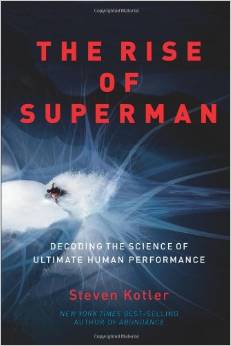
riseofsupermanOnce they get back his first book, James moves on to questions about Kotler’s book, The Rise of Superman: Decoding the Science of Ultimate Human Performance. This book is the summary of Kotler’s research on flow and what is the flow state, which he says, “the simplest thing to know is flow follows focus.”

Flow is not Kotler’s idea, and he admits as much saying the idea has been around for over one hundred years. His work mostly builds on that done by Mihaly Csikszentmihalyi, who began down this path, at the start at least, because he was broke.

In this TED Talk, Csikszentmihalyi says that he was on a ski trip when the snow melted. Not having enough money to go to a movie, he went to a free talk by some psychologist who was proposing that the recent UFO sightings in Britain were a deep seeded fear from World War II. Csikszentmihalyi thought that was at the very least an interesting proposition and began to wonder why people thought this way, and “what contributed to a life worth living?”

As he spent more time researching happiness and a good life he saw that happiness that happiness did not grow with the economy. The former has remained the same, the latter has doubled over the past fifty years. Okay, he thought, who can I examine that shows this divergence? Who is happy despite not a lot of money? Creatives!

So Csikszentmihalyi began to look at scientists, authors, and musical composers and found people reported two things that made them happy; helping others and doing work that makes you happy.

Adam Grant (episode #73) told Altucher the same thing matters for givers. Successful givers, Grant found out, gave in ways that they were skilled at and meaningful to them. Those types of givers succeed in their careers whereas others who gave outside their scope of meaning and expertise did not.

Daniel Kahneman has also written about well-being and echoes the above points, adding something else. Your situation matters. Too little money can drag down your happiness level. Too much money (whatever that means to you) can’t lift it up. Other things that tend to drag people down is the workweek, kids, and cleaning. How, when, and where can all influence how content/happy/well you are in life.

The flow state – one of many irons in the happiness fire – doesn’t come immediately. Csikszentmihalyi says that “to change something in a way that’s better than before” takes ten years of immersion. Oof, that’s not easy, but it’s not odd to hear this. Many of James’s other guests have noted that things take time.

  • It took Scott Adams years to be a successful cartoonist, even after he quit trying.
  • It took Andy Weir years to be a successful author, even after he quit trying too.
  • It took Carol Leifer years of playing auditoriums before she opened for the Beach Boys.
  • It took Maria Popova years for to grow her email list from 8 to 8,000.
  • It took Brad Feld years before he realized that the solution to many problems is actually more time, not less.

Each of these guests spent years growing their skills to the challenge and enter a flow state. My guess is that challenge is synonymous for value, and once you have the skills for a high challenge area, you will find success. My skill at scrambling eggs is about up to the challenge of making them in the morning, but the value in this is about $8/hour.

James comments that this – flow – sounds like a great idea and suggests that it should be taught in school. Kotler says that it’s being taught, but not in schools. Microsoft, Facebook, and other technology companies teach it in one way or another. The best innovation coming from Silicon Valley, Kotler says, isn’t technology, it’s how to work.

Kotler discovered flow by looking at extreme athletes and wondering how they could prepare to do what they do. There’s not many simulations that put you in a dangerous position like this:

What Kotler discovered what that these athletes found a flow sweet spot (probably by accident) of about 4% better. Higher than this and it can lead to the flight or fight stage, where you aren’t in the flow state. Lower than this and it’s not hard enough to get you there.

Finding flow is possible for anyone Kotler says, telling James that for him to jumpstart his flow state, he might try to copy the style of another writer or become more vulnerable in his writing. James gives similar advice, saying:

“I don’t push publish unless I’m somewhat afraid of what people will say when they read it.” – James Altucher

Kotler also mentions a good piece of advice that Ramit Sethi (episode #36) told James.

“If you look at someone from the outside and they have a successful business or blog and a podcast and you’re like wow, there’s no way I could do that. I felt exactly the same way…. but jump in anyway.” – Ramit Sethi

Kotler says the same thing about seeing someone ride a big wave, “what you forget about that guy is that there were weeks and months of three foot, and four foot, and five foot waves.” Those little (4%) improvements add up, in fact they double over twenty periods.

Toward the end of their interview, Kotler tells James that he got interested in the flow state after spending three years in bed with Lyme disease. It took surfing for him to break out of a condition that medicine couldn’t cure. Brad Feld (episode #91) echoed this idea in his interview with James, saying that we need to find our own unique solutions.

Thanks for reading. After each 10th episode I include a link to donate. If you are a regular reader and would like say thank you financially, you can do so here.

One additional note. Something about Kotler’s interview that struck me was how much terminology he used (In-vitro meat, transient hypofrontality). He does a nice job explaining those things, but a lot of terminology can be a BS signal. In Crimes Against Logic, Jamie Whyte argues terminology should do two things, bring clarity and testability. For example, to say something is burning in the oven has meaning. Something burning up the charts does not. The latter makes sense to us, but it can’t support an argument. This isn’t to say Kotler is wrong, I have no idea, just a reminder for you and I to smell if something’s amiss when we see a lot of terminology.

Reading notes: The story of how wireless was discovered was in the very good Thunderstruck by Erik Larson. The banana peddler became the banana king, as told in the – also very good – The Fish that Ate The Whale.

#94 A.J. Jacobs

globalreunion.bmp

A.J. Jacobs (@ajjacobs) joined James Altucher to talk where they get their ideas from, what it means to write a great book, and what the heck is all this talk about the world’s largest family reunion.

Jacobs is the author of four NYT Bestsellers; Drop Dead Healthy, A Year of Living BiblicallyMy Life as an Experiment,  and The Know it All. He’s on this podcast episode to mostly talk about Global Family Reunion. It’s an attempt to set the world record for the largest family reunion ever and Jacobs describes it to James as a “family reunion meets a TED Talk meets a music festival.” There was no word in the interview about what time the egg toss and three-legged race will be. Here are a few articles from this series; a NYT article, a People article from 2014, and one from 2015.

Jacobs may be on to talk about this project, and the accompanying book, but the interview covers a range the skills needed to be a writer. One of which has been cold-calling interviewees. Jacobs tells James that it’s a lot easier to get George H.W. Bush on the line when you say that it’s his cousin calling.

Not every call is successful though. “You have to be willing to be rejected.” Jacobs tells James. Amanda Palmer (episode #82) said much the same thing, telling James that asking is hard:

“There’s not an easy way, and that’s the point. If there was an easy way we’d all be happy and everybody would do it all the time and we’d be living in a fantastic society.” – Amanda Palmer

Being open to the fact that people will reject you is part and parcel for any career, especially writing.

Aside from the interviews for the Global Family Reunion, the actual planning has been a challenge. It’s “like planning the biggest wedding ever,” Jacobs tells James, “and I didn’t even plan my own wedding.” There are hundreds of volunteers helping and Jacobs thinks they’re helping because it’s a cause that resonates with them. Jacobs tells James that we share 99.9% of our DNA with each other and we need to cooperate to solve big problems. Hosting the biggest family reunion ever may be the first domino that gets the others moving.

James asks what got Jacobs started with this idea and he said it was a small moment.

“You’ve got to seize serendipity. A random thing that might seem small,  you’ve got to grab it and follow it for a while.” – A.J. Jacobs

A.J. said that someone complimented one of his books, and noted that they were third cousins. That’s interesting thought Jacobs. thatsinterestin

Something being interesting is a focal point for Jacobs, he tells James that he keeps an “interesting things list” on his computer that he revisits from time to time. But looking inward for ideas isn’t the only way to find good ones.

Jacobs tells the story that when he was starting out, the local San Francisco reporters would look to Parade magazine for a story prompt, and then write the local version of it. “Your inspiration can come from anywhere, including articles from other people” AJ says.

Or, it can come from selling the same thing, with a slight twist to many different people, each who will experience in their own way.

This American Life produced an episode about the “Hello” song. It goes something like this:

Catchy right. Well that jingle isn’t just for Maine, there’s one for Detroit, Calgary and a host of other cities. But many people who hear it, thing it’s just for their city. One interviewee says that “this is like finding out that your childhood teddy bear was owned by three other people on the weekends when you weren’t there.” The entire episode touches on similar themes to what Jacobs mentions.

James asks A.J. more about the logistics of his writing process.

  • Jacobs tells James that most often he likes to experience something, take copious notes, write some journal entries, and then go back for the larger piece.
  • Jacobs also says that his fingers need about twenty minutes to warm up with writing before anything good comes out. He needs to warm up his fingers before his brain. This sort of muscle memory, deeper connection to consciousness, is what Steven Kotler credits with curing his Lyme disease.
  • Jacobs used to read good books to “get in the mood of good writing” a practice that James regularly mentions.
  • Jacobs also says,  “I do think you’re more creative when you’re happy” and to this there is some scientific evidence.

To the last two points, there is good evidence in Thinking Fast and Slow that priming yourself to be in a good mood will lead to better work. If your body senses it’s in a safe place, your mood gives a thermostatic reading about the threat level, you tend to act more deeply in a certain way. My guess is that you can be walking down the side of a highway in a good mood, but you won’t have the same type of creativity as if you were walking through a peaceful woods.

Then comes a great quote from their exchange. Jacobs tells James that I “forced myself to pretend to like” giving interviews as a way to get good at them. He goes on to say:

 “It’s easier to act your way into a new way of thinking than to think your way into a new way of acting.” A.J. Jacobs quoting Millard Fuller.

Jacobs adds “delusional optimism is a wonderful thing and sometimes it pays off.” This is almost exactly what Alex Blumberg (episode #70) told James in his interview, saying that he had to be “a little bit delusional” to start Gimlet Media. Ramit Sethi (episode #36) explains this idea from a different angle:

“If you look at someone from the outside and they have a successful business, blog, or podcast and youre like, wow, there’s no way I could do that. I felt exactly the same way…jump in anyway.” – Ramit Sethi

This is a key takeaway from all the guests. You don’t need to know how to do everything, just the next thing.

It’s also going to take a bit of luck. Jacobs says, “it’s a quantity game, keeping going until you find the ones (ideas) that stick.” Seth Godin (episode #27) told James you have to keep “getting up to bat.” Godin says he may have been lucky to sell his company to Yahoo! right before the tech bubble popped, but that’s he’s been unlucky many times too.

Toward the end of the interview James asks A.J. about what some of his crazier ideas have been. Jacobs said that someone suggested he try to become the greatest lover ever. To which someone else (his wife) said that was a terrible idea. The visual version of what Jacobs may have come up with is available as Simon Rich’s book, The Married Kamasutra  (of whom both James and Jacobs are big fans).

Then they get into the idea of what types of ideas are ideal. Jacobs says that he writes in a sort of extremism. What if you lived the bible literally? What if you were the healthiest man alive? What if you outsourced your life to India? About that last bit Jacobs wrote, “why should Fortune 500 firms have all the fun? Why can’t I join in on the biggest business trend of the new century? Why can’t I outsource my low-end tasks? Why can’t I outsource my life?”

Throughout the interview is a sense of wanting to do something more with the Global Family Reunion project. It feels like Jacobs is implicitly nudging you along like a teacher might, showing us that we’re all one big family and maybe we should act this way.

The interview ends with a slew of goofy facts, a perfect microcosm of Jacobs’ humor.

  • Did you know, the 70th cousin is about how separated you could be from another human.
  • Did you know, Jews are much more closely related, occupying the 4-35th cousins range.
  • Did you know, Iceland has an app to test if you are a cousin. “Bump phones before bodies” is their slogan.
  • Did you know, through history, 80% of marriages were to a second cousin or closer.

Thanks for reading, it really means a lot to me. I was also lucky enough to have A.J. contribute to a site I run, 27 Good Things, where he shared good things to read, watch, and use. Here’s a LinkedIn piece Jacobs wrote about Fuller. If I missed anything, let me know, @mikedariano.

Any of his books are wonderfully enjoyable. Here’s a snippet from his 2007 book, The Year of Living Biblically.

On the admittedly random day of July 7, 2005, I begin my preparations. I pull out a Bible that is tucked away in the corner of my bookshelf. I don’t even remember where I got it, but it looks like the Platonic ideal of a Bible. Like a Bible they’d use in a fifties Western to stop a bullet from piercing the hero’s chest. On the front, it says “Holy Bible” in faded gold embossing. The tissue-thin pages remind me of my beloved encyclopedia. The black leather cover smells exactly like my parents’ 1976 Plymouth Valiant. It feels good, comforting.

I crack open the Bible. The title page says, ‘This Bible is presented to…’ and then, in handwritten bubble letters, the name of my ex-girlfriend. Huh. Somehow I inadvertently pilfered my ex-girlfriend’s childhood Bible. I hope inadvertently. It’s been a decade since we broke up, and I can’t remember. Regardless, that’s not a good sign. At the very least, I need to return it when I’m done.

Like I said, just go get any book by Jacobs. Okay, okay, one more, from the next page when he goes looking for a Bible and a salesman points him to a table.

He points out one Bible I might want. It’s designed to look exactly like a Seventeen magazine: An attractive (if long-sleeved) model graces the front, next to cover lines like ‘What’s Your Spiritual IQ?’ Open it up and  you’ll find sidebars such as ‘Rebecca the Control Freak.’

‘This one’s good if you’re on the subway and are too embarrassed to be seen reading the Bible,’ says Chris. ‘Because no one will ever know it’s a Bible.’ It’s an odd and poignant selling point. You know  you’re in a secular city when it’s considered more acceptable for a grown man to read a teen girl’s magazine than the Bible.