The Philosophy of Fish

Internet Archive, mentioned here.

"Let us suppose that an ichthyologist is exploring the life of the ocean. He casts a net into the water and brings up a fishy assortment. Surveying his catch, he proceeds in the usual manner of a scientist to systematise what it reveals. He arrives at two generalisations:

(1) No sea-creature is less than two inches long.

(2) All sea-creatures have gills.

These are both true of his catch, and he assumes tentatively that they will remain true however often he repeats it.

In applying this analogy, the catch stands for the body of knowledge which constitutes physical science, and the net for the sensory and intellectual equipment which we use in obtaining it. The casting of the net corresponds to observation; for knowledge which has not been or could not be obtained by observation is not admitted into physical science."

The ichthyologist goes on to explain, "In short, what my net can’t catch isn’t fish."

Moving the line of action


Buying gas for a vehicle is both easy (finding, doing, paying) and salient (gauges as well as low fuel warnings). People need no help to fill up. However, non-consumption occurs when something is perceived as too hard or unimportant. 

Consider the barnacles on your to-do list. The ones that get transferred to the new piece of paper or system or from physical to digital and back again. I’ve had items last longer than green bananas but the end is the same for both: buckle down and get it done (in the case of bananas, bake bread). 

Eventually you do roll up your sleeves, mentally brace yourself, and collect the necessary tools only to frequently find that dreaded task takes much less time than expected. If we’d known it was that simple we’d have done it much earlier. 

My wife and I bought a mattress from an online store. It’s fine. We ordered online because the perceived ease was greater, though we found out that Amazon (not where we ordered from) raises the bar for ecommerce and other companies often fall short. Amazon shifted the line of perceived ease for online orders well south of its actual location.

Business owners, volunteers, and persons on the internet can all shift the line by raising the salience and (perceived) ease. telling stories, structuring information, or bringing attention to a situation. The history of tuna demonstrates both these points. One year the California harvest of non-tuna was less than expected and fishers faced filling the tins another way. They caught larger fish, called it ‘chicken of the sea’ and packaged it with recipes pre-printed on the paper labels. ‘Hey’ the thinking went, ‘this is white meat too’. 

This model works as a way of thinking about the world but it only works as a model. There’s no Lego-style instructions. Rather, consider the JTBD for your customer, reader, team and find ways to be more salient and easier. 

In the pay-what-you-want short reading on Tyler Cowen, we highlighted how moon affiliation (wrong reasons, right or wrong outcome) shifts the action curve down. 

What’s next to a cash register?

coffee lifestyle starbucks coffee shop
Photo by Adrianna Calvo on Pexels.com

Tyler Cowen is one of the most interesting and insightful thinkers sharing their wisdom today (and for the past decade-plus!). One of his ideas highlighted in our Twenty-Minute-Read on Cowen is to think of incentives and solving for the equilibrium.

To think like an economist, like Tyler Cowen, we should consider how things work within a market. Tim Ferriss asks Cowen what advice he would put up on a billboard? Tyler responds in an interesting, and quite different way, from what many of Tim’s other guests suggest.

Normally, this question tends to lead to something inspirational or tactical, something grand or granular. There’s also a bit of personal signaling in the answers where after an hour or so of talking to Tim, guests want to step off on the right foot.

Cowen flips the question and wonders: what works on billboards. Casinos advertise on billboards. So do lawyers and radio stations. Auto dealers advertise on the radio, which you listen to in your car, and notice how nice a new car might be. Cowen doesn’t answer Ferriss because there’s not a connection between that medium and his message, and mediums matter.

The same effect came up in the college admissions scandal book, Unacceptable. After dropping off kids, “moms in workout gear might pop into a local coffee shop, where the area near the straws and napkins was blanketed with ads for test prep services and tutoring companies.” If a college tutor, guide, or private counselor wanted to find upper-middle-class clients where better than a coffee shop?

Markets are dangerous for entrepreneurs because they lead to competition. However, markets are instructive for economists, or people who want to think like them, because they lead to understanding. During his lunch with the FT, Cowen said that he looks for Ethiopian restaurants located near other Ethiopian restaurants because “competition works.”

The biggest lesson from the short piece on Cowen is to think that through. Who is getting coffee at this kind of place at this time of day?

Opportunity Cost Neglect: Beach Edition

In August we passed 700 blog posts, and many address ideas of behavioral economics, tendencies (née biases), and decision making. Yet for all those published pixels, issues still creep into my life like a palmetto bug in the kitchen. 

On a dog walk with a neighbor, I mentioned an overnight trip to the beach which cost $200 for the hotel. We both agreed it was a good value for the time of year, location, and quality of the building. 

However, put a beach trip through the JTBD machine and the opportunity cost neglect shines through. 

Briefly reviewed: Opportunity cost neglect is the idea that people are terrible at coming up with alternatives for options they select. For example, when students were asked if they would buy an expensive iPod or a cheaper one, they chose the expensive one. However, once the researcher reminded them they could buy the cheaper version and spend the savings on music for said iPod, the students mostly switched their choice. If it’s not apparent, we don’t consider it

Our $200 hotel room was like four two-day theme park tickets. In Florida that is a bargain price. It’s also about the cost of one day of crafting, which we did the previous weekend. It’s more than renting Mulan on Disney+, which at $35 seems expensive however a family of four costs twice that (with snacks) at the actual theater. 

All these were recent reminders of how much context affects perceived value shotonaniphone

☝️ Some nice opportunity cost work; if you’ve got the cheaper product then highlight the opportunity cost. 

While I felt like Homer Simpson (D’oh!), it is fun to see these ideas in the wild. It was a path of JTBD I hadn’t looked at before and like a mental nudge, a good reminder to look for ways opportunity cost lives in our lives. 

Opportunity cost neglect also matters with time. It’s not until we highlight what we could have spent time on that we see the true cost. That’s why these pay-what-you-want features are short. The goal is to scream up the sigmoid curve of ideas.

An easy way to change your mind.

This idea is related to Tyler Cowen’s idea of ‘meta-rationality’ which you read about in this pay-what-you want pdf.

Perhaps there’s no better time to see, sort, and participate in over reactions than week one of the NFL. Though I only watch a full game or two a year, there are a lot of lessons from the likes of Mike Lombardi, Bill Belichick, and questions like, should running backs run the forty-yard-dash? (Narrators: meh).

So, after week one of the NFL, how much should someone change their mind?

There were two comments from Wharton Moneyball related this this exact question.

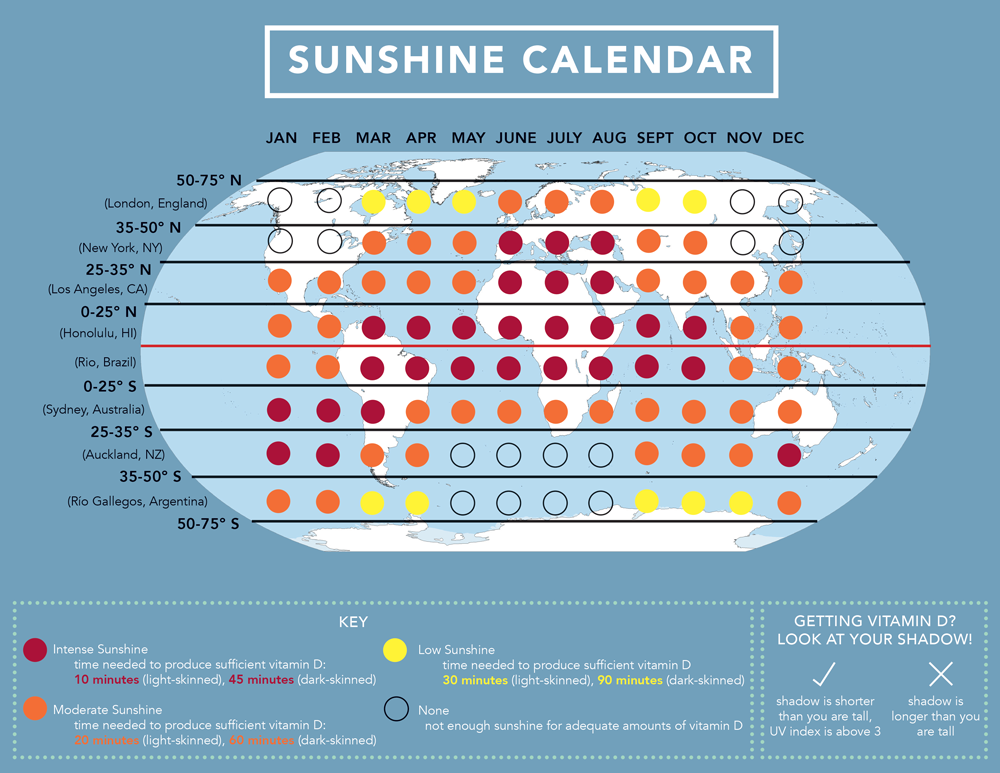
First, the hosts wondered why the small but powerful vitamin D study wasn’t getting more attention. Their guess was a combination of things including excessive dosing, strong priors, sample size, and general application (the participants were already hospitalized but went to the ICU at a much lower rate with treatment).

While people may have strong beliefs about the efficacy of vitamin D it doesn’t hurt to go for more walks, while the weather holds at least. Whether or not someone believes in vitamin D, walking can’t hurt.

Late in the episode, Cade Massey and Josh Hermsmeyer noted the impressive week one play of Gardner Minshew. While both are rooting for his success, there’s no ‘go-for-a-walk’ equivalent for updating beliefs. Base rates suggest we stay closer to home until Mr. Minshew racks up some road wins.

Lastly is this study about teacher expectations. “(U)nbiased (i.e., accurate) beliefs can be counterproductive if there are positive returns to optimism or if there are socio-demographic gaps in the degree of teachers’ over-optimism, both of which we find evidence of.” Want better results from students? Have higher expectations than the data suggests.

The easiest way to change your mind is to make changing your mind inexpensive.

The hardest way to change your mind is to attach ideas to yourself. Jason Zweig calls this thinking “identity protective cognition,” and said, “If you are not judging the validity of ideas by long-term, objective, peer-reviewed evidence then you are just protecting your own identity and it’s foolish.” 

If vitamin doesn’t affect covid health, it still doesn’t hurt. If high expectations don’t affect student results, it still doesn’t hurt. If extrapolation from week one of the NFL doesn’t predict season success it does hurt.

Related: Make small poker bets.

Small Poker Bets

Maria Konnikova is on the podcast-book-tour to promote The Biggest Bluff. It is great. I liked Mastermind more, only because I like Holmes more than poker.

One idea from her podcast conversations that might get missed by book readers is how Eric Seidel came to coach her. She told Shane Parrish: “He (Seidel) didn’t actually agree to be my coach. He said, this sounds interesting let’s try it out and see if it works.”

This is the key insight to poker, the book, and it seems life in general. It’s the insight for why poker proxies life, (though her last chapter, read the book it’s good, addresses the limits). 

No one knows what’s going to happen but you gotta be in the game to see

At first, Konnikova really wants to learn the rules and strategies. For example, if someone is dealt pocket aces should they play them? It’s a good hand, even a noob like me knows that. But the answer to ‘should I play this?’ depends on the flop, who has bet (how much), who has yet to bet, and so on. 

If the flop is three spades and someone ahead raises, then those pocket aces aren’t as sharp as we first thought. If the flop is a mishmash and we’re in the small blind then it might be good to see what the next card holds. 

When Seidel says “this sounds interesting” it was him calling a bet to see what the next card might be. It wasn’t a raise, or a fold. It was the right time for a small bet for what might be a larger gain. That moment, though Konnikova didn’t know, was the heart of the book. 

Konnikova started The Biggest Bluff looking for decision making in a card game. Years after the inception, Konnikova now thinks about life in poker terms like tilt and the Immanuel Kant idea of ‘wanna bet’. She probably notices Seidel’s insight too.

Should I be a vegetarian?

IMG_1342
Finance and fitness are nice corollaries because regular actions compound to large effects. People can also FIRE up their efforts to shorten the time. Dog walking is the ’employer match’ of the finance world.

To be heathy in waist and wallet has a cost. There’s the time it takes to educate yourself on what to do, find the best ways to do it, and work to pay the fees that allow you to do the thing you educated yourself on and optimized for. But there’s a secret to this price, sometimes it’s fun to pay!

“Buying good things can’t be the secret to success in investing. It has to be the price you pay. It’s not what you buy, it’s what you pay. There’s no asset so good it can’t become overpriced.”  – Howard Marks

This idea from Howard Marks doesn’t just apply to investing. It applies to everything.

A friend owns an RV and I asked why he chose that instead of a Hampton Inn. Well, he said, the free breakfast would be nice but he likes the campground vibe and tinkering on the RV. His price for that RV is low because he likes rewiring and upgrading the lighting.

Using this model of ‘what you pay’ the answer to vegetarianism is ‘Yes’. I like to cook, have a general idea about what to eat, and enjoy new things. It’s a low cost switch.

Another angle to answer this question is to think about the opportunity cost. Due to a medley of tendencies (née biases), we think about thing in terms of losses. Expressions like, if it ain’t broke don’t fix it, address this.

Yet, we aren’t creative when it comes to thinking about further upside. Netflix does not compete with sleep but we think it does because we think sleepily. If it’s at night and someone is in bed, we think there’s only a handful of things people might do. But the list is often much much larger.

Using the model of opportunity costs, the answer is ‘Yes’, there’s probably a vegetable based upside. Just because I don’t know about it doesn’t mean it’s not there.

Another angle is to consider the incentives. Do the people who promote doing X also benefit from me doing it? It could be that vegetarians prosthelytize because they love animals and not because eating plants is healthier. I do love my dogs but my motives are more selfish.

Using the model of incentives, the answer is ‘Maybe’. Incentives are conditional and a good default is that if I don’t recognize it, it’s working against me.

One final model is the idea from Nassim Taleb of Extremistan and Mediocristan. Most of social life is one of power laws. Fat Bottom Tails Make the Complex World Go Round. “For if the world is organized into a critical state,” wrote Mark Buchanan “then even the smallest forces can have tremendous effects.” 

For both health and wealth, the goal is to stick the landing within a certain range. According to Taleb, to avoid ruin look to the ancient examples of actions. For example, the best beverages are the old ones: water, tea, milk, wine. Vegetarianism fails this test, though it does raise the question how far into the past should someone go?

Using the model of complexity the answer is ‘Maybe’.

Luckily I’m a designer, luckily we all are, and we can prototype things. My plan going forward is to eat less meat; substitute peanut butter for turkey, nuts for beef jerky, and black-beans for taco meat (which I prefer anyway). All signs point toward moving away from meat, but not necessarily all the way.

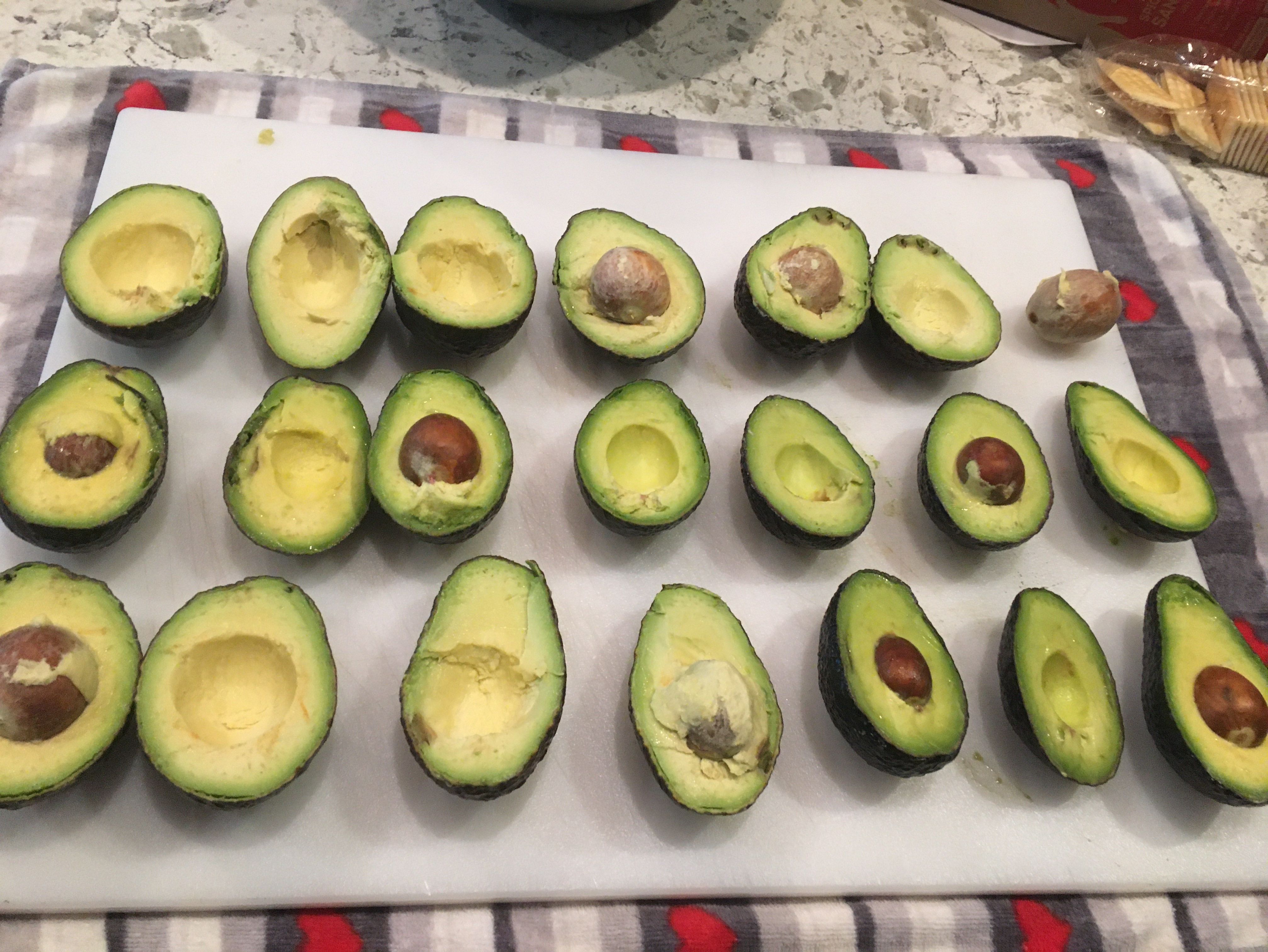
Photo is of my daughter’s sixth-grade science experiment: what keeps mashed avocado green longest? Better than lemon juice was a thin layer of water which easily pours off. 

These are just a few models to filter the world through. More are in the short pay-what-you-want piece about how Tyler Cowen thinks. Cowen says that vegetables are better with some heat.

Getting to consumption

It was delightfully ironic. Turner Novak spoke with Patrick O’Shaughnessy and said:

“There’s ideas of TikTok for X, but TikTok can already do that. If you want to watch sports in a TikTok like setting, just go on TikTok because it will know you want to watch sports.”

…on an episode where Patrick led off talking about Bottomless, a smart scale subscription service.

I want to say one word to you, just one word. Are you listening?
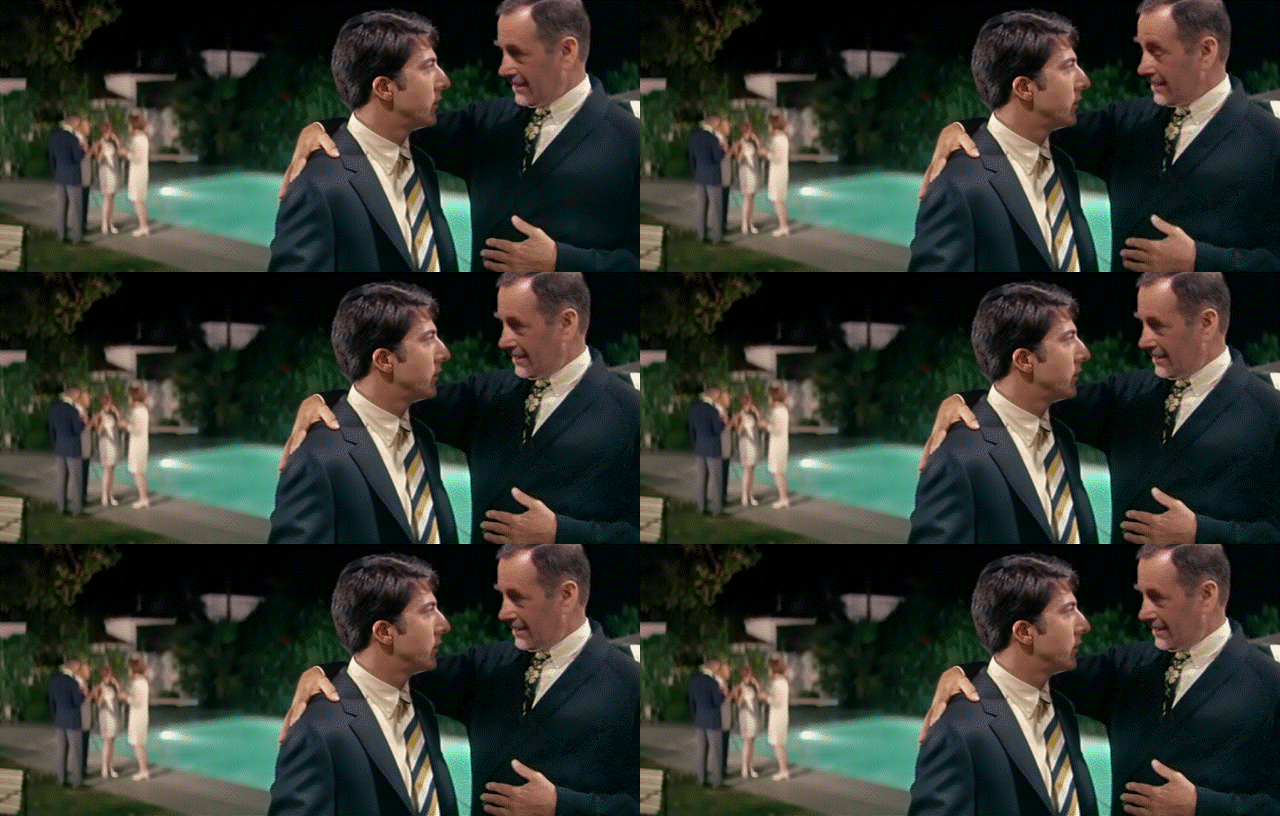
The Graduate

Prediction.

Thanks to technology (like podcasts!) there’s been a shift in getting to consumption. In the past, we’d consume if we were told. Locality mattered a lot. In 1995 a friend said I should get Dookie. I went to K-Mart. It was out of stock. I heard Green Day on the radio, went back to the store, bought the album, didn’t like it that much.

In 1995 there was a lot of what David Ogilvy called reason why advertising. “Imagine that you’re at a dinner party and the woman next to you says, ‘I have to buy a new car, have you any advice to offer to me?’ And I tell her that I think she should buy a Mercedes Benz. She says, ‘Why a Mercedes Benz?’ Well I don’t try to put a mirage up, I give her rational reasons.”

In general, said Ogilvy, the more you tell the more you sell.

There was nothing special about 1995 other than I was thirteen and that Green Day album is my first consumer memory. If anything, the era of being told about something (at least at the macro level) was tapering off.

Being told worked for a long time because we were mostly told things by groups who we trusted. There’s always been word-of-mouth, but brands are trustworthy. If a company could advertise it showed fitness. That was information.

Then we got the information superhighway.

The internet allowed people to shift from being told to searching out. Rather than using advertising’s availability, we shifted to other forms. The internet allowed reviews, questions-and-answers, stars, ratings, lists, rankings, and more. We asked Google ‘What is the best…’.
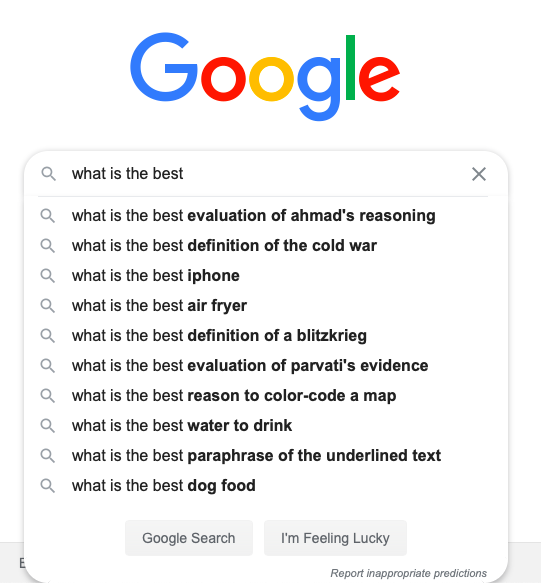
Screen Shot 2020-07-16 at 6.17.40 AM

If you do get an air fryer, opt for the bigger basket.

In 2020, we can search and be given ‘reasons why’. In 2020, we use Amazon, Google, and Instagram.

In 2020 time, we’re also seeing the rise of prediction. Bottomless predicts when you need a refill. TikTok predicts what you’ll watch. YouTube suggests next videos. Netflix has always done this.

In 1999 Reed Hastings spoke to Sarandos about Netflix. The company, Sarandos recalled to Katie Couric:

“Was about a marketing move. Back in those days, studios argued about digital distribution; who is going to pay to retrofit theaters for digital? But the cheapest thing a studio does is mail prints around, what really costs a lot of money, and is inefficient, is marketing. If we can get tasted-based merchandising of ‘You’re going to love this movie!’ And you dont’ have to spend tens or hundreds of millions of dollars on marketing, you can change the P/L of every studio in the world. Taste based picking has been at the core of the business from the beginning.”

In 1975, film critic Roger Ebert won a Pulitzer Prize for Criticism. Consumers were informed.

In 1983 Sarando enrolled in his MBA and Film School program at “Arizona Video Cassettes West”. People came in the store and they were informed, they searched, and they were suggested by Sarandos and his staff.

In 1999 Hastings noticed Pixar’s problem of profitability and wanted to change the equation.

Broadly it seems like there are three paths to consumption: being told, being sought, and being delivered.

Being told. Advertising. Billboards, Facebook Ads, and so on. In Retirementville Florida one friend says that the weekly newspaper ad brings in more business than she can handle.

Being sought. Can the right people find your product? Search Engine Optimization and Content Marketing.

Being delivered. Can a business act with ethics?


Algos, attribution, and allowances

One of our psychological tendencies (neé biases) is the fundamental attribution error. Also known as: that driver didn’t signal. We have the disposition to note that when others misstep it is their fault, but when we error it’s due to the very specific, unique, unavoidable nuance of the situation.

Conditions matter and we tend to underrate them.

Hannah Fry spoke with Shane Parrish about the role of algorithms in our lives. Though algorithms are impartial in their functionality, they are not in their design. The training set (or set of experiences by the programmer) affects the outcome. Sometimes this means we get the wrong proxies because we use what’s easy to discover, digest, or divide.

“You can’t just build an algorithm, put in on the shelf and decide whether it’s good or bad in isolation. You have to think about how the algorithm actually integrates with the world you’re embedding it in.” Hannah Fry

Conditions matter. For a natural experiment, researchers looked at county-level obesity rates and military transfers. Personnel assigned to counties with higher obesity rates were more likely to be obese. The longer they were assigned in a place, the more they trended toward the average weight.

The researchers supposed that part-of-the-reason was because of the built and natural environment. The number of gyms and parks, the access to healthy food, and the walkability of a region were all associated with a place being more or less healthy. It’s not so much ‘you are the average of the five people you spend the most time with‘ but ‘you are the average of the five places you spend the most time

Place and space make some things easier. It’s not impossible to in Ohio winters, but do watch the ice.

dt2cw90xuaag4oy
Ohio, January 2018

The latest pay-what-you-want pdf is now online and covers a handful of ideas from Tyler Cowen. Get it here

Playing telephone with Bill Miller

Bill Miller spoke with Barry Ritholtz about active management and the importance of stakeholders.

When Miller departed from Legg Mason and then bought out the residual partners, he didn’t take any of the institutional clients.

“We brought the mutual funds along but I did not bring the institutional business along. We have some separate accounts but we don’t really take institutional money, not that we won’t take it, but we aren’t actively trying to grow it. We are only interested in having clients that understand you’re going to get volatility. We try to monetize the volatility. “

Part-of-the-reason institutions are more difficult to work with is the people. Not only investment committees, but investment committee boards. Not who Miller talks to, but who they talk to.

Around the same time as the Miller interview with Ritholtz, Hannah Fry spoke with Shane Parrish about the algorithms in our lives. Counting leads to coding and our interaction with algorithms, automations, and augmentations is accelerating. One approach (often wrong) is to educate people. Tell someone the number of calories in a Starbucks drink and they don’t opt for the smaller size.

Fry highlights this. It’s not realistic to expect that an outsider has the time, talent, and tenacity to interrogate a source code. They are numbing numbers. If something is too hard to understand, often instantaneously, then it may as well not exist.

The most ubiquitous parts of life are complex. This was a good book about the iPhone but I don’t remember much other than it truly is a global supply system that makes the device in my pocket work. Mix in some YouTube videos about cellular networks (it’s ‘cell’ as in which hexagon from our tessellation map is this person in?) and relearning what the UV spectrum is and I kinda-sorta-get it. There are videos too about repairing a screen. A layperson can do that, but jailbreaking or writing apps? How much does, or should, one person know?

Back to Mr. Miller. He’s not explaining the physical world (Mediocristan), a mostly stable place where the UV spectrum has held relatively constant for hundreds of years. He’s operating in the social world (Extremistan), a mostly unstable place, and it is hard to communicate there.

When asked what he wished he knew when he started, Miller said:

“The thing that I am constantly realizing is that the world, the economy, and the markets are so much more complicated than you have any idea. Having dogmatic views and pontificating about the world as this way or that is a complete waste of time because nobody has any idea about what’s going to happen in the future.”

Listen to Ted Seides’s podcast and you’ll hear that investment committees get this. Institutions employ smart, thoughtful, well-rounded people. However, it’s the next level when the alignment of communication, incentives, and priorities breaks down. It’s how the game of telephone works. Someone can read and watch and kinda-get-it. That same person cannot pass it along.

The alignment of stakeholders is why investment letters (and to another degree, podcasts) are so important. It’s a filter. If someone can read a letter, consider the ideas, and still wants to invest then that person gets it. It’s reading the source code. It’s succeeding at the game of telephone. It’s communicating well.

Your work with stakeholders depends on communication and your communication depends on how clearly you see the world. In the latest pay-what-you-want piece we look at advice from Tyler Cowen and my grandmother. The gist? If you see the world as you wish and not as it is, you’re in for a rude awakening. Get it here