Here’s a business idea. Take a piece of fitness equipment. Make some updates. Attach a monitor and wifi card. Offer a subscription fitness package (recurring revenue!).
Peloton is an amazing business. They took something people readily joked was for hanging clothes and collecting dust, upped the price, and upended long-established equipment manufactures.
One part of their success was design.
But not of the stuff.
Of the people.
In a tangent on the Daring Fireball podcast, Ben Thompson and John Gruber said about temperature scales:
(Gruber) “I staunchly believe that Fahrenheit is the better scale for weather because it’s based on the human condition. Who gives a crap about what the boiling point of water is, it’s the most ridiculous thing I’ve ever heard in my life.”
(Thompson) “The other thing is that Celsius is not precise enough. In the car it adjusts it by point-five because a single degree of celsius is too much for the car. Fahrenheit is more finely grained in a positive way.”
Fahrenheit is easier for humans to use. Peloton is easier for humans to use.
For individuals in organizations, the goal is to make the Job To Be Done as easy as possible.
Want a daily email with one idea? It’s quick, fun, and sometimes helpful. Sign up here.
Peter McGraw and Shane Mauss joined up to write Schtick to Business, a pop-science-pop-culture look at the ways comedians can force business people to see things with fresh eyes. While most books should be blog posts, this one felt about right.
McGraw, and it’s mostly McGraw’s voice, focuses on the idea that business is mostly hunting, then harvesting. Businesses exist to find areas of need (hunt) and then serve customers over those needs (harvest). Business owners are collar-shirt-wearing truffle hunters.
Typically, and where comedians excel, is in the hunting part. It’s finding the Zero to One ideas that make the difficult act of business slightly easier. McGraw writes that you won’t be funnier after reading the book, but “I want you to think funny. That is, I want you to start thinking differently.”
When we say that people aren’t creative, we’re saying that we err towards confirmation bias, myopia, and narrow thinking. We will always do education a certain way because that’s the way we do eduction. Well, until something happens (see: a quarantine education).
Part-of-the-reason creativity is missing is career risk. McGraw’s solution to this is shitstorming. It’s brainstorming, but inverted. Instead of coming up with good ideas, a group comes up with bad ones. This isn’t necessarily a waste of time because sometimes bad ideas can lead to good ideas. Sometimes changing one part of a bad idea, is a great idea.
For example, how does an investment advisor in a medium-size town get more clients? Her weaknesses include lack of resources in staffing, lack of high-income-residents, lack of marketing resources, lack of continuing education opportunities, and so on.
However, those same drawbacks can be advantages. Chuck Akre likes being in a small town with one stoplight. Investors want LPs that stick with them. Inverting the question leads us to avenues of advantage. Jokes are a kind of inversion.
“My mom has learned everything from Martha Stewart, about cooking, and cleaning, and withholding affection.” Nikki Glaser
Once a comedian hunts down a new idea they need to harvest it and McGraw gives tools and tips for that but it’s mostly just boils down to ‘work really hard and maybe get lucky.’ That’s business.
Words mean competition. Once there is a category like ‘theme-park-vacation’ or ‘miles-per-gallon’ every Tom, Dick, and Sally can compete on that feature. Making it salient means consumer will compare on it—even if it doesn’t really matter to their decision making.
When stand up stand-up comedians work on their set; writing observations, testing jokes, and refining material they are hunting innovation. They are looking for something new. It’s creative.
Then, for a very brief time, for a very fortunate few, they get to harvest and share their ‘set’. Comedy, Luisa Diez told McGraw on his podcast, is the fastest art form. Comedians are inspired, share, then a joke expire. Comedy is the fruit fly of the hunt to harvest dichotomy.
Business owners have a longer cadence, but they can learn from comedians. Some will be inspired from McGraw’s book. Most will laugh. I did.
What’s so interesting about decision making is the variability. Change a condition change an outcome. Here are a few examples.
What would you do with $500? A grain-of-salt study because it asks about what people say they’ll do rather than what they will do. Notable is the role of time and quantities regarding promising windfalls.
They hypothetical prompt led one-in-five to say they would spend nearly five-hundred dollars. As the amounts offered increased, the amount spent increased, mostly in non-durable things. However, if people were promised the amount was coming in three months, seven-in-ten of that twenty percent said they would not ramp up spending.
Takeaway: to stimulate spending send larger sums faster.
In the red, the effects of color in investing. Thanks to Dan Egan for assisting researchers on the effect of color on investing. Through evolution and culture, people associate certain colors with certain meanings. To most Americans, red is bad. When researchers showed one anonymized stock line in red, rather than black, propensity to purchase fell by twenty-percent.
Communication with (LPs, or any stakeholder) is crucial and getting buy-in makes cutting checks easier. To paraphrase Seth Klarman, work with people who cash checks when you write them and write checks when you ask for them.
Takeaway: regular, consistent communication matters a lot, even in color.
Financial Incentives Beat Social Norms. Part of the problem of any ‘free’ service is getting people to use it. If needs aren’t salient people don’t do it. In this study, researchers looked at how to incentivize employees to select a 401k strategy. When researchers offered a chance to win a ~$25 gift card, employees logged in and investigated their plan options. That outperformed all social norm conditions.
Takeaway: whether dollars or feelings, incentives matter. In this case dollars proved more effective.
Failure to Refinance. Rightly, Tom noted that refinancing a home is well past dealing with credit card debt but these findings fit with the idea of salience affecting behavior.
Researchers looked at how much people might save if they were to refinance their home. On average it was $160 per month. Even conservative estimates around taxes, moves, and options yielded re-fi savings over one-hundred-dollars each month.
Taking their research to the street, the researchers mailed homeowners a letter offering help (and no upfront costs, those would be rolled into the new loan) to no avail. A quarter failed to open he mail, a third planned to call but didn’t, and a third didn’t think the savings were worth it.
Takeaway: the less everyday salience a behavior has, the more effort it takes to make it seem important.
Businesses exist to serve customers. Bob Moesta’s JTBD (my overview) framework (push, pull, inertia, anxieties) offers a way to see things from the customer’s perceptive. Let’s test that framework using the re-fi ideas.
Push. Often the current situation works—or else people would have already changed. It easy to think that a current budget, just is the budget. Things, are fine.
Pull. How much does a customer want to make the change? Refinancing a home falls prey to the ‘Gas Price Delusion.’ Things that are salient, like filling up the tank and seeing price changes in two-foot numbers, matter a lot relatively but not a lot absolutely. Refinancing a home mortgage matters could be a large budget slice, but it’s also a quiet one.
Anxieties. Will a re-fi affect my credit? How much is it *really* worth? What if I do change my choice to live here long-term? There’s probably a larger emotional weight on a place of residence than on most anything else.
Inertia. It’s easy to just-keep-paying the mortgage. What would motivate someone to research rates, apply to a lender, fill-out-paper-work, go through another inspection and so on.
Moesta’s Force Diagram along with some behavioral finance research shows that people are not rational and not rational for good reason. Conditions matter.
One April report noted the coronavirus reproductive number was 5.7 but offered a range of 3.8-8.9. In January the estimate was 2.6. There’s many reasons but one is that the reproductive number varies by the individual in the network.
Humans form the same (power-law graphed) networks over and over again. In research about Wikipedia edits, the graphs of posts per user was nearly identical across languages. It holds across time too, we can imagine that church members knew their parson but not every other member. It’s on TV too.
These networks are so common, they may be part of our evolution, like ten fingers. Nicholas Christakis said, “Maybe natural selection had something to do with the topology of human networks.”
Christakis looks at networks to seed interventions like a farmer who avoids the arid or soaked parts of a his field. In lab research, Christakis found that when one person is nice to another person (via monetary rewards) then that person is nicer to the next. Courtesy is contagious.
In other studies, Christakis changed the visibility of charity (or selfishness) and the contagion changed too. Visibility of inequality mattered a lot, unseen inequality mattered very little. That’s kinda interesting.
Christakis has found three features which influence how things spread through networks.
Connections, more lines between hubs
Contagions, faster spread between hubs
Positions, different originations hubs
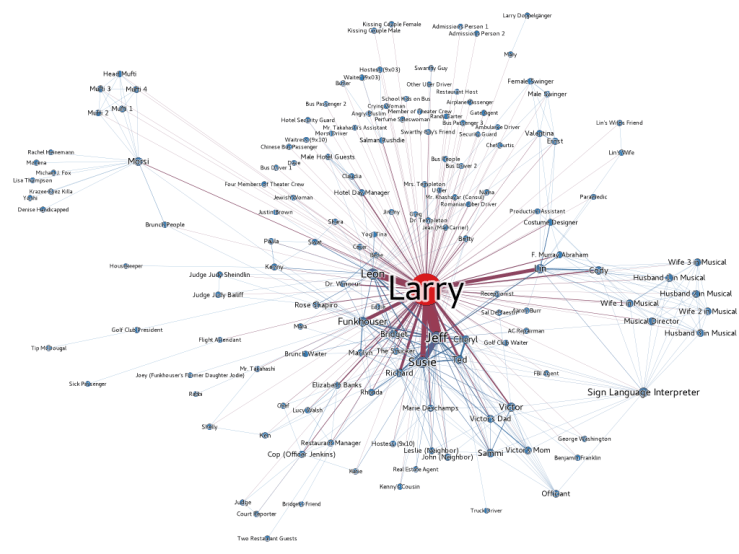
If Larry David gets an idea for his television show and he wants Julia Louis-Dreyfus to guest star he can ask her (#1), but if it’s someone he doesn’t know he’ll have ‘his people call your people’. He could pitch Julia via text (#2) or write her a letter. If it’s Jeff Garlin that has the idea and not Larry David, (#3) then the idea has to wind through Larry to get onto the show.
A real example of virality is the Zillow Zestimate. Co-founder Rich Barton wanted to advertise. That had worked for Barton at Expedia. But Bill Gurley said, “If you’re buying ads to sells ads, then you’re arbitraging traffic and that dog don’t hunt very long.” Barton wanted to focus on spreading the message (#3) far and wide. What worked better was creating something people would share (#2) among themselves.
Bar-Yam warns about an average R0 when he writes about Ebola:
“However, in a complex interdependent society it is possible for the actual number due to a single individual to dramatically differ from the average number, with severe consequences for the ability to contain an outbreak when it is just beginning.”
Ebola needs to be a disease of more concern, he wrote in 2014, because the prediction models used the connections, contagions, and positions of Africa — a different structure. “One person is not likely to be in close contact with much more than about 10 or 20 family members.” That is, the rural African figures for 1, 2, and 3 are quite different from the urban African figures. “In urban areas in Africa and in the US, the nature of the contact network is different.”
Ebola is a hot virus and should be treated with extreme caution. Richard Preston’s book, The Hot Zone is about the mid-90s almost crisis when the Ebola virus was spreading through the air in a monkey research facility just outside of Washington D.C.
In the book Preston writes about the history of research. Recalling one trip in the mid-80s:
“Occasionally they (researchers) came to villages, and at each village they encountered a roadblock of fallen trees. Having had centuries of experience with the smallpox virus, the village elders had instituted their own methods for controlling the virus, according to their received wisdom, which was to cut their villages off from the world, to protect their people from a raging plague. It was reverse quarantine, an ancient practice in Africa, where a village bars itself from strangers during a time of disease, and drives away outsiders who appear.”
Some strands of Ebola pass through he air (#2). Some do not. African villages follow the precautionary principle.
Thanks to Tim H and Tim B for the suggestions and trailheads for this post. For thinking about position (#3) check out the Friendship Paradox.
One way to wrangle a creative idea is to find areas where something is already being done but not done in your particular industry. There’s only so many things consumers need; ease, trust, consistency, etc. It’s likely that a creative solution for you is old hat to someone else.
Scott Alexander brought this up writing about the Amish health system. There are multiple reasons the Amish system is more cost effective than the English (non-Amish-but-American) system, but one is how they’ve dealt with the costs.
From Alexander:
“Much of the increase in health care costs is “administrative expenses”, and much of these administrative expenses is hiring an army of lawyers, clerks, and billing professionals to thwart insurance companies’ attempts to cheat their way out of paying. If you are an honorable Amish person and the hospital knows you will pay your bill on time with zero fuss, they can waive all this.”
And.
“Doctors around Amish country know this, and give them the medically indicated level of care instead of practicing “defensive medicine”. If Amish people ask their doctors to be financially considerate – for example, let them leave the hospital a little early – their doctors will usually say yes, whereas your doctor would say no because you could sue them if anything went wrong.”
Amish medicine costs less because it’s less costly to provide.
Duh.
But this obviousness was SoFi’s insight.
When SoFi started, the company looked at the loan default rates across a variety of metrics. Where did someone go to college? How much money do they earn? What degree does this person have? Which default more, art or vocational degrees? (Art). SoFi realized that some people defaulted less and paid promptly more. With lower costs for collections, SoFi could offer these customers a better rate.
This can be any insurance that’s sliced and diced. And it’s been happening all along.
What’s common between the Amish, the SoFi Henrys, and homes in floodplains since 1968? Legibility.
We don’t know a solution exists until we see it.
Tony Hsieh succeeded enormously in the early days of the internet. Before joining Zappos, Hsieh sold an advertising network to Microsoft for hundreds of millions. Like anyone else who’s young, wealthy, and (maybe) smart, Hsieh started angel investing. Which is where he met Nick Swinmurn.
It’s 1999. Everything internet was hot. It’s the year Webvan started taking orders for groceries in San Francisco. We can imagine Swinmurn meeting Hsieh.
‘Footwear is a forty-billion-dollar a year market and there’s no good way to buy shoes online.’
‘Of course, why would someone buy shoes online?’
‘Because of the selection!’
‘I just don’t see it.’
‘It’s already happening!’
‘People are buying shoes without trying them on first?’
‘Yes.’
‘Prove it.’
‘Have you ever opened a catalog?’
‘Sure.’
‘Weren’t shoes in there?’
‘Sure.’
‘There you go.’
‘Sure, but how many?’
‘Right now, five percent.’
Hsieh’s problem had already been solved. Now he just had to solve it better—and he did, selling Zappos to Amazon a decade later.
During the coronavirus quarantine (or whatever we’re calling this) there’s been a lot of trouble with the data. Part of the problem is a collection issue. But part of the problem is a heterogeneity issue. The data is fine it’s just that the conditions are different. There’s culture, ethnicity, practice, government and so on. It’s hard to compare one place to another.
But what makes the pandemic devilishly confusing makes business slightly easier. Your answers are out there.
Note, in a related post we addressed this idea through sports. Our Jenn Hyman post addressed this too. Thank you for reading.
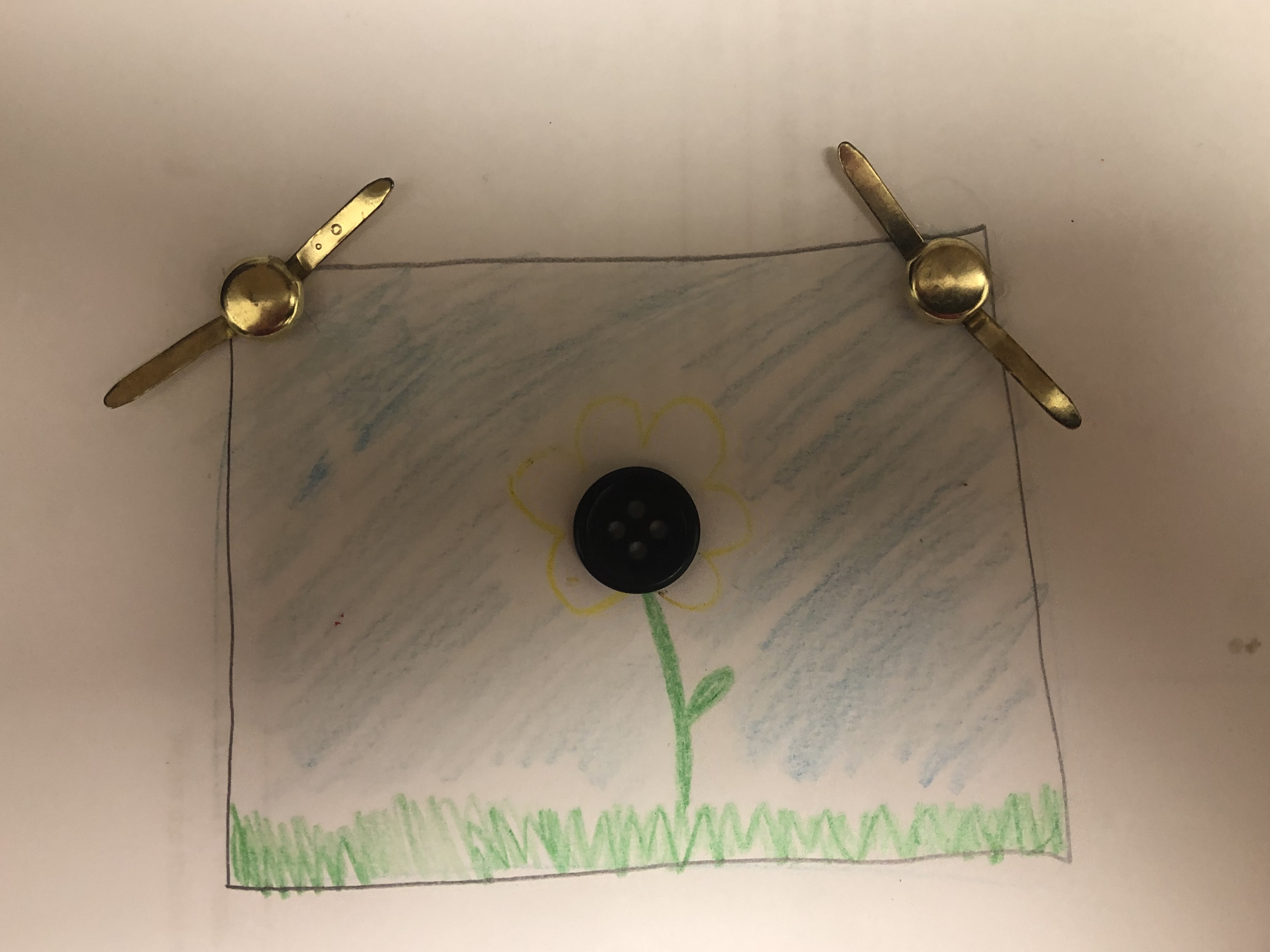
The button popped off my pants. Not due to quarantine snacking so much as use. These shorts are so old that the faded parts are a different hue from the non-faded portions.
I found the button separated from the shorts in the bottom of our washing machine. I put both aside for a day and when I came back with needle and thread the button was gone. Now the button lives on as art.
We have a button jar and I found a grey one, instead of blue, and sewed it on the shorts. I’m not great at sewing, and my stitching is uneven, but it’s functional. Attaching the button took the shorts from waste to my waist. The small act of attaching the button made them useful.
A lot of life is probably like this.
There is some range of easy-to-acquire skills that are like sewing a button. Being able to save the function, if not the form, is helpful.
No code. Being able to build small recipes for scripts using a service like IFTTT.
Productivity. Setting up folders, filters, and canned responses in emails.
Cooking. Knowing how to make a few healthy, inexpensive, sustainable meals.
Home repair. Access to a basic set of tools and the understanding of how to use them.
Personal health. Maintaining a body type that matches a lifestyle.
Personal wealth. Spending, saving, investing.
Interviewing. Listen to people and hear what they say.
When my daughters were little kids, the most common advice was to read to them. This was binary advice. Or, Just Do It. We did a lot of that. Just reading is probably a button skill too.
Though I learned to sew face masks, I can’t imagine learning to sew clothes. But knowing a little bit can certainly go a long way.
Thanks for reading, and don’t tell my wife these shorts were saved—again.
The POV40IQ email list has been restarted. If you’d like a short email each weekday you can sign up and read them. The idea is that a change in point-of-view is worth more than forty-IQ when solving a problem.
I was reading a journal article. Well, actually I was skimming it. I now skim articles because there is a lot I don’t need to know. I only know this because Tyler Cowen told me so.
When Cowen was asked how he can read so much he said something like, read for forty years. The gist is that if you’ve read a lot about one subject area you get it. For example, research on personal finance often addresses the three big questions.
In addition to the literature review is the math. Often it’s the sigma of some Greek letters which I’ve long forgotten. It’s the chef sharing her recipe for the other chefs. I’m a diner and so I skip it.
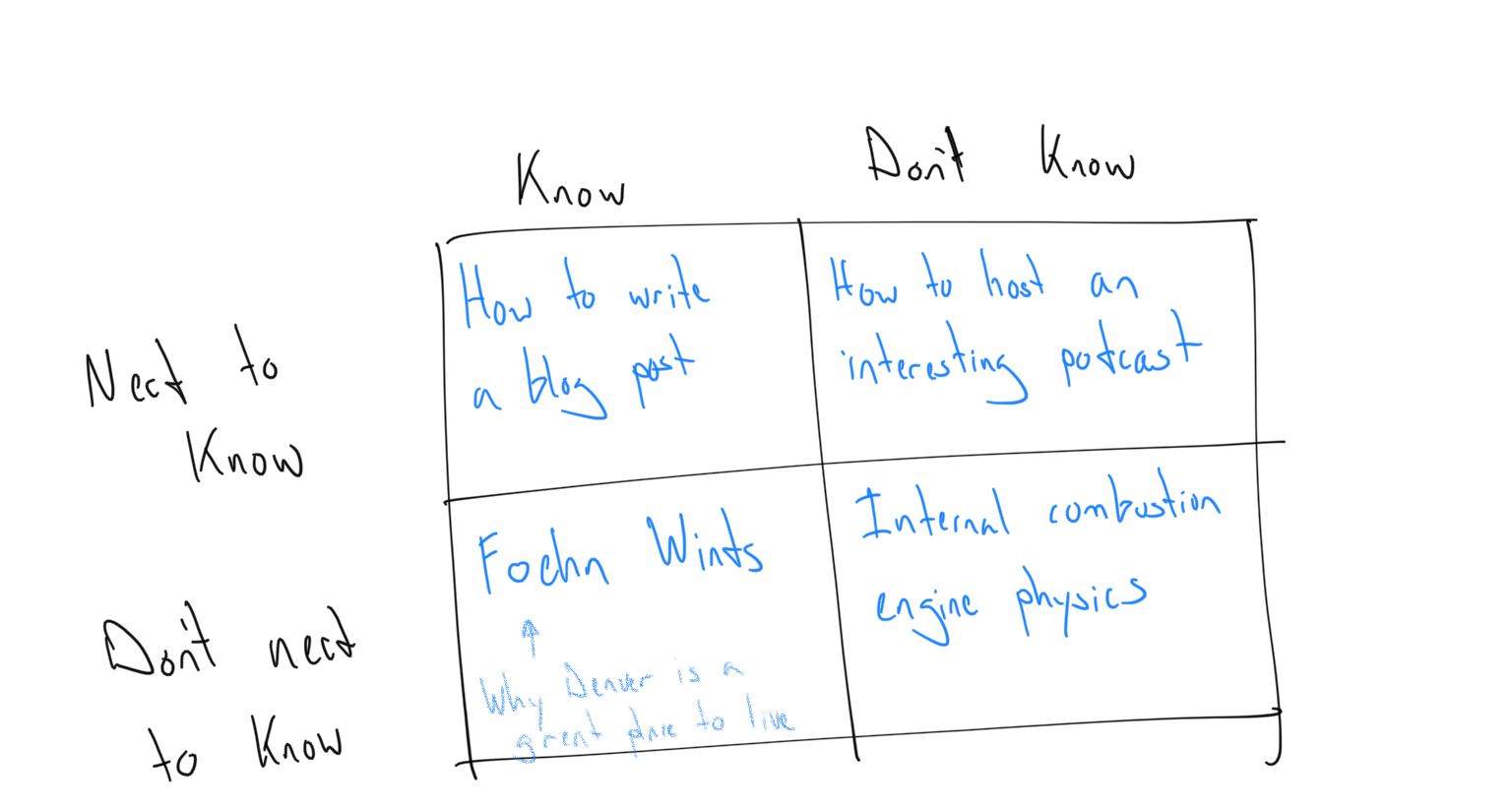
What does someone need to know, has been top-of-mind as we continue our quarantine education. Or, how fast can someone learn to fly a helicopter?
A friend is moving to South Korea and she’s been learning the language. It’s difficult but she’s persistent. However, it’s not necessary. Augmented reality, the universality of English, and western culture mean that navigating a foreign country is easier. Speaking Korean has moved from the need/don’t-know box to the don’t-need/don’t-know box.
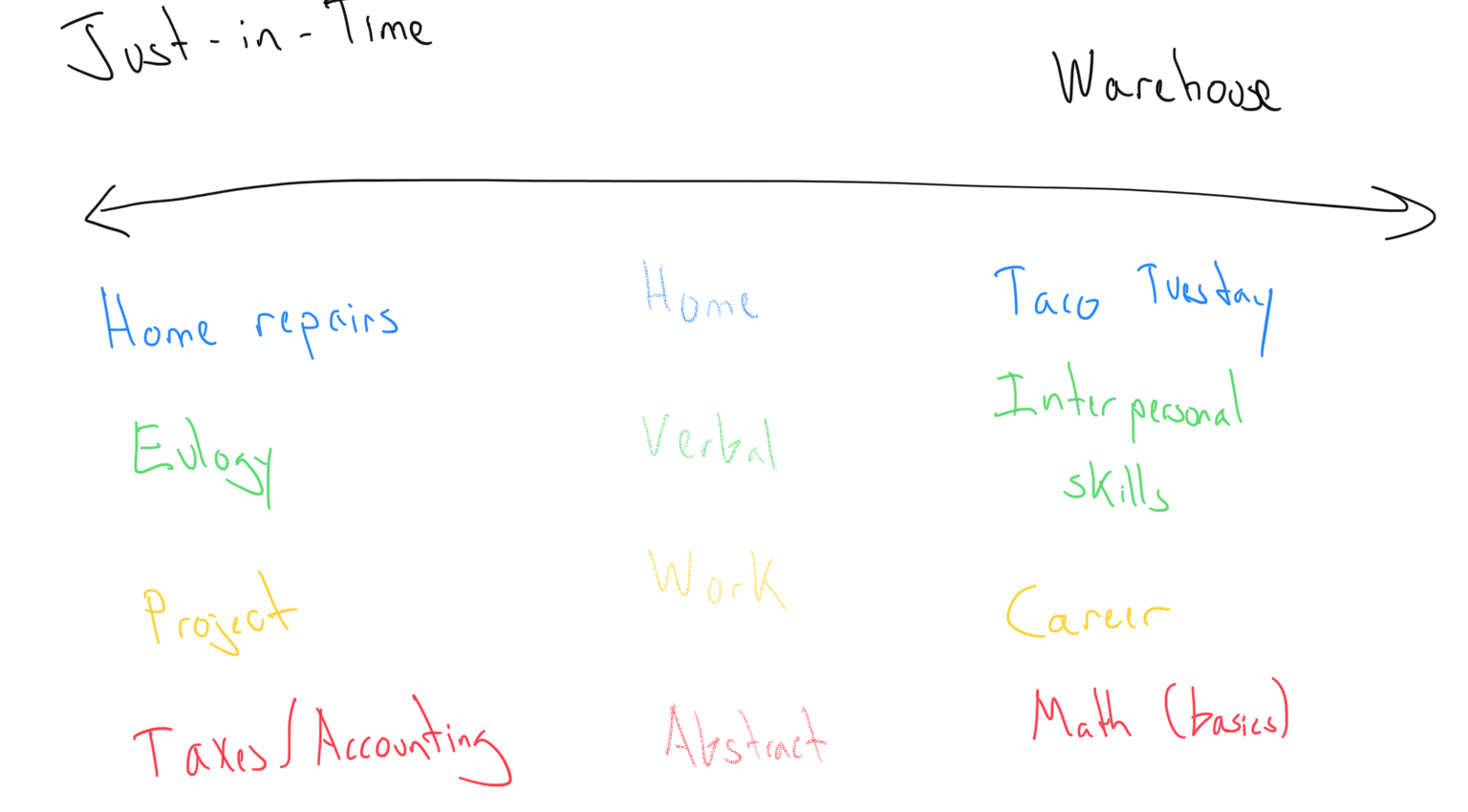
Another way to frame the question is to ask, what is just-in-time knowledge and what is warehouse knowledge?
The internet allows an infinite JIT system to be a few keystrokes away. Repetition moves tasks from left to right, neglect moves tasks from right to left.
I asked my twelve-year-old daughter what she thought sixth grade should teach: “How to read, not world history, and whatever your job requires.” My own world history is JIT knowledge.
We looked at hand washing design research because conditions matter. People are influenced by their environment, often more than they realize. In that first post we highlighted to:
Turn off the water, to feel less rushed.
Make bosses (attending physicians) clean their hands.
Use incentives to reward (or penalize).
Put the hand-cleaning area adjacent to the need-hands-clean area.
Create a social expectation.
That research maps well to the EAST framework. To change behavior make things Easy, Attractive, Social, and Timely.
There are two updates since then.
First, The Behavioral Insights team researched which infographics communicated the best. Comparing seven ‘how to’ posters from around the world on 2,500 UK adults they found that “bright infographics with the step-by-step procedure prominently displayed without too much accompanying text” worked best to communicate good hand washing steps.
However, this was a ‘what I say’ question on a ‘what I do topic.’ Instead of hand washing it could have been a personal savings infographic about spending too much on a car. Sure, people will confirm they know the information but what would they do? It’s an encouraging start but more needs done.
Second, Google Search Trends for ‘hand wash’ negatively correlates with coronavirus cases. A few years ago, Google Trends predicted the flu rates ahead of the CDC but in following years erred enormously. Researchers suggested it was because people aren’t great at diagnosing the flu. How many times have you gone to WebMD AND had the thing. This bodes well for the hand washing research, which stepped over that obstacle of unfamiliarity.
This focus on hand washing is timely but it’s also generalizable. It’s any verb. Investing. Driving. Loving. Parenting. All of these things are affected by the conditions they exist in.
“As we packed up our notebooks and travel mugs, however, I wondered why these case studies were called accidents. To call these deaths and burials accidents implicitly perpetuated the idea that the randomness of nature was the killer, not the shortsightedness, cowardice or hubris of people.”
Heidi Julavits
This approach to auto ‘accidents’ comes up in Tom Vanderbilt’s Traffic too. Names matter.
Jocko Willink developed “extreme ownership” as an accident antidote. With avalanche accidents and auto-accidents we externalize the blame. It wasn’t my fault. But Willink’s idea enters and synchs our history to our actions. Sometimes it’s a weak coupling, but it’s never an absent one. We hurried, and we got sloppy, and the odds tipped against us.
If we were to extend the idea names matter and affect how we understand the world we’d get something like the movie Arrival.
We believe in design and words are one tool in that collection.
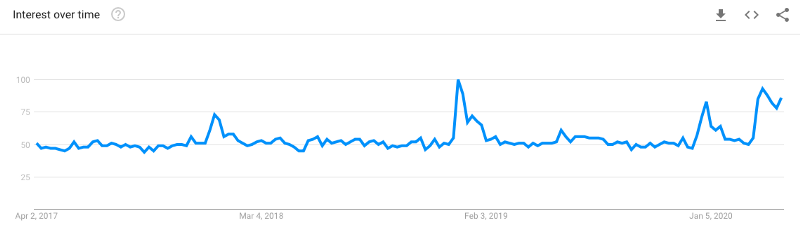
Netflix added fifteen-million subscribers in March, double their expectations. This makes sense. Most people watch Netflix on a television. Most people search for Netflix around November and December of each year.
December search spikes as well as the March 2020 one.
In 2018, the Netflix annual report noted, “We compete with (and lose to) Fortnite more than HBO.” Director of content, Ted Sarandos told Variety their biggest competitor was sleep.
Does Netflix really compete with Fortnite and sleep?
No.
Well, kinda, but probably not as much as we think. There’s a human tendency psychologists call opportunity cost neglect. It’s our inability to compare across categories. For example, when researchers went to a Toyota dealership and asked the ‘just looking’ customers what they might buy if they didn’t buy a new car, almost everyone said they might buy a Honda.
Sure.
But they also might buy a vacation, a remodeled kitchen, or two-semesters of college for their oldest daughter. A dollar is a dollar but that’s not how people think.
In another study, researchers asked people if they would buy an iPod with 40gb for $399 or an iPod with 20gb for $299. Most college students chose the larger size for more money.
However, when researchers added ‘and with your $100 in savings you can buy better headphones or download more music’ the students flipped their answer. Now it made sense to buy the smaller and cheaper option but have money for music.
Ok.
Asking people, If you don’t watch Netflix, what might you do? is a murky question. If people don’t compare across categories, then they’ll probably bring up what comes to mind: Amazon, Hulu, HBO, or play Fortnite.
To untangle this web of apps and find which activities compete with Netflix we need to ask what job do people hire Netflix to do?
Bob Moesta has pioneered the JTBD research (I’ve added my own thoughts) and he says that company growth will come from “horizontal integration, not vertical integration.”
This observation came after an interviewee told Moesta what she did after work. Some nights she ran, some nights she ate ice-cream, some nights she played video games. Superficially we don’t think that Nike, Ben and Jerry’s, and Microsoft’s Xbox compete. But for this woman, they do. For this woman the JTBD is ‘unwind after work’.
If that’s true does Netflix compete with Nike, Ben and Jerry’s, and Microsoft’s Xbox too? Let’s take some guesses.
Netflix competes with babysitters. Parents use Netflix to keep their kids out of the way. During the quarantine of 2020, it’s very likely that many WFH parents use the service for spot supervision. When my daughters were younger, my wife and I certainly did.
Netflix competes with comedy clubs. Yes, going-out and staying-in are two very different jobs. The former is a date single people have, the latter is a date married people have. But for a good laugh, Netflix stand-up specials are tops.
Netflix competes with serialized television. Many of the top shows on Netflix are the same characters is the same situations with the same friends. Customers who watch these shows hire Netflix for the familiar.
Netflix competes to be in the Zeitgeist. I tried to watch Tiger King. I wanted to join the conversation, to mosey over to the digital water cooler. I couldn’t. Every Fantasy Football League has someone who did not want to play but they did not want to be left out more.
Netflix competes with boredom/family time. Why do Netflix searches peak around Thanksgiving and Christmas? Is it a coincidence that these are the two times of the year many are too lonely or too together?
Netflix doesn’t compete with Fortnite. Netflix is lean-back, Fortnite is lean-in. Netflix is consume, then converse. Fortnite is consume and converse. Netflix is same-level. Fortnite is level-up. Though both digital apps with millions of users, the Netflix and Fornite overlap is small. We think these two companies compete because they are easy to compare.
Netflix doesn’t compete with sleep. Are there any shared benefits between sleep and Netflix?
The JTBD research is a very helpful tool figuring out what people want, not what they say they want. Moesta has written a few books but he’s a great speaker so start your intro to JTBD on YouTube.


 The Waiter's Pad