Summer Productivity

Supported by Greenhaven Capital, finding value off the beaten path.

Each season gives us a chance to pause and take stock. Thanksgiving and Christmas cover the end of the calendar year. The start of school helps parents mark changes in their children. Spring blooms, and cleanings, offer a chance as things get warm. Summer too has moments of reflection and chances for redirection.

On a trip to Michigan this summer, a friend and I both noted how much more we read during Ohio winters. There was something seasonal about plowing through books and traveling to distanct worlds and new points of view while winter settled in and surrounded us.

Productivity has been top-of-mind because it’s constrained in the summer. There’s more things to do with more people which leaves less time for work–and books.

At the site, Writing Routines many profiles feature the spirit: I write around family commitments. Almost no writers have the cabin in the woods or special office they go to. Most of those writers write at home when the kids are in school. If they have a summer deadline they turn on a movie.

Summer then, with the commitments to family, late evenings, and beach vacations offers a chance to reflect with constraints on our productivity. With only 168 hours each week, and more hours committed to more things, we can see how much we really do and whether it’s important.

My tool of reflection is the to-do list.

On Imgur a meme circulated when someone posted their encouragement to a child who wanted to be an astronaut. She had to study hard, go to college, learn lots of science, and take a physical fitness test.

The child shrugged and said, “that’s just four things.” That sounds like a list. But wait, there’s more!

Lists are fractal. Events like “Write everyday” or “Exercise 3X per week” or “Read one 10Q at lunch” can all be broken down into more granular layers. To write means having something to say which means knowing or doing something interesting.

Lists internalize. When I write each day it doesn’t just happen. Everything requires work. I’ve made the ‘Writing List’ so many times it’s become habit and doesn’t require a list anymore. Like a piece of software, my brain executes a morning script that runs: coffee, crossword (NYT mini), writing.

Lists are learnable. It may not seem like someone needs to learn how to make a simple list but sometimes we need to see the trailhead before we find the path. One option is the Bullet Journal system. Ryder Carroll wrote in his book.

“The Bullet Journal Method is for anyone struggling to find their place in the digital age. It will help you get organized by providing simple tools and techniques that can inject clarity, direction, and focus into your days. As great as getting organized feels, however, it’s just the surface of something significantly deeper and more valuable.”

With annual, monthly, and daily lists the system provides a way to track actions and break down big goals into their smaller parts.

Like any good system; writing, investing, exercising, or producing — the best system is the one you stick with. Carroll doesn’t hawk his products, though I’ve used them and they’re good, but encourages experimentation and derivation.

Constraints – like summer hours – are helpful. They offer a chance to evaluate our systems.

Sam Hinkie said, “Within heavy constraints, thinking different is one of the few ways you can do anything differently.” He was talking about running a basketball team but it can also apply to our lives. As we spend more time outside, go on more adventures with friends, and make more memories with families we can think about the role of work.

Summer is a forcing function. What’s the most valuable thing you can do? And do you do it?

Lists show us – in our own handwriting – what we wanted to do, what we did, and give the chance to reflect on what was important. Summer is a great to to reflect on our lists.

Thanks for reading.

‘Righting’ Routines

Supported by Greenhaven Road Capital, finding value off the beaten path.

I used to think my brain was my most important organ. Then I remembered who was telling me that. – Various

On a recent podcast, Marc Andreessen noted that learning from investing is difficult. Sometimes there aren’t lessons to learn, sometimes they are, sometimes they are the right lessons at the wrong time. Sometimes they’re devilishly hard to tease out.

What matters most, (based on The Two Jar Model) is what we control. It’s our routine, mindsets, work environments and more. Today we’ll look at that through writer’s lens. Though keep Marc’s comment in mind, not everything here is a lesson for you. All quotes are from Writing Routines.

Work is cummulative. Stephen King jokes that he only takes off three days a year (Christmas, July 4th, & his birthday) because it makes for good copy. He really doesn’t. When he’s writing he writes every day.

When asked about his production function, Tyler Cowen replied that he writes everyday too. “Sundays, absolutely. Christmas, too. Whatever. A few days a year I am tied up in meetings all day and that is a kind of torture. Write even when you have nothing to say, because that is every day.”

In a Reddit AMA Cowen said that it helps to be born a certain way. That means enjoying it, not Instagram-picture enjoying it, but relishing the challenge of the downs and the fruits of the ups. How does someone find this kind of work? Charlie Munger suggests getting good at doing something to enjoy it more.

Do some work, long enough, and you’ll see some rewards. Rich Cohen, author of The Fish That Ate the Whale said he has “a very impoverished social life” and with daily work it adds up. “What seems like my being prolific is just day after day after day after day after day.”


Work is designed for. There are three ways to get better at doing good work, space, time, and incentives.

Space. Where work is done matters. David Burkus said that he works from home and needed to find work/life integration. His home office is tucked away:

“So even though the commute is a few steps, it gets me into ‘work’ mode. But its only a few steps to walk back into the living areas and do something ‘life.’ So I flip back a couple times a day and, at first, it really frustrated me because I was coming from a 9-5 environment. Now, I wouldn’t trade it for anything.”

Andrea Wulf converted her attic into a study. There, “I can see the world below me without getting distracted. It’s a writing heaven.”

Time. Writing, like water, can fill any volume. Many featured writers at Writing Routines enjoy mornings but they also work around ‘life’.

Asha Dornfest noted that her schedule has matched her kid’s phases in life. When they were young, “(I) tucked my work into the spaces between family needs.” As they got older she wrote when they were in school.

Annie Duke faced similar conditions as “a pretty busy mom.” She starts when she’s free and with family stuff most writing happens, “weekdays when the kids are at school.”

Incentives. Writers have a natural metric, the word-count. Like a metronome, each syllable is part of the symphony. However that’s only one part of the job.

Many writers have some daily goal but it depends on their approach, their work, and the preparation. Metrics only work for things that can be easily counted.

Wulf has “successfully avoided to have a word count hanging over me.” Words are good for the habit but not always the creation. Incentives need to match processes that lead to good outcomes. Wulf noted, “I spend so much more time reading, researching, restructuring and thinking than writing that it has become meaningless to have a word count.”

Duke too. “I don’t write every day, but I do read every day which I think counts as preparation for writing.”


Work is professional. In the late 90’s a friend had an art exhibition and to show my support, I went. There he pulled me aside and said, ‘Can you believe that someone just paid $400 for that paining? It only took me a few hours to make!’

Briefly I thought of studying art.

Writing might seem like that, but many featured writers at Writing Routines treat it like a job. Kate Winkler said, “(I) stay committed to self-imposed deadlines, so I’ll have a weekly goal that I always meet, no matter what. Journalism has really trained me to respect deadlines and I really try to turn drafts in early.”

Sam Gwynne too, “Everything grows out of my 30 years in the journalism biz. I have worked with daily, weekly, and monthly deadlines and have done this as both an editor and writer.”

We get tricked by this when we see outcomes. Investment returns are simplifications of all kinds of things; work, effort, advice, luck, research, timing, more luck, and more work. Work is the iceberg we don’t see.

It’s clear from the routines that there are three steps to writing; preparation, production, and polishing.

A ‘good’ finished product is some, though not equal, amounts of each. We call these people writers but if we tracked their time they’d be researchers, rewriters, and coffee drinkers. The books in our hands, the podcasts in our ears, the blogs on our screens are the tips of the icebergs.

Some outline like maniacs. Kate Winkler says, “I’m incredibly anal—always have been, especially as a documentary film editor. I keep everything online and organized in very specific folders that are color coded.” That allows her to “create a lot of outlines.”

Robert Kurson uses giant pads of paper to see the story at a glance. He learned this from a film producer and includes “all kinds of arrows, exclamation points, and other notes.” This framework is good because Kurson said, “I probably spend more time on the research than the writing.”

Sam Gwynne says, “I think writers should use outlines and I am constantly amazed to hear that many do not. An outline forces you to think your way through the piece. Writing is thinking. Transitions are everything.”

Writing then is like the expression about life; easy choices hard life, hard choices easy life.

Annie Duke says thirty percent of what she puts on paper “sees the light of day.” Thanks to a lot of drafting in her head, talking with other people, and workshopping the material, “By the time I sit down to write, I’ve already put in time on what I want to say.

Kurson says that 1,000 words is a good day. “If it’s much more than that, I begin to suspect that I’ve taken shortcuts or made compromises. I’m not sure how much sees the light of day; it’s a decent amount, but that might be because I write more slowly than many writers I know.”

Andrea Wulf says, “For me, editing is as important as writing. No, probably even more important.” That’s the work; preparation, production, and polishing.


Work is storytelling. If you’re working with people tell stories.

Andrew Wulf says she reads novels while she writes, “as a reminder of the importance of language. Just because I write non–fiction doesn’t mean that beautiful language should be excluded.”

Robert Kurson adds that by the time the research is done he thinks,“How would I best tell this to friends if we were driving from my home in Chicago to my favorite Indian restaurant in Milwaukee?”

Stories are the reason for our daily email [POV40IQ](https://POV40IQ.substack.com). The name comes from a Rory Sutherland story, where he noted that a change in perspective can be worth forty IQ points.

Now you know some stories too. thanks for reading.

What’s the right metric?

Supported by Greenhaven Road Capital, finding value off the beaten path.

Committing to some verb; exercising, writing, or working often involves some metric and the metric matters. Bosses sometimes pay for getting work done, and sometimes pay for being there – and getting some work done. We’re our own bosses too and operate with the metric of our choice.

Some numbers, like dollars to retire or distance to run work well – sometimes. Other times there’s something even better.

Time is a great metric, especially for things where the process is more important than the outcome. And twenty minutes is the best anyone can work on anything for twenty minutes.

I’m trying to become a better swimmer and that means going slow to practice good form so time is a better metric than distance. I can also set a timer on my watch so that my only focus is on swimming, keeping myself totally focused.

Twenty-minutes is also a swallowable pill for less desirable work. Twenty-minutes of housework can turn into a workout with the right mindset. Whenever there’s transcription, research, or proofreading to do I set a timer for twenty-minutes, repeating it once or twice if I get into a groove.

What twenty minutes really is is an easy design hack. It shifts your perception of a situation. Any arbitrary rule can do this.

Here’s now Neil Gaiman explained his “biggest (writing) rule” to Tim Ferriss. He’ll head down to his writing cabin and “and I’m absolutely allowed not to do anything. I’m allowed to sit at my desk, I’m allowed to stare out at the world, I’m allowed to do anything I like, as long as it isn’t anything.”

No crosswords, no phones, no books. “All I’m allowed to do is absolutely nothing, or write.” Like a parent who offers their children the option of carrots or broccoli rather than fruit or vegetables, Gaiman has redesigned his environment.

Within that, he avoids wordcounts. Gaiman writes by hand using different colored fountain pens. Each color shows him how much he wrote each day.

In sitting alone in his gazebo in the woods with just his pens and notebooks, Gaiman has created an environment to write (“the most important thing about the gazebo is it’s out of wireless range”).

All metrics are like this, arbitrary. Does it matter if the goal is 100 or 98? Did you know the marathon, the fabled Greek-inspired feat of feet has changed distances over time?

The things we measure influence our behavior and we can change those measurements to change our behavior. Not just in the number but in the form.

In a recent post we noted that doing good work takes three things; the skills for the work, the motivation to do it, and the right conditions for it.

Timing ourselves is a way to frame the conditions. Do this unpleasant task for just this long. Sure.

That said, I wrote this using a word metric, not a time one. Each morning I wake up, write 400 words, and only then am I done. If it was twenty minutes I’d get distracted, fall back asleep, get more coffee, or anything else. For this task, at this time, the best metric for me is words. My morning design may be different than Gaiman’s, but it’s still designed.

We still need dollars and dates and distances for the working, creating, and running we do. But we can also use time. Most important is picking the metric that gets results. It’s not the measurement that matters, but the verb we’ve committed to. 


Thanks for reading.

Motivation, Structure, Skills

Supported by Greenhaven Road Capital, finding value off the beaten path.

Anytime we want to do something in life we need three things; enough motivation, the right skills, and helpful conditions. This trio of ingredients is actually why college is still a good choice for many young people. Having advisors, friends, and grades to keep you motivated, having a deliberate and directional progression of skills and the resources of college like libraries, study groups, and tools makes college a one-stop shop for learning.

College is like a European riverboat cruise. The XMBA is like backpacking and couch-surfing.

We talk about college alternatives because the availability of ‘the right skills’ has changed. Online lectures, blog posts, and podcast interviews with the best experts in the world makes getting the best content easier than ever. Not only that but experts who aren’t professors, like Rory Sutherland, share their expertise too.

But just because the skills are available doesn’t mean a DIY education is best for everyone. Co-Founder of an AI firm and former angel Investor Tyler Willis said, “If you don’t know which way to go, the default should be to stay in school.” He added, “If you’re going to drop out you need to work harder than you would have in school.”

Though less explicit, motivations and conditions matter quite a bit.

This education example exposed itself in the excellent Endurance by Scott Kelly who didn’t care about learning in high school or his first year in college. Then one day he picks up The Right Stuff, reads the entire thing, and wants to become an astronaut. Kelly could work hard when he wanted to. He became an EMT in high school and favored the shifts that ran through the more dangerous parts of town.

The best way to get to NASA was the U.S. Merchant Marine Academy and as a legacy student thought he had a chance. He was rejected. Why? His terrible grades.

He applied to SUNY Maritime and got in. There he wrote, “The military discipline came pretty easily for me. I think I had been craving that kind of structure, and it was almost a relief to be told what to do and how to do it.”

The Right Stuff motivated Scott Kelly.

The school structured the day for Kelly.

The classroom offered the skills and Kelly seized them. Though it wasn’t easy. He reflected on his first math class assignment, “It was late at night by the time I was done, and I tried not to reflect on the fact that everyone else in my class had probably ripped through the homework in fifteen minutes. I tried to focus on the fact that I had set myself a goal—to read this chapter, to do the problems—and I had done that. I turned out the light feeling like I might finally be able to turn things around.”

I used to teach at a small college in Ohio. I still talk to high school students. In three years I’ll have a high schooler. I’m not sure what my advice about college will be but I always tell people that school is not your only education.

College is a normal bell curve, not-college is that but with fat tails. The good is better, the bad is worse.

In either direction, students can shift the curve to the right if they have enough motivation, the right skills, and helpful conditions.


Thanks for reading

How to listen to more podcasts

Supported by Greenhaven Road Capital, finding value off the beaten path.

A friend admitted his admiration a while ago. ‘I’d be lucky to read one book a month and you seem to read one in a day.’ That’s an exaggeration in absolute but not relative terms. I read a lot more but he’s a lot busier.

Luckily for both of us, it’s easier to read more, or watch YouTube videos or listen to more podcasts. The problem isn’t finding good stuff to consume, but prioritizing it. After reading more than a book a week, listening to untold hours, and having an eclectic mix of YouTube view history, here are some things I’ve found that work.

Get a foothold. Often it takes a snippet of knowledge to get started on a topic. Before I started watching the Nudgestock videos I watched a lot of Rory Sutherland. Watching Rory I understood the kind of things he was interested in and had some framing for what was to come. Each episode built my pyramid of knowledge. However…

Be okay not knowing. The a16z podcast is the most advanced show in my regular queue and I know nothing about “Damage-free Genome Editing — Next in CRISPR” or “What’s in the Water at the George Church Lab?” That’s okay. I listen if it’s interesting. If it’s not it means I don’t have a foothold. Listening to something familiar is like swimming in a lake and a paddleboat goes by. Anyone can heft themselves in, operate the controls, and tool around.

Listening to something new is like watching a cruise ship motor past. You can’t get on, up to speed, or understand it without a lot of studies. That’s fine, watch it pass. Part of lifelong learning is realizing that unlike school, none of this on the test, there is no test. You can always learn it later, or not at all.

Skip relentlessly. There’s no such thing as a bad book, just a bad book for you. I struggled for years to read Taleb before he clicked, whereas Tyler Cowen I could read every day. For podcasts, I’ll start every episode in my feed but skip until something sticks. You have no commitment to finish each book, episode, or video. Remember what Scott Malpass told Ted Seides, “At the end of the day we don’t really care much about what other people are doing. We’ve got our own risk tolerance, our own mission. We are going to do what we need to do for Norte Dame.”

That’s what your learning is too, what you need to do for you.

Designing. Good design is ‘paving the cowpaths’. Your goal to consume more shouldn’t be to absorb an entire curriculum but to make it a daily habit. Like finances or health, the small regular steps compound better. How can you design your day to make listening, reading, or watching easier?

  • On YouTube, their recommendation engine is very good at suggesting new things. This cuts both ways. If you browse highlights, vloggers, or viral videos that’s what you’ll see. A new profile for ‘learning’ might do the job.
  • On Podcasts, go for a walk. This is my favorite thing to do. There’s something about being outside that makes this all the more enjoyable.
  • On Reading, choose your medium. The Kindle is great for battery life, portability (underrated by most), and focus. Also great is an old iPad where internet browsing is too slow to be comfortable. Or physical books if you’re one of those sorts. Find the design that fits you best.

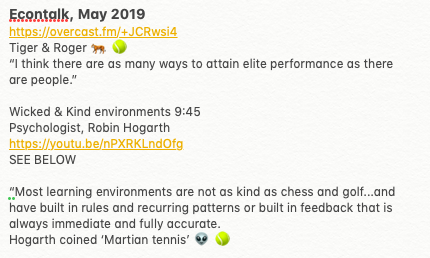
Taking notes. A frequent question I get is, ‘How do I take notes?’ Much like good design, it’s what fits you. Lately, I’ve used, but not committed to, the Apple Notes app. Here’s a sample of the Epstein note:

Note taking is great too because it makes the information stick. If you’re hiring podcasts, books, and videos for education then it’s not just consumption that performs this job, but production too.

In that note, Epstein references kind and wicked environments and they’re good descriptors for learning in school and learning in life. School is kind where the things you practice will be on the test. Life is wicked where pop quizzes rule the day. You’re preparing for the latter, which means there’s no curriculum to study. Follow your curiosity to whatever weird podcasts, books, and videos you can.


Thanks for reading.


Ambiguity Aversion

Supported by Greenhaven Road Capital, finding value off the beaten path.

How does someone make good decisions? There’s a lot of smart people talking about it and we’ve written about a number of them here. Michael Mauboussin, Nassim Taleb, Rory Sutherland, Gerd Gigerenzer, and Richard Thaler all come up on this blog. Part of what makes decision making difficult is the destination.

Diet is an easy example. The destination is a healthy body. The decision is to replace unhealthy foods with healthier ones.

Diet is easy (kinda) because it’s a kind rather than wicked environment. As David Epstein spoke about, some sports like golf and chess are very stable. Other parts of life are much more complex. Epstein’s point was that we shouldn’t learn lessons that work in one area but are void in another.

Diet is kinda kind because it’s a lot of chemistry with some social and some psychology mixed in. This is why diets tend to work with design interventions. Penn Jillette ate just a potato and fasted and that worked. Coaching solved the design issue while chemistry took care of the weight.

Let’s look at something different. Let’s look at something common in harder decisions, ambiguity.

Scott Kelly successfully spent a year in space and wrote about it in the book, Endurance. Kelly and his twin brother Mark had a rough life growing up. Part of the reason was that his family was middle class trying to live an upper-class lifestyle. Part of the reasons was his father was a drunk. One night dad went out to the bars with no food or money at home. Kelly wrote:

“The physical feeling of hunger is horrible, but much worse is the bottomlessness of not knowing when it will end.”

Later when Kelly was on the ISS there were some launch accidents. Their supply ships blew up on the launch pad or malfunctioned and burned up in the atmosphere. The ISS has a safety gap in supplies and redundancies in machineries but there was still the doubt about when the next capsule would make it up.

When there’s ambiguity for loss – how many people would really want to live in space for more than a year? – we tend to shy away from it. When there’s ambiguity for gain we can place Small Bets.

Rory Sutherland notes that we like brands because it’s insurance that something isn’t shit. Buying brands limits ambiguity. We buy brands because risks are calculated in the pre-frontal cortex whereas ambiguity is in the limbic systems, “said a simpler way, with ambiguity emotions play a much more significant role in the process than they do with risky decisions or deductive decisions.”

The lesson then is to make small, non-lethal bets, even if it costs a lot, in areas that are important to us. Buy the damn Samsung TV but take risks on anything that can compound over time like financial, habitual, or relational. Bill Gurley said about missing Google:

“I think it came down to the price at the time was remarkably high and the team was remarkably self confident in a way that would cause you to question whether they could pull it off but they did. I go back and the learning is that if you have remarkably asymmetric returns you have to ask yourself, ‘how high could up be and what could go right?’ because it’s not a 50/50 thing. If you thought there was a 20% chance you should still do it because the upside is so high.”

Humans don’t like ambiguity. It shields us from some mistakes, but it also conceals some gems.


Thanks for reading.

Andreessen and Horowitz on 10 years

Supported by Greenhaven Road Capital, finding value off the beaten path.

Ben Horowitz and Marc Andreessen were interviewed by Stewart Butterfield about their ten years at a16z. We’ll frame three rhetorical questions from the interview.

How to start? Copy

a16z started by copying Michael Ovitz’s model at CAA. Horowitz said, “We probably saved five years by copying his model.”

Recapped in, Who is Michael Ovitz, the idea was to have a team of domain experts serving clients. This was a different model for entertainment and it worked for Ovitz. It was also different for venture capital and it worked there too. But it won’t work for you unless your industry is new.

Andreessen explained that once a company starts, “Then it’s a compounding advantage where you get more and more different from the status quo…why would William Morris copy you (Ovitz)?” The couldn’t because they’d need to take salary cuts. The William Morris executives had too many stakeholders, neé bills, in their lives.

This question gets asked a lot, What’s stopping Company X from doing this? Why can’t Microsoft in the 90’s, Google in the 00’s, Facebook in the 10’s just come in and do this? 

The best answer is to say that they can’t. This is what Max Levchin did with Affirm. And it’s not unique to startups. Competitors need to think about where their opponent’s weaknesses lie and head for those. That was the CAA and a16z agency model. Take some salary money and create services.

What’s going to happen next? No one knows.

Andreessen lived through this with the Netscape browser and has seen the internet, mobile, and social trends. He said, “People don’t think these things are obvious in the beginning. They are only obvious after the fact.”

When he pitched media companies for investments in Netscape they balked. Those business “knew that normal people wouldn’t use the internet if it didn’t have Time magazine on it because Time would obviously be the killer app for the internet.”

But killer apps require a convergence of this, that, and something else. Andreessen said that “basically everything happens,” but like a solar eclipse, things like markets, technologies, and governments have to line up – or not oppose – first. One example is the book, The One Device.

If no one knows what’s going to happen and anyone can make something happen, even if it’s small, that’s great news. Andreessen is optimistic and recommends the book, How History Gets Things Wrong. The future is flexible! What’s going to happen next is up to you.

How to make mistakes? Probabilistically.

Horowitz likes the way Bezos puts it, “We rate people on the inputs, not the outputs.”

Andreessen elaborated, “We have a very specific philosophy on that (mistake making) and the book I recommend is Thinking in Bets where she (Annie Duke) talks about what is the nature of a mistake in a probabilistic domain.”

Instead of looking at outcomes, look at processes. Sports can provide handy visual examples. We praise Bill Belichick a lot but Chuck Klosterman made this point to Bill Simmons:

https://soundcloud.com/mikesnotes/clip-klosterman-on-resulting-and-alt-history-of-patriotsmiami


In his podcast with Russ Roberts, David Epstein said the same thing, “We have to be really conscious of the fact that a good outcome means we used a good process and vice versa.” Both of Michael Mauboussin’s books, More Than You Know and The Success Equation address this kind of making.

At a16z they use an idea maze. Andreessen explained, “is like a hundred step process to work your way through all the different permutations of the idea before you figure out the real thing.” It’s a way to think of alternative histories, counterfactuals, and possible outcomes. It’s a way to think probabilistically.

One idea maze solution is money. But that’s an idea maze problem too. Stewart said, “Having a whole bunch of money takes away a critical forcing function.”

Constraints like this can help. David Lynch wrote that more money means less thinking. Interviewer extraordinaire Terri Gross said that daily interviews make her a better interviewer.


Thanks for reading.


David Epstein

Supported by Greenhaven Road Capital, finding value off the beaten path.

David Epstein is on the podcast tour, talking about his new book Range, “why generalists triumph in a specialized world.” His advice isn’t to specialize or generalize but to have both, at the individual and community levels. He told Patrick O’Shaughnessy, “In areas where the next steps were clear, specialists were better. In areas where the next steps were less clear, people who worked across a large ranger were most effective.”

If you read Jack of all trades as a negative this book is for you. If it’s a positive expression then you’re rowing in the same direction as Epstein. Either way, seeing things from Epstein’s perspective is helpful. It’s what academics tend not to do. On Longform Epstein said, “The researchers (I cite) never come to the same place, they always go to their own conference where everybody believes their stuff.”

Yet a new POV is like a boost in IQ.

Michael Pollan saw this in his writings on homes, gardens, food, farms, – and most recently, hallucinogenics. “Doing it for the first time gives you a kind of wonder, of first sight, that you’ll never get again.” Even breaks from projects, relationships, or the simple crossword puzzle reveal solutions.

To make his perspective reflective Epstein does a lot of research. He tries to read ten journal articles a day early on, wandering into rabbit holes as needed. One tip he shared on Longform was to not dig into the method section unless the overall ideas look interesting.

Epstein also likes to talk to people. “I’m a reporter and I know if I talk to someone I’m going to find out things I’m not going to find out any other way.” In each of his interviews, he’s curious, which as Epstein notes, is a kind of ranginess itself. And he’s always been that way.

First, “I wanted to be an astronaut.” Then Epstein went to school at Columbia, started running track, and took a summer class because it would be easier to run track during that time.

That class was geology. Epstein loved it so much he went to graduate school for it. There he took a night class in journalism. That was fun too. With an eclectic mix, his job prospects were mixed. But he found one, the night shift, operating a phone for news tips and running out to report on stories as necessary. The experience was “a great boot camp.” It was his XMBA

Epstein followed other serendipitous moments to Sports Illustrated. His career was punctuated by that went well assignments and a focus on the truth rather than the conventional. Traditional answers are easy to tell ourselves and to tell others but traditional doesn’t necessarily mean true. Sometimes we have to find new, odd, and different solutions. Sometimes we have to show some range.

Rory Sutherland makes this point in his book, Alchemy. Terry O’Reilly’s does too, writing, “The difficult thing about counterintuitive solutions is that they are often difficult to swallow and hard to present, and are usually shunned by almost everyone initially.”

Epstein saw this too, telling Russ Roberts, “As one researcher told me, ‘The difference between cancer research and Jeopardy is that in Jeopardy we know all the answers.”

It comes up in so many domains of life that it’s hard to ignore. Part of life is making the trains run on time and part of life is laying new track. Part of life is efficient execution and part of life is non-fatal exploration.

One way to explore better is, the next time you make an analogy, “Instead of picking the first analogy that comes to mind because it has some surface similarities, create a reference class of analogies and think of what happens on the broad scale instead of the particular details.”

Exploration came up often in Epstein’s conversations. After his lunch with Russ Roberts, “I ended up with half a dozen new things on my reading list, which for someone who doesn’t know what they’re going to do next, it’s tremendously important to get suggestions to read things I wouldn’t have otherwise read.”

Epstein is also in a culture – writing – that allows this. You told O’Shaughnessy,

“Give people the liberty to start exploring.” Culture influences people. The Apple and Steve Jobs culture, said Ken Segall, was “a table, white board, and an honest exchange of ideas.”

So explore more. In his interviews Epstein mentions many different sources, here’s a few.

About To Youyou, the Nobel Prize winner with ‘No’ credentials. BBC.

About Wicked and Kind environments with the psychologist, Robin Hogarth. YouTube

About the book The Master and his Emissary, right brain and left brain, Iain McGilchrist. YouTube

About Dark Horse projects of self exploration with Todd Rose YouTube.

Act and Adapt

Supported by Greenhaven Road Capital, finding value off the beaten path.

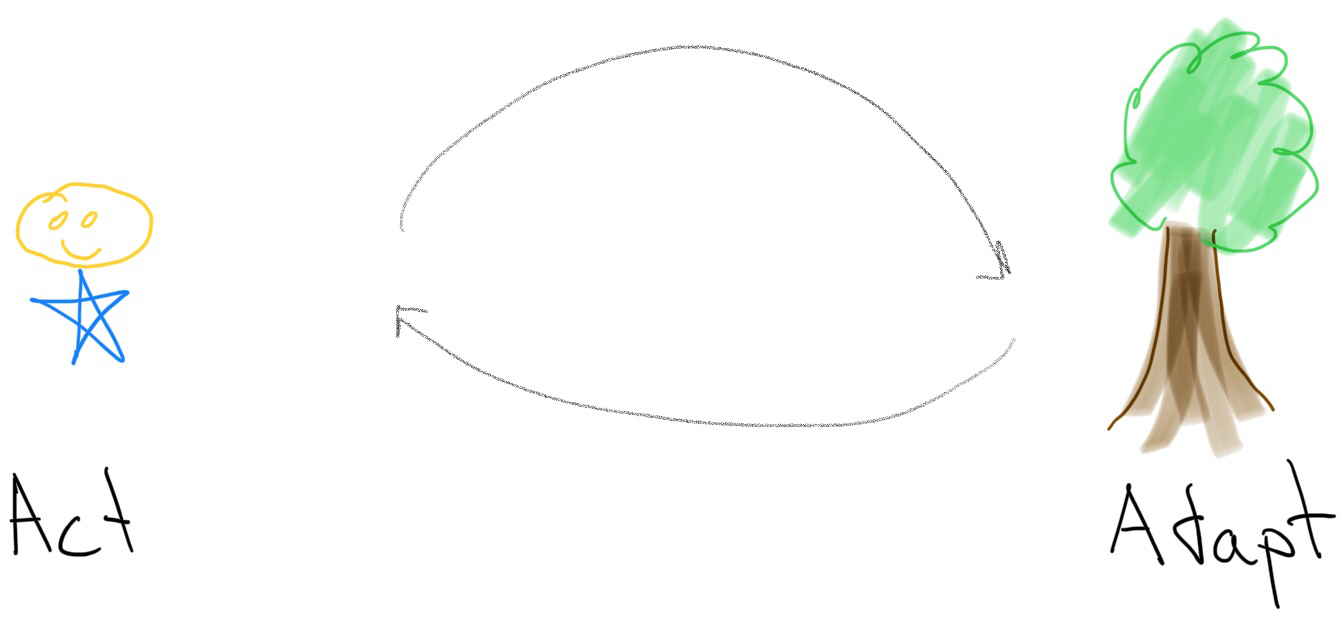
Lots of life is a balance. Greed and benevolence. Extreme ownership and decentralized command. Firm and soft. Act and adapt. When abstracted and visualized we make maps. As Adam Savage wrote, “Drawing is your brain transferring your ideas, your knowledge, your intentions, from the electrical storm cloud at its center, through synapses and never endings, through the pencil in your hand, through your fingers, until it is captured in the permanence of the page, in physical space.

The things we draw, the maps we make aren’t real – but they are helpful.

In POV40IQ emails this week we looked at situations where actions rule and ones where adaptation rules. One more example is Disney.

Marty Sklar is the only Disney employee to attend the opening of all eleven theme parks across the world. Disney theme park service is best in class. It’s so good they teach the Disney way as a class. Ramit likes it.

Sklar knows a lot of these things. Some he taught. Some he writes about, like in the book, Mickey’s Ten Commandments, a book focused on how Disney makes their theme parks so Disney like.

One way to do that is to have a patron’s point-of-view.

“In the earliest days of Disneyland, when everything was new for the guests and the Imagineers, Walt Disney decreed that every designer was to go to the park at lease every other week and stand in the lines (we call them queues) to understand what our guests were experiencing.”

That’s a case of Disney acting to see how they could improve people’s experience at the parks. Lots of good businesses do this. The IKEA founder, for example, still occasionally worked the cash registers when he was CEO.

Disney’s effort shows. The parks include some of the most innovative designs in the world. Understanding psychology, much like Rory Sutherland, Disney knows that entertaining waits aren’t waits at all.

Dumbo gives people a place to rest (in the air conditioning!). The Jungle Cruise queue is full of humor. So is the Haunted Mansion. Taking the customer’s perspective, Disney Imagineers acted. But sometimes the Imagineers adapt.

After 2008 Disney stumbled. In 2009 Disney reported to investors that attendance dropped 1% but park and resort operating profits fell by half.

How did Disney keep attendance levels up? They adapted. They offered free dining plans. People liked it, and they got used to it. Now it’s a program that brings people back year after year.

In one post we compared Howard Marks to Russian nesting dolls. There we noted the three levels we ‘live in’. Our heads, our buildings, and our environment. At each of these, we act or adapt depending on the circumstances.

Thanks for reading.

Small Bets

Supported by Greenhaven Road Capital, finding value off the beaten path.

I had a problem. Too many of my subscriptions went unread. Too much podcast advice went unheeded.

I had another problem, I need repetition to learn things. The first time it took me over an hour to change a headlight. Now it takes fifteen minutes.

I have a solution (not for the headlight). If you want a short email, each weekday, focused on one theme for the week you can sign up.

There will be no links. There will be no breaking news. There will be no interviews, analysis, or something else, someone else is already doing really well.

There will be stories. Some will be apocryphal, second hand, and every now-and-again they will be untrue. That’s okay. We aren’t aiming for statistical significance, we’re aiming for ideas to try.

Rory Sutherland is fond of saying that a change in perspective is worth forty IQ points. That’s what this is. It’s a fast hit, a thinking vitamin, a dash mushroom. It’s asymmetrical, minuscule investments for gigantic payouts. There will be weeks when this email is unhelpful, maybe even unwelcome. But there will be once when it leads to a brilliant idea. Sign up.

The theme for week one is small bets. Here are two snapshots.

Happy (belated) Father’s Day to the dads. Father is a biological term but that’s not really what we celebrate. It’s not the number of kids you have but the kind and kindness you show.

How we measure things matters. In academia it’s p-value. A value of p=.05 means that there’s less than a one in twenty chance the observed effect is due to chance. For studies published in journals read by professors that’s good. But not for real life. Instead, we’re looking for anything that works.

That’s what Sam Walton did we he started Walmart. As Charlie Munger notes, Walton invented almost nothing we might think of when we think of Walmart. Instead, he copied the best from everyone else then stacked, piled, or implemented it himself. Walton once bragged that no one had been in more Kmart stores than he had. One time he was walking down the aisle of Costco taking notes on his ubiquitous notepad when the store manager asked him to leave. That was Sam Walton.

Not all the ideas were good but none were fatal. One time Walton borrowed $1,800 for an ice cream machine and popcorn maker. They grabbed attention and got people into the story. But he wrote: “Every crazy thing we tried hadn’t turned out as well as the ice cream machine, of course, but we hadn’t made any mistakes we couldn’t correct quickly, none so big they threatened the business.”

These emails will not be statistically significant in the academic sense. These will be stories. There will be survival bias. There will be irrelevant, apocryphal, and wrong things. That’s okay too because a change in POV is worth 40IQ.

Marc Cohodes is a short seller. Cohodes is candid. He’s active on Twitter (@AlderLaneEggs) and even creates websites for whistleblowers to report fraud at companies he suspects. He’ll swear in interviews. He’s a reckless guy.

Except he’s not. To short a stock, Cohodes borrows a share at one price with a promise to repay at a later date. In theory, his downside is infinite while his upside is capped – at zero. Though brash, he’s cautious and Cohodes said that he uses the lifeguarding motto he was taught as a way to think about how he invests. Lifeguards are taught to Reach, Throw, Row, Go.

Though it makes for good television, running into the surf, diving into a pool, or swimming through the water is the path of last resort.

Caution saves lives. The Red Cross has even adapted the rhyme to instruct most people; Reach or Throw, don’t Go. The point is to nibble new ideas, not gulp them down.

Charlie Munger is an investor, but not a short seller like Cohodes. Munger has worked with Warren Buffett for four decades. Buffett said that Munger has the best brains in the business. Reflecting on his early investing career, Munger told a group of University of Michigan students, “I was not a courageous, adventuresome admirable man. I was a cautious little squirrel.”

There are many ways to take big swings but those are often the moments that expose us most. Sam Walton took calculated risks by getting cheap rents and copying best practices. His weird ideas were small things, like introducing Walmart shoppers to flip flops or buying an ice cream cart to use for promotions.

It’s not big swings that change our course but new ideas. As they say, a change in POV is worth 40IQ.