What are you reinforcing?

Chef John said something interesting while making Turkish scrambled eggs.

During the final phase, he added an extra bit of olive oil. “Since it looks good and it tastes good, and you can’t use enough olive oil in your ________.”

Now, what is the next word? How does he fill in the blank?

He says cooking, and I expected diet.

I’m reading a lot of Justin Skycak (long live blogs as rabbit holes) for a class I’m teaching and he emphasizes our long-term memory connections. Things we regularly recall become encoded more strongly.

One way or another, I’ve encoded olive oil is good for your health rather than, olive oil is good for your cooking. 

It’s good to bump into the edges of our reality. It’s good to be reminded of new things. And it looks good to eat Turkish scrambled eggs.

Food Metrics

Is this right? It is important.

A helpful question to regularly ask is: What do these numbers really mean? I used to love looking through the Sunday Best Buy ad and comparing computer hardware. RAM, hard drive, monitor size – all catnip to a teenage boy in the 90s.

But what did those numbers actually mean?

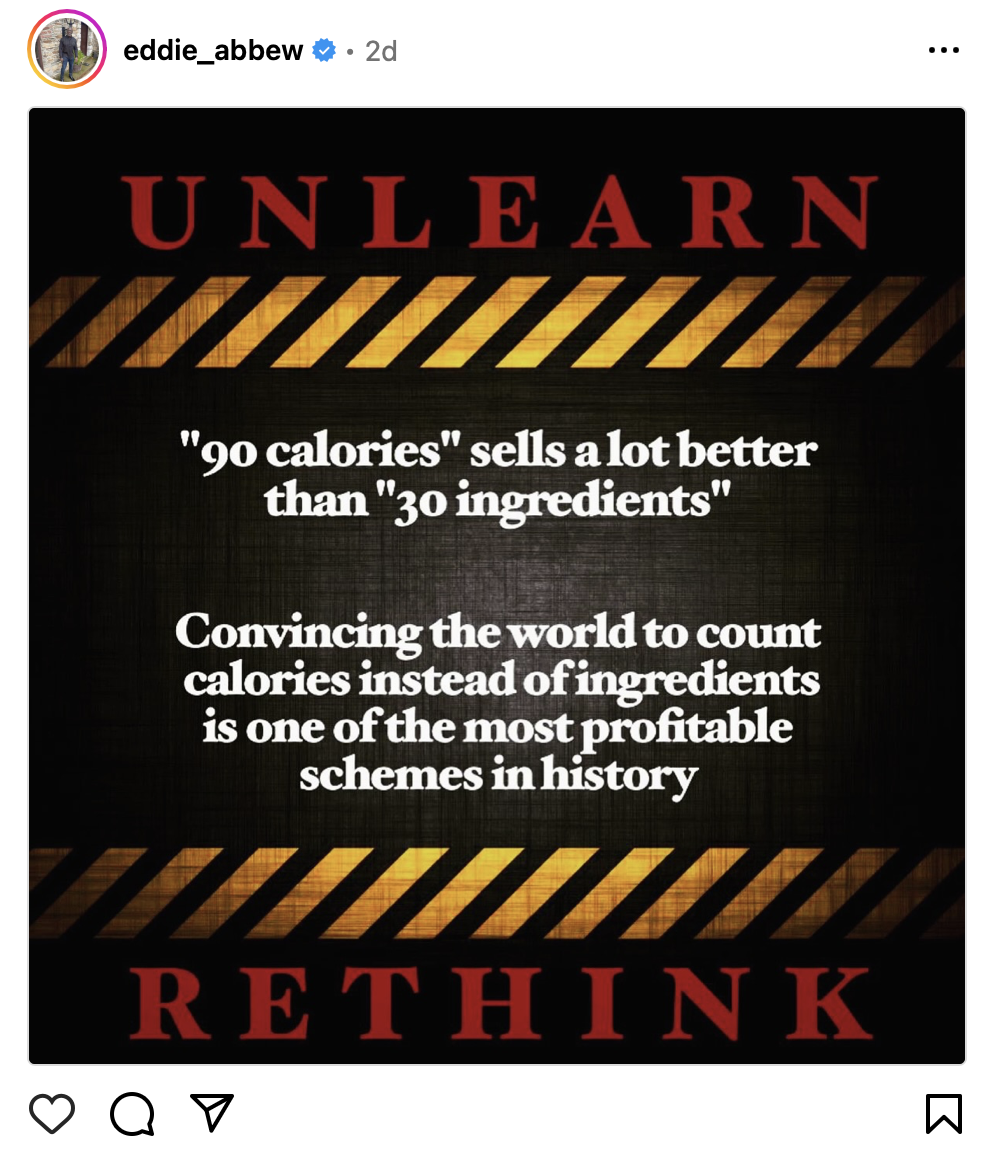
Jobs theory is about finding the meaning behind something. See “90 calories” and, click-whirr, must be healthy. That’s the meaning we associate. But is that the right connection?

Or is Eddie correct? Is number of ingredients a better signal?

Metrics, numbers, figures — whatever our attention catches is not accidental. Someone chose that, they framed the context around that scene. It’s up to us to ask, is this right?

Ben & Jerry’s: The Inside Scoop (book review)

Ben & Jerry’s: The Inside Scoop is an underrated business book. Traveling through the 1980s and 90’s it chronicles the growing pains of America’s favorite ice cream pints. 

It’s a business book with two parts. 

The fun stuff

Two hippies create, grow, and scale a super premium ice cream brand from a converted gas station in Vermont! That’s fun. 

On Black Monday 1987 the duo showed up on Wall Street with “That’s Life, vanilla ice cream with pieces of stale apple pie (the stale pieces held up better in the ice cream), and Economic Crunch, which was actually some leftover Nutcracker Suite from the previous winter, renamed for the occasion.”

Ben and Jerry drove around in a Cowmobile promoting the brand. On their one-year anniversary, they hosted a block party, with Ben and Jerry organizing, acting as characters, and offering free ice cream of course.  

The grind

“Amateurs talk about strategy,” said Omar Bradley, professionals talk about logistics.” 

Ben & Jerry’s wasn’t the only super-premium ice cream. Häagen Daz was the market leader and a bunch of me-toos. Starting in Vermont, a state with no Baskin Robbins franchise was probably a blessing. 

But the distribution was still a grind, sometimes literally as their beat-up delivery truck broke down delivering the pints. Once they contracted out to distributors it was a game of sharp elbows for shelf space, full of kickbacks, relationships, and lawsuits. 

Even the Beatles had a logistics machine! 

Oh, and the people. 

Every business is built on the foundation of its people. In a podcast with Brent Beshore, Anu Hariharan said she looks to invest in good teams with product-market fit. This is despite her technical and financial backgrounds. To paraphrase: It’s the people, stupid. 

But that’s also the hardest part of a business. 

While Ben & Jerry’s product line, market share, and revenue grew, the team’s expertise did not. They hired slowly. Not because of a great vetting process but because they were overwhelmed. They fired slowly too, a terrible combination. 

Oh, and the finances!

We won’t recount the story here, but in Shoe Dog, Phil Knight writes about taking all of his profits back to the bank to say, see, these things sell, now please give me another, larger loan.  That happened in Vermont too. Inventory. People. Facilities. Raw materials. New facilities. At least they could drown their sorrows in a fresh pint. 

Be your own boss with your best friend(s), but work like hell.

Sounds right.

Freezer doors

There’s something mentally stabilizing, even encouraging, to know what’s going to happen.

Not precisely. Not like a crystal ball. Just generally, like a heads up.

At a parent meeting, my daughter’s volleyball coach said, the season is long and the work is hard, at some point your kid will want to quit, don’t let them.

That was good. It prepared the parents.

We don’t always get this information

Sometimes we get the “Instagram” life. That’s unhelpful.

In 1987, Ben & Jerry’s had their best summer ever: a year-over-year sales increase of 60% to 32 million dollars.

Financially things were good.

Functionally things were a mess.

At their brand-new plant, the freezer doors didn’t have “tolerance”. The sliding doors were only just large enough for a forklift to perfectly pass through. Sometimes it didn’t. The result was that after enough banging on the freezer frame, the staff left the doors open and relied on the plastic strips to insulate the ice cream as best it could.

“The term freezer door,” wrote CEO Fred Lager, “became a metaphor within the company for anything that wasn’t working and was being ignored despite a painfully obvious need for attention.”

Human resources, processes, and candy chutes were all freezer doors.

They had to address these growing pains.

At an all-hands meeting after the busy summer season wound down, Ben Cohen gathered everyone and gave a state of the company. To address the freezer doors he asked everyone to form groups and create a list.

There were a lot of complaints, but Ben took them all in stride. “It’s only an indictment of management if you think that a well-managed organization doesn’t have problems,” Fred recalled Ben’s comments, “This was just telling us what we had to work on and letting the employees know that we knew about it.”

It was a heads-up.

These wrap-ups that lead to heads-ups are post-mortem reviews. At the Rewired Group, they are a mandatory part of the process. But they don’t just successfully happen.

Our egos can get in the way. Post-mortems are NOT to assign blame. Howard Marks called this book, “a very interesting book on self-justification” – aka somebody f’d up and it wasn’t me.

What works better is a culture of extreme ownership. This starts at the top. Ben Cohen wasn’t a perfect leader. No one is. In Lager’s book, he comes off as demanding and not fully aligned with the rest of the ice cream crew. But what he does do is avoid the ego trappings of the top position.

“Eighty-five percent of all problems,” wrote Deming, “are system problems not people problems.”

Be wary of the ego. Address the system. Fix the freezer door.
Pappyland (Book Review)

Pappyland by Wright Thompson is a book about wistfulness and wishfulness.

Kentucky Derby visitors are wistful.

“The day-trippers wear gangster suits and outlandish patterns and hats inappropriate to the latitude, temperature, or setting. It’s amateur hour. They hold liquor like ninth graders. The homogenization of America has left people wandering the land in search of a place to belong. We are a tribeless nation hungry for tribes. That longing and loneliness are especially on display in early May in Kentucky.”

That feeling is in late-night bourbon too. We feel nostalgic, “which I only recently learned comes from the Greek words for home and pain.” Bourbon, Wright writes, “It’s a drink made for contemplating, and what is usually being contemplated is the easy and often false memory of better days.”

It’s Springsteen’s Glory Days. Youth is wasted on the young. It’s melancholy.

There’s also wishfulness.

The book is centered around Julian Van Winkle III, the caretaker of the bourbon brand Pappy Van Winkle. My impression was silver spoons, seersuckers, and bluegrass mansions. My impression was wrong.

David Chang once cautioned an interviewer that just because a restaurant was highly rated and busy did not mean it was also a good business.

Julian grew up well, running around the bourbon-born grounds. But like the Kentucky horses, bourbon’s success was short-lived. The glamorous inheritance from his grandfather couldn’t be salvaged by his father and the family business sold out.

That’s about when Julian wished for it back.

That’s about when Julian worked for it back.

Wright weaves a good story, which I won’t spoil. It’s about Julian’s past and present. Our past and present. Wrights too.

Can we be anything but wistful of the past? Is bourbon a conduit? We marvel at AI’s ability to generate the right information. Physical artifacts do that, bourbon does that.

“We make fine bourbon at a profit if we can, at a loss if we must, but always fine bourbon.” – Pappy slogan

Haircut and Shampoo Jobs

One part of Jobs theory is that the category may not be the competition. In Competing Against Luck, Clayton Christensen wrote that V8 is in the juice aisle but it competes with the produce section. No one bought V8 instead of apple juice, but they may buy V8 instead of celery sticks.

Another grocery-based job is the Chobani Flip. The accidental yogurt company’s problem was that people saw yogurt as a morning food. Talking to customers, Chobani found that if people could mix in something else it was seen more like a snack. And the Chobani Flip was born.

Like V8, Flip doesn’t compete with other yogurts, it competes with what else parents might buy. Like Pirate Booty.

This is the Jobs insight: think of the job rather than the place or the product. Proximity (aka category!) is not the competition.

Dove shampoo brand gets this.

Framed as “person on the street”, shampoo reps ask women if they need a haircut. Yeah, it’s my split ends, the women say. Well, what if you try our shampoo first?

Naturally, the shampoo works wonders for treating split ends and the women are happy.

Naturally, it’s a great use of Jobs theory. Rather than compete with other shampoos, this company competes with haircuts.

You keep using that word, competition, I don’t think you know what it means.

95/5 Instead of 50/50

It’s 2004. Will Guidara is working at the Museum of Modern Art. Not in the esteemed gallery or adored restaurant. Will is in charge of the cafe: coffee, sandwiches, and snacks.

And he wants to create a gelato cart for the Sculpture Garden.

But first, he needs gelato worthy of the museum and his group, Union Square Hospitality. He finds Jon Snyder who sells it at a discount. He also convinces Synder to pay for the cart. It’s a nice cart.

Things are looking promising.

And then Guidara goes crazy.

He wants Italian spoons. “How amazing could a plastic spoon possibly be?” Will writes, “You’re going to have to trust me on this: they were paddle-shaped, extraordinarily well designed, and completely unique.”

But they’re expensive. His boss sees the cost and says “we’ll talk about this later.” But Guidara loves them. He gets them. He creates The 95/5 Rule.

“Manage 95% of your business down to the penny; spend the last 5 percent ‘foolishly’.”

This idea manifested later when Guidara was at Eleven Madison Park. While traditional wine flights had average wines, Will and his winos wander wider. Most of the samples were good, diverse, and less expensive. But one, the last one, was excellent. “The Rule of 95/5 gave us the ability to surprise and delight everyone that ordered those pairings, making it an experience they would never forget.”

It’s a good rule because averages are not good measures. Save where you can but splurge on one thing. That’s helpful. That gets past average thinking.

Bourbon Jobs

We hire jobs to be done for three reasons: functional, emotional, and social. This is clear at the liquor store.

In college, we bought cheap beer. The function was to get buzzed and the social job was to have fun doing it. We might upgrade to Coors Light or even PBR which our favorite wing place always had on tap. Even the upgrade is social.

Liquors differ. They’re packaged more colorfully. The containers are shaped. Their origins matter. It’s more story. People like us drink things like this.

In his book, Pappyland, Wright Thompson discusses the bourbon’s brand:

“The reason Pappy’s office was built to look like Monticello, with the leafy grounds of the Stitzel-Weller plant made to feel like an oasis from modern life, was because he knew that bourbon drinkers were often motivated by nostalgia—It’s a drink made for contemplating, and what is usually being contemplated is the easy and often false memory of better days.”

If our core emotions fire on danger, food, and sex then bourbon serves anti-danger. Bourbon serves ‘southern comfort’. It feels like the good old days, with dad or grandpa. Bourbon ads are warm. It’s a drink to sip. We never drank bourbon in college.

Vodka sells sex. Rum sells fun. Gin sells sophistication. Tequila sells a little bit of everything.

“A bottle of bourbon,” Thompson writes, “is a coded way for so many unspoken ideas to be transmitted and understood.” Often jobs are coded, sometimes they’re an enigma. Sometimes not.

But to really understand bourbon’s job, we’d have to go deeper. What’s the context? If this were a documentary what would it look like and feel like? Who is there? What are they wearing and where did they come from?

Cheerios JTBD

“Don’t eat them for the 100% whole grain oats. Don’t eat them because the oats can help lower cholesterol. Eat them for her.”

Cheerios commercial, 2023

The good. Jobs-to-be-done uses “Mario marketing”. Sell the power, not the flower. Why is ‘being healthy’ a goal? It’s to spend longer with your granddaughter.

This ad ran on a Wednesday morning in Florida. Who is watching television? Retirees. This CAC is money well spent.

The bad or the confusing. None, it’s a good advertisement.

🧐

One of the best ways to get better at something is to do it.

One of the best ways to get better at some thinking is to notice it. The human tendency to confirm beliefs is generally useful. So be curious. Give something a name and label to your experiences.

You stick your hand in shit…

This is from a daily email I write with my friend Aaron.

Mr. Cohen was at his summer job, waiting for his delivery truck to be loaded up for the day.  

“Yeah college is fun,” he told a mechanic while the two waited, “but I’m dropping out.”  

“Why?” the mechanic inquired.  

“Well, I don’t like it,” said Cohen. 

“Ahh, you stick your hand in shit you wash it off,” offered the mechanic.  

Mr. Cohen created one of the greatest brands in the United States. You know it. You’ve probably bought it. We’ll get to that in a moment.  

Cohen didn’t immediately apply the mechanic’s advice. He quit college. He mopped floors for a bit, but quit. He worked as an ER clerk, but left. He drove a taxi for a while.  

It wasn’t until Cohen had a partner and a plan that he persevered.  

The duo’s first store was an abandoned gas station. They slept there. They couldn’t pay their contractors in cash, so they paid in kind. They couldn’t afford equipment. Instead, they reached out to their friends and family asking them to check the classified sections for going-out-of-business sales.  

They faced obstacles and found solutions.  

They persevered. 

They opened Ben & Jerry’s Homemade Ice Cream in Burlington, Vermont.  

You stick your hand in shit you wash it off.  

You get knocked down, you get back up.