This post was originally published at Medium.com. I didn’t like the structure there, so I’m reposting it here. Here are 3 Things I Learned from Bob Seawright.
Bob Seawright was on the Going Deep with Aaron Watson podcast and shared some nice nuggets. Aaron Watson’s 30 minute interviews a different — in a good way. Here’s what I learned from Seawright
1- Keep track of your decisions.
“In my current job I was called upon to give advice and opinions on best practices on a variety of topics all the time, but I realized that it was increasingly easy for me to go part of the way through an answer without really having to make a call.” “My memory was often inaccurate of what I had said.” “Being human, I remembered the good calls and didn’t remember the bad calls.”
Seawright saw his hindsight bias with 20/20 vision. This bias, to remember our wins, but not our losses may keep people on the golf course, but is terrible for the rest of life.
What I liked about Seawright’s response was that he talked about how he dealt with it, by writing. His blog — Above the Markets — is the result. Now he writes things down and can see why he thought something, and if he was right.
2- Have a devil’s advocate.
“Institutional red teams are not the same thing as real disagreement.” “You need people to become empowered if they are to become a red team.” “Make sure you have people in your life that are going to challenge your thinking.”
Seawright says he was once in a small group with Daniel Kahneman (how cool is that!) who said, “we all tend to live in bubbles of various kinds.” We need people who can pop our bubble.
Side Note: In my series on survivor bias in start-ups and consequent book, there were two ways bubbles could be popped; customers and advisors. Start-ups that failed always lived in their bubble.
Institutionally this hard, Seawright says, it’s easy to stagnate. We need critical outside voices.
In his book, Smarter, Faster, Better, Charles Duhigg writes about a GE plant where efficiency and error rates had stagnated. They couldn’t effectively hire more people. More quality control staff brought diminishing returns.
What to do?
The solution for GE is the same one Seawright suggests — empowerment. Line workers were empowered and each became the quality control.
The Devil’s Advocate goes by many times; inside/outside view, contrarian opinion, constructive criticism, but it’s Gary Vaynerchuk who explained it in the color missing from ideas born in academics. He tells James Altucher this is what he would say to someone who wanted to change (27:00):
“Round up the 8 people closest to you…have a two hour conversation and the first hour and a half is completely predicated on Johnny Crest saying, “I need something from you, and it’s going to be very hard on you. I want you to tell me everything that you think I’m good at and what you think I’m bad at…so I’m giving you permission now to say things that you think may end our friendship or our relationship, because in this one moment, I’ll be okay with it, because I’m using this data to make my life happier.”
3- Is this why people hate Duke basketball?
“After any Duke, (North) Carolina game, the descriptions of the game would be widely different depending on which shade of blue you were wearing.”
One of the most famous social psychology papers is in the same arena (sports) but a different type (football). In They Saw the Same Game (1954), researchers found that students from Dartmouth and Princeton reported the same football game in very different terms.
It seems clear that the “game” actually was many different games and that each version of the events that transpired was just as “real” to a particular person as other versions were to other people.
Our position influences our point of view.
On a recent vacation to San Juan there was a homeless guy asking for food. I gave him my leftover fries, but the next person he asked gave nothing, commenting after he left that the guy was a bum.
Maybe. Maybe not. My guess is that this guy was mentally handicapped.
We both could be wrong of course (I often am), but we saw the same thing and had two different conclusions.
Chamath Palihapitiya joined Kara Swisher on the Recode podcast to talk tech. Actually, tech was just a proxy for talking about life. Here are some quotes from Palihapitiya we can disassemble, understand, and use. Software we can install today.
1/ “I’m really good at risk…I’m relatively fearless about money because I never really had money.”
Palihapitiya said this about his time in investment banking. We may not be investment bankers, but this is still good advice. If we don’t get used to something, we don’t think we need it.
In The Hour Between Dog and Wolf, John Coates explains what happens behind the scenes in our minds. We get chemically attached to successes and things, and start to try to get more of them. Coates writes that some traders would reach for trades to make up for losses because they had envisioned and committed to an upgraded house on Martha’s Vineyard. This never ended well. This is part of the reason we suggest a low overhead approach.
Palihapitiya cleared this pitfall, by never running this race. Because he never had anything, he had nothing to lose (or reach to keep).
2/ “Whatever he (Kevin Connor) needs me to do, I’m going to do. (I’d) answer every email…Kevin needed work done and I would do the work, and I keep getting promoted.”
Palihapitiya adds another voice to our theory of career capital. Introduced by Cal Newport in his book, So Good They Can’t Ignore You, it’s the idea that rare and valuable skills require rare and valuable jobs. But you don’t start at rare and valuable, you start at answering every email. You start in the backwater.
In his latest book, Gary Vaynerchuk writes the same thing, that if his kids don’t have the skills they need, he’ll start them at the bottom of the family business that bears his name. Many people start at the bottom, doing whatever is needed.
Terry Gross said, “I was a volunteer at a station of volunteers….there was a lot of peer pressure….it toughens you up, and you learn… it doesn’t feel good but it was effective.”
Sarah Tavel did whatever needed done at Pinterest. Sophia Amoruso did whatever needed done for Nasty Gal.
3/ “In hindsight it (the Winamp source code) was the pin for the grenade that destroyed the music industry.”
Palihapitiya is many things, including intellectually immodest. When Swisher asks why the Facebook phone failed he said it was because of his ego. Observations of the aplomb. Our grenade pin quote articulates another good tool, part-of-the reason thinking.
Introduced by Sanjay Bakshi, it’s the mental model that forces us to think of things being made of many parts. Dropping Winamp code online may have been the pin, but what about the rest of the grenade?
Highlighted in the – great – book, How Music Got Free, Stephen Witt tells the story of the downfall of the CD in favor of the digital download. Other parts of the reason included; lackluster albums where only a few songs were good, faster internet speeds to exchange data, middle class factory workers, and music executives with lagging strategies.
There may have been a pin, a tipping point, the straw that broke the camel’s back, but that’s never the only thing. It’s always one of many things.
4/ “None of it was planned, but I was around some pretty historical moments for our world.”
Palihapitiya was part of some major moments; the AOL/Time Warner merger, Winamp, Facebook. He didn’t know it at the time. No one does. James Manos said that the first season of The Sopranos was about making a good show – not a cultural one. Sophia Amoruso didn’t set out to create a fashion brand, she was just bored at her desk job checking ID’s at an art school. James Corden didn’t think Gavin and Stacey would be a hit. B.J. Novak didn’t think The Office would be either. Amy Schumer said that she’s still not conscious of it, rather, she’s just doing the thing that’s right in front of her.
People who make things that become big are always more focused on the making of it, rather than the largess.
5/ “I liked him (Mark Zuckerberg)…what’s the worst that can happen?”
Palihapitiya said that he joined Facebook because it was a win-win opportunity. He wanted to be around young people and create something, and there was the chance to be part of something that might be a rocket ship.
Chris Hadfield adopted this strategy to literally get on a rocket ship. He wrote about this mindset of aiming for space:
“It’s probably not going to happen but I should do things that keep me moving in the right direction, just in case – and I should be sure those things interest me, so that whatever happens, I’m happy.”
This, do the small things that make you happy, but that could also lead to big results has examples elsewhere. Casey Neistat took this approach before making his snowboarding through Times Square video:
6/ “I was curmudgeonly mostly on purpose to make sure we didn’t get lost in ourselves.”
When Palihapitiya saw an Audi in the Facebook parking lot he took a picture, and emailed it to everyone. “This is what will bring us down,” he wrote. His actions seem overbearing (though he tells Swisher is was inspirational), but they provided a ballast, the outside view.
7/ “Every time there is a new lily pad in that four hour block of time (play), they (Facebook) buy it.”
Palihapitiya theorizes that Facebook divides a day into three parts; sleep and sundry, work, and play. Facebook wants to be the biggest player in that play period. The Facebook app is one part of that time, Instagram is another. Each company is a “lily pad” that Facebook might add to their pond.
This theory fits nicely with my current project, Is Snapchat Disruptive?. The framework there comes from Professor Clayton Christensen, who writes that companies who were once disruptive can’t again be disruptive without a major change. One way is to change their values and processes – the very things that are most profitable.
Another way is to buy companies, and keep them as separate entities. They can grow on their own. That’s what Facebook looks to be doing.
8/ “Work on things that keep you really morally disciplined and then you set your trajectory 40 years into the future, and then you don’t get distracted.”
This productivity advice echoes what Gary Vaynerchuk suggests too. His analogy is a bit tidier, keep your head in the clouds and mind in the dirt. In his book, Smarter, Better, Faster, Charles Duhigg found that the best goals were stretch goals broken into SMART components.
9/ “What Mark (Zuckerberg) is becoming, is a master capital allocator. What Warren Buffett is, is a capital allocator. What Larry is learning to become, is a capital allocator. Jeff (Bezos) is actually the best capital allocator of all of them….he takes just enough small bets.”
This is another leg in Christensen’s disruption framework. Companies that have disrupted an industry or encumbnant (Amazon selling books online) and then sustained (Amazon selling everything else online), need to be open to new ideas. These new ideas need resources. They need capital allocated to them.
Ben Thompson and James Allworth spoke about this on the Exponent.fm epsidodes #70 & #71.
A quick summary for Amazon might look like this: they tried the phone, it failed, they shut it down. They tried Alexa and it’s succeeded so far and they’ll continue to follow where that may lead. Both Tim Cook and Mark Zuckerberg have danced these steps. Apple’s first phone failed. Facebook’s too.
Warren Buffett bought Berkshire Hathaway when it was a textile mill. It was one of his worst investments. Geico was one of his best. Buffett’s advice? “If you get into a lousy business, get out of it.” That’s good capital allocation.
10/ “Dealing with that, when you don’t win, is such great training for work.”
At the end of the interview Swisher says she can’t stand to play poker because she loses. That’s good, Palihapitiya says. Figuring out how you lost is golden.
Charles Duhigg’s latest book, Smarter, Better Faster tells the story of how Annie Duke abandoned her Ph.D. and picked up poker. Duhigg summarizes Duke’s – and other people’s – success as stemming from losing well. Good losers, he writes, create mental markers. When along the same path, good losers notice these, and choose another path. This is what Duke did.
11/ “I don’t think she was the right choice…the minute he (Dan Loeb) exists is a huge red flag.”
Palihapitiya thinks Marissa Mayer is the wrong choice at Yahoo. I don’t know about Mayer, but this logic is sound.
In my research on why start ups failed, an early believer bailing was a kiss of death. If a VC backed company didn’t get their seed round investors to lead their A-Round, it was like a scarlet letter.
This is the blog post version of the (final episode of) Mike’s Notes podcast, available on iTunes, Soundcloud, and Overcast. We’ll look at what are mental scripts, and how to optimize them.
When Auren Hoffman spoke about education, it struck a familiar chord. I went to college because it seemed like the things I should do. If you have good enough grades, want a good enough job, and have just enough money – go to college.
It was as if the game of Life only had one choice.
I’m pleased with college, but that doesn’t mean we shouldn’t question the scripts in our lives. Some scripts are benign, compliment someone’s new haircut or effort in sports. Others are insidious. The “not good enough” and “can’t do this scripts.” Our three characters will speak about these internal scripts. Let’s meet them.
B. Felicia Day, star of numerous web series, funny person, show writer.
C. Gary Vaynerchuk, CEO of Vaynermedia, social media machine, banana eater.
Barbara Corcoran calls her internal script her tape. She recalls meeting with Donald Trump to give him the bad news that his apartments weren’t as valuable as he thought. Corcoran had started to figure values on a cost-per-room basis, and Trump had gotten some bad deals.
Trump started to disagree, not-so-cordially I assume, and Corcoran doubted her numbers, then herself. She got defensive and wondered if she bit off more than she could chew. Then, she changed.
“The tape kicks in and I go, ‘oh yeah, you’re not any smarter than me. Then boom, I’m in my feet and I’m over it.”
Corcoran said she “got out of her head and back in her feet.” She knew her numbers were right. She knew the industry. No one could say that she didn’t know what she was talking about, except someone was.
She was able to change the tape that was playing because she had practiced that. Once she had that new script, she rallied
“Never put yourself down about things that you create. That mean voice inside you that says, ‘You’re not good enough’ is not your friend, okay? I used to hear that voice all the time. If I hadn’t started ignoring it, I wouldn’t be here right now. Okay?”
Day too faced the voice. She faced it when her entire career was built around a show about people who met online and was filmed in her house. On the surface that sounds terrible. Like one step – literally – removed from blogging in the basement. Day didn’t listen to that voice, with practice
Day writes that part of what helped her ignore that script was other people telling her she could. She needed support. That came at a regular accountability breakfast with her peers. It took years, but she got it and made her show.
Gary Vaynerchuk said:
“The number one thing that holds people back is self esteem. They don’t think they’re good enough, thus they can’t take the first step.”
Vaynerchuk too addresses our internal scripts, our tapes, the mean voice inside you. Don’t listen to it. Evict that voice. Get it out.
Vaynerchuk writes that his mom was a great cheerleader, always telling him he was the best at something. Often he wasn’t, but he didn’t care. His belief caused action, which led him to be pretty good.
This post sounded a little self-helpy, that’s fine. These are true stories, you need to take what you need.
But you have to get over the voice so you can start to fail, (tweet) and everyone fails at first. Facebook built a phone that failed before they built apps that dominate every phone. Apple’s first phone failed, so did Amazons. The latter moved to the Echo, a success.
You will stink at first.
For the first couple years you make stuff, it’s just not that good. It’s trying to be good, it has potential, but it’s not. But your taste, the thing that got you into the game, is still killer. And your taste is why your work disappoints you. A lot of people never get past this phase, they quit. Most people I know who do interesting, creative work went through years of this. – Ira Glass On Storytelling
The success process looks like this: Turn off the negative tape/script/voice in your head, fail (a lot), succeed. That’s the sequence.
To get to the end, you have to get through the beginning. I hope this post helped you start.
While those book all sound good – I added them my list – she spoke about few big ideas too.
Filters against folly.
McLean graduated as a math and English major, a two-sided brain that Ritholtz says he shares. Ugh. The left/right brain stuff is antiquated, and too focused on a fixed mindset. Let’s apply this thinking as mental models anyone can use.
We’ll take our terminology about this model – that McLean and Ritholtz use – from Garret Hardin’s (3) Filters Against Folly:
1- Numerate. What do the numbers say? Ken Fisher told Ritholtz, “there’s a place for numbers and place for not numbers.” Is your place one where they fit?
2- Literate. What do the words mean? When Stephen Gould’s cancer diagnosis had a mean survival of eight months, what did that mean?
3- Ecolate. Then what? Something comes next, like dominos. A Backstory podcast on Cuba noted that the Cuban Missile Crisis wasn’t 13 days long, it was 18 months long, starting with the Bay of Pigs snafu.
“What the (college) presidents didn’t seem to understand was that by establishing their athletic departments as stand-alone businesses outside the normal constraints of the university budget, they were setting the stage for an unprecedented surge in spending and even more dramatic shifts in the commercial nature of college sports.”
What came next was the growth of college football.
A balance of these three filters keeps us from getting steamrolled – especially from dynamic personalities. McLean said that Jeffery Skillings from Enron was very good at manipulating the story part of our filter. “You get it,” was the best compliment you could get, McLean says. That makes us feel good, and turns down our other filters.
This misstep can happen the other way too, we think something is so good that we don’t question it. Part of the reason that Greenspan missed the barreling crises, says McLean, is that he let his ideology get in the way of the facts.
How do we stop this from happening? We need to change the story.
‘The cat sat on a mat’ is not a story. ‘The cat sat on the dog’s mat’ is a story. —John le Carré
Benjamin Graham did it for the stock market by renaming it, “bipolar Mr. Market.” Mellody Hobson reframes the problem by pretending her company is public. Chris Dixon reframes startups as a maze. Dan Coyle reframes exercise repetitions as meditative. Stephen Dubner reframes shopping experiences to change the marketing. Reframing activates our mental filters. (tweet)
The advantages of the backwater.
McLean started writing for the personal finance section of Fortune. “It was sort of the backwater,” she said, “no one wanted to do writing for, so you could get in the door.”
If you want rare and valuable jobs, you must have rare and valuable skills. – Cal Newport
There, we told the stories of Gary Vaynerchuk, Felicia Day, and Austin Kleon, and how each of put in the time to get good at something.
So too for McLean. She got the chance to write for Fortune, and she took it. The dominos of one decision can be seen here too: she only got the chance to write the Enron book because of the Enron article, which she only got the chance to write because she put in her time in the backwater of Fortune.
Not only is this sequence of events important, but it’s easy too. Most people don’t want to be in the backwater. When Daymond John started Fubu by selling hats out of a garbage bag outside the mall. This backwater equivalent of retail gave him an advantage, one he seized.
Get ideas from, and test them with, other people
One of the people McLean spoke with while she was at Fortune was short-seller Doug Millett. She did this because she wanted to get the other side of the story. At Fortune people would stop by to pitch stocks. McLean even had to pick winners every three weeks for the magazine.
“I’m tired of writing about these glowing companies,” McLean said, “so I began to seek out short sellers.” Not because she thought they were right or wrong, but because their thoughts differed.
In my podcast with Aaron Watson, we talked about biases, and I noted that biases don’t necessarily mean we’re wrong. They are something to be aware of, like your temperature. If it’s too far out of whack, then you need to check it.
McLean had the inside view (the people who came to Fortune to pitch stocks), now she wanted the outside view (the short sellers) to get the full picture. Morgan Housel used this same model to find his job at The Motley Fool. Bill Simmons used this model to be a “superforecaster.”
Other people see our blind spots and biases easier than we do. McLean found people who had the sharpest eyes to spot hers.
Eric Weiner has written a wonderful book, The Geography of Genius. In it he deconstructs what makes a place, and someone in there, a genius. It’s not simple. It’s more art than science, but that’s not to say there aren’t a few things we can learn.
Constraints are good.
Da Vinci was an illegitimate child, and couldn’t grow up to be a lawyer, “settling’ for artist. Donald Campbell said the greatest things about being Scottish was “having something to push against.”
I’vepodcasted about this (episode #012), and we’ve seen other creative people advocate for constraints. Daymond John calls it the ‘Power of Broke,’ Amanda Palmer noted that “limitations can expand rather than shrink the creative flow.” Seth Godin made his video game shorter – because there wasn’t enough bandwidth – and his video game became more popular.
The most successful production company right now isn’t Disney, it’s Blumhouse productions. Who?
The studio that made Paranormal Activity for $15K which brought in $194M. Filmmaker Rob Cohen worked with Blumhouse and said this about limited budgets:
“You’re going to have to be clever, and that cleverness stretches you, it makes you think outside the box because the money panacea isn’t in your arsenal anymore. You have to fix the problems another way.”
Flyting is good.
Guess who argued? Everybody. Ancient Greece had the symposia, Florence had their workshops, Edinburgh had flyting (15th century rap battles), Calcutta had the adda. Each day of a place of genius ended the same way, arguments then beer.
Places of genius were places of ideas. Those ideas didn’t live in silos (which can kills companies), they lived between people. Not only that, but the conversations pushed boundaries, changed minds, and made the world a better place.
Today we can create deep connections more easily than ever. Nicholas Megalis did it. Austin Kleon suggests you do it too. Penn Jillette did it at clown college. Dan Coyle calls them “hotbeds.” Judd Apatow works with a long list of people because they make him better.
A major theme from Civilization by Niall Ferguson is that people do better when they connect. Ditto for Steven Johnson’s book, Where Good Ideas Come From.
Bimodal is good.
You don’t get to genius level if you don’t come up with something awesome.
Mozart, Weiner writes, “constructed symphonies like Pixar does movies.” Small children and sophisticated patrons enjoyed them the same. Ditto for Florence, where the Wall Street tycoons of the day (Medici family) were patrons of the arts, but demanding. Here is a commission and money for it, but it had better be good. Kolkata was “acculturation without assimilation.” Silicon Valley was hippy engineers.
Great ideas are mixtures of oil and water. They are things that we never thought of combining in novel ways. They are bimodal.
Nassim Taleb suggest a bimodal fitness strategy, long walks and heavy weights. Charles Duhigg suggests a bimodal goal system, lofty ambitions and concrete steps. Cal Newport suggests a bimodal work strategy. Employment may become more bimodal.
In #askGaryVee, Gary Vaynerchuk writes, “I spend all my time in the clouds and dirt.”
The advantage to a bimodal model is that it combines things at both spectrums, things that wouldn’t normally overlap. Combining old things in new ways is one path to genius.
Walking is good.
“The ancient Greeks were great walkers,” explains Weiner’s Athens tour guide. What’s amazing is often walking is credited – and for really wonderful things.
The best advocacy for walks may be Mason Currey’s book Daily Rituals:
Beethoven? “After a midday dinner, Beethoven embarked on a long, vigorous walk, which would occupy much of the rest of the afternoon. He always carried a pencil and a couple of sheets of music paper in his pocket, to record chance musical thoughts.”
Soren Kierkegaard? “Typically, he wrote in the morning, set off on a long walk through Copenhagen at noon, and then returned to his writing for the rest of the day and into the evening. The walks were where he had his best ideas, and sometimes he would be in such a hurry to get them down that, returning home, he would write standing up before his desk, still wearing his hat and gripping his walking stick or umbrella.”
Charles Dickens? “Promptly at 2:00, Dickens left his desk for a vigorous three-hour walk through the countryside or the streets of London, continuing to think of his story and, as he described it, “searching for some pictures I wanted to build upon.” Returning home, his brother-in-law remembered, “he looked the personification of energy, which seemed to ooze from every pore as from some hidden reservoir.”
Why? I have two guesses; we built a better brain, and we give it a chance to work.
Molecular Biologist John Medina explains the biological angle:
“Exercise also aids in the development of healthy tissue by stimulating one of the brain’s most powerful growth factors, BDNF. That stands for brain-derived neurotrophic factor. “I call it Miracle-Gro, brain fertilizer,” says Harvard psychiatrist John Ratey. “It keeps [existing] neurons young and healthy, and makes them more ready to connect with one another. “
In his book, Where Good Ideas Come From, Steven Johnson explains the second“the history of innovation is replete with stories of good ideas that occurred to people while they were out on a stroll.” Johnson suggests that we think differently, in a way where things that might not normally connect do.
Gary Vaynerchuk is someone I can only handle so much of, which is a problem because he’s everywhere. No matter what social network you’re on, Gary is there too. If evangelists worshipped business and toured like rock stars, Gary would be their leader.
What would be the gospel? To persist.
Vaynerchuk told Rich Roll that he’s been working out for two years and still doesn’t see any chest muscle. That’s okay, Vaynerchuk says, because he understands the analogy between this, and his business. It takes years of hustle to achieve anything.
If you want to start a business, Vaynerchuk says, there’s something to remember above all else, be patient.
“The biggest single decision of your life,” Vaynerchuk says, is trying to start a $1M business instead of a $300K one. This leads to “very impatient behavior in the first 24 hours out of the box. They’re looking for fast and cheap dollars…there’s not a single fucking person on earth that made it big in four minutes.”
Jason Fried said that we confuse “being a success,” with “being a superhero.” Don’t fall for the finish line fallacy, which is what happens if your finish line is superhero, a definition for someone, by someone else.
Steven Pressfield’s bookThe War of Art is a constant reminder, and cheerleader, for people running the long race. The book is an inspiration for perspiration
Pressfield’s framework is to treat “your thing” like a professional, not an ameatuer. A professional “puts their butt where their heart wants to be,” Pressfield says.
“The professional arms himself with patience, not only to give the stars time to align in his career, but to keep himself from flaming out in each individual work. He knows that any job, whether it’s a move or a kitchen remodel, takes twice as long as he thinks and costs twice as much. He accepts that. He recognizes it as reality.”
Good things take time. The professional knows this and doesn’t flame out.
Felicia Day is an unexpected character in my life. I can’t remember why I read her book, but I’m glad I did.You’re Never Weird on the Internet (Almost) made me smile – a lot.
Day’s story is one of persistence as well. After a quick story, she opens her book this way:
“So how did I get this super-awesome career? Well, you’re in luck, because this book is designed to tell you how I got here! Short answer: A) By being raised weird. B) By failing over and over again. C) And by never taking ‘no’ for an answer.”
Day had an open door to quit. Her family hinted it. With a background in advanced mathematics, she could secure a job in any industry that didn’t rhyme with “ollywood.” She never quit though.
One small thing led to another. She started a small project called The Guild, an online web series Day shot in her house and garage. It required begging people for supplies and help. Even when she succeeded (going from making commercials to making The Guild), she faced the next set of challenges. Good things take time.
An equation for good things.
If we wanted to put a more formulaic spin on this we can turn to Cal Newport, who wrote, “rare and valuable jobs require rare and valuable skills.” If you want a job like Gary Vaynerchuk’s, Steven Pressfield’s, or Felicia Day’s you’ll need the skills those jobs take – which take time.
How to be a treasure hunter.
Carl Fismer wanted to dive for sunken treasures, so he found the grandfather of American treasure hunters, Art McKee.
Pulling up to his house one day, Fismer presented himself to McKee and said, “I want to be a treasure hunter, and I’m willing to work for free to learn the business.”
“Besides diving, what else can you do?” McKee asked.
“Nothing,” Fismer said.
“Everyone’s a diver, got too many of those,” McKee said, turning back to what he had been doing.
“Firmer got into his car and drove back to Sarasota, where he enrolled in an emergency medical technician course, earning his boat captain’s license, learned to work on small engines, and volunteered to cook for fifteen firemen a day at the firehouse.”
Two years later he returned to McKee’s house, and when asked again, this is what he said:
“I’m a boat captain, I fix small engines, I’m a state-certified paramedic, and I cook. Meatloaf is my specialty.”
“Good,” McKee said, “you’re on my next trip.”
Resistance will tell you to quit.
If you’re in the middle, and expecting results, know that good things take time. If you’ve been doing “your thing” for 4 minutes, know that it’s going to take a lot longer. If your career has stagnated, men objectify you, and work is a grind, know that good things take time.
To end on a final quote from Pressfield, “do the work.”
If you don’t have a copy of the book The War of Art, get in touch and I’ll send one. The catch? If you think it’s good, you have to buy one for someone else.
This is a short post. Part I explains why I tried out Medium, and then why I left. Part II are links to things I published there that you may have missed.
Part I
Well, after two weeks of publishing on Medium.com, I’m back. The short answer for why is that Medium is messy.
The main reason I switched to Medium – this site is hosted on WordPress – was because I wanted to experiment with shorter posts, and thought a new place might help. These posts are longer, and a new environment can shift how someone works. J.K. Rowling moved to a castle to finish Harry Potter.*
While I’m no Rowling, I thought the change would be good – and it was, okay.
I didn’t dislike Medium, but I didn’t like it either. Writing there delineated parts of my process that I hadn’t noticed. For example, I use Markdown for links to my other posts. This process makes my writing a lot faster. Not until I switched to Medium did I realize how much faster.
I should have expected this. B.J. Novak and Casey Neistat both mentioned that software doesn’t matter as much as what you do with it. That’s obvious. The key part is that I could do a lot more, better, with what I was using. Novak writes in Word because he can do a lot more.
Medium is also messy, a few people reached out to say they didn’t like wading through the mess to find what I wrote. Besides being flattered, I felt the same way. Sometimes I would get notifications for articles like “How to use Snapchat emojis” or “3 ideas for the future.” Meh.
This blog is back, (back baby!) and will look like this: long form posts on Mondays and Wednesdays. Friday will be the post that goes along with my podcast. I’m finishing Season 1 of Mike’s Notes, you can see all the episodes at Soundcloud, iTunes, or Overcast.
I’m outlining Season 2 right now and am really excited about it.
Update (3/17/16): That didn’t take long: We’re back
I’m temporarily (beginning March 2016) experimenting writing at Medium.com. There are a few things there that may interesting to readers of this site, and you can pick and choose.
Survivor Bias Project. What can we learned from failed technology companies (how do they spend money wrong, what’s the ‘best highway,’ how to talk to customers).
Thesis: If you keep your overhead low, you get more opportunities to win big.
Low overhead is a chance for optionality. We saw this before, but if you missed it optionality is:
When William Teschhumeh Sherman marched on Savannah he never committed to any one route, keeping his enemy off balance and his options open.
When Nassim Taleb bought contracts to buy or not buy a stock in the future he had options for what do do (the things he bought literally are called options).
Daymond John doesn’t focus his Shark Tank deals on any industry, instead keeping his options open.
“If you ‘have optionality,’ you don’t have much need for what is commonly called intelligence, knowledge, insight, skills, and these complicated things that take place in our brain cells.” – Nassim Taleb
It’s like a slot machine that only takes time, focus, and energy:
One way to get optionality is to keep your overhead low.
“We don’t have an isolated group [managers] surrounded by servants. Berkshire’s headquarters is a tiny little suite.” – Charlie Munger
Sophia Amoruso, founder of Nasty Gal clothing, author of #Girlboss.
Comedians.
Failed startups. In my research on failed startups there are four financial mistake that startups make; buying inventory — hiring too quickly — paying for marketing — susceptibility to the sunk cost bias. Each of these increases overhead and decreases optionality.
One founder advised readers, “continue bootstrapping even after getting funding.”
Another wrote that things got bad when they, “stopped working on the app and devoted all of our resources to repacking our backend technology.”
Spending more on X (inventory, employees, hosting, etc) seems like it solves a problem. It doesn’t. It only bends the map.
Sophia Amoruso kept her overhead low by slowly graduating to new locations. First it was a pool house, then something larger, but always in small steps.
Eventually it was time for a move into a warehouse and she decided her team could handle the move as she took a vacation (her first in years).
Everything went smoothly, except when Amoruso got back she saw that someone ordered Herman Miller Aeron chairs. She writes: “There was no way that I was going to have interns rolling around on these things! It sent the wrong message to the company to preach frugality while balling out on twelve grand worth of chairs.”
They couldn’t return the chairs, so they sold them all on Craigslist.
Comedians. In Judd Apatow’s book Sick in the Head there are many comedians who tell him that they succeeded – in part – because they kept their overhead low.
Jay Leno worked on cars during the week and that covered his low cost of living (“I didn’t have a lifestyle to maintain.”). It also let him work on the weekends and do gigs that barely paid for his transportation and food.
When Apatow interviewed Jerry Seinfeld it led to this exchange:
Judd: The other thing that I remember about our interview is that your apartment had nothing in it. Like, it was not decorated.
Jerry: Oh, I was a minimalist from the beginning. I think that’s why I’ve done well as a comedian.
Judd: No distractions.
Jerry: If you always want less, in words
Sarah Silverman told Apatow, “I’ve always kept my overhead low so I could do whatever I want.”
Leno, Seinfeld, and Silverman all knew that keeping their overhead low led to more options in the future.
Getting it right early is easier than fixing it later.
We get used to things really quickly (hedonic adaptation) and find it hard to change from our established path (status quo bias).
Because it’s hard to scale back, make scaling up a slower process. Whether that’s in terms of the place you live, your business, or vacation plans. Move slowly, and think of financial costs like quicksand – you might get stuck as a great opportunity passes you by. People in quicksand don’t have options.
Greg Ip’s book Foolproof is about how the choices we make to danger and the choices we (should) make when things appear safe. It’s a great book. This book fits nicely among Taleb’s Antifragile, Gall’s Systemantics, and Tetlock’s Superforecating.
What I most appreciated about Ip’s work was the novelty of it. The research he dug up was new and interesting. The anecdotes were funny and tight. This was a good book. Here are six things I learned from it.
1- Seeing is believing but NOT seeing is also believing.
On the personal level seeing is believing has changed lives. Michael Lombardi, Penn Jillette, and Ezra Klein (among others) all said that when they saw someone do something – they thought they could do it too. This is not what Ip is addressing.
In Foolproof, Ip’s point is that things are happening, whether we see them or not. Just because someplace doesn’t flood this year, doesn’t mean it won’t flood in the future.
Or, as John Gall writes in Systemantics:
“Our point, repeatedly stressed in this text, is that Systems operate according to Laws of Nature, and that Laws of Nature are not suspended to accommodate our human shortcomings.”
Just because we can’t see it, doesn’t mean it’s not there.
2- When everything looks like a nail.
If we understand where someone is coming from, we can better understand their point of view. The best framework I know is spectrums.
An easy spectrum in 2016 is the political one; left or right, republican or democrat, outsider or insider. Knowing any of these starting points can help us pinpoint a candidate’s arguments. But there are many other good examples of spectrums:
– Brian Koppelman and David Levien faced a spectrum of choices – maybe one episode to a guaranteed season – with their new show Billions. They had to decided where to land on that spectrum because that would dictate their actions.
– Charlie Munger (via Tren Griffin ) pointed us to the spectrum of things that can be counted and things that can’t be counted. Munger wrote, “practically everybody overweighs the stuff that can be numbered, because it yields to the statistical techniques they’re taught in academia, and doesn’t mix in hard-to-measure stuff that may be more important.”
– In the post on black box problems we saw the mini-spectrum of complicated to complex problems. There, we noted that you had to know where you were to solve the type of problem. For example, you can’t use the same heuristics to calculate the tides as you would to predict snowfall.
– In the Chris Dixon post we looked at the spectrum of skill and luck. Dixon uses this spectrum to figure out why someone failed. Was it bad luck, or not enough skill?
Ip introduces another spectrum, engineers to ecologist. He writes:
“Engineers use the maximum of our knowledge to solve problems.”
“Ecologists think complex systems may produce unintended consequences whiare are worse.”
If you can identify a condition as created by engineers or ecologists you’ll understand it better. Engineered systems typically solve for small, regular problems but miss suffer from large irregular ones (black swans). Ecological systems typically suffer from small, regular events, but not from black swans.
Ip does a wonderful job in the book to point out why neither system is always the answer. Instead he nudges us to think about second order effects.
3- Solutions have second order effects, you better be sure about what they are.
A big point of the book is for people to understand that systems have ripple effects. If one person puts out sandbags in a flood, that stops their flooding problem but it doesn’t stop the water. The next person needs put out sandbags and so on, but eventually the water will flow somewhere.
That’s a clear demonstration of the second (and third and so on) effects, but many engineered solutions aren’t so clear.
– Ip quotes Brad Delong who wrote, “new ways to borrow and spread risk seemed to have little downside….it seemed worth trying. It wasn’t.” Delong – a very smart academic – didn’t foresee the second order effects of new borrowing techniques.
– In our post on CEO pay, we saw the unintended consequences (second order effects) of shifting from salary to stock options.
– Another example from Foolproof is the Mark to Market regulation that changed how banks reported their asset prices. The first order effect was that banks couldn’t hide bad loans. The second order effect was that Mark to Market added fuel to the financial panic associated with mortgage backed securities.
Figuring out second order effects is really hard, let’s move to a simpler problem, “risk homeostasis.”
4- What’s riskier, climbing Mt. Hood or driving a car?
Another nice distinction Ip makes in the book is why we engage in risky behavior. He looks at our “risk thermostat” and writes “reducing the risk increases our appetite for the activity.” But only directly. Ip found that taxis that had anti-lock brakes drove harder and faster than ones that didn’t. Drivers of cars that were safer – a better airbag system for example – didn’t have as strong an effect on risky behavior.
This idea is in Laurence Gonzalez’s book, Deep Survival too. Gonzales calls it “risk homeostasis” but the idea is the same. If we feel safer, we engage in riskier behavior to return to some internal risk level. Gonzalez writes about how four men planned a decent where, “paradoxically, the very discussion that was intended to reduce risk encouraged faith in a faulty system.” The climbers thought they shifted the descent into a less risky system and so they engaged in a more risky type of descent.
In both these cases – taxi drivers and mountain climbers – we see that when the riskiness of the act is directly reduced, people return to a basic level of risk taking.
5- A celebration for failed restauranteurs, economies, and marriages.
Failure at the micro level is often quite good for the macro level. Nassim Taleb writes that we should have a National Entrepreneur Day, “I am an ingrate toward the man whose overconfidence caused him to open a restaurant and fail, enjoying my nice meal while he is probably eating canned tuna.” Taleb notes that the overall restaurant landscape is stronger thanks to the many small failures.
Ip’s research reflects this too. He looked at the economies of India and Thailand and found, “the benefits of easy credit are sometimes worth the crisis and bailout that followed.”
In her book, The Up Side of Down, Megan McArdle looked at why ‘bad’ things can be ‘good.’ She writes, “if you do a Google search of the phrase “The best thing that ever happened to me,” marriage and childbirth certainly do pop up. But….Here’s a partial list of the unexpected items that make up life’s Greatest Hits: Divorce My husband’s affair Cancer Get fired.”
6- How to be safe? Have space.
If you want to avoid disaster you need space between you and the disaster.
– Ip writes that airplanes work in the system of “big sky, little airplanes.” In-air crashes rarely happen. It’s when the space is constricted (runways, airports, approach, takeoff) that most crashes occur.
– Charlie Munger suggests space too: “No matter how wonderful [a business] is, it’s not worth an infinite price. We have to have a price that makes sense and gives a margin of safety considering the normal vicissitudes of life.”
– Goldman Sachs has a “Global Core Liquid Assets” fund of $179B in case of a liquidity crisis.
– Nassim Taleb writes in Antifragile that redundancy is a form space, but not an easy one to justify. “Redundancy is ambiguous because it seems like a waste if nothing unusual happens. Except that something unusual happens—usually.”
I wrote another post Danger in Safey where I oultined three ways safety makes us feel safe. The thinking with that post was inspired by some of Ip’s writings.


 , many good books.

 I’m temporarily (beginning March 2016)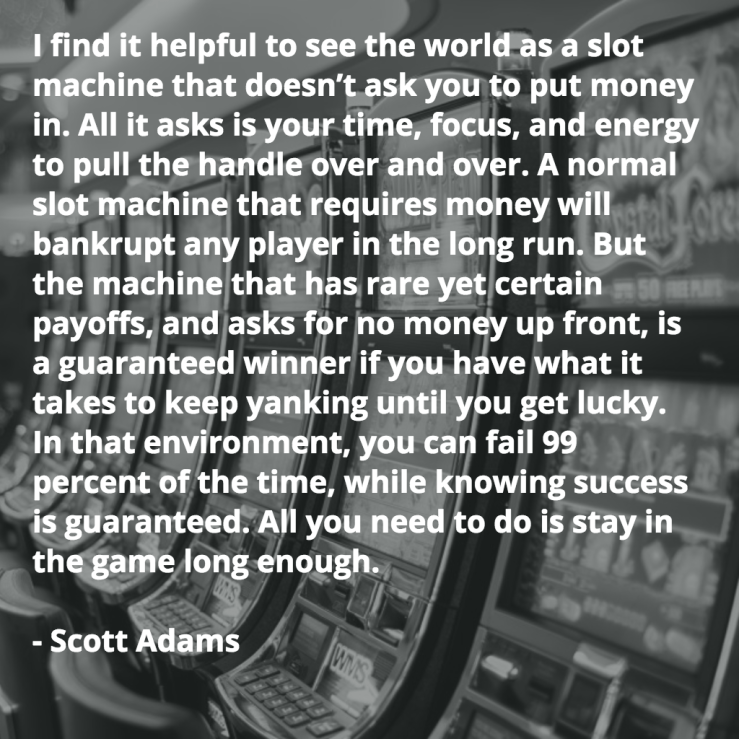


 A big point of the book is for people to understand that systems have ripple effects. If one person puts out sandbags in a flood, that stops their flooding problem but it doesn’t stop the water. The next person needs put out sandbags and so on, but eventually the water will flow somewhere.
  The Waiter's Pad
