What to think while waiting

David Henderson recalls his first class with Armen Alchian in 1972, who started class noting that if someone understands the incentives they can understand a lot of ‘mysterious’ behavior.

“On the first day of class he said when we went to the bookstore we’d be in a long line and we’d be angry about that. But we shouldn’t be. We should be happy because it means economics works. The people working are on a standard wage and they don’t have a strong incentive. There’s no ownership, no one gets a big benefit if they do better.” – David Henderson, September 2021

We should be happy to wait? Kinda.

One theme around here is the value of curiosity. Mostly that means to wonder how and why and when things happen – or even when they don’t happen. And incentives are ripe for thought.

We’ve looked at prediction incentives, Marine incentives, and the incentives of salting roads. There’s music incentives, be careful what you count. And football recruit incentives, more careful counting.

Incentives come up so much because one way to be curious is to ask: why does that happen? and part-of-the-reason that happens are the incentives.

This kind of curiosity takes work. Like exercise takes calories, crypto (or cars) take gas, or relationships take conversations – curiosity takes work. To be curious is to think, wonder, and ask questions. To be curious is to move past the simple story and see what else is there. Sometimes there’s not more, sometimes there’s incentives, and sometimes there’s something unexpected.

One of the highlights of my interneting has been writing a post about curiousity for Ribbon Farm.
Cold War incentives

“We’re mostly pretty right,” I told my daughters (13/11). The gist was that our diet is pretty good, but some of what we do will be wrong, we just don’t know what. Even though we shifted to eat slightly less meat, thinking like Bayesians even in the kitchen, I’m 100% sure we are not 100% right.

Related is the idea of incentives. We think our current incentives are aligned, and they may be, but they too need occasional updates. Hopefully exposure and examples tune us in to them a little more.

To set the scene, it’s 1983. The Berlin wall has been up for two decades. Ronald Reagan has been president for three years and he’s rattling the Soviet Union. The U.S. is conducting war games, which is exactly the pretense the Soviets planned to use to disguise their first strike. The Soviets have an information problem. They need to orient themselves.

“They (the Soviet Union) started an operation to look out for indicators that the Americans were preparing to launch a nuclear attack. Are the military mobilizing? Were blood banks being stored up in case the casualty rate increased? Eventually it became completely absurd. Agents were told to count the lights on in the Pentagon in Washington or the Ministry of Defense in London. If there were more than a certain number, this would clearly conclude they were plotting away at night. And, if they came up with ideas they would get promotions. The agents in the field didn’t get promotions for saying nothing. You only got promotion for finding evidence that, yes, they are planning something.” – Taylor Downing, September 2021

This is the opposite of the don’t just do something principle (part of the Favorite Ideas Daily Email), which notes that sometimes the best action is not to act. But it’s hard to reward inaction that leads to a good outcome. That’s just not how we see the world.


The seeds of the ’80s were laid in the post-war alignments. A few favorite bits: Dan Carlin has a great podcast episode about the Cuban Missile Crisis (1962). Konrad Schumann jumps over (1961) the barbed wire wall, and it’s fascinating to think that this thing basically showed up overnight. There is also a documentary on YouTube about building a tunnel, maybe the first reality TV?, under the wall to save some college friends.

Roulette with Bobby

A friend wants to pay off his mortgage in the next three years. He’s got two young kids. He’s younger than me. Meanwhile, I refinanced into a new thirty year mortgage. If he pays off his home debt it will be quite an accomplishment.

Bobby’s plan is different from mine. But I don’t know that he’s wrong. Personal finance is more like cooking than baking. We looked at, for instance, a 15 or 30 year mortgage?

In a way Bobby and I are at the roulette wheel. He’s bet on black. I’ve bet on red. One of us will be right, but we can’t know ahead of time. Most of personal finance is reducing the range of choices to just good options. It feels like we’ve both done that.

The analogy of roulette also works because rather than red or black, the ball could land on green. Despite planning, we both could be wrong.

It’s also important that we have designed our systems. Sometimes we think knowledge leads to action, but around here we know that design rules the day. Bobby has a plan to pay off his mortgage early – that plan is the design. Our family has automatics contributions – that’s our design.

“If someone says financial literacy at a party I basically give them a thirty minute lecture. The idea is that in a perfect world, if someone is taught about FICO and the impact on their life, they would take actions to improve their FICO score. This is just not what researchers have found – and it’s really robust…the punchline is that environment matters.” – Kristen Berman, All the Hacks, October 2021

Roulette, as an investment, is not in the range-of-good-choices. But as an analogy it fits nice. Prepare and pick from prime possibilities but remember the ball might not bounce any of those way.


There’s a lot about design here. It’s one of my 62 favorite ideas.

Dan Carlin’s creative thinking tool

One way to change decision making is to think different. One terrific tweak is to design different processes. “Start with the base rate” would be one way. Another is framing.

“I had a military history professor and one of the greatest things he taught, and I use this tool all the time, take out the most obvious easy solution from your consideration, take it out of the factoring in your thinking and then try to solve the problem.” – Dan Carlin, Common Sense, September 2021

Carlin goes on to say that part-of-the-reason there was no total war during the Cold War was because of nuclear war. Traditional war, Carlin notes, was “off the table”, and we are a creative bunch so a new solution was found.

Sometimes though, the culture of a place is so strong that framing traditional ideas in new ways is not enough. Mike Lombardi told Annie Duke that more organizations should have a “change department”, where an individual’s sole goal is to change your mind.

Sometimes the culture of a place is so so strong that framing or formatting are not enough. A new culture must be formed. This, wrote Clayton Chirstensen, is the innovator’s solution. Christensen’s disruption occurs when an industry leader continues to serve their best customers but the rules of the game change.

These are design choice. “Starting with the base rate” may not lead to adjusted conclusions but it will be closer to them than not. And we are all designers.


Design is one of the 62 favorite ideas. Read them all in a daily email drip on for five bucks. Find it on Amazon too.

Peloton Strategy

Peloton is great. Do I own a bike? No. Treadmill? Nope. Do I even use the app to get pickleball workout coaching? No. Peloton is great as an example of a business strategy. Peloton doesn’t offer discounts and Peloton makes it easy are two quick observations. Let’s add two more.

“At Peloton we are very inspired by behavior that already exists and then making that easier. It’s like all human technology that finds a human need or something already happening and making it easier to do. With stacking there were already people doing it, even calling it stacking, so when we launched the feature not only did it make the lives easier for the people doing it, but the people who hadn’t thought about it said, ‘might as well tack on a ten minute stretch’.” – David Packles, The Science of Change October 2021

A Peloton Stack is a workout playlist: run then add a stretch, core then add some yoga. Like Instagram, Peloton noticed their users doing something else to get a JTBD done. And one way to serve customers better is to make the hacks part of the product.

A second portion of Peloton’s success is their CAC attack. “Once you have a Peloton,” Packles said, “you are using it for years, it’s the most engaged fitness product of all time.” Part of a good customer acquisitions strategy is “going for the no”. It’s good to rule out customers so not to allocate extra resources to unproductive efforts.

Peloton has high engagement because they get ‘no’. Engagement, and lack of churn and cheap customers and all-the-other-interconnected-parts is an interconnected solution. Peloton uses the fresh start, social influence, and more.

Nice work Packles and all of Peloton. It’s a treat to observe businesses that offer a slew of of tactics that form a thoughtful strategy.


Thanks for reading.

Filters for thought

The best way to make decisions is to collect information most related to the system at hand. Touch a hot stove. Drop a pen. Kiss a lover. Each of these offers a direct action-feedback-action loop.

But these aren’t the interesting parts of life. The interesting parts of life are multiple people functioning at different times towards a goal that’s only shared in the sense of each person’s understanding.

Life is messy.

But we know that. Like driving across Interstate 80 with the prospect of a blizzard, we can plan accordingly. In talking with Cleveland Browns General Manager Andrew Berry, Annie Duke noted how difficult the decisions are within a team. Teams are messy! There are sunk costs, biases, entrenched interests as well as the alignment (or not) of stakeholders . But Berry knows this.

“There’s a couple things we try to do. Number one is to do the hardcore analysis removed from the emotion of the season, the player, the decision maker….

“The second part is getting a number of independent perspectives and letting them state their case. It’s easy as the decision maker to be in your own cocoon and only consider your viewpoint on a player…And the last thing we try to do is have a third-party perspective. There are a couple of things we use that aren’t in our building. As much as you try to weed out every type of bias with your internal evaluation methods, it’s to some degree impossible.” – Andrew Berry, The Alliance for Decision Making podcast, July 2021

That’s a lot of specific, helpful, in-practice advice but it is really just one thing: distance.

Distance is the idea behind base rates. It’s switching to “the outside view“. Distance is the idea behind sleeping on it. If the input to good decision making is the best information, then distance changes the information.

Berry recognizes, first, that he alone won’t make the best choice. Berry recognizes that his team will make better choices with training. Berry recognizes that no matter how much work he puts into himself and his team that they’ll still use some suboptimal information, so they get outside information too.

A friend went to a wedding and proudly said he wasn’t hungover because he alternated drinks of beer and water. That’s good design. Berry probably has good design too, don’t evaluate players within one week of a season. Maybe they do it like the Olympics, and throw out the best and worst scores. Whatever the Cleveland Browns system is, they definitely have a system for making good decisions.


Life is messy is one of Brent Beshore’s expressions and it’s a wonderful “default”. If our thinking is framed by the starting state then to start with the idea that life is messy makes a lot of other parts less so.

The ball bet

What are the odds of more than twelve named Atlantic hurricanes in 2021? That Bitcoin will top 75K in 2021? More than 2M travelers through TSA in a single day?

These, and more, were part of the 2021 predictions. That post built on the ideas of Superforecasting, which offers ideas towards better predictions. Julia Galef adds another.

Here’s one of the prompts: Will I lose power at my home in Central Florida for more than three days? I figure these odds were about 10%, and would wager that, no, we will not lose power for more than three days.

Imagine another prompt. In this bag of twenty balls there is one red and nineteen black, pick the red one and win. Okay, simple enough. There’s a five percent chance to win the red. And here’s Galef’s guise, you can only play one game.

Do I feel more confident about the hurricanes making landfall or the finding of the red ball? The hypothetical ball bag bet can slide up or down: 5%, 10%, 30%, etc.

“You just ask yourself, do I feel more optimistic about taking that bet or [the other]…You can play with the ratio of balls to kind of narrow down the number you put on your confidence in the original question.” – Julia Galef, BBC’s More or Less, August 2021

With my kids we use coin flipping. One day I had an appointment and told them there was a 5% chance they would have to go to after care at the school. “That’s like flipping a coin and landing on heads four times in a row” I told them.

Probabilistic thinking is difficult but it can be helping in making good decisions. Poker’s appeal highlights this idea too.


The TSA’s nadir was 87,000 travelers the week of April 13 2020, down 95% from the same week in 2019. In 2021 that number was more than one million. The week of June 11, 2021 there were more than two million travelers. I guessed there was a seventy-five percent chance that would happen.

Dice tails

Maxim two, from Richard Zeckhauser, is “when you are having trouble getting your thinking straight, go to a simple case.” This maxim came to mind listening to Michael Mauboussin and the Acquired duo discuss business valuation and the difference between tangible and intangible assets.

“(Intangible assets like brand, code, etc.) also makes you vulnerable. If your product or service does not work there’s not much there left. If you think of pushing out the tails relative to traditional business, that’s the way I think about it. There are more extreme good things and more extreme bad things than we’ve witnessed in the past.” – Michael Mauboussin, Acquired, October 2021

We’ve thought about this idea before, in the complex world and in the increasing returns economy. But it’s a big idea and like the lead in a story, we need to fill out this character a bit more.

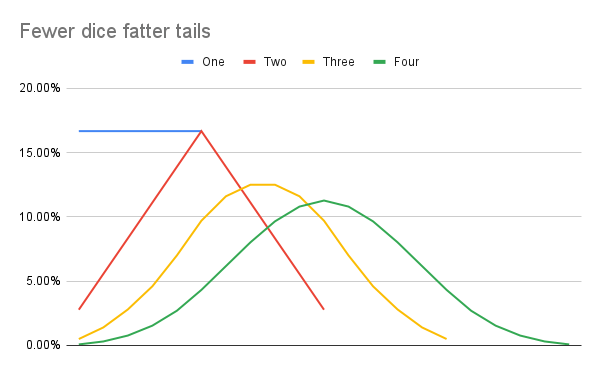
Here’s the distribution of results of one, two, three, and four dice rolls. For one, the results are equally likely. For two, as anyone who has played Catan knows, seven comes up the most.

one two three four dice distributions

Though it’s a basic Google chart, it is simple enough for Zeckhauser and satisfactory for Mauboussin. For a die, the chance of rolling the highest score is ~16%. In the case of two the chance is ~3%, for three it’s ~0.5% and for four it’s ~0.1%.

Different parts of life are more or less similar to different amounts of dice. Businesses with lots of intangible value are closer to the end of fewer dice, because those kinds of distributions have fatter tails. Business with more tangible capital are more like rolling many dice.

Now, dice distributions offer no mechanistic or explanatory approach about what kind of system a case may be. There’s nothing about “brand building” that makes it more like rolling two dice relative to something like pool construction. But the metaphoric fit is just fine.


Thanks to Michael Mauboussin for this post and all the others. He was one of the early podcast guests who was going around explaining things that seemed like really big ideas in a really basic way. He was so good at it I thought, hey, I should write some of this stuff down. Well, I’m still writing.

Slack, in the black

One way to think about how life works is that it’s a series of events in pieces of time. A business’s cash flow is one example. An operating business will succeed if their expenses are less than their incomes. If incomes were stashed away, then a business can weather moments of swelling outflows.

We looked at this with flooding too. Locales flood when the net additions outweigh the net subtractions. Florida’s coastal flood warnings occur during hurricanes, when an “exogenous” event shocks the local system.

Company culture can operate this way too:

“The key to making hard decisions at the top is being ‘in the black’ with your emotional bank account with the culture. As a leader you have to build that bank account and make deposits every day to build trust and credibility with the people who work there, knowing, there are days where you make a giant withdrawal because you’re going to screw up. And you will! It’s just too complicated, but you know that when you have that big withdrawal you’ll still be in the black.” – Doug Conant, The Knowledge Project, August 2021

Conant was head of Campbell’s Soup and at Nabisco during the KKR takeover. In his conversation he’s candid about how to achieve this emotional slack. This isn’t something everyone does all the time, or gets a certification for, but rather it is something that happens in bits in pieces every day.

Conant also frames this idea nicely. Much like a travel budget in time not dollars, Conant compares the cultural balance of an organization to the financial budget. These analogies help our understanding.

Slack is most important in systems with dynamic change. Driving is a physical system where slack is important: how much space is between you and the car ahead of you?Financial slack is having an emergency fund. Levies, barriers, and pumps are slack for flooding. Meditation, peace, or religion are all personal slack for stress.

Marc Andreessen had an interesting take on this idea of events in time. Water cooler conversations, he said, have never really worked well for him. Off-site events though, have been good. It’s a similar amount of interactions: five minutes, five days a week, fifty weeks a year, at the water cooler. That’s twenty-one hours, about one one off-site.

Slack is a way to change the balance of event in time.


Hurricanes are not really exogenous shocks. I mean, we have days where business don’t charge sales tax to encourage people to buy hurricanes supplies. But thinking about systems at different levels: the home, the community, the region, the nation, the world, can change the way we see things.

What’s this place optimized for?

Everything around us, notes Jason Crawford, is a solution. It may be a ‘local maxima’ rather than a ‘global maxima’, but everything around us is the best idea we’ve had yet (given the culture and incentives).

And these solutions all influence our decision. The punchline to behavioral sciences, says Kristen Berman is environment, environment, environment. The question to ask then is: A solution for who?

“If you go to a mall how could you not spend money? People have thought deeply about how to get you to spend money, they’ve thought deeply about getting you to buy something. It’s a hard fight, and it’s getting harder. Amazon Prime is the gold standard for this. They’ve figured out something about human behavior and it’s going to be hard to fight that.” – Kristen Berman, October 2021

Cinnabon is a tasty brick and mortar example of how place matters. The stores are in places of captured traffic and infrequent visits. Da Buns, said Kat Cole, are treats. So the frequency of customers affects the type of product.

Another instance is that oh-you-know-it smell. That wonderful waft was an accident. The first location lacked enough room for the oven to go in the back – per best practice prescription – so it was jammed in the front. Learning their lessons, the second location prioritized moving the oven out of the way. Whoops. Luckily for us all, they fixed that.

I’m not as strongly behavioral as Berman (though I did update) but her idea of wise designs hits home. In 2014 our family went on a Disney Cruise. We had a blast. But one evening my wife scheduled dinner with a Disney Vacation Club (their timeshare component) representative. It was there, in that office, sweating bullets that I realized something about myself. I’m bad at ‘No.’

This guy was good. Each objection he countered. Each escape he blocked. Each obstacle he climbed. Somehow, like Aladdin, we escaped.

Now I know about ‘No’ and good design and Berman’s advice.