Apples to apples in Iceland

The basic base rate question is: what should I expect in situations like this? Most often we have looked at base rates through the lens of projects. We have an optimistic tendency to think, “yeah but…”. Sometimes it is! Sometimes it’s not.
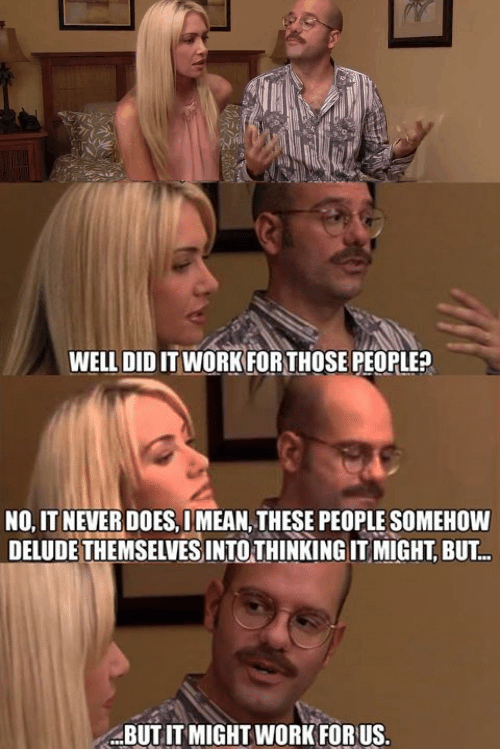
but it might work for us

The general advice for using base rates has been to start with them, rather than our impressions, and then adapt from there.

Another way to think about base rates is as sampling. It’s important to get the “situations like this” part right, right? This is tricky, and this came up during the summer of 2021 as more and more covid vaccinated people became infected with the covid virus. At one point 67% of Iceland’s cases were among the vaccinated.

“When you look at Iceland and graph out (cases) by who is vaccinated, who is not, and where the cases are, you can see that there are more cases in the vaccinated group than the unvaccinated group.” – Dr. Kat, NPR Planet Money, August 2021

That sounds like the vaccine doesn’t work, or doesn’t work as well, or never-worked?! Maybe, but maybe our conclusions are muddied by an initial assumption that’s wrong.

Rather than jump right to Iceland, let’s pull a Zeckhauser and simplify everything. Imagine in Indiana there is a group of 100 people, half are vaccinated and half are not. In the vaccinated group there are five infections and in the unvaccinated group there are five infections. Putting aside “long-infection”, hospitalization, and death, it-looks-like, in-this-case, that the vaccine is meh.

Okay, now in Nevada there is another group of 100 people. This time there are 90 which are vaccinated and 10 are not. In the vaccinated group there are five infections and in the unvaccinated group there are five infections. Putting aside the same other-factors, in this case the vaccine is doing a lot of work! This was the case in Iceland too. Six of every thousand vaccinated people caught covid while fifteen of every thousand unvaccinated people caught covid. And all of the other-factors were much worse for the unvaccinated group. Vaccination reduced someone’s risk by more than half.

This idea is known as the “base rate fallacy” but really it’s comparing apples to apples which will make the idea stick better anyway(another bit of Zeckhauser advice is to keep explanations simple). BRF is good for talking with economists and behavioral scientists but for implementing this idea it’s an apple-to-apples question a day that will keep the bad decisions at bay.
Travel budgets

Actions are the children of mindset and environment.

When running his document storage company, AJ Wasserstein created a travel budget. Budgets are good. Budgets are a design tool, and we are all designers.

Wasserstein’s budget wasn’t denominated in dollars, it was in days away from home

“One thing I did while working at Archives One was give myself a travel budget. I gave myself permission to travel a certain number of days a month. It wasn’t a financial budget, rather a nights-away-from-home budget. If I started to exceed that consistently, my role at the company needed to be cleaved and I had to hire someone to do part of what I was doing.” – AJ Wasserstein, Circle of Competence, June 2021

Wasserstein asked a different question. Rather than ask what was financially costly he asked what was socially costly and optimized for that. A lot of times we assume that the important is easily measured. Dollars? Yes. But other things too.

Peloton ease

Economist Tyler Cowen cautions against the optimism around self-driving cars because when costs fall, consumption rises. If the costs of driving fall, there could be a lot more cars on the (now congested) road. Cost isn’t just about price, but also understandability, beliefs, and time.

Another way to think-like-an-economist is to consider ease. Every time a how will I… question gets answered things get easier and Peloton answers a lot of questions.

Wooden barrel

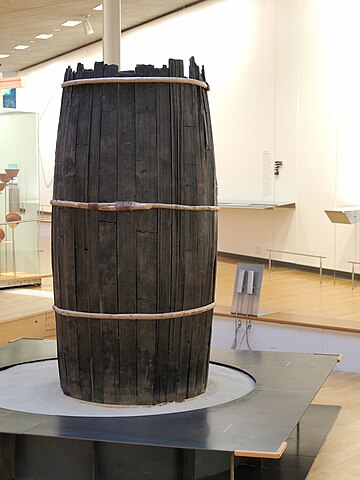
A wooden barrel like this can only hold water up to the shortest piece. Each answered how will I… extends the length of that board. Extend the set and action is taken. Here’s Christian Hunt on his background to buying a Peloton:

“My partner brought it up…we had been bombarded by advertisements…I knew a few people who had them and it just got to the point where we thought, ‘Let’s just give this a go, we can return it if we don’t like it.’ And the people I spoke to about it were so positively engaged. Worse case scenario: this thing goes back.” – @ChristianHunt, Human Risk

Just in that comment Hunt hints at the many boards that lead to a Peloton purchase. There’s price (finance it!), usage (we’ve got classes), social (follow your friends), competition (leaderboards), and even logistics!

When surveyed why they bought a Peloton, 78% of people said convenience. Consciously that means convenient to use but really it is everything.


Wood Barrel, via Wikipedia.

From field to city to car to circuit

This is a podcast episode covering the consumer journey from field to city to car to circuit.

The consumer journey has been one where a business shares information to a consumer depending where they are. That started at the farm with the creation of the Sears catalog, a moved to the city with the creation of stores, then moved to the car with the creation of malls and large big box centers like Walmart, and finally our story is at the point where it is on the Internet with online brand Zappos, Amazon, Warby Parker.

The selling, at least to the American consumer, is remarkably consistent. There has to be a way to talk directly to consumers whether in a store on the pages of a catalog or via an Instagram account. There has to be a way to get the product to the consumer, whether that is the new railway system, the rural mail delivery, or two day shipping.

This episode was a little less organized than normal and recorded outside. Thank you for your patience.

The podcast is available as Mike’s Notes: Apple, ListenNotes, or Overcast.

Curated Creativity

Broadly there are 3 ways to spend a day online.
– trends, the algorithm or human generated headlines
– feeds, the self selected sources
– search, the internet queries of Wikipedia articles, travel plans, and what-is-my-kid’s-teacher’s-email

Articulating the ways helps distinguish when we are, or aren’t in a helpful place. On days when it’s time to work it isn’t helpful to spend too long in the trends. Naming also helps us establish healthy habits. Jason Zweig uses the fire hoses and tea cups system.

The 3 ways aren’t good or bad. They are more helpful or less helpful depending on the work to be done. Here’s some help for the feed type of work, two curated podcast feeds.

Economics. Tyler Cowen is a wonderful thinker we have looked at many times: how to eat well, how to argue well (with yourself!), and how to consider incentives. Cowen is a podcast host and frequent guest but more importantly, he shares many potential podcast people on his blog Marginal Revolution.

Periodically I cull through the blog for the MR Mentions podcast feed. These are guests or ideas mentioned by Cowen. It’s not a comprehensive list and it runs through my own filter, but it is a way to think a bit more like an economist.

Behavioral Science. Rory Sutherland is a wonderful thinker too. We’ve probably looked at his ideas even more: the room or Zoom, marathon lottos, and ambiguity aversion are just some places his ideas percolate. Sutherland has hosted Nudgestock, a B.S. conference since 2014 (the presentations are on YouTube!), a great index of thinkers.

Periodically I cull through a Twitter list of Nudgestock guests to find podcast episodes for the Behavioral Listenings podcast feed.

The pitch. These feeds are free and both contain potentially valuable ideas. The main cost is the time to listen, however with the advantages of 1.5x speed, wireless headphones, asynchronous listening, and portability those costs are reduced. Plus there’s no psychological baggage (sunk costs) to make you stick around. This is my list, not yours, so passing on an episodes is a reflection of my (poor) choices.

Happy listening and cheers to the long-tail of content. Before the fire hose it felt good to “stay abreast”. In 2021 it’s about timing: what do I need to know and when. A good feed is one internet tool.

Football ’21 favorites or field?

“Between the Chiefs, Bucs, Packers and Bills there’s a fifty percent chance of one of those four teams winning the Super Bowl. In other words, you can have those four teams or the other twenty-eight in the league.” – Cade Massey, Wharton Moneyball, August 2021

Take the other twenty-eight! This idea holds in both sports and investing.

One potential bit of mental muck is what we can call Visibility. It is easy to imagine a specific thing happening rather than a range of things happening. Visibility is part-of-the-reason counterfactuals and postmortems are difficult to conduct. That three of the four quarterbacks have in fact won a Super Bowl makes this effect more so. I can ‘see’ one of these quarterbacks winning the big one, but that doesn’t provide helpful information.

Not so fast though.

What is ‘the field’? As Tim Harford wrote, it is as often the words as the numbers which cause confusion (life expectancy for instance). In the case of the NFL, it’s the twenty-eight other teams that might win the Super Bowl.

But is that right? Can every other team win the Super Bowl? While on “any given Sunday” any team might win, stringing together a group of wins to be champion is far less likely.

The central point to Zeckhauser’s Maxims is that reframing a situation may cause our conclusions to change. We used this framework to ask: Was the Ohio Vaccine Lotta a Good Idea? What if we reframe the question around Super Bowl favorites then?

Roughly speaking there are three groups: the Favorites (4 teams), the Chasers (X), and the No Chancers (Y). Now how many Chasers and No Chancers there are is questionable, but the framing changes our thinking. If this is the structure then the relevant idea isn’t the field but a subset of the field: the Chasers. If there are 4 Favorites, 4 Chasers, and 24 No Chancers then the choice changes. Take the favorites. What if there are 4 Favorites, 8 Chasers, and 20 No Chancers? The top twelve preseason favorites have won 85% of the previous 20 Super Bowls.

There’s no definite answer to this Favorites, Chasers, and No Chancers structure but the framing does change how we think about it.

Another mental model is the same mindset we used “Tracking Tom“. The idea there was that there’s more downward variance than upward variance. The same idea holds for the Bucs, Chiefs, Bills, and Packers: those teams are more likely to underachieve. Put another way, it’s more likely that something goes wrong (someone’s quarterback underperforms) than right. The Chiefs and Bills, for instance, both notably outperformed their 2020 Pythagorean figures.
“Uncertainty is generally underestimated,” said Adi Wyner, “and that means that the field collectively have a little bit more probability than you might assign to four teams.” The data agrees. Take the field.

Subtraction’s Value

One way to think of a decision is to think of the ‘right’ answer. This has limits. ‘Right’ answers exist within conditional assumptions, and mostly in the mathematics and moral fields. Should I be honest with my partner? has a ‘right’ answer. What’s the optimal distance my 2017 Subaru Outback should follow this other vehicle given these LIDAR, radar, sonar, sonic readings? has a ‘right’ answer. Note, I have no idea how adaptive cruise control works but it is the best automotive technology of the last decade.

‘Right’ answers are limited because of all the conditionals. Self-driving cars are one example. It’s a math heavy domain, the cost and availability of technology (read: number collecting and computing) has fallen, and we’ve never had as many smart-focused-people or as many save-our-collective-butt-companies, and yet it feels slow. Why is self-driving so slow? The conditions! Snow, rain, city, country, semis, motorcycles, bright lights, night lights, desserts, animals, forests, and not least of all: other drivers.

To get the ‘right’ answer to a question like: should the car warn the driver and begin automatic braking? the system needs a pretty tight window of conditions. So if the ‘right’ answer is difficult to come by is there a better option? There might be.

Rory Sutherland’s work comes up a lot here because Rory Sutherland’s work brings up an important idea. Sutherland loves marketing because marketing deals with psychology which is a lot easier to change than the objective thing. Package delivery is an example. Tracking numbers, emails that note your package is on its way, and estimated delivery dates all deliver psychological value. Contrast this with getting a package faster: logistical value, which has a very real cost. It’s not that better package tracking is better than faster package delivery but that it delivers more value than it costs. It’s the same idea of Michael Lewis’ Moneyball: what’s highly (or somewhat) valuable yet costs very little? Sutherland’s tool is psychology. Lewis highlights math. Let’s add another: subtraction.

“It’s an easy problem for a dad to fix, I grabbed a block to add to the shorter column but Ezra had removed a block from the shorter problem. Ezra is normally a horrible subtractor but he plays a lot of Legos and this was an instance where he stumbled upon subtraction.” – Leidy Klotz

Leidy knew how to fix his son’s Lego bridge. Add a block here —>. But Ezra had an idea too. Take a block away here —>.

Whether a situation’s ‘right’ answer is to add or remove is irrelevant – for now. What’s a better car: a Toyota or a Lexus? The question is which costs more?
It’s easy to add. We have a tendency to add. But adding probably costs more and when it’s a costlier implementation but only a marginally better outcome then the better choice might be to subtract.

March 2, 2022 update:

Sunk cost straws

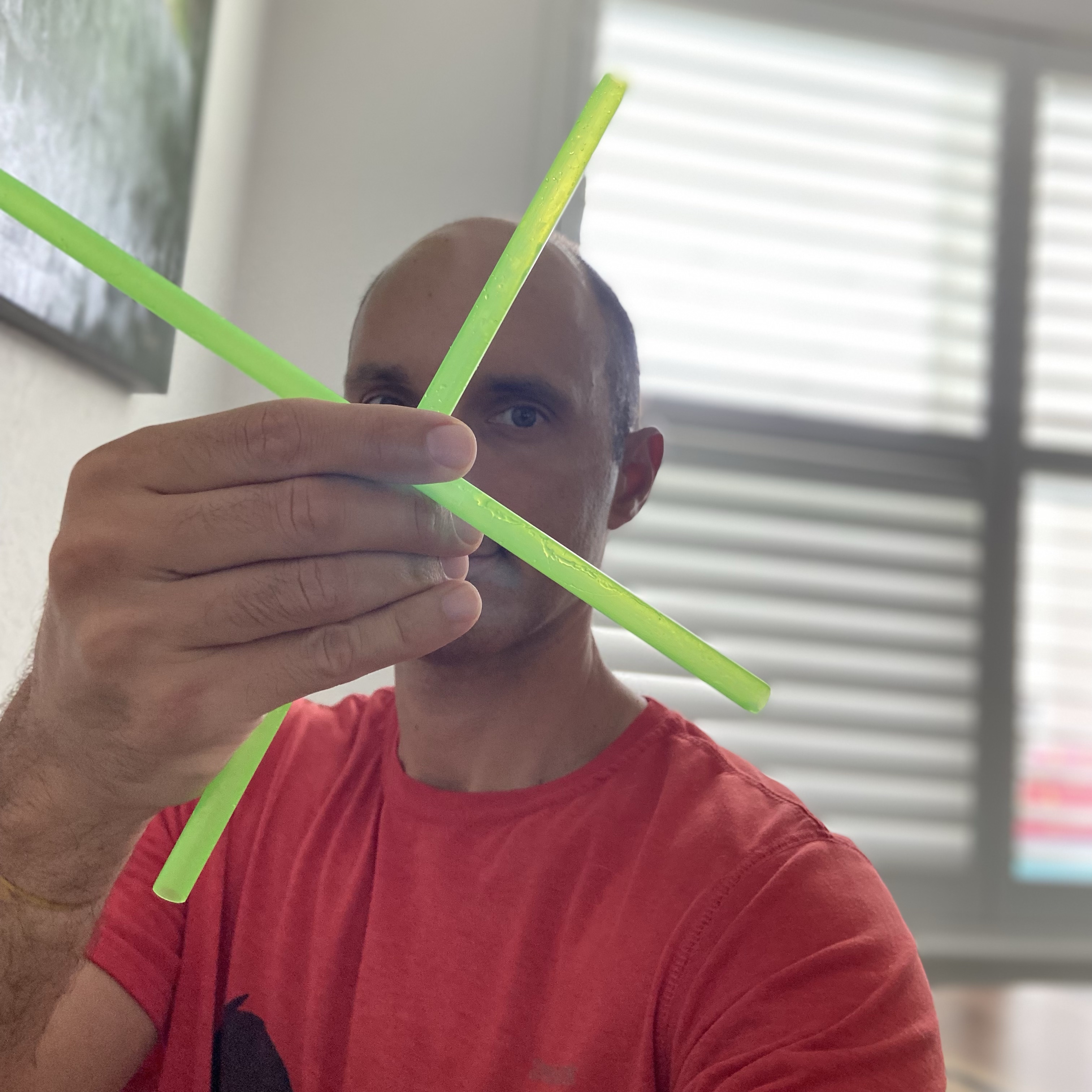
me and my straws

See these green things? They are reusable straws, purchased from Wawa.

A lot of times people say “sunk costs” like it’s a bad thing. Part of Poker’s Appeal is thinking conditionally, and one way to do that is to avoid sunk costs. Here’s Maria Konnikova talking with Annie Duke:

“The chips don’t remember they used to be in a stack this tall and there used to be more of them. All they know is they are chips. It’s hard mentally, but it’s really important to forget what happened and how much you had because bias is going to creep in: I need to make it back, I need to be more risk averse because I can’t lose the rest.” – Maria Konnikova, Alliance for Decision Education, July 2021

Bill Gates says it is “very important” to bring in outsiders in part to avoid sunk costs.

When we say (with hindsight!) ‘sunk costs yada yada’ what we mean is: ‘This person used unhelpful information to make their decision.’ Sometimes the mechanism with sunk costs is ego, admitting we were wrong is hard.

So I won’t admit it. I was right to buy the straws!

My reusable straws are not going to save the world. They are not going to make a marginal difference. But we will use them, and we will use them because of sunk costs. I paid for these darn things so I may as well use ’em. Here, the mental barnacle that usually afflicts decision making navigation can steer me in the pro-social direction. Like a person who commits to working out if only to use their gym membership I dutifully wash the straws after each milkshake, Frappuccino, and coke my kids consume.

How we even ended up with the straws is a testament to the Wawa ordering system. After ordering drinks, the whole screen filled with a picture and prompt offering the straws and I said yes. Only forty-nine cents! While my use is negligible, Wawa’s is not. Our family of four’s lifetime will probably use fewer straws cumulatively than one-week of lunch orders at a busy Wawa. And there’s the trick. It doesn’t make sense individually but it does collectively. It’s a case of Large N small p being used to change the world.

One of the best changes in my life has been to accept things as they are, rather than upset at the way they should be. Things should not be a way, things just are. Human psychology is like that. It’s not that humans have biases but that we have tendencies in how we understand the world. We have sunk costs because that approach works, conditionally.

To be the most right, and affect the most change, we must see the world as it is. That means noticing sunk costs as a tool, and using it as needed.


Eric Bradlow of Wharton talks a lot about Large N small p. He also wonders about the “effect size” and with-regard-to straws I have no idea.

Free Meals

At the start of Dan Levy’s book Maxims for Thinking Analytically, a book about Richard Zeckhauser’s tools for thought, is this riddle: “Mary and Jim want to paint a room together. If Mary painted alone it would take her 2 hours, and if Jim painted alone it would take him 3 hours. How long would it take to paint the room if they paint together?”

It’s not 2.5 hours.

Zeckhauser’s first maxim is: “When you are having trouble getting your thinking straight, go to an extreme case”. We used this maxim to ask: was the Ohio vaccine lotto a good idea? And it probably was.

Danny Meyer uses a version of this maxim too. One of the most important factors for a restaurant’s success is the location. (Overall it’s a hard business). Meyer wants to avoid errors of commission. Even if a restaurant proves successful it is “stuck with” the location. So Danny explores many locations to find something that works and ask an extreme question:

“Sometimes a space says, don’t plant anything here, this place should not be a restaurant. The first question I ask myself when I look at a restaurant space is: would I want this even if it were free?” Danny Meyer, July 2021, The Knowledge Project

Another way to consider this kind of framing is the expression you couldn’t pay me to. One advantage to living in the south, where football rules the roost, is the access to football. If you like it that is. One friend uses you couldn’t pay me to to express her feeling about SEC football games, the same games where tickets can be hundreds of dollars.

Levy’s riddle is easy once we slow our thinking. Thinking fast we average the work, and get 2.5 hours. Thinking slow(er), like Zeckhauser, and we notice that Mary alone would take two hours. That’s the extreme.

Competing with counterfactuals

Peter Attia has this idea called ‘healthspan’. Rather than measure what is easy (years), Attia suggests we aim for something more difficult to measure, but more meaningful: health.

The idea, IIRC from Attia is that it’s the quality of years that matter. Okay, sure, but what does that mean? It’s to ask: what do I want to be able to do when I’m 80? an work backwards from there. If I want to be able to pick up my grandkids then, what do I need to be able to do now?

Working backward is one nice way to frame this idea. Another is to think about competition. Imagine the Healthspan Games.

A proxy for this was Sport Climbing in the 2020 Tokyo Olympics. In this event contestants competed in speed, bouldering, and lead courses. Each contestant was ranked by finish and ranks were multiplied for a final score. If someone finished first, fourth, and seventh, their final score was 28.

A competitor must consider how they could compete. Of course it would be very good to be very good at each section, but a slip in the head end is much more costly than a slip at the tail due to the multiplicative nature of the scoring. An initial score of 2x5x8=80 improves by fixing the middle score to 2x4x8=64 whereas a weakest leg fix yields 2x5x7=70. This may not be a case to fix weaknesses first.

Sport climbing is a good proxy for the Healthspan Games because they also have three areas of competition: strength, balance, and flexibility. However the competitors are slightly different. Instead of athletes from different countries, the competition is different versions of oneself. It’s the you that does yoga against the you that does not. The different versions of you are a counterfactual.

“Counterfactuals are hard because we don’t think about what is on the other side. ‘What if we had done nothing; How many games would we have won?’.”  – Sam Hinkie to Zach Lowe, April 2016

Counterfactuals and competition are one way to reframe the idea of: how to be healthy. It’s easy to think about weight (lost or lifted) or speed while running as the important aspects. But the competition is more varied than these very visible areas.

Are strength, flexibility, and balance the most important parts for a long Healthspan? Probably. Does framing them this way make them easier to think about? Probably too.


We return to the idea of easy to measure vs helpful to measure in the “metric” tag.
IIRC = if I recall correctly