Correlated Decisions

“We use quantitative methods to put together diversified portfolios that don’t blow up over time. We have technical guys who are very sophisticated, one guy was the MIT chess champion. We need these guys to balance our portfolios, but they’re not picking stocks. I pick those guys because they have no idea how to pick stocks and I don’t want to know what they think about picking stocks, that’s for our researchers.”

– Joel Greenblatt, Capital Allocators.

The JTBD of diversity within an organization is uncorrelated decisions. If we’re all thinking the same way, the expression goes, nobody is thinking.

Early in the episode with Ted Seides, Greenblatt cautioned that there’s always more correlation in a portfolio than someone expects. This is consistent with the idea that most financial issues are liquidity issues.

If there are 3 ways to spend your day then we should be wary about the feed, the search, and the trends. For instance, the September 1 – December 1 BTC search trends. When Coinbase emailed me “Why Bitcoin is in the News.” I thought, this might be a good time to sell.
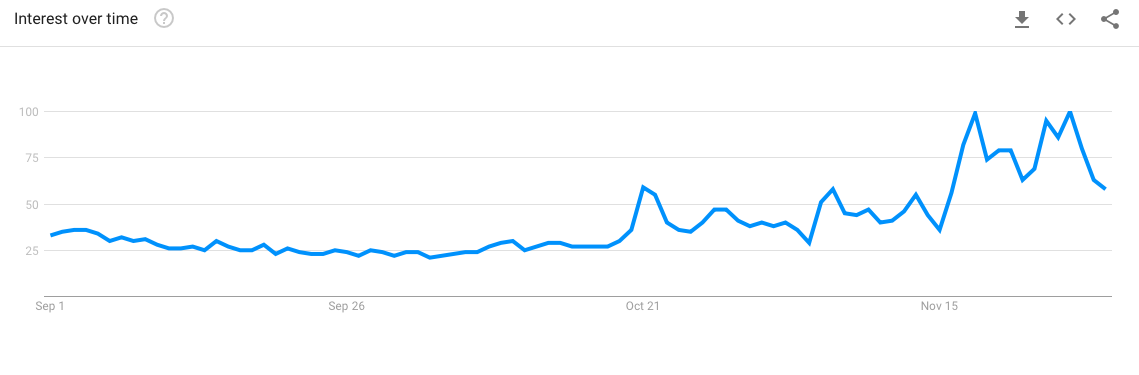
Google Trends for “bitcoin”.

Trends, searches, and feeds aren’t bad, but they are correlated.

The best solution to uncorrelated decision making is to use a bit of decision making advice from Rory Sutherland. When we select one at a time, we choose the average item. When we choose multiple things at a time, we choose a variety.

Rather than consider a best option then, we can consider a basket of options. With finite resources it’s hard (impossible?) not to prioritize but it does lead to new ideas.

It’s neat to hear that Greenblatt’s operation is like a newsroom: editorial and news, research and technical. Division is balance. The worst outcomes aren’t when something goes against us but when everything does.
How we decide

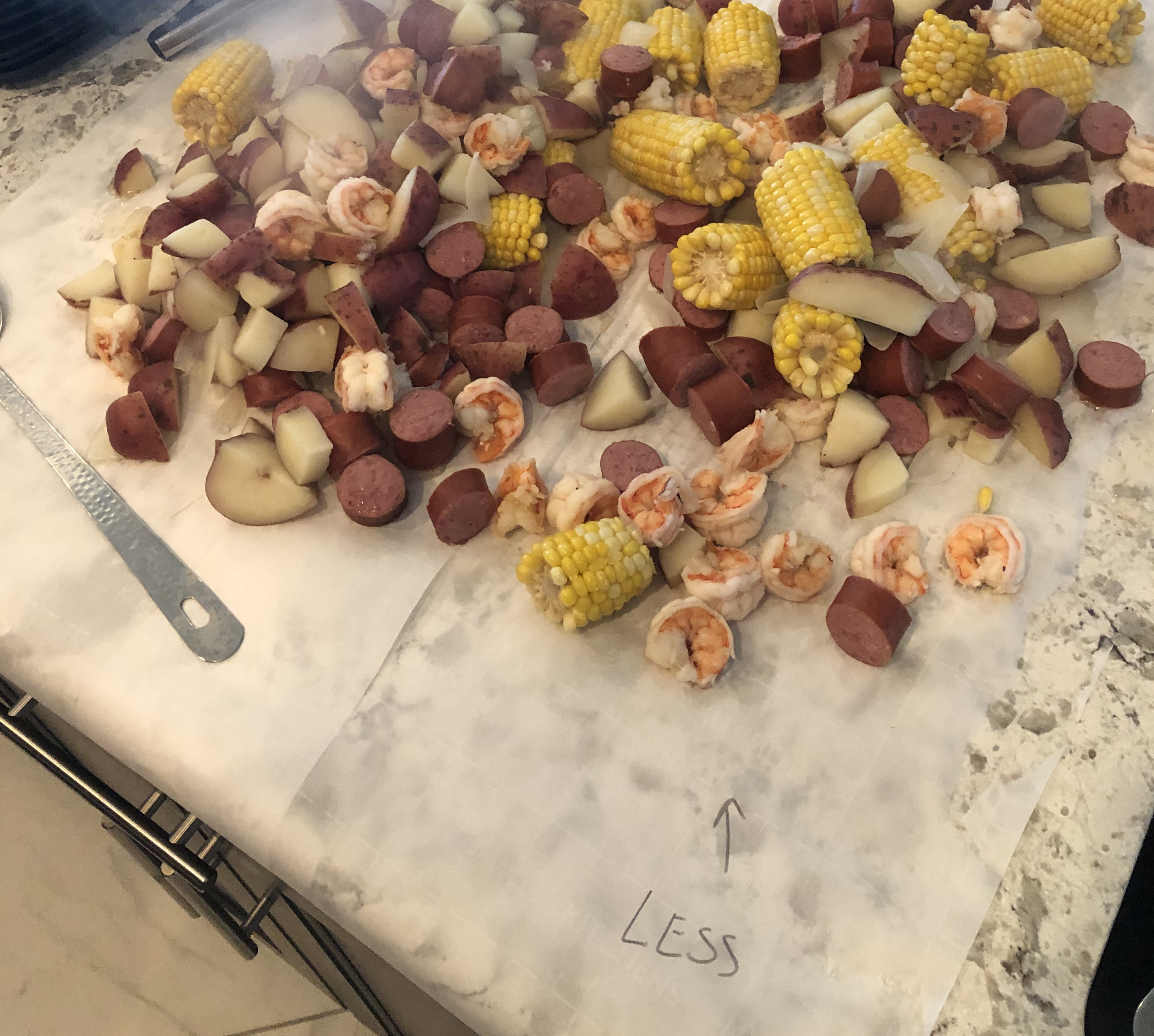
Our first boil, 2019

Moving to Florida in 2018 has been mostly positive. Y’all and ma’am are great and I use them each day. The weather is wonderful. We also make a boil.

A low-country boil (minus the pesky crawfish) is a holiday and weekend staple. Boil water with seasoning; add potatoes, corn, onions, sausage, shrimp, enjoy. The ratio of work to taste is very low. It’s a good deal.

But making it the first time was hard. We had friends over and I didn’t want to be the person who gave everyone food poisoning or served potatoes that tasted like dirt. The whole meal went great, if not a touch spicy, and each subsequent preparation has been slightly easier even for serving a crowd.

There’s a lot of other options we could do as well. We made a lot of chili when we lived in Ohio. We could order out, make sausage stuffed potatoes, or any number of things. But we don’t. We make a boil.

A boil is familiar. It’s easy. The opportunity cost is opaque. Will <other meal> be better? We don’t know. Let’s make a boil.

A lot of decisions are like this. Opportunity costs are hard to quantify.

During the late teens one bit of regular startup advice was that a product had to be 10x better than the existing option. While JTBD offers a slightly different approach, the idea is a good one. People do switch from one thing to another all the time but it’s often because the decision to do so is easy.

Making a boil in Ohio: hard.

Making a boil in Florida: easy.

Organizations then can consider how to dial the friction up or down. To keep serving people, make it easy for them to stay. To serve new people, make it easy for them to switch.

‘Peloton doesn’t offer discounts’

One of the challenges of running a business is seeing a business from the customer’s perspective. Internally your worldview is all website updates and payment processing, employees and benefits, and hiring and HR. Externally the customer wonders: does this do what I want?

Enter jobs-to-be-done.

Job-father Bob Moesta joined Customer Camp to conduct a mock-interview with Amanda about her Peloton purchase. It’s really good. You don’t even need to conduct ‘JOBS’ interviews to get something good from watching. For instance, framing.

Amanda wanted a Peloton. After getting and liking an Oura ring, and hearing her friends talk about Peloton she wanted one. It was better than a treadmill—if she wanted to run she could just run outside. So, Amanda and her husband watched for a Black Friday deal. None came.

A holiday deal? Nope. Is there any discount? No. There’s not really a Peloton discount, and Amanda was hearing about shipping delays (thanks Covid). So Amanda and her husband ordered one, financed with Affirm.

“Finance a stationary bike?!?!?” – Boomer

Well not really, it’s a 0% loan. It’s basically a payment plan. Actually Amanda notes, it’s like a gym membership.

Now here’s the magic trick business model: Peloton pays Affirm a commission for each bike sold and financed. 50M$ in Q3 2020. Peloton doesn’t offer discounts but it does offer 0% financing. And that’s the magic.

This, as regular readers know, is Alchemy. The financial picture is the same for Peloton: they have a retail cost and accept less than that to sell more units. The question is how much less and to who? Having Affirm be the who and the amount be vague creates value. Buyers hold Peloton in higher esteem and it just feels good to finance something at 0%. As one friend told me “it’s free money.”

To the accounting office it’s the same. To the market it’s different.

Second Order Parenting

“Perhaps the most important thing is supporting a kid’s sense of autonomy.” – William Stixrud

Peter Attia wants to be an Olympian. When he’s 100. When Attia first explained the idea, he worked backward. What should someone do now if they want to do something else later? If you want to be able to go to Disney World with your grandkids you better be able to walk eight miles now. Or some such thing.

Working backwards is a nice tool for solving problems. I want to get to n so first I need to get to n-1.

A similar approach is advocated in the book, The Self Driven Child. In that book William Stixrud and Neil Johnson ask parents to consider their future eighteen-year-old. Then, like Attia, work backwards and consider what a child needs to do at twelve so they are successful later.

Stixrud’s and Johnson’s ideas come down to four pieces of advice for parents:

  1. Offer help, not force 
  2. Offer advice, it’s their choice  
  3. Encourage children to make their own decisions
  4. Have kids solve their own problems, as much as possible 

It’s not so much about ice-cream for dinner, but it’s about setting some (wide, but safe) boundaries for children to operate within.

This has been hard because parenting is a bit of a wicked problem. There’s a lot of showy things a parent can do but might not necessarily be that helpful. Once a child is mentally and physically safe, what’s the next clear thing?

In the ERE book, Jacob Fisker shares a reverse fishbone diagram to show ‘net’ effects. The aim is to end up above the horizontal line. Eating a candy is a positive first order effect, it tastes good. But a negative second order effect (low nutrients, high sugar), and maybe even more (bad habits).

Early Retirement Extreme --- A philosophical and practical guide to  financial independence -- Contents

Easy decisions, hard life. Hard decisions, easy life.

There are many things with negative first order effects (difficult conversations, certain exercises, working late/early) but which have positive n+1 effects and so they are worth doing. Personal finance follows this diagram for example. Parenting according to Stixrud and Johnson follows it too. It might not feel easy and it might violate the actions=progress maxim, but it’s difficult non-actions that help kids the most.

One personal instance is schoolwork. We’ve been distance learning and I’ve played a large role from checking work to answering questions. And, sometimes just telling my daughters the answers. Like junk food it’s easy at first but it violates both the fishbone approach and the self-driven child advice.

How much to change, I don’t know. But this isn’t baking. Like over-price or over-rated or over-indexed, the direction for gains is clear: my kids have to learn to live their own lives and it’s my job to support them.

The TiVo Problem

Via Alex Rampell (2015):

“The battle between every startup and incumbent comes down to whether the startup gets distribution before the incumbent gets innovation.”

White Claw succeeded, gaining distribution before Budweiser could imitate/innovate. Hallmark is entangled with this problem as Disney/Hulu carry Lifetime. Barefoot Wine succeeded finding the overlap between price-point, JTBD, and non-wine-snob. Snapchat introduces stories, Facebook copies. Innovation vs. Distribution.

There are a few options given this condition.

1/ Rampell suggests to “be boring”. Or, to be first in the chronology. Customers wanted Comcast before the wanted Tivo.

2/ Innovate where the competition can’t. This is (was?) the SoFi plan: filter better borrowers who default less lowering costs and pass on the some savings.

3/ The system might change, as in the case of medicine where the large firms (Glaxo) mostly license innovation.

This post will be the first thread in a larger exploration of this idea. For instance, Etsy seems to have held off Amazon Homemade and Candy Crush is still crushing it.

Market Mechanism 2

Photo by Tirachard Kumtanom on Pexels.com

This is in addition to the previous post on the market mechanism. Briefly, it’s the idea that competition erodes the value captured by the producer.

Barry Ritholtz asked Morgan Housel about what he wished he knew when he started. Housel responded, “One thing that sticks out is that good investing is not about being good at something but you have to find something that other people are bad at. The fact that you are good at modeling does not necessarily make a difference because a lot of people are good at that.”

This, said Fredrik DeBoer, is part of the myth of college. One way to avoid the squeeze of the market mechanism is to have a rare skill. In Housel’s words, to be good at something other people are bad at. People are compensated by what they know, proxied by a degree, then a graduate degree. More degrees more (proxied) competition.

Success is found, said Hamilton Helmer, in the durable. “If you do something better, the question is, ‘How can this be durable?’ There has to be something that prevents others from taking all of that away from you.” How can you avoid the market mechanism creating a commodity?

It probably will happen too. Rufus Peabody said about gambling: “I used to bet second halves in college and professional football. That used to drive my yearly earnings, it was an ATM machine basically. But the last three years I’ve basically broke even there and may not continue running the models because the inefficiencies that were there are no longer there.”

Profits attract competition, competition drives profits and prices down. The market mechanism is Santa for the consumer and saboteur to the producer.

There’s one way to avoid the market mechanism; attract less competition.

Movies, wine, investing, and sports all offer financial and psychic income. That’s a double dose of the market mechanism once someone sniffs out the potential rewards. A cooler choice might be digging pools.

Numeracy + Psychology

One of the consistent behavioral psychology findings is the framing effect. People judge what is pointed out and consider the number attached to it. Two out of every three dentists approve chewing no-sugar gum. Sure, but do they caveat that with increased flossing? Heck, no one cares. The thinking goes that if it was flossing that was important someone would have mentioned it.

This effect is most often seen in medical communication and Matt Yglesias captures it perfectly here:

But that headline is good. It’s salient – 4 people. It’s got friction. The real surprise is that they didn’t say ‘warn’ rather than ‘said’.

This kind of psycho-logic-magic needs countered with another kind of psycho-logic-magic.

We can assume two things work: (1) that people pay attention to and value what someone points out to them. This is normal, helpful, and completely understandable. It works. Most things that most people say are relevant to our lives. (2) that new news works. Different is interesting. This is also, normally helpful and understandable.

Here’s the pitch. This is the angle, the message. Here’s the psycho-logic-magic for vaccine interventions: opportunity cost.

If you’re pro-vaccine point out all the things that will be back to normal once people get it. Grandparents will visit grandchildren. Sports will resume. Christmas won’t be cancelled. Freedom and fellowship. Dining out and date nights. Cruise ships and college trips. Find whatever people value and point it out. People do not consider the opportunity cost unless it is explicit.

Closing note: if SkininTheGame is the ultimate signal, my wife had her second dose last weekend.

Design Ease

James Clear joined Ted Seides to talk about habits:

“Or you see a plate of cookies on the table and that’s a visual cue for the cookies. The practical strategy is to make the cues for your good habits as obvious as possible. Rather than having cookies on the counter have fruit or nuts or something you want to eat.”

James Clear

Clear has a good framework which boils down to ease. Make the things you want to do easier (access, reward, feedback, etc.) and make the things you don’t want to do more difficult. We faced this one Christmas, relegating the cookies and promoting the fruit.

When the cookies (bottom left) were on the island we gorged on them. When they were moved five feet away to the corner, and replaced by fruit the gluttony stopped.

Recently we noted influential words and a potential addition is the word ‘design’. That’s a heavy word. It carries too much.

‘Design’ gives the impression that something was cultivated and refined. It gives the air of investment and taste. Design can be that, but there’s a quick and simple design rule that works almost all the time—and worked for our cookie and fruit switch at Christmas.

Go from zero to one.

Not in the Peter Thiel sense, but in the behavioral economics sense. If something is understood as free, we do more of it. Make us pay even a tiny bit though, and we do much much less.

Clear gives an example in the podcast. He told Ted that he’ll keep his phone in the other room, a mere 30 seconds away. That’s a big old nothing-burger of cost, yet it is when it comes to actually doing the thing. Try this. Put your phone one place and sit down with a book/computer/project in another.

Well done. You’re a designer.

What the mean age means.

The Math of Life and Death is a good addition to the when are we ever going to use this collection of popular science books. With numeracy being so important in life, a regular diet of these ideas keeps someone mentally fit. Consider the story of student loans as one example.

Often the mathematical manuscripts show mean and median differing in network systems like in the case of income or the social graph. Or, how much Bill Gates skews average wealth but not legs.

Kip Yates reminds us of other instances.

“However, ecological fallacies can be more subtle than this. Perhaps it would surprise you to know that despite having a mean life expectancy of just 78.8 years, the majority of British males will live longer than the overall population life expectancy of eighty-one years. At first this statement seems contradictory, but it is due to a discrepancy in the statistics we use to summarize the data. The small, but significant, number of people who die young brings down the mean age of death (the typically quoted life expectancy in which everyone’s age at death is added together and then divided by the total number of people). Surprisingly, these early deaths take the mean well below the median (the age that falls exactly in the middle: as many people die before this age as after). The median age of death for UK males is eighty-two, meaning that half of them will be at least this age when they die.”

Kip Yates

Numeracy is becoming more important because we are generating more data. Luckily, we don’t have to become mathematicians but we do have to see if ideas pass the sniff test. We have to think about how survivor explains sampling, and consider gambling parlays. We have to be mathematically minded.

Poker’s Appeal?

Photo by Javon Swaby on Pexels.com

“I’ve grown accustomed to this type of (probabilistic) thinking because my background consists of experience in two disciplines; sports and poker, in which you’ll see pretty much everything at least once. Play enough poker hands and you’ll make your share of royal flushes. Play a few more and you’ll see your opponent has made a royal flush when you have a full house.”

Nate Silver, The Signal and the Noise, 2020 update, audiobook.

Maybe the reason poker is popular isn’t so much the gambling as the way of thinking. We’ve looked at lot of poker players here, at least relative to their overall occurrence.

From James Holzhauer we get the idea of forward and backward thinking. How might his Jeopardy run been thwarted? What if the questions were harder? Or, much easier?

From Jeopardy James we also get to think about what Mauboussin calls the success equation. If outcomes are a product of skill and luck, what are the skill components to Jeopardy? There’s knowledge, yes, but there’s also buzzer ability. Here noobs are severely disadvantaged, and Jeopardy has evolved the training time challengers now get.

From Annie Duke we see the market mechanism at play. Why does Duke no longer play poker? It’s harder! Make something glamorous and financially rewarding and people flock to it, which raises the skill and increases the role of luck. It’s the reason behind why pool companies manage differently from Netflix.

From Maria Konnikova we think about small bets, or +EV. It’s not that all every decision must be correct but that decisions on the whole are.

Maybe the reason we like poker so much isn’t the glamorousness or the risk taking but the approach. Maybe the reason we like poker is because it articulates an innate sensation.

Probabilistic can be a worldview. It’s not the default, but it is helpful. Maybe poker is like sushi or pickleball, something about the approach appeals to us.