Peter Rahal

Supported by Greenhaven Road Capital, finding value off the beaten path.

Peter Rahal and Jared Smith founded RXBar in 2012 and sold to Kellogg in 2017 (for 650 million dollars). Rahal shared his story on the How I Built This Podcast and no podcast is the antithesis of 28 Lessons from Startups that Failed as this one.

Peter Rahal didn’t know he was dyslexic until late in his academic career. “From second grade to age twenty-two I just thought I was not successful.” Malcolm Gladwell suggested dyslexia was an advantage but I think it’s something different. Successful entrepreneurs are prosocial deviants. They want to dent the universe. They want to shape the future. They want to do something their way because they believe it’s better. It might be why many founders don’t like formal school.

Josh Wolfe does one better than ‘not liking formal school’.

There are ranges of tendencies that don’t help in K-12 school. In that setting they’re weaknesses, but for each weakness has a strength. Ben Thompson said, “I’m a strong believer that for anyone, their strengths are their weaknesses.” Think about where you live, Thompson explained. There are advantages to be in SF or DC or USA but there are disadvantages too, like insularity or biases.

Rahal guessed that dyslexics trend towards entrepreneurship because they tend to see the whole better and, “A lot of entry-level jobs require sequential thinking and I think that’s why you see a lot of entrepreneurs who are dyslexic.”

What does someone do if they can’t do some of the Level One job?

Rahal bounced around after college. He worked for a family friend. He went to Lebanon. He said about the time there, seeing his family’s history, “I had to be there. You gain a lot of empathy from seeing how people live.”

In early 2012, Rahal attended a class at his CrossFit gym. While there he wondered why they sold water and t-shirts but not protein bars. He told Inc.com, “The (bar) category was so competitive in places like Whole Foods,” but not at CrossFit.

He went home and tried a batch. The RXBar recipe includes dates and figs but was made with anger, hunger, entitlement, and a short temper. Peter Rahal was not complacent.  He pitched his friends on the idea. He wanted to see what they thought, but he also needed help. “One of the advantages of being dyslexic is knowing very early in your life what you’re not good at. I knew I couldn’t do it by myself. I couldn’t do a lot and Jared (Smith) could balance me out.”

The RXBar team (neé Peter and Jared) started their market research. WholeFoods didn’t stock anything as simple, nutritious, or delicious. So Rahal and Smith fired up a red Cuisinart blender and got to work. It wasn’t any more difficult than making cookies.

The duo tinkered in Rahal’s parent’s basement and invested five thousand dollars each for supplies and raw materials. Their low overhead was essential, especially for a business with inventory. William Thorndike concluded, “There’s an apparent inverse correlation between the construction of elaborate new headquarter buildings and investor returns.”

Then there was the advice they got from Peter’s father. “I remember asking my dad, ‘Do you know any rich people you could connect me with?’ He’s old school, super traditional. He told me, ‘You need to shut the fuck up and sell a thousand bars.'”

So they did.

“I remember showing up at the CrossFit gym I was a member of with a Tupperware of this stuff all the time. I did this all the time. We collected data all the time. It was; ‘Do you like this? What about this?’ We just asked a ton of questions.”

Talking to your customers is essential.

Fellow HIBT guest, Ron Shaich did almost the same thing. Before he started with bread, Shaich sold cookies and like Rahal he beat the street asking people what parts they liked and what parts they didn’t. Listening to customers led to Panera Bread.

Tiffany Zhong said, “Anyone who does stuff in product, design, engineering, or wants to start their own company should know how to talk to and interview users or potential users.” Jenn Hyman bought one hundred dresses from Bloomingdales and hosted a pop-up event at Harvard. “The idea behind this was to see if: Women will rent dresses. What will they rent? How much will they pay?”

At CrossFit, people liked the bars. Rahal’s idea sprouted in August 2012 and with the first sale in March 2013 the seedling broke through the surface. Now it just had to survive.

They kept their costs low, designing packaging with PowerPoint. They assumed, hoped, and neglected the stability of the product. “In the early stages of business you can’t break the laws but you have to break the rules a little bit. We were eating it and we were fine.”

They kept selling the bars at CrossFit. They WANTED to sell the bars at CrossFit. “I think a lot of people look at niches and (think) it’s not big enough for them.” The strategy was to be in a CrossFit in Chicago before being in a grocery store in California. The early days were a combination of sales hustle and ingenuity to keep costs low. “Instead of moving to a kitchen we moved to my parent’s basement. Instead of going to a designer we used PowerPoint. Instead of going to a printer we went to Staples. Instead of a third party website designer, we went to Shopify.”

RXBar succeeded because technology allowed them to scale. All of the intangible parts; the software, website, marketing, etc. were enabled by software. Sam McBride was employee #4, (in 2018 he was the COO) and he said their early marketing was him laying in bed at night and sending Direct Messages to Instagram users asking if they’d ‘influence’ the product.

In his Talk at Google, McBride restated the simplicity of RXBar’s early business model. “The business was very simple; make bars and sell bars and that was basically it. In between, there hopefully was enough cash to buy raw materials to make more bars the next time.”

Sidenote: this situation is why Albert Wenger is so bullish on cryptocurrencies. When asked about the necessity of financing, “There’s one and only one answer that’s the correct answer, the timing of cash flows. You need financing if you need to pay people before you get paid.”

McBride had an unconventional path to RXBar. He knew Smith and Rahal but he joined the company because he sold his home security business in rural Kansas. Really? “This has become a filter for me. If any kind of early-stage company or product is not met with enough people that don’t get it or it’s not kind of uncomfortable or embarrassing to explain what you’re doing, then probably too many people are already doing it.”

Howard Marks suggested investors (and entrepreneurs) be different and be right. It’s easier to be different if you’re in a boring business. Michael Ovitz/CAA survived their early days thanks to their unglamorous, though lucrative, daytime television contracts.

Businesses succeed when they make something people want to buy. McBride said, “We were so close to the consumer; selling directly, taking their phone calls, emailing when they had problems, we knew that the packaging would work.”

This is why CrossFit was so important. People don’t call the 800 number on packaging but people will tell you between bites when something is delicious. As RXBar grew they included a phone number and the rule was one ring only said, McBride. Paul English did this at Kayak too.

Through luck and skill, RXBar did a lot of things right for the conditions of the day. Rahal said, “It was an interesting time in CrossFit because the idea of retail was just beginning.” Danny Meyer saw this too, “I would also have the good fortune of entering the restaurant industry during its fertile period of revolutionary change.”

Another helpful trend was online sales. Rahal explained, “When you’re selling online you’re collecting that cash.” McBride noted this too, saying that rather than net-60 terms they had net-1, immediate payment.

Another was online marketing. McBride’s home security business was direct to consumer and explained, “We couldn’t use influencers in the home security business but we could use influencers really effectively for food.”

But they still had to make the bars. They couldn’t keep up with demand from the kitchen basement so they moved to a co-packer. The first one didn’t work out and they had to dump $300,000 of inventory. They kept growing, selling, and making bars. Eventually, they outgrew the American date supply.

In November 2017 Kellogg purchased the company. “We wanted to do a 100 percent sale, because the process takes a shitload of time,” Rahal told Inc.com. It’s almost like he’s read Brent Beshore’s Messy Marketplace.

When asked about his success Rahal said:

“I’m very lucky to be born in the United States, to have my father and mother raise me like they did. I’m very lucky to have met Jared to have a humble partner to do this with. I’m very lucky this is the golden age for entrepreneurship in food. Talent has to be a variable but it doesn’t happen without good timing and luck.”

The sale to Kellog was a finish line for one part of the company’s life but the starting line for another. McBride told his audience that in the early days “We never sat down and wrote out our core values. They just sort of are what they are and everyone knows them.” That’s easy with four people. It’s harder with hundreds and McBride noted that they had to be more thoughtful around hiring as the company grew.

One part of the RXBar culture is clarity. “Super direct, totally transparent, and authentic,” McBride said. To emphasize the point McBride had his annual review at an all-hands meeting. “It was really effective conveying that being vulnerable is okay and that everybody’s got pretty decent-sized-weaknesses.”

RXBar is transitioning from selling and growing to strategizing and gathering. McBride explained:

“I think of it as a continuation from execution to strategy. In the early days, you’re like 95% execution and 5% strategy. You know where you’re going but all you’re doing is executing. But as the business grows you have to spend much more time on strategy because you’re driving a much larger organization towards a goal.”

Kellogs helps with this. Chris Dixon noted that there’s often a race between companies with good ideas and companies with users. Can the company with the ideas generate more users faster than the company with the users can generate good ideas?  McBride said that Kellog, “brought a global perspective that would have been hard to build as fast as we needed to build it.”

RXBar is another example of Scott Adam’s slot machine approach. The company was a longshot and in an alternate history was not the category winner. But it this one they were and that happened because Rahal attempted it. That’s a good lesson early into 2019, to make the attempt.

Thanks for reading.
Michael Ovitz

pablo-12.png

Supported by Greenhaven Road Capital, finding value off the beaten path.

Michael Ovitz says that “past is prologue” and with that idea in mind, we’ll look at his book, Who is Michael Ovitz?. We laud Ovitz for his persona of success but that’s not the character in the book. He’s contrite. He’s reflective. He longs for lost relationships.

He made a lot of money. He did loads of charity work. He empowered artists. Ben Horowitz said, “CAA was really an impossible thing.” But was it worth it?

Maybe the customary CAA red is a warning. This is what it takes and this is what you get.

That’s not to say there’s nothing to learn. One lesson is to be different. “In any multiplayer contest, you want to be the outlier.” CAA succeeded they were different and different was good. Ovitz said that client’s ideas were like clay and CAA was like the studio where it got turned into something great. “That worked really well for the creative clients, but it did not make us popular.”

CAA helped clients with everything and it was that culture of service Ben Horowitz brought to a16z. But this isn’t ‘copy and paste’. “There’s no one thing where you can say, ‘My god, you guys called everybody a partner that’s really a game changer.’ It’s a composite,” explained Ovitz.

Horowitz added, “Culture supports the strategy. You can’t come in from the outside with the culture of somebody else’s company.” Amazon can’t have Apple’s culture and Apple can’t have Amazon’s culture Horowitz said. Culture also has to fit into the time and place a group is in.

Ovitz et al. succeeded because timing matters, “We were lucky to work in a golden age of commercial film. People went to the local multiplex three times a month, piracy had yet to explode, and cable was in its infancy.”

CAA could package actors with directors and writers for studios because of the era they were in. Gary Vaynerchuk talked to Ovitz too and pointed out that creators can go straight to consumers via technology now and Ovitz agreed on how things have changed. He told Horowitz, “When we started there was a very large barrier to entry in the media business. Anything you could read, see, or hear was controlled by twenty-five companies.”

That’s less so today and why we have Modern Monopolies, Machine, Platforms, Crowds, and Streaming, Sharing, Stealing. It’s why Here Comes Everybody and the rise of the Attention Merchants.

Boring Businesses. When Ovitz fled William Morris, CAA was buoyed thanks to daytime TV. It, “wasn’t glamorous, but it was lucrative.” Another revenue stream was authors. A third was syndication. CAA’s foothold was in the perceptive mud but the profitable pay dirt.

Scott Galloway recalled an investment summit where a few attendees “own(ed) media properties and the national airline, but most killed it in iron/ore smelting, insurance, and the like.” Ali Hamed told Patrick O’Shaughnessy about a Stanford Ph.D. who built an app for heavy construction equipment operators. “That’s a person who’s solving a problem that no one in Silicon Valley gives a rats ass about.” Others like Brent Beshore and Josh Wolfe find their own ‘boring’ businesses.

Ovitz became ritz, but the foundation of CAA was poured with hard, unglamorous work and reinforced with honesty. Ovitz told Horowitz “We were less concerned with telling people things they wanted to hear. We were more concerned with telling them things they didn’t want to hear.”

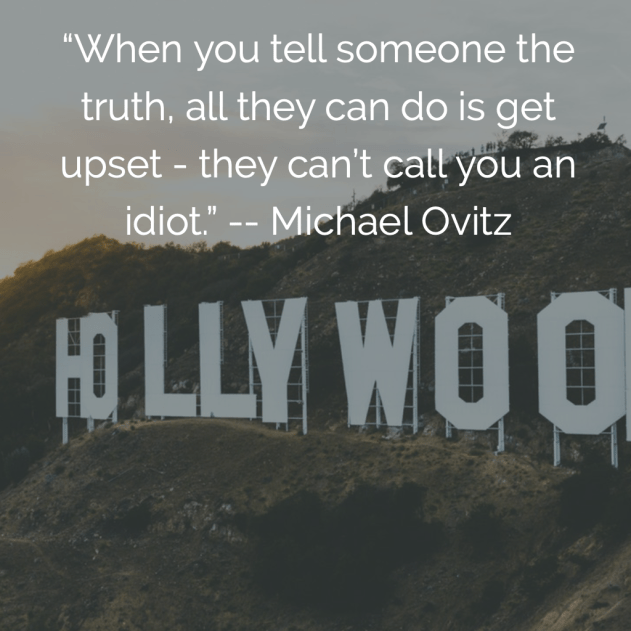
And wrote in the book, “When you tell someone the truth, all they can do is get upset – they can’t call you an idiot.”

Roz Hewsenian told Ted Seides something Ovitzian, to never say ‘No’ to a client. “You figure out how to give them some of what they want so that you show them you heard them, which is ninety-percent what the issue is.”

Aggressive Education. “Patton was a threatening motherfucker, and so was I.” Ovitz may have wanted a role in a buddy cop comedy but instead, he played the role of bad cop. He told Horowitz “I don’t think we could have done it differently because we were in a cutthroat business.”

He was always working. He was always learning. Assisting with M&A work he wrote, “Collaborating with Pete (Peterson) and Steve (Schwarzman) and Herb Allen beat going to Harvard Business School; they taught me how to be an investment banker.”

Then years later, “As Marc (Andreessen) and Ben (Horowitz) led me into their world, I felt like a privileged student in a graduate school of one.”

Ovitz’s aggressive growth mindset is reflected in others who have less cutthroat images. Alice Waters’s education was in the fields of France. Rich Snyder (In-N-Out) was over kitchen friers and in leadership seminars. Stewart Butterflied got his continuing education at Yahoo (and saw what not to do). Seth Klarman got his at Mutual Shares.

A great what-if that we can only ask now is ‘What-if Michael Ovitz had social media?’ Paul Newman said Ovitz was “a cross between a barracuda and Mother Teresa.” Somewhere between the pre-2018 perception of Ovitz and the post-book-tour perception is the real Michael Ovitz.

When he and CAA were humming, Rowland Perkins advised Ovitz that “you can only start fires” if you talk to journalists. So with nothing to talk about the media wrote what they wanted to be talked about.

In Ovitz’s era, he should have followed Buffett’s lead and wrote letters. Today, everyone has their own outlet for storytelling. As Seth Godin wrote, “making is insufficient.” What really matters is change and change takes making and communicating.


That’s what Ovitz did, that’s what Ovitz got.

Thanks for reading.


Andreessen, Horowitz, Cowen

Supported by Greenhaven Road Capital, finding value off the beaten path.

At the end of each year, the venture capital firm a16z drops a slew of podcast episodes and from 2018 we’ll focus on the conversation between Tyler Cowen, Ben Horowitz, and Marc Andreessen.

At the start, Cowen asked about their history as a couple, from Netscape to Loudcloud and Marc said they started Loudcloud in 1999 because “It turns out the internet worked and it was a big deal and people were unprepared for it.”

When AOL linked to a website that website was often unprepared deluge. This was when AOL handled nearly half of all internet traffic. After selling to HP the duo vested then invested in a venture capital firm. Horowitz said, “It was one of those ideas that came out of our experiences, we were customers of venture capital.”

The duo started a16z and started looking for weird people. “The kinds of people who start these companies,” said Andreessen, “are not normal.” He told Tim Ferriss, “These things look like cult and fringe activities until they break mainstream.” He told Barry Ritholtz, “It was beyond not obvious, it was considered ridiculous. It was well-known in 1992 that the internet was for academics and nerds.”

There is something about entrepreneurs…

Entrepreneurship is prosocial deviancy. We see this in Yvon Chouinard, Barbara Corcoran, Ken Grossman, and Katrina Lake among others. Each attempts a new future.

Cowen asks about blockchain and Horowitz said, “When asked ‘What’s the killer app?’ No one ever gets it right.” Some say that YouTube embeds and broadband were the internet’s killer apps. Some people say it was email. On mobile some say it was messaging, others GPS, others social.

The real killer app said Fred Wilson, is “the native thing that needs to happen.” Andrew Ng noted that malls with websites weren’t Amazon.com. Michael Smith studied why Netflix wasn’t just another production house. The same is true for blockchain.

“If you think about the smartphone it was much worse than the PC,” said Horowitz, “It had a tiny screen, it was far less powerful, etc, etc. But it had a couple of properties that weren’t in a PC. It had a GPS and it had a camera, so you could now build things like Lyft and Instagram.”

https://soundcloud.com/mikesnotes/037-six-things-instagram-did-right

We’ve looked at Instagram’s start and it’s one a blockchain company could copy; create a native app by listening to customers as early as you can. The early social networks like Instagram and Twitter were not good, but they were the best thing at the time. Blockchain applications don’t need to be perfect, just good enough with continuous improvements.

There’s a fair bit about culture too but it’s an important idea that’s still hard to articulate. Maybe part of the reason culture is nebulous is that culture changes from company to company.

a16z has a cultural leadership fund where “We’re trying to apply culture to the venture capital model,” said Horowitz, who has a lot of thoughts on culture.

Current book suggestions.

Horowitz said, “One of the most interesting books I’ve read lately is Genghis Kahn and the Making of the Modern World. It turns out to be unexpectedly the most interesting book on the topic of how you think about inclusion that I ever read.”

Andreessen said, “Private Truths, Public Lies… (Timur Kuran) basically models where revolutions come from, it’s like an explanation for the fall of the Berlin Wall, an explanation for political revolution and it so happens to be highly relevant for both the left and right in the United States right now.”


Thanks for reading.

Chris Dixon and Fred Wilson

Supported by Greenhaven Road Capital, finding value off the beaten path.

This September 2018 episode of the a16z podcast between Chris Dixon and Fred Wilson was full of interestingness. Let’s get to it.

What are you building? Bad Blood tells the story of Theranos’s fall and the many causes.

Another misstep was their software approach to a chemistry problem. Software and psychology are more pliable than physics or chemistry. Businesses get in trouble when they garble this difference.

“My view is that software has so many more degrees of freedom, has so much more plasticity, ability to adapt, to evolve,” Dixon said, “Maybe unlike the car or the TV, the core itself will also dramatically change and not just the apps around it.”

Rory Sutherland makes the point (5:00) that trains don’t need to be that much faster if they’re that much more enjoyable.

What is native? This is a BIG trend.¹ Another framing is, ‘What’s the killer app?’ Dixon said, “Every new computing platform has new capabilities and, generally, startups will exploit the new capabilities and the incumbents may or may not successfully port over to the new platform.”

New companies (disruptors) tend to adapt and adopt first. They discover customer’s latent needs that feature X is now less important than feature Y even though products with X are objectively better than products with Y. Clayton Christensen said,  “Understanding the job is the critical unit of analysis.” It’s realizing customers want quarter-inch holes, not quarter-inch bits.

Peak back to 1994, said Dixon.

Back then, “‘Going online’ was this thing you did for ten minutes…The internet wasn’t a real thing until you had broadband.” Wilson agreed, noting that YouTube’s success was thanks to “Broadband (80%) and also social sharing…The embeddable YouTube player was genius.”

We used to listen to the radio while we waited for a dial-up connection. Now we connect to listen to the instant radio.

Broadband plus mobile allowed for podcasts, two-factor identification, and blogs.

AI and Crypto will allow for err, well, we don’t know yet. “We’ve not had our iPhone moment for crypto yet,” said Wilson. Dixon’s partner Ben Horowitz said, “When asked ‘What’s the killer app?’ No one ever gets it right.” Andrew Ng is curious about the killer app too.

Both think that some things will change and some things will not. Domains and the internet will not. Both collect domain names. “It’s like owning a piece of the internet, it’s like owning real estate on Grand Central Park,” said Dixon. Wilson added he’d “never sell one.”

Domains are valuable (to these two) because they’re unique. “We never had the ability to make a digital good non-replicable,” Wilson said, “and I think that’s held back a lot of the business models around digital goods.” But that’s changing.

“Selling a single song has become a not a great business model so musicians go where the scarcity is, off-line, to shows and merchandising,” said Dixon. Wilson added, “Imagine if there was some way of releasing art that felt more like mining bitcoin. The artist’s move might be to loosen scarcity, not tighten scarcity. What if a song only had 20 million plays?”

Neither forecasts on a future but both agree with finding the native solutions. Wilson said, “When we first started invested in the internet in 1994, 1995, we were basically investing in things that existed offline that were getting moved onto the internet; online newspapers, online stores. That’s not the move. You need to find the native thing that needs to happen.”

Netflix, said Michael Smith, succeeded because they’re a techno-entertainment company.  “The advantage Netflix got was from using its data was to do something that no traditional broadcast network could replicate. Netflix’s advantage didn’t come from knowing how many fans of Kevin Spacey were in the audience. Netflix’s advantage came from knowing exactly who they were as individuals and promote content to them directly based on their individual preferences.”

Alex Moazed points this out too. “Rather than merely squeezing a little more efficiency out of an existing business, these companies operate on a completely different model that truly capitalizes on the Internet’s potential.”

A few other quotes.

Collaborative intelligence will take our jobs. “But the way jobs are actually taken is a much subtler thing. With these software applications you just don’t need as many people, it’s much subtler. It’s not a one to one transition, it’s more and more incremental software makes everyone more efficient.” Dixon

Availability tendency. “It’s always harder to envision the new jobs that will be created rather than the old jobs which have been destroyed.” Dixon

SAAS investments. The duo talks about the advantages of SAAS, Dixon said, “The great thing about SAAS is that once you have customers and they like you, it’s like an annuity.” That was a theme to our podcast on Moats and Allocators:

Thanks for reading.


1/ By BIG TREND I mean one that I just started noticing, so it could just be my availability bias.

The ​2018 Year in Review

Supported by Greenhaven Road Capital, finding value off the beaten path.

In 2018 we passed 500 posts which is important if you live in a society with base ten numbers. 🎉

But it was a milestone because the podcast I admire most is Russ Roberts’s EconTalk. I don’t listen to every episode and it’s rarely my favorite of the week but Roberts has been professional, thoughtful, and has provided good arguments for a decade! Roberts’s episodes from 2007  include Sunstein, Michael Munger, Cowen, Taleb, Michael Lewis, Dan Pink, Taleb, Kevin Kelly, and Bogle. Multiply that lineup by a decade and you’ll get a partial sum of Russ Roberts’s work. That’s something to aspire to.

ICYMI these were the most popular posts for the year. Surprising to me these were longish ones. We’ve got more of that coming.

Books & Learning. In addition to deep books, we did a book list on China, and in the second month of the year a post on how to read more books. Fittingly, in the second to last month of the year, we did a post on not reading books. There was a warm response to each of these.

Podcasting. The medium matters and what makes a good podcast is still a work in progress. That said, I agree with what people enjoyed listening to. David Ogilvy’s work ‘rules‘, An Attitude of Factfullness, Skimm’d Lessons, and Making it in America were all episodes I enjoyed making and well received. The podcast is available on iTunes, Overcast, or Soundcloud.

Reflections. One. of my favorite books this year was Finn Murphy’s The Long Haul. ‘A Trucker’s Tales of Life on the Road’, is a view of America and the American Dream. One part of being a ‘bed-bugger’, a mover, that appealed to Murphy was the work. He could be proud of the clean trailer in the morning and he could be proud of his full trailer at night. Here’s one part:

“I discovered that moving suited me perfectly becuase I could lose myself inside the work. Many young male neurotics find out early that hard labor is a salve for an overactive mind…Hard work temporarily shut down the constant movie running in my brain that looped around in an endless cacophony of other people’s expectations, obligation, guilt, anger and rebellion.”

For context, Matthew Crawford, who wrote Shop Class as Soul Craft blurbed Murphy’s book. And both get at the shortfall of blogging. In one year there are 100x more readers than all my students in eight semesters of college instruction but the impact is reversed.

College is a deluge. This online thing is a drip. So maybe like compound interest or Wansink’s 500 extra calorie idea, the small steps we take add up to quite a trip.

The physical is easiest to see; I’ve gained/lost weight this year. The financial is next easiest to see; my account has grown/shrunk this year. The intellectual is most difficult; I’ve learned much/some this year. But eventually, after more than a decade of podcasts, the change is there and it’s easy to see. Thanks for reading.

This Blog’s Biases

Supported by Greenhaven Road Capital, finding value off the beaten path.

Traffic and automotive. This blog is annoyed by the automotive. Traffic and Happy City form the outline of my ideas about cars, roads, and how people use them. In general, they don’t bring out the best in us because of a poor feedback structure. However, looking at them through the lens of In-N-Out’s Cheeseburgers shows path dependent effects and lets us study a Chesterton Fence.

Mediums. This blog probably oversamples from people on podcasts. If someone doesn’t share their work we miss them. I’d wager we also don’t get everyone’s best ideas. Some also keep their head down so not to attract competition, avoiding alpha erosion.

Good enough. This blog probably overestimates the importance of ‘good enough.’ In marketing, it goes under satisficing, where we don’t maximize like economists but satisfice like humans. In Christensen’s disruption theory consumers switch from one product to another because the previously important area is now good enough and something else is paramount. In money, it lives in the FIRE movement, where people decide a lifestyle is good enough.

Conditions matter. This blog probably overestimates how much conditions matter. Network researcher Nicholas Christakis explained one experiment: “The gist of the experiment is that I can take you people and connect you according to one set of rules and you’re mean sons-of-bitches to each other. Or I can take you and connect you by a different set of rules and you’re sweet and kind to each other. It’s the same people, but different architecture yields different emergent properties of the system.” However…

Research and the real world. This blog probably overemphasizes the written and underemphasizes the done. Ironically, being there is advice that comes up again and again. Robert Cialdini gave one example when he said “I went into it (his first field project) to get some ideas for doing research in my laboratories. Say something this way versus that way…I realized that in a laboratory with college students I was missing the power of these techniques to really make a difference outside of the laboratory in the real world.” Facing the winds of the real world is also where you find thick data.

Kindness. This blog probably gives too much space to nice people – maybe. Here I’m selective, rationalizing more like Gerd Gigerenzer, that kindness is ‘rational’ because there’s more than the idea in a message.

Arguments. This blog probably overestimates the value of good arguments. It’s been a long time since I was part of a team working on a project so maybe people are doing this or maybe it’s a marginal benefit or maybe people don’t have the resources to disagree. But maybe not. James Mattis said:

“Take the mavericks in your service, the ones that wear rumpled uniforms and look like a bag of mud but whose ideas are so offsetting that they actually upset the people in the bureaucracy. One of your primary jobs is to take the risk and protect these people, because if they are not nurtured in your service, the enemy will bring their contrary ideas to you.”

Thanks for reading.

2018 Books

Supported by Greenhaven Road Capital, finding value off the beaten path

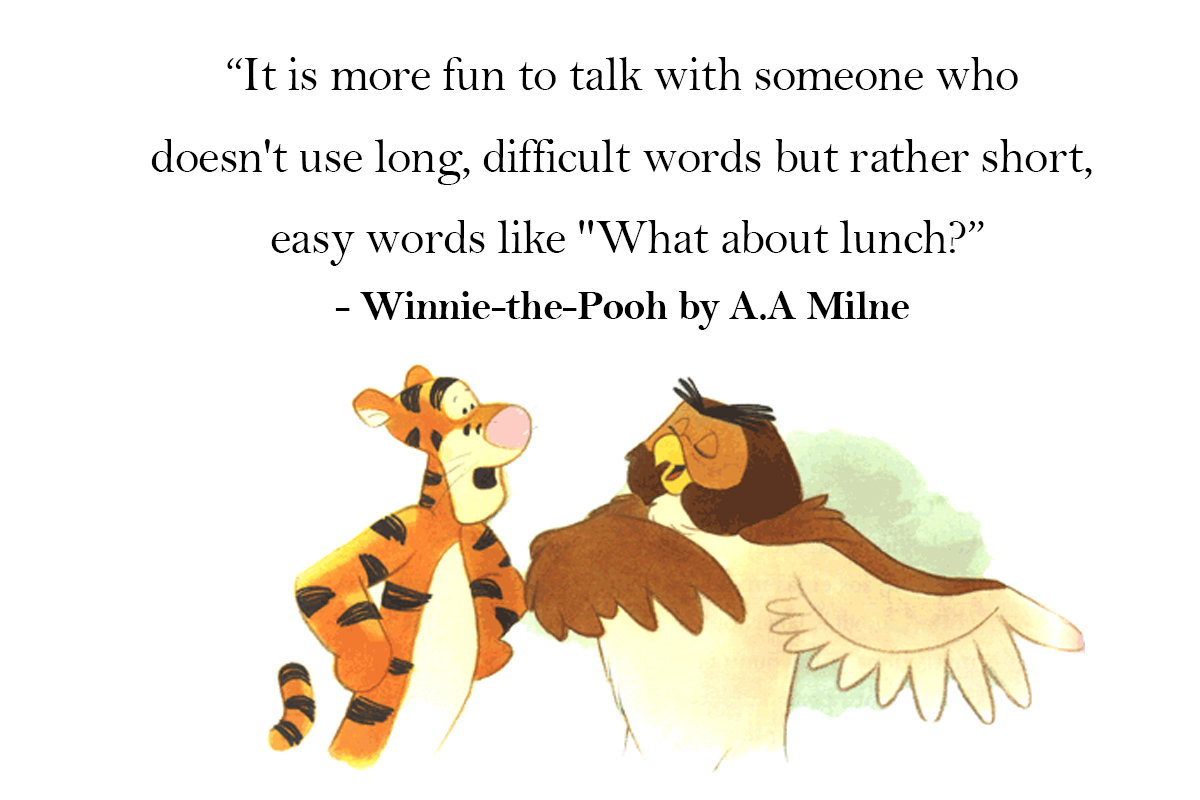
The (hindsight) theme for this year was continuing education. In years past I might read one book and bounce to another like Tigger the tiger might move through the Hundred Acre Wood. This year I was more like Pooh, childlike and curious. 

Current economies. Though not a book, Brian Arthur’s paper was insightful and Modern Monopolies was a framework with examples. The Gorilla Game though dated is still helpful. Breaking Smart is page-for-digital-page the best book I read this year. Videocracy is the choice for wrapping your head around YouTube.

Single stories. A Truck Full of Money is the story of Kayak, but even better, it’s written by Tracy Kidder. Made in America is the story of Walmart. Springfield Confidential is the (partial) story of The Simpsons. Reacher Said Nothing is the (academic) story of Jack Reacher. At Work is a collection of Annie Leibovitz pictures and stories. To Pixar and Beyond is the (CFA) story of Pixar. Creativity Inc. is the (CEO) story of Pixar. The Long Haul is the story of America from a trucker’s perspective. Buffett by Lowenstein was better than expected, and I probably should have read sooner.

Marketing. Take your pick of a David Ogilvy book, my favorite is Ogilvy on Advertising. I also recommend Rory Sutherland on YouTube and Terry O’Reilly on the podcast Under the Influence. Win Bigly is ‘persuasion in a world where facts don’t matter.’ Hit Makers for the subjectivity of popularity. Hidden in Plain Sight by Jan Chipchase for finding thick data because “The best way to understand how a culture adopts (or doesn’t adopt) an innovation is to go there and see it for yourself.”

History. The Worldly Philosophers filled in a gap I’d had about Malthus, Mill, Veblen, and Keynes and their economic ideas. Ditto for Churchill and Orwell, a snappy set of stories about each. For only Churchill check out Hero of the Empire, about the Boer War. Chasing the Scream is a how we got to now story of addiction.

Misc. Mastermind by Maria Konnikova is what you’d expect if you enjoy her New Yorker articles and Sherlock Holmes (I do!). Best State Ever if you want to laugh at, and with, Floridians. Thinking in Bets for decision making from a poker perspetive.

Fiction. City of Thieves is written by David Benioff of Game of Thrones, advocated by Brian Koppelman and read by Ron Pearlman – I loved it. The Midnight Line – or any Jack Reacher book. Norse Mythology, Gaiman and the old stories.

The movie was better than the book. Factfullness was championed by Bill Gates but Hans Rosling’s enthusiasm sparkles in video. Gridiron Genius was good but Lombardi’s podcast is better. The Good Neighbor is the story of Mr. Rogers, and though I haven’t seen the movie I probably have in most of the alternative histories.

Thanks for reading.

Image result for winnie the pooh quotes

Andrew Ng

Supported by Greenhaven Road Capital, finding value off the beaten path.

Andrew Ng has quite the resume to talk about AI, building the AI team at Baidu, cofounding Coursera, and leading Google Brain. His November 2017 talk on the Artificial Intelligence Channel is an overview.

We’re talking about AI now because we have enough data, passable algorithms, and people programming the two.

AI is a tool, like email and spreadsheets and it’s changing how we work. Ng gave this rule of thumb, “anything a typical person can do with less than a second of thinking we can probably now assume automate.” Ajay Agrawal said much the same, “AI doesn’t do workflow, it does tasks.” At Goldman Sachs for example, they figured out that an IPO has 146 distinct steps.

Ng gave the example of a security guard; notice, identify, categorize, respond, repeat. AI can do some of those things. AI will replace security guards, maybe. Jobs have always been about outcomes. People don’t want quarter-inch drill bits, they want quarter-inch holes. Job security will be about using new technology to create those holes.

And people adopt to adapt all the time. Blackboards became smartboards, books became digital, and grade books went online but teachers still teach.

To date, machines have vanquished only one occupation; elevator operator. Hal Varian said, “Automation generally eliminates dull, tedious, and receptive tasks.” AI, like other technologies, will make people better at their jobs. Accountants used to count, Computers used to compute.

giphy-3

Pedro Domingos told Shane Parrish, “People sometimes think the easiest jobs to automate are the blue collar ones but our experience is the opposite. It’s often white collar jobs that are easier to automate.” Computers don’t miss the gorilla inserted into lung scans.

Robots are not coming for our jobs but they will change them. Author of the book Humans+Machines, Paul Daugherty said, “The skills we see increasing in importance in the human plus machine age are creativity, reasoning, and socio-emotional intelligence.”

In Average is Over, Tyler Cowen proposes that income divergence will continue based on this qualifying question; can you work well with machines? The have and have-not trends “stem from some fairly basic and hard-to-reverse forces: the increasing productivity of intelligent machines, economic globalization, and the split of modern economies into both very stagnant sectors and some very dynamic sectors.”

If this were a movie about the changing economy AI could be a villain from central casting.

Ng compares AI to electricity, noting it will be ubiquitous thanks to more data and better models. Data accumulation is like the advice on planting a tree; the best time was thirty years ago, the next best time is today. That’s what Google did.

GOOG 411 began in 2007 as a directory information service. Google Economist Hal Varian said the call-in service, “learned how to recognize voices, learned how to recognize accents, learned all these different things in this very limited domain of directory information. That was enough to get started and now I think we have one of the best voice recognition systems in the world.”

We’ve been saying ‘Hey Google’ for over a decade.

Today, 2018, algorithms are less important than the data and people are more important than both. Varian said, “These days the scarcest factor by far is expertise.” Rory Sutherland worried that there are more data sets than mathematicians competent enough to handle them. But this prioritization may be shifting.

In a talk about his book AI Superpowers, Kai-Fu Lee suggests a shift of AI preeminence from the United States to China. The U.S. has the leading researchers but China has the best data, thanks in part to the number of people and the environment they live in. Mobile payments are one example, Lee explained, “People’s spending patterns are so much more valuable than their clicking patterns.”

Ng noted that more than 10% of Google and Baidu searches come through voice “because voice recognition is finally accurate enough.” Product adoption or abandonment is largely drive by if something is ‘good enough’, an idea at the heart of Disruption Theory.

AI like other tools, can improve the way people work but will never be perfect, just like other tools.

Data is the new electricity. Err, I mean oil, data is the new oil! Oops! Should have said gold, yes, data is the new gold! Wait, that’s not it either? Analogies can help but data is different.

Hal Varian said, “Some people say ‘data is the new oil’. My response is, they have one thing in common. To be useful they have to be refined. A barrel of oil isn’t worth much but turn it into gasoline, kerosene, or hydrocarbons and it’s worth something. It’s the same thing with data…(but data is non-rival)…It’s a mistake to talk about data ownership because it’s too narrow a concept.”

This is a divergence in AI opinion. People like Varian think data ownership is the wrong perspective. People like Ng believe data ownership is the only way to earn a competitive advantage, “algorithms from a company point of view are for the most part not defensible.”

Ng teaches his Stanford students about a virtual loop where data leads to a product that leads to users who generate data. 🔁 And, “after a period of time, you might have enough data to yourself have a have a defensible business.”

For example, Blue River Technology uses “cameras, computers, and artificial intelligence to allow Ag machines to see every plant in a field.”

Ng concluded his presentation with one lesson from his internet days; selling things online does not make you an internet company. “What defines the internet company is whether or not you have an architect at your organization to leverage internet capabilities to do the things that the internet allows you do really well.”

Things like a/b testing, short product cycles, and bottom-up actions. Internet companies had to “push decision making down from the CEO to the engineers and product managers because the internet products and uses are so complicated that a lot of knowledge about what needs to be done lives only in the heads of the engineers and product managers.”

In other words, it has to be a decentralized command. Pedro Domingos said, “Machine learning is computers programming themselves instead of having to be programmed by us…In general terms, tell them what you want them to do and let them figure out by themselves how to do it.”

The challenge then is to figure out what it means to be an AI company.

But there’s more to jobs than work. I won’t muddy up what those things are but The Long Haul and Shop Class as Soulcraft provide clear examples.

h/t Patrick O’Shaughnessy on Twitter.

Paul Daugherty

Supported by Greenhaven Road Capital, finding value off the beaten path.

Paul Daugherty has spent thirty-plus years at Accenture and with co-author, H. James Wilson wrote Human + Machine: Reimagining Work in the Age of AI. They emphasize similar ideas that Haskel and Westlake point out in Capitalism without Capital and Hal Varian addresses in his talk Bots vs Tots. Each author wants us to rethink how work is done and how work might be done with the rise of machines.

F6E41D25-92A6-4343-9180-189A860BBE88.jpg

Actually, that’s bad phrasing.

The conquering of machines!

Wrong direction.

Seth Godin lamented that we missed a great opportunity to brand global warming. ‘Global’ and ‘Warming’ are two mostly positive words. As Scott Adams suggests, wording matters. Godin thought global warming should be called ‘atmosphere cancer.’ It’s why Paul Daugherty has “started using the term ‘collaborative intelligence’ rather than ‘artificial intelligence’. The problem with AI is it scares the public and it leads to the wrong discussions.”

We’re having this discussion now even though ‘artificial intelligence’ has been around for more than sixty years because of three changes. There have been advances in computing, there is data from new sources and at scale, and algorithms have advanced, including progress with voice and speech.

Daugherty starts one talk by saying, “If you forget the rest of my talk here’s the real thing to take away; the plus sign on the cover of the book. If you remember nothing else about what I say, just remember the plus sign because it’s the fundamental basis for the research we’ve done.”

AI is already at work. Wal-Mart has used VR to simulate Black Friday Mobs. At Accenture, someone built a system to track resumes, experiences, and current jobs openings to suggest when and where someone should considering retraining and transferring before their job becomes obsolete. There are amazing possibilities but, “the problem a lot of business executives have is ‘What do you do with it all?'”

Daugherty showed this Dilbert Cartoon where The Boss asks, “But why can’t we 3D print a blockchain and HTML it into a Bitcoin.” Rather than nonsense, Daugherty suggests baby steps.

We need to change our thinking. Robots are coming for us but as assistants, not adversaries. Machines will not take our jobs. Work will remain. With a little work in the right direction will change for the better.

“AI gives people superpowers.” Both Mercedes and Tesla tried mostly automated factories and both blundered.

AI won’t be confined to the factory. It’ll be everywhere like electricity or wifi. It’ll be in brands. AI Personality Trainers are people who tune pop up chatbots in apps. “AI is your brand.” AI is also used to flag money laundering and in some cases moves from 70% false positives to 30%. Technology gives people superpowers.

“The skills we see increasing in importance in the human plus machine age are creativity, reasoning, and socio-emotional intelligence.”

The future is difficult to predict except to say that it’s going to be different. Tim Hartford talked about how we overlook the simple things and focus on the glamorous. It wasn’t just Gutenberg’s press in 1450 but paper too! Ditto for Bladerunner where the replicants look just like humans but the phones look just the phones.

giphy-2.gif

But not even baby steps happen without organizational support, support that starts at the top. “One thing we see is a senior leadership driven mindset around applying AI differently to the organization. It’s not just AI at the edges and at the small things but taking on something that matters to the organization and changing some of the behavior and culture in the organization.”

Daugherty adds that it should be a C-suite job or direct report. “You want somebody in your business understanding the context and application of AI and be accountable for it.”

In surveys of 1500 companies for the book, Daugherty found that only 1 in 10 companies were applying AI in reimagined ways. He and Wilson also found that “two-thirds of executives believe their workforce isn’t ready for AI.” But don’t go out and try to hire a machine learning specialist. “That’s what people often say, ‘I need more machine learning experts,’ or whatever the technology might be. That’s important but the bigger issue is the talent that uses AI. How do you change the culture and train the people that need to use AI for these different types of jobs?”

AI experts won’t be silver bullets. It’s your culture that matters most. Adaptability is what precedes survival. “One of the greatest examples of this is Amazon. If you look at their Go stores, they started small, tested on employees first, improvised and innovated with the technology, and now they’re scaling it. That’s a great example of behavior we see consistently with leading organizations.”

After listening to Daugherty I felt optimistic because he’s optimistic. “I strongly believe, that the more human-like technology is, the more it enhances our ability to be human.”

Hal Varian

Supported by Greenhaven Road Capital, finding value off the beaten path.

Hal Varian is the author of two economics textbooks and co-author of Information Rules: A Strategic Guide to the Network Economy. Varian spoke at the ESMT business school in Berlin in 2018.

Varian’s talk is titled Artificial Intelligence Economics and Industrial Organization. AI EIO, “kind of like old MacDonald had a farm.”

Varian represents the techno-economy as a pyramid with three layers. A base layer of data, a next layer up of information and the next layer of up knowledge. It’s only at the knowledge peak where we get action.

“There’s a lot of debate about the data economy, the information economy, the knowledge economy, but they’re all part of the same process, and no part can stand on its own.”

A series of recent breakthroughs is part of the reason the AI EIO conversation has entered the public sphere. “Many techniques have emerged that just a few years ago we thought were impossible.”

Data is our sand at the beach, models our buckets, and then it’s up to us. “These days the scarcest factor by far,” said Varian, “is expertise.” Rory Sutherland agrees, “One of my great worries about big data is that there are far more big data sets than there are mathematicians competent enough to handle them.”

Think of data as a raw material, like sand or oil – with one big difference. “Some people say ‘data is the new oil’. My response is, they have one thing in common. To be useful they have to be refined. A barrel of oil isn’t worth much but turn it into gasoline, kerosene, or hydrocarbons and it’s worth something. It’s the same thing with data.”

But data is non-rival. Two organizations can, and maybe should, have the same data. “It’s a mistake to talk about data ownership because it’s too narrow a concept.” Instead, maybe data is something to license.

Good organizations have people that argue well. Good economics have organizations that compete. Cordial clashes are fractal. “Usually pluralism is important because it allows a diversity of viewpoints and in many cases allows for a significant improvement in terms of unitizing that data.”

Varian emphasized the abundance of services for data. He also said that Google Home started as Goog-411. The call in service, “learned how to recognize voices, learned how to recognize accents, learned all these different things in this very limited domain of directory information. That was enough to get started and now I think we have one of the best voice recognition systems in the world.”

Maybe a better analogy is that data is like a river, we are the settlers, and models are the mill. It took a lot of effort to discover the data/river, and we had to be willing to venture out and harness it. Now we need to figure out how to use it well. “The challenge is finding the expertise to extract the value from the data.”

The goal isn’t perfection, just improvements. Robots won’t take our jobs but they can make our jobs better. “We think it has to be people plus machines to really be effective.” How well someone works with machines is a key part of Tyler Cowen’s book Average is Over.

The good news is that everyone is kind of figuring things out together. Cowen wrote that computers play chess moves no human understands. Varian said that computers find indicators of health (and sex) in the eye that no human understood – at least for a couple of weeks. The doctors did figure it out, and that’s kind of what we’re all doing on the banks of this river.

Varian has other good talks on YouTube, if you want more check out Bots and Tots.